





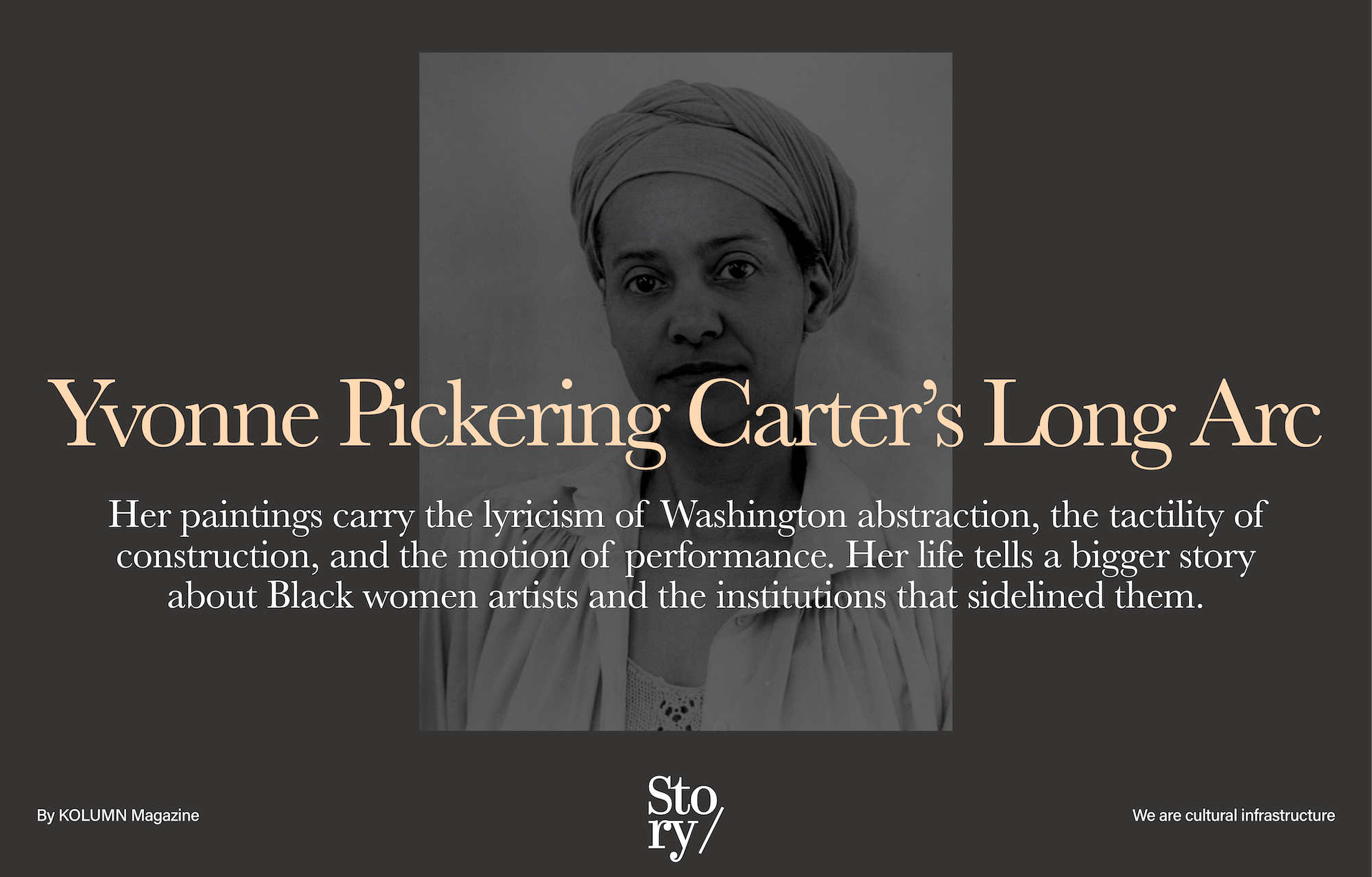
Before the comeback narrative, there was already a career—long, experimental, and rigorously self-directed.
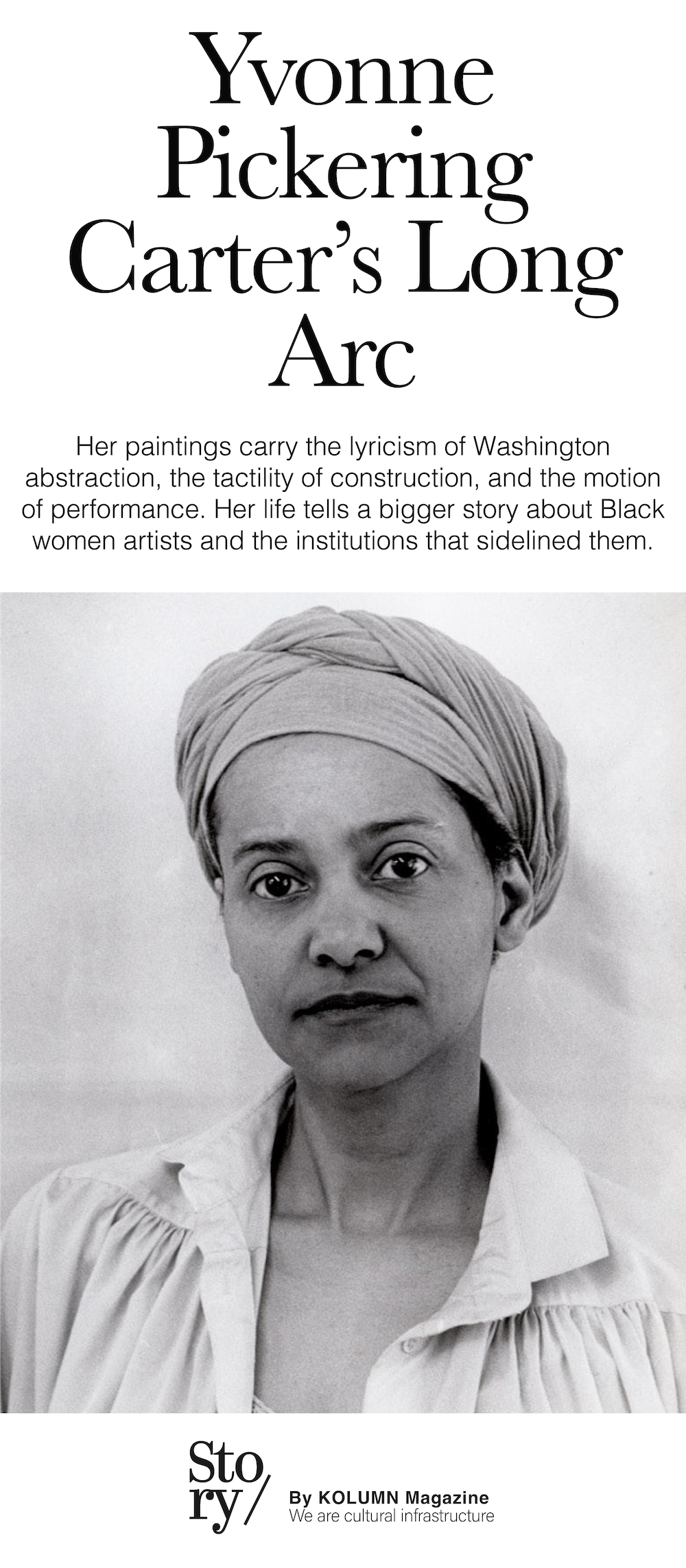
Before the comeback narrative, there was already a career—long, experimental, and rigorously self-directed.
By KOLUMN Magazine
There are artists whose careers move in a straight, legible line: school, gallery, reviews, museum acquisition, textbook, canon. And then there are artists like Yvonne Pickering Carter, whose life in art has been more elastic, more improvisational, and in some ways more revealing about how American culture actually works. Carter, born in Washington, D.C., in 1939, trained at Howard University, taught for decades at the University of the District of Columbia, built bodies of work that moved across painting, collage, sculpture, performance, costume, poetry, and environmental installation, and still spent large stretches of her life outside the kind of sustained national recognition that often gets mistaken for historical importance. Her recent reemergence in New York gallery spaces did not mark the beginning of her significance. It marked the belated arrival of broader attention.
That distinction matters. Carter is often now introduced through the language of “rediscovery,” a term the contemporary art market loves because it flatters the discoverer as much as the artist. But in Carter’s case, the more accurate story is that she had been making, showing, teaching, and evolving for more than six decades before a wider public suddenly noticed. She had exhibited with major African American artists, maintained a serious studio practice, appeared in institutional contexts, and placed work in museum collections. If she was invisible to some sectors of the art world, that invisibility says less about the scale of her achievement than about the selective habits of the institutions that shape reputation.
Her importance sits at several intersections at once. She belongs to a generation of Black artists shaped by Howard University’s powerful intellectual tradition. She is part of a lineage of Washington-area abstraction that is often discussed through male or white counterparts before Black women are brought into frame. She is also one of those rare artists for whom medium was never a stable category. Painting led to fabric, fabric led to costume, costume led to motion, motion led to performance, and performance fed back into the pictorial field. That restless crossing of boundaries makes her difficult to file, which may be one reason she was neglected. But it is also exactly why she matters now. In a contemporary art world that prizes interdisciplinarity, Carter looks less like an outlier than a forerunner.
A childhood built by hand
Carter’s biography helps explain the physical intelligence of her work. According to scholarship published alongside her 2023 Berry Campbell exhibition, she was born to Esther and Lorenzo Irving Pickering and was the second of eight children. Though born in Washington, she grew up in Charleston, South Carolina, in a multigenerational household that included her paternal grandparents. Her father, a dentist, was also an accomplished carpenter, and that double identity—professional discipline on one side, practical building knowledge on the other—appears to have left a durable mark on his daughter’s imagination. Carter later recalled that he taught her tools early; once she learned what an Allen wrench was, she said, she learned them all.
That anecdote is revealing in more ways than one. Plenty of artists inherit aesthetic influence, but Carter also inherited construction literacy. She understood not just how things looked but how they were put together. That difference matters when you look at the arc of her work: folded paper, sewn surfaces, manipulated supports, draped canvas, costume construction, environmental space-making. Even when the final result appears lyrical, airy, or improvisational, there is usually some underlying act of engineering. She did not merely paint on surfaces; she often altered the conditions of the surface itself.
The New Yorker’s 2022 profile on Carter sharpened this theme with a line that also doubles as a social history of Black women artists in mid-century America. Carter recalled that her father warned her that she might struggle to find work because “being Black excluded people very fast, and being female just as fast,” yet he kept sending her to art school anyway. It is an almost brutal capsule of the era: frank about discrimination, skeptical about the profession, but not willing to deny her the training. That combination of realism and support seems to have helped produce Carter’s particular temperament—never naïve about institutions, never entirely dependent on them.
Howard University and the making of an artist
If Carter’s father gave her one kind of education, Howard University gave her another. She received her B.A. in 1962 and her M.F.A. in 1968, and during those years she was shaped by one of the most important intellectual ecosystems in Black American art. Sources tied to her recent exhibitions note that she was inspired by James A. Porter, the foundational scholar of African American art history, and studied in the orbit of figures including James Wells, David Driskell, Loïs Mailou Jones, and Lila Asher. She also completed work in interior design at the Traphagen School of Design in New York.
Howard’s importance to Carter cannot be reduced to résumé language. For Black artists of her generation, Howard was not just a place to acquire technique; it was a place where Black art history, Black aesthetics, and international cultural conversation could be treated as serious intellectual terrain rather than marginal supplements to a Euro-American mainstream. To study there in the 1960s meant entering a discourse in which Black artistic production was not an exception needing defense but a field worthy of rigorous analysis in its own right. Carter’s later career—with its refusal of confinement, its movement between media, and its ease with both abstraction and cultural memory—reads as wholly consistent with that environment.
There is also the matter of friendship and adjacency. Carter later told The New Yorker that Alma Thomas was a “very dear friend,” and that Alma’s sister had been her boss in the library at Howard. That is not a trivial anecdote. It places Carter within a living network of Black women modernists whose relationships were intellectual, social, and professional all at once. Too often, art history isolates artists into singular geniuses and ignores the ecosystems that sustain them. Carter’s formation happened in community, in a Black institutional setting, around people who were themselves building the historical record even as they made the work.
The early paintings: lyricism, air, and the body’s trace
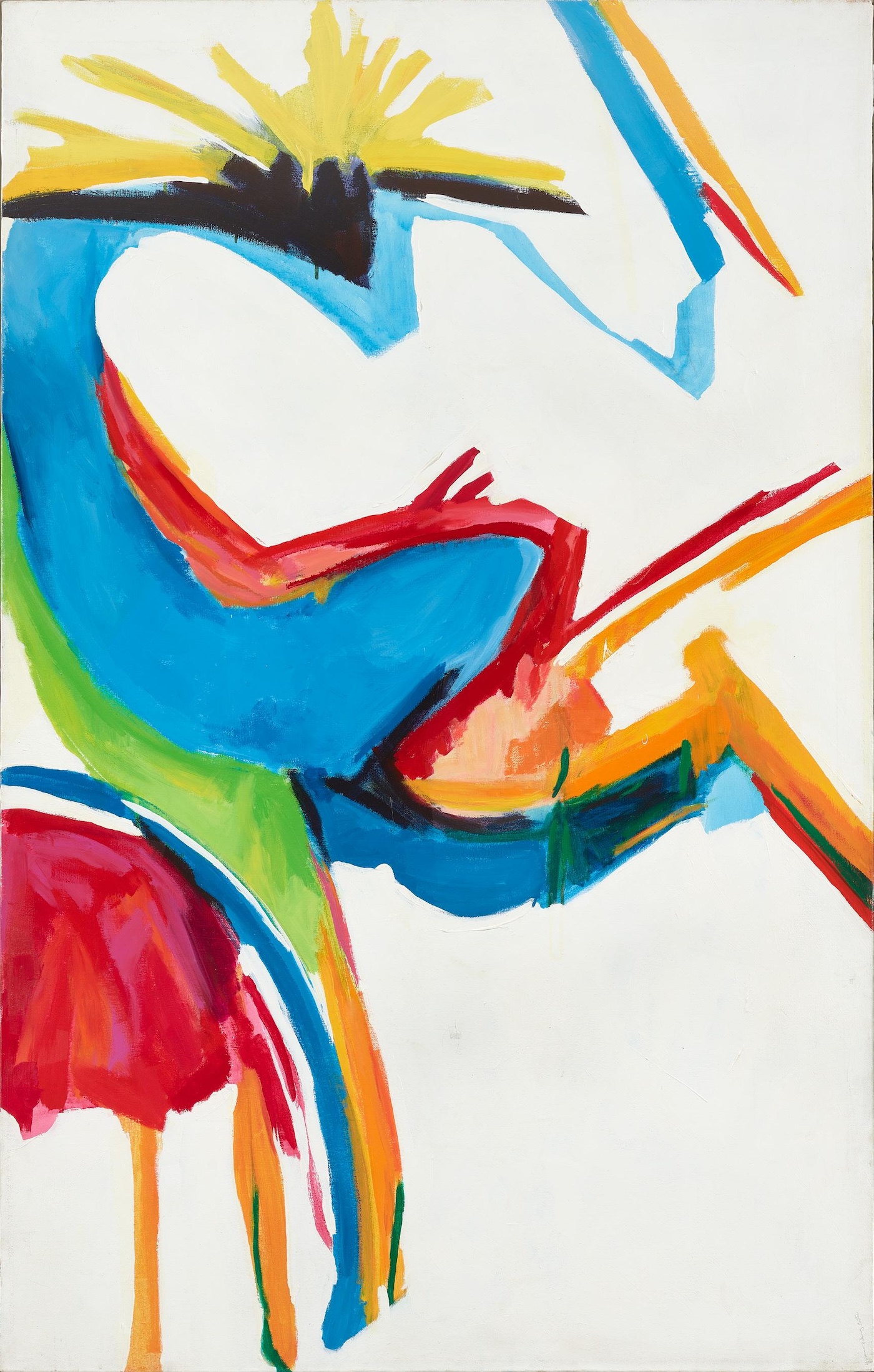
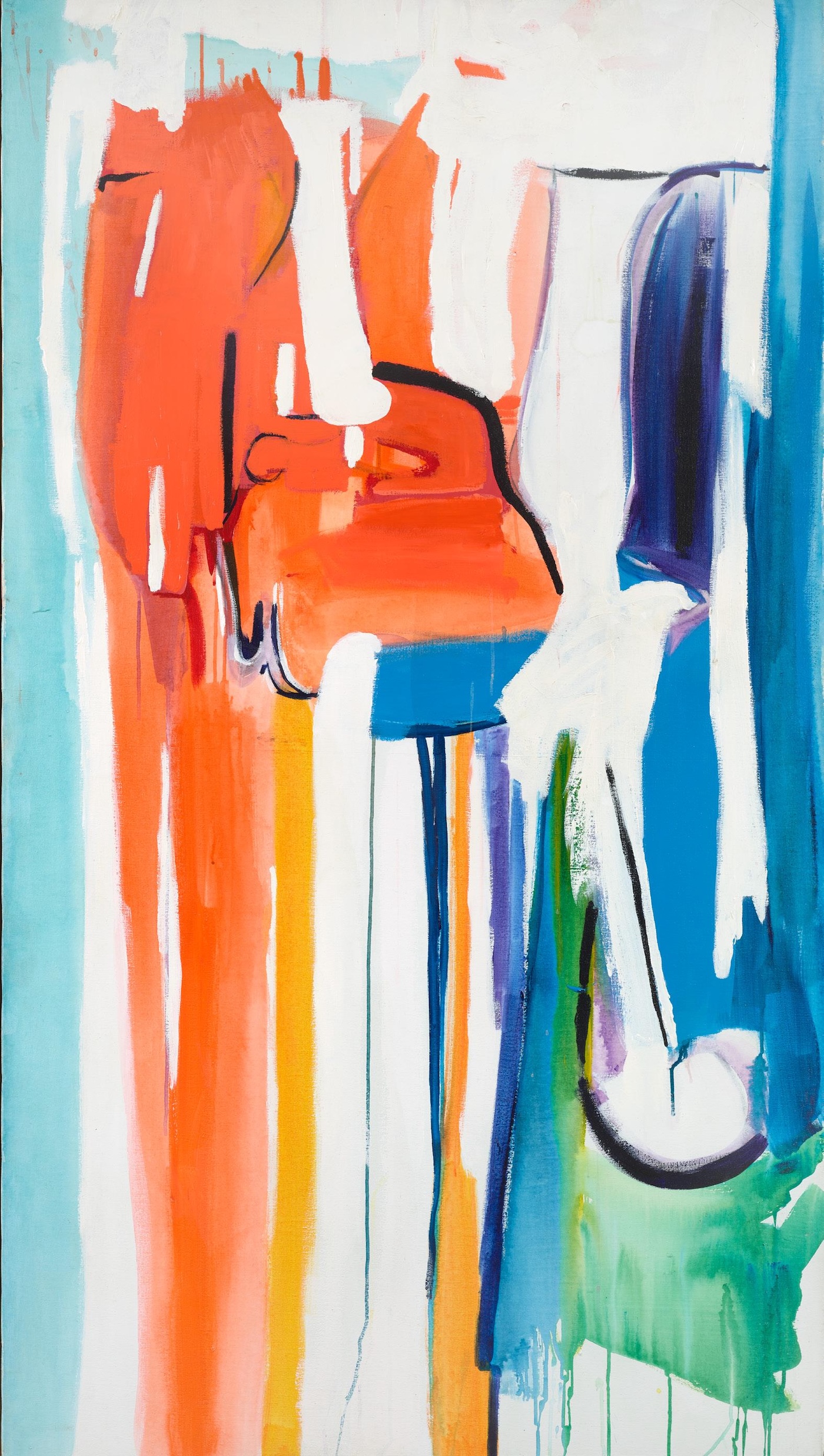
By the 1970s Carter had begun exhibiting widely, and the record from those years suggests an artist already finding her own language. The scholarship around her 2023 New York exhibition traces her participation in the 1972 National Exhibition: Black Artists at Smith-Mason Gallery in Washington and identifies her first solo exhibition as taking place in 1973 at Howard’s James A. Porter Gallery. A 1976 three-person exhibition at Fendrick Gallery prompted a reviewer to describe her watercolors as “lyrical abstract works” with “floating Frankenthaler-like lines and forms.”
“In Carter’s work, abstraction is rarely still. Even the quiet pieces feel like they are remembering movement.”
Those comparisons are useful, but only up to a point. Yes, Carter’s work can recall Color Field painting and the Washington Color School, and gallery materials for Linear Variation Series openly acknowledge resonances with Helen Frankenthaler and Morris Louis. But Carter’s paintings seem less invested in depersonalized stain than in a kind of animated delicacy. The painted line often feels like an event rather than a formal system, and the space around it is not passive emptiness but charged atmosphere. Even a terse 1984 Washington Post review gets at this quality, describing Carter’s “Cloud Series” as almost minimalist and saying the artist gave watercolor a “zen expression” through barely-there lines.
That emphasis on breath, pause, and suspended motion would remain central to her work. Berry Campbell’s materials describe the Linear Variation paintings of the 1970s as white backdrops crossed by bright lines and veils that “rhythmically echo” the cadence of the body. That phrasing is especially telling because it suggests Carter was never simply arranging abstract elements in static relation. The line was already bodily, already temporal, already moving toward performance before performance became an explicit category in her practice. In retrospect, the paintings look like scores for motion as much as pictures.
The Pennsylvania Academy of the Fine Arts’ description of her 1985 Water Series #30 makes that bodily dimension even clearer. PAFA notes that Carter extended watercolor’s possibilities by folding and sewing paper together to create a sculptural dimension, and it connects the work’s fluidity—sky reflections, wind on water, pigment moving across surface—to Carter’s parallel life as a performance artist designing her own flowing costumes to generate an “aqueous flow of energy” with her body in space. That is one of the best concise summaries of Carter’s aesthetic available anywhere: painting, structure, motion, atmosphere, body, and environment all folding into one another.
Teaching while making
In 1971, Carter began teaching at the University of the District of Columbia, first as an associate professor of art and mass media and later as chair of the Department of Mass Media, Communication, and Fine Arts. That long academic career is central to her story, not incidental to it. Too often, the art world treats teaching as what artists do on the side, a practical concession separate from the “real” work of studio production. But for many Black artists, especially women navigating structurally unequal markets and institutions, teaching was not only financial infrastructure. It was part of the cultural project. It meant building audiences, training younger artists, and creating spaces where serious art discourse could take root outside elite commercial circuits.
A 1988 Washington Post article on area university art programs quoted Carter, then identified as chair of UDC’s art department, describing the school’s “mixed student body from beginning students to gifted artists” and emphasizing both the range of the students and the strengths of the faculty. Even in that brief appearance, you can see an educator attentive to access rather than exclusivity. UDC, an open-admissions public institution, was not the kind of school that routinely produces glossy mythology in the art press. But its mission mattered, and Carter’s role there placed her within a civic, not merely market, understanding of art.
That teaching life may also help explain the breadth of her practice. Artists working inside universities often encounter multiple disciplines in practical ways—design, communication, performance, criticism, pedagogy, audience-making. Carter’s own work moved through painting, collage, costume, and performance with an ease that feels less like trend-chasing than like someone accustomed to living inside an expanded definition of art. Her career suggests that the classroom and the studio were not separate worlds but adjoining rooms.
The funeral parlor, the studio, and the performance turn
One of the most striking episodes in Carter’s life is architectural as much as artistic. In 1976, while continuing her work in Washington, she transformed a former funeral parlor in Charleston into a home and studio she shared with her then-husband. The Berry Campbell scholarship notes that she served as contractor on the renovation and established her studio in the old casket foundry. That detail alone would make the space memorable. But in Carter’s case the building did more than house the work. It fed the work.
The studio became a site where painted remnants, fabric, mannequins, and constructed forms accumulated and then began to migrate toward performance. Carter draped mannequins in complex costumes made from moiré, netting, ribbons, tulle, and painted canvas fragments. She called these works “paintings,” but she also understood them as performance pieces, connected in part to the dance courses she had taken at Howard. As she later put it, “There was something about movement that was important to me.” That sentence is deceptively plain. It is really an artist’s manifesto in miniature. For Carter, movement was not decoration added after the fact. It was a structural need.
Even outside the fuller catalogue scholarship, period coverage shows that critics noticed the unusual nature of the work. In 1986, the Washington Post described Carter’s “Tabernacle” and “Shrine” series as draped, stained canvas wall pieces with generic Christian references. The terms “tabernacle” and “shrine” are telling because they suggest objects hovering between painting, sculpture, ritual environment, and devotional architecture. Carter was not simply making flat abstractions and then switching mediums. She was testing how an abstract language could become spatial, ceremonial, wearable, and alive.
That move into performance also complicates easy assumptions about African American art in the late twentieth century. Carter was working in abstraction, but not in a narrow formalist sense. Her work could hold spiritual suggestion, domestic materiality, bodily motion, and cultural improvisation without resolving into a simple narrative picture. That hybridity helps explain why she may have been hard to place. Institutions often prefer artists who fit a clean category. Carter kept dissolving the categories.
Black women artists and second-class treatment
To understand Carter’s career honestly, you have to place it inside the systemic conditions Black women artists faced. One of the most revealing moments in the record comes from the history of the unrealized 1979 exhibition Contemporary Afro-American Women Artists. Archives of American Art describes the project as a National Women’s Caucus for Art exhibition meant to coincide with the College Art Association meeting in Washington, and notes that it was canceled because of lack of funding. Carter was among the artists assembled for it, alongside figures such as Betye Saar, Faith Ringgold, Mavis Pusey, Alma Thomas, and Loïs Mailou Jones.
The cancellation was not a small bureaucratic mishap. It was a familiar institutional message. Carter and the other artists were, in effect, told that the concept existed, the talent existed, the historical need existed—but the commitment did not. A reduced version of the project later appeared at the Martin Luther King Jr. Memorial Library, and Lisa N. Peters’s catalogue essay cites Washington Post coverage noting that some saw the exhibition as evidence of “second-class treatment” for Black women artists. That phrase lands hard because it is so blunt. It names the structure beneath the omission.
This is the context in which Carter’s later “rediscovery” must be read. It was not that nobody around her understood the work. Rather, the institutions that manufacture prestige repeatedly failed to give Black women artists the same scale of investment, documentation, repetition, and market reinforcement extended to others. Carter’s recent rise in visibility is welcome. It is also an indictment. When a woman with her training, exhibition history, intellectual grounding, and formal ambition can still be presented as a surprise in her eighties, the surprise belongs to the gatekeepers.
Home as artwork, artwork as environment
One of the most compelling things about Carter is that she appears to have treated lived space itself as an extension of practice. The New Yorker profile described the house on Wadmalaw Island, South Carolina, where she lived for years after retirement—a home built by her father, surrounded by azaleas, and eventually packed with art to the point that movers were astonished by what they found. Gallery materials similarly describe her surroundings as artistic environments, not mere storage for completed works.
That matters because it points to a worldview bigger than object production. Some artists make things for walls. Carter seems to have imagined entire atmospheres: rooms shaped by color, surfaces, costume, memory, construction, and movement. This may help explain why the rediscovery story began not in a dealer’s database or a museum archive but in a domestic encounter—people entering a home and realizing it was full of work the larger art world had not properly accounted for. The story is almost allegorical. The art had been there. The room had been there. The failure was elsewhere.
When Carter retired from UDC and returned to Charleston, she did not simply withdraw. In 2006 she opened Gallery Cornelia, named for her grandmother, by converting her father’s former dental office into a roughly 600-square-foot exhibition space. Gallery materials say she wanted, on returning home, to “plant, cut grass, and make paintings.” A 2007 Carolina Arts piece described Gallery Cornelia as specializing in nationally recognized African American artists and contemporary women artists. Even in retirement, then, Carter was not just tending her own work. She was building platform and visibility for others.
There is something deeply consistent in that arc. The child taught tools becomes the adult who renovates buildings. The artist neglected by institutions becomes the curator who creates her own venue. The maker of wearable paintings becomes the arranger of artistic environments. Carter’s story is not simply one of production; it is one of self-fashioned infrastructure. She did not wait for ideal conditions. She kept making conditions.
The comeback, and the problem with that word
The version of Carter’s story most people now know begins in 2019, when she left South Carolina to move closer to her daughter in Washington, D.C. According to The New Yorker and Berry Campbell’s account, movers packing her Wadmalaw Island home were stunned by the amount and quality of the work and tipped off Charleston gallerist Joanna White. Around the same time, Selena Parnon of Hunter Dunbar Projects encountered Carter’s name in a book and followed the thread toward the work. Those converging accidents led to Carter’s inclusion in the 2022 exhibition Ninth Street and Beyond: 70 Years of Women in Abstraction in New York, and from there to a fresh wave of attention.
It is undeniably a good story. It has coincidence, charm, and the pleasing dramatic shape of overdue recognition. But it is worth resisting the temptation to sentimentalize it. The rediscovery narrative can obscure the actual labor of the decades before. It can also encourage the idea that the market has now “rescued” the artist, as though the artist were inert until dealers arrived. Carter’s life suggests the opposite. She had built an enormous practice, sustained a pedagogical career, maintained artistic networks, and entered museum collections before the latest round of attention. The market did not make the work possible. The work made the market’s attention finally seem plausible.
Her 2023 Berry Campbell solo exhibition, Linear Variation Series, reinforced that point by focusing not on novelty but on continuity. The show reexamined a 1970s body of work and positioned it in relation to the history of abstraction, Carter’s own later performance practice, and the broader need to rethink how African American women modernists are situated in art history. That framing matters. Rather than market Carter as a curiosity from the attic, the exhibition argued for a serious historical placement. It was, at its best, a revision of the record.
Why Yvonne Pickering Carter matters now
Carter matters for the quality of the work itself, first of all: the lyric handling of line, the spare atmospheres, the sculptural manipulation of paper, the tactile imagination, the movement between painting and body-based performance. But she also matters because her career helps expose several blind spots at once. She shows how narrowly abstraction has often been narrated. She shows how Black women artists were routinely left underfunded, under-documented, or treated as peripheral. And she shows that the categories by which art history organizes itself—painting, sculpture, performance, design, craft—are often least useful when confronting artists who were thinking ahead of them.
She also belongs to a larger corrective movement now underway. Museums, galleries, scholars, and collectors have spent the last several years revisiting the contributions of women abstractionists and Black modernists who did not receive proportional attention in their prime. Carter’s inclusion in Ninth Street and Beyond and her later New York solo presentation place her directly within that revisionist energy. But again, the most responsible way to frame that moment is not as sudden validation from nowhere. It is as the beginning of a fuller accounting.
There is another reason Carter feels urgent now: she offers a model of artistic life not organized by immediate visibility. In an era saturated with self-branding, instant circulation, and a tendency to confuse attention with achievement, Carter’s career reads almost as a rebuke. She kept working across decades. She kept teaching. She kept building spaces. She kept experimenting. She kept following the internal logic of the work, even when the surrounding culture was not adequately prepared to reward it. That kind of persistence is not romantic. It is hard. It is also, in the deepest sense, professional.
The legacy beyond belated praise
Any serious appraisal of Yvonne Pickering Carter has to move beyond the easy emotional arc of neglect-to-recognition. That arc is real, but it is incomplete. Carter’s legacy lies not merely in the fact that she was finally noticed. It lies in the body of work she produced before she was noticed, the students she taught, the artists she supported, the spaces she transformed, and the formal questions she pursued again and again: what a painting can hold, how a surface can move, how a body can become part of an image, how a home can become an artistic field, how abstraction can remain sensuous without becoming decorative, and how Black women artists have long built modernism in forms the mainstream was too narrow to register.
“The real story is not that Yvonne Pickering Carter arrived late. It is that the institutions took so long to arrive at her.”
That legacy is visible now in the institutions that hold her work. The North Carolina Museum of Art lists pieces from her Linear Variation and L.S.D.F. series. PAFA has Water Series #30, with its folded and sewn paper construction. Smithsonian archival records preserve images of Carter demonstrating movement in one of her own costumes. These are not fragments of an unrealized career. They are pieces of a substantial one.
And maybe that is the best way to end—with scale, not sentiment. Yvonne Pickering Carter should not be understood simply as an octogenarian artist who had a charming late-career resurgence. She should be understood as a major American artist whose long practice illuminates the entwined histories of Black art, women’s abstraction, performance, pedagogy, and institutional neglect. The recent attention has made her easier to see. It has not made her more important than she already was.
More great stories
George Raymond Jr. and the Price of Freedom Work
March 31, 2026
No Comments

He Built a Career Telling Hard Truths
March 31, 2026
No Comments