





Democracy in Mississippi was not denied politely. It was guarded by fists, guns, jail cells and men who knew the law would mostly protect them.
Democracy in Mississippi was not denied politely. It was guarded by fists, guns, jail cells and men who knew the law would mostly protect them.
By KOLUMN Magazine
George Raymond Jr. does not occupy the same easy shelf in public memory as Medgar Evers, Fannie Lou Hamer, John Lewis or James Meredith. His name is not routinely summoned in schoolbook recitations of the movement, nor is he widely treated as one of its central builders. But in Mississippi—especially in Canton—Raymond was not peripheral. He was essential. He was one of those organizers without whom the better-known chapters of the Black freedom struggle would have looked very different, or might not have happened in the same way at all. Archival and movement histories place him at the center of CORE’s Madison County work, describe him as a former Freedom Rider from New Orleans, and credit him with providing much of the strategic direction for the Canton movement when the first CORE office opened there in 1963.
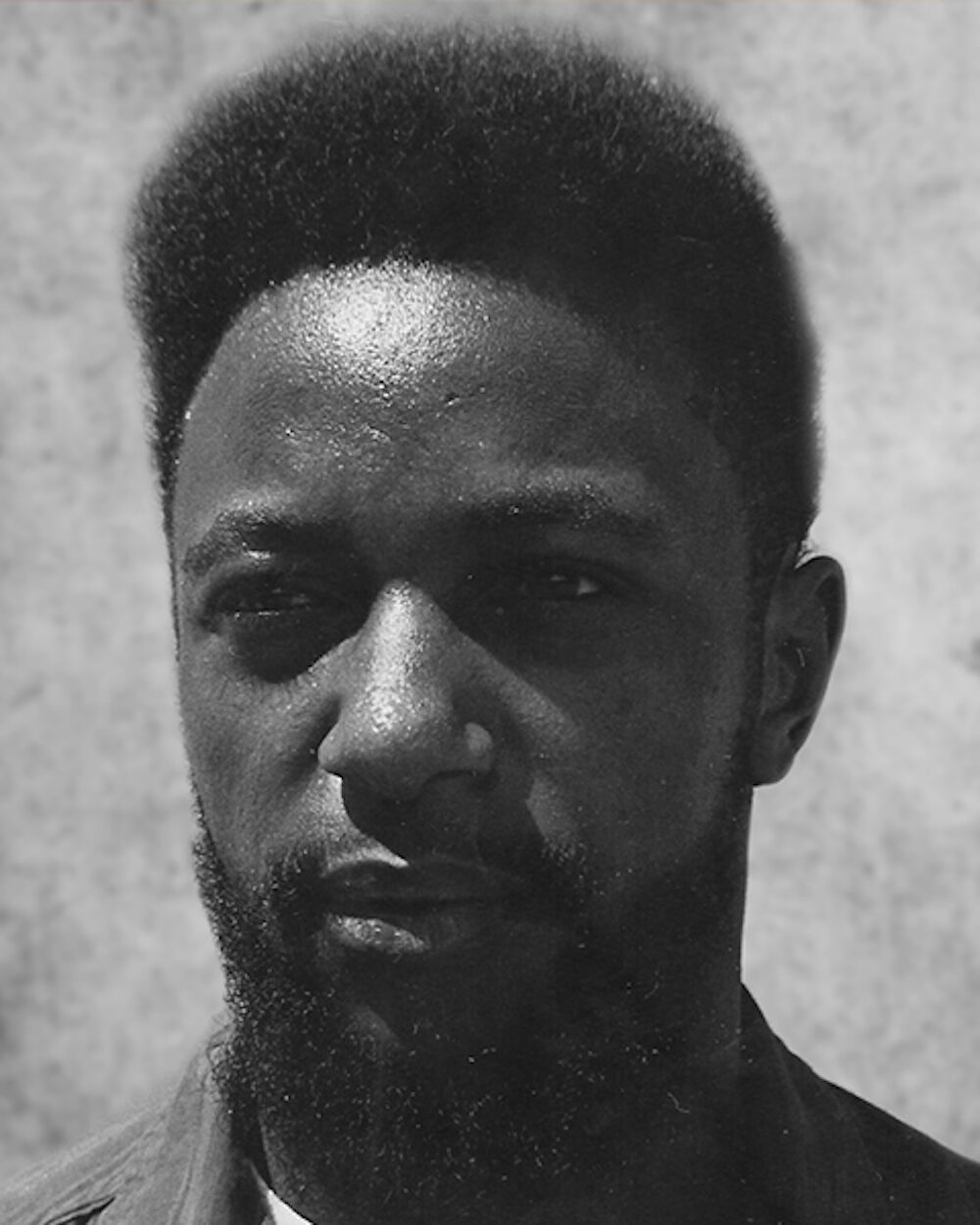
That matters because the story of civil rights is too often flattened into spectacle: famous speeches, dramatic confrontations, martyrdom, legislation. Those things matter, of course. But movements are also made of fieldwork—of nights spent in churches, afternoons spent knocking on doors, conversations with wary residents, rides on dangerous roads, and the hard task of persuading people who have every reason to be afraid that political action is still worth the risk. George Raymond Jr. belonged to that tradition of movement labor. In Mississippi, CORE and SNCC pursued local leadership, voter education and grassroots infrastructure rather than mere symbolic protest, and Raymond became one of the young field workers helping transform that philosophy into daily practice.
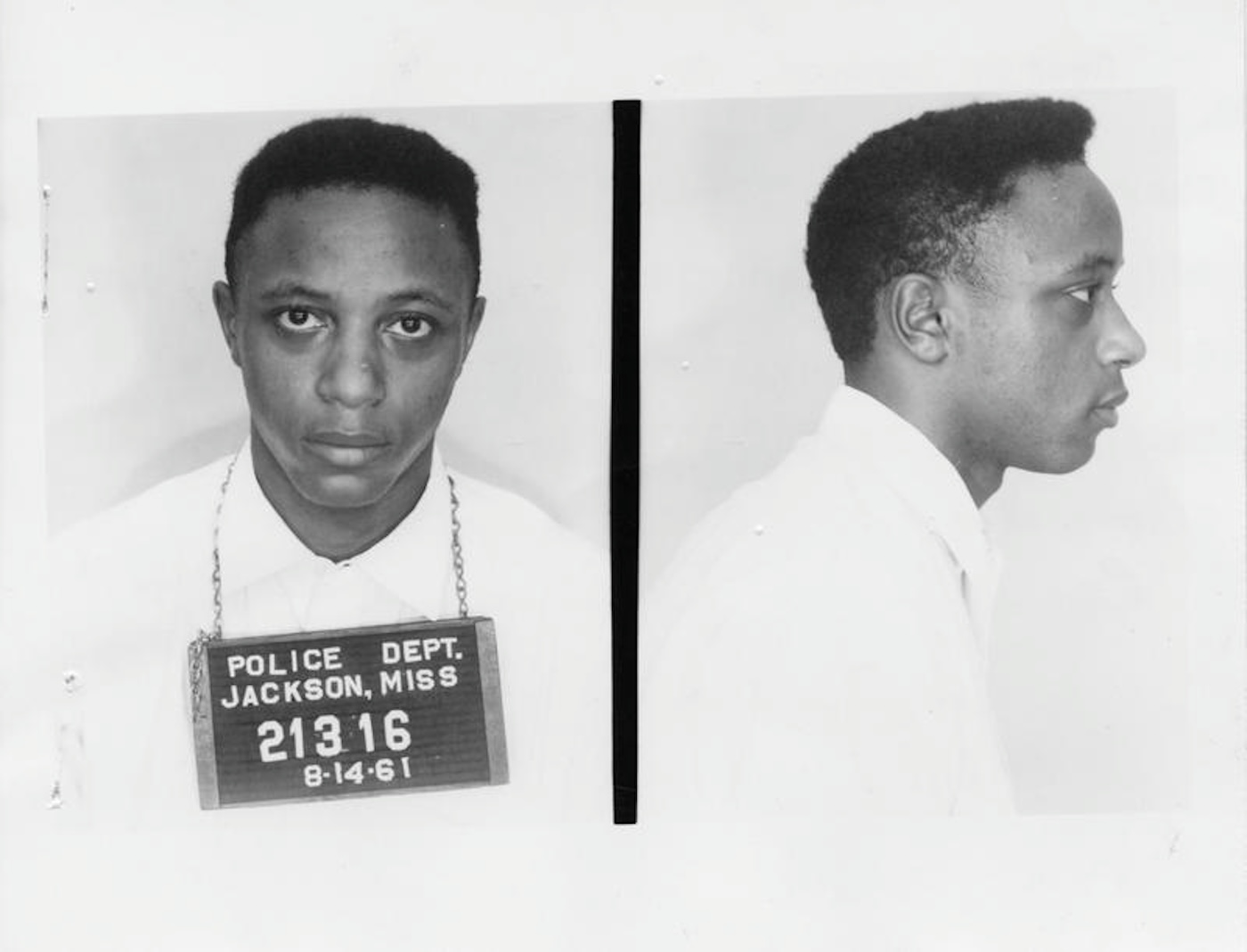
He was also, by every serious account, brave to the point of exposure. Civil Rights Digital Library records show that he was only eighteen when he was arrested during the Freedom Rides at the Trailways bus terminal in Jackson on August 14, 1961, alongside Pauline K. Sims. Later, he helped drive voter-registration organizing during Freedom Summer and was severely beaten in Canton. Mississippi Free Press, drawing on documentary interviews with family and fellow activists, adds a more intimate portrait: a strong-willed young man from New Orleans who left home just after graduation, went into Mississippi on assignment, gained the trust of veterans like Dave Dennis, and endured repeated abuse from police and white supremacists.
“If there is ever a fight and I need somebody to have my back, George is the person.” Dave Dennis remembered him that way decades later.
That quote helps explain why Raymond deserves more than a footnote. He was not simply present at historic moments; he helped create the conditions for them. He worked in the long shadow of white terror, where the mechanics of disfranchisement were enforced not only by law but by beatings, threats, jailings and economic retaliation. In Madison County, even though Black residents made up a majority of the population, only a tiny fraction were registered to vote in the early 1960s. Raymond’s work unfolded in that gap between demographic reality and political exclusion. It was organizing in its most exacting form: bringing Black Mississippians from fear toward action, from private grievance toward public confrontation, from isolation toward movement.
A young man from New Orleans enters the movement
The broad outlines of Raymond’s early life are modestly documented but clear enough. He was born in New Orleans in 1943, part of a generation of Black southerners coming of age under formal segregation but increasingly unwilling to accept it as permanent. Later accounts connected to the documentary George Raymond: Thirst for Freedom identify him as a graduate of Cohen High School in New Orleans and describe him as courageous, outspoken and intensely action-oriented. Those details come mainly through later reporting and family recollection rather than extensive institutional biography, which is itself telling: for many movement workers, the archival record is thinner than the scale of their contribution.
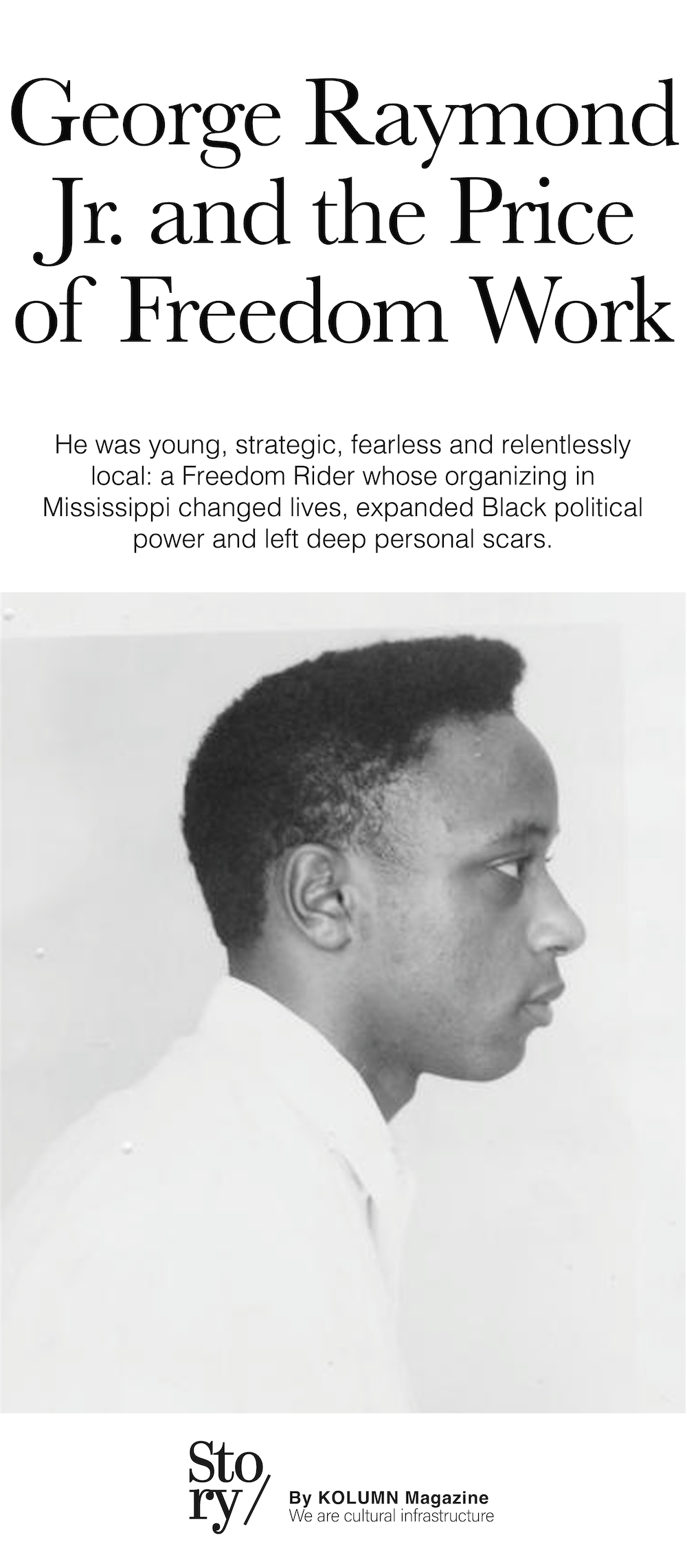
What is better documented is his very early entry into direct action. SNCC Digital notes that the Freedom Rides helped expand CORE’s southern presence and gave many young activists their first intense experience in organized southern struggle. Raymond was one of them. Civil Rights Digital Library’s record of his 1961 arrest fixes him in that lineage of young Black activists who tested the federal promise of desegregated interstate travel not in theory, but in hostile terminals, in jail cells and under state surveillance. The mugshot that survives from Jackson is not just a photograph of an arrest. It is evidence of a political generation announcing itself to the Deep South.
The move from New Orleans to Mississippi also shows how civil-rights organizing worked across state lines. Raymond did not emerge only as a “local hero” in the narrow sense. He was part of a southern activist network shaped by CORE, COFO and overlapping ties with SNCC. Mississippi Free Press reports that CORE sent him to Canton in 1961 to help increase Black voter registration. He arrived alone, by that account, staying at the Bill Will Motel and slowly building contacts through Jackson State and Tougaloo that would allow him to recruit volunteers and establish an office. That picture—one young organizer entering a violently repressive county with little institutional protection—captures both the audacity and fragility of the movement’s field operations.
There is also a tendency, when discussing civil-rights history, to assume that the most effective organizers were older, ministerial, already formed. Raymond complicates that assumption. He was barely out of high school when he entered some of the most dangerous work in the South. Dave Dennis, another Louisiana activist and a major movement figure in his own right, later recalled meeting Raymond while Raymond was still in high school. That memory matters because it positions Raymond not as an afterthought to the movement’s established leaders, but as part of the youth-driven transformation of the early 1960s, when students and very young adults redefined both the pace and moral grammar of protest.
Canton was not peripheral—it was the work
To understand George Raymond Jr., one has to understand Canton. In national memory, Mississippi civil-rights geography tends to be dominated by names like Jackson, Meridian, Philadelphia, Greenwood and Ruleville. Canton can seem secondary. But Mississippi Encyclopedia and SNCC Digital both make plain that Madison County was one of the state’s crucial organizing theaters and that Raymond stood near the center of it. Mississippi Encyclopedia says he provided much of the strategy for the Canton movement and was the only staff member when the first CORE office opened in the county in 1963. Its CORE entry goes further, noting that by 1964 the Madison County project had become CORE’s most active in the state.
That is not a minor distinction. It means Raymond was helping run one of the movement’s most important county-level operations in the state most synonymous with white resistance to Black voting rights. SNCC Digital describes Madison County as a project where young field workers like Raymond, Anne Moody and Mateo “Flukie” Suarez worked with local stalwarts like C. O. Chinn and Annie Devine. The framework here is important: Raymond was neither a lone hero nor a generic staffer. He was a connective organizer, someone who could bridge outside movement resources and local Black leadership. In Mississippi, that was often the difference between a short-lived protest burst and a durable campaign.
Canton did not become significant because history happened to stop there. It became significant because organizers like Raymond made it impossible to ignore.
The numbers tell part of the story. Mississippi Free Press reports that although Canton’s population was about 60 percent Black, only around 200 Black residents were registered to vote when Raymond arrived. Mississippi Encyclopedia’s CORE entry describes the February 28, 1964 Freedom Day in Madison County, where 350 Black residents attempted to register and only five were allowed to take the test. This was disfranchisement as system, not accident. It was upheld through procedural obstruction, armed intimidation and the ever-present threat of violent reprisal. Raymond’s task was to confront that regime not with rhetorical denunciation alone, but with a campaign that kept bringing people back to the courthouse.
Primary movement documents sharpen that reality. In a February 1964 statement attributed to Raymond on Freedom Day, he identified himself as the field representative in Canton and described voter-registration work there as having begun in June 1963 under COFO’s framework. Other CRM Vet documents record George Raymond and fellow organizers appealing directly to federal officials over police harassment and brutality in Canton, while incident summaries describe arrests, intimidation and direct violence against local Black residents and workers. These are not retrospective embellishments. They are contemporary traces of organizing under siege.
The architecture of local trust
One reason Raymond’s significance can be missed is that movement infrastructure does not always look dramatic from a distance. It can look like small meetings, personal relationships and repetitive tasks. But SNCC Digital is unusually explicit about the importance of Raymond’s partnership with C. O. Chinn. The site notes that Chinn and Raymond worked closely together in the summer of 1963, making rounds in Canton and Madison County and strengthening the budding local movement. The same entry stresses that their relationship mattered for gaining local support in the voter-registration struggle.
That sentence deserves attention. “Gaining local support” sounds almost bureaucratic until one remembers what it meant in Mississippi. It meant persuading Black residents that these young organizers would not disappear at the first sign of danger. It meant showing up consistently enough that movement work felt less like an outside intervention and more like a community’s own political awakening. It meant having people like Annie Devine and C. O. Chinn vouch for you. Raymond’s importance lay partly in his capacity to become legible and trustworthy inside a community that had good reason to be suspicious of outsiders and deeply aware of the price of resistance.
Anne Moody’s trajectory offers one measure of that influence. Mississippi Encyclopedia lists her among the organizers in Canton during Freedom Summer, and broader accounts of the county movement place Raymond within the circle of activists who helped draw younger Mississippians into sustained work. While the available online records should be treated carefully in assigning singular causal credit, the consistent picture is that Raymond was part of the movement environment that shaped figures like Moody and helped turn Canton into an organizing base rather than a passive backdrop.
The lesson here is larger than biography. Much of the civil-rights movement’s actual durability came from people who could do relational politics under extreme pressure. They were not simply charismatic; they were dependable. In the Mississippi Free Press account, Dave Dennis’s praise of Raymond is rooted in trust—an organizer’s trust, forged in danger, not celebrity. That kind of trust is one of the movement’s least glamorous but most indispensable currencies.
Violence was not incidental. It was the governing method.
Any honest article about George Raymond Jr. has to resist the temptation to tell a cleanly inspirational story. His life was not only noble; it was brutalized. Violence in Mississippi was not a side effect of activism. It was one of the principal tools used to enforce racial order, and Raymond was repeatedly targeted by it. Civil Rights Digital Library notes that he was severely beaten in Canton in 1964. A February 1964 CRM Vet incident report states that Raymond had been pistol-whipped by Constable Herbie Evans and charged afterward with intimidating an officer and resisting arrest, though he was never tried. Another telegram to Robert F. Kennedy records police beating local men leaving a voter-registration meeting.
Mississippi Free Press fills in more of the personal texture. In documentary recollections cited there, Raymond’s eventual wife Myrtis Evans describes an encounter with Madison County Sheriff Billy Noble in which the couple were ordered from the car and Raymond was jabbed with a gun hard enough to leave marks on his back. The article also reports Glen Cotton saying Noble had threatened to beat Raymond whenever he encountered him and had followed through on that threat. This is the kind of detail that should disrupt any sanitized understanding of “civil disobedience” as merely moral theater. For Raymond and his peers, nonviolence often meant enduring the state’s willingness to maim them.
The larger movement context confirms that this was systematic. Mississippi Encyclopedia’s CORE entry recounts high levels of police intimidation and white violence in Madison County. The Scene on Radio transcript about Freedom Summer adds a sobering retrospective line: fellow workers said Raymond changed from a light-hearted young man into a more tense and bitter person after surviving repeated beatings and jail abuse. Even allowing for the interpretive nature of retrospective commentary, that observation points to something often underemphasized in civil-rights storytelling—the psychic afterlife of movement violence.
Democracy in Mississippi was not denied politely. It was guarded by fists, guns, jail cells and men who knew the law would mostly protect them.
That is one reason Raymond’s early death resonates so strongly in later accounts. He died in 1973 at age thirty. Civil Rights Digital Library records the fact plainly. Mississippi Free Press, summarizing the documentary, reports that doctors said his body resembled that of a much older man because of extreme trauma. That latter claim comes through the film and related reporting, not a medical record reproduced in the article, so it should be read as reported testimony rather than independently verified clinical fact. But even with that caution, the underlying truth is hard to miss: Raymond’s body bore the movement’s costs.
From direct action to voter power
Raymond’s public life cannot be reduced to voter registration alone. He also appears in one of the most famous scenes of Mississippi protest: the Jackson Woolworth’s sit-in of May 28, 1963. Mississippi Encyclopedia’s entry on sit-ins lists him among those who joined Anne Moody, Pearlena Lewis, John Salter, Walter Williams and others at the “whites only” lunch counter, where demonstrators endured two hours of assaults, food-smearing and flying objects. Mississippi Free Press also places Raymond in that protest, alongside Medgar Evers and the others, emphasizing the violence of the scene.
The sit-in matters not only because it was visually iconic, but because it shows Raymond moving across tactical forms. He was not exclusively a backstage organizer or a courthouse strategist. He participated in confrontational direct action as well. That dual role is important. Many of the movement’s most effective organizers were capable of both the symbolic and the practical—of taking the seat at the counter and then returning to the slower work of building structures that could survive after the cameras moved on. Raymond’s career suggests exactly that kind of range.
The Madison County Freedom Days of 1964 offer a second example. Mississippi Encyclopedia recounts that on the first Freedom Day, hundreds of Black residents attempted to register, with only five allowed to take the test. Subsequent efforts continued despite arrests and suppressed marches. Raymond was not merely attached to that campaign in name; contemporary documents identify him as the project leader and field representative. The rhythm of this work—mobilize, confront obstruction, regroup, return—captures the movement’s insistence that citizenship had to be exercised before it was safely granted.
And then there was the Mississippi Freedom Democratic Party. Several biographical accounts identify Raymond as a member, and the association makes sense within the political ecology of Canton. Madison County organizing flowed naturally toward the MFDP’s challenge to Mississippi’s all-white Democratic apparatus. Raymond’s career, in other words, sits at the hinge between protest and political insurgency. He belonged to that current of the movement that understood integration fights, voter registration and party challenges not as separate causes, but as mutually reinforcing fronts in the same battle over Black citizenship.
The ghost over Philadelphia, Mississippi
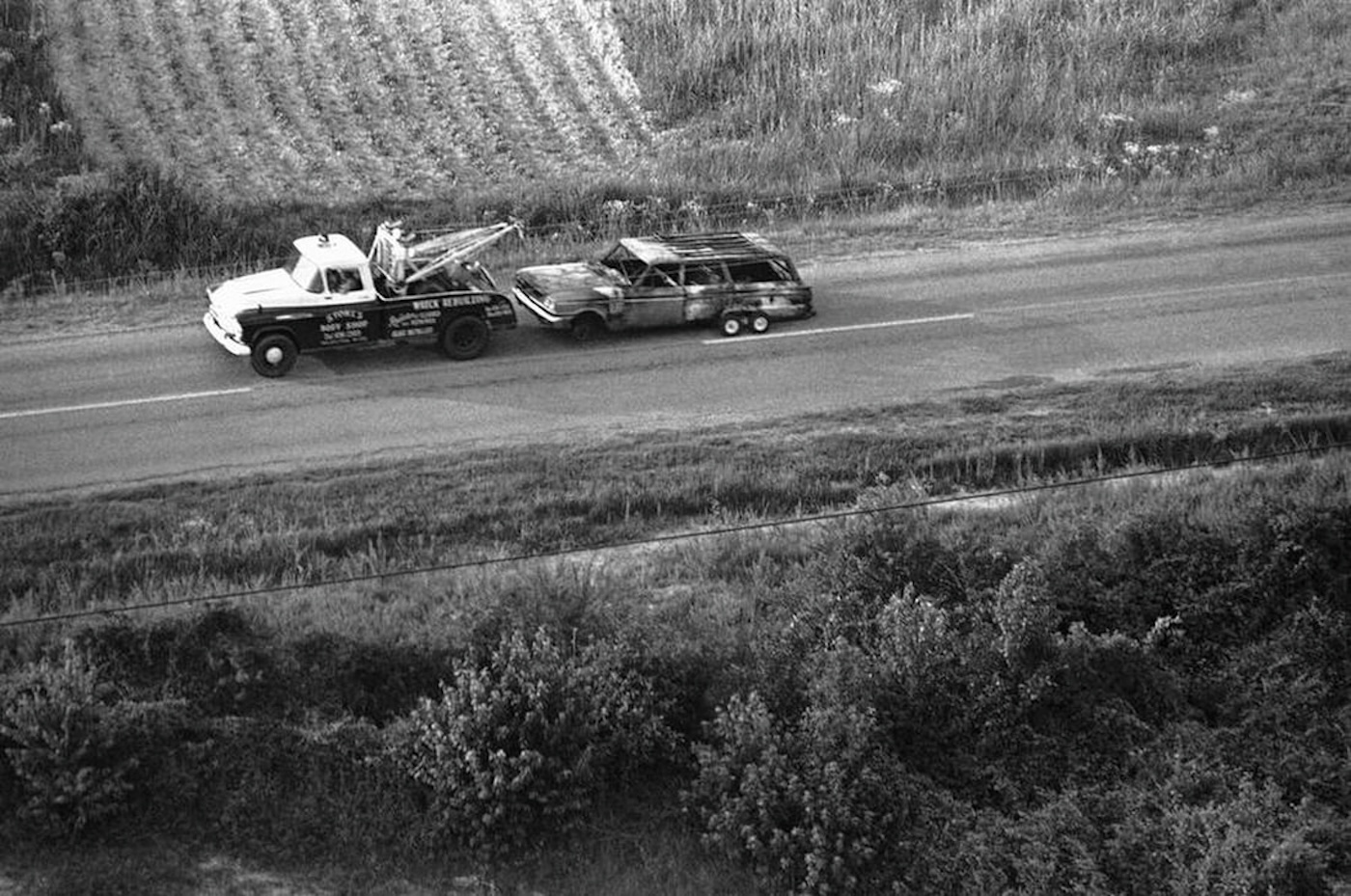
One of the most haunting episodes attached to Raymond’s story is his proximity to the 1964 murders of James Chaney, Andrew Goodman and Michael Schwerner. Mississippi Free Press reports, citing documentary interviews and journalist Jerry Mitchell, that the station wagon used that day had been intended for George Raymond and that Deputy Cecil Price reportedly mistook Chaney for Raymond when he first saw the vehicle. The article also reports Raymond’s son reflecting on the possibility that his father might have been in that car under slightly different circumstances.
This episode has to be handled carefully. It is widely repeated in secondary and documentary accounts, but it remains the sort of counterfactual adjacent history that can easily become overdramatized if stated too absolutely. The strongest responsible claim is that later reporting and testimony have sustained the belief that Raymond may have been the intended driver and that Price recognized the station wagon as associated with him. That does not diminish the horror of what happened to Chaney, Goodman and Schwerner. Instead, it highlights how intimately entangled local organizers were with events that later became national symbols.
The value of this episode is interpretive as much as factual. It reminds us that movement history is often organized retrospectively around martyrdom, but beneath those famous tragedies there were dense networks of workers moving cars, sharing assignments, switching plans and carrying risk collectively. Raymond was part of that web. He was close enough to one of the era’s defining crimes that his absence from the car now feels historically eerie. Yet even when he was not the martyr in the headline, he remained one of the people doing the work that made Mississippi freedom struggle both visible and vulnerable.
Marches, rural expansion and the unfinished campaign
Raymond’s activism did not stop with Freedom Summer. Mississippi Free Press says he continued through the Meredith March Against Fear near Canton in 1966. The National Park Service’s Mississippi civil-rights resource study notes public comment identifying him with the 1965 March on Brandon in Rankin County. A contemporaneous CORE press release hosted by CRM Vet confirms that George Raymond was one of the leaders of a Freedom March through Rankin County in May 1965, a protest tied to voter discrimination and the seating of Mississippi’s congressional delegation.
Those details matter because they show Raymond’s work expanding beyond a single town. He was part of a county-by-county struggle to break the architecture of white political monopoly. Mississippi Encyclopedia’s CORE entry notes that in 1965 CORE extended activity into counties including Rankin and Leake. CRM Vet’s Madison County personnel and county reports list Raymond as project director, a role that underscores both his responsibility and his standing within the organization.
This is where Raymond’s significance becomes especially clear. He belongs not only to the story of protest, nor only to the story of Canton, but to the history of how Black political organizing in Mississippi scaled outward. His career traces the movement’s shift from spectacular challenge to sustained regional pressure—courthouse campaigns, marches, rural organizing, and infrastructure for a broader democratic claim. To call him an “activist” is accurate. To call him an organizer is more precise.
Culture, nightlife and movement space
Raymond’s life also complicates the boundary between politics and culture. Mississippi-related accounts connect him to Club Desire, the well-known Canton blues and R&B venue that also served as a movement meeting place. Later biographical summaries say that after Clarence Chinn stepped back, Raymond helped operate the New Club Desire, where civic, social and civil-rights groups gathered. The documentary coverage in Mississippi Free Press likewise notes his involvement with the club.
This part of the story is not trivial color. It speaks to a broader truth about southern Black life in the movement era: political organizing often depended on social spaces that were not formally “political” in the conventional sense. Clubs, churches, homes, back rooms and storefronts functioned as strategy hubs, refuge sites and information networks. Culture was not separate from the movement; it was one of the mediums through which community and courage were sustained. Raymond’s association with Club Desire suggests that he understood this intuitively, or at least worked comfortably inside that ecosystem.
There is a tendency in civil-rights memory to divide lives into sacred activism and ordinary life, as if organizers existed only in marches and jails. But Raymond’s story hints at a fuller Black public world—one where music, business, social gathering and movement work overlapped. That overlap is part of why local struggles could survive. They were embedded in communities, not staged outside them.
Why he faded, and why he should not have
So why is George Raymond Jr. not better known? Part of the answer is structural. Civil-rights memory, especially in mainstream national telling, has always privileged a manageable cast of icons. It prefers singular geniuses, martyred innocence and moments that photograph well. Organizers like Raymond complicate that formula. They were young but not always student-famous, courageous but not always nationally visible, central locally but less easy to package nationally. Their achievements were distributed across communities rather than owned by one signature event.
Another part of the answer may be that Raymond’s life was short. He died at thirty, before he could become a statesman of memory, publish a definitive memoir, hold office or spend decades narrating his own place in history. Many of the movement’s public reputations were shaped not only by what people did in the 1960s, but by who lived long enough to keep telling the story. Raymond did not get that time.
Mississippi Free Press quotes Will Kelly as saying, “We were taught not to talk about Raymond. It was in your best interest to leave everything alone.” That line should not be read as a full explanatory theory on its own, but it does evoke a familiar southern pattern: silence as survival, silence as local accommodation, silence as the afterlife of terror. In places where speaking too plainly about organizers once carried real risk, historical forgetting can become socially inherited.
George Raymond Jr. is not forgotten because he mattered less. He is forgotten because movements often bury their mechanics and canonize only their symbols.
The recent documentary work around him, and the archival visibility provided by institutions like MDAH, CRDL, Mississippi Encyclopedia and SNCC Digital, are part of an overdue correction. They do not merely add another name to the roster. They help rebalance our understanding of how southern Black freedom struggle actually functioned—through county projects, local alliances, repeated risk and relentless groundwork by people whose names did not always make the textbooks.
The real measure of George Raymond Jr.
The strongest case for George Raymond Jr.’s significance is not that he was everywhere, though he was present at more pivotal sites than many Americans realize. It is that he embodied the movement’s most demanding form of labor. He was young enough to be dismissed, disciplined enough to lead, trusted enough to be relied upon, and exposed enough to become a target. He linked direct action to voter registration, local leadership to national networks, and cultural space to political struggle. He helped make Canton matter in the civil-rights movement, and in doing so helped make democracy more real for Black Mississippians who had been told for generations that the ballot was not theirs to claim.
His life also insists on moral specificity. Raymond’s story is not simply uplifting. It is clarifying. It tells us that civil rights was won not only through soaring rhetoric but through field discipline and bodily sacrifice. It tells us that local movements depended on organizers who could strategize, endure and persuade at once. It tells us that white supremacy in Mississippi was not an abstraction but a system administered through sheriffs, constables, registrars and mobs. And it tells us that some of the people who pushed hardest against that system died too young to be comfortably memorialized.
In that sense, George Raymond Jr. belongs to a category larger than “unsung hero,” a phrase that can sometimes sentimentalize obscurity. He was an operational figure in one of the most consequential democratic struggles in modern American history. Mississippi’s movement record places him in the room, on the road, at the courthouse, in the jail orbit, at the lunch counter, in the march and inside the strategic core of Madison County organizing. That is not a side character. That is a builder.
And maybe that is the right final way to see him: as a builder whose work outlived his name. Every increase in Black voter participation in places like Madison County, every new local activist brought into the circle, every church meeting that became a political classroom, every county campaign that refused to be broken by fear—those were part of the architecture Raymond helped raise. Public memory is finally starting to catch up. History should do more than catch up. It should revise itself accordingly.
More great stories
Yvonne Pickering Carter’s Long Arc
March 31, 2026
No Comments
He Built a Career Telling Hard Truths
March 31, 2026
No Comments