



Nothing in the world is more dangerous than sincere ignorance and conscientious stupidity. - Martin Luther King Jr., Strength to Love (1963).
Nothing in the world is more dangerous than sincere ignorance and conscientious stupidity. - Martin Luther King Jr., Strength to Love (1963).
By KOLUMN Magazine
There is a certain kind of political claim that thrives not because it is wholly false, but because it is just true enough to travel. It can fit inside a meme, a podcast clip, a debate-stage jab, or a social-media monologue. It gives the speaker the pleasure of sounding informed while requiring very little actual history. “Democrats were the party of the Ku Klux Klan” is one of those claims.
It is repeated with the swagger of revelation, as if someone has finally pulled a sheet off a hidden national secret. Often the line is delivered not as an invitation to history, but as a shortcut around it. The idea is simple: if Democrats were once the party most associated with the Klan, then contemporary conversations about race, racism, civil rights, and political allegiance can be reduced to hypocrisy theater. Roll the clip, drop the line, walk away.
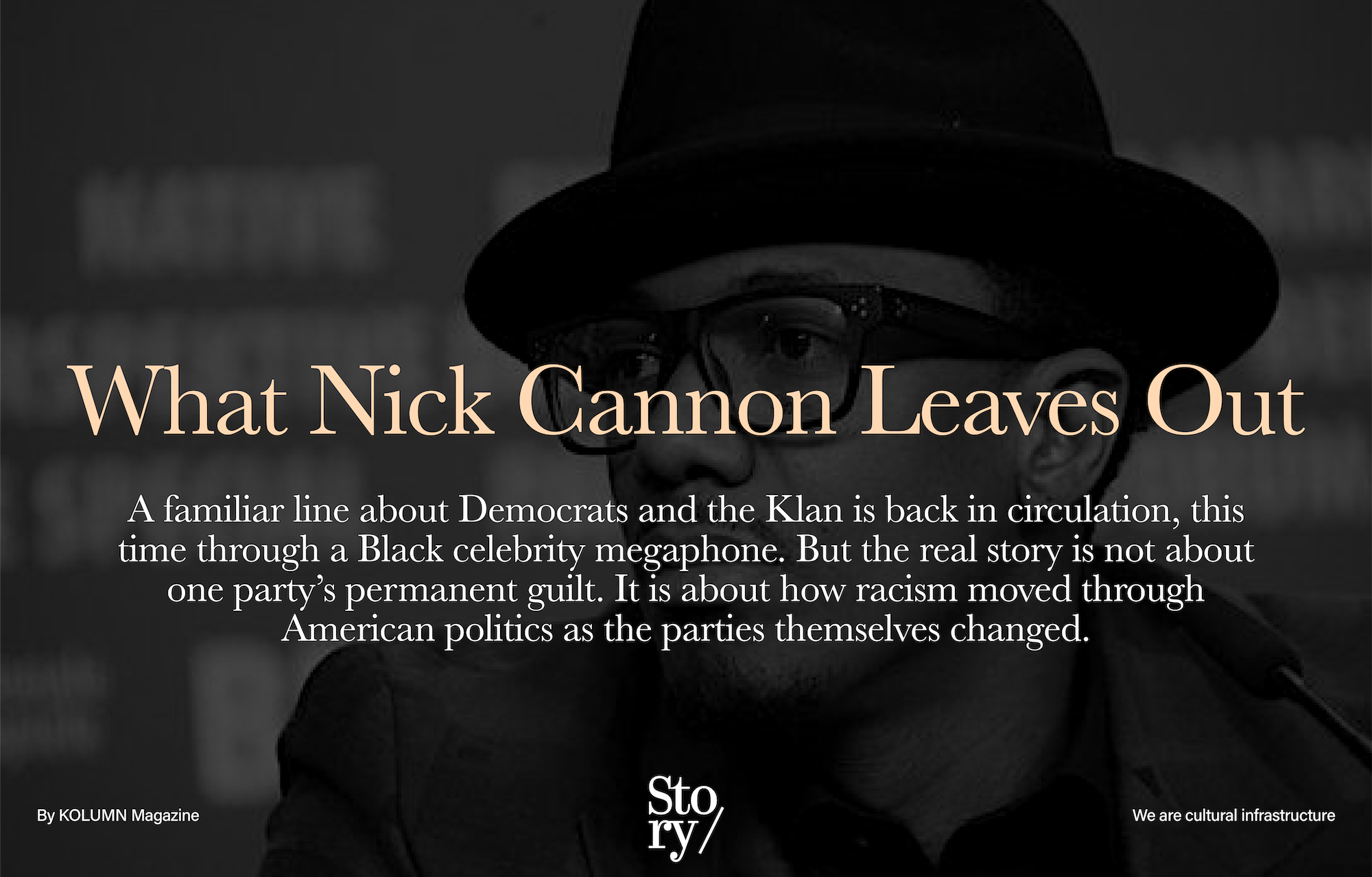
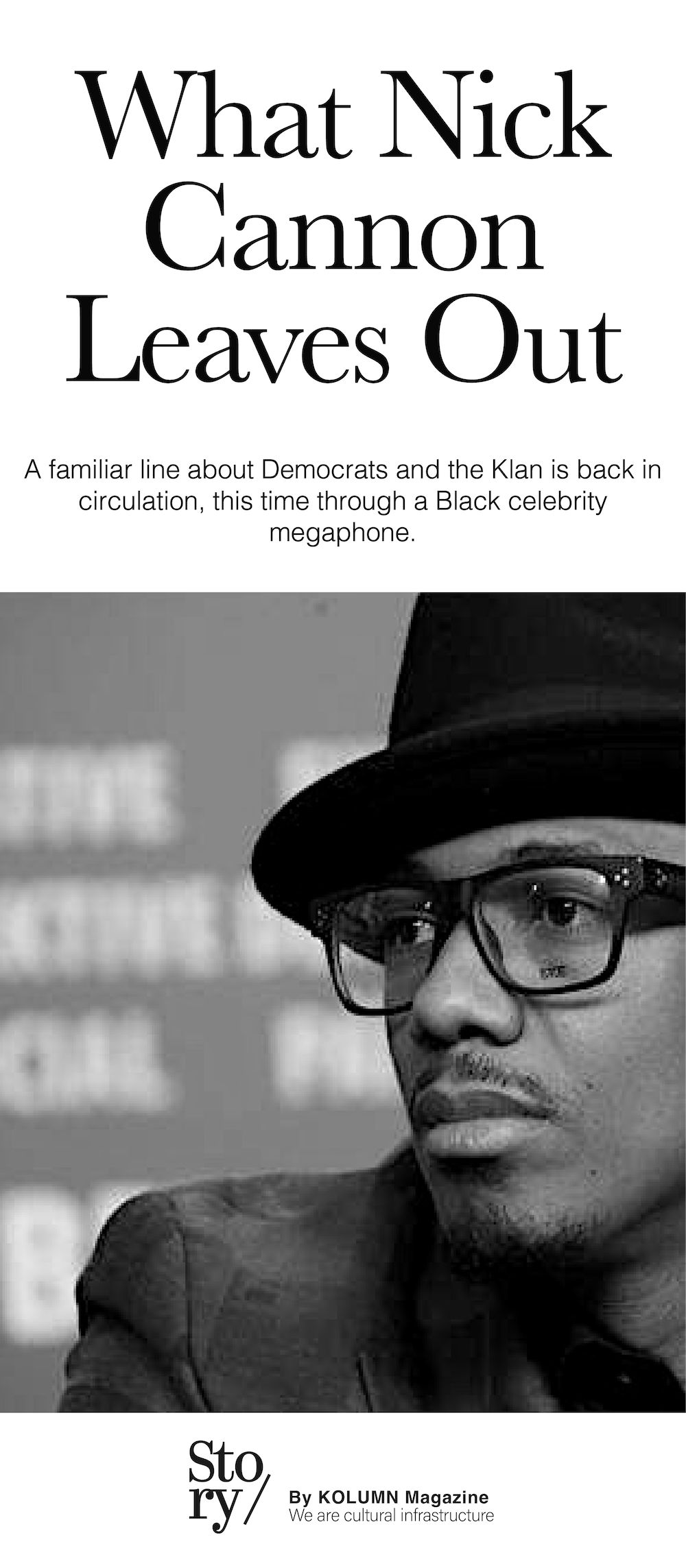
Lately that habit has not been confined to right-wing punditry. During a recent episode of his web talk show “Big Drive”, Nick Cannon echoed the familiar talking point, saying people do not know that “the Democrats are the party of the KKK” and that Republicans were the party that freed the slaves. Coverage of the episode also noted that Cannon said he does not subscribe to either party, while expressing admiration for Donald Trump.
What makes comments like Cannon’s sticky is that they draw power from a real historical fragment. The Democratic Party of the slave South and the Jim Crow South absolutely housed some of the country’s fiercest defenders of slavery, segregation, disfranchisement, and white rule. During Reconstruction, white terrorist violence by the Ku Klux Klan and similar groups was directed against Black political participation and the Republican-led attempt to build a multiracial democracy in the South. That much is not serious controversy. It is baseline history.
But the reason the claim works so well as a partisan weapon is precisely because it leaves out the rest. It leaves out the fact that white supremacy was not born inside a party caucus. It was a moral doctrine, a social system, and a political order embraced by white Americans who believed Black people were inferior and that the country should be organized accordingly. Party labels were important, but they were containers. The ideology was deeper than the container. It existed before the modern Republican Party was founded, survived the first Klan, outlived Reconstruction, hardened under Jim Crow, and adapted to changing coalitions long after the old openly segregationist order began to fracture.
That is the throughline that tends to disappear when people like Cannon present themselves as delivering forbidden knowledge to Black audiences. A fact without chronology is one of the easiest ways to lie about history. A fact without political transformation is even easier. And when that compressed history reaches Black voters through a celebrity platform rather than through historical study, it becomes less education than performance.
Cannon’s intent, however genuine, is objectively questionable, as his framing reminds us Dr. Martin Luther King Jr’s warning in Strength to Love (1963)… “Nothing in the world is more dangerous than sincere ignorance and conscientious stupidity”
“White supremacy was never a single party’s property. It was a national system that flowed through parties, regions, courts, churches, police departments, and ordinary white civic life.”
To understand what is wrong with the slogan, you have to begin before the Klan, before the civil-rights-era realignment, and before the talking point itself. You have to begin with slavery.
Before the Klan, There Was the Creed
The most important thing to say at the outset is also the thing American political shorthand usually skips: racism in the United States was not originally a partisan identity. It was a white social creed. It provided the moral logic for slavery, the intellectual scaffolding for Black dispossession, and the emotional permission structure for racial terror. It was preached in churches, dressed up in pseudoscience, reinforced in courts, and normalized in daily life.
Political parties did not invent that creed. They inherited it, used it, and were shaped by it.
By the mid-19th century, the Democratic Party had become the dominant national vehicle for slaveholding interests, especially in the South. Encyclopaedia Britannica notes that during the 19th century the Democratic Party supported or tolerated slavery and, after the Civil War, opposed civil-rights reforms in order to retain Southern white support.
The Republican Party, by contrast, emerged in the 1850s as an antislavery coalition opposed to the extension of slavery into new territories. Britannica’s history of the GOP is clear on that point: the party traces its roots to antislavery leaders who joined forces to oppose slavery’s expansion and, ultimately, favored its abolition.
That distinction matters, but it needs handling with care. It does not mean all Republicans were racial egalitarians in the modern sense. Many were not. It does not mean all Democrats outside the South were interchangeable with the slaveholding elite. They were not. What it does mean is that slavery was the defining fracture in national politics, and the major parties of the 1850s took meaningfully different positions on that fracture. The Democratic coalition contained the political force most invested in preserving slavery; the Republican coalition formed largely in opposition to slavery’s expansion.
That is why secession followed Abraham Lincoln’s election. Slaveholding states did not bolt the Union because they feared a Democratic administration would threaten their way of life. They left because a Republican opposed to the spread of slavery had won the presidency. The Civil War resolved the legal status of slavery. It did not eradicate the belief system that had sustained slavery from the beginning.
Emancipation Did Not Defeat White Supremacy
This is where a lot of modern commentary goes off the rails. It treats the abolition of slavery as though it closed the argument about race. In reality, emancipation opened a new and even more volatile one: what would freedom actually mean?
Would formerly enslaved people receive meaningful citizenship, voting rights, protection from terror, land, education, and access to office? Or would they be declared free in name and then shoved back into subordination by force, law, and custom?
Reconstruction was the first national attempt to answer those questions in democratic terms. House historical materials note that Republican lawmakers, in the years following the Civil War, worked to guarantee the civil and political rights of African Americans, passing the Civil Rights Act of 1866 and building the constitutional architecture that included the Reconstruction Amendments.
The Library of Congress describes Reconstruction as a period in which Black communities built institutions and sought full civil rights even as Southern governments rapidly removed protections and white terror groups moved to maintain a social order of white supremacy.
That is where the first Ku Klux Klan enters the story. The Klan did not arise as some random social club that happened to overlap with politics. It was a counterrevolutionary force. The Senate’s history of the Enforcement Acts records that Klansmen terrorized Black citizens for voting, running for office, and serving on juries. Congress responded by passing federal measures, including the Ku Klux Klan Act of 1871, empowering the government to combat conspiracies denying equal protection of the laws.
In the Reconstruction South, the Klan’s targets were Black Republicans, white Republicans, officeholders, voters, teachers, and anyone else threatening the old racial order. The Democratic Party in the former Confederacy became the political home of white conservatives seeking to overthrow Reconstruction and restore white control. So yes, when people say that the Democratic Party of that period was bound up with the world that produced the Klan, they are not inventing a connection. The connection was real.
But what that real connection does not mean is that racial meaning can be carried forward untouched across 150 years of party transformation. That is the sleight of hand.
“The first Klan was not a historical gotcha. It was a weapon used to destroy Black democracy.”
Redemption, Jim Crow, and the Administrative Face of White Power
After Reconstruction collapsed, white supremacy in the South did not need to rely solely on clandestine terror. It increasingly had the law.
The period that followed is often remembered through spectacle: lynch mobs, cross burnings, night riders, hooded men. Those things were real and central. But the lasting architecture of white domination was also bureaucratic. It lived in election rules, school systems, labor arrangements, housing restrictions, court decisions, and the routine denial of state protection to Black people.
The Library of Congress’s exhibition on the segregation era notes that by the early 20th century the political and racial order had hardened into a new system, and that the migration of Black voters and the New Deal would later begin to shift the balance. But before that shift, Southern white conservatives ruled through institutionalized segregation and disenfranchisement.
This is the part of the story the slogan usually flattens. It makes the Klan the whole thing. The Klan was never the whole thing. The Klan was one expression of a broader white supremacist consensus. The real power of Jim Crow came from the fact that it was not merely extremist. It was ordinary. It was defended by sheriffs, judges, registrars, governors, legislators, newspaper editors, employers, and “respectable” white citizens who would never have needed to put on a hood to preserve racial hierarchy.
If you only remember the terrorists, you miss the administrators. If you only remember the administrators, you miss the terror that made their rules stick. The system worked because each reinforced the other.
That is also why the line about Democrats being the party of the Klan, though partially true in this era, still fails as a comprehensive explanation. The problem was not just the party label. The problem was a white regional regime that used the Democratic Party as its main political instrument.
The Second Klan and the National Spread of White Nationalism
The historical shorthand gets even shakier when it encounters the 20th century. The second Ku Klux Klan, which surged in the 1910s and 1920s, was not simply a re-run of Reconstruction terror in the Deep South. It was broader, more national, and animated by a mix of racism, nativism, antisemitism, anti-Catholicism, and moral authoritarianism.
Smithsonian’s account of the 1924 Democratic National Convention captures just how deeply the Klan question rattled the party. The convention was described at the time as a “Klanbake,” and the fight over whether to condemn the KKK by name exposed a party divided over the group’s power and influence.
That history matters because it shows the Democratic Party was still entangled with Klan politics well into the 20th century. But even here, the simple slogan under-explains the broader story. The second Klan had national reach. It fed on white Protestant nationalism that far exceeded any single party apparatus. Its energy came from a wider white anxietal culture: fears about immigrants, Catholics, Jews, Black migration, urban change, gender shifts, and national identity itself.
So again, the line is incomplete in two directions at once. It understates the Democratic Party’s historical complicity in white supremacist politics, but it also understates how national and socially embedded white supremacy really was.
The Black Vote Moves, and the Coalition Starts to Crack
One of the major reasons the partisan story becomes more complicated is Black political agency.
For decades after emancipation, Black voters overwhelmingly aligned with the Republican Party, and for obvious reasons: the GOP had been the party of Lincoln, Reconstruction, and the amendments that made Black citizenship and Black male suffrage constitutional realities. But party loyalty is not a sacrament. It is a political judgment.
By 1936, according to the Library of Congress, a majority of Black voters had abandoned their historic allegiance to the Republican Party and joined the New Deal coalition, helping shift the balance of power inside the Democratic Party away from its Southern white conservative bloc.
That is a foundational fact for anyone trying to discuss modern Black politics honestly. Black voters did not remain frozen in the 1860s. They assessed which coalition was offering material openings, however limited and unequal those openings still were. The New Deal was racially compromised in profound ways; Black Americans were hardly naïve about that. But there were new jobs, new forms of federal presence, and new points of leverage. Library of Congress materials on the Depression and New Deal note that despite deep inequities, African Americans found some opportunities for employment and advancement in programs that had previously been closed to them.
That movement created one of the most consequential tensions in American political history. The Democratic Party became a coalition containing both Black voters and white Southern segregationists. It was structurally unstable, morally compromised, and politically explosive. But it also marked the beginning of the end of the old racial alignment.
This is exactly the kind of history that gets erased when a celebrity commentator jumps straight from Reconstruction-era Democrats to present-day Black electoral behavior, as though no century-long transformation intervened.
Civil Rights Blew Open the Contradiction
By the middle of the 20th century, the contradiction inside the Democratic coalition could not be managed indefinitely. The civil rights movement forced the issue.
The movement itself, as the Library of Congress notes, was nationwide, multifaceted, and met with severe violence. It used marches, boycotts, sit-ins, freedom rides, and legislative pressure to challenge segregation and exclusion.
As national Democrats moved more decisively toward civil rights, Southern Democrats hardened into resistance. The Guardian, writing on the June 1963 civil rights crisis, noted that John F. Kennedy’s alignment with civil rights would help end Democratic dominance in the South and that Southern Democrats immediately retaliated legislatively.
The record of the Civil Rights Act of 1964 is especially clarifying. The National Archives notes that Southern Democratic opponents tried to kill the bill with a filibuster. Senate history records that cloture was achieved through a bipartisan coalition of 27 Republicans and 44 Democrats, clearing the way for passage.
That set of facts tends to produce two bad arguments. One side says, “See? Democrats were the segregationists, case closed.” The other side says, “See? Republicans supported civil rights, case closed.” Neither “case closed” survives contact with the next decade.
The real takeaway is that by the 1960s, the old New Deal coalition was breaking apart along racial and regional lines. Southern Democrats remained the core institutional defenders of segregation inside Congress. But the national Democratic Party was moving toward civil-rights liberalism, while national Republicans were beginning to face a choice: continue competing broadly as the old party of Lincoln, or more aggressively court white Southern backlash.
The Southern Strategy Was Not a Conspiracy Theory
This is the point where historical denial tends to get especially intense. People who love the “Democrats were the Klan party” line often pretend the Southern strategy is either fabricated or wildly overstated. It is neither.
Britannica defines the Southern strategy as a Republican campaign strategy pursued from the 1960s that sought to increase and preserve support from white Southern voters by subtly endorsing segregation, discrimination, and Black disenfranchisement, and it notes that by the late 1970s much of the South’s regular political leadership had switched from Democratic to Republican.
The Atlantic’s analysis of the rise of the Republican majority likewise situates the GOP’s later success in the realignment that followed this shift.
This does not mean every individual racist Democrat became a Republican overnight, or that every Southern voter moved for exactly one reason. Realignment is messier than uniforms in a locker-room swap. It is gradual, asymmetrical, and uneven. But the broad historical movement is not seriously in doubt: as the national Democratic Party embraced civil rights, large numbers of white Southern conservatives migrated into a Republican coalition increasingly receptive to their grievances.
That is why the modern talking point is so misleading when it is presented as a direct line from the Klan to contemporary Democrats. It deliberately ignores the political migration that followed the civil rights era. It asks the audience to believe that party names matter more than party constituencies, strategies, and governing agendas.
“The slogan works by freezing history at the exact moment most useful to the person saying it.”
Nick Cannon and the Prestige of Contrarian Ignorance
Which brings the story back to Nick Cannon.
Cannon is hardly the first public figure to stumble into historical reductionism. But his comments are revealing because they show how this kind of half-history now circulates through celebrity discourse aimed, implicitly or explicitly, at Black audiences. His argument follows a familiar pattern: pull a Reconstruction-era or Jim Crow-era fact, strip out the chronology, add a flourish about Republicans freeing the slaves, then present the whole thing as evidence that Black voters have been conned.
What makes that style of commentary dangerous is not merely its factual incompleteness. It is its posture. It offers contrarian certainty in place of historical rigor. It flatters the audience with the suggestion that they are hearing the “real” story, when in fact they are often hearing a pruned one.
The available reporting on Cannon’s remarks shows exactly that pattern. Search-result and follow-up coverage quote him saying Democrats were “the party of the KKK,” Republicans were “the party that freed the slaves,” and that he does not subscribe to either party. TMZ’s coverage also noted, correctly, that Democrats in the Reconstruction-era South had strong ties to the Klan and that political realignment followed in the 1960s.
The issue, then, is not whether Cannon touched a real historical point. He did. The issue is whether he handled it responsibly. He did not.
That matters because Black voters are not helped by selective historical theater. They are helped by analysis that can hold multiple truths at once: that the Democratic Party bears real historical guilt for slavery, segregation, and white Southern terror; that the Republican Party originated in antislavery politics and Reconstruction; that Black voters later migrated toward Democrats for material and strategic reasons; and that the Republican Party’s modern success in the South cannot be understood apart from racial backlash and coded appeals to white grievance.
Word In Black has been particularly direct about this larger reality. In one 2024 piece, Keith Boykin argued that today’s GOP can no longer seriously claim Lincoln’s mantle without reckoning with how the party changed after the 1960s. In another, he argued that Black Republicans often have to minimize the reality of racism in order to remain credible inside their own coalition. Whether or not one embraces every edge of Boykin’s framing, the larger point lands: Black political judgment in the present is shaped far more by contemporary coalition behavior than by ancestor branding from 1860.
Why Black Voters Don’t Need a Party Genealogy Chart
A lot of commentary about Black politics still assumes that Black voters are historically naïve, emotionally manipulated, or trapped in inherited loyalties. That assumption is usually less insightful than insulting.
Black political behavior has never been static. It has been strategic. Black communities have moved, organized, pressured, negotiated, and withheld support based on changing political conditions. They helped make Reconstruction possible. They built mutual-aid structures when the state abandoned them. They helped reshape the New Deal coalition. They forced civil rights onto the national agenda. They assessed which institutions were most vulnerable to pressure and which coalitions were most likely to respond.
That history is why present-day Black voters are often unimpressed by lectures about which party was worse in 1872. For many voters, the relevant question is not, “Which party has the cleaner family tree?” It is, “Which coalition is more responsive to Black interests now, and which one is more hostile now?”
That is not an anti-historical position. It is a historically literate one.
A Black voter in 2026 does not need to forget that white Southern Democrats built Jim Crow. But that same voter also does not need to ignore the Southern strategy, the partisan sorting of the post-civil-rights era, or the modern uses of racial resentment in electoral politics. The point of history is not to furnish easy absolution. It is to clarify how power moved.
The Trouble With Treating Party Names Like Moral Essences
One reason this subject remains so combustible is that both parties have reasons to prefer a flatter story.
Democrats have incentives to emphasize their modern association with civil rights while muting the full ugliness of the party’s role in slavery, Redemption, segregation, and Southern disfranchisement. Republicans have incentives to emphasize the party’s antislavery origins while muting the later appeal to white Southern backlash that helped transform the modern electoral map. Both selective memories are politically useful. Neither is sufficient.
Britannica’s party histories make the broad transformation plain: Democrats moved from supporting or tolerating slavery and opposing postwar civil-rights reforms to becoming, by the mid-20th century, a party identified with labor, minority civil rights, and progressive reform; Republicans moved from an antislavery coalition to a party associated in the 20th and 21st centuries with conservative policy and, through the Southern strategy, a successful appeal to white Southern voters.
That does not make one party morally pure. It makes clear that parties are not static moral essences. They are coalitions that change under pressure, through conflict, through migration, through strategic calculation, and through voter realignment.
Which is exactly why the phrase “Democrats were the party of the Klan,” though historically grounded in one period, becomes deceptive when used as a timeless descriptor. It asks listeners to confuse historical association with permanent identity.
White Supremacy Changed Its Vocabulary, Not Its Ambition
There is another reason the slogan remains inadequate: it mistakes changes in language for changes in substance.
Over time, overt white supremacist rhetoric became less publicly respectable in national politics, especially after the civil rights movement. But racial politics did not disappear. They adapted. Appeals to “local control,” “law and order,” “states’ rights,” “taxpayer protection,” “welfare dependency,” and “voter integrity” have not always meant the same thing in every context. But repeatedly, they have been used in ways that preserve racial hierarchy while avoiding the blunt vocabulary of the old order.
This is one of the central lessons of the post-1960s era. White supremacy did not vanish when its loudest language became embarrassing. It became more coded, more policy-facing, more institutionally respectable.
That is another reason celebrity-level historical shortcuts are so unhelpful. They encourage people to think racism can be solved by tracing who wore the worse label in a previous century. The more difficult task is seeing how racial hierarchy survives in changed form.
“American racism did not retire when the old slogans aged poorly. It learned how to speak in cleaner clothes.”
The Better History Is Harder to Chant
So what is the most honest answer to the original question?
Were Democrats once the party most associated with the Ku Klux Klan, especially in the Reconstruction and Jim Crow South? Yes, in a significant historical sense. Southern Democrats were central defenders of slavery’s political legacy, the overthrow of Reconstruction, and the building of Jim Crow, and Klan violence was aligned with that white-supremacist order.
Was the Republican Party founded in opposition to slavery’s expansion and deeply involved in Reconstruction-era civil-rights policy? Yes.
Did Black voters later move into the Democratic coalition, and did the Democratic Party’s center of gravity shift away from its old Southern bloc? Yes.
Did the civil rights era trigger a racial and regional realignment in which many white Southern conservatives moved into the Republican coalition, aided by strategies that appealed to racial resentment more subtly than old-style segregationism had? Also yes.
Those truths do not cancel one another out. They complete one another.
The better sentence, then, is not the one most likely to trend. The better sentence is this: white supremacy in America was never just a party brand. It was a governing logic of the country, and both major parties were reshaped by their changing relationships to that logic.
That sentence is less satisfying to people who want partisan exoneration. It is much more useful to anyone trying to understand history.
What Responsible Political Memory Would Look Like
A responsible public memory would let Democrats reckon honestly with the fact that their party once served as the principal political vessel for slavery’s defenders, segregationists, and white Southern terror. It would also force Republicans to reckon honestly with the fact that their party’s later growth in the South cannot be understood without the politics of white backlash.
It would stop pretending that history can be won by identifying the villain of one era and assigning the costume permanently to one team. It would recognize that parties change because the electorate changes, movements intervene, coalitions crack, and politicians chase power where they think it can be found.
And it would ask more of high-profile Black commentators than recycled provocation.
Nick Cannon’s remarks matter less because they reveal something new than because they reveal how easy it still is to market historical compression as independent thought. That is the real caution here. Black communities have always had to sort truth from performance, information from spectacle, strategy from seduction. There is nothing radical about repeating an under-contextualized talking point simply because it annoys liberals or sounds anti-establishment. The bar has to be higher than that.
Because history, especially on this subject, is not a parlor trick. It is an inheritance of blood, law, terror, adaptation, and struggle. It asks for more than slogan literacy.
And if there is a final lesson in all of this, it is not that one party is innocent and the other damned. It is that white supremacy was far too central to American life to remain confined to a single label. It traveled where power traveled. It attached itself to whichever coalition could carry it forward. Sometimes that coalition was explicitly Democratic. Later, key forms of its backlash politics found a home in the modern Republican South. Often it operated beyond the parties altogether, through the broader machinery of white public life.
That is the history worth keeping intact, especially when public figures with large Black audiences start handing out the abridged version.
The slogan says Democrats were the party of the Klan. The fuller record says something harder and more important: the United States made white supremacy durable enough to survive party change. Understanding that is less comforting than winning a talking point. It is also closer to the truth.
More great stories
George Raymond Jr. and the Price of Freedom Work
March 31, 2026
No Comments
Yvonne Pickering Carter’s Long Arc
March 31, 2026
No Comments