


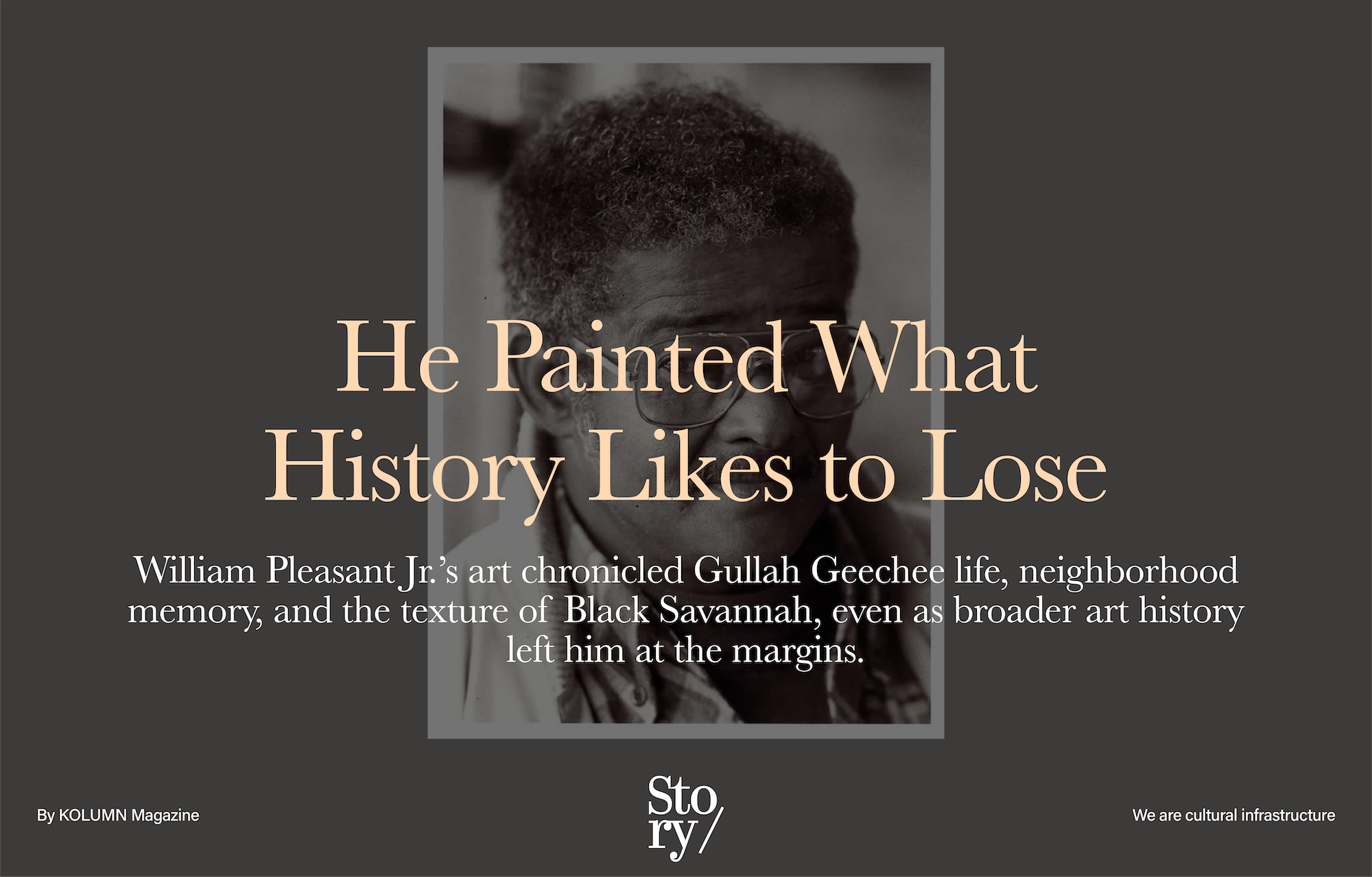
He painted what history likes to lose.
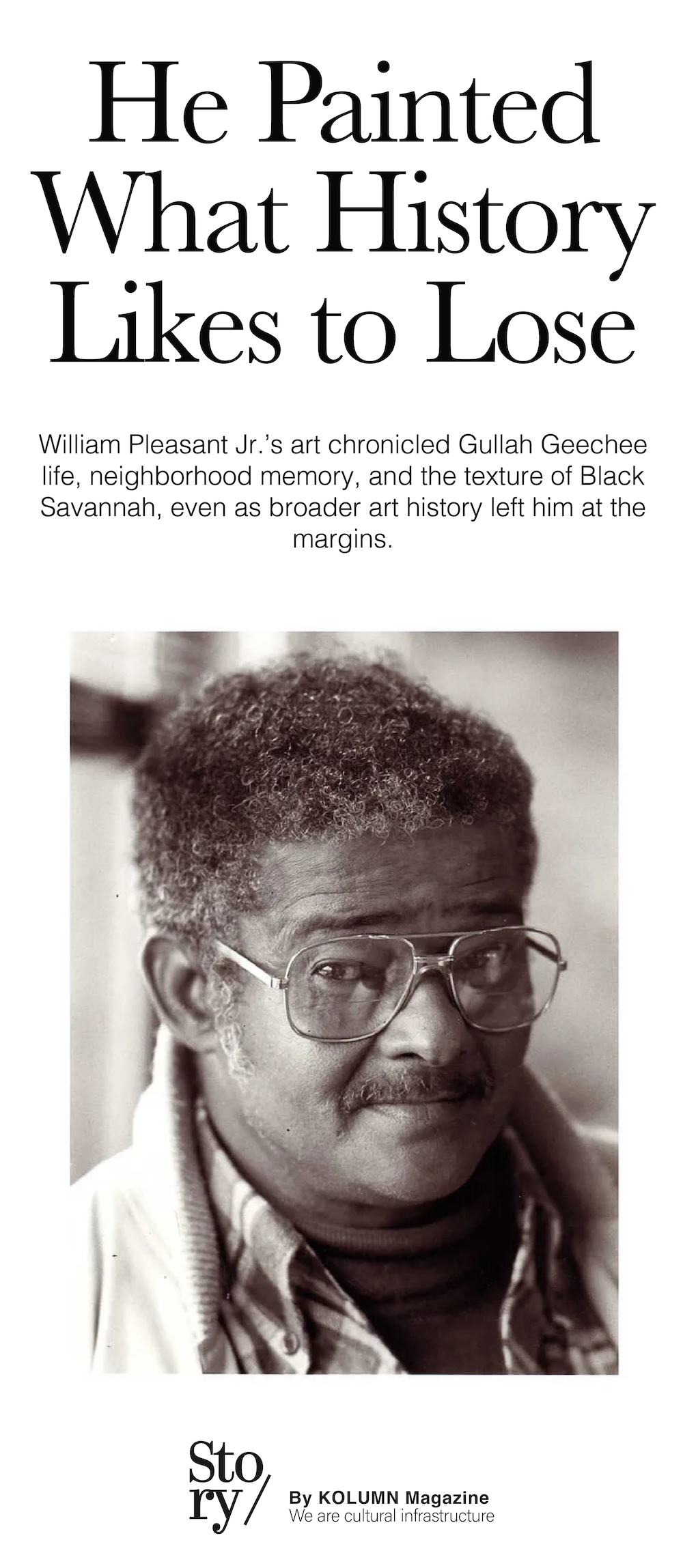
He painted what history likes to lose.
By KOLUMN Magazine
William Pleasant Jr. is the kind of American artist who exposes a recurring weakness in the way this country tells cultural history. He was not obscure because he lacked range, discipline, subject matter, or public consequence. He was obscure because American institutions, especially local and regional ones, have often been far better at celebrating Black culture in the abstract than at steadily preserving the Black artists who actually documented it. Pleasant, born in Savannah, Georgia, in 1928 and dead by 1997, spent a lifetime painting the people, storefronts, vendors, neighborhoods, textures, and memory-worlds of Black Savannah. He also worked as a commercial artist and sign painter, participated in civil-rights-era civic life, and moved through performance culture early in life as a singer and impressionist. Today, his best-known work, The Huckster, is held by the Smithsonian’s National Museum of African American History and Culture, where it has been shown in the museum’s Cultural Expressions gallery. That placement matters not just because it confers prestige, but because it confirms what Pleasant’s life had been saying all along: he was making history, not just pictures.
A Painter of Presence, Not Background
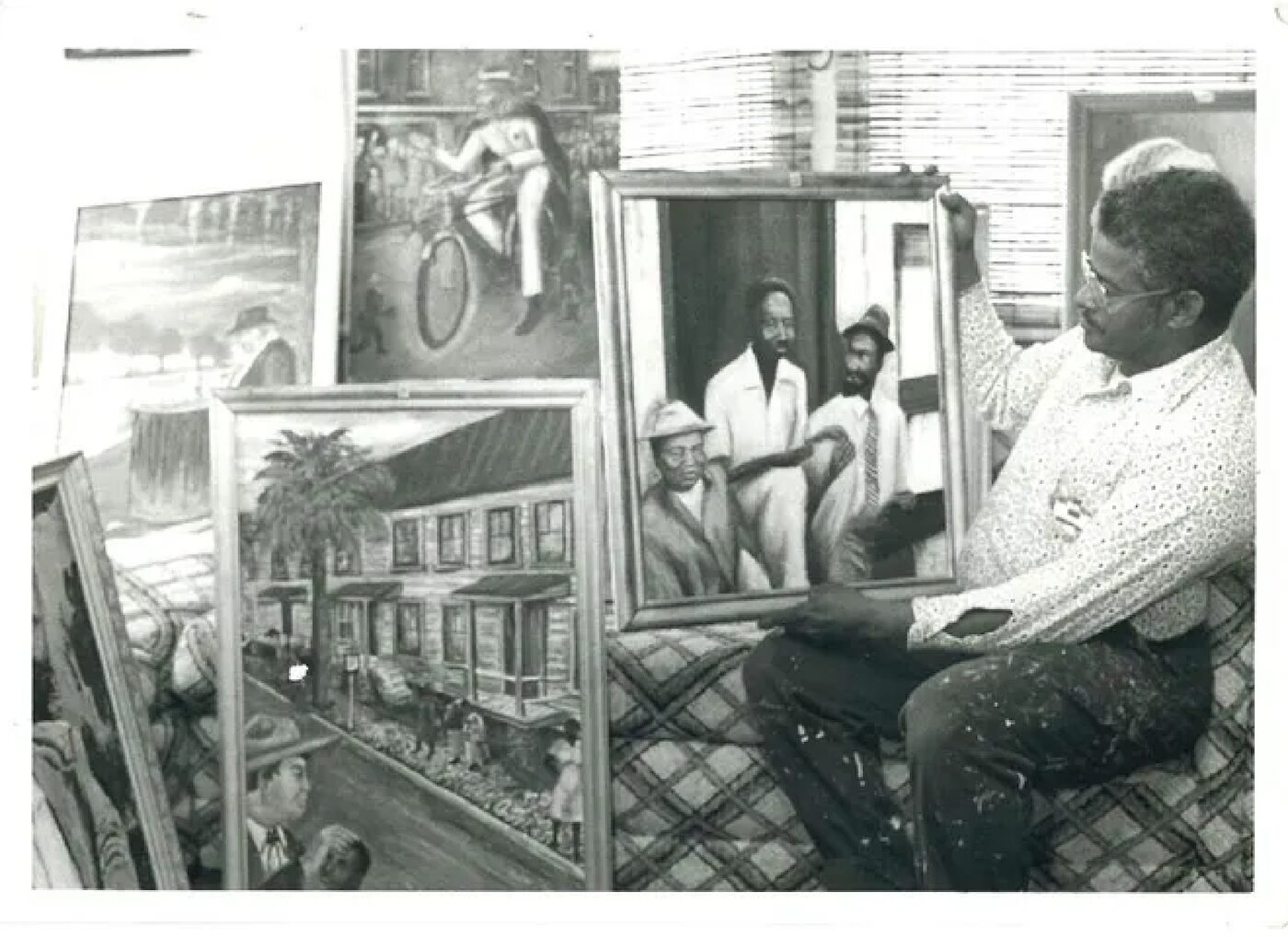
That is the central fact of William Pleasant Jr.’s significance. He was an artist, yes, but he was also a custodian of presence. He painted what segregation tried to downgrade into background scenery. He recorded Black Savannah not as a sidebar to the city’s story but as one of its central authors. In his work, everyday life is not ordinary in the dismissive sense. It is thick with memory, labor, style, ritual, and survival. His paintings of Gullah Geechee life and Savannah street scenes did not merely illustrate a region; they asserted a claim about who belongs in the historical record. Local reporting and family accounts describe him as a prolific painter of genre scenes and African American landmarks, and his own legacy organizations frame the work similarly: a sustained effort to document influential people and historic sites tied to Savannah’s Black heritage.
Pleasant’s biography also resists easy categorization. He was born William Merriette Pleasant Jr. in Savannah on June 23, 1928. African American Registry accounts of his life describe formal study at Beach High School, Savannah State College, Delaware State College, Tyler School of Fine Arts in Philadelphia, and York College in Pennsylvania. That same source also places him in an unusually wide set of civic, artistic, and fraternal worlds: an early member of Savannah’s Bahá’í community, a Mason, a commercial sign painter, a performer, and a civic-minded Black intellectual shaped by mid-century southern realities. Some of those details come from commemorative and secondary materials rather than a single institutional archive, so they deserve to be handled with care. But even at minimum, the available record makes one thing plain: Pleasant’s life was interdisciplinary before that word became fashionable. He did not separate art from community, or culture from public life.
Inheritance and Early Expression
His family background helps explain part of that orientation. Reporting from Savannah links Pleasant to Louis Pleasant, one of the founders of the Savannah Tribune in the nineteenth century. That family connection matters because it locates William Pleasant Jr. inside a longer Black civic lineage in Savannah, one in which newspapers, public memory, political participation, and cultural production were already intertwined. Connect Savannah, drawing on family interviews, describes those roots as “deep, deep” in the city, and identifies Pleasant as both an heir to that legacy and a maker of a new one. It is not hard to see the logic. A family tied to Black press history would have understood, instinctively, that representation is never just aesthetic. It is also documentary, political, and communal. Pleasant’s art follows that principle.
Before he became known primarily as a painter, Pleasant had already developed the instincts of a performer. Archival newspaper coverage from Savannah records him as a child and young man appearing in musical and entertainment settings. In 1943, The Savannah Tribune called him a “nationally known boy entertainer.” A 1960 Herald item described him as having been “quite a sensation” on the Major Bowles radio amateur program, and said he had appeared on W. C. Handy’s Stars of Tomorrow on Broadway as well as the nationally broadcast program Wings Over Jordan. Other Savannah newspaper notices from the 1940s and 1950s mention him singing as a tenor soloist. These clippings matter for more than biographical color. They suggest an artist who understood performance, voice, audience, and timing long before the museum world ever encountered him.
The Street as Archive
That early performance experience may also help explain the clarity and theatricality present in the body of work for which Pleasant is now remembered. Even when the subject is still, the paintings often imply motion: commerce on the street, talk on a stoop, heat in the air, ritual in a neighborhood, history pressing against the edge of the canvas. He understood how people occupy public space, how identity is announced through gesture and costume, how a city performs itself block by block. His background in sign painting deepened that fluency. Archival reporting from 1960 identifies him as a “commercial artist,” and later coverage notes that his hand-painted signs remained visible at sites like City Market, the Savannah Visitor’s Center complex, and Beth Eden Baptist Church. Sign work is not separate from fine art here; it is part of the same practice of shaping public vision. It taught him how images meet pedestrians, how color carries across distance, and how art can live outside elite interiors.
That matters because Pleasant’s career unfolded in a South where Black visibility was always contested. Savannah is frequently sold through a polished visual vocabulary: squares, moss, architecture, ghosts, preservation, genteel memory. Pleasant painted another Savannah, one no less beautiful but far more honest. His was a city of Black workers, Black families, Black vendors, Black sacred spaces, and Black neighborhoods full of inherited style. In the available accounts of his work, he repeatedly emerges as a chronicler of people and landmarks that official memory neglected or flattened. African American Registry says he documented “once-influential people and historical landmarks of Savannah’s Black heritage.” His family legacy materials say much the same. Connect Savannah describes paintings of genre scenes and Gullah Geechee life produced over decades. In each version of the story, the verb is essentially identical: document.
The Huckster and the Politics of Visibility
To document, in Pleasant’s case, did not mean to work like a camera. He was an expressionist painter, and the expressionist tendency matters here. Expressionism allowed him to do more than record external appearances. It gave him room to heighten mood, dignity, strain, and atmosphere. It let him paint the social temperature of a place. That is one reason Pleasant should be taken seriously not only as a regional artist but as a theorist of Black everyday life in paint. His subject matter was local, but his problem was national: how do you represent a people whose historical presence is routinely minimized, romanticized, or erased? Pleasant’s answer was to paint them insistently, specifically, and repeatedly. Secondary sources identify him as an expressionist; the surviving descriptions of the work support the label.
No single work illustrates that better than The Huckster. The Smithsonian’s National Museum of African American History and Culture identifies it as a 1980 oil painting depicting Savannah, Georgia, and places it on view in the Cultural Expressions gallery. The title is itself revealing. A “huckster” is a seller, a street merchant, someone working the public realm with improvisation and stamina. In American history, that kind of figure is often treated as incidental, picturesque, or quaint. Pleasant’s decision to make such a person the subject of a museum-worthy painting performs a reversal. He takes a Black working figure who might otherwise be dismissed as mere scenery and restores scale, gravity, and aesthetic centrality. Smithsonian placement does not create that importance; it acknowledges it.
“Pleasant did not paint Black Savannah as folklore. He painted it as evidence.”
The painting’s afterlife says as much about American institutions as it does about Pleasant. By 2016, according to institutional and commemorative sources, The Huckster had entered the Smithsonian’s permanent collection and was being exhibited as part of the new museum’s long-term presentation. That development brought a measure of overdue national visibility. Yet the very need for Smithsonian recognition underscores the prior failure closer to home. Connect Savannah reported in 2016 that Pleasant’s sons believed his work was not represented in any major museum collection in Savannah and described a broader struggle to secure recognition for his artistic contribution. That same report noted that one of his surviving murals on the Barnard Street School building had been painted over during a 1988 renovation associated with SCAD, allegedly without family notification. Even allowing for the fact that this account comes through local reporting and family testimony, the larger pattern is hard to miss: preservation arrived unevenly, and sometimes after loss.
Memory, Activism, and Cultural Preservation
That phrase, evidence, may be the best way to understand his larger cultural role. Pleasant did not paint Black Savannah as folklore. He painted it as evidence. Evidence that these people lived, traded, worshipped, dressed, endured, joked, sold, sang, gathered, and built. Evidence that the city’s Black geography was not peripheral but constitutive. Evidence that beauty and hardship occupied the same streets. Evidence that memory has a physical environment and that once those environments are altered or destroyed, art may become one of the last witnesses left standing. This is why Pleasant’s work belongs in conversation with historians, preservationists, folklorists, and civil rights scholars as much as with painters.
His civic commitments reinforce that reading. Multiple sources describe Pleasant as an early member of the Savannah NAACP and a collaborator of the legendary Savannah civil rights leader W. W. Law. One city archival finding aid for ASALH and related cultural organizations records a 1985 exhibit by Pleasant titled Journey Down Memory Lane: Savannah as it was, which by title alone sounds like an artist’s declaration of method. He was not interested in memory as mist. He was interested in memory anchored to place. Connect Savannah likewise links him to Law and to Savannah’s civil-rights-era Black institutional life. The overlap between activism and art in Pleasant’s career should not be treated as incidental. In Black southern history, cultural preservation was often itself a political act. To remember accurately was to resist domination.
Recognition, Erasure, and the Work of Legacy
The title Journey Down Memory Lane: Savannah as it was deserves lingering attention. It suggests nostalgia at first glance, but Pleasant’s body of work complicates that. The phrase “as it was” can be wistful, but it can also be corrective. It can mean: before demolition, before institutional neglect, before tourist branding smoothed out the city’s Black edges, before key landmarks vanished, before the record was edited. The archival record confirms that the exhibit ran from April 12 to June 22, 1985, and a Savannah Tribune item from May of that year describes it as a collection of paintings spanning 1940 to 1960. That date range is telling. It places Pleasant’s attention squarely on mid-century Black life in Savannah, a period thick with migration, segregation, civic mobilization, and transformation.
Pleasant’s role as a sign painter and commercial artist also deserves more than a footnote. Too often, art history divides labor into prestige categories: easel painting at the top, commercial work somewhere lower down, local signage barely considered. But for many Black artists in the twentieth century, those distinctions were economically artificial. Commercial practice paid bills, trained the eye, and shaped public visual culture. In Pleasant’s case, sign work was another means of inscribing Black presence into the city. The fact that some of his hand-painted signs reportedly remained part of Savannah’s visible landscape decades later tells us something about permanence and use. His art did not belong only to collectors. It belonged to streets, storefronts, and public-facing institutions. That is not lesser work. It is democratic work.
A Legacy Still Catching Up
There is also a tension in Pleasant’s story that feels distinctly American. He was celebrated enough to be visible, yet insufficiently institutionalized to be secure. He had public talent early, community standing, exhibit history, and civic involvement. He was hardly unknown in his immediate world. Yet broader art-historical incorporation lagged. That lag is familiar for Black artists whose work is geographically rooted and socially documentary rather than easily folded into fashionable national narratives. They are often praised locally, under-collected formally, and rediscovered only when a larger institution validates what communities already knew. Pleasant’s Smithsonian presence thus reads not only as triumph but as indictment. It prompts an uncomfortable question: why did it take so long?
Part of the answer may lie in the kinds of subjects he chose. Pleasant painted Black life without translating it for white comfort. Even when his work is accessible, it is not deferential. It does not ask permission to matter. Street vendors, neighborhood figures, and community landmarks can be hard for establishment institutions to rank as “major” subjects unless they already possess the language to value social history as art history. Pleasant’s work insists on that merger. A vendor is not just a vendor. A storefront is not just a storefront. A Black neighborhood landmark is not just local color. Each is a container of historical experience. By painting them, Pleasant elevated visual anthropology, communal memory, and Black vernacular culture into the realm of fine art.
The family’s later efforts to preserve and promote the work further demonstrate that Pleasant left not merely paintings but an unfinished public argument. Connect Savannah’s 2016 reporting centered on his descendants’ attempt to secure fuller recognition and protect the legacy. Family- and legacy-affiliated sites since then have framed his work through themes of signage, civil rights, Black Power, and historical preservation. One Pleasant Institute description says an exhibition titled Signs for Life would explore “Civil Rights and Black Power through the related paintings and signage” of William Pleasant Jr., while another notes a spotlight on The Huckster. Those curatorial choices are instructive. They present Pleasant not as a quaint regionalist, but as an artist whose visual language sits at the intersection of politics, public communication, and memory.
That interpretive frame also helps rescue Pleasant from the trap of sentimental regionalism. Black southern artists are often celebrated for “capturing a way of life,” a phrase that can quickly slide into depoliticized nostalgia. Pleasant’s work merits something sharper. He captured a way of life under pressure. He painted communities shaped by segregation, activism, changing urban development, and the ongoing struggle over who gets remembered. His collaboration with or proximity to figures like W. W. Law places him in a city where preservation and civil rights were intimately linked. In Savannah, fighting for Black history was not an abstract educational project. It was a battle over real houses, real churches, real routes, real institutions, and real names. Pleasant’s canvases should be read in that context: as acts of visual preservation parallel to the civic preservation work surrounding him.
There is an additional layer to his significance: Pleasant helps expand how we think about Black male artists of the twentieth-century South. The dominant narratives often center either on artists who broke nationally through the mainstream art market or on self-taught visionaries later reclaimed by curators. Pleasant fits neither box neatly. He was educated, commercially skilled, civically engaged, publicly performative, regionally grounded, and stylistically serious. He moved between fine art and functional art, between community documentation and expressive interpretation. That hybridity is part of why he remains so useful to scholars and writers now. He offers a model of Black artistic practice that is embedded rather than detached, accountable to place rather than fleeing it.
He also reminds us that locality is not smallness. Savannah was his subject because Savannah contained a world. Within it were the afterlives of slavery, the structures of Jim Crow, the strength of Black institutions, the persistence of Gullah Geechee culture, the creativity of Black commerce, and the intellectual labor of self-representation. Pleasant’s art condensed those histories into scenes a viewer could enter without a lecture. That accessibility is one of his strengths. He did not require theoretical jargon to make an argument. The work, as described across sources and evidenced by The Huckster, seems to say: look closely, because this is the nation too.
It is worth noting, too, what the national record does not contain. There is not, at least in the accessible material surfaced here, a large body of sustained coverage from the major national outlets that routinely shape American cultural memory. That absence is itself revealing. Pleasant is exactly the kind of artist who should have attracted far more national criticism and institutional analysis: a Black southern painter, tied to civil rights and public memory, whose work now sits within the Smithsonian’s defining Black history museum. The thinness of broader mainstream coverage is not proof of minor significance. It is better understood as evidence of a chronic blind spot in the cultural press. Local papers, archives, community memory, and institutional object records often preserved what national tastemakers missed.
That is why writing about Pleasant now requires a certain discipline. He should not be inflated beyond the record, but neither should he be minimized by the record’s gaps. The responsible approach is to let the available evidence do its work. We know he was born in Savannah in 1928. We know he was active as a performer and singer in youth. We know mid-century reporting identified him as a commercial artist. We know he exhibited in Savannah, including a memory-centered 1985 show. We know he was linked to Savannah’s Black civic and civil-rights life, including the NAACP and W. W. Law. We know his paintings documented Black Savannah and Gullah Geechee life. We know The Huckster is in the Smithsonian’s collection and on view in a major national museum. And we know his descendants and supporters have had to fight for fuller acknowledgment of that achievement. Those are not small facts. Together, they describe an artist of genuine historical weight.
What, then, is William Pleasant Jr.’s legacy? It is partly aesthetic. He made expressionist paintings rooted in Black southern life and gave vernacular subjects a seriousness they were too rarely granted. It is partly documentary. He preserved people and places that formal archives and museums did not always protect in time. It is partly civic. His life touched organizations, movements, and institutions invested in Black advancement and memory. And it is partly cautionary. His story exposes how easily major artists can remain under-recognized when their work grows from Black local worlds rather than from the routes most legible to elite art systems.
But his legacy is also something more intimate. Pleasant teaches that beauty can be an archival method. A painting can do the work of a witness statement. A street vendor can stand in for an economy, a neighborhood, a racial order, a city’s hidden scaffolding. A mural lost to renovation can reveal how fragile public memory really is. A sign painter can turn out to be one of a place’s most important historians. Once you understand that, Pleasant’s career comes into focus. He was not operating at the edges of history. He was painting at its pressure points.
In the end, William Pleasant Jr. belongs to a lineage of Black artists who understood that representation is not simply about being seen. It is about being seen correctly, in scale, in context, and with dignity. He painted Savannah’s Black life as if it deserved permanence, which of course it did. He painted labor without reducing people to toil. He painted community without flattening it into stereotype. He painted memory without surrendering to haze. And long before a national museum gave him wall space, he had already made the harder argument: that the lives surrounding him were worthy of art, worthy of record, and worthy of historical seriousness. The country is still catching up.
That may be the most fitting final measure of his importance. William Pleasant Jr. did what many indispensable artists do. He made it harder to lie about a place.
More great stories
When Reading Became Civil Disobedience
March 27, 2026
No Comments
Before Harlem Was a Renaissance, There Was Will Marion Cook
March 27, 2026
No Comments