




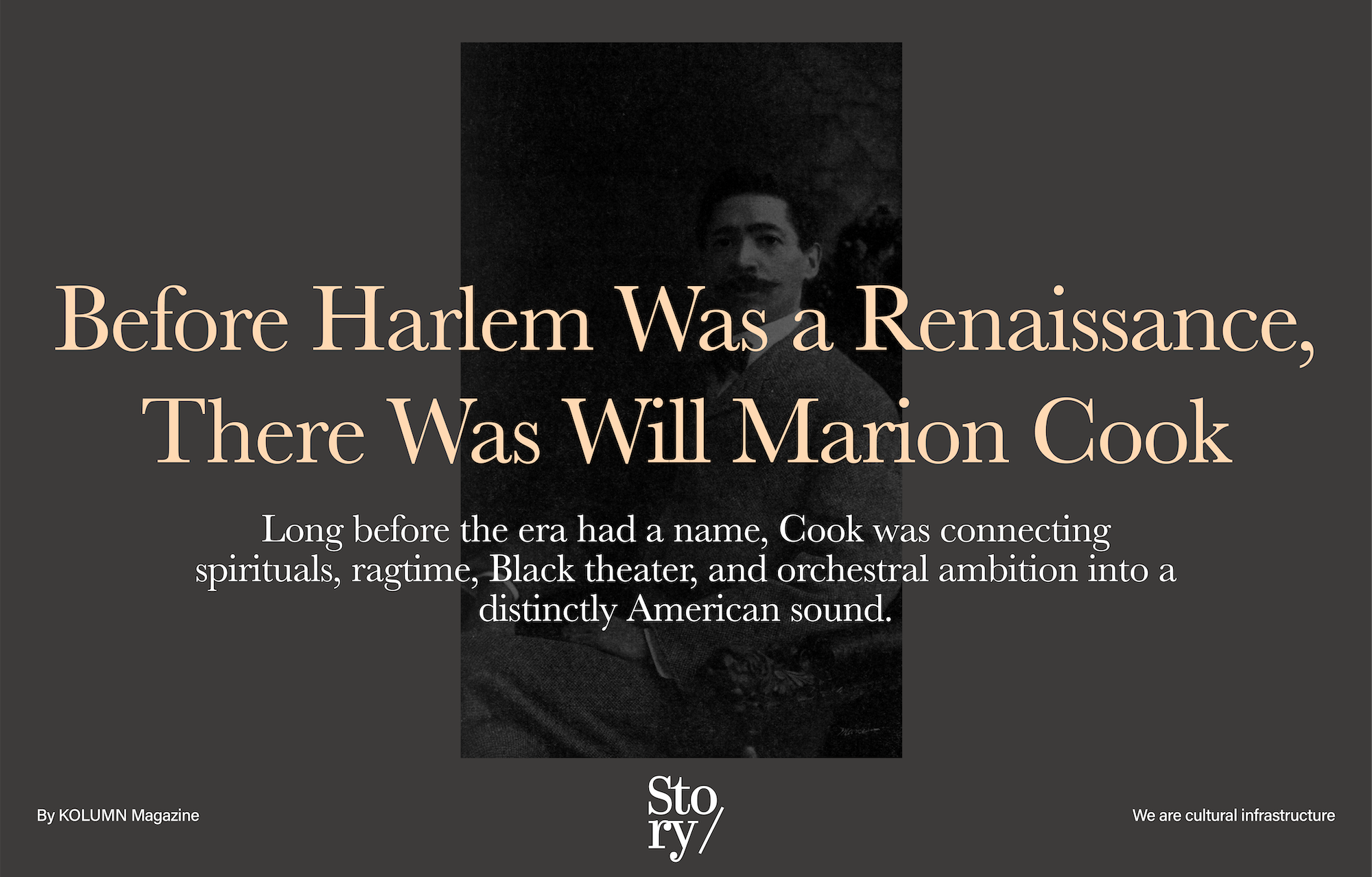
Will Marion Cook did not merely cross the line between “high” and “popular” music. He exposed how artificial that line was in the first place.
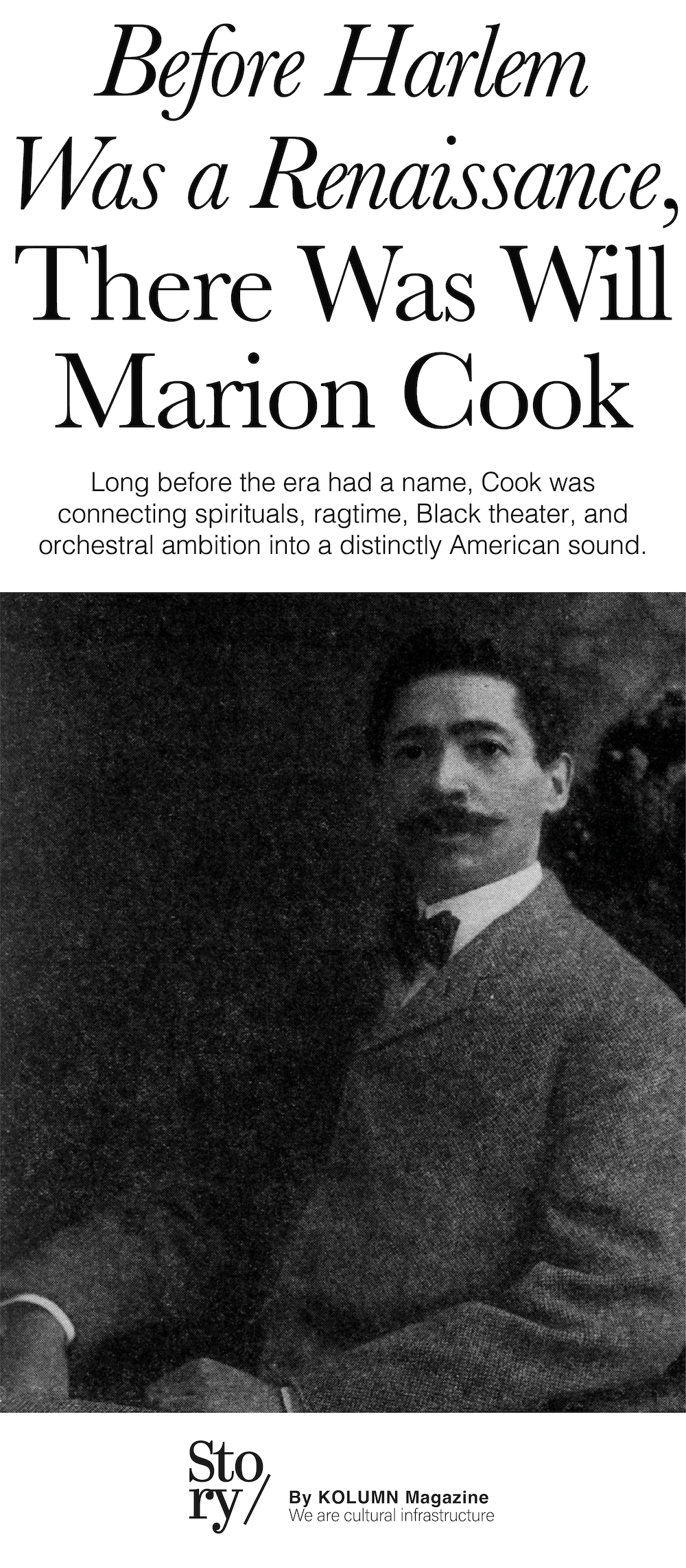
Will Marion Cook did not merely cross the line between “high” and “popular” music. He exposed how artificial that line was in the first place.
By KOLUMN Magazine
There are certain figures in American culture who are remembered not because they fit neatly inside a category, but because they kept breaking categories until the culture around them changed. Will Marion Cook was one of those people. He was a composer, violinist, conductor, producer, choral director, teacher, and theatrical force of nature. He was classically trained, but he could not fully enter the classical establishment. He was deeply learned in European musical forms, but he refused to abandon Black vernacular sound. He helped build Black musical theater, mentored younger musicians who would become giants, and worked in the years before jazz was fully named yet after Black music had already begun remaking the nation’s ears. The Library of Congress calls him one of the most important figures in pre-jazz African American music, and that framing is useful precisely because it captures how much of Cook’s importance lies in the bridge he built rather than in any single genre.
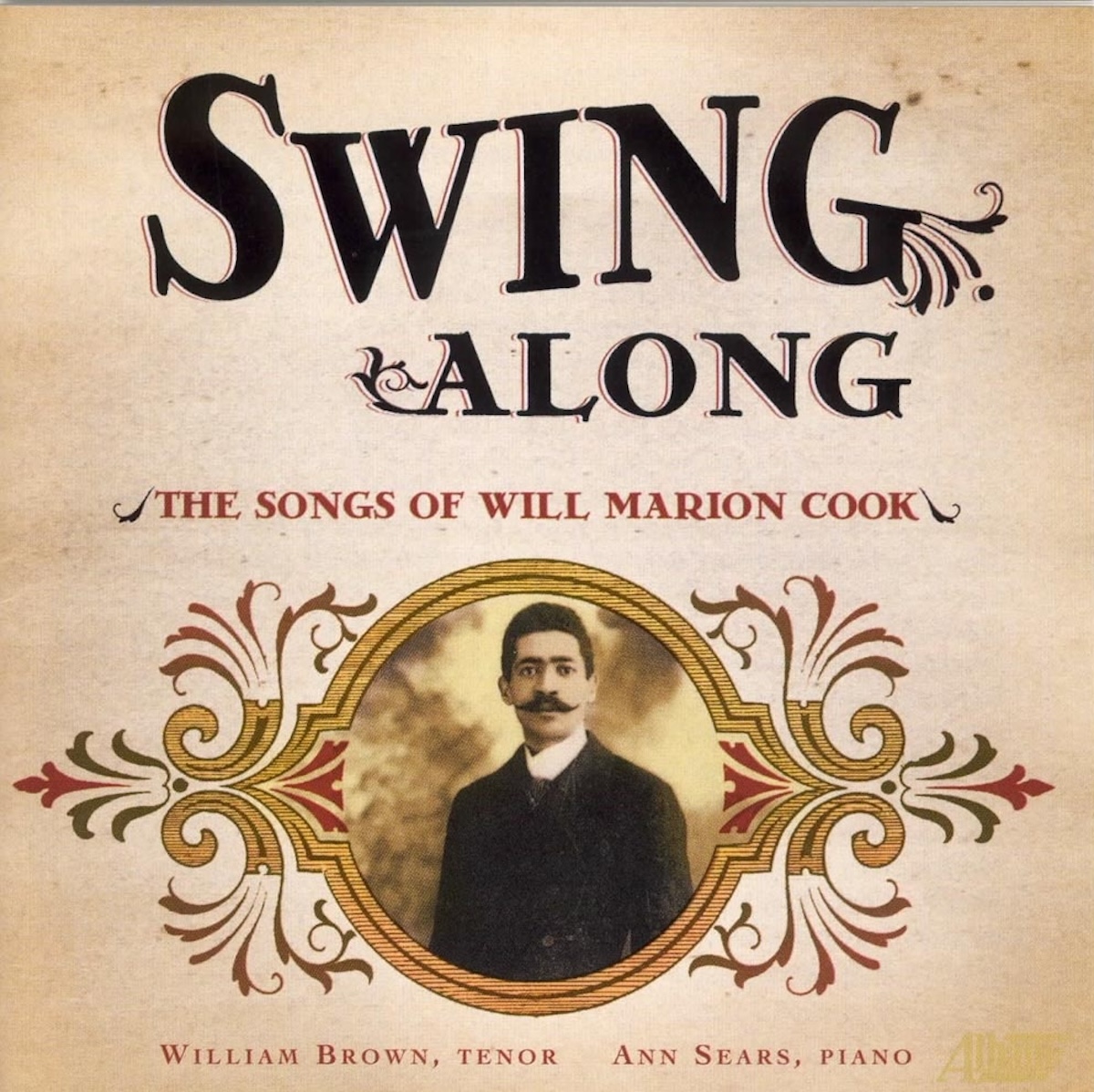
Cook’s life also tells a distinctly American story about talent under constraint. Born in Washington, D.C., in 1869, just after the Civil War, he came out of a Black professional family that believed in education, aspiration, and discipline. His father, John Hartwell Cook, was part of the first class at Howard University Law School and later became its first dean. After his father’s death, Cook’s life became less stable, and as a boy he spent time in Chattanooga with his grandfather, where he encountered Black folk music in a direct and durable way. He began violin study young, attended Oberlin, and then, with help from a fundraising effort supported by Frederick Douglass, studied in Berlin at the Hochschule für Musik. Later he studied at the National Conservatory in New York, where Antonín Dvořák taught. That pedigree alone should have positioned him for a major classical career. In another country, or perhaps in a less racist version of this one, it might have. Instead, as the Library of Congress notes plainly, his classical career “went nowhere,” and private teaching became one of the few viable routes open to him.
Reinvention Under Constraint
That disappointment is central to understanding Cook. It would be tempting to write the familiar story here: a Black artist excluded from one realm, then “discovering” his true voice in another. But that version would be too clean, and Cook’s life was not clean. He did not simply pivot from classical music to popular music because he found the latter more authentic or more profitable. He was pushed, blocked, redirected, and enraged by the color line. The Guardian, in reflecting on the longer history of American music after Dvořák, argued that figures such as Cook were among those who might have forged a different American modernist tradition had they not been barred from so many conservatories and concert halls; instead, they brought their classical training into the vernacular forms that became central to jazz and other popular idioms. That is not a consolation prize. It is a description of structural theft and artistic transformation happening at the same time.
Cook’s early ambitions had the scale of opera and concert music. One of his first major compositions was Scenes from the Opera of Uncle Tom’s Cabin, intended for the 1893 Chicago World’s Fair but never performed. Even that unrealized project says something about his imagination. He was not thinking small. He was thinking theatrically, structurally, and nationally. When his route into the formal concert world narrowed, he did not reduce his ambitions. He transferred them. The result was not retreat. It was reinvention.
Broadway Breakthrough: “Clorindy” and the Sound of Arrival
That reinvention came into focus in the late 1890s, especially through his collaboration with the poet Paul Laurence Dunbar. Together they made work that now reads less like a detour and more like a blueprint. The Smithsonian has argued that the collaborations of Dunbar and Cook produced some of the first examples of contemporary musical theater. That is a provocative claim, but not an unreasonable one. Cook understood how to use chorus, harmonic density, stage energy, and Black idiom in ways that moved beyond minstrel inheritance even while having to work inside a culture still distorted by minstrelsy’s expectations. He was not creating in a free field. He was creating in a field crowded with caricature, commercial pressure, and white appetite. That he could build new forms there at all is part of what makes him historically consequential.
The breakout moment came with Clorindy, or The Origin of the Cakewalk in 1898. The details around that opening have become part of Black theater lore. According to the Library of Congress, Cook managed to get the show staged as an extended afterpiece at the Casino Roof Garden on Broadway. The audience was initially sparse, but the choral sound reportedly drew people upward from the main show downstairs. By the end of the opening chorus, the roof was packed, and the company received a ten-minute ovation. Smithsonian preserved Cook’s own memory of that moment: he recalled feeling so exhilarated that he “drank a glass of water, thought it wine and got glorious drunk,” because “Negroes at last were on Broadway, and there to stay.” The line matters because it captures both triumph and prophecy. Cook understood that a door had opened, but he also knew doors in America do not stay open by sentiment alone. They stay open because someone keeps forcing them.
Clorindy has sometimes been overshadowed by later productions, but it deserves more attention than it usually gets. It was not simply a successful Black show; it was an announcement that Black musical sophistication could not be contained by the industry’s condescension. Cook’s score drew on syncopation, choral writing, and theatrical momentum in ways that pointed toward a new American synthesis. He was already doing what later histories would celebrate in others: taking formal training and applying it to Black performance traditions without flattening either one. The cakewalk itself, often trivialized in popular memory, carried layers of satire and social inversion, and Cook’s treatment of it was not accidental decoration. It was part of a broader effort to insist that Black social rhythm belonged at the center of the American stage.
Building a Black Theater Canon: In Dahomey and Beyond
The collaborations that followed with Bert Williams and George Walker pushed this further. Cook became musical director for a run of pioneering productions including The Sons of Ham, In Dahomey, Abyssinia, and Bandana Land. Of those, In Dahomey remains the landmark most often attached to his name, and with good reason. The Library of Congress describes it as the first musical composed and performed entirely by African Americans in a major Broadway theater. Other sources phrase the milestone slightly differently, emphasizing full length or legitimate Broadway staging, but the consensus is clear: In Dahomey was a turning point in American theater history. It opened in 1903, with music by Cook, book by Jesse A. Shipp, and lyrics by Dunbar, and it went on to tour in the United States and the United Kingdom.
What made In Dahomey so important was not only that it existed, but that it was expansive, exportable, and professionally undeniable. This was not a novelty sketch or a marginal entertainment tucked away from the theatrical mainstream. It was ambitious commercial theater made by Black artists, starring Black performers, and carrying Black musical intelligence into elite and popular spaces that had long profited from imitation while denying authorship. The production’s success abroad matters too. Black American performance was being consumed internationally already, often through distorted forms. Cook and his collaborators altered that exchange by carrying a more authored version of Black theatrical modernity across the Atlantic.
With In Dahomey, Cook helped make Black musical theater legible to Broadway not as imitation, but as authorship.
Still, Cook’s story is not one of uncomplicated ascent. He worked in an era when Black performers and composers often had to navigate demeaning material to secure institutional visibility. Dunbar’s lyrics for Clorindy, the Library of Congress notes, were written in dialect style, perhaps at Cook’s insistence. That point can unsettle contemporary readers, and it should. Any serious account of Cook has to hold two truths at once: he was a brilliant architect of Black theatrical advancement, and he sometimes worked through forms that were shaped by racist expectations. But that contradiction belongs not only to Cook. It belongs to American entertainment itself. The early Black musical stage was built in hostile conditions. It often had to speak in compromised dialects while smuggling in new harmonies, new forms of ensemble singing, new choreographic energy, and new models of Black professional collaboration. Cook was a master smuggler of seriousness into spaces that expected only stereotype.
Syncopation, Chorus, and the Architecture of Sound
His life offstage complicates the picture further. In 1898 he married the young singer Abbie Mitchell, who had been discovered singing as a girl and cast in Clorindy. She later appeared in several of his productions, including Jes Lak White Fo’ks and The Southerners, and became an important artist in her own right. Their son, Will Mercer Cook, would go on to become a scholar and diplomat. Sources on the marriage suggest both turbulence and enduring closeness. It would be easy to reduce this part of Cook’s life to anecdote, but it reveals something larger about the networks of Black cultural production at the turn of the century: families, touring companies, artistic mentorship, and professional survival were tightly braided together. In many cases, Black performance history moved not through stable institutions but through households, road companies, classrooms, and informal circles of training. Cook was at the center of many of those circles.
One of the most revealing aspects of Cook’s career is how much of it revolved around chorus and ensemble work. The Library of Congress notes that many of his theater pieces were scored for chorus and that collections such as Three Negro Songs became popular with community choirs in the early twentieth century. That is easy to glide past, but it matters. Cook was not merely a tunesmith. He was an architect of sound in groups. He understood the dramatic and emotional power of many voices working together, and he knew how to arrange for that power without sacrificing rhythmic life. In that sense, he belongs to the lineage not only of Broadway composers but also of Black choral builders and later jazz orchestrators. He thought in textures, in sections, in conversation between solo and group.
That same sensibility carried into his work as a conductor. He joined the Clef Club world orbiting James Reese Europe and served as chorus master and assistant conductor of the Clef Club Orchestra. In 1912, a historic Carnegie Hall concert featured his 150-voice chorus performing Swing Along! Later, in 1918, he founded the New York Syncopated Orchestra, later known as the Southern Syncopated Orchestra, which toured in the United States and Europe. Oxford’s account of the ensemble notes that much of the orchestra’s music was written and arranged by Cook and that the group, amid the instability of touring, underwent name changes and internal turmoil. The Guardian, writing about the long roots of the jazz orchestra, places Cook’s syncopated ensembles among the first iterations of the big-band idea. That framing is useful because it helps pull Cook out of the overly narrow box of “early Black musical theater” and puts him where he also belongs: in the prehistory of large-ensemble jazz.
The Southern Syncopated Orchestra deserves its own paragraph because it shows Cook operating at full historical voltage. This was not merely a band; it was a vehicle for transatlantic circulation. The ensemble included important players, among them Sidney Bechet, and helped bring Black American syncopated music to European audiences in a form closer to its creators than to imported stereotype. Marva Griffin Carter’s work on Cook, as summarized in search results, argues that he helped pave the path for orchestral concert jazz, and that seems right. He was not simply presenting ragtime as novelty. He was staging Black orchestral possibility. He was asking audiences to hear syncopation as structure, not trick.
This is also where Cook’s relationship to jazz becomes especially interesting. He is frequently described as “pre-jazz,” and chronologically that makes sense. But aesthetically the phrase can undersell him. Cook did not just precede jazz; he helped create the conditions in which jazz could emerge as a serious large-scale language. His use of improvisatory energy, ensemble color, and classical complexity inside Black vernacular forms anticipated key features of later jazz practice. The Library of Congress goes so far as to suggest that his work may have paved the way for the marriage of popular spirit and classical complexity that became jazz. That is a strong claim, but it is not hyperbole. Once you understand Cook as someone translating formal discipline into Black modern sound, his influence becomes easier to hear even when the recordings are scarce and the mainstream histories are thin.
Cook’s greatest achievement may be that he treated Black musical vernacular as worthy of formal ambition before much of America knew how to hear that ambition.
If Cook had done only that, he would deserve a larger place in American memory. But he also taught. He mentored. He shaped younger artists. The Library of Congress identifies Duke Ellington and Eva Jessye among those he influenced. The National Register documentation for Cook’s Harlem house says he encouraged the careers of figures including Eubie Blake, Sidney Bechet, Josephine Baker, and Ellington, and records Ellington’s famous description of him as “the master of all masters of our people.” Ellington also preserved a piece of advice from Cook that now reads like an artistic manifesto: first find the logical way, then avoid it, and let the inner self break through. There is something almost modernist in that instruction—anti-formula, anti-imitation, insistent on personality. But it is also deeply Black in its refusal of deference. Be yourself, Cook told Ellington, not as therapeutic cliché but as compositional discipline.
That advice helps explain why Cook matters beyond the footnote level. He was not only a precursor; he was a transmitter. He carried a set of musical values from one era to the next. Through him, the world of Dvořák, concert rigor, Black folk memory, Broadway experiment, and syncopated ensemble practice all touched the generation that would define twentieth-century American music more visibly. When later audiences celebrate Ellington’s orchestral imagination, or the way jazz fused popular pulse with compositional intelligence, they are often celebrating a horizon that Cook helped build. The line is not singular and not exclusive, but it is real.
Legacy, Memory, and the Architecture of American Sound
There is, of course, a question that hovers over any figure like Cook: why is he not more famous? Part of the answer is archival. Much early Black performance history is fragmentary, underpreserved, or mediated through institutions that did not value Black creators equally. Part of the answer is genre hierarchy. Artists who lived between categories often get remembered less than those who symbolize a category cleanly. Cook was too theatrical for some classical histories, too classically trained for simplified popular histories, too early for jazz canons, and too complicated for easy hero-making. Part of the answer is also racism in historical memory itself. America has a long habit of celebrating the finished form while forgetting the Black architects who built its frame.
Yet his afterlife has not been nonexistent. His house on West 138th Street in Harlem, where he lived from 1918 until his death in 1944, was declared a National Historic Landmark. The National Register paperwork emphasizes both his own accomplishments and the breadth of his influence on later musicians. That residence in Strivers’ Row is more than a preservation site. It is evidence that Cook belonged not only to the stage but to the making of Harlem as a cultural geography. Before “Harlem Renaissance” hardened into textbook phrase, Cook was already part of the social and artistic fabric that made Harlem legible as a capital of Black creativity.
His death in 1944 closed a life that had stretched from Reconstruction into the swing era. Think about that span for a minute. Cook was born only a few years after emancipation and died after jazz had transformed global culture. He lived long enough to see some of the world he helped create become thinkable, marketable, even celebrated—though not always with his name attached. That timing matters. It means Cook’s life can be read as a hinge across several Black cultural epochs: post-Civil War aspiration, late nineteenth-century concert ambition, the rise of Black musical theater, the emergence of syncopated large ensembles, and the early maturation of jazz modernity. Few figures sit at that many crossroads.
And so the real significance of William Marion Cook may lie in how hard he makes it to tell a lazy story about American music. He is a problem for any narrative that wants Broadway to have emerged without Black innovation. He is a problem for any narrative that treats jazz as spontaneous magic without lineage, discipline, or theatrical ancestry. He is a problem for any narrative that imagines Black composers as operating only in “folk” space while white composers held the keys to formal development. Cook knew European tradition, Black folk inheritance, theatrical commerce, and ensemble craft. He moved among them with difficulty, impatience, and brilliance. He was not a symbol of purity. He was a symbol of pressure. What happens when a musician of genuine range is forced to invent around the boundaries of race? In Cook’s case, what happens is that a country starts to sound more like itself.
There is also something instructive in Cook’s temperament. Sources repeatedly describe him as uncompromising, difficult, temperamental, respected. Too often, those terms get softened when attached to artists we want to canonize politely. But maybe politeness is the wrong lens. Cook lived in a society determined to limit Black ambition while consuming Black creativity. It would have been stranger if he had been mild about that arrangement. His refusal to smooth himself into acceptability may be part of why younger artists took him seriously. A mentor who tells you not to choose the logical path is unlikely to be a man of small submission.
For contemporary readers, Cook also offers a corrective to the way we sometimes discuss innovation. We tend to reward the person who appears at the moment a form becomes fully visible. But forms do not arrive all at once. They are assembled by people who work in partial recognition, compromised conditions, and unstable institutions. Cook was one of those assemblers. He did not live to enjoy the level of canonical security accorded to some of the people who followed him. But the trail from Dvořák’s American experiment to Ellington’s orchestral sovereignty runs through him. So does the trail from minstrel-corrupted stage convention to Black-authored Broadway muscle. So does the trail from chorus-rich Black performance tradition to the larger logic of the jazz orchestra.
In the end, perhaps the cleanest way to describe Cook is the way history often describes people who were everywhere before they were remembered anywhere: he was foundational. Not singular. Not solitary. But foundational. He belonged to a generation of Black artists who had to create not just work, but context for the work—audiences for it, venues for it, collaborators around it, and younger artists beyond it. He helped make Black musical theater legible as serious achievement. He carried classical discipline into vernacular innovation. He mentored figures who would become titanic. And he leaves behind a body of evidence, scattered but unmistakable, that American music did not become American by accident. It became American because artists like Will Marion Cook kept insisting that Black sound, Black structure, Black wit, and Black ambition were not supplements to the culture. They were the culture.
That is why Cook deserves more than occasional revival and specialty scholarship. He deserves placement in the main line of the story. Not as a courtesy inclusion. Not as a “forgotten pioneer” wheeled out for commemorative months and then returned to the margins. He deserves to be understood as one of the people who changed the terms of American listening. When Duke Ellington called him “the master of all masters of our people,” that was not just filial praise. It was lineage speaking clearly.
More great stories
He Painted What History Likes to Lose
March 27, 2026
No Comments
When Reading Became Civil Disobedience
March 27, 2026
No Comments