





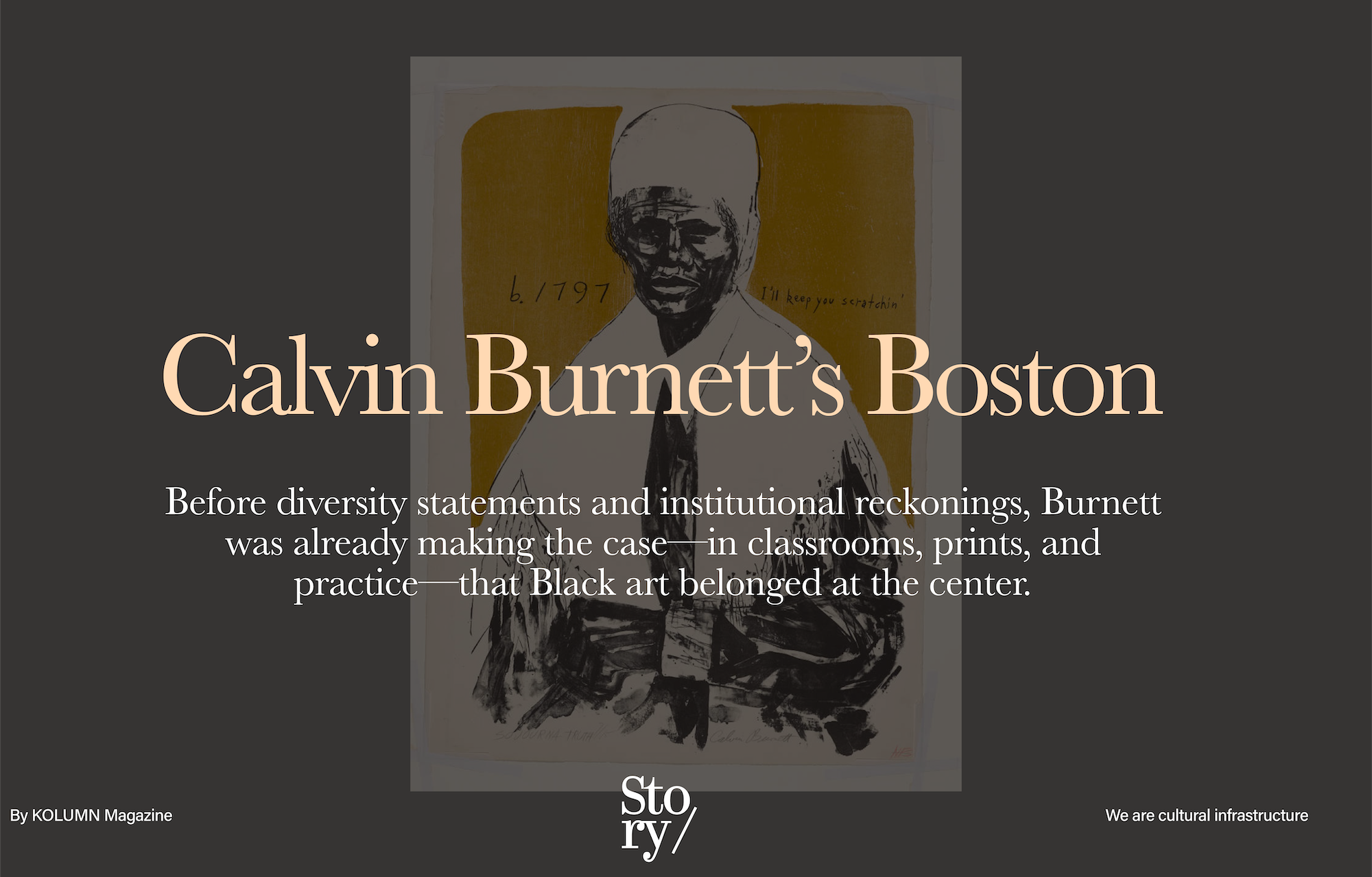
For Burnett, art was not a single lane. It was a field of possibility.
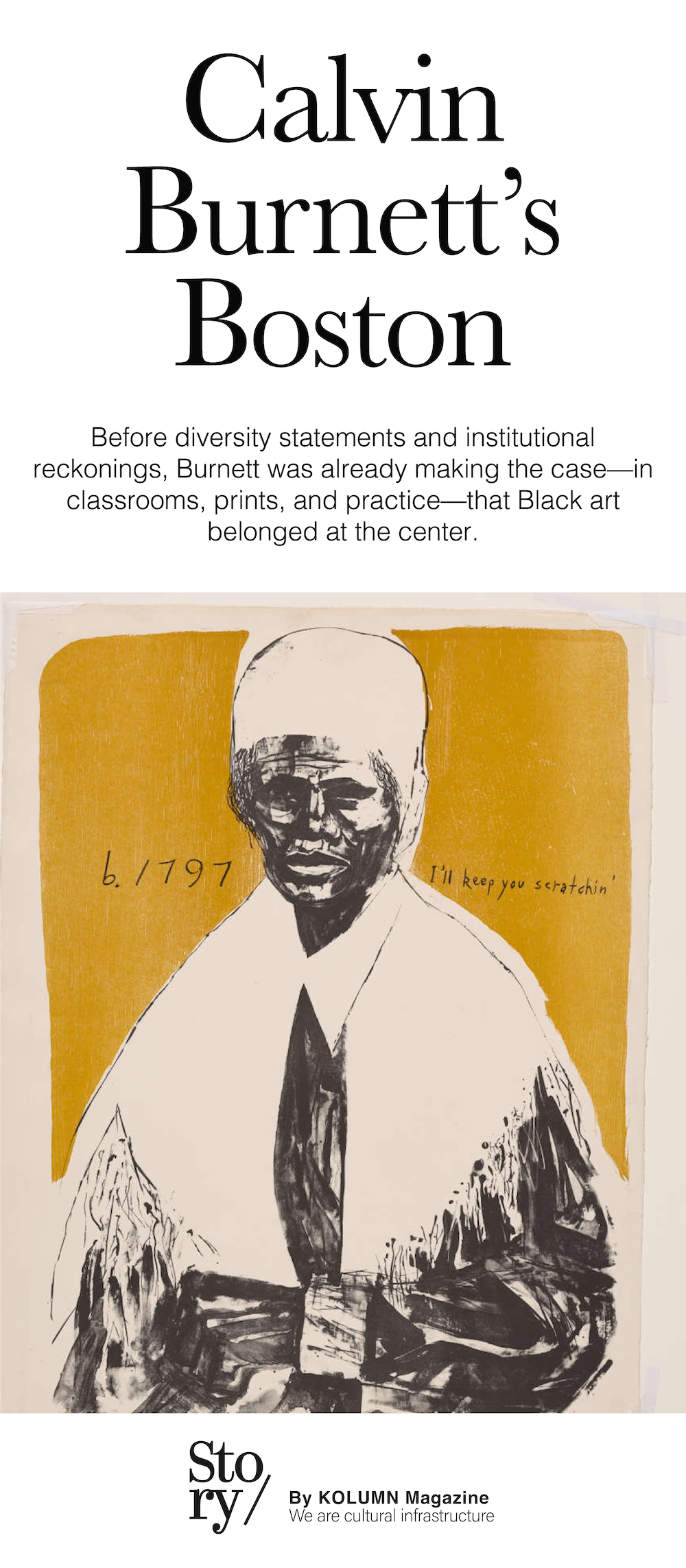
For Burnett, art was not a single lane. It was a field of possibility.
By KOLUMN Magazine
Calvin Burnett does not occupy the same immediate place in public memory as some of the better-known Black artists of the 20th century. He is not invoked as reflexively as Jacob Lawrence or Romare Bearden, nor has he been as fully institutionalized in the mainstream art canon. But that gap between significance and recognition is precisely what makes Burnett so compelling. He was the kind of artist whose career tells you as much about American culture’s blind spots as it does about artistic excellence. He was an illustrator, printmaker, painter, designer, and teacher. He worked in Boston, taught for decades, exhibited widely, published an influential drawing book, helped advocate for Black students and Black faculty, and left behind an archive that suggests both breadth and depth. Yet even now, his name still too often arrives as a discovery instead of a foundation.
That should change. Burnett’s life offers a way to think about Black artistic labor outside the usual shorthand. He was not only a maker of images, but a builder of artistic conditions. He was not only an illustrator, but part of a generation of Black artists who refused the hierarchy that tried to rank “fine art” above design, teaching, or commercial practice. And he was not only a professor, but an educator whose philosophy centered experimentation, confidence, and individuality. In an art world that often demanded narrow specialization, Burnett made multiplicity look principled.
That refusal to be reduced may be the key to understanding him. In his 1980–81 oral history for the Smithsonian’s Archives of American Art, Burnett spoke with unusual candor about race, art school, commercial art, teaching, and artistic freedom. The transcript is invaluable because it reveals a figure who was analytically sharp, dryly funny, politically alert, and uninterested in simplistic binaries. Burnett did not talk like someone chasing posterity. He talked like someone who had spent a lifetime doing the work and had reached a point where he could name the contradictions plainly.
A Cambridge childhood shaped by precarity and encouragement
Calvin W. Burnett was born in Cambridge, Massachusetts, on July 18, 1921. He grew up during the Great Depression in a family that had education and professional standing, but not the kind of financial cushion those things are often assumed to provide. His father was a physician, yet the family still felt economic instability so acutely that, as Burnett later recalled, some patients paid in food rather than cash. That detail matters because it complicates any easy reading of middle-class Black stability in the early 20th century. Respectability did not guarantee security.
What Burnett did have, though, was a household that treated artistic interest as real. In the Smithsonian interview, he remembered his father drawing a bit and his mother painting an apple so convincingly that it seemed almost miraculous to him as a child. He also remembered sitting around copying comic strips—Mickey Mouse and other newspaper images—and, crucially, being given a dedicated space to do it. His father even bought him an ink holder he treasured for the rest of his life. These are small domestic details, but they point to something larger: Burnett’s artistry was not an accident of talent alone. It was talent noticed, tolerated, and gently supported.
He attended Cambridge High and Latin School and, by his own telling, was not especially fond of conventional schooling. What he did know was that he could draw. He had enough self-knowledge to understand that art was not a hobby he might set aside later; it was the thing he wanted to organize his life around. Burnett recalled that his father had wanted him to go to Harvard for a liberal arts education, but he chose art school instead. He later described that choice not as rebellion for its own sake, but as an instinctive move toward the environment where he could actually flourish. Once he arrived in art school, he said, he liked learning in a way he never had before.
That may sound obvious now, but it was not trivial then. For a Black student in the late 1930s and early 1940s, choosing a life in the arts was hardly the safest route, especially in a field where access, patronage, and institutional acceptance were constrained by race and class. Burnett’s decision was a gamble on vocation. The fact that he made it so early, and stayed with it so completely, tells you something about both his confidence and his stubbornness.
Art school, isolation, and the racial quiet of the era
Burnett graduated from the Massachusetts School of Art in 1942, later earned another degree in arts education, and received his M.F.A. from Boston University in 1960. Those milestones matter on paper, but the oral history gives them texture. He explained that there were essentially no Black faculty members and almost no Black students in the art school environment he entered. Every few years, maybe one or two Black students passed through. That scarcity shaped the social climate in a complicated way. Burnett said he had felt racial pressure more distinctly in high school, where there were enough Black students to be separated and categorized. At art school, he was often simply the only one.
Burnett understood that silence about race was not the same thing as equality.
His description of that period is striking for its ambivalence. On one hand, he said, his peers treated him like anyone else, and the era’s etiquette was to avoid naming racial difference directly. On the other hand, he later recognized the costs of that silence. He said it was actually a relief when the civil rights era and Black Power made race speakable in more direct terms. Liberal politeness, in his telling, could be a kind of erasure. Burnett was perceptive about the emotional architecture of midcentury liberalism: it could accommodate Black presence without honestly confronting Black experience.
This is one reason Burnett’s legacy matters now. He offers a deeply useful account of what it meant to move through white cultural institutions before “inclusion” became official language. He did not romanticize those spaces. He also did not flatten them into caricature. He understood that one could be accepted in a limited sense and still be unseen. That subtlety is part of what makes his reflections so contemporary. He had already lived the contradiction that many institutions are only recently willing to describe.
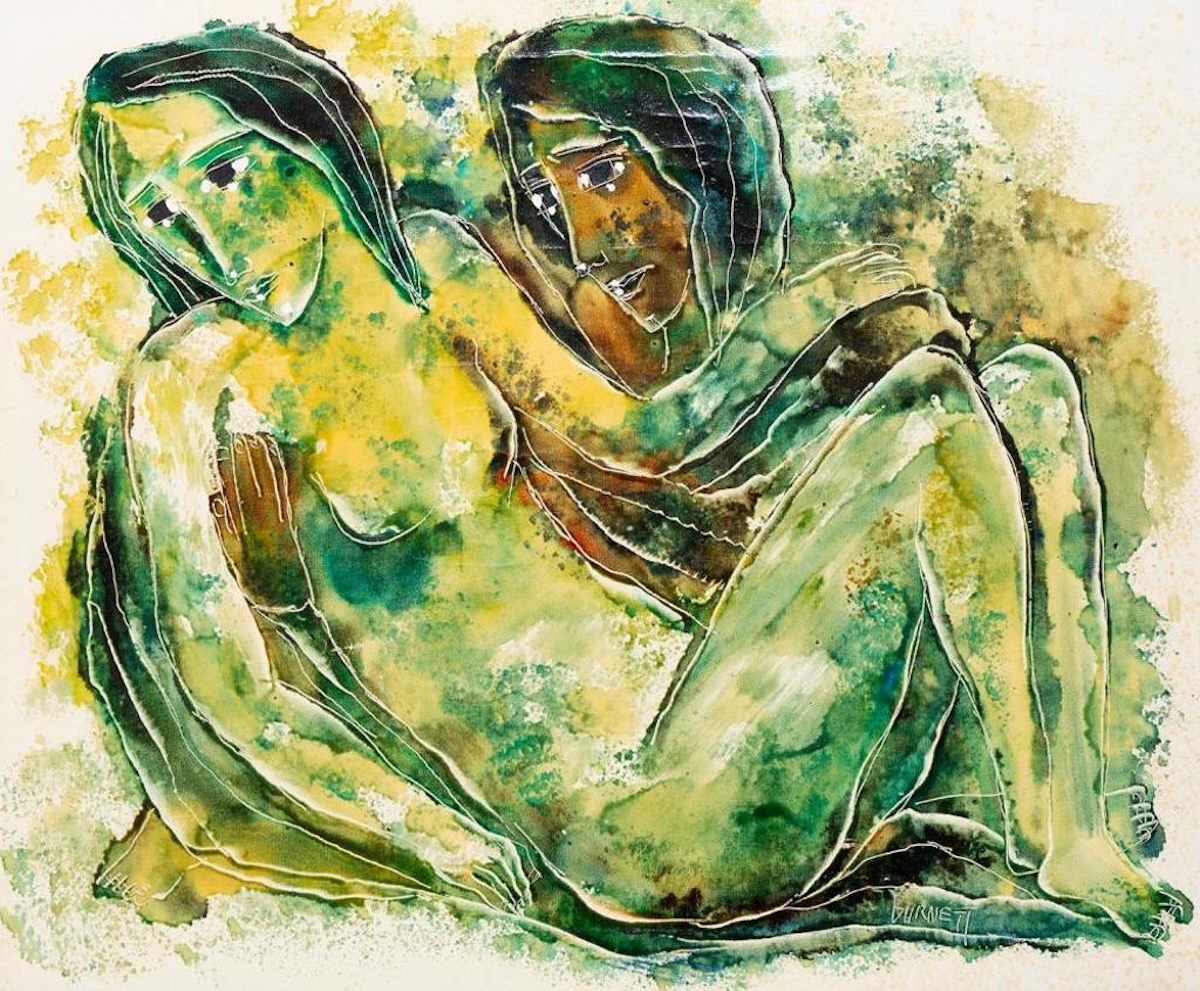
War years, freelance hustle, and the refusal to rank art forms
World War II altered the trajectory of many American artists, and Burnett was no exception. Because of poor eyesight, he did not serve in the military; instead, he worked in a shipyard during the war. The Cambridge Black History Project notes that he worked in a shipyard because his eyesight kept him out of service, and Burnett himself later described the work as grueling and uninspiring. Yet even then, he continued drawing and painting whenever possible. He also used the wartime period to save money, which later gave him a buffer as he pieced together an artistic life.
After the war, Burnett returned immediately to art. He took evening courses at the Boston Museum School, built a freelance practice, and carried a portfolio around looking for sign-painting, silkscreen, and illustration jobs. He specifically mentioned taking small jobs with D.C. Heath and doing the kind of practical visual labor that art history narratives often treat as secondary. Burnett did not. He was adamant that commercial art and fine art were not moral opposites. In the oral history, he flatly rejected the notion that an artist somehow diminished themself by doing paid, applied work for others. A person, he argued, could do both.
That position was not merely personal preference. It was philosophical. Burnett had lived in the overlap between disciplines, and he resented the snobbery that tried to isolate “serious” art from design, advertising, or illustration. He described debates in the Boston art world where people clung to what he considered absurd distinctions, and he made clear that he found the whole hierarchy provincial. His view now feels prescient. Contemporary art schools routinely celebrate interdisciplinarity; Burnett was defending it decades earlier, when doing so still meant pushing against inherited class assumptions about labor, purity, and prestige.
It is also part of why the label “illustrator” should not be understood narrowly in his case. Burnett was an illustrator, yes, but not in a minor key. He belonged to that rich Black lineage in which illustration, printmaking, painting, and pedagogy were porous rather than separate categories. He made images for books and commercial contexts, but he also exhibited, experimented, and pushed form. His career disrupts the habit of talking about Black illustrators only in terms of service work or visual accompaniment. He was constructing an aesthetic life, not moonlighting in one.
An early career built in Boston, but never confined by it
By the mid-1940s, Burnett had begun to show his work publicly. In the oral history, he recalled exhibiting with Boris Mirski Gallery in 1946 and being written up in local papers that same year. He also spoke about sketching servicemen at hospitals and at the USO on Dudley Street, making portraits for them and then reworking those sketches into larger drawings for himself. That practice—part document, part gift, part artistic source material—captures a great deal about Burnett. He was observant, socially grounded, and always turning encounter into image.
He rejected the old hierarchy that placed “fine art” above illustration, design, or teaching.
He exhibited at respected venues in the 1940s and 1950s, including the Addison Gallery and the Institute of Contemporary Art, according to the oral history and later biographical records. The National Gallery of Art now holds Burnett’s Boats (1942), Still Life (1942), and Waiting (1955), while the Brooklyn Museum lists Tavern in its collection. Those holdings help demonstrate that his work was neither marginal in quality nor invisible in circulation. He was making strong work early, and institutions noticed.
Yet Burnett’s recognition seems to have remained uneven, especially when measured against his output and influence. That unevenness was not unusual for Black artists working in Boston or nationally. One of the more telling contemporary references comes from the Museum of Fine Arts, Boston, where Dana Chandler Jr., reflecting on institutional exclusion, named Burnett among the Black artists whose work he had expected to see but did not. The remark was not about Burnett alone, but it helps place him in a familiar pattern: respected by peers, visible in some circles, insufficiently collected or centered by major institutions during the years when canon formation was happening in real time.
Bryan Marquard’s 2007 obituary in The Boston Globe, preserved in reposted form, captured something essential about Burnett’s visual sensibility. Critic Robert Taylor had once described Burnett’s best works as the “visual equivalent” of Billie Holiday or Bessie Smith. That comparison is vivid because it suggests emotional tonality more than style: sorrow, depth, survival, compression. Burnett’s line could be angular and inward, his compositions moody without becoming inert. Even in brief descriptions, one gets the sense of an artist attentive to psychological weather as much as formal arrangement.
The teacher who thought art education should open doors
If Burnett had only been a working artist, his career would still merit closer attention. But teaching is central to his significance. He taught at the Massachusetts College of Art for 33 years, retiring in 1985, and the Smithsonian finding aid notes that he was the first African American appointed to the faculty there. MassArt’s own remembrance likewise emphasizes that he returned to his alma mater and taught there for three decades. That alone makes him historically important: he was not simply present in the institution, he changed its history.
Burnett’s teaching philosophy deserves real attention because it was unusually coherent. He did not believe art instruction should produce obedient replicas of the teacher. In the oral history, he described what he called “discovery learning,” an approach grounded in experimentation, trial and error, and the development of a personal relationship to medium. He contrasted art with fields like engineering or medicine, where mistakes have catastrophic consequences. In art, he argued, you learn by trying, testing, selecting, and rejecting. The point is not to imitate authority; the point is to discover what your materials can do and what your own vision requires.
There is something deeply democratic in that view. Burnett said his role was to give students the confidence to do what they thought possible, rather than merely repeat what some authority had declared correct. Elsewhere in the transcript, he described teaching as “opening doors for people.” That phrase is compact enough to sound simple, but in context it reveals a teacher who had moved past the performance of mastery. He knew the difference between being able to do something and being able to teach someone else to do it. He had seen brilliant artists who were terrible teachers and understood that pedagogy was its own discipline.
Former student Judith Byron Schachner’s 2023 remembrance offers a useful glimpse of what that looked like in practice. She remembered Burnett as kind, encouraging, and passionate, and she credited one of his classroom presentations with helping set her on the path toward children’s book illustration. It is a brief account, but it confirms what the oral history suggests: Burnett did not teach defensively. He exposed students to possibilities. He treated a career in illustration not as a fallback but as a viable, exciting life. That matters, especially in institutions where commercial and narrative image-making have often been subtly devalued.
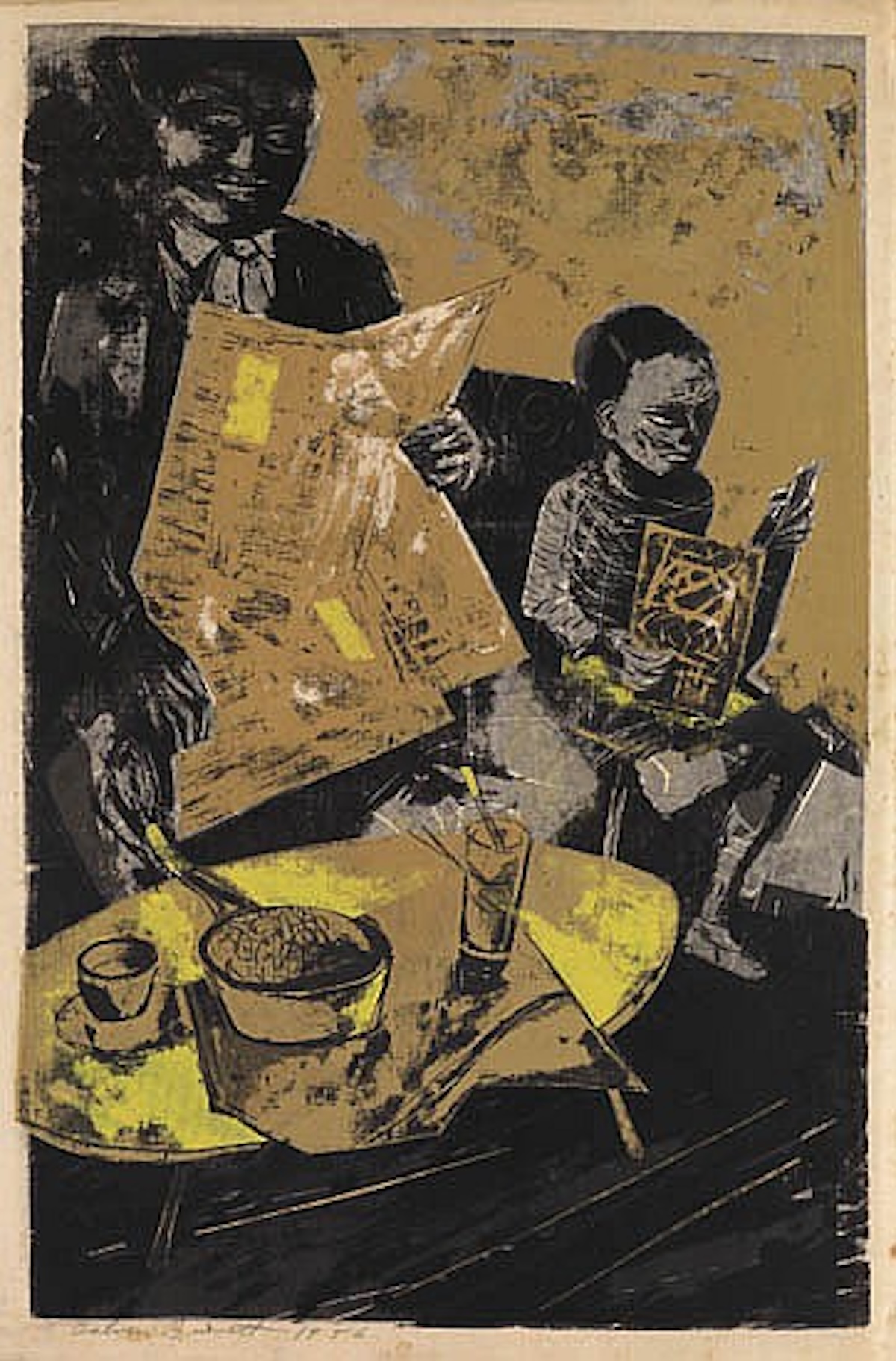
Printmaking, politics, and Black civic life
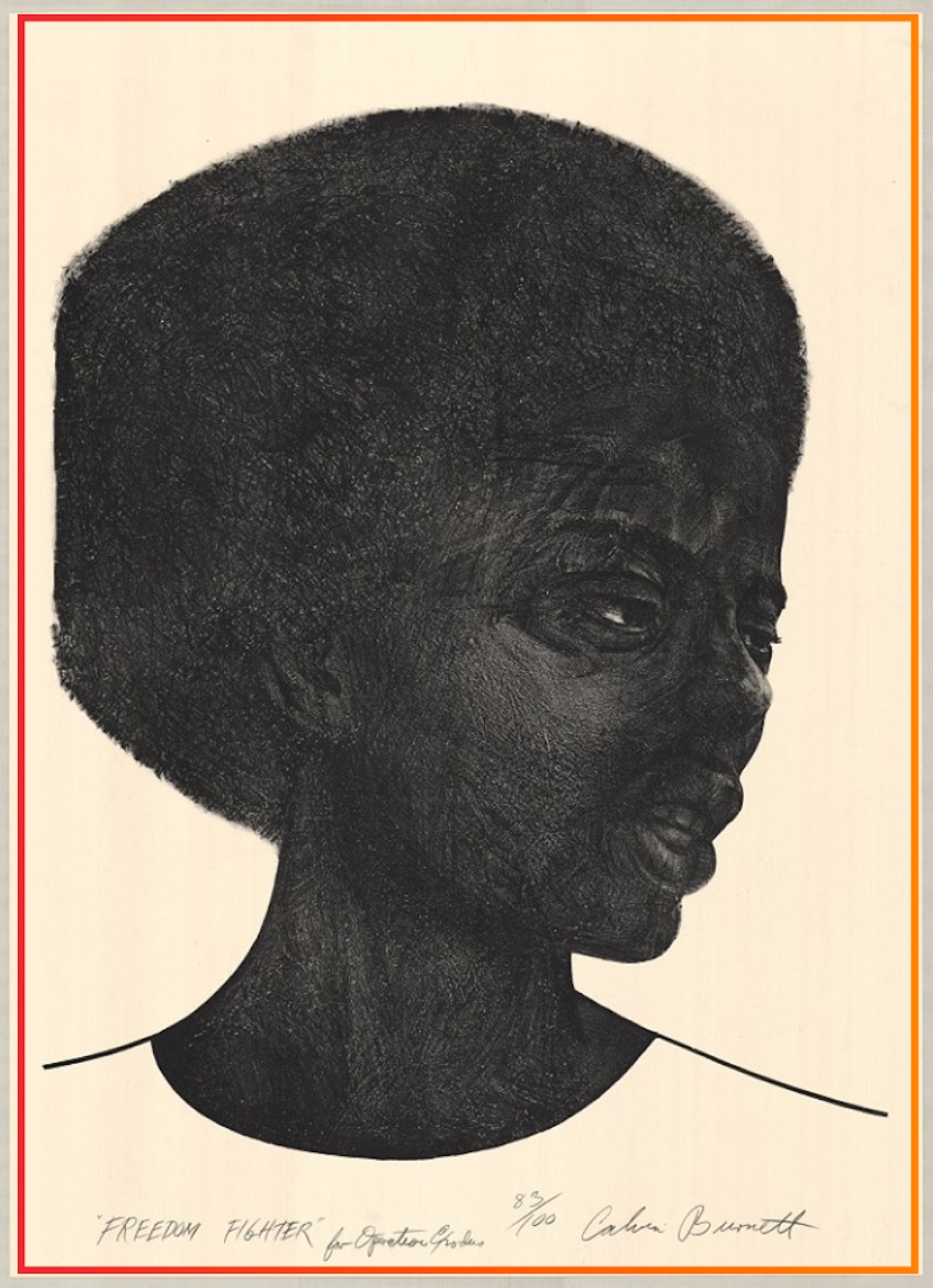
Burnett’s art was never detached from public life. One of the clearest examples is his 1969 lithograph Freedom Fighter for Operation Exodus, a work now in the Madison Museum of Contemporary Art and also cataloged by Syracuse University. The print refers to Operation Exodus, the parent-led Boston initiative that bused Black children from overcrowded, under-resourced neighborhoods to recently desegregated schools. The museum notes that Burnett made the work to raise funds for the program. This was not art floating above politics; it was art participating in Black civic struggle.
The image and its context also help connect Burnett’s practice to his work as an educator. The Cambridge Black History Project notes that he taught at the Elma Lewis School in Roxbury and suggests those early teaching experiences may have informed the print. Even without overstating causality, the through-line is clear: Burnett’s art, teaching, and political commitments fed one another. He was attentive to schooling not just as a profession but as a racial battleground. In Boston, that was never an abstract issue.
His archival record reinforces that point. The Smithsonian finding aid shows that while on the faculty at MassArt, Burnett was involved with the Black Artists Union, the Committee on Urban Education, and the Committee on Minority Affairs. Those groups pushed for more diverse faculty representation and more support for minority and disadvantaged students. That is the kind of labor institutions often benefit from without fully honoring: committee work, advocacy, the steady pressure required to make a school less hostile and more accountable. Burnett did that too.
In that sense, Burnett belongs in a broader history of Black artist-organizers who understood that representation is not only a matter of what appears on gallery walls. It is also about admissions, hiring, curriculum, funding, and who gets mentored into a future. The point was not simply to survive a white institution, but to alter it. Burnett’s papers suggest he was part of exactly that kind of work.
A restless maker, even late in life
One of the pleasures of reading Burnett’s oral history is realizing how little patience he had for stylistic confinement. He told the interviewer to look around the room and notice how different the works were from one another—and how much he loved that difference. His wife, Torrey Burnett, later said he enjoyed changing his style. That is not the most market-friendly trait for an artist; markets often prefer recognizable signatures and easily branded consistency. But it may be one of the reasons Burnett remained alive to experimentation across decades.
His work moved through drawings, paintings, prints, woodcuts, collage, and mixed-media constructions. In the oral history, he discussed using photographs, spray paint, collage, and structural alterations to reshape earlier works, including paintings connected to his M.F.A. period. He spoke about revising, overpainting, and discovering new directions through material chance. In one passage, he explains how receiving old stretched canvases from a deceased friend opened up an unexpected box-like, three-dimensional mode of working because he used the backs rather than painting over the fronts. That anecdote reveals a great deal: Burnett was not only versatile, he was opportunistic in the best sense, ready to let circumstance generate formal innovation.
It also speaks to a larger feature of Black artistic practice in the 20th century: improvisation as method. Not improvisation in the shallow sense of making do because resources are scarce, though scarcity was real. Improvisation in the richer sense of testing what form can become when rules loosen and available materials become prompts rather than limits. Burnett’s work seems to have emerged from exactly that spirit.
Why Calvin Burnett matters now
Burnett died on October 8, 2007, in Medway, Massachusetts, at age 86. Obituaries noted his wife Torrey, his daughter Tobey, his long teaching career, and the range of collections that held his work, including the Smithsonian, the Museum of Fine Arts, the Museum of African American History, and the Boston Public Library. They also noted that he authored Objective Drawing Techniques, a book used in many colleges. Those facts are substantial. But facts alone do not explain the larger significance of his life.
What makes Burnett enduring is the way his career sits at the intersection of several essential histories at once: Black Boston, American illustration, postwar printmaking, arts education, and institutional change. He is important not because he fits neatly into a single category, but because he doesn’t. His life argues against reduction. It argues that illustration can be intellectually serious, that teaching can be artistically generative, that committee work and public advocacy are part of cultural production, and that Black artists have long shaped institutions even when institutions failed to center them.
There is also something timely in Burnett’s skepticism toward purity. Contemporary art discourse is full of talk about hybridity, interdisciplinarity, and breaking boundaries. Burnett lived those ideas before they became fashionable institutional vocabulary. He had already fought the older war against the false distinction between commercial and fine art. He had already insisted that students needed confidence more than obedience. He had already understood that style could be plural, that Black political consciousness belonged inside the work, and that institutions needed structural change, not just symbolic appreciation.
That is why writing about Calvin Burnett now feels less like recovery than correction. He was there. He made the work. He taught the students. He joined the committees. He helped shape Boston’s artistic life for decades. The problem is not that his significance is hard to find. The problem is that American cultural memory has too often looked elsewhere first.
And maybe that is the final lesson. Burnett’s life does not ask to be romanticized. It asks to be read properly. He was a serious Black artist who worked across forms, took teaching seriously, refused hierarchy, and understood both the pleasures and the politics of making images. Once you see that clearly, he stops looking like a footnote. He starts looking like what he was: a major cultural worker whose lines continue outward through the students he taught, the institutions he pressed, and the images he left behind.
More great stories
Rosa Parks, After Montgomery
March 26, 2026
No Comments
The Quiet Force of Robert Parris Moses
March 25, 2026
No Comments