



“Palmer Hayden did not leave behind a comfortable legacy. He left behind a living one.”
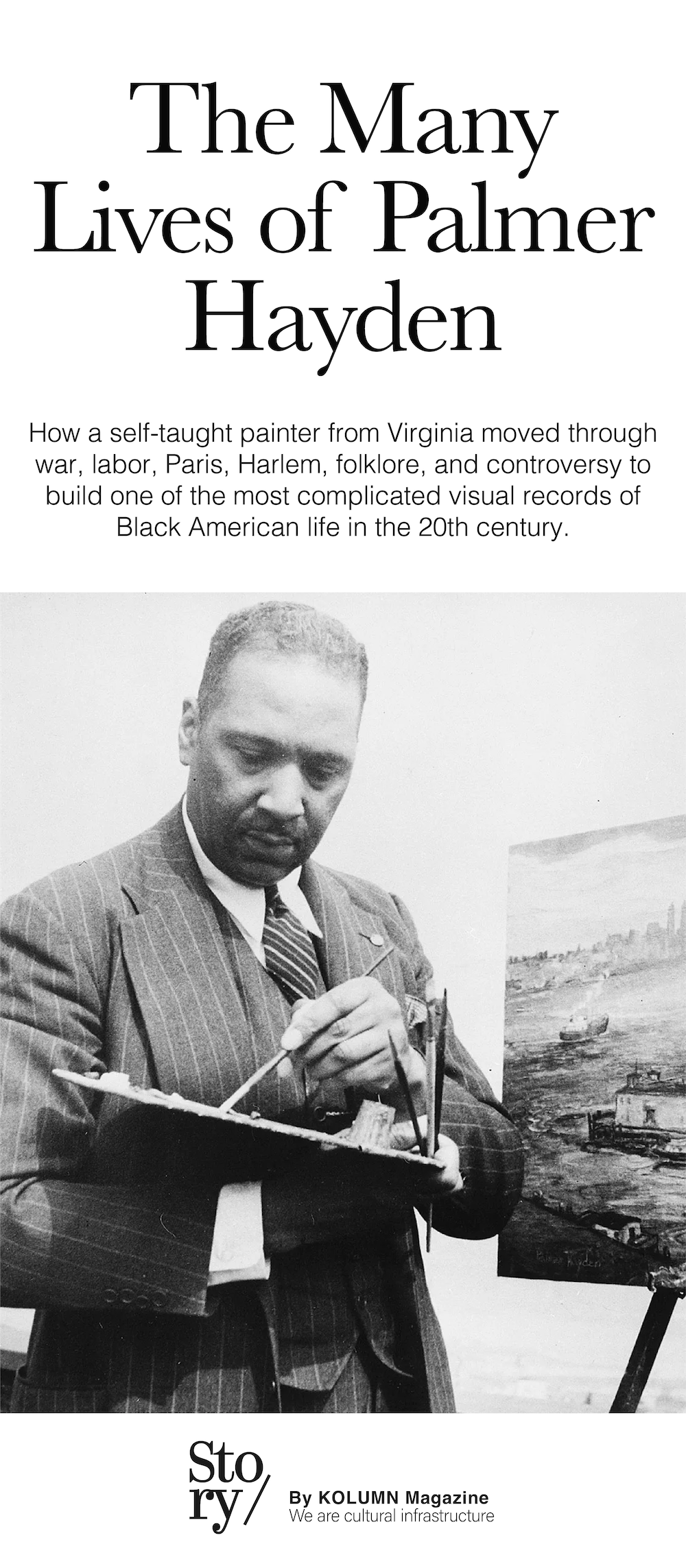
“Palmer Hayden did not leave behind a comfortable legacy. He left behind a living one.”
By KOLUMN Magazine
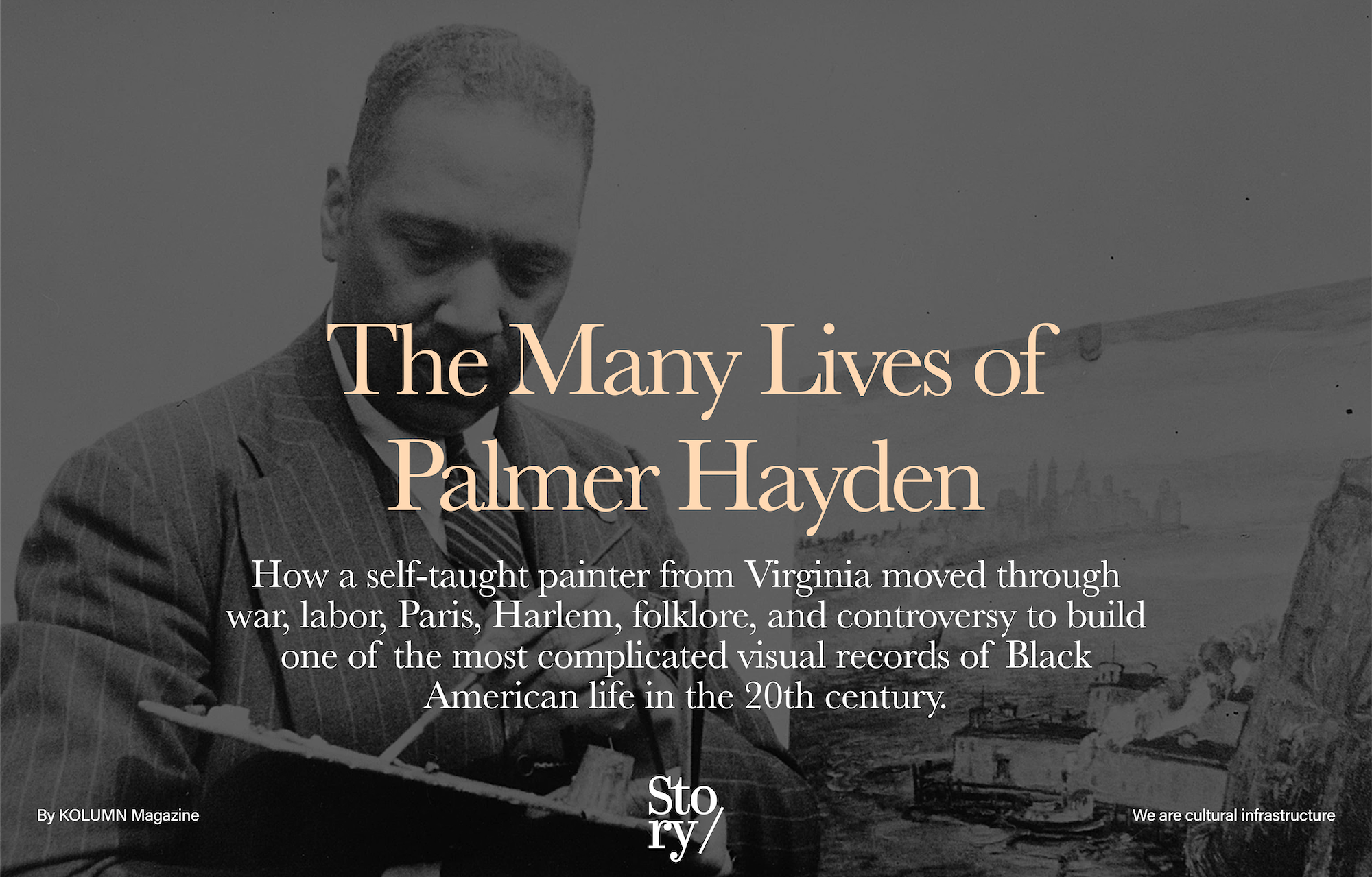
Palmer Hayden does not fit neatly into the version of American art history that prefers its artists easy to summarize. He is too restless for that, too wide-ranging, too full of formal detours and historical contradictions. He painted seascapes and city scenes, folklore and still lifes, intimate interiors and crowded public life. He worked through the Harlem Renaissance but never entirely resembled its most easily recognizable visual stars. He embraced scenes of Black daily life long before such work was properly valued by mainstream institutions, yet some of his best-known paintings still generate discomfort because of the exaggerated features and caricatural distortions he used. He was both inside the story and out on its edges. That tension is central to understanding him.
Born Peyton Cole Hedgeman in Widewater, Virginia, on January 15, 1890, Hayden later adopted the name Palmer Hayden, the name under which he built his career. His life moved through a series of American institutions and improvisations: rural Virginia, Washington labor, military service, Greenwich Village work, janitorial jobs, correspondence art study, New York art circles, Paris, Harlem, and finally the long arc of an artist trying to make a living while insisting that Black life in all its ordinariness and mythic scale belonged on canvas. Smithsonian’s American Art Museum describes his relationship to the Harlem Renaissance as “more spiritual than stylistic,” which is as good a place to begin as any. Hayden was part of that world, but he never seemed content to behave exactly as the market, the movement, or the critics expected.
“Palmer Hayden’s work matters now not because it is easy, but because it preserves the difficulty of Black self-representation in an era that demanded both visibility and performance.”
That refusal, or inability, to stay in one lane is one reason his significance has grown in recent years. As museums and critics revisit the Harlem Renaissance and widen the frame beyond a few canonical names, Hayden increasingly looks less like a minor side figure and more like a crucial, difficult witness. The Washington Post, writing about one of his Paris-period works, called attention to the artist’s search for simplicity and interiority, while more recent coverage of the Metropolitan Museum of Art’s major Harlem Renaissance exhibition pointed to the sophistication of works like Fétiche et Fleurs in complicating older assumptions about Black modernism. The Atlantic likewise situated Hayden within a larger, transatlantic modernist story that stretched far beyond Harlem nightlife and the cliché version of the era.
What makes Palmer Hayden enduring is not that every painting lands cleanly with contemporary viewers. It is almost the opposite. His work endures because it asks hard questions about representation, dignity, aspiration, labor, memory, and the visual language available to Black artists in the early 20th century. He painted joy and strain, movement and stillness, recognition and distortion. He painted people at work, people in rooms, people on stoops, people in legend. He painted Black life not as abstraction, but as atmosphere and argument.
A Virginia beginning, and an early education in improvisation
Hayden’s story begins in rural Virginia, but like many Black artists of his generation, his real education came through migration and adaptation. Smithsonian records note that he was born to Nancy and John Hedgeman in Widewater. He showed an early interest in drawing, though his ambitions were not initially fixed on painting alone. Accounts of his early life suggest a young man whose artistic interests developed in fragments, shaped as much by necessity as by formal instruction. The Archives of American Art record the basic outline: born in 1890, he later relocated, studied intermittently, and pieced together an artistic life under conditions that were financially unstable and socially constrained.
There is something important in that fragmented apprenticeship. Hayden was not produced by a single academy, a single patron, or a single stylistic school. He spent time in Washington, did manual and service work, and served in the military. By one widely cited account, he enrolled in a correspondence drawing course while serving at West Point with the 10th Cavalry, spending a large portion of his modest monthly pay on lessons. Even when the exact texture of those early years is reconstructed from archival notes and later biographical accounts, the pattern is clear: Hayden was investing in art while surviving inside labor systems that rarely imagined a Black working man as a serious painter.
That matters because labor never leaves his art. Even before you get to The Janitor Who Paints, perhaps the work most explicitly tied to the indignities of his day jobs, you can see Hayden’s sensitivity to the social status of his subjects. His paintings are full of workers, families, musicians, neighborhood gatherings, and folk heroes. He keeps returning to the question of what kinds of Black lives are considered worth recording. In that sense, his biography is not just background. It is a method.
When he arrived in New York, Hayden supported himself through a range of jobs, including janitorial work and postal work, while continuing his studies. He pursued charcoal drawing at Columbia and studied at Cooper Union after encouragement from artist and instructor Victor Perard, whose studio Hayden cleaned. That detail has the feel of American fable, but it is also a precise illustration of the racialized economics of artistic ambition. Hayden entered the art world through a service entrance. He cleaned the room before he could claim space inside it.
The Harmon Foundation and the strange gift of recognition
In 1926, Hayden won one of the earliest major recognitions of his career: a Harmon Foundation award for his painting Schooners. The Harmon Foundation, for all the paternalism embedded in its structure, played a major role in promoting Black artists during a period when mainstream institutions offered limited access and even less sustained support. Smithsonian and other biographical sources credit that award with helping launch Hayden’s professional career.
“For Hayden, success did not erase class or racial condescension. It merely changed the room in which he encountered it.”
But recognition came wrapped in insult. A frequently cited New York Times headline about the award emphasized Hayden’s race and his wage work, effectively framing him as a “Negro worker” who painted in his spare time rather than as a serious artist who happened to labor for survival. Even in victory, the social script insisted on condescension. What the coverage praised was not simply the art, but the spectacle of uplift: the hardworking Black laborer elevated, briefly, into culture. The achievement was real. So was the diminishment. This is one of the central Palmer Hayden stories: acclaim arriving through a frame that still shrank him.
Still, the award changed things. It brought money, visibility, and credibility. It also made Paris possible.
Paris, freedom, and the reshaping of a painter
Hayden went to Paris in 1927 and remained there, with travel beyond the city, until 1932. That period is indispensable to understanding his development. For many Black American artists and writers, Paris offered a different social atmosphere than the United States, not free of racism, but less tightly governed by the same codes of segregation and humiliation. The Atlantic recently underscored that broader point in revisiting the Harlem Renaissance as a movement larger than Harlem itself, noting Paris as a site of both training and liberation for Black American artists. Hayden belongs squarely in that transatlantic history.
In France, Hayden painted landscapes and marine scenes, including works associated with coastal towns like Concarneau. He visited museums, absorbed European painting, and engaged African art not just as a fashionable citation but as a serious aesthetic and cultural encounter. The Washington Post’s meditation on his Untitled (Dreamer) emphasized the inwardness of his Paris-period work, suggesting an artist using distance not simply to escape America, but to refine a visual language for thought, longing, and self-fashioning.
This Paris chapter is sometimes flattened into a familiar Harlem Renaissance template: Black artist goes to Europe, finds freedom, returns renewed. Hayden’s case is more interesting than that. He did not return as a polished apostle of one clean modernist style. He returned with a broadened vocabulary. His work could still be narrative and illustrative. It could still feel tied to folklore and popular image-making. But it also became more formally adventurous and symbolically layered. Fétiche et Fleurs, the still life that has drawn renewed attention in recent years, is a good example. The painting juxtaposes a bouquet with a Fang reliquary figure, bringing together European still-life convention and African sculptural presence in a way that resists easy categorization. Washington Post coverage of the Met’s Harlem Renaissance exhibition read the work as an allusion to the criticism Hayden faced from both Black and white viewers, while Artnet noted that the piece was acclaimed after his return from Paris.
That is part of Hayden’s importance. He was not simply painting Black subjects for a Black public. He was negotiating multiple art histories at once: American realism, European modernism, African visual influence, folk narrative, and the politics of racial representation in the interwar period. He was not always seamless in that negotiation. But he was rarely uninteresting.
Harlem as subject, stage, and social text
If Paris widened Hayden’s formal and cultural vocabulary, Harlem gave him one of his richest recurring subjects. His images of urban Black life do not rely solely on spectacle. Even when they are lively and crowded, they are attentive to the choreography of everyday existence: neighbors gathering outside on hot nights, musicians, couples, workers, and street-corner sociality. These are paintings that understand Harlem not merely as symbol, but as lived environment.
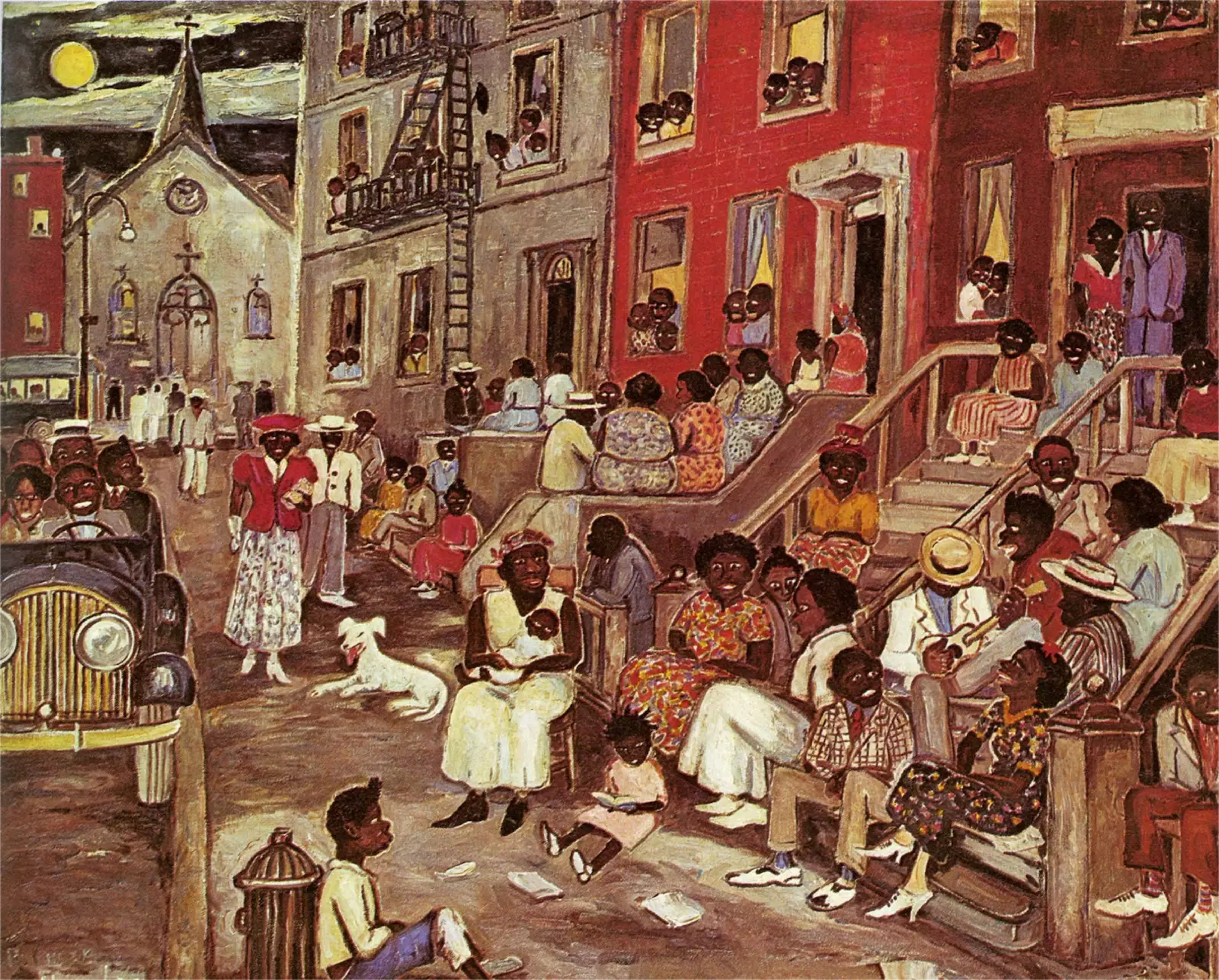
Midsummer Night in Harlem is among the most cited examples. The painting captures residents gathered outdoors in the evening heat, transforming a common neighborhood scene into something theatrical, communal, and deeply observed. Google Arts & Culture identifies the work as a 1936 painting now held by the Museum of African American Art in Los Angeles. Later commentary has emphasized the way the composition evokes the density and pleasure of Harlem life. What stands out is Hayden’s sense of public intimacy: the way a block can become both domestic extension and civic stage.
“Hayden’s Harlem scenes are full of pleasure, but never innocent of politics. In his hands, a summer block becomes a debate about who gets to depict Black people, and how.”
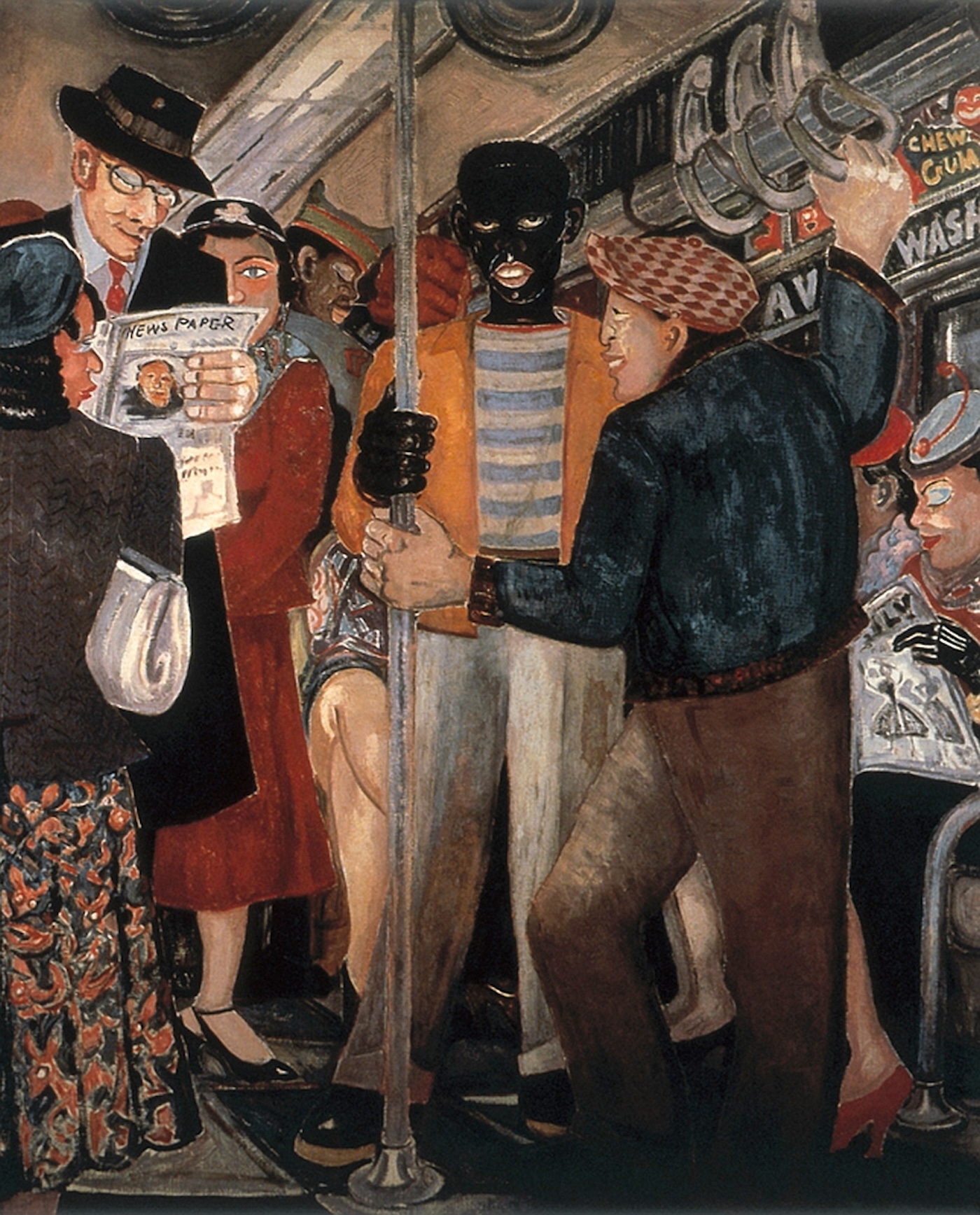
Yet even here, controversy shadows appreciation. Hayden’s figures sometimes carry exaggerated lips, enlarged eyes, and stylizations that many viewers read as uncomfortably close to minstrel caricature. That tension has long followed his work. Scholars including John Ott and Phoebe Wolfskill have treated the issue seriously, asking whether Hayden was critiquing racist visual conventions, trapped within them, strategically repurposing them, or doing some unstable combination of all three. The question is not fully settled, and perhaps it should not be. His paintings are historically specific objects, made in a visual culture saturated with racist distortion. Hayden’s art sometimes resists that field and sometimes appears entangled in it.
That is precisely why he remains relevant. Palmer Hayden is not useful because he offers a frictionless image of Black cultural production. He is useful because he exposes the pressure Black artists were under when trying to render Black subjects legible to different publics. Respectability had one set of demands. Folk authenticity had another. White patronage and white criticism added their own distortions. Black audiences, understandably protective of dignity in an anti-Black culture, could be sharply critical when representation seemed to tip toward stereotype. Hayden worked inside that minefield.
“The Janitor Who Paints” and the politics of humiliation
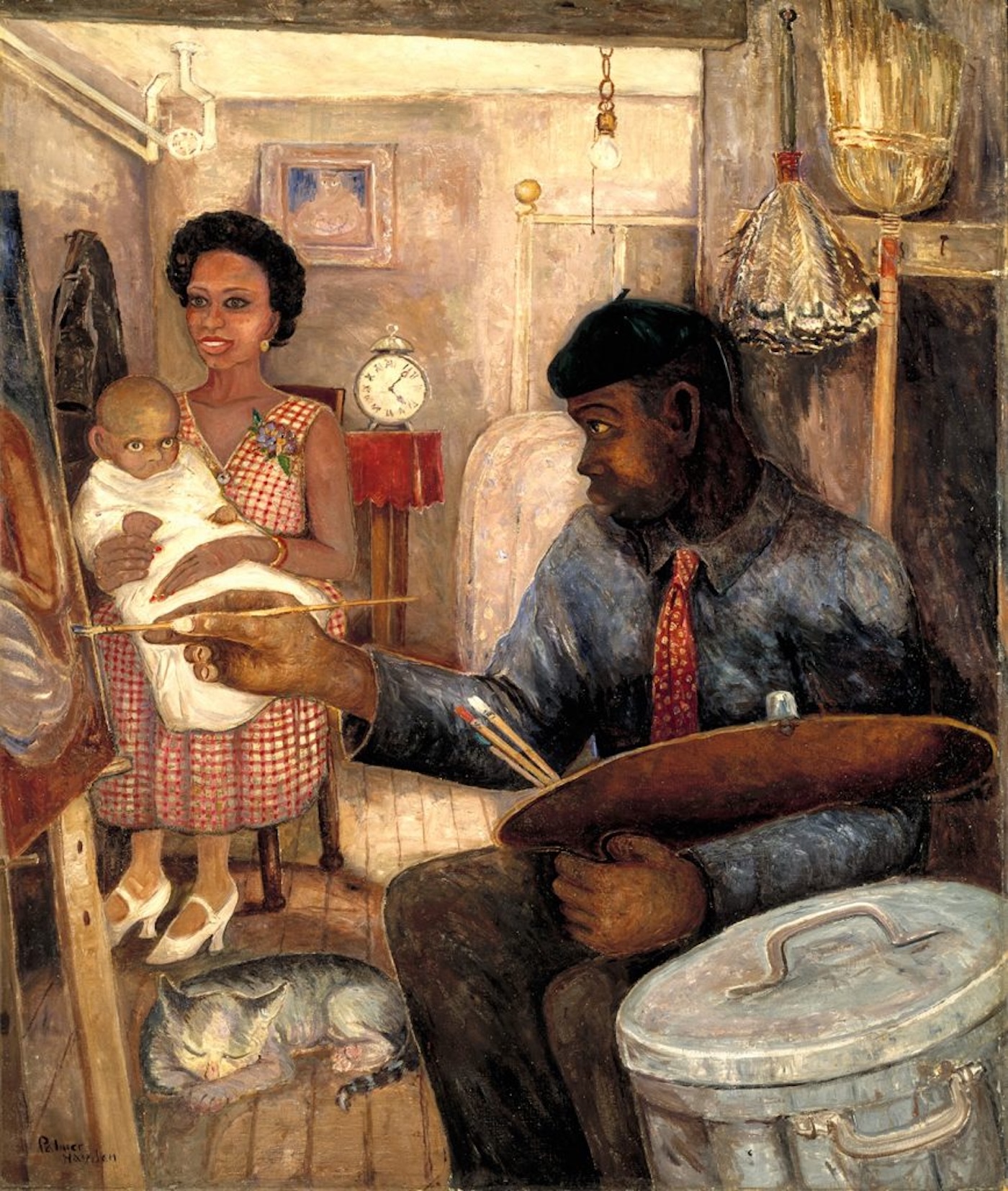
No work crystallizes Hayden’s biography and the contradictions of his reception more than The Janitor Who Paints. The Smithsonian American Art Museum describes it, quoting Hayden himself in a 1969 interview, as “a sort of protest painting” about his own economic and social standing and that of fellow African Americans. The inspiration, Hayden said, came from his friend Cloyd Boykin, an artist who also supported himself as a janitor. He painted Boykin because “no one called Boykin the artist.” That sentence lands with force because it summarizes the social problem the painting addresses: labor identities fixed so hard that artistic identity could barely surface.
The painting shows an artist at work in cramped quarters, surrounded not only by artistic tools but by the implements of cleaning labor. The domestic interior is compressed, crowded, almost suffocating. The artist paints, but the title and the setting refuse romance. He is not “the painter.” He is the janitor who paints. The hierarchy is embedded right there.
And then there is the formal problem: the faces. Early and later versions of the work have led to intense debate because of Hayden’s use of exaggerated features. Ott’s scholarship notes that the painting’s history includes revision and reinterpretation over time, complicating any single reading. The art-historical argument here is not trivial academic hair-splitting. It goes to the center of how Black modern art is read. Was Hayden indicting a society that forced Black artists into humiliating social positions while also forcing them into preexisting visual stereotypes? Was he ironically exposing the available image-bank? Or was he, however self-consciously, still reproducing forms that did damage? The painting’s power lies partly in the fact that it sustains all of those questions at once.
What seems hardest to deny is that Hayden understood humiliation intimately. He knew what it meant to have his labor foregrounded over his art. He knew what it meant to be recognized and belittled in the same breath. The Janitor Who Paints is not subtle about its grievance. It is a protest painting because the protest is structural, not just emotional. It protests a world that could admire Black culture while refusing to honor Black artists as artists.
Folklore, myth, and the American vernacular
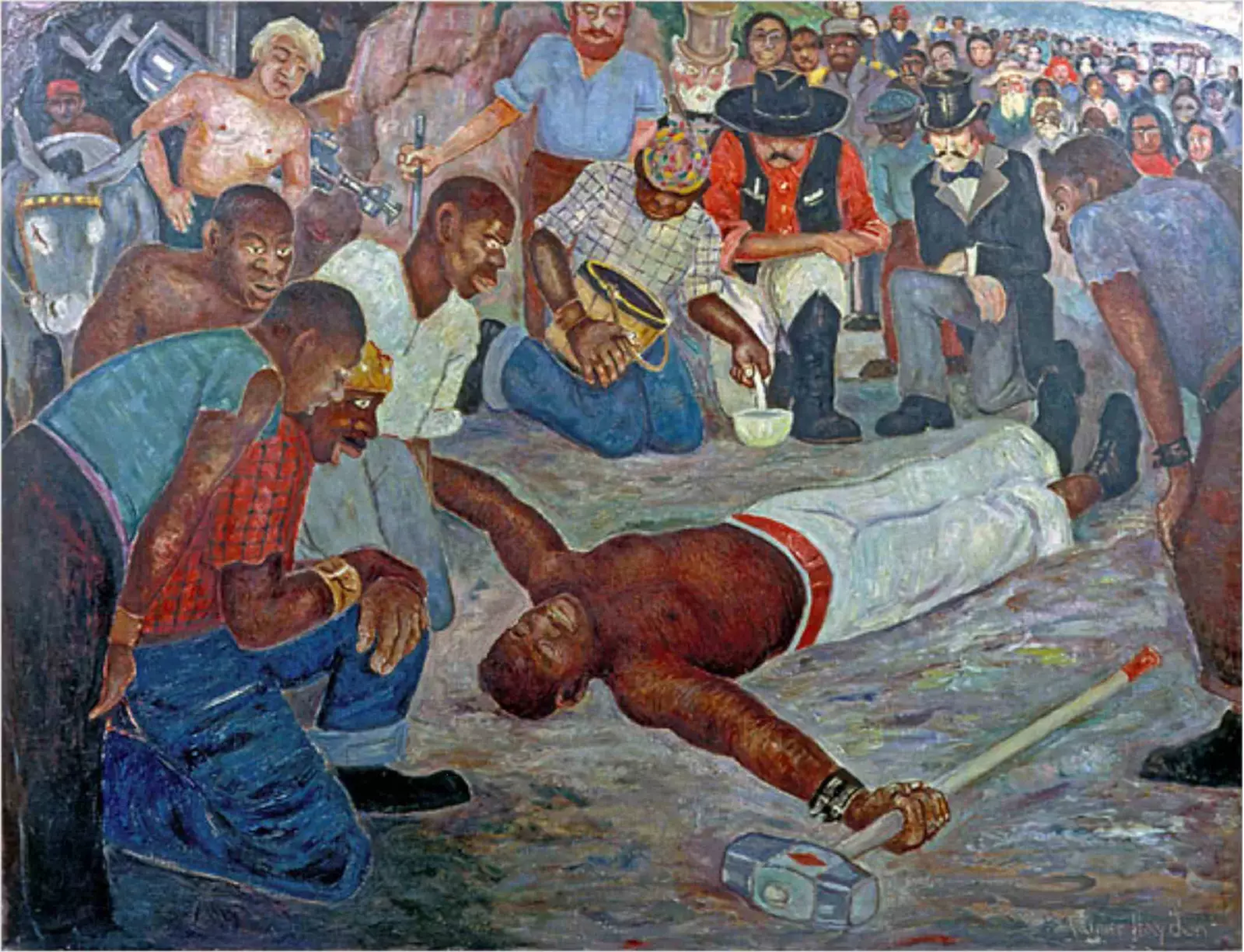
Hayden’s significance extends well beyond the Harlem scenes and the caricature debate. One of the most ambitious chapters of his career was the Ballad of John Henry series, a group of twelve paintings he began in 1944 and pursued for years. Smithsonian’s American Art Museum notes that the project occupied him for roughly a decade and led to a 1952 exhibition at Harlem’s Countee Cullen Library. The series centered the legendary steel-driving folk hero John Henry, turning oral tradition and song into sustained visual narrative.
This is a major clue to Hayden’s artistic self-conception. He was not merely a recorder of scenes. He was also a visual folklorist. He understood Black life as something held in work songs, legends, gestures, neighborhood memory, and collective symbols. The John Henry paintings place him in dialogue with a much broader project of Black cultural preservation and reinterpretation. He was painting not just what he saw, but what Black communities carried.
The Smithsonian’s object records and exhibition traces confirm the centrality of the series within Hayden’s later career. These were not casual side works. They were a serious, long-term investment in myth as Black social history. John Henry, after all, is more than a folk hero. He is labor myth, resistance myth, industrial myth, and mortality myth. For a painter so attentive to work and dignity, the figure makes perfect sense. Hayden’s John Henry is not just an American legend. He is a Black working-class monument.
It is also worth noticing that this folk emphasis helped distinguish Hayden from some of the more sleekly modernist narratives about Black art. He was not trying only to prove that Black artists could master elite painterly traditions, though he clearly could engage them. He was also insisting that Black folklore, Black labor memory, and Black everyday life deserved the scale of art history.
Why the work still divides viewers
Any honest account of Palmer Hayden has to stay with the discomfort. It would be easier to turn him into a purely celebratory figure: Harlem Renaissance painter, early chronicler of Black life, underrecognized talent finally getting his due. Much of that would be true. It would also be incomplete.
Hayden still divides viewers because his art sits at the crossroads of affirmation and distortion. Some of his paintings are warm, affectionate, and socially rich. Some are visually jagged in ways that make contemporary viewers recoil. The same artist who devoted so much of his career to Black subjects also made choices that seem to echo the visual logic of racist caricature. The question of intent matters, but it does not settle the question of effect.
Yet refusing simplification is part of serious criticism. It is possible to say that Hayden’s work helped expand the visual record of Black life in American art and also say that some of his representational strategies remain troubling. It is possible to see him as a painter of dignity who did not always resolve the traps of the image culture around him. In fact, that unresolved quality may be one of the most historically revealing things about him.
The Guardian’s review of Afro Modern years ago pointed, however sharply, to the painful convergence between primitivist tendencies in white and Black artists alike when looking at certain works. That judgment may be uncomfortable, but it captures something real about the period’s visual contradictions. Black artists were not working outside modernism’s racialized frameworks; they were forced to navigate them. Hayden’s art often shows the strain of that navigation.
A career bigger than the simplified Harlem Renaissance
Another reason Hayden matters is that he helps correct a popular misunderstanding of the Harlem Renaissance itself. Too often, the period gets reduced to jazz clubs, glamorous portraits, literary celebrities, and a handful of iconic images. But the movement was also about working artists, migrant artists, self-taught artists, transatlantic artists, civil servants, teachers, illustrators, muralists, and stubborn experimenters who did not fit the glamorous script. Hayden belongs to that broader, messier reality.
He was part of the cultural awakening associated with Harlem, but his subjects ranged from Southern scenes to European landscapes to African-inflected still lifes to American folklore. He worked in oil and watercolor. He drew on personal labor history. He moved between realism, stylization, and narrative picture-making. If anything, his career argues against treating Black art of the era as a single aesthetic front. He embodies plurality.
That plurality is increasingly visible in how institutions present him. Smithsonian holdings, archival materials, the Virginia Museum of Fine Arts, the Museum of African American Art in Los Angeles, and contemporary criticism all point to an artist whose range now reads as a strength rather than a lack of coherence. The more art history opens itself to artists who worked across vernacular and formal boundaries, the more legible Hayden becomes.
Late years, legacy, and the work of reevaluation
Hayden died in New York on February 18, 1973. By then he had lived long enough to see some recognition, but not the full scale of institutional reevaluation now underway around Black modern art. Archival sources indicate that he continued to work late in life and had even received support for projects focused on African American soldiers between the world wars. His papers, preserved by the Archives of American Art, include diaries, correspondence, photographs, clippings, and records that make clear how persistent and workmanlike his career really was. He was not a flash of Harlem mythology. He was a lifelong producer.
Today, Palmer Hayden’s legacy rests on several intertwined claims. He was among the early Black American painters to center Black subjects with sustained seriousness across multiple genres. He helped build the visual language of the Harlem Renaissance while also exceeding it. He documented social life that mainstream American art had routinely ignored or trivialized. He engaged African forms and transatlantic modernist ideas without surrendering his interest in common people and common stories. And he left behind paintings that continue to provoke necessary argument about the politics of representation.
That last point may be the most important. Hayden is not merely a figure to honor. He is a figure to study, debate, and keep in circulation. In an era when museums are rethinking the boundaries of American art, he offers a reminder that Black artists were never waiting passively outside the canon. They were already making the canon larger, stranger, and more truthful than it wanted to be.
“Palmer Hayden did not leave behind a comfortable legacy. He left behind a living one.”
To look at Hayden now is to see an artist who understood that Black life contained grandeur and fatigue, lyricism and labor, intimacy and myth. He painted that fullness before the culture had built adequate language for it. Sometimes he got there beautifully. Sometimes he got there unevenly. But he kept going. He kept painting. And in that persistence there is its own kind of monument.
Palmer Hayden may never become the most universally beloved painter of the Harlem Renaissance. His work resists that kind of easy consensus. But he may be one of the most necessary artists to revisit precisely because he reveals how Black art in America was made under pressure: pressure to represent, pressure to uplift, pressure to survive, pressure to modernize, pressure to be legible to patrons, critics, and community all at once. His canvases carry those pressures openly. They do not hide the strain. That honesty is part of their force.
So the case for Palmer Hayden is not that he was flawless. It is that he was foundational. Not because he resolved the hardest questions of Black representation, but because he painted inside them with unusual courage and range. He gave American art working people, dreamers, janitors, dancers, mothers, musicians, mythic laborers, and Harlem neighbors as worthy subjects. He made room on canvas for Black life in its ordinary density and symbolic power. And he did it early enough, and often enough, that later generations could build from what he left behind.
In that sense, Palmer Hayden’s significance is not only historical. It is methodological. He teaches viewers how to sit with complication. He asks us to see Black art not as a sequence of uncomplicated triumphs, but as a field of experimentation shaped by race, class, migration, aspiration, and visual inheritance. That is a harder story than the usual one. It is also the truer one.
More great stories
Donna Bruton’s Quiet Revolution
March 23, 2026
No Comments
A Town, a Lie, and the Long Afterlife of Jim Crow
March 22, 2026
No Comments