





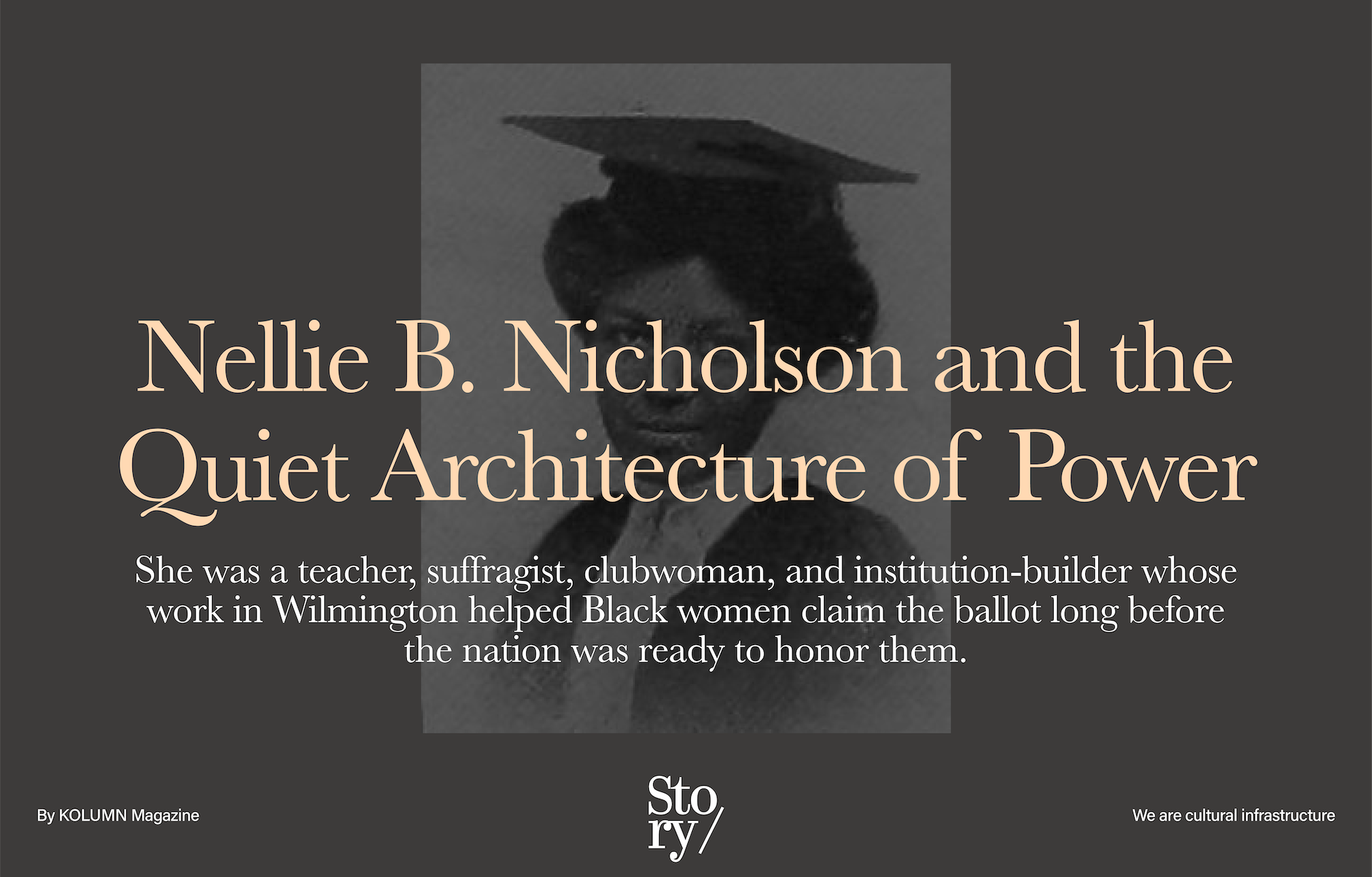
Nellie B. Nicholson’s activism was not built for spectacle. It was built for endurance.”
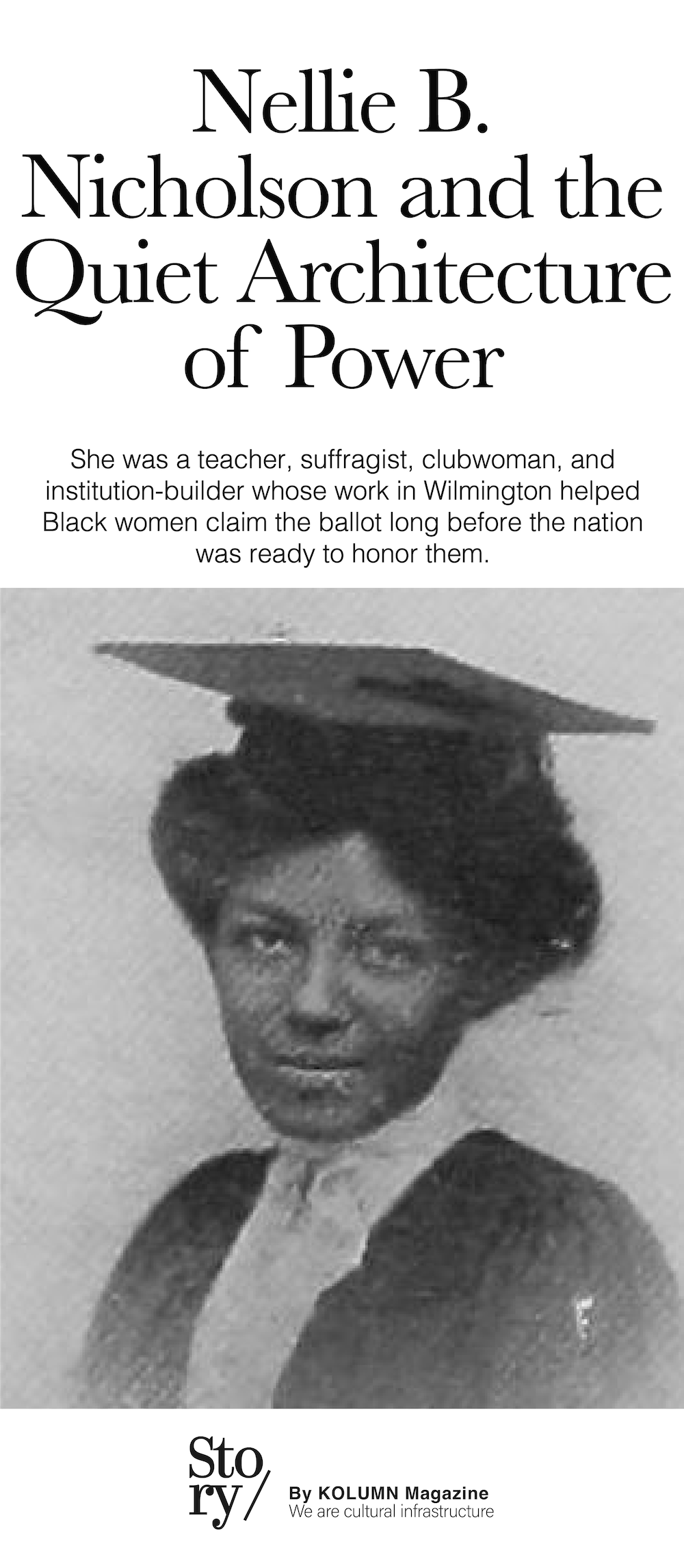
Nellie B. Nicholson’s activism was not built for spectacle. It was built for endurance.”
By KOLUMN Magazine
Nellie B. Nicholson was not the kind of activist whose life is commonly framed around a single iconic photograph, one famous speech, or one courthouse showdown. Her importance lies somewhere deeper and, in many ways, more difficult to narrate: in the patient, disciplined, institution-minded work that helped Black women turn aspiration into civic practice. She was an educator. She was a suffragist. She was a clubwoman. She was a member of the Black collegiate and professional class that believed schooling and political action belonged together. And in Wilmington, Delaware, she became part of a generation of African American women who insisted that democracy had to be lived, studied, taught, and defended.
That sentence alone already hints at a larger problem in the historical record. Nellie B. Nicholson is exactly the kind of figure American public memory tends to undercount: a Black woman whose activism was collective rather than self-promotional, whose political work moved through clubs, schools, sororities, suffrage groups, and local institutions rather than through the loud machinery of national celebrity. What survives in the public record is real, but comparatively thin. Brown University preserves her scrapbook from the years surrounding her graduation in 1911; the University of Delaware’s suffrage exhibition places her among the Black women who shaped Delaware’s voting-rights struggle; later references tie her to Howard High School, Alpha Kappa Alpha’s Zeta Omega chapter, and Wilmington’s Black civic world. Taken together, those records reveal a life that was less flashy than foundational.
To write about Nicholson honestly is to resist the temptation to inflate or flatten her. She was not simply “a suffragist,” though she certainly was that. She was not just “an educator,” though she spent more than four decades in education across Maryland, Delaware, and Pennsylvania. She was part of a Black women’s political tradition that understood something essential: before a right can be exercised in public, it has to be cultivated in private and communal life. That meant teaching children. It meant mentoring young women. It meant joining organizations that could outlast one election cycle. It meant reading, studying, marching, registering voters, and creating social worlds in which Black women could imagine themselves not as petitioners at democracy’s door, but as rightful participants in it.
Nicholson was born in Baltimore on July 22, 1888, to George W. and Charlotte Nicholson. According to the biographical record summarized through later scholarship, her father had served in the United States Colored Troops during the Civil War, and her mother was a skilled seamstress and dressmaker. Those details matter. In a single family frame, they place her at the crossroads of two major Black historical traditions: the long struggle for freedom through military service and the equally long labor of Black women’s economic skill, discipline, and care work. The daughter of that household would go on to become an educated Black woman in an era when such a path demanded brilliance, stamina, and no small amount of defiance.
She attended the Baltimore Colored Training School before enrolling at Pembroke College, the women’s college associated with Brown University. Brown’s own archival description notes that Nicholson graduated in the class of 1911 and is believed to have been the fifth Black woman graduate from Pembroke. That fact is not just a nice institutional milestone. It signals the degree to which she was moving through spaces still marked by exclusion. Black women in elite higher education at the turn of the twentieth century were not merely accumulating credentials; they were entering environments that often regarded them as anomalies. To persist in such settings required intellectual seriousness and social dexterity, but it also sharpened a political understanding. Access, in Nicholson’s generation, was never just personal advancement. It was proof of concept.
Her Brown scrapbook, which covers roughly 1906 to 1917 and includes 172 photographs, event programs, ribbons, dried flowers, and handwritten captions, offers a small but powerful window into that world. The archive says the scrapbook includes friends and family, campus buildings, women’s athletics, housemates at 45 East Transit Street in Providence, and records of post-graduation travels and work. A scrapbook is not a manifesto, but it is its own kind of argument. It shows a young Black woman documenting belonging in spaces where belonging could not be taken for granted. It shows self-fashioning, memory-making, and the quiet insistence that one’s education, friendships, movement, and inner life were worth preserving. For Black women of Nicholson’s era, that kind of self-archiving was not trivial. It was a form of historical self-defense.
And then there is the question of what a woman like Nicholson did with education once she had it. The answer, again, is not glamorous in the Hollywood sense. She taught. She kept teaching. Brown’s archival summary says she worked as an educator in Maryland, Delaware, and Pennsylvania for more than forty years. Delaware’s educational directory for 1914-15 places her on the faculty at Howard High School in Wilmington, alongside other Black educators who would also become prominent in civic life. Howard High mattered enormously. In the segregated landscape of Delaware, it was a central institution in Black community formation. It was not only a school but a meeting ground for leadership, respectability politics, ambition, and activism. To teach there was to inhabit one of the most consequential positions available to a Black professional woman in the state.
That institutional context is key to understanding Nicholson’s activism. Too often, public memory treats suffrage as though it were carried entirely by marches and slogans. But Black women’s suffrage organizing was frequently embedded in schools, churches, clubs, and homes. The University of Delaware’s exhibition on Delaware’s suffrage campaign makes clear that African American women in the state “participated actively” in the struggle for voting rights. It also makes clear that they did so in the face of racial hostility, distance from many white suffragists, and open racist abuse from public officials and editors. Nicholson moved within that landscape as part of a cohort of Howard High-connected women whose educational work and political work reinforced one another.
In 1914, Nicholson helped found the Equal Suffrage Study Club in Wilmington, a Black women’s organization formed to study and advocate for voting rights. The club’s first meeting was held at the home of Emma Belle Gibson Sykes, another Howard High-associated educator. That detail matters because it tells us what kind of political culture these women were building. This was not only a campaign operation. It was a study club. The name suggests discipline, literacy, and collective inquiry. These women were not waiting to be instructed in democracy by the state that excluded them. They were developing their own civic pedagogy, one in which Black women could debate, strategize, and prepare for political participation on their own terms.
If the phrase “study club” sounds modest, that is exactly why it deserves more attention. For Black women in the early twentieth century, study was political. Reading newspapers critically was political. Parsing legislation was political. Learning the history of rights claims was political. Respectability itself, often caricatured today as mere performance, could also be tactical: a way to insist upon one’s fitness for citizenship in a public world determined to deny it. Nicholson’s world did not have the luxury of separating intellect from activism. In that sense, she represented a very Black, very female mode of political formation—one that made the classroom, the parlor, the church basement, and the club meeting into training grounds for democratic struggle.
The Equal Suffrage Study Club also marched as a separate unit in Wilmington’s first suffrage parade in 1914. That single fact captures a recurring truth about the suffrage movement: Black women were there, but they were often forced to organize within and against structures of racial separation. Even where they participated, they were not always embraced as equals by white suffrage leadership. Delaware’s suffrage history makes that especially plain. The University of Delaware exhibition notes that white suffragists in the state often kept their distance from African American counterparts, fearing white backlash. Nicholson and her peers, then, were contending with both anti-suffrage forces and the racial caution of putative allies. Their separate marching was participation, but it was also evidence of segregation’s stubborn reach.
For Black suffragists in Delaware, the ballot was never detached from race. It arrived burdened by it.
The political conditions around Nicholson’s suffrage work were ugly. In 1915, as Delaware debated amending its constitution to enfranchise women, Black women in Wilmington confronted racially inflammatory attacks in the local press. The University of Delaware exhibit highlights how Mary J. Woodlen and Blanche W. Stubbs, two members of the African American Equal Suffrage Study Club, answered racist editorials directly, denouncing the editor’s assumptions about Black women. Later, during the 1920 ratification fight, anti-suffrage legislator John E. “Bull” McNabb hurled racist slurs on the chamber floor, and Emma Gibson Sykes publicly condemned him as “a disgrace to the state.” This was the atmosphere in which Nicholson organized. Suffrage, for Black Delaware women, was not just a constitutional issue. It was a battle against public contempt.
That context helps explain why Nicholson’s significance should not be reduced to whether she left behind a famous speech. Her importance lies in being part of a Black women’s infrastructure of seriousness. The Equal Suffrage Study Club was made up of educators, club leaders, and community figures. These were women who understood that winning formal rights required more than symbolic inclusion. It required preparation, mutual reinforcement, and an organized Black public. When the Nineteenth Amendment was ratified, Nicholson and her colleagues did not treat the matter as finished. The club moved to encourage African American women to register and vote. That post-ratification work is crucial. It recognizes that law on paper and power in practice are never the same thing.
This is one of the central lessons of Nicholson’s life. She belonged to a tradition of Black women activists who understood that access has to be operationalized. You do not just win a right; you teach people how to use it, defend it, and build institutions around it. In Delaware, where Black women voters in Wilmington were able to cast ballots “without incident” in the 1920 election even as many Black women in former Confederate states met massive resistance, local organizing mattered. The University of Delaware exhibition describes that 1920 moment while also noting the larger betrayal that followed, when the National Woman’s Party refused to meaningfully confront the disfranchisement of African American women in the South. The lesson was brutal but clarifying: formal suffrage was not universal freedom, and Black women would have to keep organizing long after celebratory headlines faded.
Nicholson’s work extended into that broader civic realm. Sources credit members of the Equal Suffrage Study Club with helping support the founding of a Wilmington chapter of the NAACP in 1915, and Nicholson is identified as its first press relations staffer. Even allowing for the fragmentary nature of the surviving record, that is a revealing detail. Press work is about narrative control. It is about deciding what the public hears, what counts as civic legitimacy, and whose grievances are documented rather than ignored. For a Black woman educator-suffragist to move into that role makes perfect sense. Teaching, study, and communication were all part of the same project: making Black citizenship visible and defensible.
Her civic life also ran through Black women’s club and sorority networks. Nicholson co-founded a Delaware affiliate of the Women’s College Club of Delaware with Sadie L. Jones, according to biographical summaries drawn from suffrage scholarship. She was also a charter member of Alpha Kappa Alpha’s Zeta Omega chapter in Wilmington when it was established on April 28, 1922. The chapter’s history, as preserved by the organization itself, identifies Nellie Blythe Nicholson Taylor among the founding members and emphasizes the chapter’s early focus on scholarships, vocational guidance, and community problems. That is no minor sidebar. Black sororities were among the most important engines of Black women’s civic leadership in the twentieth century. Nicholson’s place in that lineage links her suffrage work to a longer tradition of service, mentorship, and professional organizing.
To modern readers, sorority membership can sometimes seem social before political. Historically, for Black women, that distinction often collapses. Greek-letter organizations created durable networks among educated Black women shut out from white institutions and public power. They raised funds, sponsored students, created leadership pipelines, and translated collegial ties into civic action. Nicholson’s involvement in Zeta Omega suggests that she understood a crucial truth: movements need maintenance. The parade is only the beginning. The meeting minutes, scholarship committees, mentoring relationships, and recurring community programs are what turn a moment into a tradition.
There is also something revealing in Nicholson’s continued commitment to learning. Biographical summaries indicate that after several years of teaching she pursued further study, eventually earning a master’s degree in mathematics education from the University of Pennsylvania in 1931. Additional references point to further summer study at institutions including Columbia University and the University of Chicago. That profile—a Black woman teacher continuing her education while working—belongs to a larger history of Black educational striving that does not always get told with the admiration it deserves. Advanced study, especially for Black women in the early twentieth century, was not ornamental. It was often a practical strategy for professional survival, status, mobility, and intellectual authority in segregated systems that routinely undervalued Black teachers.
And mathematics education is worth pausing over. It subtly complicates our assumptions about who Black women activists were allowed to be. Nicholson was not simply a moral crusader in the sentimental mode. She was trained in a field associated with rigor, method, and discipline. The combination is striking: a woman shaped by Black freedom traditions, female associational life, and quantitative pedagogy. It suggests a cast of mind attentive to structure. Perhaps that is why her activism appears, in the surviving record, so methodical. She did not drift into civic work. She joined, co-founded, and sustained organizations. She helped build what others could enter.
Nicholson married William H. Taylor in 1928. He was a widower with three children, and later records indicate that she continued teaching at Howard High School while commuting from her home in Philadelphia. That image—of a woman balancing marriage, stepfamily obligations, advanced study, and sustained professional work—belongs in the story too. So much of Black women’s activism has historically been carried under the pressure of multiple responsibilities. Nicholson’s life appears to have followed that pattern. She did not leave the classroom for a cleaner, more recognizable “activist” lane. She remained inside the dense weave of work, family, learning, and civic responsibility that defined so many Black women’s political lives.
By around 1930, a Howard High School staff photograph still placed Nicholson Taylor among the educators who had helped found the Equal Suffrage Study Club. The University of Delaware exhibit identifies her in that image alongside Helen Wormley Anderson Webb and Caroline B. Williams. There is something moving about that. A decade and more after the high drama of ratification, these women were still there—still teaching, still embedded in the institution that had incubated so much of Wilmington’s Black civic energy. It is a reminder that the end of a formal suffrage campaign does not end the history of citizenship. It just changes the venue.
The classroom was one of Nicholson’s polling places: a site where Black futures were prepared before they were counted.
So what, finally, was Nellie B. Nicholson fighting for? The easiest answer is women’s suffrage, and that is true as far as it goes. But it does not go far enough. She was fighting for Black women’s public legitimacy. She was fighting for the idea that education was not separate from freedom but one of its preconditions. She was fighting for associational life—the clubs, schools, and sororities through which Black women could act collectively. She was fighting against a version of American democracy that wanted Black women’s labor while discounting Black women’s minds. She was fighting for a citizenship that had to be practiced daily, not merely granted ceremonially.
That last point matters in the present tense. Nicholson’s life speaks directly to our own era’s uneasy relationship with voting rights, education, and public memory. We like our heroes dramatic. We like biographies that resolve cleanly into a single triumph. But democratic life is usually sustained by people whose names do not become shorthand. Nicholson’s significance is partly that she forces us to honor maintenance, preparation, and local leadership. She belongs to the infrastructure of Black political modernity. Without women like her, the bigger names do not stand on stable ground.
There is also a specifically regional lesson in her story. Delaware is often awkwardly positioned in American historical imagination—neither fully North in the moral sense people sometimes want to assign, nor straightforwardly South in the ways segregation and anti-Blackness actually operated. Nicholson’s activism in Wilmington shows how thoroughly Black women understood that liminal terrain. Delaware’s African American suffragists had to confront racist editorializing, white suffragists’ caution, and legislative ugliness, even as they carved out spaces of coalition and tactical possibility. Their story disrupts any simplistic map of progress. It reveals a borderland politics where rights were negotiated in layered, uneven ways. Nicholson was one of the people helping Black women navigate that complexity.
Her story also enlarges how we think about Black women’s intellectual life. It is tempting to divide the world into scholars over here, activists over there, teachers somewhere else, clubwomen in another corner. Nicholson’s life makes those categories look artificial. She studied. She taught. She organized. She joined a sorority chapter. She co-founded a college club. She marched. She helped shepherd women from suffrage agitation into voter participation. The same woman could do all of that because, in Black women’s history, those activities have long been mutually reinforcing rather than mutually exclusive.
If anything, Nicholson’s partial obscurity today tells us as much about the nation as it does about her. Public memory has often favored the charismatic over the cumulative, the singular over the networked, the male over the female, the white over the Black, the famous institution over the local one, the speech over the study club. Recovering Nicholson requires a different historiographic ethic. It requires taking Black women’s everyday political labor seriously enough to treat it as history, not just context. It requires seeing a school faculty list, a sorority chapter history, a university scrapbook finding aid, and a suffrage exhibition not as scraps orbiting the “real” story, but as the story itself.
Nicholson died on December 20, 1965, and is buried at Eden Cemetery in Collingdale, Pennsylvania. On paper, that can sound like the simple closing line of a life. In reality, her work extends past it. Every time historians recover Black women’s suffrage networks in Delaware, her name resurfaces. Every time Brown archives her scrapbook, a fuller picture of Black women’s educational life becomes possible. Every time Alpha Kappa Alpha recounts Zeta Omega’s founding, her place in institutional Black womanhood is reaffirmed. Every time scholars revisit the overlooked architecture of local democracy, women like Nellie B. Nicholson move closer to where they belong: not at the margins of the story, but in its beams and joints.
What remains most compelling about her is the scale at which she worked. She was not trying to become an icon. She was trying to help build a world. In that world, Black women could be educated and politically active, professionally serious and publicly engaged, intellectually ambitious and rooted in community. They could be faculty and marchers, clubwomen and strategists, mentors and organizers. They could see voting not as a symbolic endpoint but as part of a larger discipline of belonging. That is the legacy Nicholson offers now. It is a legacy less about applause than about construction. Less about the one-day victory than about the decades-long practice that makes freedom usable.
In the end, Nellie B. Nicholson matters because she helps us tell the truth about movements. They are not made only by the people at the podium. They are made by the people who hold the line between aspiration and institution. The teacher who stays. The clubwoman who convenes. The organizer who studies. The citizen who teaches others how to become citizens, too. Nicholson was one of those people. And American history, if it is serious about itself, has to learn how to say her name with the weight it deserves.
More great stories
Donna Bruton’s Quiet Revolution
March 23, 2026
No Comments
A Town, a Lie, and the Long Afterlife of Jim Crow
March 22, 2026
No Comments