



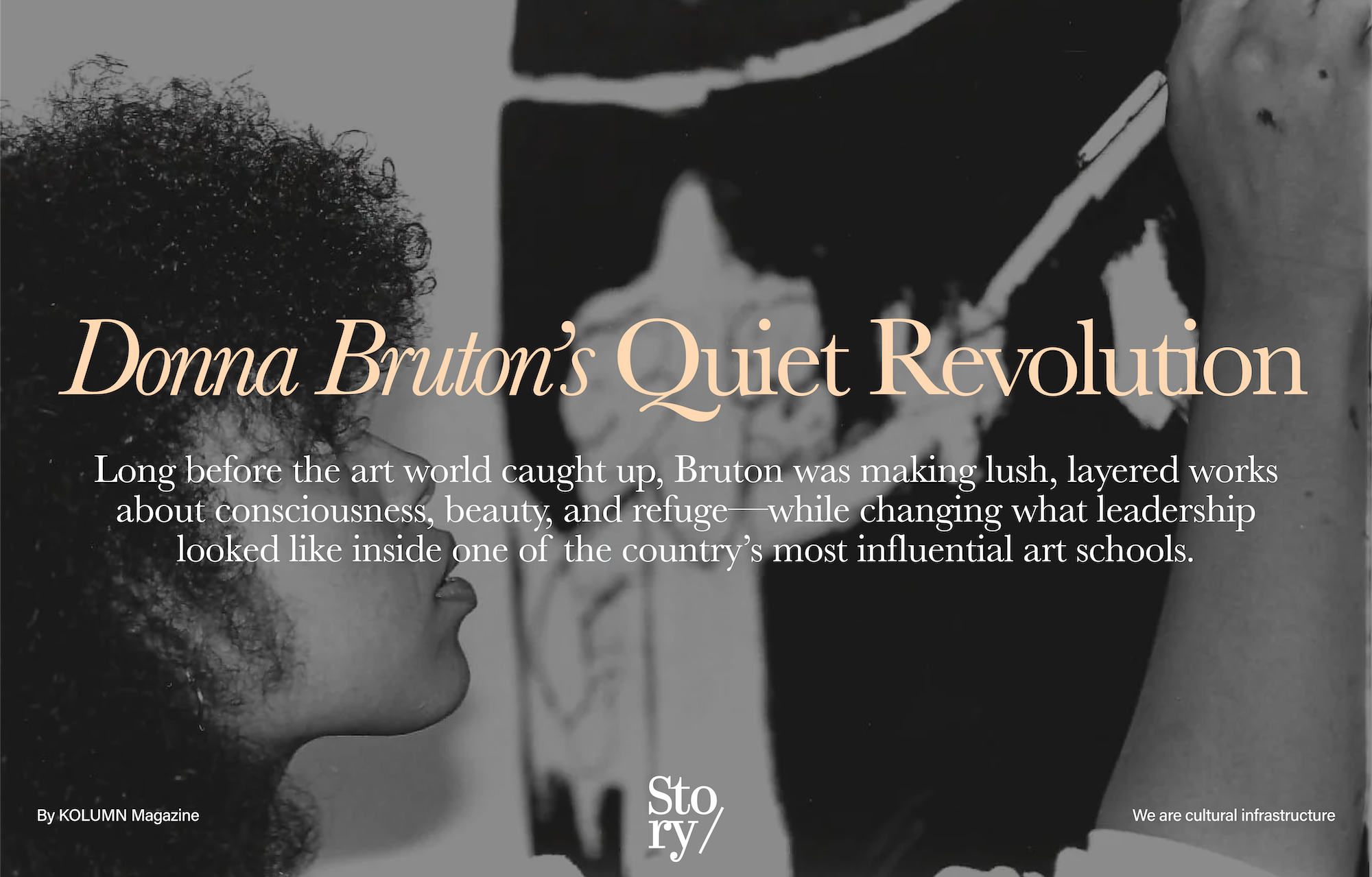
Donna Bruton did not make paintings that begged to be consumed. She made paintings that asked to be met.
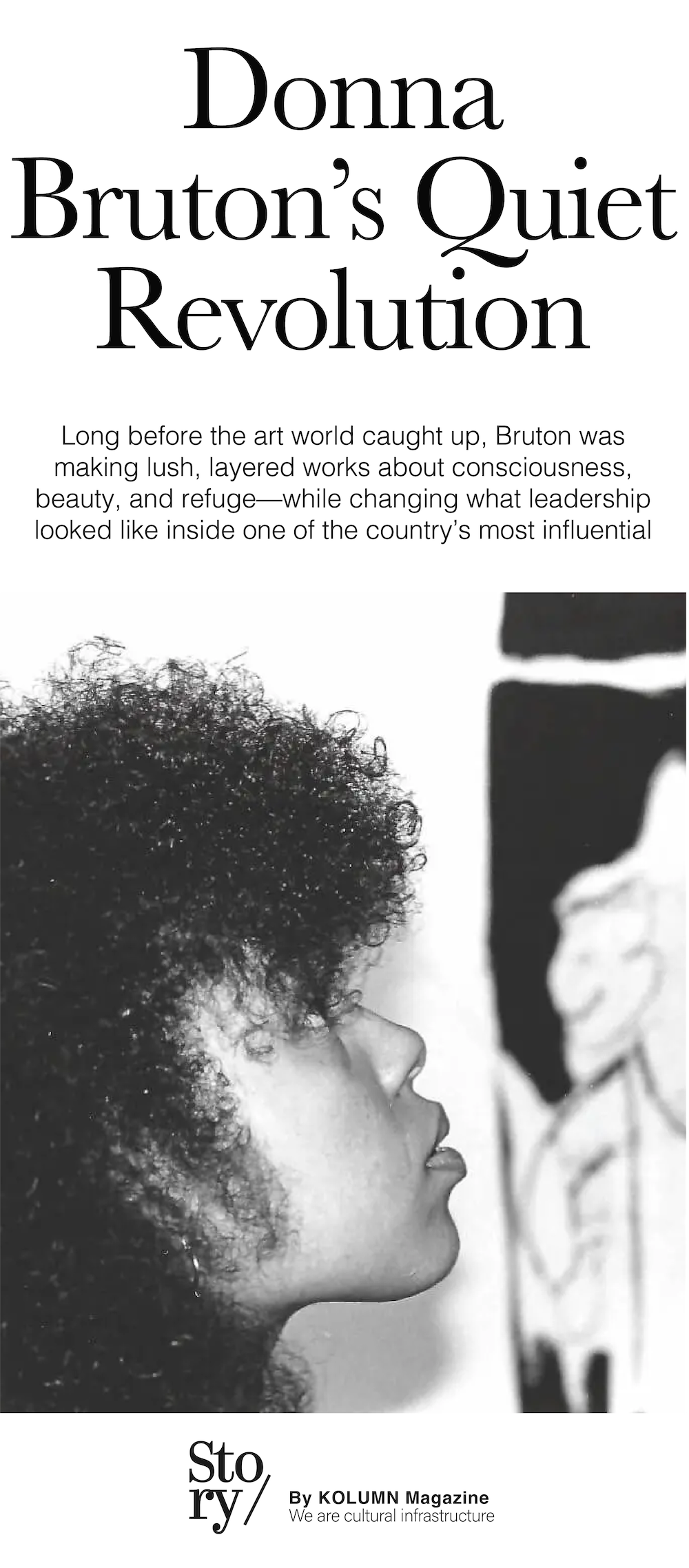
Donna Bruton did not make paintings that begged to be consumed. She made paintings that asked to be met.
By KOLUMN Magazine
Donna Bruton was a painter, mixed-media artist, teacher, and academic leader whose work held together interior life, spiritual searching, domestic memory, and feminist critique in ways that now feel strikingly contemporary. She was also, by every available record, a figure of unusual seriousness and unusual warmth, the kind of artist whose influence traveled not only through her canvases but through the students she taught, the structures she helped reshape, and the examples she set inside institutions not built with Black women in mind.
Bruton was born Donnamaria Bruton in 1954 in Milwaukee and raised in Detroit after her father, former Major League outfielder Bill Bruton, moved the family when he played for the Tigers in the early 1960s. She earned a BFA in graphic design from Michigan State University, later studied painting at the School of the Art Institute of Chicago, and completed an MFA in painting and printmaking at Yale in 1991. She went on to teach at the University of Texas at Austin before joining the Rhode Island School of Design in 1992, where she served as a professor, later chaired the painting department, and then became interim dean of graduate studies. She died in 2012 after a two-year battle with cancer, leaving behind a body of work that institutions and critics have only more recently begun to assess with the seriousness it deserves.
That delayed recognition matters. It is not incidental to her story; it is part of it. A 2022 retrospective at the Newport Art Museum, Donnamaria Bruton: From Sense to Soul, was described as the first comprehensive examination of her work since her death. A 2025 feature in Boston Art Review argued that a decade after her passing, her influence was only beginning to come into view. That is often how it goes with artists like Bruton: artists who teach as seriously as they make work, artists whose spirituality does not package easily, artists whose paintings resist loud branding, artists whose labor inside institutions can eclipse public discussion of their art. Her career asks a pointed question: what kinds of artists does the art world know how to celebrate in real time, and which ones does it leave for later?
“Rising above the human condition has truly been a journey from sense to soul. A pilgrimage to a holy or secret place of refuge.”
That sentence, drawn from a 1991 artist statement and later foregrounded by the Newport Art Museum, may be the clearest entry point into Bruton’s work. It explains both her paintings and her posture toward painting. She was not simply arranging forms on a surface. She was trying to reach a condition, to trace consciousness, to render what cannot be cleanly diagrammed. Her paintings and collages often feel like they are hovering between dream, memory, private symbol, and material fact. They are tactile and airy at once. They can feel domestic without becoming quaint, spiritual without becoming vague, feminine without ceding complexity. That is part of why they hold up so well now. They anticipated the current hunger for art that can contain vulnerability, philosophy, and formal intelligence at the same time.
An inheritance of art, sport, and Black modernism
Bruton’s story begins in a family that was already thick with American Black achievement, though not in a tidy, poster-ready way. Her father, Bill Bruton, was a celebrated center fielder who played in the major leagues after getting help early in his career from Judy Johnson, the Negro Leagues star and Hall of Famer who later became his father-in-law. Johnson’s baseball life carried its own legacy of Black excellence constrained by segregation and under-recognition. That family line matters not because it turns Donna Bruton into a footnote to famous men, but because it shows that she was raised inside a culture where discipline, excellence, and aspiration were already ordinary expectations. The archive also suggests that art held real importance in the household. According to Boston Art Review, a painting by the noted landscape artist Edward L. Loper Sr. hung over the family fireplace, providing Bruton with an early and sustained encounter with fine art. Loper, married to her father’s sister, would become a key mentor.
This convergence of athletics, Black family legacy, and art history gave Bruton a distinct foundation. Loper was not a casual influence. The Newport Art Museum and Boston Art Review both identify him as central to her development, and the latter notes that she studied with him in his Delaware studio between her undergraduate years and graduate training. She also made frequent visits to the Barnes Foundation in the Philadelphia area, where she encountered works by Pierre Bonnard and Henri Matisse and absorbed the foundation’s emphasis on “learning to see.” Those experiences helped shift her palette and deepen her understanding of color relationships and composition. In other words, Bruton’s painterly intelligence was built through a chain of Black mentorship and self-fashioned study that connected Detroit, Delaware, Philadelphia, Chicago, and Yale.
That geography is part of the art. Detroit, especially, seems crucial. The available record places her there not only as a young person in a baseball family but as an emerging artist who worked on public murals in the 1970s. That kind of early mural practice matters. Murals train an artist to think at scale, to think publicly, to think about image as social presence. Even if Bruton would later become known for intimate symbolism and meditative surfaces, there is something in her mature work that still feels architectural, still aware of how an image occupies a room and addresses a body. Her paintings do not merely sit on walls. They establish atmospheres.
The making of a painter
Bruton’s formal path was neither rushed nor linear. She completed her BFA in graphic design at Michigan State in 1976, earned a certificate in painting from the School of the Art Institute of Chicago, worked as a color and fabric stylist for Chrysler from 1983 to 1987, and finished her MFA at Yale in 1991. That Chrysler period is especially revealing. It means Bruton spent years thinking about color, texture, surface, interiors, and material behavior in a context adjacent to design and industry, not just fine art. The result was not design slickness. It was a sophisticated material literacy that seems to have enriched the layered tactility of her later paintings and collages.
Before the luminous interiors and dreamlike landscapes of her later years, Bruton made darker, more emotionally charged works. The Newport Art Museum notes that she began with art that was “dark and emotional” before the Barnes Foundation visits and Loper’s influence helped brighten her palette. That shift did not represent a retreat from seriousness. It represented a different route toward it. The darkness remained, but transformed into something more atmospheric and complicated. If her early work seems to wrestle directly with pain, the later work often metabolizes pain into symbol, color, and structure. She did not abandon emotional depth; she changed its visual temperature.
Her own words from a 1993 exhibition at Women & Their Work in Austin make plain that emotion and spirituality were never secondary concerns. “Painting reflects states of consciousness that emerge from the currents in the human mind and resolve to states of spiritual reckoning,” she wrote. She went on, in the same statement, to describe darkness and pain as comforting, sacred, and profaned only when over-intellectualized. Those are not the words of an artist interested in clever distance. They are the words of an artist committed to inner life as a legitimate source of formal inquiry. Bruton’s paintings were not just meant to be decoded. They were meant to be inhabited.
“The darkness and the pain of the paintings was comforting … the feelings were sacred, the intellectualizing of them was profane.”
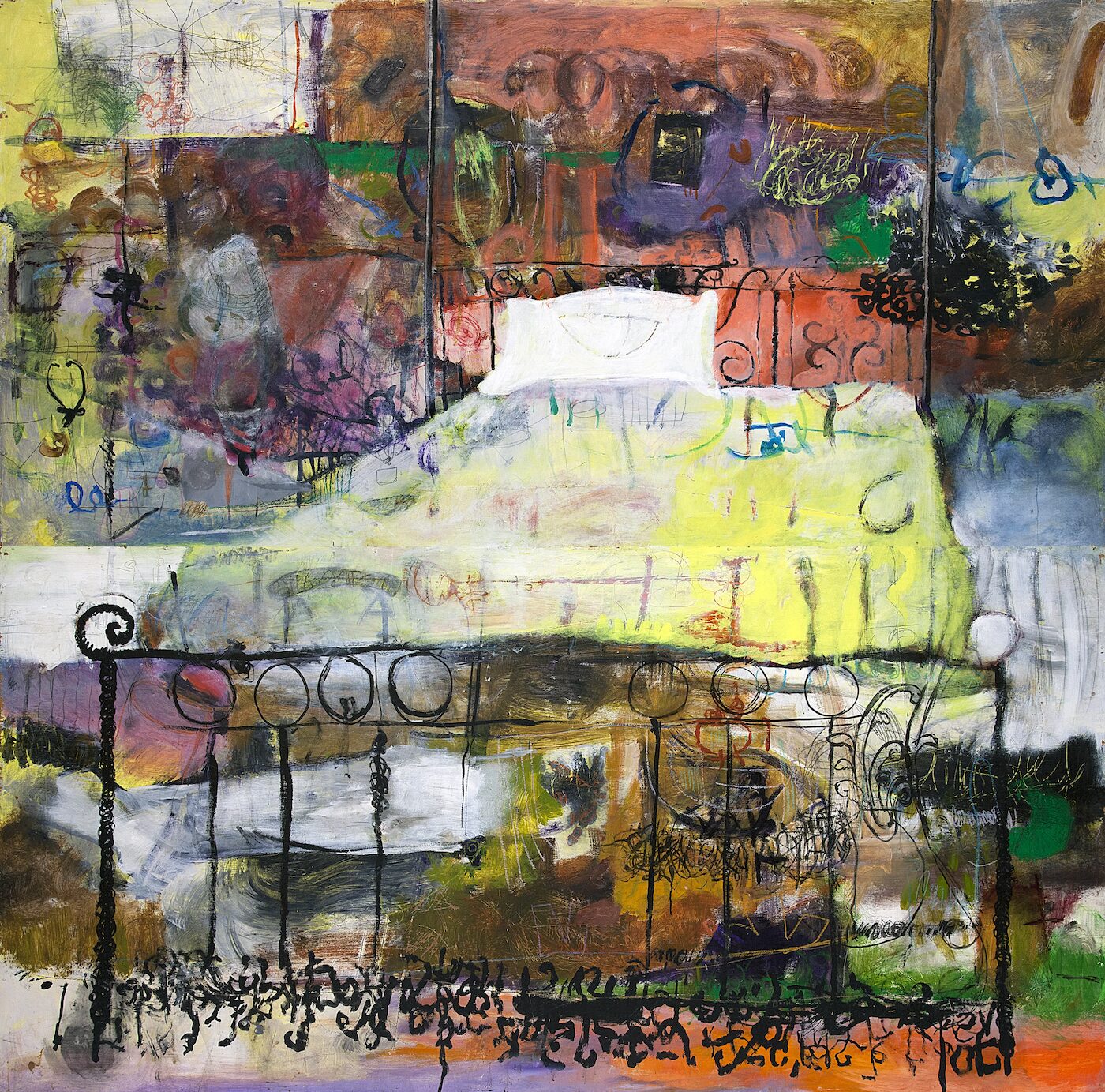
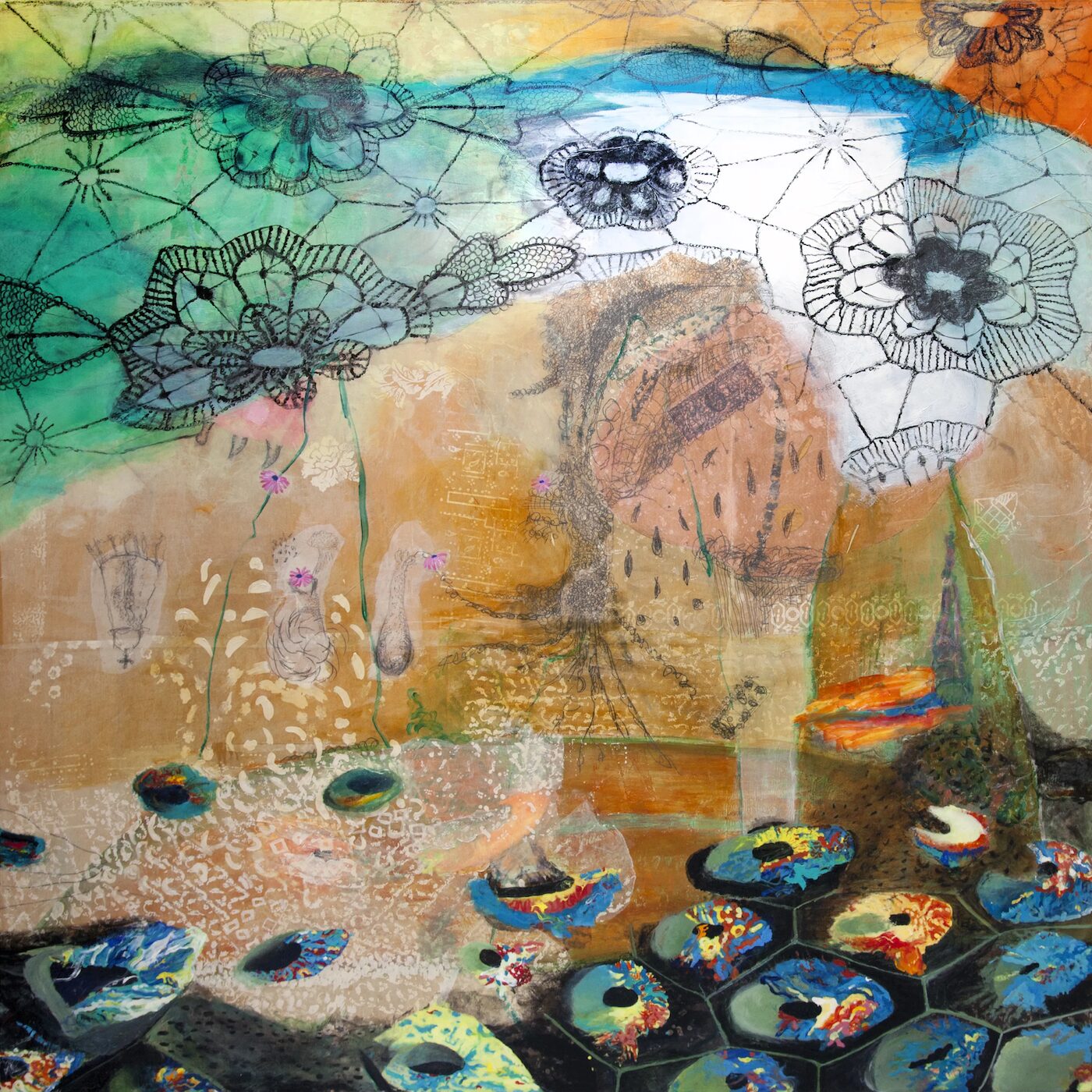
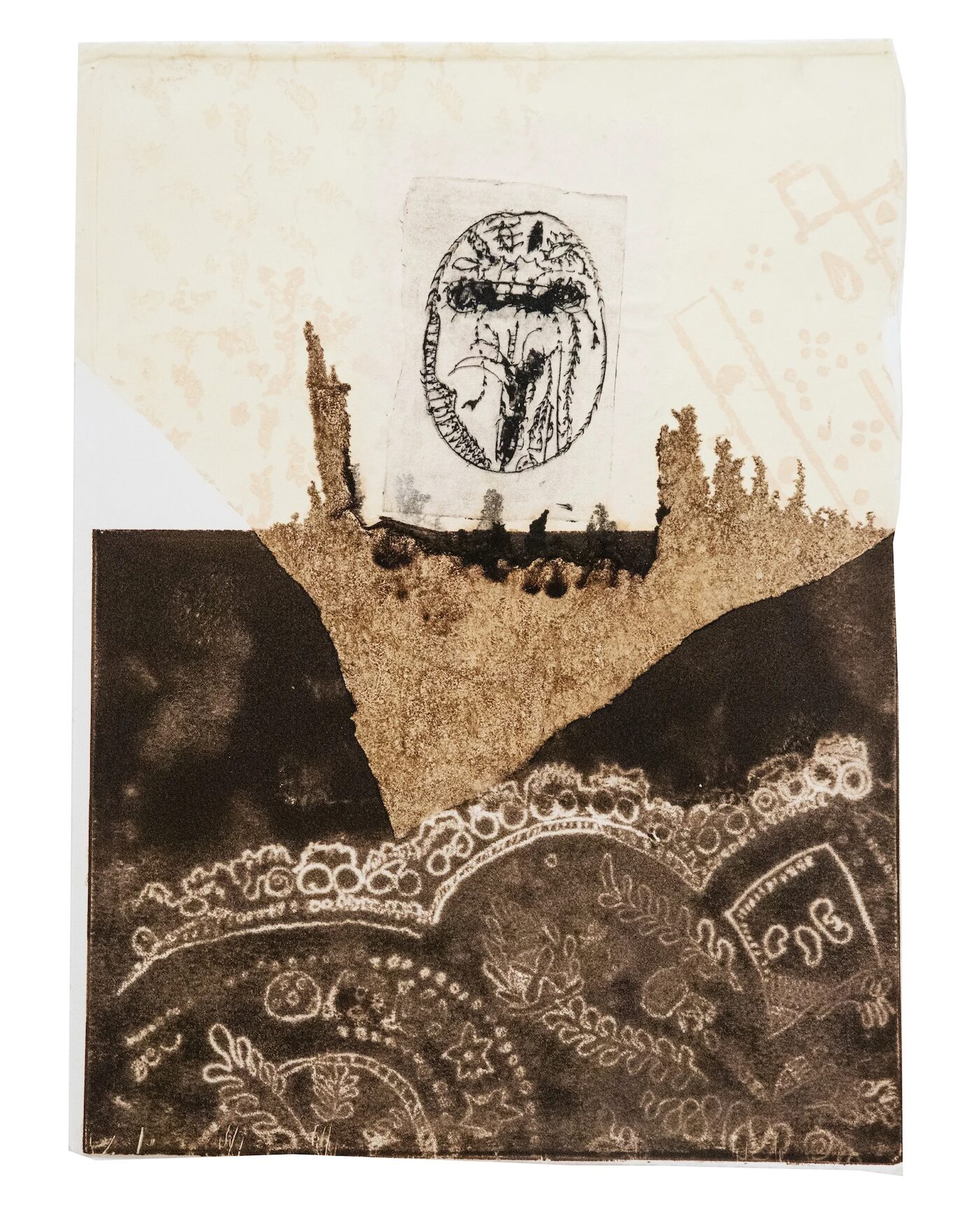
That line lands differently now, in an era when so much art writing wants to prove rather than perceive. Bruton’s practice reminds us that rigor and mystery are not opposites. Her paintings often joined acrylic, graphite, printed paper, ribbon, stenciled pattern, glitter, and collage into surfaces that felt suspended between the seen and the half-remembered. The Boston Art Review account calls them “visual maps” charting territory between the material and spiritual worlds. That is accurate, but perhaps still not enough. The paintings also register as records of feminine life without settling for literalism. Interiors, clothing, lace-like pattern, objects from domestic space, and references to bodily presence recur in her work, but they do so as psychic material. These are not simple depictions of home. They are meditations on what a home stores: memory, refuge, projection, obligation, tenderness, fear.
Interiors, exteriors, and the poetics of refuge
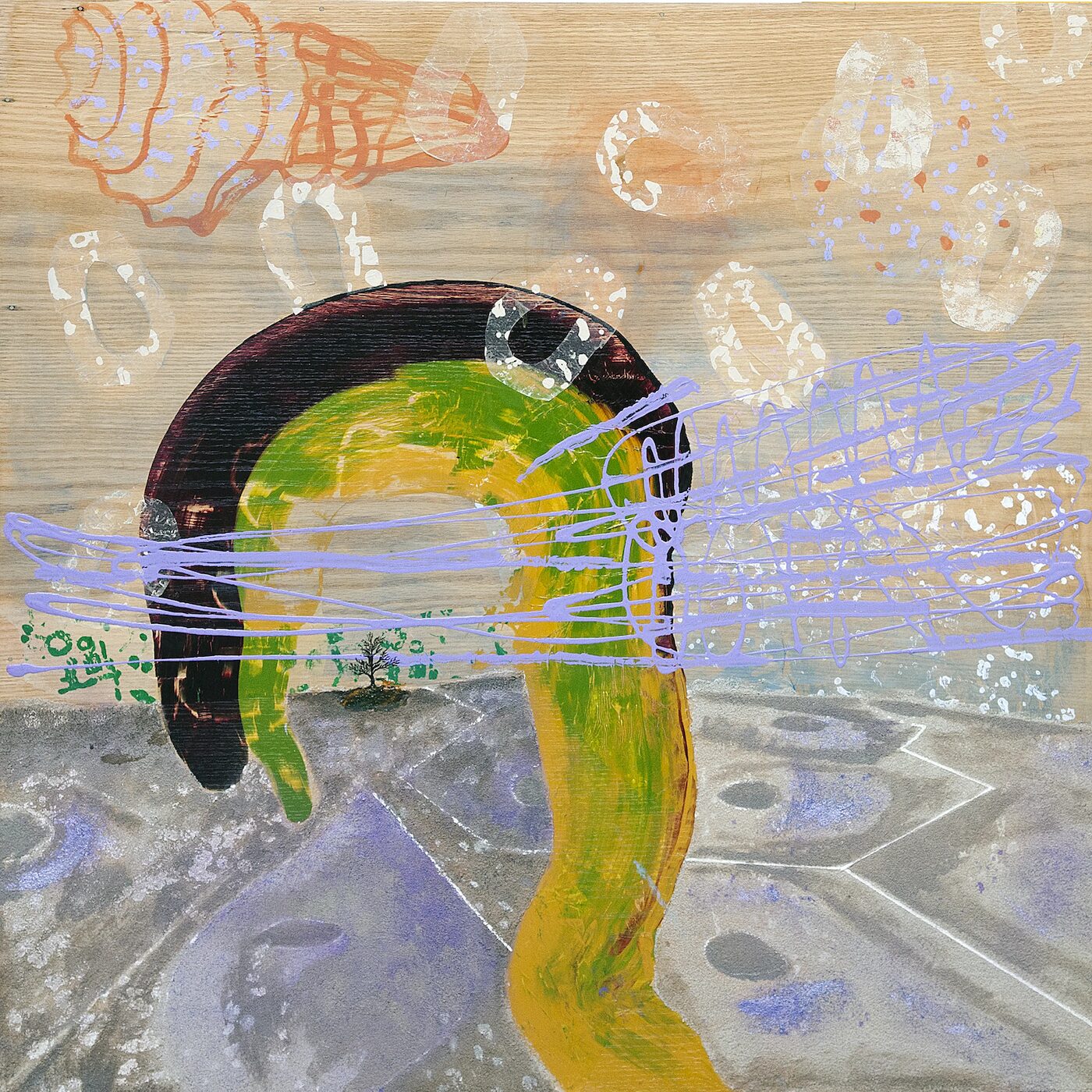
One of the clearest ways to understand Bruton’s evolution is through the movement from interiors to landscapes. According to the Newport Art Museum, she spent much of the 1990s focused on dreamy interiors, then shifted toward exteriors and more otherworldly landscapes in the 2000s. That movement could be read as a kind of expansion, though not a rejection. The inside becomes outside, but the emotional atmosphere remains. The private room becomes a field, a spiritual site, a place of passage. In both phases, Bruton seems interested less in documenting place than in translating what place feels like when memory and consciousness pass through it.
The phrase “sense to soul,” used by the Newport show, is especially apt because it captures the way Bruton’s art appears to move from sensory encounter toward inward revelation. Yet the movement is never cleanly upward or abstract. Her paintings stay committed to matter. A tabletop, a dress form, a fragment of wallpaper-like pattern, a measuring device, a collaged scrap: these things keep the work tethered to lived experience. That tether is important because it separates Bruton from a generic spiritual abstraction. Her work is embodied. It knows gender, household labor, adornment, and the social codes embedded in objects. Even when a painting drifts toward the visionary, it carries material evidence of everyday life along with it.
This is also why the work can feel so contemporary. Bruton made paintings that honored feeling without sentimentalizing it, and honored beauty without surrendering to decorative emptiness. Her surfaces can be lush, but they are never merely pretty. The beauty is tested by abrasion, interruption, and accumulation. Pattern shares space with uncertainty. Elegance shares space with unease. Domestic imagery shares space with spiritual hunger. That balancing act is difficult, and Bruton made it look almost natural.
Feminism, body politics, and The Calculation Project
If Bruton had only been a painter of memory and refuge, that would already be enough to secure her significance. But her work also mounted a sharp critique of how women’s bodies are measured, sold, and psychologically disciplined. The clearest example is The Calculation Project, an early-2000s body of work that used dresses and modified dolls to confront beauty standards and fat phobia. According to Boston Art Review, the project grew partly out of Bruton’s scrutiny of catalog-shopping culture and how consumer imagery shapes self-concept. She used actual measurements from herself, her sisters, and other women to create dresses sized for a woman who wears an American size 24, then embellished them with comic-book images, fur, and artificial flowers. The effect was not just sculptural. It was argumentative.
The argument was that the fashion industry’s beauty ideals were not neutral aesthetics. They were psychological and spiritual violence. Bruton’s dresses, made from vellum and collage materials rather than wearable fabric, turned the fantasy machinery of advertising back on itself. The works were body-shaped but unwearable, alluring but accusatory. They exposed the gap between the “image” woman and the living woman. They also challenged the assumption that critique must arrive in a cold conceptual register. Bruton’s feminist language was materially seductive, visually playful, and philosophically hard-edged all at once.
Boston Art Review places Bruton in dialogue with bell hooks and Judy Chicago, and while that connection is partly interpretive, it is convincing. Hooks matters here because Bruton’s feminism appears tied to Black women’s consciousness, self-worth, and spiritual integrity rather than to a purely institutional rights discourse. Chicago matters because Bruton, like Chicago, understood that women’s experiences had to be made visible through form, installation, and alternative visual language. But Bruton’s treatment of these concerns was distinctly her own. She did not monumentalize womanhood in a single key. She tracked its distortions, its pleasures, its wounds, and its absurdities.
That The Calculation Project was included in the 2002 Gwangju Biennale’s Art to Wear exhibition in Korea is not a minor footnote. It indicates international recognition for a practice that, by then, had found a way to connect painting, sculpture, fashion critique, and Black feminist thought. It also suggests something else: Bruton was operating with far more range than the still-too-common shorthand of “teacher who also painted” would suggest. She was moving across mediums and discourses with real intellectual control.
Bruton’s work insisted that beauty is never just beauty. It is also discipline, fantasy, commerce, memory, and power.
Teaching as artistic practice
For nearly twenty years at RISD, Bruton taught painting while also taking on major leadership roles. She served as painting department head from 2001 to 2003, then as interim dean of graduate studies from 2003 to 2005. The recent reassessment of her life has emphasized that these were not routine administrative titles. According to Boston Art Review, Bruton became the first Black person and first woman to serve as head of RISD’s painting department. That is the kind of fact that should be better known, not only because it marks a personal milestone, but because it tells us something about the institution she entered and changed.
The same feature argues that Bruton often bore the burden of representation inside the school. Her husband, Tim Coutis, is quoted describing her as effectively representing “Black America at RISD,” while advocating for Black students and other students of color. The piece further notes that after Bruton joined the painting faculty, RISD successfully recruited Kara Walker in 1994. The implication is not that Bruton alone transformed the institution, but that her presence helped make new futures possible there. She did the kind of work many Black women in academia know intimately: visible labor, emotional labor, diversity labor, culture-shifting labor, labor that institutions need and frequently under-credit.
This matters for understanding why Bruton may have remained underrecognized as an artist after her death. When a Black woman becomes indispensable to an institution, the institution often narrates her through service rather than through authorship. Boston Art Review names this directly, arguing that her administrative and mentoring roles may have overshadowed her creative practice in broader art-world discourse. That reading rings true. Bruton’s career reveals a recurring American pattern: the Black woman artist who must both make the work and make the room more survivable for others, then wait for history to notice she was doing both.
Bruton’s teaching philosophy itself sounds like an extension of her painting practice. She emphasized “visual intelligence” and individual discovery, and described her courses as “discovery oriented,” directed by assignments meant to aid students in their explorations. “Exploration is the key word,” she said. That line aligns perfectly with the work. Her paintings are exploratory, layered, resistant to closure. She taught students not only how to make paintings, but how to encounter uncertainty without shutting down. In a culture increasingly impatient with slow looking, that pedagogy feels radical.
The problem of modesty in an immodest art world
One of the most useful ideas in the recent writing on Bruton is the description of her practice as a form of “modest painting.” The phrase, drawn in Boston Art Review from art critic Mira Schor, does not mean minor painting or timid painting. It means painting that resists the spectacle economy of contemporary art. Painting that does not scream its importance in order to have importance. Painting that trusts intimacy, slowness, and private intensity. That framework helps explain why Bruton’s reputation did not inflate quickly. She was making work that asked for concentration rather than instant legibility. She was committed to authenticity rather than art-world performance.
This is one reason her rediscovery feels so resonant now. The current art conversation is increasingly interested in archives, overlooked Black women artists, practices of care, and artists whose careers unfolded outside the usual machinery of celebrity. Bruton sits at the intersection of all of those concerns, but she also exceeds them. She was not simply neglected. She was making a proposition. She proposed that painting could still serve as spiritual inquiry without becoming retreatist, that feminist critique could remain sensuous, that domestic imagery could hold philosophical depth, that teaching and leadership could be artistically meaningful, and that Black women need not separate inner life from formal ambition.
It helps, too, that there are now clearer institutional markers of her legacy. Her work is in the collections of the RISD Museum and the Newport Art Museum, and records associated with her career also note the Gwangju Biennale connection and other private holdings. Cade Tompkins Projects has managed her estate and played a major role in posthumous exhibitions, including a two-part 2018 presentation and later promotion of the Newport retrospective. These are the mechanisms by which a legacy becomes legible, but in Bruton’s case they feel less like hype than like correction.
Why Donna Bruton matters now
The simplest answer is that the paintings are good—more than good, really. They are intelligent, idiosyncratic, materially rich, and emotionally durable. But that answer is too small. Donna Bruton matters now because her life and work illuminate several long-running truths about American culture and American art.
She matters because she shows how Black artistic lineages are often built through family networks, local mentorship, and self-fashioned study rather than through the neat institutional narratives critics prefer. She matters because her work expands the conversation about Black art beyond the binaries that sometimes flatten it—figuration versus abstraction, politics versus beauty, public statement versus private feeling. Her paintings suggest that Black art can be visionary, interior, domestic, metaphysical, and socially sharp all at once.
She matters because she complicates our sense of what feminist art looks like. Bruton’s critique of the body and the beauty industry was not detachable from spirituality, memory, or tenderness. She understood that misogyny enters the psyche through image long before it becomes law or policy. She understood that the violence of measurement can be hidden behind glamour. And she understood that women’s lives, especially Black women’s lives, often require forms capable of holding contradiction.
She matters because her career exposes how institutions use Black women’s labor. The first Black and first female head of RISD’s painting department should not have needed a decade-plus for meaningful reassessment as an artist. Yet that lag is familiar. Bruton’s life offers a case study in what gets missed when service becomes the dominant frame through which a Black woman is remembered.
She matters because she treated painting as a mode of knowledge. Not branding. Not trend response. Knowledge. She trusted that there were things a painting could know before language could catch up. That may be her deepest lesson. We are living in a time saturated with explanation, statement, positioning, and content. Bruton made works that slowed those reflexes down. She asked viewers to dwell in atmosphere, symbol, and sensation long enough for something truer to emerge.
The unfinished work of recognition
There is still more to recover. The public record on Bruton remains thinner than it should be. Much of the richest recent writing comes not from the biggest national newspapers the culture usually cites as arbiters, but from regional institutions, museum texts, estate materials, and art publications doing the slower labor of reconstruction. That is not a weakness in her story. It is a clue about how artistic history is actually made and remade. Many major artists do not re-enter public consciousness because a single giant outlet anoints them. They return because curators, scholars, family members, local archives, and smaller publications refuse to let the work disappear. Bruton’s current reemergence belongs to that tradition.
That also means the story is still being written. The archival work cited by Boston Art Review—journals, typed reflections, family interviews, institutional records—suggests there is more scholarship to come. The 2022 Newport retrospective was an important step, but not the final word. Neither were the posthumous gallery exhibitions. Bruton seems destined for the kind of expanded critical attention that can finally situate her across multiple conversations: Black women’s art history, spiritual abstraction, feminist material practice, pedagogical legacy, and late-20th-century American painting.
And maybe that is fitting. Bruton’s work was never about arriving at a single fixed reading. It was about passage, relation, layering, and return. It was about what accumulates when you keep looking. Her own language—sense to soul—offers a structure for understanding the artist and the afterlife of her art. First there is sensation: the color, the texture, the fragment, the dress, the room, the landscape. Then there is the slower realization that all of it is carrying more than itself. That the image is also a vessel. That memory is present. That a body is present. That a moral and spiritual argument is present. And then, perhaps, there is recognition.
Donna Bruton did not make paintings that begged to be consumed. She made paintings that asked to be met.
That distinction may be the key to her significance. In a culture that rewards speed, she practiced depth. In an art world that often celebrates noise, she trusted resonance. In institutions that leaned on her visibility, she kept building interior freedom. Her legacy is not only that she painted beautifully, though she did. It is that she insisted beauty could be a vehicle for inquiry, for critique, for healing, for Black womanhood, for spiritual rigor, and for the difficult work of becoming more fully human.
The overdue reassessment of Donna Bruton is, finally, not just about restoring one artist to the record. It is about expanding the record itself—expanding what counts as important, what counts as political, what counts as formal innovation, what counts as legacy. Her life joined mural making and modernist study, Detroit and Delaware, design and painting, feminism and mysticism, teaching and authorship, Black institutional history and deeply private visual language. Few artists manage that kind of synthesis without losing clarity. Bruton did. The result is a body of work and a life that feel newly urgent now, not because they suddenly changed, but because the culture may finally be ready to see what was already there.
More great stories
Where Black Love Lived on the Dial
March 22, 2026
No Comments
What the Art World Missed When It Missed Vivian Browne
March 22, 2026
No Comments