




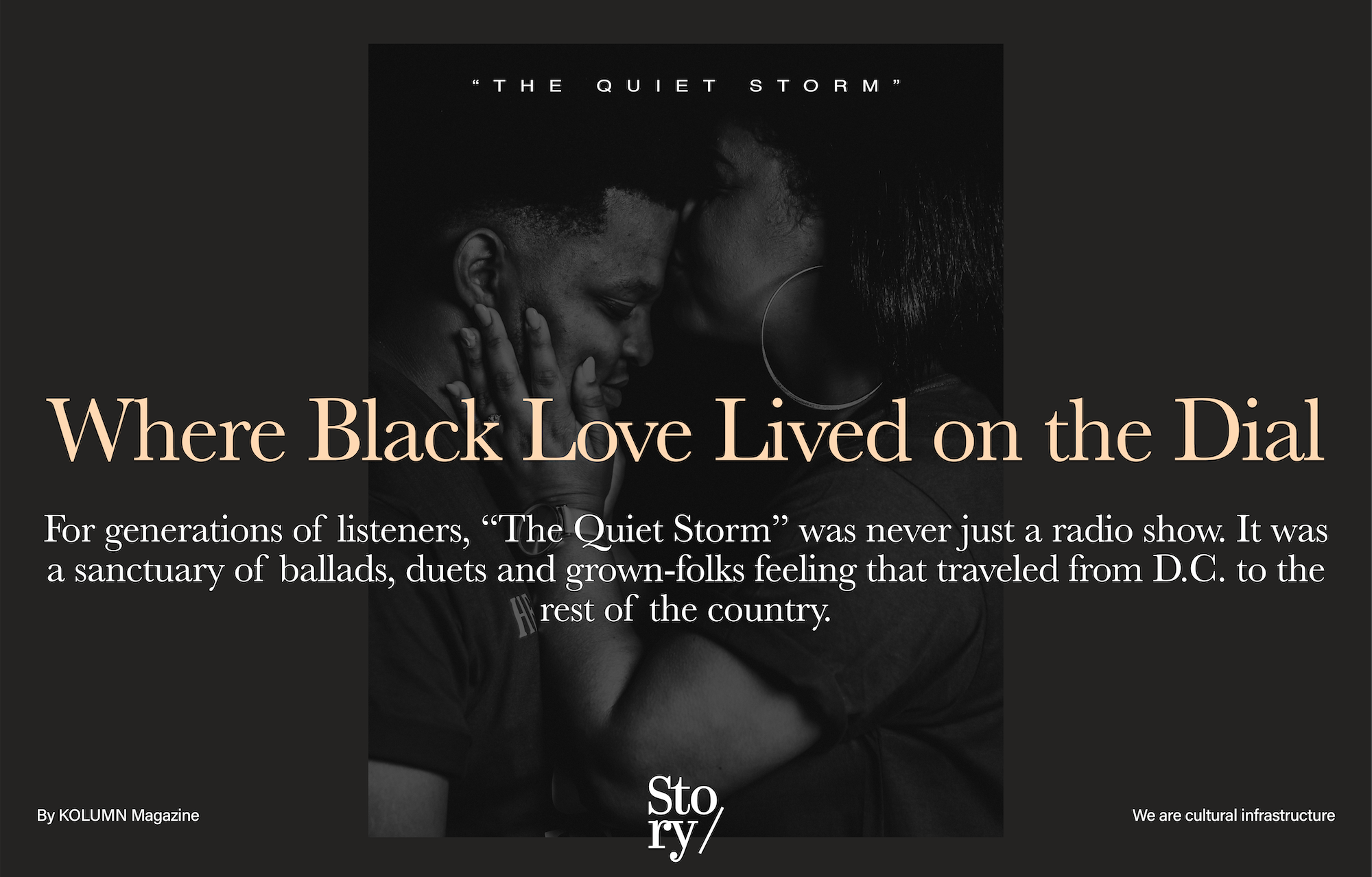
The Quiet Storm did not merely soundtrack Black romance. It dignified Black tenderness.
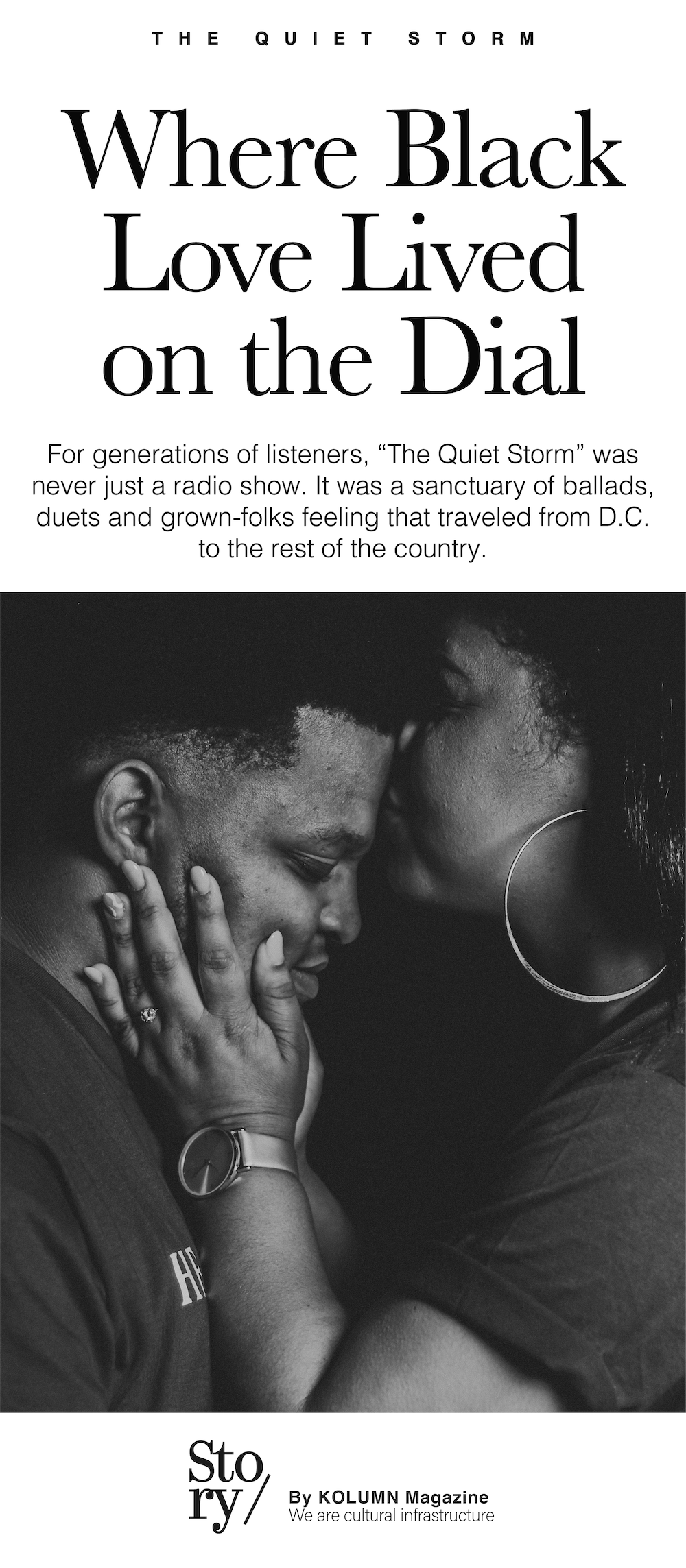
The Quiet Storm did not merely soundtrack Black romance. It dignified Black tenderness.
By KOLUMN Magazine
There are some inventions that announce themselves with fanfare, marketing campaigns and corporate certainty. Then there are inventions that slip quietly into people’s lives until, years later, they feel less like products than like rituals. “The Quiet Storm” belongs to that second category. It began in 1976 at Howard University’s WHUR 96.3 FM in Washington, D.C., when Melvin Lindsey, then a student intern, was asked to fill air time during a labor disruption. WHUR’s own history says he stepped to the mic with little more than records from his basement, a satin-smooth voice, and an instinct for mood. He mixed slow soul, ballads and album cuts into an atmosphere listeners immediately recognized as different. The name came from Smokey Robinson’s 1975 song and album A Quiet Storm, and the format was developed at WHUR by Cathy Hughes and Lindsey together.
Different is almost too small a word for what happened next. The station’s own retrospective recalls listeners dimming the lights and leaning toward their radios, waiting for the next record as if it mattered personally—which, of course, it did. By the late 1970s and into the 1980s, “The Quiet Storm” had become one of the most recognizable after-hours experiences in Black radio. Howard’s account of Hughes credits the format with revolutionizing urban radio and says it eventually aired on more than 480 stations nationwide; other accounts describe its spread more generally as “hundreds” of stations, which may be the safer way to put it. Either way, the core fact is clear: what began on a D.C. campus became a national template.
But “The Quiet Storm” lasted because of something deeper than radio innovation. It became a home for Black Love.
Not just Black romance, though it certainly held that. Not just candlelight and seduction, though it knew a great deal about both. It held Black Love in the fuller sense: closeness, devotion, care, longing, memory, reconciliation, sensuality, emotional safety, grown friendship, household tenderness, community warmth, and that deeply human need to belong to one another. In the ballad, Black listeners heard vulnerability without embarrassment. In the duet, they heard reciprocity, negotiation and trust. In the lyric, they heard lives that sounded like their own—complicated, stylish, bruised, hopeful and still open to love.
That is what made the format so powerful. Black listeners did not come to “The Quiet Storm” because life was easy. They came because life was not. Through economic instability, the afterlife of segregation, urban disinvestment, political betrayal, the crack era, the AIDS crisis, mass incarceration, long workdays, crowded homes, thin budgets and daily acts of racial navigation, Black people kept making room for love. Not as fantasy. As practice. As refuge. As a way of remaining whole.
And because every generation meets love through the songs of its own time, the format never stayed frozen in 1976. The records changed, exactly as they were supposed to. The emotional work did not. One generation found itself in Al Green, Roberta Flack, Marvin Gaye and the Isley Brothers. Another found itself in Luther Vandross, Anita Baker, Sade and New Edition. Another heard the same after-hours truth in Babyface, Toni Braxton, Maxwell, Faith Evans, Boyz II Men and Erykah Badu. The song list evolved decade by decade, but the larger function remained intact: “The Quiet Storm” offered Black America a recurring place to hear love taken seriously. The 1970s, 1980s and 1990s arc reflected in the timeline you provided captures that generational handoff clearly, moving from foundational 1970s soul and romantic R&B to the polished adult balladry of the 1980s and the plush intimacy of 1990s contemporary R&B.
The invention was radio. The breakthrough was emotional
A lot of histories of “The Quiet Storm” stop at the origin story because the origin story is irresistible. A strike. A student. A station. A stack of records. A theme borrowed from Smokey Robinson. All true, and all important. But the real breakthrough was not merely operational. It was emotional.
Lindsey understood that pacing could be its own kind of intimacy. WHUR’s history describes him as a “radio music designer,” and that phrase lands because it gets at what he actually did. He did not just play slow songs. He sequenced feeling. He understood that one song’s afterglow could change the meaning of the next one. He trusted the listener enough not to overtalk the music. Dyana Williams told Oxford American that Lindsey sounded as if he were part of the verses and the chorus themselves. His former collaborator Jack Shuler recalled that the early formula took time to develop, but once it clicked, the understated delivery became part of the show’s genius.
That mattered because Black radio already had volume. It already had urgency, wit, church, politics, community announcements, news, dance records and personality. What “The Quiet Storm” offered was a different emotional register. It whispered where other programming often projected. It lingered where other programming moved quickly. It assumed that Black listeners wanted softness without surrender, sensuality without foolishness, sophistication without coldness. It trusted Black adults with grown feeling.
And Black audiences recognized themselves in that trust.
In public, Black life is often narrated through struggle, resistance, spectacle or trend. The archive tends to be louder about what Black people endured than about how Black people loved. “The Quiet Storm” quietly corrected that imbalance. It made room for the interior. It understood that Black Love deserved not just mention, but atmosphere.
Washington was the perfect cradle
It is difficult to imagine the format being born anywhere other than Washington, D.C. The city had its own political charge in the 1970s, with Black residents asserting a fuller civic identity in the wake of home rule and the rise of Black political power. It was a federal city, a Southern city, a Black city, a stylish city and an ambitious city. WHUR, embedded at Howard University, sat at the intersection of all those energies. Oxford American notes that “The Quiet Storm” hit D.C. during a period of expanding Black political voice and self-governance, while WHUR’s own history frames the show as inseparable from the campus and community that nurtured it.
That context matters. “The Quiet Storm” was not born in a vacuum. It came out of an HBCU ecosystem, out of Black institutional life, out of a station that was both commercial and culturally accountable. Cathy Hughes’s role was central here. Howard’s School of Communications credits her with creating the format with Lindsey at WHUR, and Hughes herself has described thinking in terms of audience lifestyle—what listeners were doing, what they needed, how programming could meet them there. In Oxford American, she put it bluntly: she knew she had an overpopulation of unattached Black women who wanted to be serenaded, even if only by radio.
That line is revealing because it gets at a truth often lost in broader radio history: “The Quiet Storm” was not just aesthetically clever. It was socially observant. It understood the emotional needs of its audience. It understood loneliness. It understood aspiration. It understood what it meant to want companionship, sensuality, reassurance or simply a more beautiful end to the day.
“For Black listeners, the format was not just about being in love. It was about remaining reachable by love.”
And because it understood all that, it became ritual.
It played in kitchens after the dishes were done. In parked cars outside apartment buildings. In dorm rooms, row houses and basement rec rooms. It moved through first dates, marriage ruts, soft reconciliations, late-night phone calls, solitary reflection and household unwinding. Black couples listened together, yes. But so did Black people alone. People healing. People remembering. People hoping. People learning how to stay open-hearted after disappointment. That broader emotional range is exactly why Black Love is the right through-line here. “The Quiet Storm” was never narrow.
The 1970s: when Black Love learned how to breathe on radio
The 1970s gave “The Quiet Storm” its emotional blueprint, and the sequence of records associated with that decade shows why. This was music about grown feeling: devotion, eroticism, hesitation, ache, reassurance, adult complication, and the difficult work of staying emotionally available. The core 1970s run attached to the format includes Al Green’s “Let’s Stay Together,” Billy Paul’s “Me and Mrs. Jones,” Roberta Flack’s “Killing Me Softly with His Song” and “Feel Like Making Love,” Marvin Gaye’s “Let’s Get It On,” Barry White’s “Can’t Get Enough of Your Love, Babe,” the Stylistics’ “You Make Me Feel Brand New,” the Isley Brothers’ “For the Love of You” and “Footsteps in the Dark,” Norman Connors’ “You Are My Starship,” L.T.D.’s “Love Ballad,” Bill Withers’ “Lovely Day,” Heatwave’s “Always and Forever,” Peabo Bryson’s “I’m So Into You,” Phyllis Hyman’s “The Answer Is You,” Bobby Caldwell’s “What You Won’t Do for Love,” Stephanie Mills’ “Feel the Fire” and Angela Bofill’s “I Try.”
Listen to those titles alone and the emotional map reveals itself. “Let’s Stay Together” is not puppy love. It is endurance. “Me and Mrs. Jones” is desire burdened by consequence. “Killing Me Softly” is the shock of recognition. “Let’s Get It On” is sensuality rendered with ceremony. “You Make Me Feel Brand New” sounds like love as restoration. “For the Love of You” sounds like surrender as peace. “Footsteps in the Dark” turns uncertainty into atmosphere. “Always and Forever” makes permanence sound plausible, even luxurious.
This is why the 1970s matter so much to the story. They established that Black Love on the radio could be serious, elegant and full of layers. These songs were not disposable crush records. They were records for people with jobs, histories, children, disappointments and emotional memory. They made room for the full adulthood of Black listeners.
That mattered in a decade when Black public life was still being defined, too often, by pressure. The civil-rights movement had changed law and politics, but it had not erased structural inequality. Cities were absorbing deindustrialization and disinvestment. Black families were navigating instability even while building new kinds of possibility. Under those conditions, “The Quiet Storm” did something culturally profound. It refused to let struggle monopolize Black emotional life.
That refusal is part of Black Love too. Love is not merely what happens when pressure disappears. For many Black people, love has been what gets practiced under pressure. The songs of the 1970s knew that. They did not sound naïve. They sounded lived-in.
Roberta Flack is crucial here. Britannica identifies her as a key figure in the emerging quiet storm sound, with its romantic lyrics, slow tempos and jazz-inflected refinement. That tracks. Flack’s recordings trusted silence and shading. She sang like someone who understood that tenderness is not weakness but command. Marvin Gaye and Barry White gave the format its sensual authority. The Isley Brothers gave it devotional drift. Bill Withers gave it steadiness. Phyllis Hyman, Angela Bofill and Stephanie Mills brought emotional candor that could feel both glamorous and close to home.
For Black listeners, these records did translation work. They said things people felt but could not always say cleanly. They turned desire into language. They turned uncertainty into poetry. They made care audible. And that is exactly why the format stuck.
The 1980s: polish, ache and restoration
If the 1970s established the emotional vocabulary, the 1980s gave “The Quiet Storm” its durable national shape. Britannica’s history of American radio notes that quiet storm emerged from a meeting point between urban radio and adult contemporary, a hybrid that made sense for stations seeking older Black listeners with more settled listening habits. By the 1980s, the format was no longer only a D.C. phenomenon. It had become a recognized programming lane. Howard’s profile of Hughes says it aired on more than 480 stations nationwide, while AFRO and other retrospectives describe it as spreading quickly across the nation.
“In the hardest years, ‘The Quiet Storm’ made tenderness feel like a form of Black endurance.”
The records associated with the 1980s explain why the expansion felt natural. The decade’s arc includes Al Jarreau’s “We’re in This Love Together,” Luther Vandross’s “A House Is Not a Home” and, with Cheryl Lynn, “If This World Were Mine,” James Ingram’s “Just Once,” Patti Austin and James Ingram’s “Baby, Come to Me,” Marvin Gaye’s “Sexual Healing,” Grover Washington Jr.’s “The Best Is Yet to Come,” DeBarge’s “All This Love,” the Isley Brothers’ “Between the Sheets,” Michael Jackson’s “The Lady in My Life,” Peabo Bryson’s “Tonight, I Celebrate My Love,” Art of Noise’s “Moments in Love,” Lionel Richie’s “Hello,” Billy Ocean’s “Suddenly,” Chaka Khan’s “Through the Fire,” Force MDs’ “Tender Love,” Stevie Wonder’s “Overjoyed,” René & Angela’s “You Don’t Have to Cry,” Anita Baker’s “Sweet Love,” “Giving You the Best That I Got” and “Caught Up in the Rapture,” Brenda Russell’s “Piano in the Dark,” Michel’le’s “Something in My Heart,” Maze’s “Silky Soul,” and New Edition’s “Can You Stand the Rain.”
That is one of the great late-night lineups in Black music history. It is also a master class in how Black Love sounds when it has lived a little. Luther Vandross, maybe more than any male singer of the decade, understood adult longing as architecture. His versions of “A House Is Not a Home” and “If This World Were Mine” are not just performances; they are emotional spaces people step into. Anita Baker brought something equally important: elegance without distance. Her records felt immaculately arranged but still intimate, like a perfectly set table in a house where people actually live. Chaka Khan’s “Through the Fire” took devotion to the edge of the dramatic without losing its emotional truth. “Can You Stand the Rain” asked, in plain terms, one of the most important questions any love song can ask.
That question had special force in the 1980s because so many Black communities were moving through seasons of widening inequality, urban disinvestment, the crack epidemic, punitive policing and the hard ideology of Reagan-era policy. Black households carried enormous stress. Under those conditions, “The Quiet Storm” did not function simply as escape. It functioned as restoration.
Restoration is a better word than escape because it suggests return rather than denial. The format let Black listeners return to themselves, and to one another, after a day spent navigating harsher social terms. It gave couples room to recover their tenderness. It gave single listeners room to keep believing in intimacy. It gave households a soundtrack for calm that did not pretend the world outside was calm too.
Berklee’s 2025 profile of Amani Roberts, author of a recent book on the format, quotes him describing R&B as an emotion, an experience and a way of life. He argues that quiet storm dominated airwaves for more than two decades and helped artists such as Luther Vandross, Whitney Houston and Boyz II Men reach broader audiences. That broad cultural impact matters, but so does the personal angle in Roberts’s reflection: the music got him through hard times and stayed with him in the best times too. That is exactly how the format worked for many Black listeners. It became both companion and archive.
“In the hardest years, ‘The Quiet Storm’ made tenderness feel like a form of Black endurance.”
It is tempting, when talking about beloved radio figures, to focus only on voice. Lindsey’s voice absolutely mattered. It was part of the seduction of the format. But the deeper gift was curation.
WHUR’s own history says Lindsey often worked without a rigid playlist and leaned on album cuts from the records he loved in private. The Washington Post, in his obituary, remembered a show built from romantic and sometimes moody music by artists such as Smokey Robinson, Sarah Vaughan, Ashford & Simpson, Barry White, Stevie Wonder and Diana Ross. Oxford American adds that Lindsey and Shuler learned early that the D.C. audience would always respond to acts such as the Isley Brothers and Phyllis Hyman. Together, those accounts make something clear: Lindsey did not merely follow the culture. He arranged it.
That arrangement changed lives in ways hard to quantify. The Washington Post reported that in his final broadcast, Lindsey took calls from listeners from his hospital bed as he was dying of AIDS-related complications in 1992. Cathy Hughes told the paper that because WHUR was where he started, that was where he wanted to end it. That closing circle says something profound about the relationship between Lindsey and his audience. They did not experience him as a distant format mechanic. They experienced him as a trusted emotional presence.
Even that final chapter deepens the through-line of Black Love. The care around Lindsey in his final weeks, described in The Washington Post and in broader remembrances, belonged to the same emotional world his programming had long made possible: one in which intimacy, loyalty and tenderness were taken seriously. The format may have centered music, but its lasting force came from the human bonds it helped people rehearse.
The 1990s: a new generation, same hunger
By the 1990s, Black popular music had changed. Hip-hop had reorganized the center of gravity. New jack swing had sped up the room. Contemporary R&B was sleeker, more conversational, sometimes more explicit, and increasingly in dialogue with rap production and culture. But “The Quiet Storm” did not collapse under those changes. It adapted, because the need it served was older than any one production trend.
The decade’s sequence includes Babyface’s “Whip Appeal,” Quincy Jones’s “The Secret Garden,” Lisa Fischer’s “How Can I Ease the Pain,” Peabo Bryson’s “Can You Stop the Rain,” Tracie Spencer’s “Tender Kisses,” Toni Braxton’s “Love Shoulda Brought You Home,” Sade’s “No Ordinary Love” and “Cherish the Day,” Vanessa Williams’ “Love Is,” Janet Jackson’s “Any Time, Any Place,” Boyz II Men’s “I’ll Make Love to You,” Luther Vandross’s “Always and Forever,” Faith Evans’s “Soon as I Get Home,” D’Angelo’s “Brown Sugar,” Maxwell’s “Ascension (Don’t Ever Wonder),” Erykah Badu’s “Next Lifetime,” Rachelle Ferrell and Will Downing’s “Nothing Has Ever Felt Like This,” Walter Beasley’s “Visions,” Dru Hill’s “Beauty,” Case’s “Happily Ever After,” and Jon B.’s “They Don’t Know.”
What connects those songs is not sameness but seriousness of feeling. Babyface made intimacy sound hand-tailored. Toni Braxton brought cool devastation. Sade remained unmatched at turning reserve into heat. Janet Jackson made desire sound private even at pop scale. Boyz II Men mainstreamed lush vulnerability. Maxwell and D’Angelo brought in neo-soul textures without losing the format’s low-lit core. Faith Evans, Erykah Badu and Jon B. each, in different ways, made the emotional interior feel contemporary again.
This is where the generational logic of “The Quiet Storm” becomes easiest to see. Every generation embraces the songs relative to its own release dates because every generation needs its own language for intimacy. The people who had dimmed the lights to Al Green and Roberta Flack in the 1970s could grow into Luther and Anita in the 1980s, then hear new shades of love and longing in Babyface, Toni Braxton, Maxwell and Faith Evans in the 1990s. The format did not ask listeners to stay in one era. It asked them to stay in touch with feeling.
That continuity mattered in the 1990s too, because for all the decade’s sheen, Black America was navigating recession, punitive criminal justice policy, civic abandonment, the continuing AIDS crisis and the emotional disruptions of changing urban life. The songs may have been glossier. The need for belonging was no less real.
“The Quiet Storm” met that need by refusing to trivialize Black desire. It treated Black Love as layered: hopeful and wounded, sensual and reflective, romantic and communal. Someone listening alone to “Next Lifetime” was still in the same emotional universe as the couple slow-dancing to “I’ll Make Love to You.” Someone holding onto a marriage through “Always and Forever” was in the same world as someone rebuilding trust through “Can You Stop the Rain.” The songs differed. The larger work—making Black feeling audible—remained the same.
Why the format spread
The simplest explanation for “The Quiet Storm’s”’ national adoption is that it worked. It attracted listeners, held audiences and created a valuable adult R&B lane for stations. But that explanation, while true, is incomplete.
It spread because it solved a cultural problem. It gave Black radio a stable, repeatable form for intimacy. It turned mood into programming without emptying mood of meaning. It recognized that Black audiences wanted more than hype, and that grown listeners, especially, wanted records that respected patience, yearning and emotional complexity. Howard’s account of Hughes says the format revolutionized urban radio; NBC Washington, in a documentary package on Lindsey, describes the show as the blueprint for a new music format that spread from D.C. outward.
And because it spread through Black communities first, the format carried social meaning along with musical meaning. It helped normalize the idea that Black Love was not fringe material or special-occasion sentimentality, but central emotional content. It made the soundtrack of Black adulthood legible to itself.
There is something politically meaningful in that, even if the songs themselves were not overtly political. The format’s existence argued that Black people deserved beauty, atmosphere and emotional privacy. It argued that softness belonged in Black public culture too. That may sound simple now. It was not simple then.
The quiet part was the point
A lot of American culture rewards Black loudness when it can market it and punishes Black emotion when it cannot categorize it. “The Quiet Storm” sidestepped that trap. Its quietness was not passivity. It was intention.
The format carved out a zone where Black listeners could hear themselves not as symbols, not as crises, not as trends, but as people with inner weather. That is why the phrase still resonates. A storm is force. Quiet is control. Put them together and you get something close to the emotional truth of Black life itself: intensity managed with grace.
That is also why the legacy remains larger than nostalgia. The DNA of “The Quiet Storm” is everywhere—in adult R&B radio, in streaming slow-jam playlists, in late-night “grown and sexy” formats, in the way critics still use “quiet storm” to describe a certain kind of romantic, jazz-touched, emotionally literate Black music. Berklee’s recent coverage of Roberts’s book frames the format as something that defined American music, and that does not feel like overstatement.
Because what “The Quiet Storm” really defined was permission: permission for Black tenderness to be central, permission for the intimate to be elegant, permission for love to be treated as serious cultural material.
The place where Black Love kept speaking
Melvin Lindsey died in 1992 at 36, but the format he helped shape outlived him by decades. WHUR still treats “The Original Quiet Storm” as a living legacy, and the broader tradition he helped launch remains audible across radio and digital culture alike. The endurance makes sense. Formats survive when they continue doing useful emotional work.
“The Quiet Storm” did that work for generations of Black listeners. It made room for couples and for solitude. For sensuality and for healing. For longing and for loyalty. For people who had someone to hold and people who were still waiting. For Black Love as romance, yes, but also as mutual care, family feeling, community warmth, memory, strength and belonging.
That is the deepest reason it mattered. It let Black people hear love not as luxury, but as lifeblood.
The songs changed with the years, just as they should have. Al Green gave way to Luther. Anita Baker made room for Sade. Babyface opened the door for Maxwell and Faith Evans. Each generation embraced the records that belonged to its own present tense. But the larger promise stayed intact: after dark, on the dial, Black people could still find a place where their tenderness sounded like home. The decade-by-decade arc of the 1970s, 1980s and 1990s song canon makes that inheritance unmistakable.
And maybe that is the clearest way to say it.
“The Quiet Storm” was not just a radio program.
It was a public language for private feeling.
It was where Black Love kept speaking.
More great stories
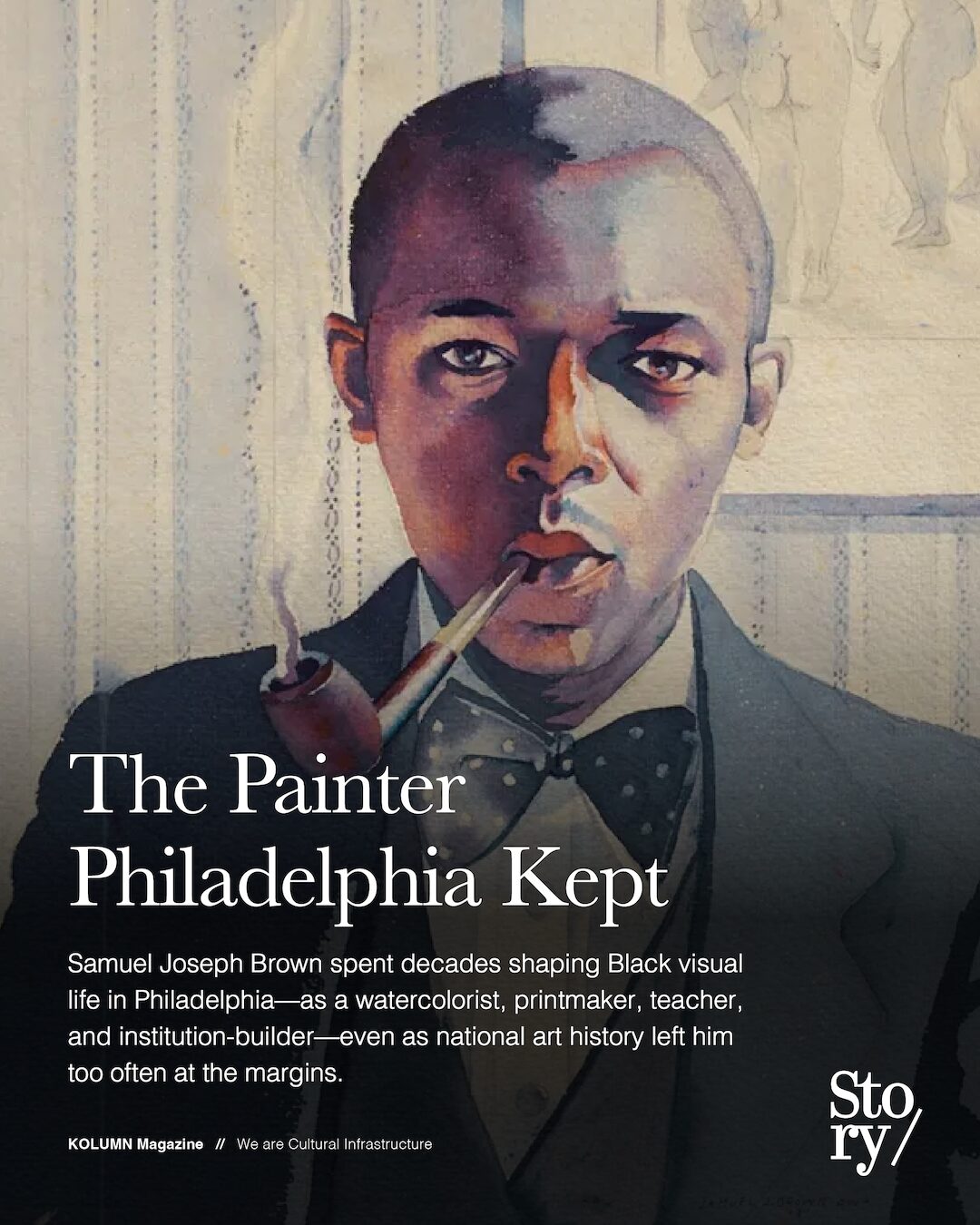
The Painter Philadelphia Kept
March 21, 2026
No Comments
The Marriage That Threatened Jim Crow
March 21, 2026
No Comments