



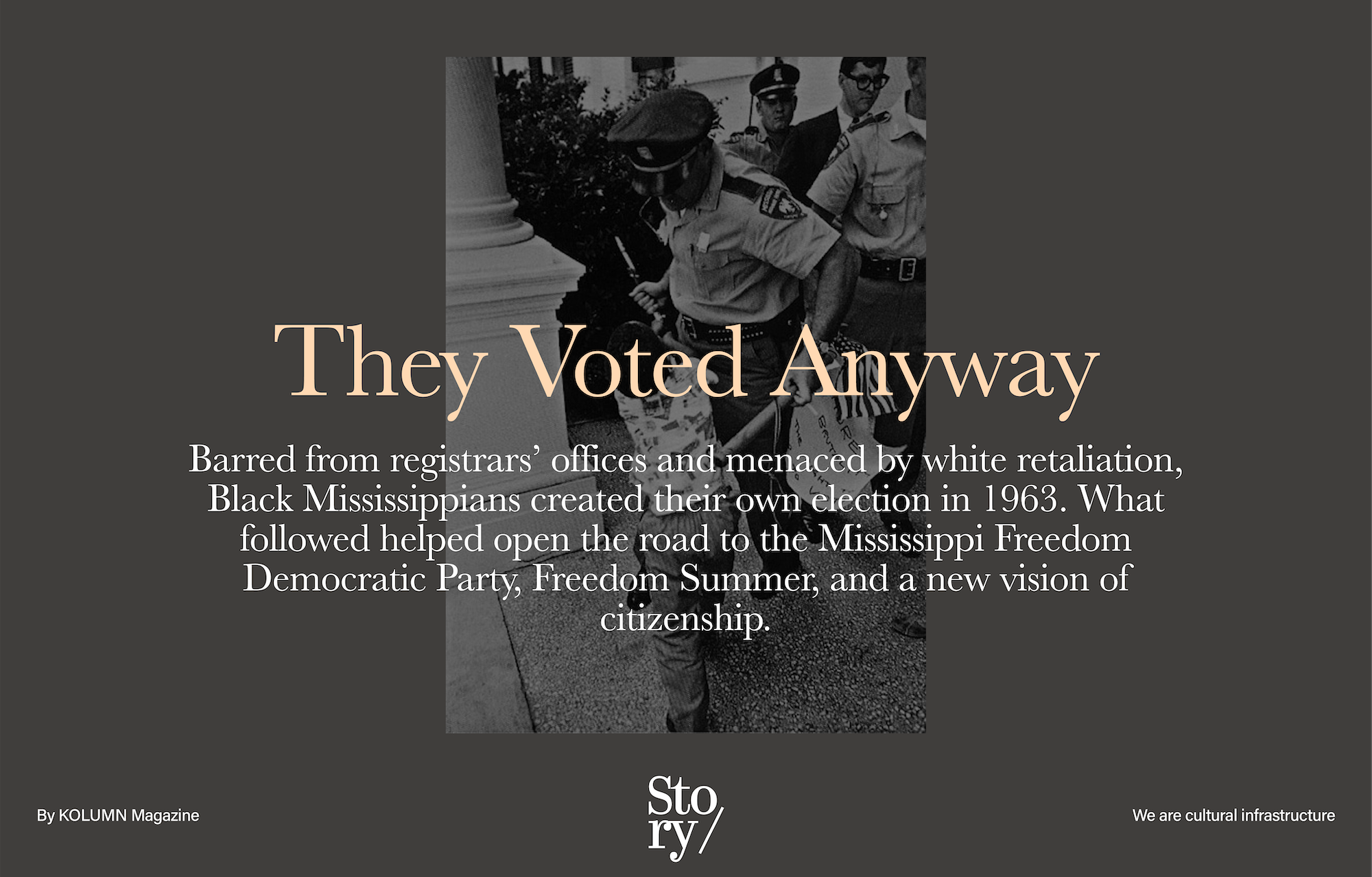
The Freedom Vote was called “mock” because Mississippi’s legal system refused to recognize Black citizenship. The courage behind it was anything but pretend.
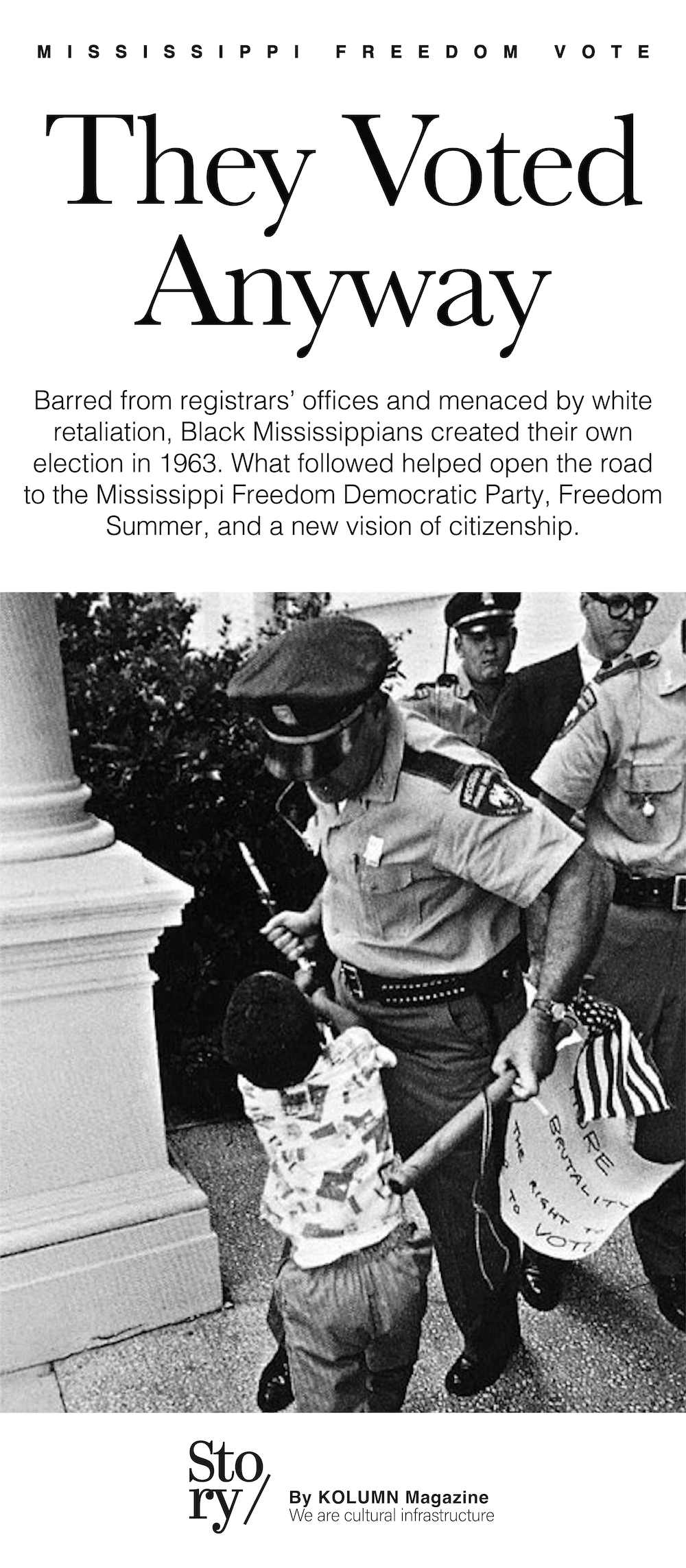
The Freedom Vote was called “mock” because Mississippi’s legal system refused to recognize Black citizenship. The courage behind it was anything but pretend.
By KOLUMN Magazine
In the fall of 1963, Mississippi was still functioning as a democracy in name and a racial oligarchy in practice. Black Mississippians paid taxes, worked the land, built churches, raised families, and sustained towns across the state, but in the eyes of Mississippi’s political system, most of them did not count. Registration procedures were intentionally hostile. White registrars had broad discretion to reject Black applicants. Poll taxes, literacy tests, constitutional interpretation requirements, and the threat of eviction, firing, arrest, and violence turned voting into a gauntlet. In that landscape, the Mississippi Freedom Vote emerged as one of the most inventive and revealing acts of the civil rights era: a parallel election designed to show what would happen if Black citizens were allowed to vote like citizens.
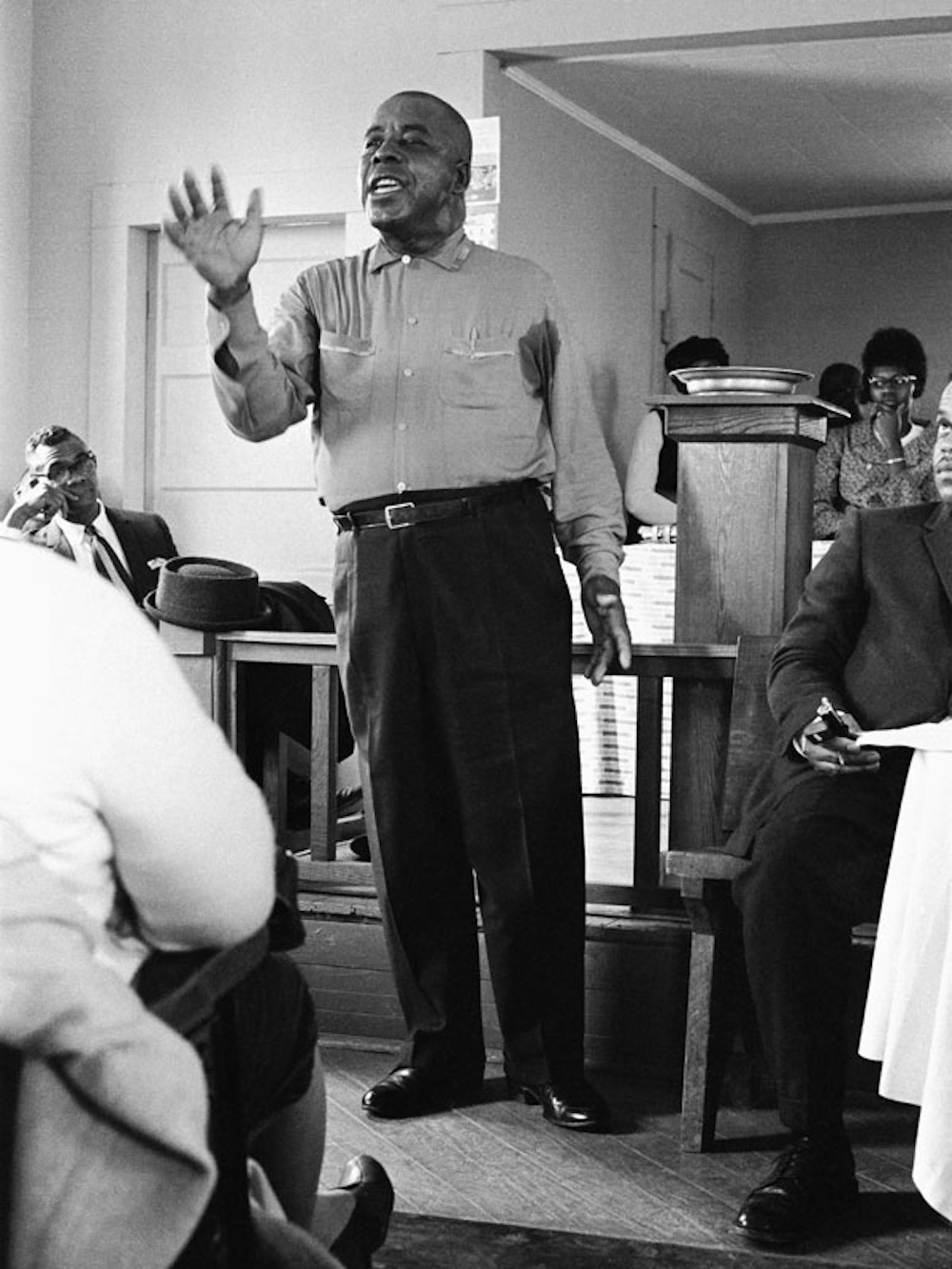
The Freedom Vote, sometimes called the Freedom Ballot, was organized in 1963 by the Council of Federated Organizations, or COFO, the coalition linking Mississippi’s major civil rights groups, including SNCC, CORE, NAACP, and SCLC allies in the state. Its immediate purpose was to coincide with Mississippi’s gubernatorial election, a contest in which the official political system excluded most Black people while still claiming legitimacy. COFO’s organizers proposed a simple but radical counterpoint: if the state would not let Black Mississippians participate in a real election, they would stage one themselves. That act was protest, political education, data collection, and movement-building all at once.
To understand why the Freedom Vote mattered, it helps to begin with the scale of exclusion it confronted. In the fall of 1963, SNCC’s Freedom Vote history notes that only about 12,000 Black Mississippians were registered to vote. PBS, describing the broader Mississippi crisis that the 1964 Freedom Summer would inherit, reports that less than 7 percent of the state’s African Americans were registered in 1964, despite Black residents constituting majorities in many counties. These numbers were not accidental. They were the result of a system built over decades to keep Black political power theoretical, fragmented, and punishable.
That system shaped not only who could cast a ballot, but who could imagine themselves as a political actor. White Mississippi had spent generations insisting that Black civic participation was unnatural, dangerous, or impossible. The genius of the Freedom Vote was that it challenged all three assumptions at once. It gave people a ballot. It gave them candidates. It gave them polling places. It gave them a public, collective experience of voting in full view of the communities that had long been told they did not belong in politics. Mississippi Encyclopedia notes that the campaign aimed not just to dramatize exclusion, but also to expose African Americans to the mechanics of voting and to nurture Black political institutions. That detail matters. This was not merely theater for northern cameras. It was infrastructure for citizenship.
The Freedom Vote ticket itself told a story. At a convention in Jackson in October 1963, delegates nominated Aaron Henry for governor and Edwin King for lieutenant governor. Henry, a Clarksdale pharmacist and NAACP leader, represented established Black leadership with deep roots in Mississippi organizing. King, a white chaplain at Tougaloo College and civil rights activist, embodied the interracial coalition that the movement was trying to build in defiance of a state order premised on rigid segregation. Several histories identify the Henry-King slate as the first serious Black-white integrated ticket for Mississippi statewide office since Reconstruction. In a state where Reconstruction had been recast by white power as a nightmare rather than a democratic experiment, that symbolism was direct and deliberate.
It is easy, decades later, to misread a parallel election as a symbolic stunt. But the organizers did not think that way, and neither did the people who participated. SNCC’s account recalls Mike Miller explaining that although everyone knew it was not the state’s official ballot, people also understood that showing up publicly to vote was itself a test. To cast a Freedom Vote ballot meant stepping into a visible space and declaring, before neighbors and enemies alike, that one believed oneself entitled to political voice. In Mississippi in 1963, that was a dangerous declaration. White employers could retaliate. White Citizens’ Councils could pressure lenders or landlords. Sheriffs could harass organizers. The Klan did not need formal authority to make fear effective.
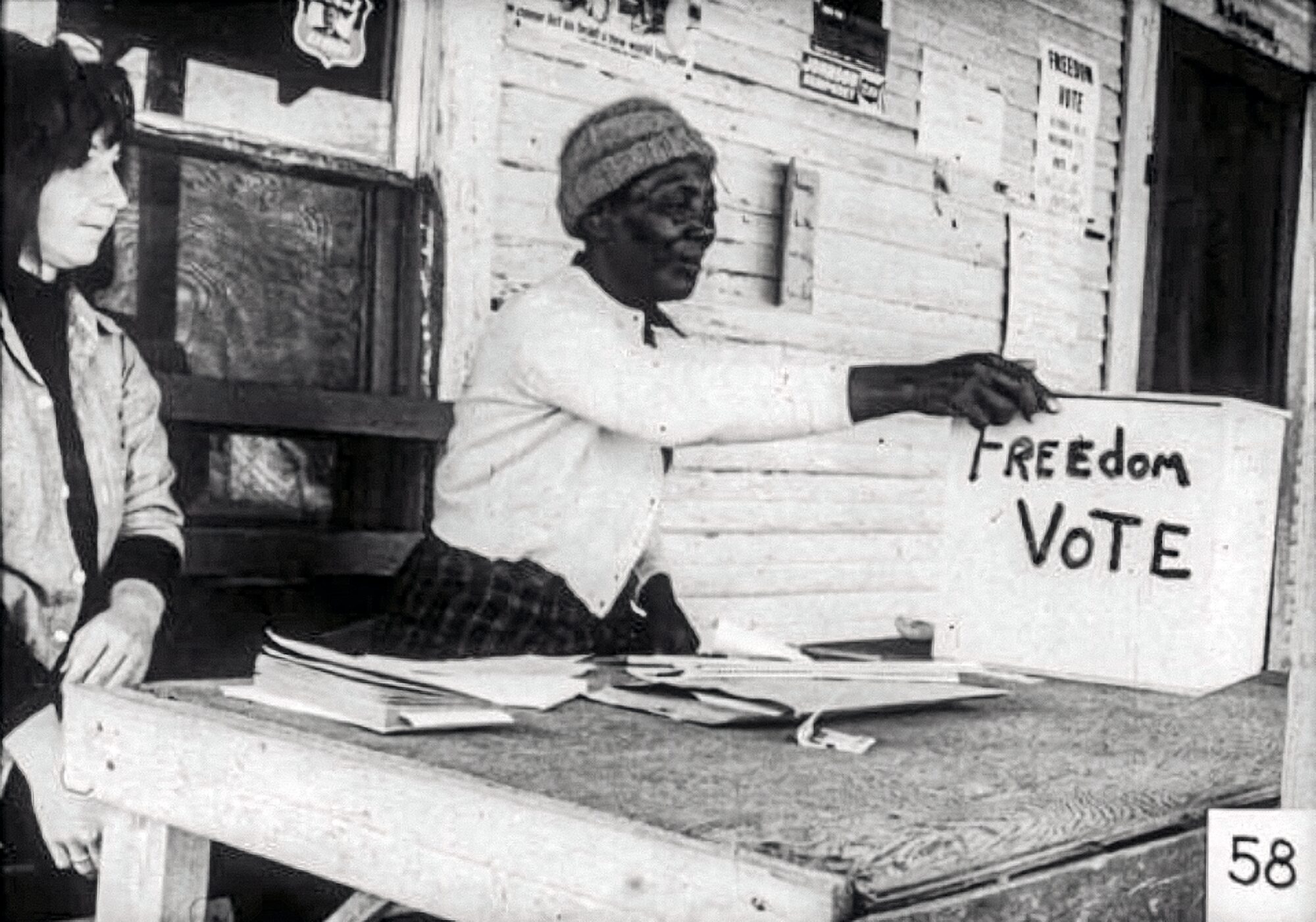
The mechanics of the campaign reveal just how grounded it was. Polling places were set up in churches, stores, community spaces, beauty parlors, and pool halls. Civil Rights Movement Archive documents from the period show organizers thinking with pragmatic precision about where to place polling sites and how to maximize participation. A surviving sample ballot listed the official Democratic and Republican candidates alongside the Freedom Vote candidates, making the point visually and politically: Black Mississippians were being asked to compare the choices the state recognized with the political alternative the movement was building.
This was also an organizing campaign in the deepest sense of the word. People had to be persuaded to trust one another, to risk visibility, and to participate in something that could not deliver an immediate legal payoff. Volunteers canvassed, spoke in churches, organized mass meetings, distributed literature, and explained the meaning of the ballot. Mississippi Encyclopedia credits Allard Lowenstein and other organizers with helping shape the campaign, but the actual force behind it was local: Black Mississippians who understood county power structures, knew which households were reachable, and could read the risk level of every invitation. The Freedom Vote worked because it was not imposed on Mississippi communities from outside; it was built through them.
That point can get lost when Freedom Summer tends to dominate public memory. The Mississippi movement did not spring fully formed in 1964. It was preceded by years of dangerous local organizing and by experiments like the Freedom Vote that tested capacity, exposed weaknesses, and created new political habits. Stanford’s King Institute describes the 1963 Freedom Vote as one of COFO’s first major Mississippi efforts and notes that it sought to prove that Black Mississippians would vote in large numbers absent discriminatory barriers and terror. SNCC’s broader materials place the campaign inside a long organizing tradition in which voter registration was never just a bureaucratic process; it was a mechanism for community transformation.
The numbers alone made the state’s exclusion impossible to dismiss. Here the historical record offers a useful nuance. SNCC’s event page says that 83,000 Mississippians cast ballots for Henry and King. Other sources, including Mississippi Encyclopedia and later summaries based on archived tallies, give the figure as 78,869, often rounded to “more than 80,000.” Rather than a contradiction, the discrepancy reflects the difference between final tabulations and rounded movement memory. What matters is the scale. Even the lower figure dwarfed the number of Black Mississippians formally registered in much of the state apparatus that year, and it demonstrated beyond argument that the supposed absence of Black voters was the product of suppression, not apathy.
That mattered nationally because segregationists had long relied on a convenient fiction: that Black southerners either did not want to vote or were not prepared to do so responsibly. The Freedom Vote demolished that fiction. It showed not only that Black people would vote, but that they would organize an election under conditions of intimidation, with little formal protection, and with a seriousness that made Mississippi’s official democracy look thin by comparison. In that sense, the Freedom Vote was evidence. It generated a record. It gave civil rights workers something concrete to show national journalists, clergy, foundations, elected officials, and liberal allies who still spoke about southern disfranchisement in abstract terms.
The timing was also strategic. The Freedom Vote coincided with Mississippi’s real gubernatorial contest, where segregationist politics were mainstream politics. The state’s official ballot did not merely operate within a racist system; it helped reproduce one. By placing Aaron Henry and Edwin King before voters in a parallel contest, the movement asked a pointed question: what would Mississippi politics look like if the people most affected by the state’s brutality could meaningfully shape it? That question was about more than electoral outcomes. It was about legitimacy itself.
Aaron Henry’s prominence in the campaign is especially important. Mississippi State University’s exhibit on Henry and the Freedom Vote credits him heavily in the campaign’s creation and emphasizes the ballot’s role in encouraging Black voter participation. Henry occupied a position that movement histories sometimes flatten: he was both a grassroots figure and an institutional bridge, able to translate between local Mississippi realities and national civil rights networks. His candidacy helped make the Freedom Vote feel serious rather than merely demonstrative. It said, in effect, that Black Mississippians were not only asserting a right; they were asserting standards for governance.
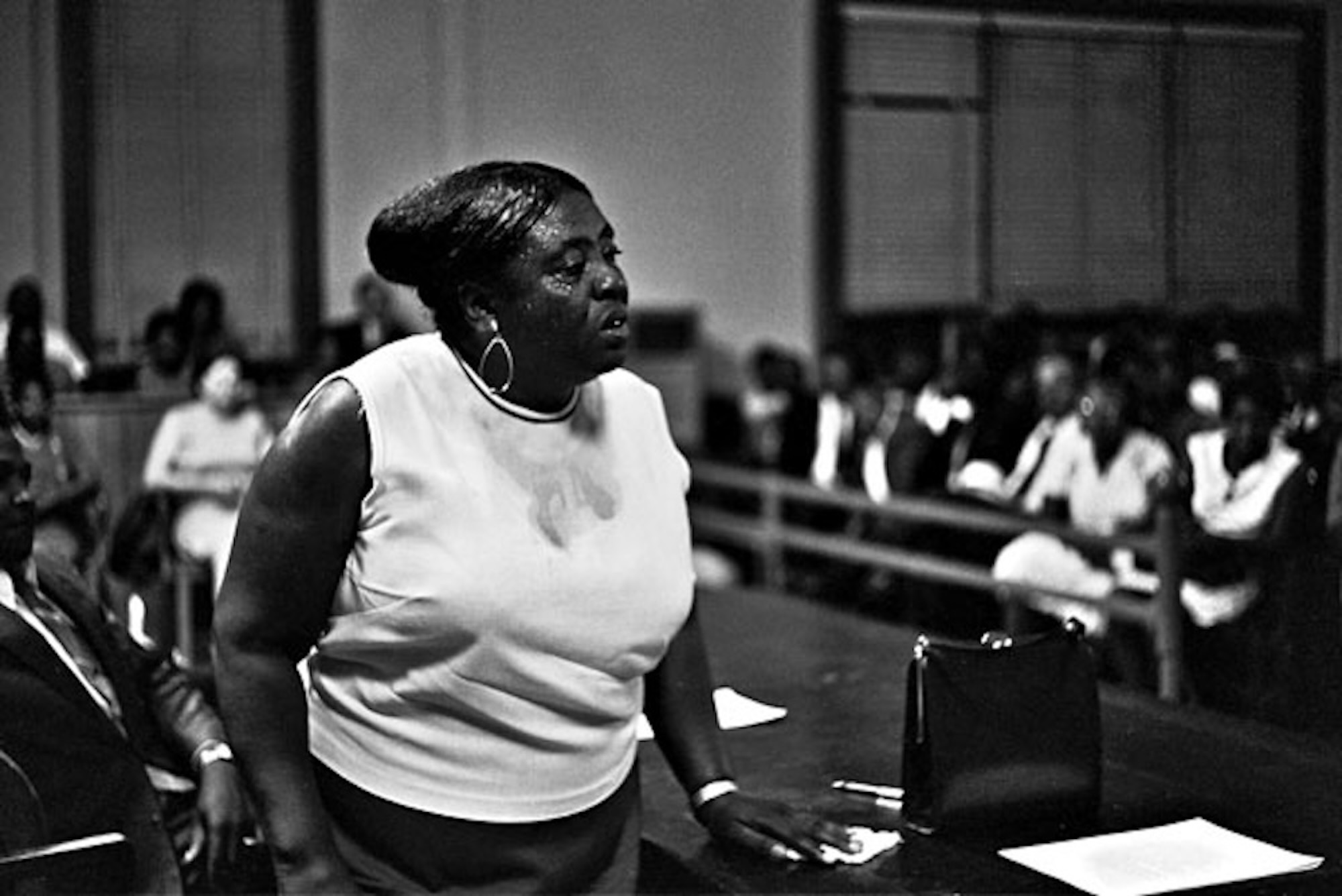
Edwin King’s presence on the ticket also mattered in ways that exceed symbolism. Mississippi’s racial order depended on the idea that white dissenters were illegitimate and Black autonomy was unthinkable. An integrated ticket therefore performed a new political possibility in public. It suggested that alliances across race could be organized around justice rather than white control. That may sound obvious now. In Mississippi in 1963, it was incendiary.
The campaign’s physical geography tells another part of the story. Churches became polling stations because they were among the few institutions Black communities controlled with relative autonomy. Beauty parlors, stores, and pool halls became civic spaces because formal civic space had been denied. This was a recurring pattern in Black political history: where the state closed the front door, Black communities made a side entrance and called it democracy anyway. The Freedom Vote belongs in that lineage, alongside mutual aid societies, independent schools, freedom houses, and mass meetings that did the work of citizenship before the state would acknowledge it.
Another reason the Freedom Vote matters is that it changed movement strategy. Stanford’s entry on COFO identifies the campaign as a precursor to Freedom Summer, and SNCC’s materials say plainly that the Freedom Vote “laid the foundation” for the next year’s mass organizing. That is not just institutional self-congratulation. The campaign provided a proof of concept. It showed that large-scale political mobilization in Mississippi was possible, that volunteers could be deployed, that local networks could sustain turnout, and that a statewide initiative could unify scattered county struggles into a common narrative.
Freedom Summer in 1964 is often remembered for its influx of hundreds of mostly white northern students, the murders of James Chaney, Andrew Goodman, and Michael Schwerner, and the founding of Freedom Schools. All of that deserves memory. But Freedom Summer also built directly on the practical lessons of the Freedom Vote. PBS and Stanford both frame 1964 as an effort to draw national attention to the violent suppression of Black voting rights in Mississippi while expanding grassroots organizing. The Freedom Vote had already demonstrated the core fact beneath that strategy: the obstacle was not Black disengagement, but white repression enforced through law and terror.
Just as importantly, the Freedom Vote helped prepare the ground for the Mississippi Freedom Democratic Party, or MFDP. SNCC and Mississippi Encyclopedia both describe the MFDP, founded in 1964, as a parallel political party open without regard to race and intended to challenge the legitimacy of Mississippi’s all-white Democratic Party. That institutional move did not come from nowhere. The Freedom Vote had already trained communities to imagine a parallel democratic structure. It had already shown that official exclusion could be met by counter-institutions rather than passive outrage. Once people have held a parallel election, building a parallel party no longer sounds impossible.
That is one of the Freedom Vote’s most enduring lessons: democracy is not only a set of rules handed down by legitimate authority. It is also a set of practices people can claim, perform, and defend when authority becomes the problem. In this respect, the campaign was not only tactical but philosophical. It asked what makes an election real. Is it the state’s blessing, even when the state is openly racist? Or is it the presence of actual citizens publicly exercising collective will? Mississippi’s white establishment had the law. The movement had the better argument.
The Freedom Vote also complicates the way civil rights history is often narrated around charismatic leaders and climactic legislation. It was not centered on Washington. It did not produce a famous march or a single unforgettable speech. It was painstaking and local. It required meetings, rides, mimeographs, training, persuasion, and a thousand calculations about danger. That makes it especially important, because it shows how the movement actually worked on the ground. The voter registration struggle in Mississippi was an organizing struggle before it became a legislative victory. The Voting Rights Act of 1965 did not descend onto empty terrain; it landed on soil prepared by people who had already forced the country to confront the absurdity and cruelty of disfranchisement.
There is another human layer here that deserves emphasis: dignity. Histories of disfranchisement often focus on barriers, which they should, but those barriers also carried emotional consequences. They were designed to humiliate. To be turned away by a registrar, to be quizzed arbitrarily on constitutional clauses, to fear losing a job for trying to register, was to be told over and over that one’s citizenship was conditional. The Freedom Vote pushed back against that psychological regime. It allowed Black Mississippians not only to protest exclusion, but to inhabit belonging. For a few days in November 1963, they did not ask permission to be citizens. They acted like citizens.
More great stories
The Marriage That Threatened Jim Crow
March 21, 2026
No Comments
A Bomb on Christmas Night, A Warning to a Movement
March 21, 2026
No Comments