





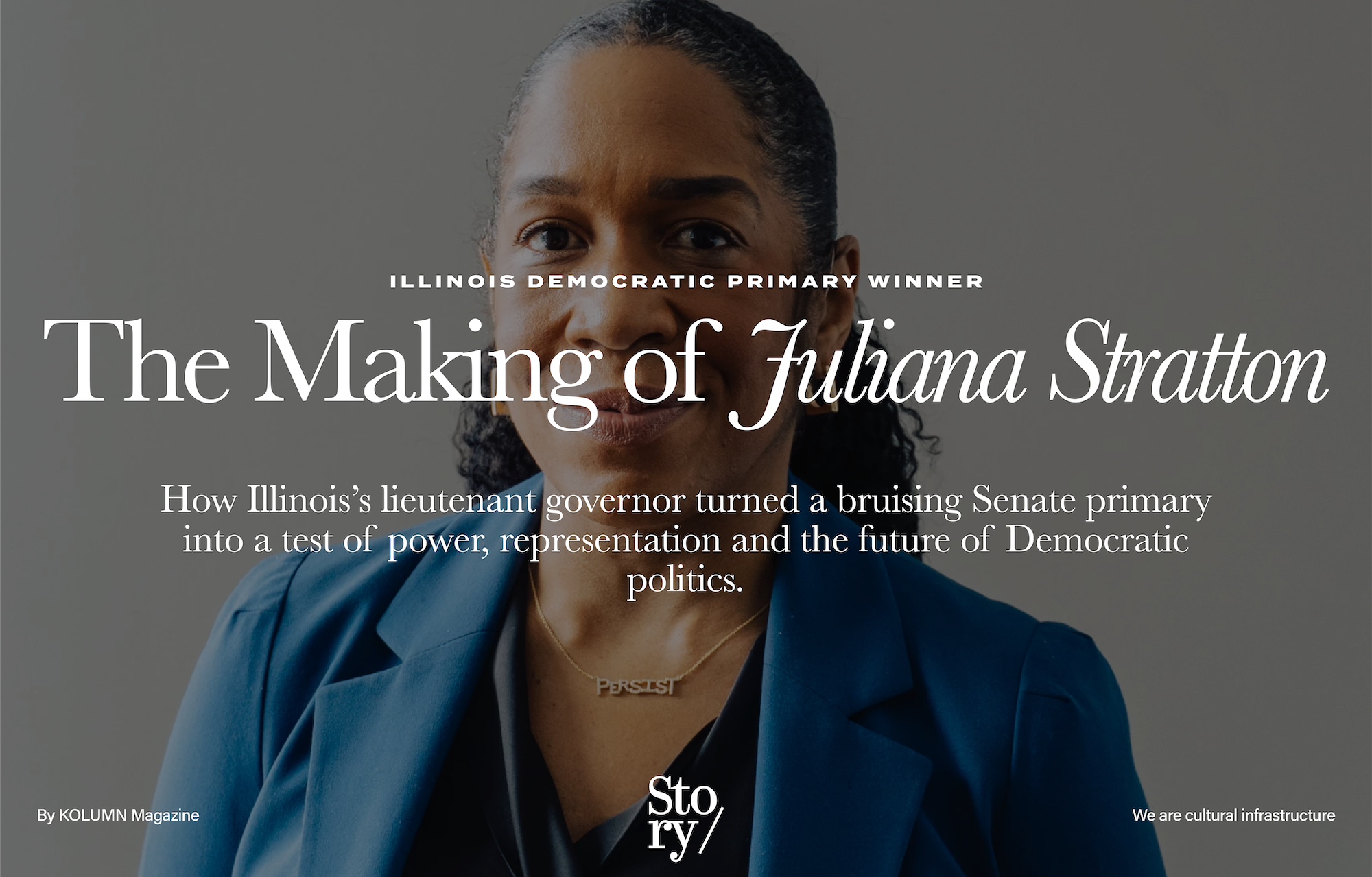
Stratton’s win was not just a triumph of message. It was a triumph of fit: biography, office and moment finally aligned.
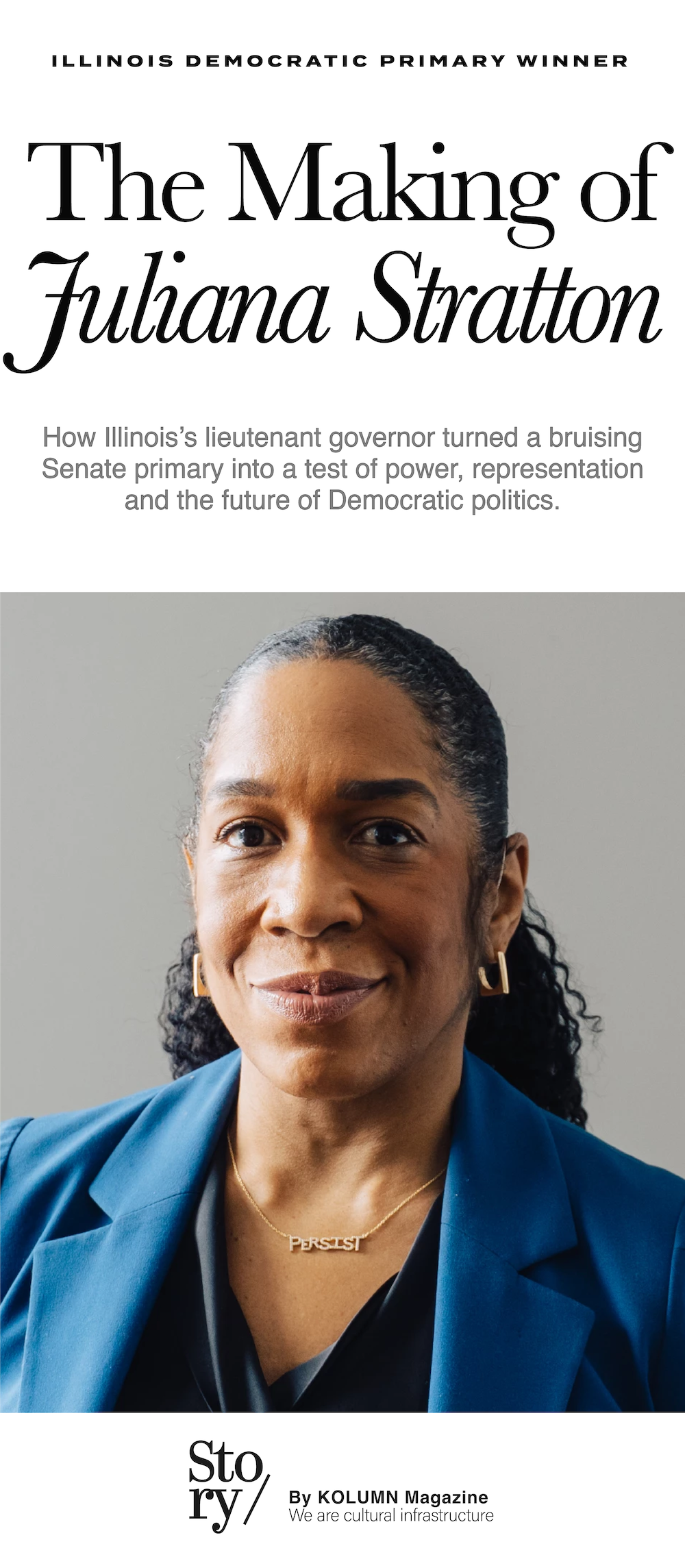
Stratton’s win was not just a triumph of message. It was a triumph of fit: biography, office and moment finally aligned.
By KOLUMN Magazine
When Juliana Stratton won Illinois’s Democratic primary for the open U.S. Senate seat left behind by Dick Durbin, the result landed as more than a clean electoral win. It was a succession battle, a proxy war, a test of billionaire influence, a measure of how much progressive language Democratic primary voters were willing to reward, and a reminder that biography still matters in politics when it is paired with organization and timing. Stratton, Illinois’s lieutenant governor, defeated two sitting members of Congress in one of the state’s most closely watched primaries in years and instantly became the favorite for November in a state that leans reliably Democratic in statewide federal races.
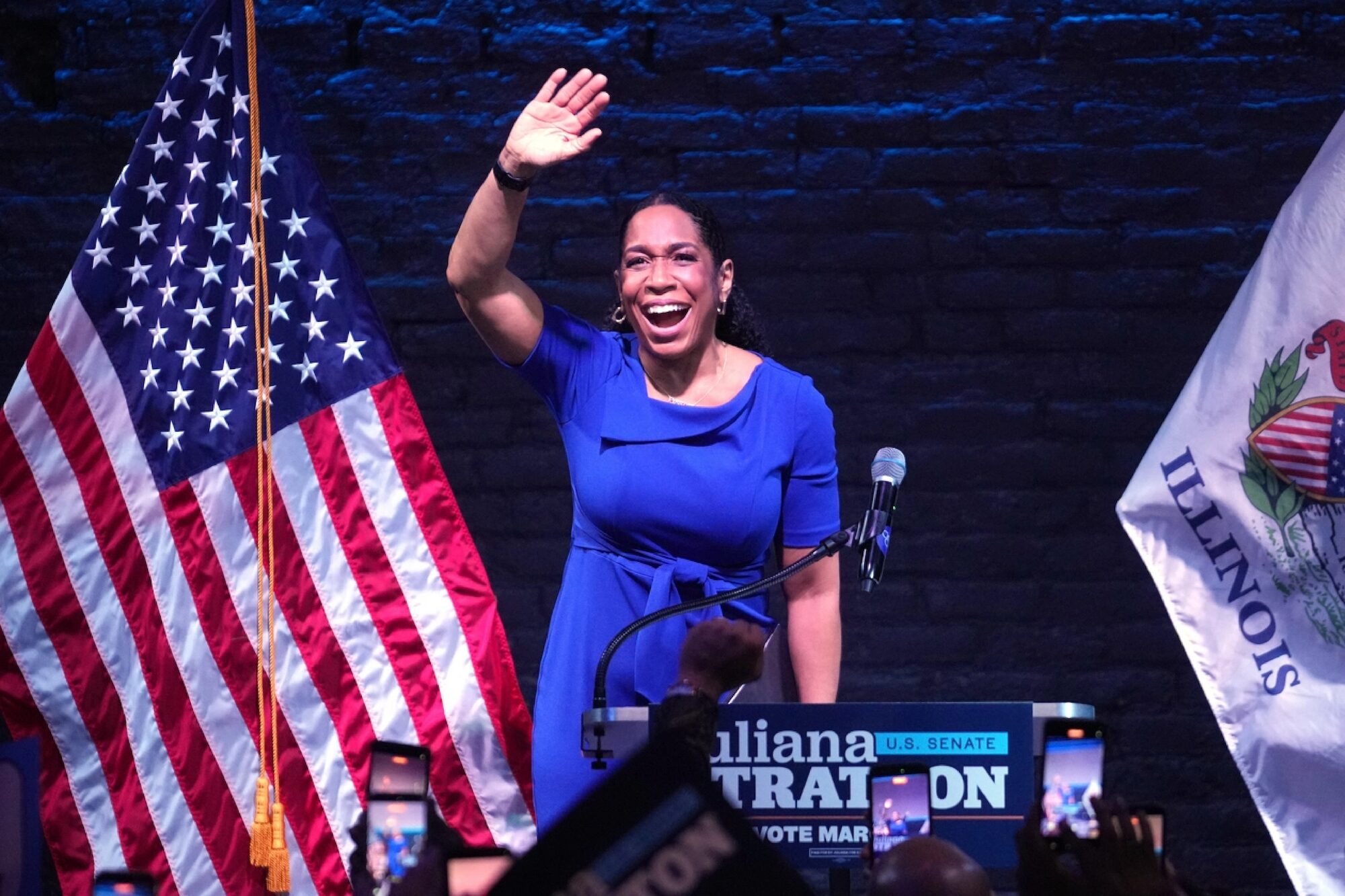
That alone would make the contest important. But the larger significance of Stratton’s victory lies in what kind of candidate she was, what kind of field she beat, and what her win suggested about Illinois Democrats in 2026. She was not the richest candidate in the race. She was not the best-known member of Congress in the field. She did not come into the campaign with the same personal fortune or fundraising machinery as Rep. Raja Krishnamoorthi, nor did she own the same congressional seniority-and-recognition profile as Rep. Robin Kelly. Yet she won anyway, powered by a coalition that included Black voters, Chicago-area strength, institutional support from Governor J.B. Pritzker, and a message pitched as economically populist, culturally fluent and unapologetically combative toward Trump-era politics.
The race mattered because Illinois was not simply choosing a nominee. It was deciding what follows a Durbin era that stretched back to 1996 and, before that, the long tradition of Illinois Democrats building power through layered alliances among Chicago, the suburbs, labor, Black political leadership and statewide institutional networks. Durbin did not endorse a successor, which left the field open and the question raw: would Illinois Democrats choose money, congressional stature, ideological clarity, executive experience, symbolic history, or some combination of the above? In Stratton, they chose a candidate who made the argument that those categories were not mutually exclusive.
Who Stratton was before this race
Stratton did not appear out of nowhere. Before this Senate run, she had already assembled a resume that made her legible to multiple wings of the Democratic coalition. She has served as Illinois’s 48th lieutenant governor since 2019, and official state biographies emphasize a portfolio that includes criminal justice work, rural affairs, women and girls, and other cross-cutting governance priorities. Before statewide office, she served in the Illinois House, and earlier in her career she worked in mediation, public safety and Cook County justice reform. Illinois also notes that she became the first Black woman to serve as the state’s lieutenant governor.
That background mattered because it helped her run not just as a symbol but as an operator. Her Justice, Equity and Opportunity initiative inside the lieutenant governor’s office gave her something many candidates claim and fewer can document: a policy lane tied to criminal justice reform that was both substantive and administratively real. WBEZ reported early in Pritzker’s first term that Stratton was tapped to spearhead the effort, and the lieutenant governor’s office describes it as a first-of-its-kind initiative meant to move Illinois away from punitive approaches and toward more equitable, restorative practices. In other words, by the time she entered the Senate race, Stratton had already spent years translating movement-adjacent language into state-level governance.
That may sound like an inside-baseball point, but it was actually central to her appeal. Democratic voters, especially in a moment of fatigue with Washington, often say they want people who can both speak the language of justice and show receipts. Stratton’s profile let her do that. She could campaign as a progressive without reading like an entirely federalized figure. She could talk about affordability, rights and immigration while still presenting herself as someone who had sat inside government and managed actual portfolios. That distinction became especially useful in a race crowded with television advertising and outside money, where voters had to decide quickly which candidate felt least synthetic.
The seat that changed everything
Open Senate seats are rare. Open Senate seats in blue states are even rarer, because the primary often functions as the real contest. Durbin’s retirement created exactly that kind of race. Suddenly, ambition that had been waiting offstage moved to center. Stratton launched quickly, becoming the first prominent Democrat to enter, and framed her candidacy around “working people” and resistance to Donald Trump. The speed of her announcement mattered. It let her define herself early as a plausible heir to a statewide Democratic lane before the contest fully calcified.
From the beginning, however, this was not a coronation. Krishnamoorthi entered with formidable fundraising power and outside support, while Kelly brought her own base, congressional experience and credibility with many Black voters. The result was a three-way top tier in which each candidate could claim something different: Krishnamoorthi had money and national-tech visibility; Kelly had congressional standing and a long record; Stratton had statewide office, executive proximity and the governor’s orbit. Illinois Democrats were not sorting among amateurs. They were sorting among fully credible contenders.
That is part of why Stratton’s victory deserves to be read carefully. She did not win a thin field. She defeated two sitting House members in a race that became a national story because it gathered several of the Democratic Party’s current tensions into one place: immigration, big money, crypto, the afterlife of party machines, the role of pro-Israel spending networks, and the strategic question of whether primary voters wanted a cautious institutionalist or a sharper-edged fighter.
Money everywhere, but not all money works the same
One of the most revealing things about the Illinois race was how expensive it became, and how little money alone settled it. Reporting from Reuters, The Washington Post and others described a contest awash in outside spending, with Pritzker’s allies boosting Stratton while crypto-backed groups spent heavily around Krishnamoorthi. Fairshake, the crypto super PAC, poured nearly $10 million into the race on Krishnamoorthi’s side, while Pritzker-backed forces spent heavily to lift Stratton. That made the primary look, at times, like a laboratory for two forms of modern Democratic influence: billionaire patronage and tech-money intervention.
And yet the outcome was not a simple story of the highest bidder winning. Stratton had powerful backing, yes, but she still had to convert that support into something voters recognized as organic enough to trust. Krishnamoorthi had huge fundraising totals and major outside support, but wealth in a primary is not the same as warmth, and saturation is not the same as affection. Illinois Democrats appear to have decided that money could amplify a candidacy, but it could not fully substitute for a governing story or a political identity that made sense on contact.
The significance here goes beyond Illinois. Across both parties, primaries increasingly function as tests of whether outside money can force a coalition into being. Sometimes it can. Sometimes it cannot. Stratton’s victory suggests a more complicated truth: outside money matters a great deal, but it matters most when it is reinforcing an existing political fit rather than trying to invent one from scratch. Pritzker’s support helped Stratton; it did not create her. The crypto spending against her made the race sharper; it did not define her. That distinction is politically important, especially as Democrats keep arguing internally about oligarchic influence while relying on wealthy benefactors of their own.
Why her message worked
Stratton ran on a platform that, by recent Senate-primary standards, was not shy. Reuters and AP both highlighted her support for Medicare for All and abolishing ICE, and Reuters also noted her call for a $25 federal minimum wage. In another state, or in another cycle, consultants might have warned that this was too much, too fast, too easy to caricature. In Illinois’s Democratic primary electorate, it appears to have read differently: not as fringe, but as clarity.
There was also context. Reuters reported before the election that backlash to Trump immigration policies had made immigration a central issue in the race, especially amid high-profile tensions involving ICE and Chicago. In that environment, the Democratic candidates were pulled toward stronger positions, but Stratton’s stance helped distinguish her as the clearest progressive in the top tier. Primary voters often reward candidates who seem least afraid of their own convictions, and Stratton appears to have benefited from looking less triangulated than her rivals.
Still, it would be too neat to say she won purely by moving left. She also ran on affordability, middle-class opportunity and practical rights-based politics. Local reporting described her case to voters as broader than ideology alone. She was not asking Illinois Democrats merely to endorse a list of positions; she was asking them to choose a kind of representative voice. That may be the better explanation for her win. Voters did not just hear “progressive.” They heard “fighter,” “statewide,” “working people,” and “ready now.” Those words, in combination, travel farther than policy labels by themselves.
The coalition beneath the result
Available reporting suggests Stratton’s coalition was anchored in Cook County and especially strong among the kinds of voters who still determine Democratic statewide primaries in Illinois: urban voters, Black voters and institutional Democrats comfortable with Pritzker-era governance. The Wall Street Journal reported that her support was powered by Cook County, while other coverage described her as benefiting from endorsements by Pritzker, Tammy Duckworth and Cook County Board President Toni Preckwinkle. In Illinois politics, that is not just a list of names. It is a map of interconnected authority.
But endorsements alone do not explain the emotional logic of the coalition. Stratton occupied a particular symbolic space. She was a Black woman running statewide in a Democratic primary after years of visible service as lieutenant governor, with a reform-oriented portfolio and an ability to speak to both insider and outsider instincts. For many voters, especially Black women who remain the Democratic Party’s most reliable constituency, that combination may have felt overdue rather than merely appealing. Her win was not just accepted; it was legible. It fit a broader pattern in Democratic politics in which Black women are expected to save coalitions but are still too rarely centered as their lead beneficiaries.
This is where the history gets larger than Illinois. If Stratton wins in November, Reuters, The Washington Post and others note that she would become one of only a very small number of Black women ever to serve in the U.S. Senate. The Senate’s own historical materials underscore just how rare such representation has been, with Carol Moseley Braun of Illinois still standing as the first Black woman ever elected to the chamber. That history gives Stratton’s primary victory an unusual charge. She is not simply approaching a promotion. She is approaching a line of continuity that runs directly through one of Illinois’s most resonant political firsts.
The Pritzker question
No serious reading of Stratton’s win can ignore Pritzker. His endorsement and allied spending made the race, in part, a referendum on his influence. National coverage framed the primary as a test of whether the governor could transfer his power to a chosen successor. In raw political terms, he can now claim that he did. That matters not just for Illinois governance but for how he is read nationally, particularly as observers continue to speculate about his future in Democratic presidential politics.
Yet that success comes with a built-in tension. Stratton won with his backing, but the more she advances, the more she will need to show that she is not merely the governor’s extension cord. That is not an accusation unique to her; it is the standard problem facing lieutenant governors, vice presidents and other seconds-in-command who seek top office. The challenge is to accept the lift without shrinking into dependency. Stratton’s task now is to turn a victory that partly affirmed Pritzker’s power into a general-election candidacy that foregrounds her own.
So far, the ingredients for that pivot exist. She has her own biography, her own reform portfolio and her own ideological signature. The question is whether those qualities can become more prominent than the architecture that helped deliver the nomination. In primaries, voters sometimes tolerate the visible hand of party power because they are choosing among familiar Democrats. In general elections, independence tends to test better than inheritance. Stratton does not need to repudiate Pritzker. She needs to stop looking like an appendix to him.
Why this victory matters beyond Illinois
The cleanest interpretation of Stratton’s victory is that Democrats in Illinois wanted someone who looked ready for the present rather than nostalgic for an earlier style of Senate politics. Durbin was a classic institutional legislator. Stratton ran as something different: more movement-aware, more media-native, more direct about conflict, and more comfortable blurring the old line between activist rhetoric and governing ambition. That does not mean Illinois Democrats rejected experience. It means they defined experience differently. Executive service and issue stewardship counted. So did the capacity to sound like the country voters believe they are living in now.
Her victory also says something specific about the Democratic Party’s internal future. For years, party elites have tried to figure out whether primary voters want moderation dressed as pragmatism or conviction dressed as realism. Stratton’s win suggests those categories are no longer so separate. Her politics were plainly progressive, but her candidacy was structured as practical, statewide and governance-ready. That mix may prove increasingly important for Democrats trying to survive the twin pressures of donor politics and base frustration.
There is another level of significance, too: race and gender representation in institutions that have historically resisted both. The Senate remains one of the country’s most exclusive political clubs, and its demographic diversification has come slowly. In 2025, for the first time, two Black women were serving simultaneously in the Senate, according to PBS and Pew reporting. Stratton’s general-election candidacy now enters that still-small historical corridor. Her primary victory does not finish that story, but it enlarges it. It says that in a major Democratic state, a Black woman with an executive record and progressive message can be the vessel for succession rather than the side note to it.
The limits of the moment
None of this means Stratton’s win should be romanticized. Illinois remains a state where power often travels through recognizable channels. She benefited from those channels. The race was heavily financed, sharply messaged and tied to bigger interests than a civics-class idealist would prefer. There is no reason to pretend otherwise. If anything, the primary exposed how dependent even intraparty contests have become on super PACs, elite validators and nationalized issue warfare.
Nor does a Democratic primary victory erase the work ahead. Reuters and AP both describe Stratton as the general-election favorite because of Illinois’s partisan lean, but “favorite” is not the same as “finished.” General elections impose different disciplines. Don Tracy, the Republican nominee, will try to reframe the race around cost of living, geography and the familiar argument that Illinois Democrats are too Chicago-centered. Stratton will need to widen her coalition without sanding down the qualities that made her primary campaign effective.
Still, primaries reveal something real even when they do not foretell everything. This one revealed that Stratton was able to inhabit several political identities at once without collapsing under the weight of any single one. She was reformer and insider, progressive and executive, symbol and administrator. In contemporary Democratic politics, that combination is rare enough to notice. In Illinois politics, it was enough to win.
The meaning of the win
In the end, Juliana Stratton’s Illinois Senate primary victory matters because it answered several questions at once. It answered whether a lieutenant governor can emerge from the shadow of a long-serving senator and two sitting House members. It answered whether a campaign backed by major state power can still feel authentic enough to prevail. It answered whether Black women’s leadership can be treated as central rather than auxiliary in a marquee statewide contest. And it answered, at least for now, what kind of Democrat Illinois wants in the post-Durbin transition: not a placeholder, not a caretaker, but a candidate who sounds like she believes the job should be used, loudly.
That is the larger significance of the primary. Stratton did not just win a nomination. She became the shape of Illinois Democratic succession in real time. In another era, that succession might have gone to the most senior legislator or the best-funded operator. In this one, it went to a candidate who could braid history, governance, coalition politics and ideological confidence into one argument. Whether that argument carries her all the way to the Senate will be decided in November. But the primary already established something durable: Illinois Democrats looked at a crowded, expensive, nationally watched race and decided that Juliana Stratton was not merely viable. She was the person who made the most sense for the moment.
More great stories
The Long Ledger of Black Banking
March 18, 2026
No Comments
Before Detroit, There Was Greenfield
March 18, 2026
No Comments