




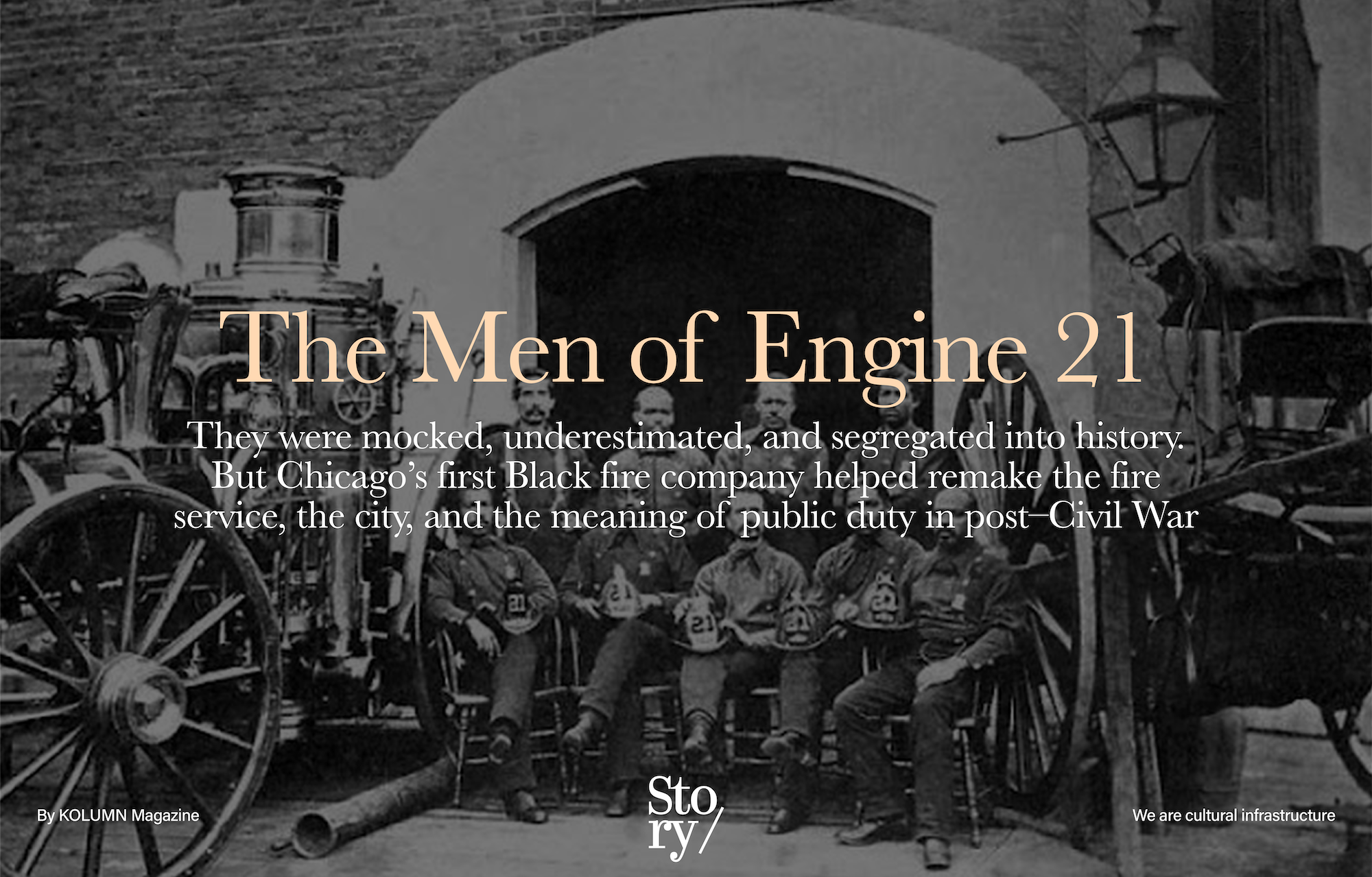
In a city rebuilding from ash, Engine 21 made a radical claim: that Black men belonged not at the margins of civic life, but at its center.
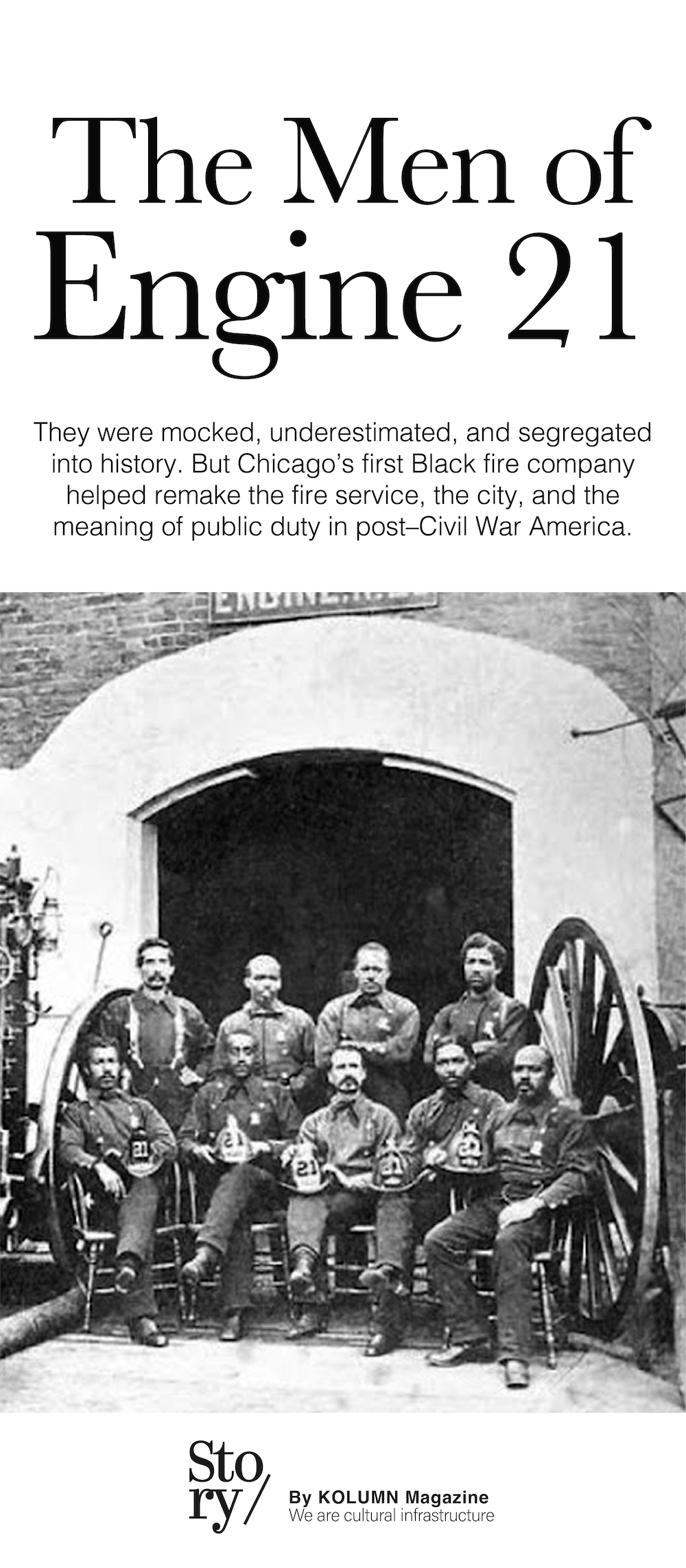
In a city rebuilding from ash, Engine 21 made a radical claim: that Black men belonged not at the margins of civic life, but at its center.
By KOLUMN Magazine
There are some institutions that become symbolic almost by accident. A schoolhouse becomes shorthand for democracy. A church basement becomes shorthand for movement organizing. A bus seat becomes shorthand for protest. And a firehouse — especially an old one, with bunks upstairs and apparatus below — becomes shorthand for urgency, courage, and public trust.
Engine Company 21 deserves to sit in that category.
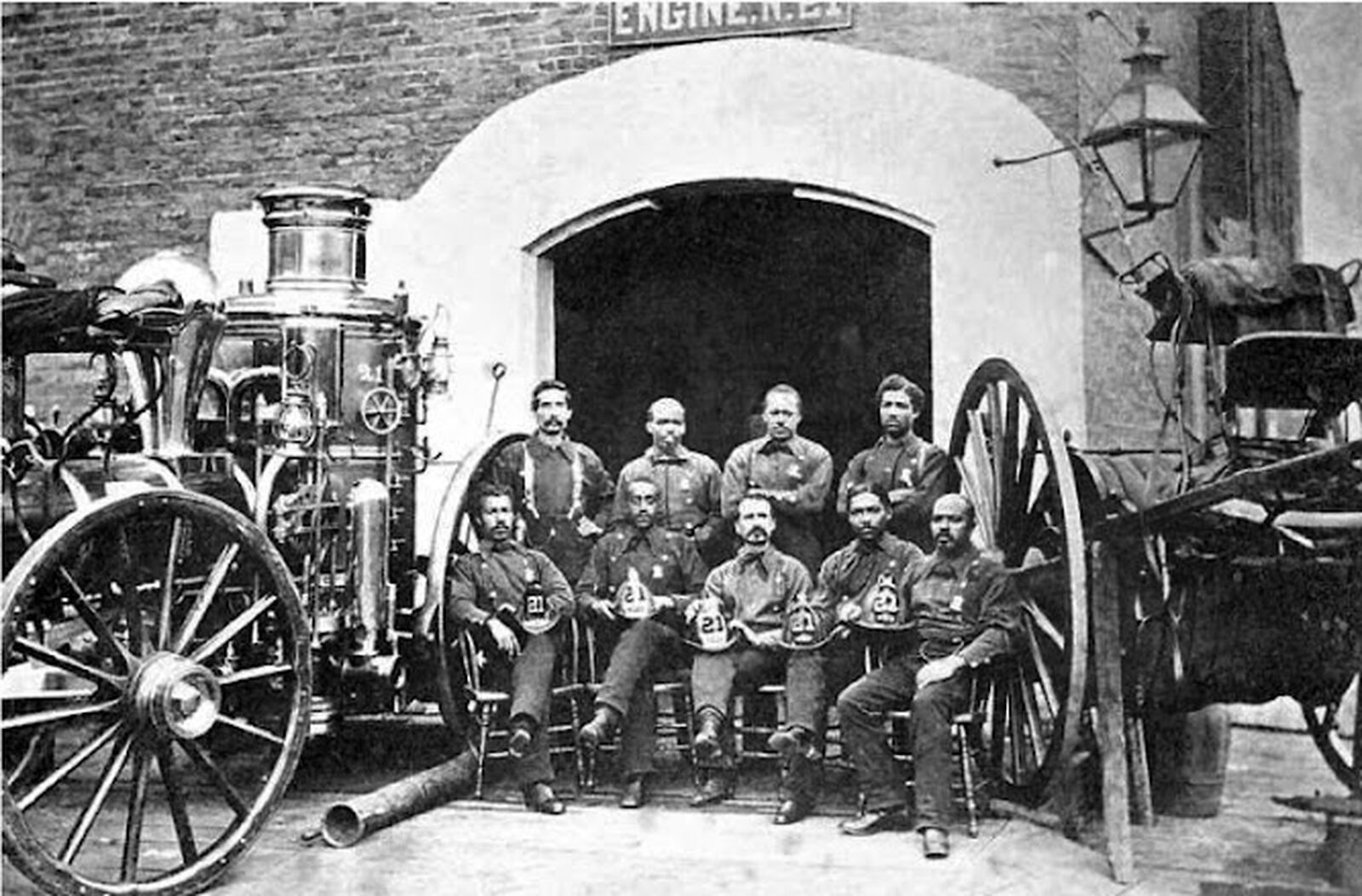
Organized in Chicago in 1872, just months after the Great Chicago Fire transformed the city into a laboratory of rebuilding, Engine Company 21 was the first all-Black paid fire company in the Chicago Fire Department and, by many accounts, the first organized paid Black firefighting company in the United States. Its story is often reduced to a single invention: the fire pole. That part matters. Members of the company are widely credited with pioneering the practical use of the sliding pole inside a firehouse, an innovation that spread because it worked. But the deeper significance of Engine 21 was never just mechanical. It was political, social, and human. The company stood at the intersection of Reconstruction, Black labor, white backlash, urban modernization, and the long fight over who gets to belong in public life.
To write about Engine Company 21 is to write about more than a fire company. It is to write about a postwar America still arguing over whether Black citizens could be trusted with authority, discipline, and visibility. It is to write about Chicago trying to reassemble itself after catastrophe. And it is to write about the way Black excellence has so often been treated in this country: welcomed when useful, doubted when visible, praised when exceptional, and too rarely woven into the standard public memory.
“Engine Company 21 was not just fighting fires. It was fighting caricature, exclusion, and the idea that Black civic competence needed to be proven over and over again.”
After the fire, a new Chicago — and an old American question
The Great Chicago Fire of October 1871 killed roughly 300 people, destroyed more than 17,000 buildings across about 3.5 square miles, and left nearly 100,000 residents homeless. The numbers are staggering even now. In the immediate aftermath, Chicago had little choice but to rebuild fast, and rebuilding meant more than erecting new structures. It meant rethinking infrastructure, public safety, and civic authority in a city suddenly forced to imagine itself again. Joseph Medill, elected mayor shortly after the fire, was part of a Reconstruction-era political culture that, however unevenly, recognized that municipal institutions could be used to widen Black participation in civic life.
That context matters because Engine Company 21 did not appear in a vacuum. It emerged in a nation still processing emancipation, citizenship, and the practical meaning of freedom. Across the North, Black migrants and formerly enslaved people were seeking footholds in urban labor markets that promised wages, status, and at least the possibility of advancement. Public service jobs carried a particular charge. A firefighting post was not just a paycheck. It signaled trust. It placed Black men in uniform, in the public eye, in moments of emergency. That was both the opportunity and the controversy.
Chicago officials reportedly understood that assigning Black firefighters to a company would provoke resistance. Contemporary reporting around the company’s formation even warned local residents against interfering with the men’s rights. That warning alone tells you what city leaders expected: not calm acceptance, but friction. The creation of Engine 21 was therefore not simply administrative. It was a statement, tentative and incomplete but still meaningful, that Black labor could not be excluded forever from the skilled, uniformed ranks of urban public service.
The company began with only a handful of men. Some later accounts note that several had formerly been enslaved and had moved north after emancipation. They entered one of the most perilous professions in the city at a time when firefighting demanded not just physical stamina, but technical skill, teamwork, horsemanship, and coolness under pressure. This was not ceremonial inclusion. These men were expected to perform under conditions that could kill them. And they did.
A company built under suspicion
The prejudice Engine 21 faced was not subtle. An academic history published through the University of Chicago’s Chicago Journal of History shows how white Chicagoans and white observers elsewhere routinely cast the company as incompetent, childlike, or fit only for lesser duties. The familiar racist logic of the period followed them everywhere: Black men could perhaps do hard labor, critics implied, but not skilled labor; they could serve, but not lead; they could be useful, but not equal.
The insults came in different forms. Some were direct. Former white firemen and newspaper commentators called the company inferior. Others were paternalistic, praising the firefighters’ strength while refusing to acknowledge intelligence, training, or judgment. Still others leaned on minstrel-style caricature, reducing the men to comic figures in print. The point was always the same: to deny them the full dignity of professional competence.
This is what makes Engine 21 so historically important. The company’s struggle was not only about entrance into the fire service. It was about rebutting an entire racial ideology. In late-19th-century America, public institutions were battlegrounds where Black citizenship was tested, narrowed, and contested. A Black fire company in Chicago challenged white assumptions in at least three overlapping ways. It challenged labor hierarchy by placing Black men in skilled municipal work. It challenged social hierarchy by putting them in uniformed service with public authority. And it challenged gender hierarchy by publicly embodying a profession closely tied to bravery, discipline, and masculine honor.
That last point may sound academic, but it was real. Firefighters were not invisible laborers. They were public figures. They entered burning buildings, paraded in uniform, appeared in civic rituals, and represented municipal order in moments of chaos. For Black men in the 1870s, that kind of visibility mattered. It contradicted the nation’s effort to shrink Black life back into caricature after emancipation. Engine 21 was a working company, but it was also a public argument.
What the record shows: they were good at the job
The simplest answer to racist doubt was performance.
And by the available record, Engine Company 21 performed at a high level. The University of Chicago history cites Chicago Fire Department annual reports showing the company repeatedly outperformed many white counterparts. In 1893, for example, the company responded to 474 alarms, well above the reported average of 360; worked 184 hours compared with an average of 110; and handled duties at 148 alarms compared with 75 for the average company. Contemporary accounts also described the company developing a reputation for rapid response.
That data is important because it cuts through mythology. Engine 21 was not symbolic first and functional second. It was functional enough to force the symbolism onto the city. Performance made prejudice harder to sustain in the face of evidence, even if it never made prejudice disappear.
One telling episode came during the massive 1885 Chicago Lumber Company fire, a three-alarm blaze that threatened huge sections of the city after leaping the river. According to accounts preserved in later histories, spectators initially mocked the Black firefighters as they dragged hose toward the inferno. But ridicule gave way to admiration as the men proved themselves under brutal conditions. The shift is revealing. White derision was easy at a distance. Reality complicated it.
There is something familiar about that pattern. Black workers are doubted, then watched, then forced to overperform, then grudgingly praised as exceptions rather than accepted as equals. Engine 21 lived inside that loop. The men could win admiration at a fire scene and still encounter exclusion elsewhere. They could be indispensable in emergency and unwelcome in daily life. That contradiction is not a side note to the story. It is the story.
The invention everybody remembers — and what it can obscure
The fire pole is the detail that carried Engine 21 into broader popular memory. Smithsonian Magazine recounts that in the late 1870s, Captain David Kenyon of Company 21 installed a permanent pole after seeing a fellow firefighter descend quickly on a wooden pole used around the hayloft. The innovation cut response time, and other Chicago companies that initially mocked the idea adopted it once they saw how effective it was. The Illinois History and Lincoln Collections likewise notes that Chicago’s first Black fire department was the first to install a fireman’s pole, helping the company consistently arrive at fires faster.
There is a reason this story endures. It is vivid. It is cinematic. It lends itself to the iconography of the American firehouse. It also offers a neat narrative payoff: underestimated Black firefighters innovate, skeptics are forced to copy them, history validates the marginalized.
That narrative is true as far as it goes. But it can also flatten the company into a trivia answer. Engine 21 becomes “the Black company that invented the fire pole,” and the fuller history slips away. The pole mattered because it represented ingenuity under pressure, yes. But its symbolic weight also came from who produced it. This was not a random station innovation. It emerged from a company whose very existence was contested, and whose excellence had to be measurable to be legible. The pole was not separate from the politics of race; it was born inside them.
In other words, the invention should not distract from the inventors. Nor should it distract from the environment that made speed essential. Nineteenth-century firefighting was intensely competitive and brutally physical. Seconds mattered. In a culture already eager to judge Black incompetence, arriving faster than everyone else was more than operational advantage. It was rebuttal.
Inside the company: labor, dignity, and the politics of everyday life
What did it mean for these men to live and work together in that space? Historical accounts suggest the answer goes beyond alarms and apparatus.
The University of Chicago article describes how white anxieties extended into the firehouse itself. Newspapers felt compelled to describe its neatness and orderliness, implicitly answering racist assumptions that Black men could not inhabit respectable shared space. The department’s Benevolent Association initially barred Black firefighters, showing that even when Black men could labor alongside whites, social equality remained off limits. Later, at least one original member of Engine 21, Wilson C. Hawkins, gained admission — a small but telling sign that the boundaries were not fixed, only defended.
That fight for dignity in ordinary space is often what gets lost in heroic histories. The public sees the blaze, the rescue, the uniform. What it doesn’t always see is the quieter struggle over where a Black firefighter could eat, whom he could socialize with, whether he could stop in a bar without insult, whether he would be treated as a fellow professional or as a tolerated anomaly. One later summary from DeKalb County’s Black history series recounts a barroom incident involving two firefighters from Engine 21 being refused service, leading to a confrontation. Whether one episode or many, the pattern is familiar: service to the city did not protect Black men from the city’s racism.
And yet the uniform still mattered. The same scholarly account notes that the men of Engine 21 used dress, public ritual, and participation in parades to assert manhood and civic presence. In 1878 they marched in a parade for President Rutherford B. Hayes, alongside military units, including Black troops. In a post–Civil War America where military service and uniform had become potent symbols of citizenship and masculine dignity, that visibility carried real force.
This is one of the most compelling parts of the company’s history. Engine 21 was never only about inclusion through suffering. It was also about self-fashioning, pride, and insistence. These men were not waiting to be declared respectable. They acted as though the dignity of the office already belonged to them. History tends to reward that kind of confidence only in retrospect. At the time, it often reads as provocation to those invested in hierarchy.
Why Engine 21 mattered to Black Chicago
Chicago is often remembered as a city of migration, machines, stockyards, politics, architecture, and neighborhoods in constant renegotiation. Engine Company 21 belongs in that civic archive because it offered an early Black foothold in municipal power long before the Great Migration transformed the city’s demographics in the 20th century.
Its existence suggested that the city — however imperfectly — could be pushed toward an interracial civic order. A Black fire company meant more than employment. It meant Black children and Black residents could see men who looked like them wearing the authority of the city. It meant emergency response in Black communities did not have to be imagined solely through white control. And it meant the skill, bravery, and discipline of Black workers entered one of the most publicly honored municipal professions in America.
That significance helps explain why later chroniclers and Black journalists have continued to return to Engine 21. The Chicago Crusader, covering the company’s 150th anniversary in 2022, quoted historian DeK alb Walcott Jr. describing Engine 21 not only as the first paid Black firemen in America but as the company whose men invented the fire pole and outperformed peers during Reconstruction. Whether every superlative survives academic debate is less important than the larger truth Walcott is underscoring: Engine 21 is foundational Black Chicago history, and it has too often been treated as a footnote rather than a pillar.
The memory gap itself is instructive. America is comfortable with inventions detached from race. It is less comfortable with institutions that reveal how thoroughly Black Americans have shaped public systems while being excluded from their full honors. Engine 21 does not fit neatly into a sentimental diversity narrative. Its story is not “they were finally welcomed.” Its story is “they were necessary, excellent, and still constrained.” That is harder material. It demands a more honest civic memory.
The limits of Reconstruction, in one fire company
If Engine Company 21 represented possibility, it also foreshadowed retreat.
The same University of Chicago research argues that the company’s trajectory mirrored the rise and unraveling of Reconstruction politics in Chicago. Early municipal willingness to experiment with interracial civic inclusion gave way over time to harder color lines. Black firefighters petitioned for Black leadership; those efforts were denied. Eventually, department decisions effectively moved the men out of downtown visibility and into the Black Belt, reinforcing segregation rather than challenging it. By the late 19th century, the city was no longer using its institutions to project an interracial democratic ideal with the same commitment.
That arc feels painfully American. First there is the moment of opening, usually born from crisis. Then comes backlash. Then comes administrative narrowing, bureaucratic retreat, or quiet resegregation. The institution survives, but the radical edge is blunted. Engine 21’s history makes that pattern legible at the municipal level. Reconstruction did not fail only in Congress or at the ballot box. It also faltered in city departments, social clubs, promotion pipelines, and who got to remain visible in public space.
This is why the company belongs in the broader history of Black public service alongside better-known organizations and struggles: Black police officers, Black postal workers, Black teachers, Black soldiers, Black railway porters. These were arenas where citizenship became practical. Not abstract rights, but daily authority. Daily labor. Daily exposure to danger. Daily friction. Engine 21 fits squarely into that lineage.
Why its story still resonates now
There is a temptation to file stories like this under “hidden history” and leave them there, as though retrieval is enough. It is not enough.
Engine Company 21 matters now because the questions surrounding it are still with us. Who gets seen as naturally competent in public-safety work? Who gets remembered as an innovator rather than simply a worker? Whose excellence is treated as representative, and whose is treated as surprising? And how do public institutions celebrate Black firsts without confronting the systems that made those firsts so difficult in the first place?
In recent years, fire departments and fire-service publications have been more willing to acknowledge the Black origins of the fire pole and the significance of all-Black companies such as Engine 21. That is welcome. But commemoration should not stop at invention lore or anniversary ceremonies. Serious remembrance means restoring these men to the center of urban, labor, and Reconstruction history. It means understanding that Black firefighting history is not a niche addendum to American history. It is American history.
It also means refusing the easy version of progress. Engine 21 did not “solve” racism by being good at the job. Excellence rarely solves prejudice on its own. What it does do is remove the alibi. It exposes discrimination as discrimination, not concern about standards. The men of Engine 21 met the standard and then some. What remained was the country’s refusal to treat that fact as ordinary.
And maybe that is the most durable lesson of all. Black accomplishment in America has often been framed as inspirational when it should be understood structurally. Engine 21 was not inspiring because a few brave men overcame odds. It was significant because it revealed how a city worked, whom it trusted, whom it doubted, and what happened when Black workers forced their way into the bloodstream of civic life.
More than a pole, more than a first
The pole will probably remain the easiest point of entry into this history. That is fine, so long as it is not the endpoint.
Yes, Engine Company 21 helped give the American firehouse one of its most famous visual motifs. Yes, the company’s speed and ingenuity changed the profession. Yes, it deserves a place in the history of invention. But if that is all we say, then we miss the larger claim these firefighters made with their lives.
They showed that Black public service was not theoretical. It was disciplined, dangerous, and indispensable. They showed that a city could call on Black men in moments of crisis even while large portions of that same city refused them equal respect. They showed that Reconstruction’s most meaningful tests often happened not in speeches, but on the apparatus floor, at the scene of the fire, in the social club, at the promotion board, and in the daily insistence on being seen as men and professionals.
There is something especially fitting about the fact that Engine 21 emerged from the ashes of the Great Chicago Fire. Catastrophe often produces reinvention, but not always justice. Chicago rebuilt itself into a bigger, more modern city. Engine 21 reminds us that rebuilding also opened a brief window for reimagining citizenship. The company’s existence proved what was possible. The backlash it faced proved how fragile possibility could be.
Today, when American institutions are eager to celebrate pioneers, Engine Company 21 asks for something more serious than celebration. It asks for context. It asks for memory with structure around it. It asks us to see Black firefighters not as a side chapter in the romance of the fire service, but as central actors in the making of modern urban America.
That is the real legacy of Engine Company 21.
Not simply that it slid down faster.
Not simply that it got there first.
But that it forced the country, however briefly and imperfectly, to confront what Black excellence in public life looked like when it arrived with sirens on.
More great stories
The Nat King Cole Show: Prime Time, Segregated
March 17, 2026
No Comments
Mississippi’s Quiet Power Broker of the Civil-Rights Era
March 16, 2026
No Comments