



We do not intend to wait placidly.
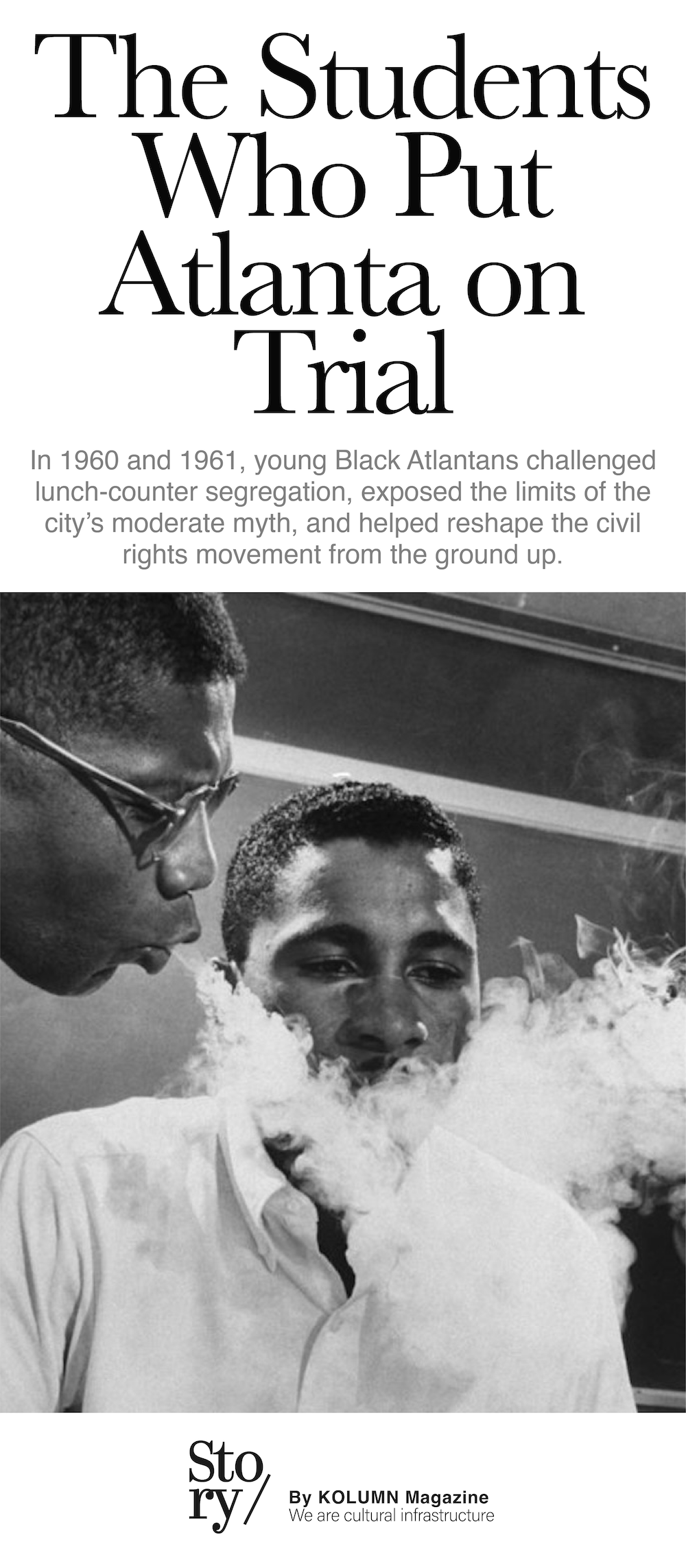
We do not intend to wait placidly.
By KOLUMN Magazine
Atlanta liked to flatter itself in 1960. It was modern, commercial, rising. It was not Birmingham, not Little Rock, not the sort of Southern city that made national headlines for sheer public ugliness. It had a slogan—“the city too busy to hate”—and slogans, as cities know, are often half aspiration and half alibi. Atlanta’s civic leadership promoted a version of racial moderation that sounded progressive enough to soothe outsiders while leaving segregation largely intact for the people who had to live under it. Black Atlantans still faced exclusion in schools, jobs, housing, hospitals, policing, and public accommodations. Downtown lunch counters remained segregated. So did theaters, restaurants, and much of ordinary civic life. The gap between the city’s self-image and its racial reality was exactly where the Atlanta student movement found its leverage.
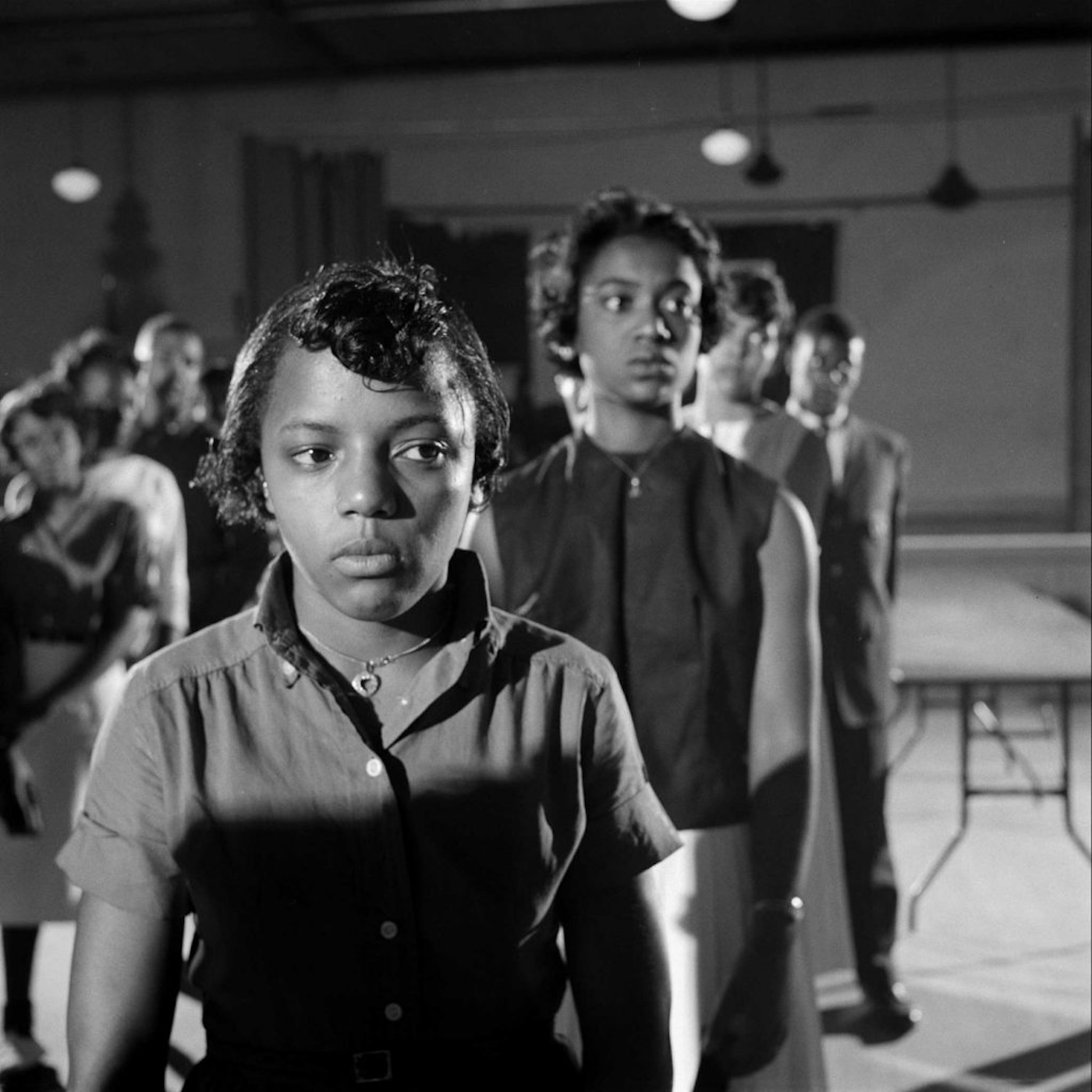
The sit-ins that unfolded in Atlanta between 1960 and 1961 were part of the wider student-led wave that followed Greensboro, but they were also distinctly local in their tone, structure, and stakes. These protests were not spontaneous outbursts by a few aggrieved students acting on instinct alone. They were organized by young people from the Atlanta University Center and allied institutions who studied the moment, crafted a public argument, built a coalition, accepted the possibility of arrest, and then sustained pressure for more than a year. Their campaign was shaped by figures including Lonnie King, Julian Bond, Herschelle Sullivan, Ruby Doris Smith, Gwen Isles, Roslyn Pope, and many others whose names deserve to be spoken as central, not supporting, players in civil rights history.
What made Atlanta especially revealing was that the students were fighting on two fronts at once. They were confronting white segregationists, business owners, and state power. But they were also pressing against the caution of Black elites, college administrators, and respectable gradualists who worried that direct action would destabilize fragile arrangements. The Atlanta sit-ins were therefore a contest not only over lunch counters, but over strategy, leadership, class style, and the pace of change. Who got to decide when freedom was “timely”? Who had to keep waiting? Who benefited from delay? In Atlanta, students asked those questions with their bodies.
The document that announced a new generation
Before the sit-ins came the argument. On March 9, 1960, students published a paid newspaper advertisement titled “An Appeal for Human Rights.” It appeared in the Atlanta Journal, the Atlanta Constitution, and the Atlanta Daily World. The text was broad, forceful, and remarkably clear-eyed. It did not ask merely for better manners at lunch counters. It laid out a system-wide indictment of racial injustice in education, employment, housing, voting, hospitals, law enforcement, and public accommodations. It framed equality not as a favor to be granted, but as a birthright and a democratic obligation. The appeal later appeared in The New York Times and entered the Congressional Record, giving the students’ manifesto national reach.
Roslyn Pope, then a Spelman senior and student leader, is widely credited with writing the document that became the movement’s manifesto. Its power came partly from its refusal to narrow the issue. Segregation, the students insisted, was not a problem of isolated customs. It was a regime. And they did something rhetorically savvy that still feels modern: they framed the struggle in the language of human rights as well as civil rights. That shift mattered. It suggested that Atlanta’s racial order was not just locally embarrassing or constitutionally shaky. It was morally illegitimate at the level of basic human dignity.
One of the most striking lines in the appeal remains its rejection of incrementalism. The students declared that they did not intend to wait “placidly” for rights already theirs by law and morality. That sentence landed because it named a mood. These were young people born into segregation but unwilling to inherit its timetable. They had watched adults negotiate, litigate, accommodate, and explain. They were not contemptuous of older struggles; they were beneficiaries of them. But they were also done being told that justice required endless patience from the injured.
The “Appeal” also mattered because it made the students legible to the city before they ever sat down at a counter. Atlanta’s white leadership tried to dismiss the document as outside agitation or the handiwork of professors. Governor Ernest Vandiver called it “anti-American.” But that attempt to infantilize the movement only revealed what the students already understood: a disciplined Black student body speaking for itself was profoundly threatening. The whole architecture of Southern moderation depended on younger Black people consenting to gradualism. Atlanta’s students had just announced that they did not.
Why Atlanta’s sit-ins looked different
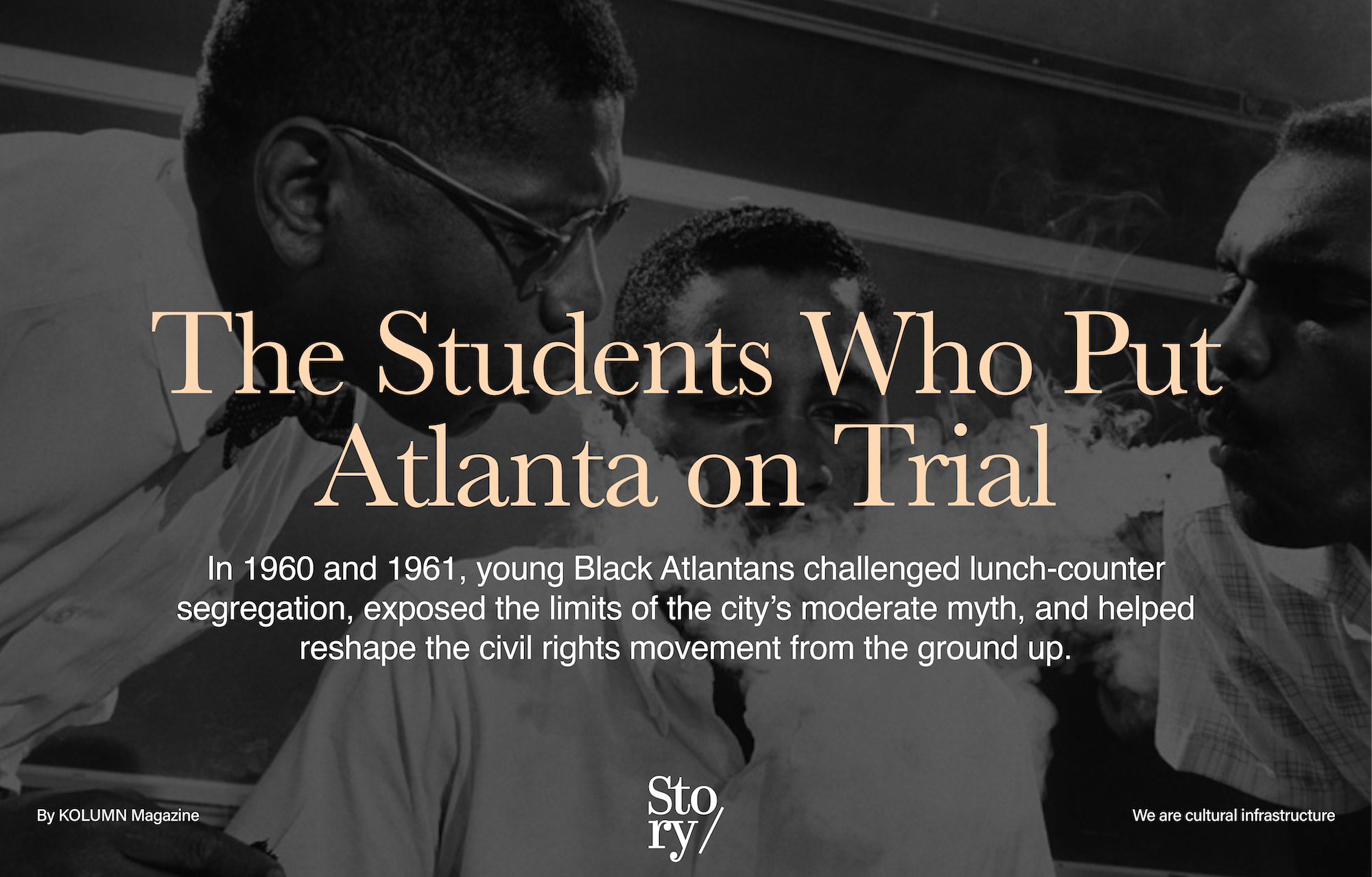
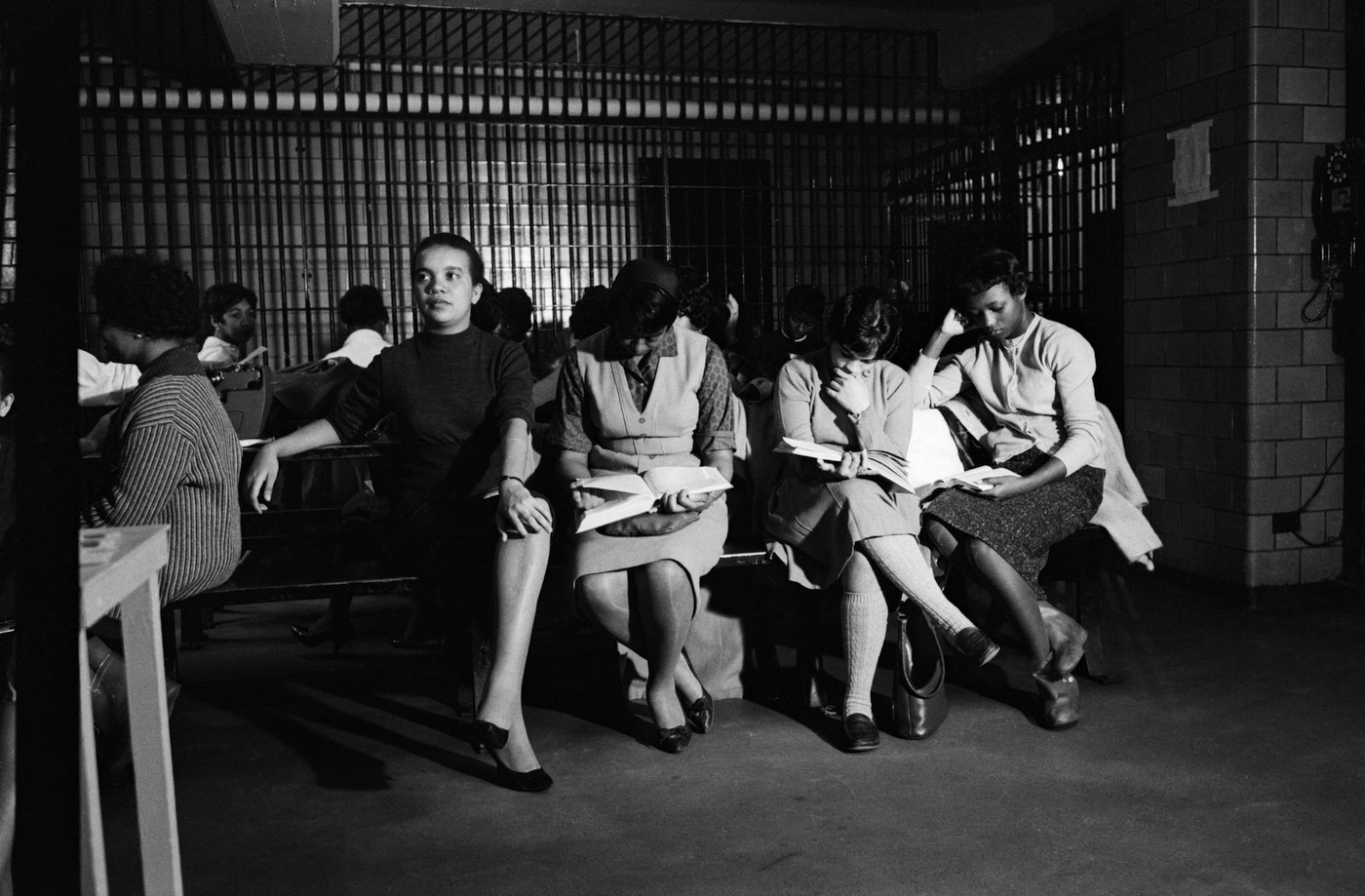
The first Atlanta sit-ins began on March 15, 1960, just six days after publication of the “Appeal.” More than 200 students targeted eleven downtown stores and cafeterias. Among the organizers were Spelman students Ruby Doris Smith and Gwen Isles, along with Julian Bond and other student activists. Eighty-three students were arrested. The action was peaceful and coordinated, and that coordination was a clue to the movement’s depth. Atlanta was home to a dense concentration of Black intellectual and institutional life through the Atlanta University Center—Morehouse, Spelman, Clark, Morris Brown, Atlanta University, and the Interdenominational Theological Center. That campus ecosystem gave the movement a recruitment base, a political culture, and a sense of shared mission.
Lonnie King, a Morehouse student, was among the first to press for Atlanta to act after the Greensboro sit-ins captured national attention. According to SNCC Digital Gateway, he read about Greensboro in Atlanta’s Black press and moved quickly with Julian Bond and others to build a local campaign. Nineteen students formed the Committee on Appeal for Human Rights, or COAHR, which became the organizational engine of what is now widely called the Atlanta Student Movement. Herschelle Sullivan later joined King as co-chai.
Atlanta’s version of student protest also reflected a particular tension within the Black freedom struggle. Some college presidents and established leaders urged restraint, preferring court battles or behind-the-scenes negotiation. SNCC Digital Gateway notes that several presidents discouraged students from sitting in and advised them to focus on school while letting the NAACP handle “the racial battle.” Yet students also found support from faculty such as historian Howard Zinn at Spelman, who, according to movement recollections preserved by SNCC Digital Gateway, took classes to trials and legislative proceedings and supported student challenges to segregation. Atlanta’s movement did not emerge in a vacuum. It emerged in argument.
That argument sharpened the movement. Students in Atlanta were not just angry; they were strategic. They understood that the city’s brand as a moderate commercial capital created pressure points. Downtown merchants cared about public image, holiday traffic, and national embarrassment. Politicians cared about stability. National media cared about contradiction. If Atlanta insisted on presenting itself as exceptional, the students would use that exceptionalism against it. They would sit in at the counters and force the city to explain why a supposedly modern metropolis still would not serve Black students a cup of coffee.
Rich’s, downtown Atlanta, and the politics of embarrassment
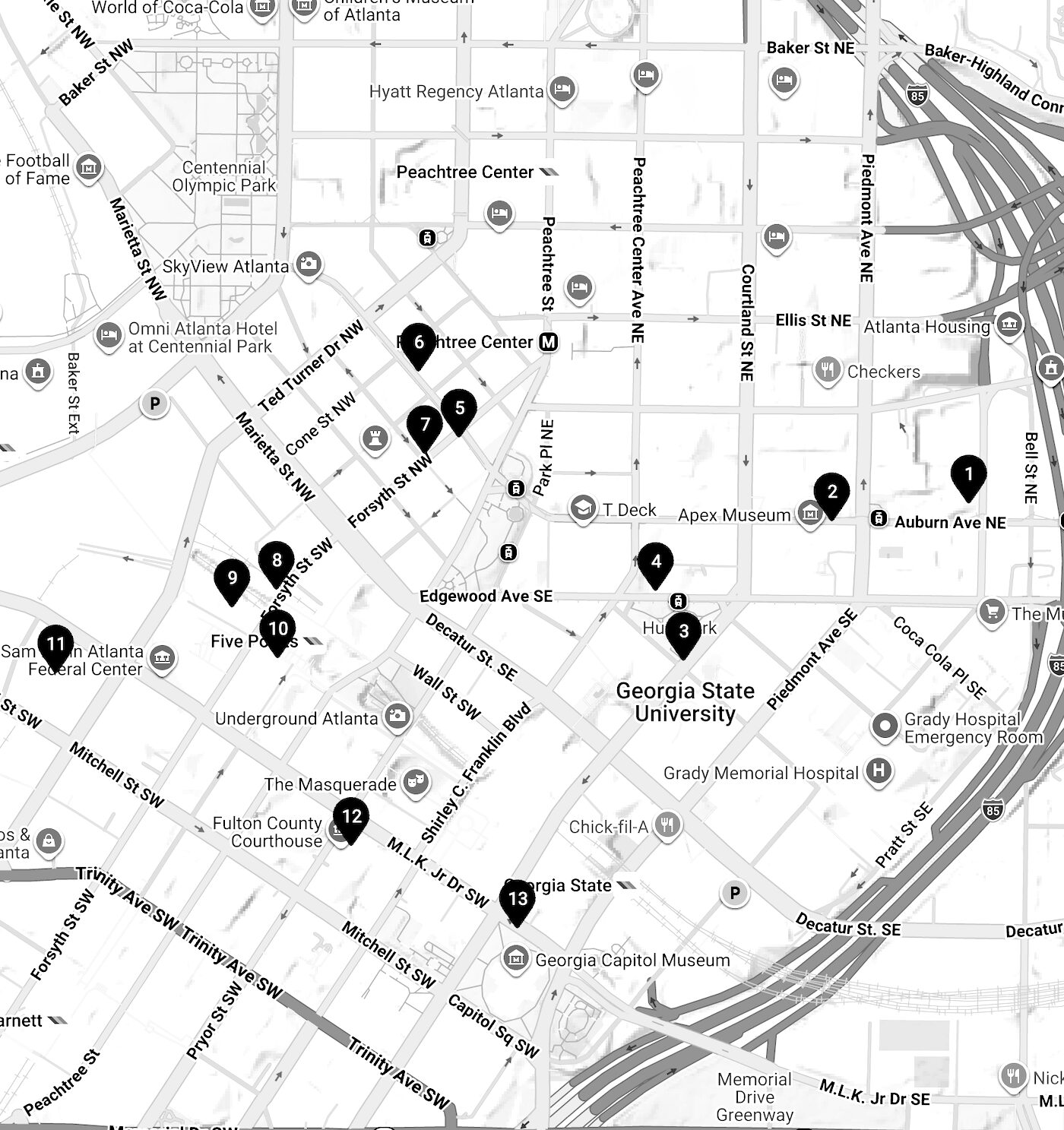
No symbol mattered more in the Atlanta campaign than Rich’s department store, the city’s retail giant and a major downtown landmark. Rich’s was not just a place to shop. It was a civic theater of middle-class Atlanta life, and that made it an ideal target. To challenge segregation there was to challenge Atlanta’s self-story in one of its most polished public spaces. Students also targeted cafeterias in City Hall, the Fulton County Courthouse, the Georgia State Capitol, and other downtown locations, making plain that segregation was woven through both commerce and government.
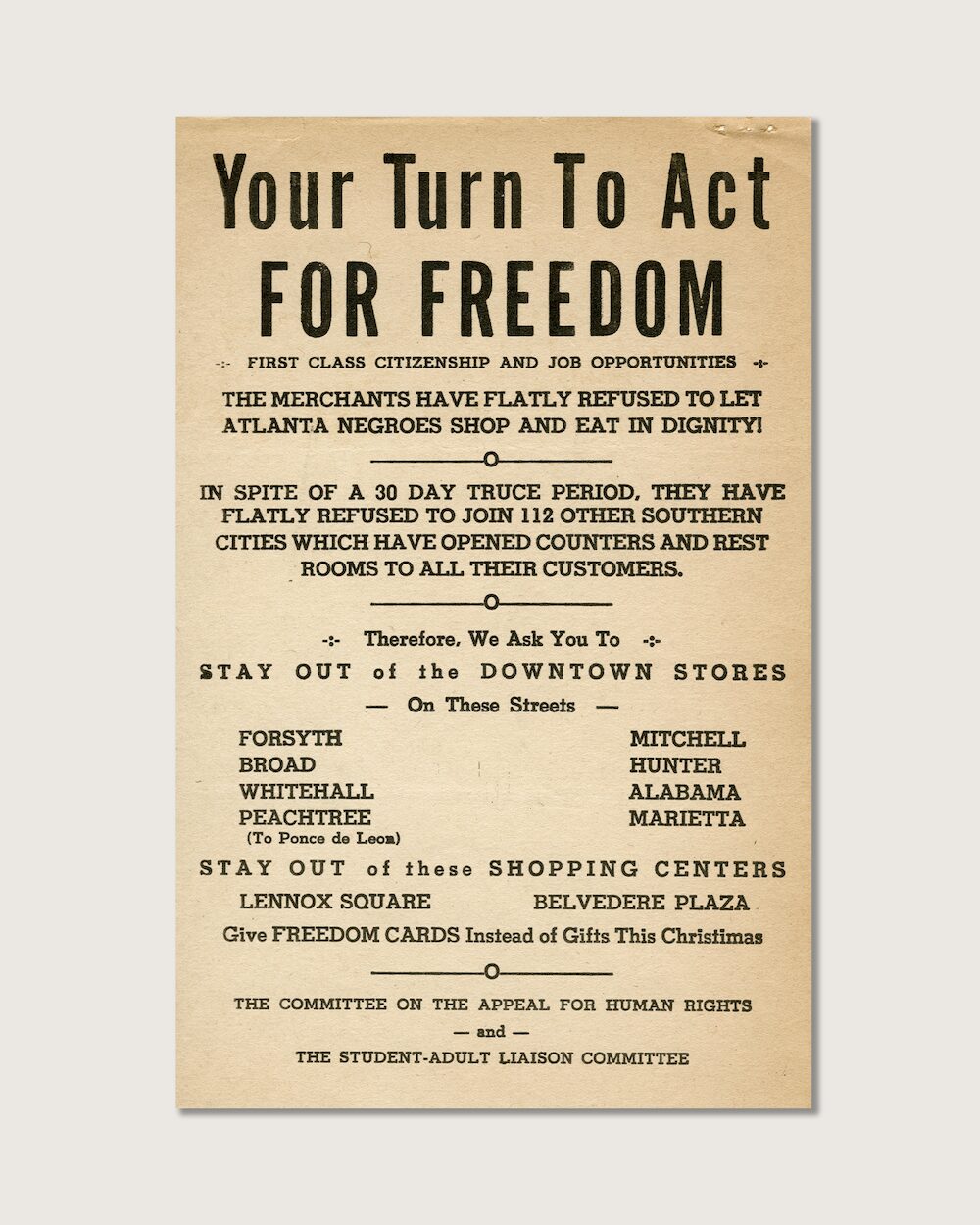
The first wave of actions in March 1960 produced arrests but not immediate victory. Local retailers agreed to negotiate with COAHR, yet neither side showed much willingness to compromise. Negotiations stalled. The protests expanded. Summer slowed some activity because students left campus, but the campaign did not disappear. It evolved into a longer contest involving sit-ins, picketing, boycotts, and publicity battles. The students were learning a lesson that would shape movements well beyond Atlanta: direct action is rarely one dramatic day followed by surrender. More often it is a grinding campaign of persistence, attrition, and recalibration.
The city’s white leadership wanted the protests managed, not solved. Moderate whites often preferred negotiation precisely because negotiation could become a way to absorb energy without conceding principle. Black business and political elites, meanwhile, were sometimes caught between solidarity with the students and fear that open confrontation would jeopardize hard-won access or provoke backlash. Atlanta students kept exposing that delicate dance. They were, in effect, asking whether moderation that preserved segregation was really moderation at all.
That insight helps explain why the campaign resonated beyond Atlanta. The sit-ins made visible the distance between national democratic rhetoric and Southern everyday life. A lunch counter is a small thing until you understand what it represents: who is recognized as a customer, a citizen, a person entitled to ordinary civility. The students sat where they were not supposed to sit because those counters were a map of the whole system.
Martin Luther King Jr. joins a student movement
One of the most widely remembered episodes of the Atlanta sit-ins came in October 1960, when Martin Luther King Jr. joined a student-led demonstration at Rich’s. The emphasis matters. King Institute records and associated documents make clear that King joined an action organized by students; as one King Institute note on the arrest documents states, King himself maintained that “the students asked me to come.” On October 19, King and dozens of others were arrested after participating in the sit-in and refusing to post bond.
The moment is often remembered as a King story because of what followed, but it was also a student story about tactical intelligence. Student leaders understood that involving King would intensify publicity and raise the political costs of repression. They were right. King’s arrest at Rich’s, and especially his subsequent jailing over an earlier probation issue tied to a traffic matter, pushed the Atlanta campaign into national political orbit just weeks before the 1960 presidential election.
This is where Atlanta’s local struggle collided with presidential politics. On October 26, 1960, John F. Kennedy phoned Coretta Scott King to express sympathy and concern while King was jailed. Robert Kennedy also made calls to Georgia officials that helped hasten King’s release. The King Institute, the JFK Library, and the American Presidency Project all preserve versions of this timeline. Historians have long argued that the Kennedy intervention mattered politically because it signaled responsiveness to Black voters at a critical moment in a close election.
But even here, the core point should not be lost in Camelot mythology. The national political drama existed because Atlanta students had already built a local campaign strong enough to make King’s participation consequential. Without the groundwork laid by COAHR and the Atlanta Student Movement, there is no Rich’s arrest in the form history remembers, no midnight fear around King’s safety, and perhaps no famous Kennedy call reverberating through Black political life that fall. The students did not merely join history; they created the conditions in which national leaders were forced to respond.
Atlanta and the founding of SNCC
The Atlanta sit-ins also sit at the origin point of one of the most important organizations in modern American political history: the Student Nonviolent Coordinating Committee. In April 1960, Ella Baker convened student activists at Shaw University in Raleigh. SNCC Digital Gateway records that Baker urged the students to consider forming their own organization rather than simply becoming a youth arm of SCLC. A temporary SNCC emerged from that conference, and Atlanta activists were part of the generation that made such an organization possible. Julian Bond would go on to become SNCC’s communications director. Atlanta would later become one of SNCC’s key hubs.
This is one of the reasons the Atlanta sit-ins deserve more than local-history status. They were not just a chapter in Atlanta’s civic narrative. They were part of the transformation of the civil rights movement from a leader-centered, courtroom-heavy phase into a broader era of youth-led direct action and participatory democracy. Baker saw that the sit-in students were not a temporary phenomenon to be managed by older organizations. They were a political force with their own vision, discipline, and appetite for risk. Atlanta helped prove her right.
The contrast between SNCC’s emerging style and older forms of leadership was not absolute—alliances mattered, and institutions overlapped—but it was real. The Atlanta student movement sharpened that distinction. These activists were often more impatient, less deferential, and more willing to disrupt the rituals of Southern respectability. They were not interested in being symbols of eventual progress. They wanted results. That impatience was not immaturity. It was political analysis born from life under delay.
The long year: boycott, negotiation, pressure
The Atlanta campaign lasted far longer than many public memories allow. It was not over after the first arrests in March 1960, and it was not over after King’s arrest in October. Students continued picketing, boycotting, and pressing the city through 1961. The Civil Rights Digital Library summarizes the arc plainly: after more than a year of demonstrations and failed negotiations, members of Atlanta’s Black political establishment met privately with white business leaders and negotiated a settlement in which lunch counters would be desegregated after the court-ordered integration of city schools the following fall. Student leaders protested this arrangement on campus but ultimately submitted to it, and lunch counters were desegregated in September 1961.
That settlement tells you a great deal about Atlanta. The city moved, but on terms that tried to preserve elite control. Rather than conceding immediately in response to student demands, white business leaders and Black establishment figures produced a phased solution tied to school integration. In practical terms, it still marked a victory: segregation at downtown lunch counters ended. But politically, it was also a managed compromise, one that revealed the discomfort many elites felt with student power. The students had forced the issue into the center of civic life, yet the final choreography was arranged by older hands behind closed doors.
This tension has often been flattened in celebratory accounts. There is a temptation to narrate civil rights victories as a smooth convergence of courage, conscience, and eventual agreement. Atlanta resists that tidy script. The students won something substantial, but not by being politely welcomed into a consensus. They won by creating a crisis that others then tried to contain. They exposed the limits of the “city too busy to hate” myth by forcing Atlanta’s commercial and political leadership to choose between endless delay and visible hypocrisy.
And even then, Atlanta was not especially fast. The New Georgia Encyclopedia notes that by October 1961, more than 100 Southern cities had already desegregated lunch counters. Atlanta, so proud of its exceptionalism, had actually lagged many of its regional peers in dismantling local public-accommodations segregation. That detail is worth sitting with. Moderation can look enlightened from a distance while functioning as delay up close.
More than lunch counters
If you only remember the Atlanta sit-ins as a fight over who could sit at a counter in a department store, you miss the range of the movement’s ambitions. “An Appeal for Human Rights” made clear that the students saw segregation as a connected structure. Their later actions proved they meant it. Kennesaw State’s Atlanta Student Movement timeline records that in April 1961, COAHR filed a lawsuit seeking desegregation of recreational centers, parks, swimming pools, and segregated courtroom seating. The same timeline notes that COAHR began a campaign to end segregation in movie theaters and conducted a citywide voter registration effort that registered 5,000 new Black voters.
That broader agenda matters because it places the sit-ins in their proper political frame. The students were not simply trying to integrate a meal. They were trying to alter the civic terms of Black life in Atlanta. Public accommodations mattered because they were public. Exclusion from them signaled exclusion from the city itself. By pressing on multiple fronts—stores, theaters, parks, courts, and voting—the movement was building a case that Black citizenship could not be compartmentalized.
The students also changed the terms of historical memory. They demonstrated that Black college students in Atlanta were not peripheral to the movement but central to it. Too often, civil rights storytelling collapses into a few iconic male leaders and a handful of set-piece events. The Atlanta sit-ins push against that compression. Women were everywhere in this story—as writers, organizers, strategists, and arrestees. Ruby Doris Smith, Gwen Isles, Herschelle Sullivan, Roslyn Pope, Marilyn Pryce, Marion Wright, and many others were not background figures in a drama driven by men. They were architects of the campaign itself.
What the Atlanta sit-ins changed
The Atlanta sit-ins changed policy, but their significance runs deeper than the eventual desegregation of lunch counters and restaurants. They punctured civic mythology. They clarified generational shifts in the movement. They helped incubate SNCC. They drew Martin Luther King Jr. into a student-led direct-action campaign that then ricocheted into national electoral politics. And they modeled a style of protest that joined moral language, organizational discipline, media savvy, and economic pressure.
They also offered a lesson that still feels painfully current: cities often celebrate racial progress most loudly when they are trying hardest to control its pace. Atlanta’s moderate self-image did not spare Black residents the degradations of Jim Crow. What changed the city was not branding. It was organized confrontation by young people willing to expose the lie. The sit-ins worked because students understood that public reputation can be leveraged against private injustice. They did not ask Atlanta to become the city it imagined itself to be. They made the city pay a price for not being it.
Their legacy also survives in how movements speak. The appeal to human rights, the insistence that delay is itself a political choice, the refusal to separate symbolic dignity from structural inequality—those are not antique ideas. They are durable movement grammar. When modern activists challenge policing, housing inequality, voter suppression, or discriminatory public policy, they are often speaking in registers the Atlanta students helped refine: local in target, expansive in analysis, and unwilling to let power pretend that one “small” injustice is ever really small.
The Atlanta sit-ins were a warning to the powerful and a promise to the future: the next generation would not wait for permission to claim democracy.
In the end, the Atlanta sit-ins matter because they reveal something essential about the civil rights movement itself. Progress did not arrive simply because enlightened leaders saw the moral light. It was forced into public view by disciplined people who made injustice costly, visible, and impossible to narrate away. In Atlanta, students did that with remarkable sophistication. They wrote a manifesto. They organized across campuses. They sat down in places built to exclude them. They went to jail. They endured criticism from enemies and hesitation from allies. And they stayed in motion long enough to move the city.
Atlanta today is often remembered as a capital of Black political, cultural, and professional life. That story has truth in it. But one reason the city became legible that way is because students in 1960 and 1961 refused to let Atlanta keep congratulating itself while serving segregation with its coffee. They understood that history is not made only in legislatures and courts. Sometimes it is made at a counter, in a newspaper ad, in a jail cell, in the disciplined silence of people who sit where the world says they do not belong and remain there long enough to change it.
More great stories
All Power, No Myth
March 16, 2026
No Comments
Alexander “Skunder” Boghossian and the Art of Crossing Worlds
March 16, 2026
No Comments