




We will make these jails Temples of Freedom.
We will make these jails Temples of Freedom.
By KOLUMN Magazine
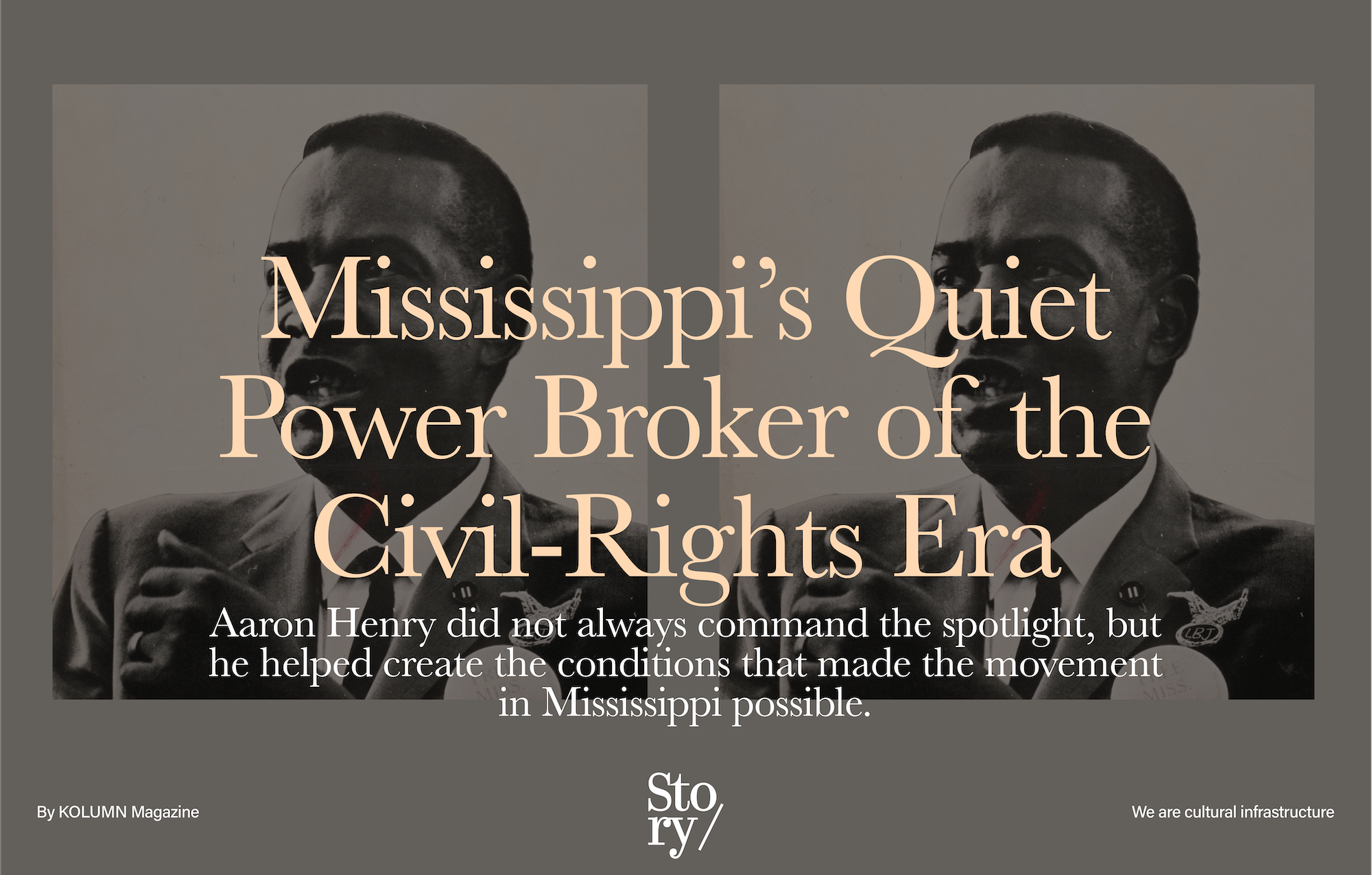
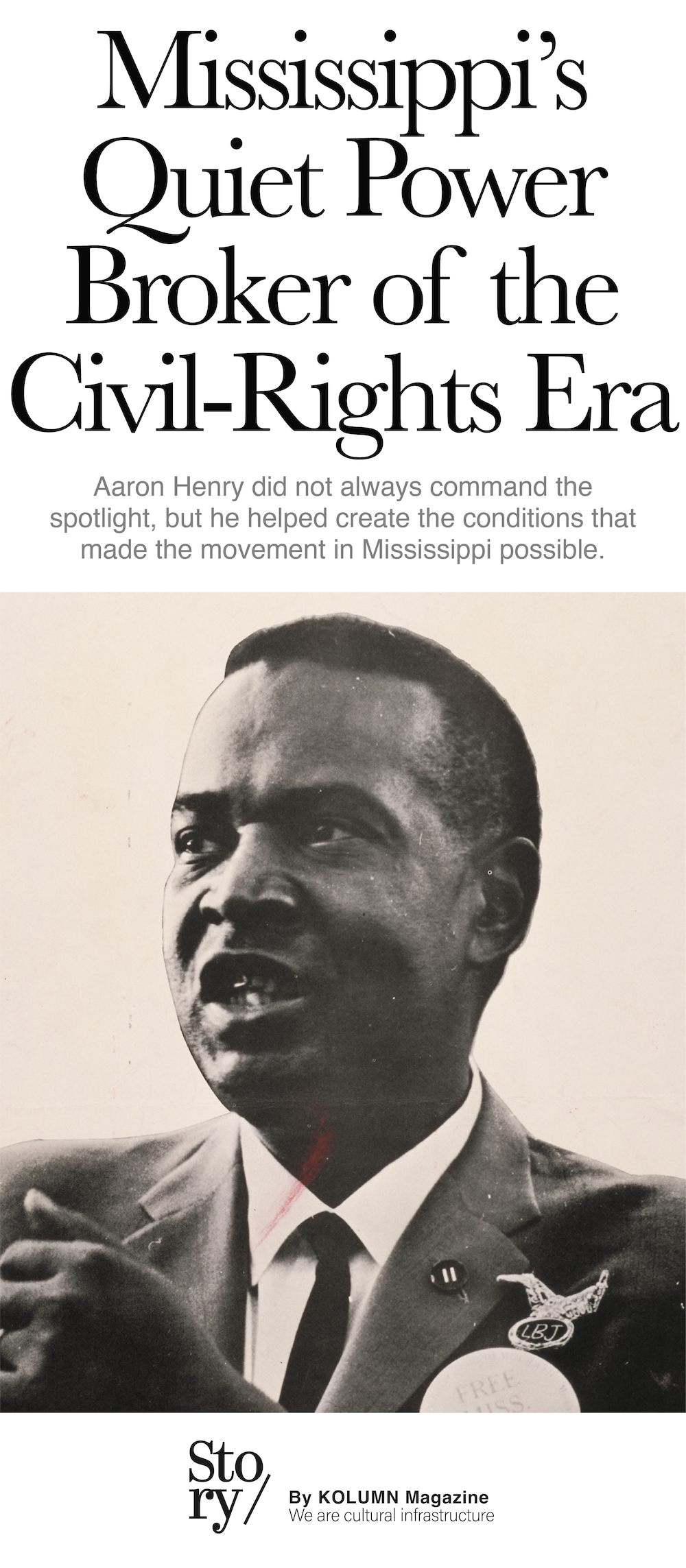
In Mississippi, where white supremacy was not just custom but system, not just prejudice but governance, Aaron Henry became one of the people who made organized Black resistance durable. He was a pharmacist in Clarksdale, a World War II veteran, a longtime NAACP leader, a founder of the Mississippi Freedom Democratic Party, a bridge between local Black communities and younger field organizers, and later a state legislator who kept pressing the unfinished business of freedom into Mississippi’s official chambers.
His biography carries the familiar ingredients of twentieth-century Black political awakening in the South: plantation childhood, military service, higher education made possible by the G.I. Bill, entrepreneurial self-determination, and confrontation with a state determined to humiliate Black citizenship at every turn. But that summary still undersells him. Henry was not simply present for Mississippi’s defining movement battles. He was a builder of the institutions, relationships, and political experiments that turned scattered grievance into organized challenge. SNCC’s own historical record describes him as one of the key mentors who made voter-registration work in Mississippi possible, and historians of the state’s freedom struggle repeatedly place him at the center of the coalition politics that shaped the early 1960s.
What makes Henry especially important is that he complicates a simpler version of civil-rights history. He was neither only a courtroom gradualist nor only a street militant. He worked inside the NAACP and alongside SNCC. He helped lead boycotts and also helped build alternative political parties. He was respectable in the way Black professionals in Jim Crow often had to be, but he was also willing to be arrested, sued, threatened, and bombed. He could sound moderate, and then act in ways that made Mississippi’s white power structure treat him as a mortal threat. That combination explains a lot about why he mattered: he understood that in Mississippi, survival and confrontation often had to travel together.
That line, attributed to Henry during his rise to state NAACP leadership, captures his style better than the usual labels do. He was not reckless. He was resolved. He recognized, earlier than many establishment leaders, that Mississippi’s racial order was not going to yield simply because Black citizens behaved impeccably. It would yield only when enough people organized against it in public, at cost, and with strategic persistence.
Born into the Delta’s discipline
Aaron Edd Henry was born on July 2, 1922, in Coahoma County, Mississippi, outside Clarksdale, into the hard world of Delta agriculture. He was the son of sharecroppers, and by his own recollection he worked cotton fields from an early age. His parents died before he was six, and he was raised by his maternal uncle, Ed Henry, a cobbler whose relative independence made an impression. That detail matters. For many Black Southerners of Henry’s generation, seeing even a small degree of economic autonomy could reshape what seemed possible. In the midst of plantation rule, the cobbler and the druggist were not just occupations; they were evidence that Black life might be organized around something other than permanent subordination.
Henry later recalled detesting cotton work. That statement reads as personal memory, but it also sounds like political origin story. Mississippi’s plantation economy was not merely an economic arrangement. It was a social technology of domination. To hate the cotton fields was to hate the structure that assigned Black people their place, their pace, their vulnerability, and often even their sense of worth. Henry’s later activism did not emerge in abstraction. It emerged from a life that had already taught him what racial hierarchy looked like when it governed time, labor, schooling, and aspiration.
He was drafted during World War II and served in the Pacific as a staff sergeant in a segregated military. Like many Black veterans, he came home with a sharpened understanding of the contradiction between democratic rhetoric abroad and racial subjection at home. SNCC Digital Gateway notes that after the war he used the G.I. Bill to complete his degree at Xavier College, and Mississippi Encyclopedia records that he studied pharmacy there, graduating in 1950 before returning to Clarksdale to open the Fourth Street Drug Store. That drugstore would become more than a business. It would become a political hub, a symbol of Black enterprise, and eventually a target.
The veteran-to-voter path was immediate. Mississippi Encyclopedia reports that Henry registered to vote after returning from military service and took pride in voting in the 1946 mayoral election. That was no small act in Mississippi, where poll taxes, literacy tests, intimidation, and administrative whim functioned as a regime of disenfranchisement. The fact that Henry registered, and then pushed others to do the same, placed him on a collision course with the state’s racial order almost as soon as he returned home.
Building a movement before the movement looked national
One of the easiest mistakes in writing civil-rights history is to treat Mississippi as though it suddenly awakened when national media did. Henry’s life is a reminder that deep local organizing long predated the most famous moments. In 1951, he helped found the Clarksdale and Coahoma County NAACP branch, part of a broader architecture of Black institution-building in the Delta. Around the same time, he was involved in the Regional Council of Negro Leadership, the T. R. M. Howard-led organization that promoted voting rights, economic self-help, and a more assertive public Black politics in Mississippi. In a later interview, Henry described the RCNL as something like a “home grown NAACP,” which is telling: the state’s movement culture was already inventing forms suited to local conditions.
This early period matters because it shows Henry not as a follower of better-known national leaders, but as part of the generation that laid the groundwork for the movement Mississippi would later become famous for. Long before Freedom Summer, he was helping create local infrastructure: branch leadership, voter education, political communication, and business-based civic networks. This was the less glamorous work, but it was indispensable. You cannot suddenly register voters, host organizers, sustain boycotts, or protect families under attack unless someone has already spent years building relationships the public may never see.
By 1960, Henry had become president of the Mississippi State Conference of the NAACP, a position he would hold for more than two decades. That made him one of the most powerful Black political figures in the state, though “powerful” in Mississippi could also mean highly exposed. In a 1974 interview archived by Veterans of the Civil Rights Movement, Henry said he had been president of the Mississippi state conference since 1960 and had served the local branch since 1952. That continuity is striking. It signals not a brief moment of protest, but sustained stewardship across eras.
SNCC’s historical account emphasizes why younger organizers respected him. Henry welcomed SNCC’s energy into Mississippi even though national NAACP leadership often felt uneasy about COFO and the faster, riskier cadence of field organizing. Henry sided with what Mississippi needed. He understood that local people facing daily terror could not afford turf wars among national organizations. In that sense, one of his greatest gifts was political elasticity. He did not confuse institutional loyalty with strategic wisdom.
Aaron Henry was one of the movement leaders who understood that organization mattered as much as outrage.
Clarksdale, boycott politics, and the cost of confrontation
If Henry had only chaired meetings, he would still matter. But he did much more than that. In late 1961, he helped initiate a boycott in Clarksdale against white merchants who refused to hire Black workers or discriminated against Black customers. This was both economic and moral warfare. In a town where Black spending helped underwrite white businesses that denied Black dignity, boycott politics turned consumption into leverage. It also made Henry newly dangerous in the eyes of local white elites, because it proved that the freedom struggle could impose material pressure, not just moral complaint.
The reprisals were swift and familiar. Henry and others were arrested on charges tied to the boycott. His drugstore was attacked. His home was firebombed. Accounts from Mississippi History Now and other historical summaries also note that he was arrested more than thirty times over the course of his civil-rights career. What matters here is not just the violence itself, but what it reveals about Mississippi’s rules: when Black citizens acted collectively and effectively, white power answered with police, courts, job retaliation, mob terror, and arson. Henry’s family paid part of that price too; some accounts note that his wife lost her teaching job amid the backlash.
The pharmacy is one of the defining images of Henry’s life. It was where he practiced a profession, accumulated respectability, and built community trust. It was also a place where organizers gathered and where the movement could anchor itself in the everyday. That is partly why attacks on the store carried such symbolic force. When white supremacists targeted it, they were not only attacking property. They were attacking an alternative model of Black civic life: independent, rooted, service-oriented, and unwilling to ask permission.
One of the recurring truths of Mississippi’s movement was that leadership required a particular intimacy with danger. Henry knew that. So did his family. So did the people who kept coming back to his store and house anyway. The movement in Mississippi did not survive because its leaders were fearless in some mythic sense. It survived because they decided fear would not be sovereign. Henry’s life is full of those decisions.
The bridge between local Black Mississippi and SNCC
There is a reason historians keep returning to Henry as a connective figure. Mississippi History Now quotes historian John Dittmer describing him as a link between Black middle-class Mississippians and the younger full-time activists of SNCC and CORE. That formulation may be the most concise explanation of his significance. Henry was rooted enough to be trusted locally and flexible enough to work with insurgent young organizers whose methods could unsettle older institutions. In a state where generational distrust and organizational rivalry could have easily fractured the movement, he functioned as connective tissue.
SNCC needed people like Henry because Mississippi was not a blank map awaiting idealistic students. It was a place of kinship networks, church politics, reputational stakes, class distinctions, and lethal retaliation. Outsiders could energize or dramatize a campaign, but durable work depended on local figures who understood the terrain. Henry, along with people such as Amzie Moore, helped make Mississippi legible to SNCC and helped make SNCC acceptable to communities that had every reason to be suspicious of risk.
That bridging role also meant he was often negotiating tensions that later narratives flatten. The NAACP’s national leadership was sometimes cautious about COFO. SNCC could be impatient with institutional incrementalism. Local Black people had to calculate immediate survival, not just movement theory. Henry moved among these worlds. He understood the need for legal strategy and the need for direct action. He believed in voting rights and in organization broader than the ballot. He understood that the point was not purity; it was progress under impossible conditions.
Medgar Evers, grief, and movement continuity
Henry’s career cannot be understood apart from Medgar Evers. The two men were close friends and major Mississippi NAACP leaders. The National Park Service notes that Henry served as Mississippi NAACP president for over thirty years and was at the forefront of the state movement alongside Evers, the organization’s field secretary until his assassination in 1963. After Evers was murdered in his driveway in Jackson, Henry felt the loss intensely and wrote an open letter to him a year later, reflecting on both friendship and unfinished struggle.
That relationship illuminates Henry’s emotional and political burden. Evers’s assassination was both personal devastation and public warning. It announced, once again, that Mississippi’s racial regime was prepared to kill movement leadership in broad daylight terms. The state’s message was not subtle: if a nationally known NAACP figure could be murdered at home, then no leader was beyond reach. For Henry, staying in Mississippi after that was not simply admirable. It was a deliberate refusal to let terror dictate geography, memory, or political tempo.
One of the useful correctives in writing about Henry is to resist the temptation to treat him as a supporting character in someone else’s martyrdom. Evers’s murder changed Henry, but it did not eclipse him. If anything, Henry’s later work demonstrates how movements continue after spectacular violence. He helped hold together local morale, institutional memory, and political strategy in a state that had every intention of exhausting Black resistance.
In Mississippi, surviving the movement was part of leading it.
Freedom Vote and the making of a parallel politics
By 1963, Henry was involved in one of the movement’s most creative political experiments: the Mississippi Freedom Vote. Officially, Mississippi’s Black population was largely shut out of the ballot box. So movement organizers created a mock gubernatorial election to demonstrate both Black willingness to vote and the illegitimacy of a state that denied that vote. Henry ran for governor on the Freedom Vote ticket, with Edwin King as the candidate for lieutenant governor. More than 80,000 Mississippians cast ballots. SNCC Digital Gateway describes the action as foundational; it laid the groundwork for what came next.
The genius of the Freedom Vote was that it turned disenfranchisement into evidence. Mississippi officials could continue pretending that Black Mississippians were politically apathetic or unprepared. The Freedom Vote demolished that fiction. People voted in churches, beauty parlors, homes, and community spaces. The campaign said, plainly, that the issue was never Black indifference. The issue was white suppression. By stepping onto that ballot, Henry did not merely symbolize resistance. He helped stage a democratic indictment of the state.
This is one of the places where Henry’s practicality shines. He understood the value of parallel institution-building: if the state blocks legitimate access, create a structure that exposes the block. That instinct would become even more consequential in 1964 with the founding of the Mississippi Freedom Democratic Party.
The Mississippi Freedom Democratic Party and Atlantic City
The MFDP remains one of the most important democratic challenges in modern U.S. political history, and Henry was central to it. The Library of Congress states that the party was organized during Freedom Summer by Robert Moses, Aaron Henry, David Dennis, and Amzie Moore as an alternative to Mississippi’s all-white Democratic Party. The purpose was direct: if Mississippi’s regular delegation rested on Black exclusion, then it had no legitimate claim to represent the state’s Democrats.
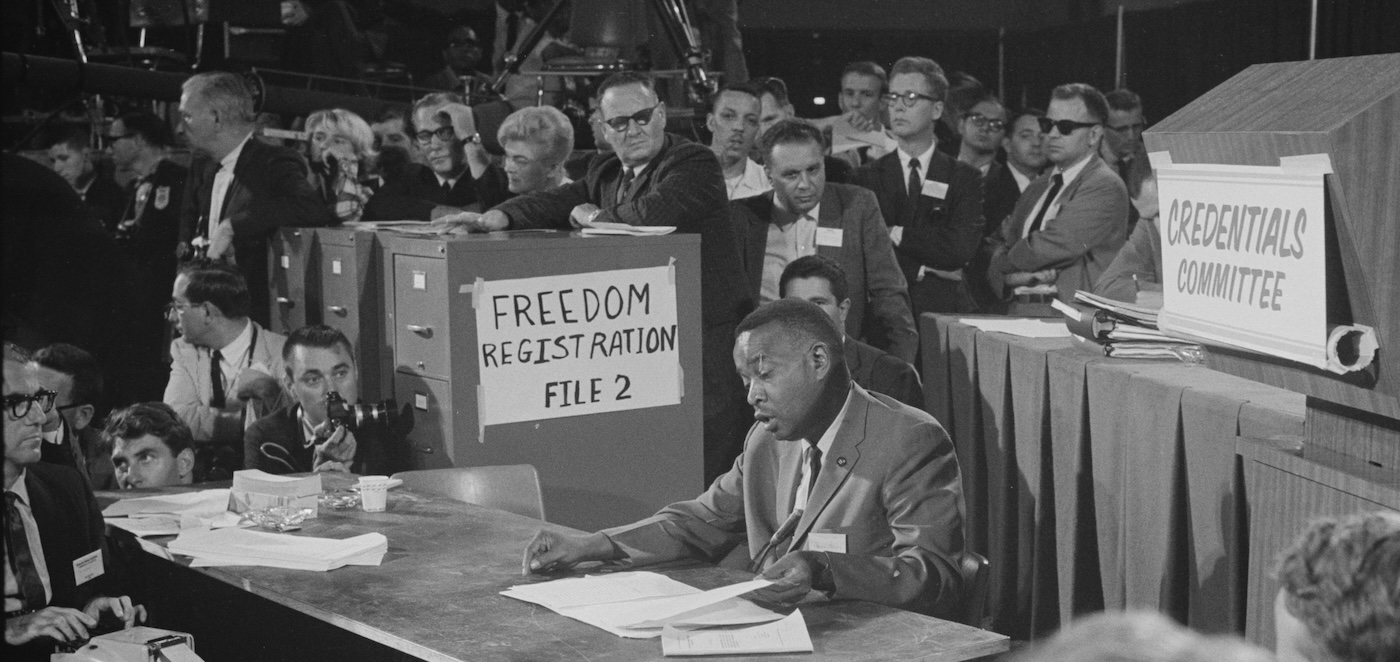
At the 1964 Democratic National Convention in Atlantic City, Henry chaired the MFDP delegation. Fannie Lou Hamer’s testimony became the convention’s most famous moment, but Henry’s leadership was structurally crucial. He was one of the people translating years of organizing into a national institutional confrontation. The party challenged the seating of the regular Mississippi delegation and, in doing so, forced the national Democratic Party to decide whether its stated commitments to democracy and civil rights meant anything when tested by Southern white power. The Johnson administration pushed a compromise: seat two Black delegates alongside the white regulars. The MFDP rejected it. The refusal mattered. It exposed the limits of liberal accommodation and proved that token inclusion was not justice.
Henry’s place in Atlantic City says a lot about his political range. He was not simply a local organizer or state NAACP administrator. He could also inhabit the national party arena, argue legitimacy, and insist that procedural democracy include Black people in fact, not in rhetoric. The spectacle of him speaking before the credentials committee survives in Library of Congress photographs because it marked a threshold moment: Mississippi’s freedom struggle had forced itself into the formal machinery of American politics.
And yet Atlantic City was also a lesson in the limits of national sympathy. The MFDP was morally right and politically disruptive. That combination often produces admiration in retrospect and abandonment in real time. Henry emerged from that battle with a deeper understanding of both possibility and betrayal. But he did not leave politics. He kept trying to reorganize it.
What kind of leader was Aaron Henry?
Henry is sometimes described as moderate, and in a narrow stylistic sense that is true. He was not given to flamboyance. He was a businessman and pharmacist, measured in speech, institutionally literate, and capable of operating inside formal structures. But to reduce him to moderation is to miss the substance of his work. A man whose house and business were bombed, who led boycotts, who welcomed SNCC into Mississippi, who ran in the Freedom Vote, and who helped build the MFDP was not moderate in the sense white Southern power preferred. He was disciplined. There is a difference.
He also embodied a specifically Mississippi form of movement leadership: anchored in church-and-business respectability, but radicalized by the state’s refusal to grant even minimal justice. Mississippi made incrementalists out of some people and insurgents out of others. Henry became both institutional and insurgent at once. That duality is why he could work with national civil-rights organizations, college-age organizers, rural Black communities, and later elected officials without entirely belonging to only one political idiom.
There is another layer here worth saying plainly. Henry’s career reminds us that charisma is not the only form of historical consequence. Some leaders become icons because the camera loves them. Others matter because movements can rely on them. Henry was reliable in the deepest political sense: he stayed, coordinated, absorbed pressure, kept organizations functioning, and continued the struggle after headlines moved on.
From movement politics to state power
Henry did not stop at protest politics. In 1979, he was elected to the Mississippi House of Representatives, where he served until 1996. Mississippi History Now notes that he worked on the Ways and Means Committee and pushed measures tied to housing, education, health care, and employment opportunities for Black Mississippians. He also repeatedly introduced legislation to remove the Confederate battle emblem from the Mississippi state flag, though those bills never reached the floor.
This later period is often treated as epilogue, but it should be read as continuation. Henry’s legislative career represented a long arc from excluded voter to lawmaker in the same state that once tried to crush him for demanding the franchise. That transition did not mean Mississippi had been redeemed. It meant the movement had opened cracks in the state’s architecture, and Henry intended to press on them from the inside.
His push against the Confederate imagery in the state flag now reads as especially prescient. Long before broad public consensus shifted, Henry was naming what many officials preferred to normalize: state symbols are not decorative when they encode political domination. That he kept filing those bills despite near-certain failure says something essential about his view of politics. He understood that legislation can function not only as lawmaking but as memory work, moral record, and strategic insistence.
Why he is less famous than he should be
Aaron Henry is not absent from civil-rights history, but he is too often under-scaled within it. Part of that is narrative preference. American memory likes singular heroes and dramatic climaxes. Henry’s importance is harder to compress. He matters in connective ways, infrastructural ways, sustaining ways. He is not only the subject of one big scene; he is part of why so many scenes happened at all.
Another reason is geographic. Mississippi’s freedom struggle produced some of the most searing political theater in American history, but national memory often fixes on the most cinematic names and moments. That can flatten the ecosystem underneath them. Henry’s story asks for a different reading habit. It asks us to notice organizers who were rooted in towns, who kept the books and the storefronts open, who negotiated among organizations, and who treated politics as something that had to be practiced every day, not merely performed on historic occasions.
There is also the burden of temperament. Henry did not cultivate myth the way some public figures did. He was, by many accounts, steady, shrewd, and unshowy. Those are not the traits that always win national immortality. But they are often the traits that movements need most.
The legacy that still speaks
Henry died in 1997 after declining health and a stroke the year before. By then he had spent decades in public struggle, endured repeated arrests, watched friends die, survived attacks on his home and business, and served the state that once tried to strip him of dignity. Tributes after his death emphasized his tenacity and his role in ensuring that African American Democrats had a voice in Mississippi and nationally. That phrase, “had a voice,” is modest on the page. In Mississippi, it names a revolution.
His legacy lives in several registers at once. It lives in the moral genealogy of Mississippi voting-rights organizing. It lives in the institutional memory of the NAACP and the movement coalition work that made COFO possible. It lives in the MFDP’s insistence that democracy cannot coexist with exclusion. It lives in the elected offices later occupied by Black Mississippians in a state that once treated Black suffrage as an existential threat. And it lives in the broader lesson his life offers: freedom movements require not just prophets and martyrs, but also disciplined civic architects.
For readers encountering Aaron Henry for the first time, the temptation may be to slot him into a supporting role next to larger names. That would repeat the error history has already made too often. He was a principal actor in Mississippi’s freedom struggle. Not because he was always the loudest person in the room, but because he kept building rooms the movement could enter.
Aaron Henry’s greatness was not accidental, and it was not ornamental. It was organizational.
That may be the most useful way to understand him now. He belonged to that indispensable class of leaders who convert outrage into structure, local trust into coalition, and private dignity into public strategy. He turned a drugstore into a civic node, a state NAACP office into a movement hinge, a mock election into democratic evidence, and a convention challenge into a national moral referendum. He did not get everything he fought for. Very few movement builders do. But he changed the scale of what Mississippi’s Black citizens could demand, imagine, and eventually hold.
And maybe that is the right final measure. Aaron Henry was not important because he symbolized courage in the abstract. He was important because he practiced it in systems, over time, under pressure, and close to home. He understood that the fight for freedom was not only about winning moments; it was about constructing capacity. In Mississippi, that may have been the hardest work of all.
More great stories
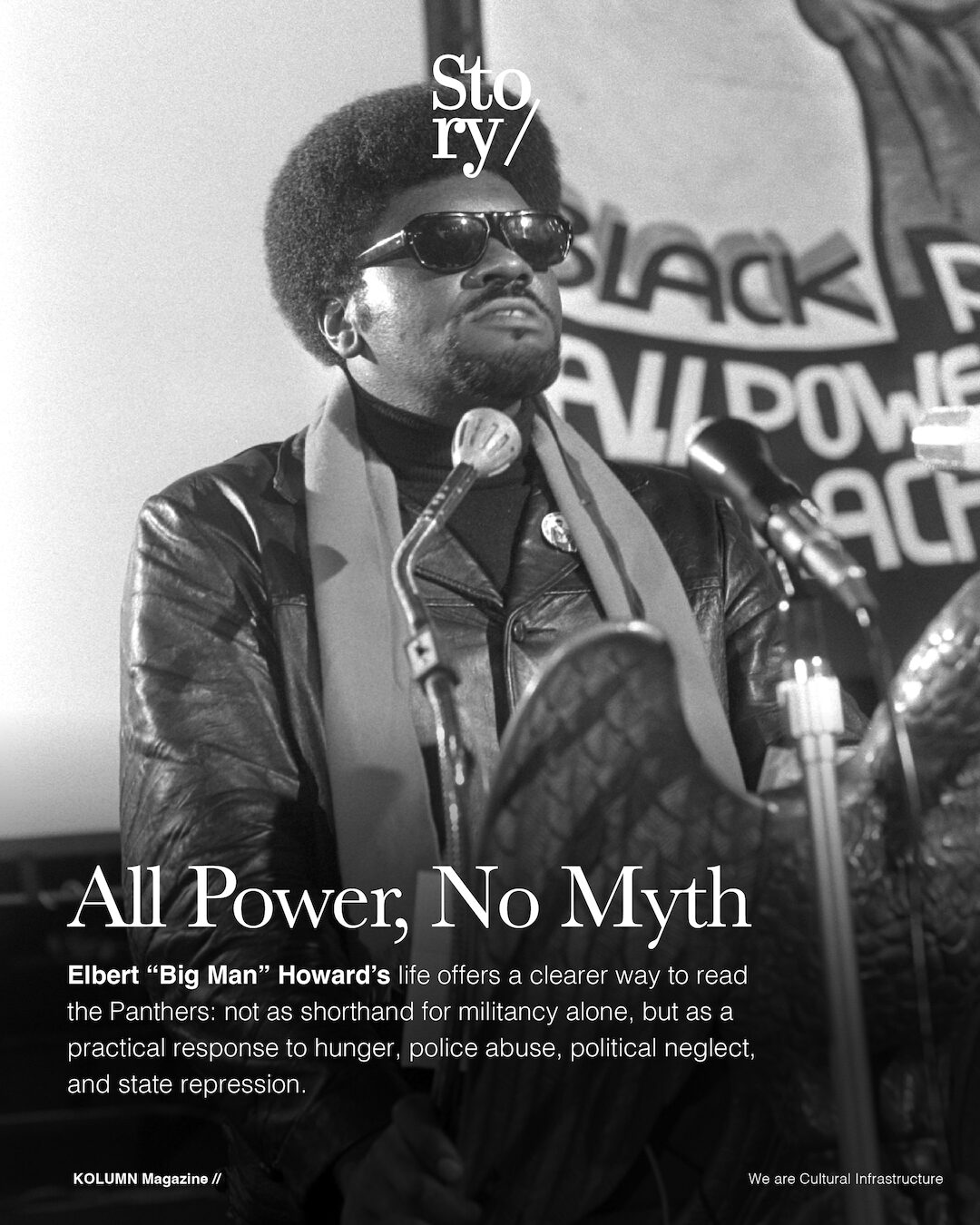
All Power, No Myth
March 16, 2026
No Comments
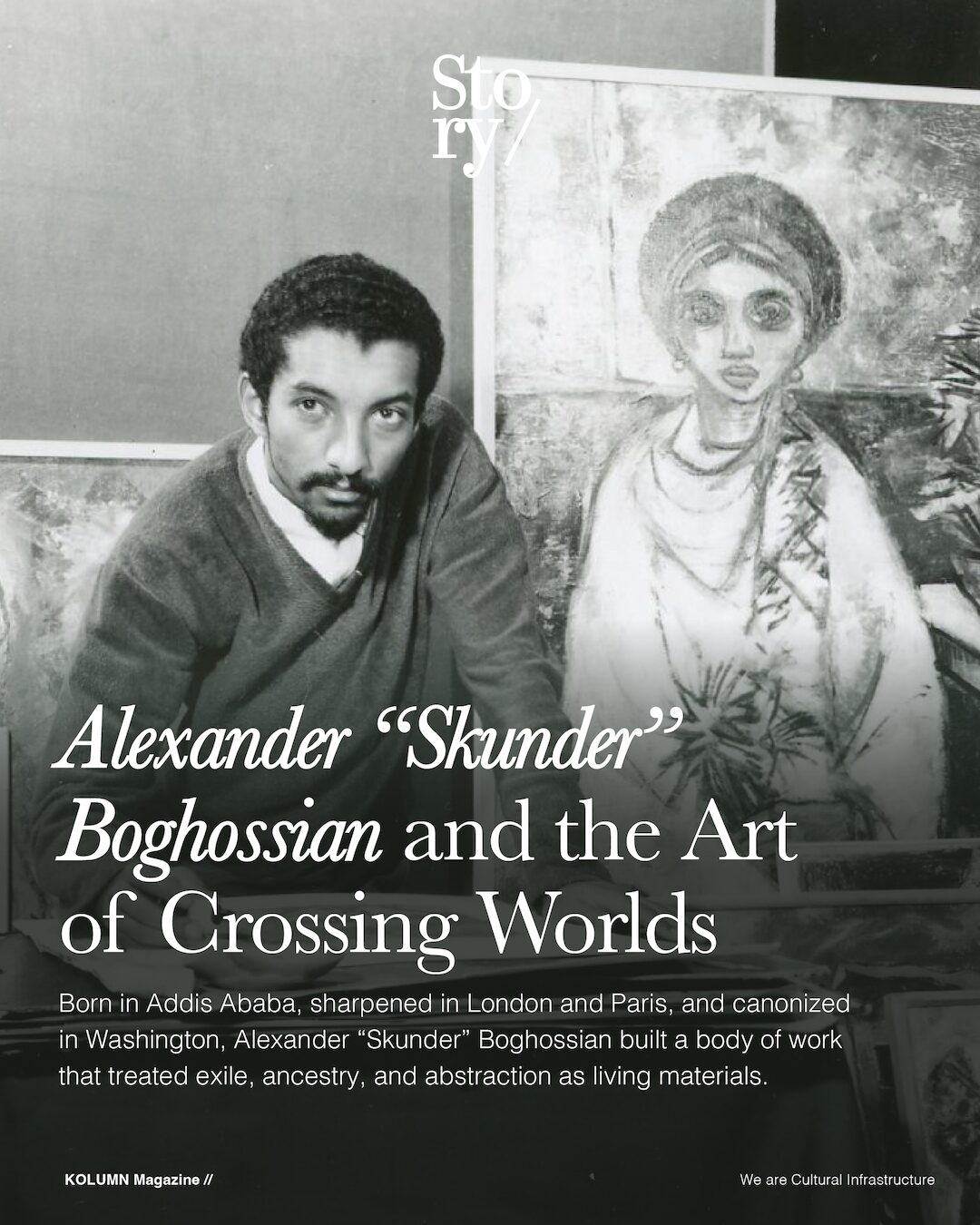
Alexander “Skunder” Boghossian and the Art of Crossing Worlds
March 16, 2026
No Comments