



The vote was about more than memory. It was about whether history creates obligations or only ceremonies.
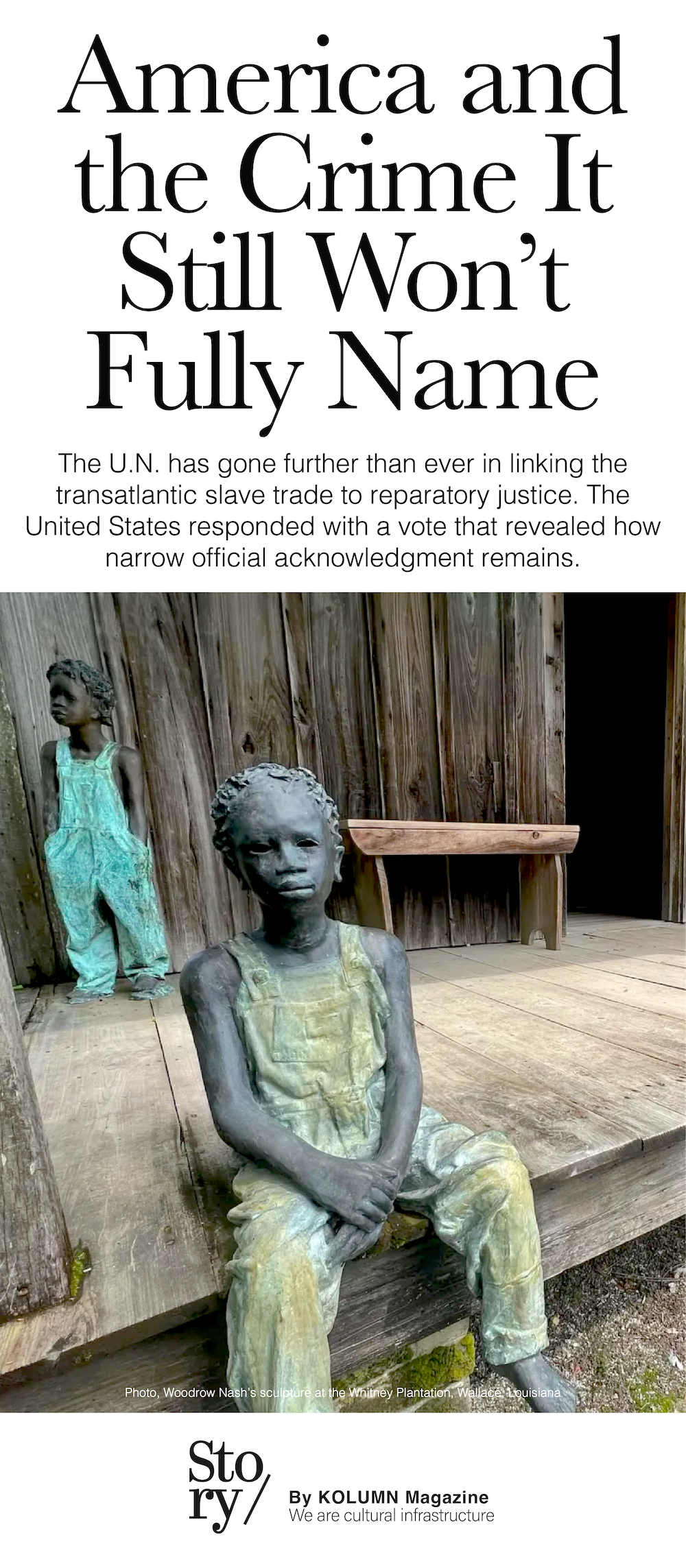
The vote was about more than memory. It was about whether history creates obligations or only ceremonies.
By KOLUMN Magazine
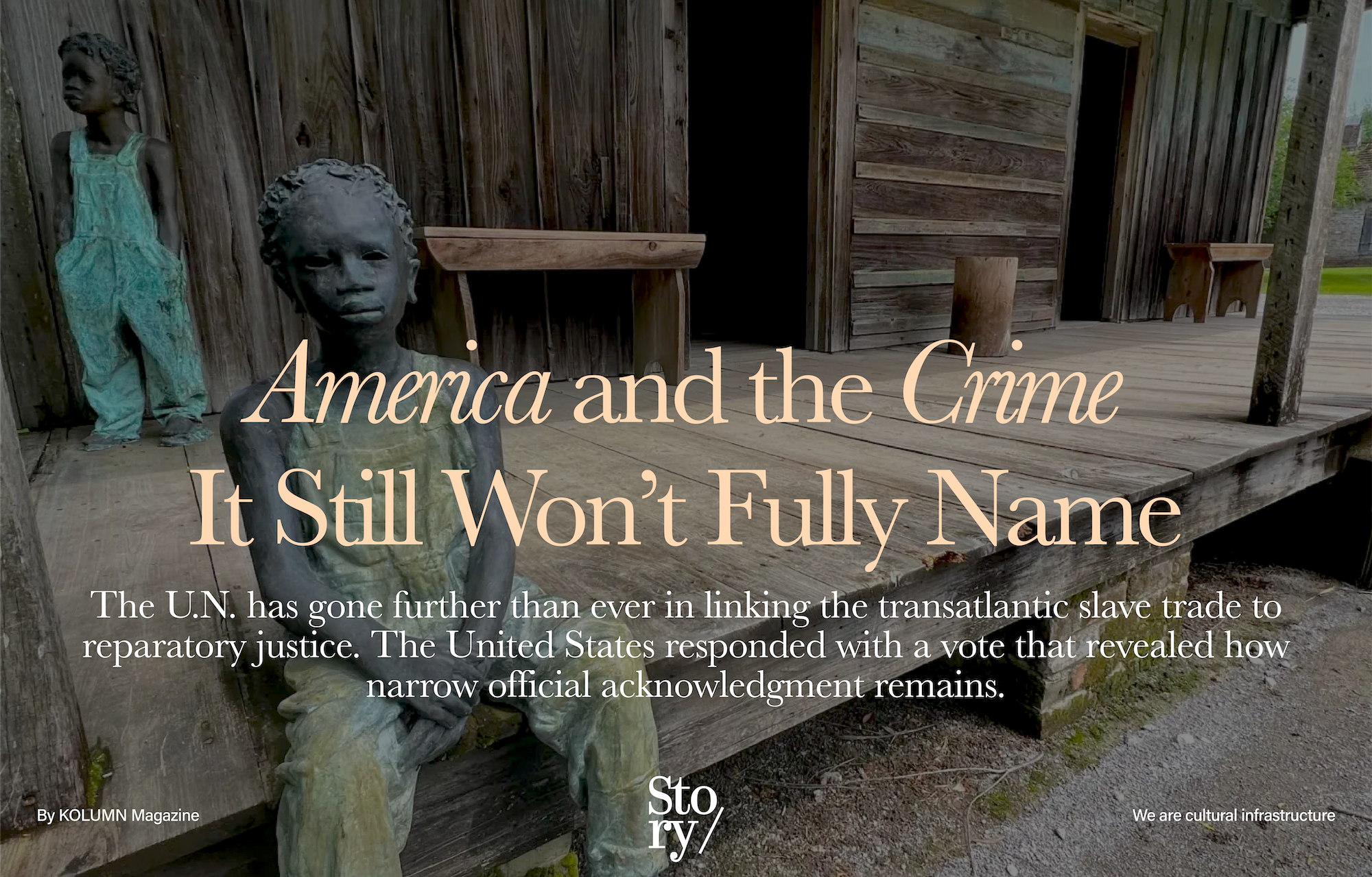
On Wednesday, March 25, 2026, the United Nations General Assembly adopted a Ghana-led resolution declaring the trafficking of enslaved Africans and racialized chattel enslavement of Africans the “gravest crime against humanity” and calling for reparatory justice. The vote was lopsided: 123 countries in favor, 3 against, and 52 abstentions. The United States was one of the three no votes, alongside Israel and Argentina. Britain and European Union member states mostly abstained. The resolution is not legally binding, but in diplomatic terms it was still a major event: a formal effort by much of the world to put slavery, its afterlives, and the question of repair at the center of international politics.
That means the story is not simply that the U.N. said something new about slavery. It is that, when offered a chance to stand with a broad global consensus on historical truth and reparatory justice, the United States chose instead to stand nearly alone. That choice matters because countries do not cast votes like this in a vacuum. They cast them with full awareness of symbolism, precedent, law, domestic politics, and audience. Washington knew what it was saying. The rest of the world heard it.
There is an important nuance here, and it is one too many headlines will flatten. The 2001 Durban Declaration already recognized slavery and the slave trade as crimes against humanity and said they “should always have been so.” What this new resolution did was push further: it elevated the transatlantic trade and racialized chattel slavery as the “gravest” crime against humanity and explicitly linked that recognition to a program of reparatory justice, including apology, restitution, compensation, rehabilitation, guarantees of non-repetition, and policy changes aimed at racism and systemic discrimination. So this was not a first draft of memory. It was an escalation from acknowledgment to consequence.
That escalation is exactly why the vote became combustible.
What the resolution actually said
The adopted text condemned the trafficking of enslaved Africans and the transatlantic slave trade as an enduring injustice, called for formal talks on reparatory justice, encouraged the return of cultural items and archives to countries of origin, and asked regional bodies including the African Union, CARICOM, and the Organization of American States to collaborate with U.N. entities on reconciliation and repair. AP’s reporting made plain that the resolution moved beyond memorial language into a framework that named apology, compensation, restitution, rehabilitation, and structural reform as part of the conversation.
The measure also reflected the political work of the last several years. Ghana’s President John Dramani Mahama had publicly framed the effort as part of a larger pan-African and diaspora campaign supported by the African Union, CARICOM, and countries across the Global South. Reuters reported that Ghana and its allies viewed the resolution as a step toward accountability for a trade that carried at least 12.5 million Africans across the Atlantic and whose consequences remain visible in racial inequality today.
That matters because this was never just about a sentence in a U.N. document. It was about whether the international system would continue to treat slavery as a safely mourned past or as an event with present-tense obligations. Ghana’s argument, and the argument of many African and Caribbean states, is that the slave trade was not merely horrific. It was foundational. It reorganized wealth, labor, empire, and race on a global scale, and the inequalities it produced did not dissolve simply because formal abolition came later.
Why the United States said no
A U.S. Mission to the United Nations response captured the core argument of Washington, which objected to what it called the “cynical usage of historical wrongs” to reallocate modern resources to people and nations “distantly related” to historical victims. The U.S. position also echoed a broader Western legal objection: that calling the transatlantic slave trade the “gravest” crime against humanity improperly created a hierarchy among atrocity crimes.
On paper, that is a legalistic argument. In practice, it is a political one. To say that the problem is the word “gravest” is to treat the central danger as semantic inflation rather than historical minimization. It is a way of sounding precise while avoiding the larger moral question. The United States did not merely decline to co-sponsor a text. It voted against it. That is a much stronger act than saying, “We prefer alternative wording.” A no vote broadcasts resistance.
And the U.S. argument about present-day resource transfers was even more revealing. It signaled that Washington understood the vote not as an abstract history seminar but as part of a live reparations debate. In other words, the United States seems to have recognized exactly what supporters intended: that naming the crime at the highest diplomatic level could strengthen material claims down the road. That appears to be what spooked it.
This is where the diplomacy gives way to ideology. For decades, much of the American political establishment has been comfortable condemning slavery in the past tense while balking at any language that might imply a present duty. There is bipartisan familiarity with the ritual phrase that slavery was a “stain” or an “original sin.” There is much less comfort with the idea that stolen labor, extracted wealth, blocked inheritance, state violence, and policy-backed exclusion form a chain that runs from plantation accounting books to modern wealth gaps. The U.N. vote forced that discomfort into the open.
The Western abstention was not neutrality
If the American no vote was blunt, the European response was more polished but not necessarily more generous. The European Union’s explanation of vote said the transatlantic slave trade was an “unparalleled tragedy” and acknowledged its lasting impacts, but objected that the resolution’s use of “gravest” implied a hierarchy among atrocity crimes and raised legal concerns about retroactivity and reparations. The EU ultimately abstained, saying it could not support the final text despite agreeing with the importance of remembrance and the need to combat contemporary racism.
What the U.S. opposed outright, much of Europe tried to proceduralize away.
Britain’s explanation was even more explicit. The U.K. said it was “firmly of the view” that no hierarchy of historical atrocities should be created and argued that international law’s principles of intertemporality and non-retroactivity meant there was no duty to provide reparations for acts that were not violations of international law when committed. It also rejected the idea that such principles could be bypassed through the language of “continuing harms.”
Those positions are legally coherent within a narrow state-centered framework. They are also politically convenient for states whose wealth, institutions, and imperial reach were entangled with slavery and colonial extraction. The abstention camp effectively said: yes, this was horrific; yes, its legacy remains; yes, racism persists; but no, do not convert that recognition into language that might sharpen claims. That is not nothing. But it is also not accountability.
The gap between American opposition and European abstention is therefore less moral than stylistic. Washington slammed the brakes. Europe pressed them more delicately. But neither position amounted to an embrace of reparatory justice as supporters understand it.
Ghana’s push did not come out of nowhere
Mahama and Ghana did not invent this conversation this week. They inserted themselves into a long line of African, Caribbean, and diaspora advocacy. In a Guardian essay published before the vote, Mahama situated the resolution within a lineage that included the 1993 Abuja Proclamation, CARICOM’s reparations framework, the 2023 Accra Proclamation, and the African Union’s recent elevation of reparations as a central political theme. He argued that this was not about assigning collective guilt to living generations so much as confronting how historical crimes shape contemporary inequality.
The African Union’s own materials back that up. Its 2025 Theme of the Year was “Justice for Africans and People of African Descent Through Reparations,” and the AU described that agenda as building on decades of advocacy around transatlantic enslavement, colonialism, apartheid, genocide, restitution of looted cultural heritage, and cooperation with the Caribbean diaspora. The AU also tied the present moment to the 2001 Durban framework and to efforts to build common African positions on reparations.
CARICOM, for its part, has spent years articulating what reparatory justice could mean in practice. Its Ten Point Plan includes a formal apology, repatriation options, Indigenous development, cultural institutions, public health remedies, literacy and educational repair, African knowledge programs, psychological rehabilitation, technology transfer, and debt cancellation. Whether one agrees with every plank or not, the key point is that reparations in this discourse are not reducible to a single check. They are envisioned as institutional, developmental, cultural, and transgenerational.
This broader context is crucial because critics often treat reparations as a rhetorical demand designed to embarrass governments. Supporters increasingly treat them as a policy architecture. The U.N. vote fit that shift. It was an attempt to move from commemoration to infrastructure.
The argument over law is real, but it is not the whole story
Defenders of the U.S., U.K., and EU positions will say, with some justification, that international law should not be retroactively rewritten and that terms like “gravest” can indeed create doctrinal problems. They will note that crimes against humanity as a formal category emerged much later and that states have reason to resist vague language that could be used unpredictably in future disputes. Those are not frivolous concerns. They are the concerns states usually raise when they fear precedent.
But there is another legal and moral tradition at work here, one centered on lasting injury. The U.N. human rights system has repeatedly stressed that the consequences of enslavement and colonialism remain active in the present and that reparatory justice includes restitution, rehabilitation, satisfaction, and guarantees of non-repetition. An OHCHR overview published in late 2025 says reparatory justice is as much about the present as the past and emphasizes the need to reverse the enduring consequences of slavery, the slave trade, colonialism, apartheid, and related atrocities.
The Durban framework also matters precisely because it showed that the international community had already crossed a threshold in 2001, agreeing that slavery and the slave trade were crimes against humanity and should always have been so. The new dispute, then, is not over whether slavery was monstrous. It is over what follows from saying so with full seriousness. Does recognition carry only memorial value, or can it justify remedies? The legalist response says the first. The reparatory response says that is far too small.
Howard law professor Justin Hansford, quoted by Reuters, called this vote the furthest the U.N. has gone in recognizing transatlantic slavery as a crime against humanity and in calling for reparations. That assessment helps explain why opponents dug in. Even a nonbinding resolution can move the conversation by shifting the default vocabulary of legitimacy.
Why this hit so hard in the United States
For the United States, the vote landed inside an especially tense domestic landscape. AP noted that support for reparations gained momentum after George Floyd’s murder in 2020 but has since run into a broader conservative backlash over how race, inequality, and history are taught and discussed in public institutions. Reuters, in separate reporting on Mahama’s trip to New York, connected the U.N. debate to American battles over museum exhibits, Black history curricula, monuments, and what critics describe as a renewed effort to sanitize the record of slavery and segregation.
America often wants the authority that comes from moral clarity without the obligations that moral clarity can create.
That context makes the U.S. vote feel less like an isolated foreign-policy event and more like an export of domestic culture war. Mahama said plainly that he sees American policy trends as helping normalize the erasure of Black history. Whether one agrees with every part of his critique, the timing is impossible to ignore. At the very moment the U.N. was being asked to formalize stronger language about slavery and reparations, Washington was moving in the opposite symbolic direction.
There is also a distinctly American habit of treating reparations as politically toxic the moment the conversation threatens to become concrete. H.R. 40, the bill to create a federal commission to study and develop reparations proposals for African Americans, was reintroduced in the 119th Congress in January 2025. But even the modest step of study remains stuck. That legislative inertia makes the U.S. no vote at the U.N. feel entirely consistent with domestic precedent: acknowledge the history, maybe; institutionalize the implications, no.
The irony, of course, is that the United States has long presented itself as a global moral instructor on human rights, historical reckoning, and democratic repair. It has demanded memory work from other nations. It has urged truth-telling after atrocities abroad. Yet when a multilateral body moved to more forcefully describe one of the foundational crimes shaping the Atlantic world, Washington’s instinct was not to lead the reckoning but to contain it.
Symbolic votes are not “just symbolic”
One easy dismissal of this episode is to shrug and say the resolution was nonbinding. That is technically true and journalistically insufficient. General Assembly resolutions are not Security Council resolutions. They do not compel state action in the same way. But they do matter as expressions of world opinion, as agenda-setters, and as legitimating documents that activists, lawyers, scholars, and diplomats can point to later. AP put it plainly: these votes are important reflections of global opinion.
That symbolic power is exactly why states fight over wording so fiercely. Nobody spends this much diplomatic energy on a text they believe is meaningless. The U.S., U.K., and EU objections themselves prove the point. Their concern was not merely aesthetic. It was about what naming can authorize. Once the world body says the transatlantic slave trade was not only criminal but singularly grave, and once it pairs that declaration with reparatory language, it becomes harder to wave away future demands as fringe or unserious.
This is also why supporters celebrated the vote as historic. They were not claiming it instantly created a reparations tribunal or opened a checkbook. They were claiming that the floor of legitimacy just moved. And, by Reuters’ account, some advocates explicitly see the resolution as part of a pathway toward a broader reparative framework, potentially including a future U.N.-backed mechanism.
In that sense, the American no vote may have lost the immediate battle even as it clarified the terrain ahead. The resolution passed anyway. Washington could not stop that. But it did mark itself as a holdout at a moment when much of Africa, the Caribbean, and significant portions of the Global South are trying to redefine how historical atrocity is discussed in multilateral space.
The language of “no hierarchy” has its own politics
The most repeated objection from Western governments was that calling the slave trade the “gravest” crime against humanity would create a hierarchy of atrocities. This is a serious claim, and it deserves a serious response. No one wants atrocity Olympics. No community wants to hear its suffering downgraded. But there is also a politics in refusing distinctions altogether. Sometimes “no hierarchy” becomes a way to prevent any fuller reckoning with scale, duration, centrality, and enduring impact.
The transatlantic slave trade lasted for centuries, involved the systematic trafficking of millions, fused profit with racial ideology, helped build empires and modern capitalism, and produced social orders whose aftershocks remain measurable. You do not need to deny the horror of genocide, apartheid, colonial terror, or other crimes against humanity to say that slavery’s architecture was world-making in a particular way. Supporters of the resolution were effectively arguing that this historical centrality warrants especially forceful naming.
The legal problem with “gravest” may be real. But the rhetorical resistance to stronger language also reflects anxiety about what happens when slavery is no longer spoken of as one atrocity among many, safely filed in the moral archive, and is instead treated as a structuring event of the modern world. That framing has consequences for museums, schools, finance, diplomacy, inheritance, and political legitimacy. It asks too many institutions to look in the mirror for comfort.
What reparatory justice means beyond cash
One of the most predictable ways this conversation gets narrowed is by reducing reparations to payouts and then mocking the idea as impractical. But the resolution, and the institutions behind it, point to something wider. The text approved by the General Assembly referenced apology, restitution, compensation, rehabilitation, guarantees of non-repetition, and legal and policy change. CARICOM’s plan reaches into public health, education, technology, archives, cultural memory, debt, and psychological rehabilitation. OHCHR materials similarly describe reparatory justice as a package of measures aimed at restoring dignity, achieving healing, and reversing lasting inequalities.
That breadth is important because the injury itself was broad. The transatlantic slave trade was not just unpaid labor. It was family rupture, cultural theft, racial codification, state terror, land expropriation, denial of education, and the transfer of wealth across continents and generations. A serious reparatory framework would almost certainly have to be plural, uneven, and institutionally complex. It would not look the same in Ghana, Jamaica, Barbados, Brazil, Britain, or the United States.
That complexity is another reason Western governments are cautious. Once reparations are understood as institutional redesign rather than a one-time demand, they become harder to dismiss as symbolic theater. They start to sound like governance.
The American contradiction, laid bare
What makes the U.S. vote especially jarring is that America’s own public culture is full of half-accepted truths about slavery. There is broad mainstream agreement that slavery was evil. There is broad reluctance to follow that admission too far into the present. The country can tolerate morality without remedy. It is less comfortable with causation. Once causation becomes clear, remedy starts to look less like charity and more like debt. That is precisely where consensus collapses.
At the U.N., that contradiction became visible in a single roll call. The United States could have abstained, as many European states did. It could have signaled discomfort with the wording while withholding direct opposition. It chose not to. That sharper posture suggests something deeper than drafting concern. It suggests a determination to resist the normalization of a reparations-centered framework.
And this is where the vote tells on America. The country still wants slavery remembered in a way that confirms its eventual self-correction. It is far less willing to remember slavery in a way that reorders current obligations. The U.N. resolution pressed that distinction hard enough that Washington answered with a no.
What happens now
The resolution itself will not produce instant material change. No reparations tribunal springs automatically from a General Assembly vote. No country is compelled tomorrow to transfer funds, return archives, or rewrite law. But history at the U.N. tends to move in layers. First comes naming. Then coalition-building. Then institutional experimentation. Then new norms. The Ghana-led effort seems to be consciously working within that sequence.
Supporters now have several things they did not have before this vote: a stronger global tally, a formal text linking slavery to reparatory justice, a higher-profile public split between African and Caribbean advocates and Western powers, and a clearer sense of which legal objections they will need to answer next. The no vote, paradoxically, may sharpen the movement rather than weaken it. Opposition clarifies the job.
For the United States, the more immediate consequence is reputational. Washington has again put itself on the wrong side of a symbolic racial justice fight with global resonance. In a period when it is already under scrutiny for battles over history education, museums, and race-conscious policy, that is not a trivial development. The vote adds an international chapter to a domestic story already in progress.
And for descendants of the enslaved, especially across the African diaspora, the significance may be more intimate than procedural. International institutions have often treated slavery as something to commemorate annually and then move past. This vote said, in effect, that the story is not finished. Whatever the legal caveats, that is not a small thing.
The deeper question beneath the vote
Strip away the protocol and the legal jargon, and this controversy comes down to a blunt question: what does the world owe to the people whose labor, dispossession, and dehumanization helped build it?
The U.N. majority did not fully answer that question on March 25. But it did refuse to keep dodging it. It said the transatlantic slave trade belongs not only in museums and remembrance ceremonies but in the active vocabulary of justice. The United States responded by voting no.
That no vote will be defended as a matter of legal precision, caution about precedent, and concern over historical hierarchy. Some of those arguments will be made sincerely. But politics is also about what a government chooses to risk. On this question, Washington risked offending a global majority rather than risk legitimizing stronger claims for repair. That is the clearest reading of the record.
History, of course, has a nasty habit of outlasting procedural objections. The Durban Declaration helped set the stage for this week’s vote. This week’s vote may help set the stage for something larger still. That is usually how global norms move: first they are denounced as imprecise, radical, or destabilizing; later they become common sense.
So the lasting image from this episode may not be the legal memo or the explanation of vote. It may be the tableau itself: 123 countries saying the crime must be named more forcefully and that repair must be part of the conversation, while the United States sat in one of only three seats marked no. That is not just a diplomatic detail. It is a portrait of a country still trying to control the terms on which its deepest historical debts can be spoken aloud.
More great stories

Elizabeth Catlett Never Separated Art From Freedom
April 1, 2026
No Comments
Paul Robeson Was Too Much for America
April 1, 2026
No Comments