





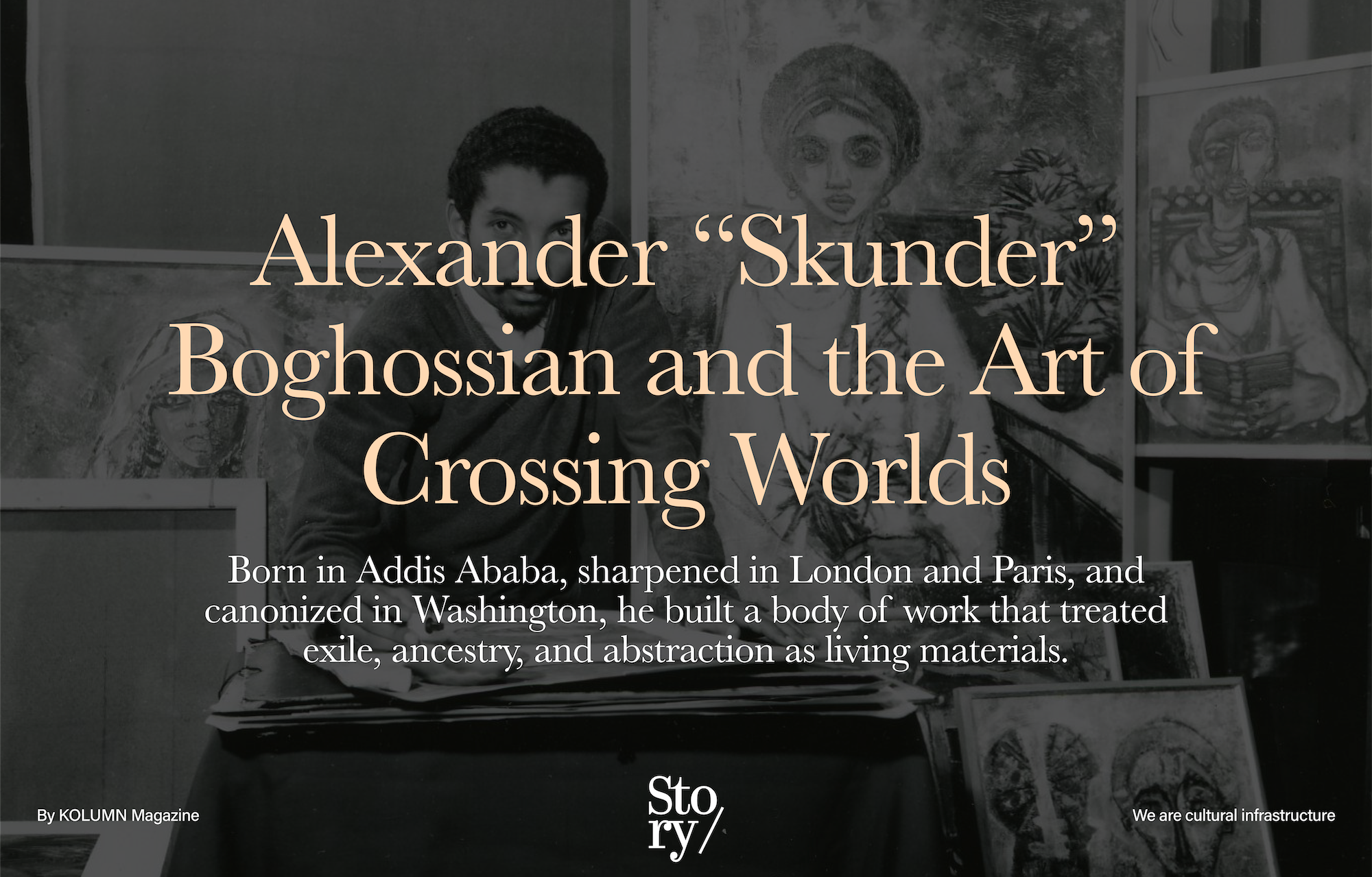
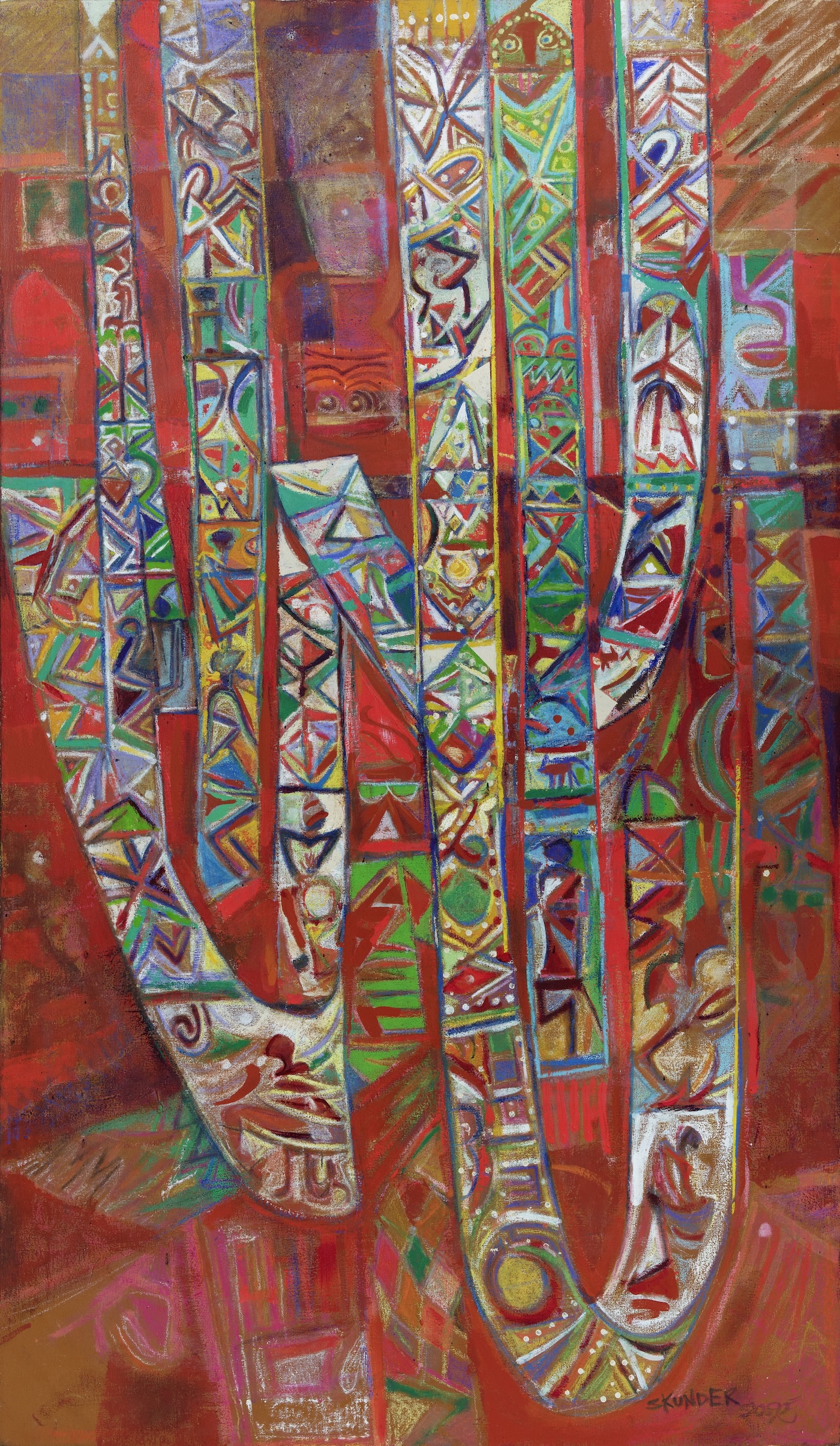
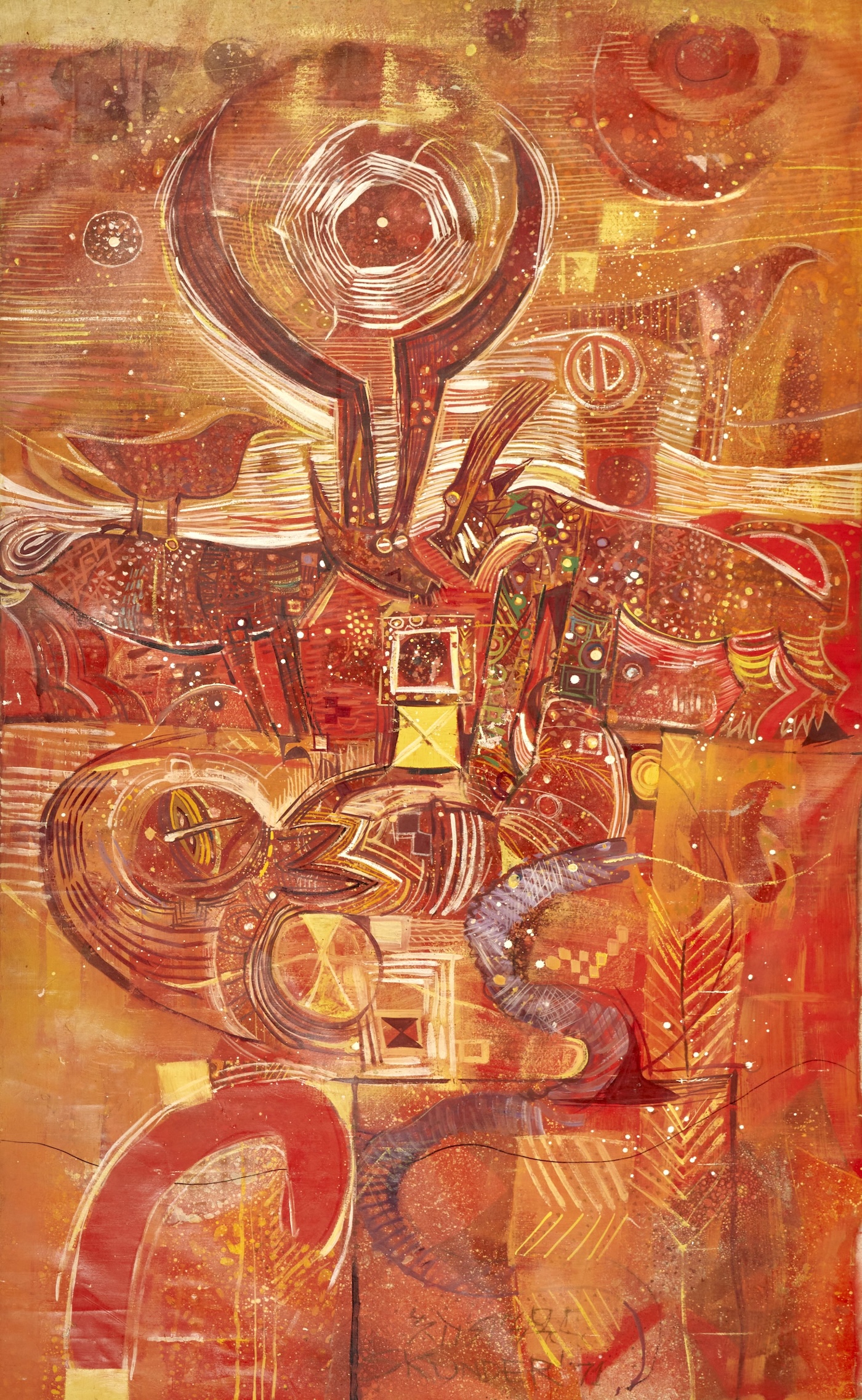
Skunder’s paintings do not simply depict symbols. They behave like symbolic systems in motion.
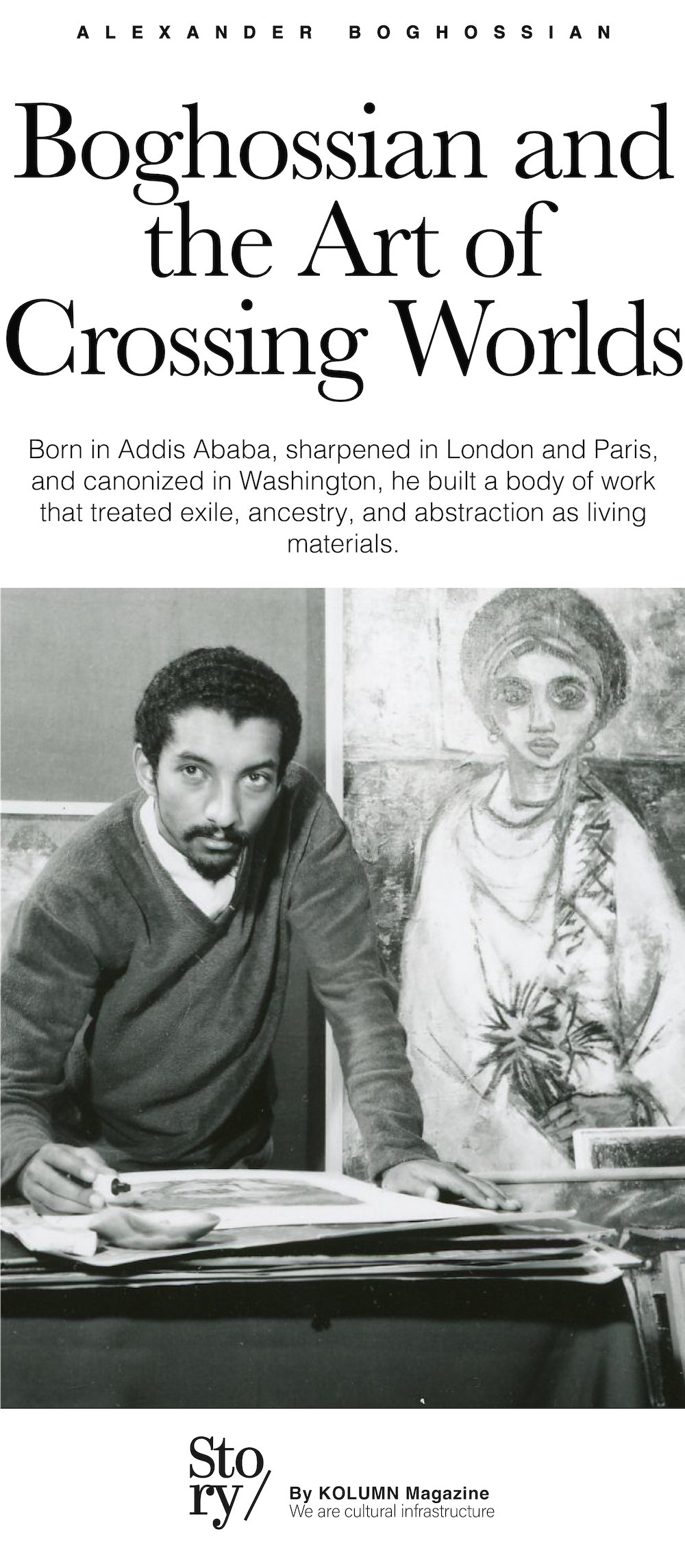
Skunder’s paintings do not simply depict symbols. They behave like symbolic systems in motion.
By KOLUMN Magazine
Long before museums began earnestly revising their accounts of modernism, long before curators started talking about “global surrealism” or “multiple modernities,” Andrew “Skunder” Boghossian was already painting as if those older boundaries had no authority over him. Born in Addis Ababa in 1937, educated in Europe, shaped by Ethiopian sacred art, electrified by jazz, and later anchored at Howard University, he built a practice that made African modernism look less like a regional offshoot and more like a center of gravity. The institutions eventually caught up. The Museum of Modern Art acquired Ju-Ju’s Wedding in the mid-1960s, making him the first contemporary Ethiopian artist to enter its collection, while the Smithsonian’s National Museum of African Art and the Met would later help place him more firmly within the larger story of 20th-century art.
That institutional validation matters, but it can also flatten what made him so unusual. Boghossian was not merely an “important Ethiopian painter,” nor just an early African modernist who got recognized abroad. He was a cultural synthesizer of rare daring. He pulled from Ethiopian Christian iconography, däbtära healing scrolls, African sculpture, European modernism, Afro-diasporic spiritual systems, and the improvisational structure of jazz. He was at once local and transnational, rigorous and ecstatic, scholarly and intuitive. His paintings often seem to hover between liturgy and dream, between the visible world and a symbolic one vibrating just beneath it. That quality is part of why his work still feels contemporary now: it understands identity not as a fixed category but as a field of movement.
To write about Boghossian today is to write about a figure who sits at several crossroads at once: Ethiopia and the Black Atlantic, sacred image-making and abstraction, postwar avant-garde experimentation and anti-colonial consciousness, teaching and making, fame and under-recognition. He was celebrated in Ethiopia, where he won the Haile Selassie I Prize for fine arts, and he later became a revered mentor in Washington. Yet he also spent years negotiating the familiar gap between artistic importance and market visibility, between critical stature and public name recognition. A 1986 Washington Post profile captured that tension bluntly: in Ethiopia he had been a cultural star, but in the United States he found himself working to “recapture” recognition.
His significance, then, is not only aesthetic. It is historical. Boghossian helped prove that African modern art was not derivative, delayed, or peripheral. It was fully engaged in the same century-wide arguments about form, freedom, spirit, politics, and memory that animated artists everywhere else. He did not ask permission to enter those arguments. He changed them.
Addis Ababa, inheritance, and a complicated beginning
Alexander “Skunder” Boghossian was born in Addis Ababa on July 22, 1937, during a period shadowed by the aftershocks of the Italian invasion of Ethiopia. He came from a family shaped by layered histories. His mother was Ethiopian; his father, of Armenian descent, served as a colonel in the imperial bodyguard. That Ethiopian-Armenian identity matters, not because it turns him into a neat emblem of multiculturalism, but because it sharpened his early awareness that belonging could be plural, historical, and politically charged all at once. Ethiopia itself occupied a singular position in the Black imagination: an ancient African polity with a powerful Christian iconographic tradition and an anti-colonial symbolic status that resonated far beyond its borders. Boghossian’s life began inside that density.
His early education exposed him both to Ethiopian tradition and to cosmopolitan instruction. Accounts of his upbringing note his study of Ge’ez script and his fluency in Amharic, Armenian, English, and French. He also studied informally under figures such as Stanislaw Chojnacki, the historian of Ethiopian art. Those details matter because Boghossian’s later paintings never read like the work of an artist discovering heritage from a distance. They feel instead like the work of someone who internalized visual systems early enough for them to become instinctive. The eyes, the scroll-like inscriptions, the frontal icon-like figures, the sense of surface as both image and text: these were not borrowed motifs. They were native materials that he later radicalized.
There was also music. Boghossian later spoke of jazz with something close to reverence, calling it one of the century’s great collective inventions. That comment, preserved in biographical accounts, is revealing. Jazz gave him more than atmosphere. It offered a formal logic: modulation, repetition with variation, structural freedom inside discipline, the possibility that complexity could remain sensuous. You can feel that logic in his paintings, especially the ones that seem to pulse rather than settle.
If modernism in many Western accounts still gets narrated as a march from representation to abstraction, from tradition to rupture, Boghossian’s early formation suggests a different model. For him, inheritance was not the opposite of experiment. It was the condition that made experiment meaningful.
London, Paris, and the making of a modernist who refused hierarchy
In 1955, Boghossian received a government scholarship that sent him to Europe. He studied in London, including at Saint Martin’s School of Art, the Central School of Art and Design, and the Slade School of Fine Art, before moving to Paris, where he continued his training and entered a broader network of artists and intellectuals. The Smithsonian summarizes this period clearly: he was born in Addis Ababa, won a scholarship to Europe, and went on to live and work across key postwar art capitals before eventually moving to the United States.
Europe gave him technical training and exposure, but it did not Europeanize him in any simplistic sense. What it did was intensify his comparative eye. Paris in particular placed him in proximity to major artistic and political currents: postwar abstraction, surrealism’s afterlives, Négritude, pan-African intellectual exchange, and the wider circulation of anti-colonial thought. Biographical accounts connect him to circles influenced by figures like Léopold Sédar Senghor and to the 1959 Second Congress of Negro Writers and Artists in Rome. Even where individual anecdotes are difficult to reconstruct in total detail, the broader fact is clear: Boghossian was not a provincial visitor to Europe. He was part of a larger transnational Black cultural conversation.
What makes his Paris years so important is that they demonstrate how false the usual binary can be between “African authenticity” and “European influence.” Boghossian’s work did not become less Ethiopian as it absorbed modernist strategies. It became more self-conscious about how Ethiopian visual traditions could function inside modernist debates. He was not merely learning from Europe; he was learning how to reposition Ethiopia within a modern visual field that had too often treated Africa as source material rather than authorship.
That distinction is crucial. European modernism had long extracted from African art while denying living African artists equal standing in the present tense. Boghossian turned that arrangement inside out. He knew the languages of European modernism, but he also knew an older Ethiopian pictorial archive whose complexity European institutions had barely reckoned with. His achievement was not that he bridged two worlds as if they were sealed off from one another. It was that he painted from the knowledge that they had always been entangled, though not on equal terms.
The scroll, the icon, the dream
To understand Boghossian’s art, it helps to begin with the Ethiopian magic or healing scrolls that loom so large in discussion of his imagery. These scrolls, associated with däbtära practitioners, combine sacred language, talismanic design, and symbolic imagery meant to protect, heal, or repel evil. Smithsonian and Bonhams materials both emphasize how central this imagery became to Boghossian’s mature vocabulary. Bonhams notes that JuJu’s Wedding marked an important early use of these “magical scroll” forms, while Smithsonian materials on his later work continue to stress the symbolic power of scroll imagery and related motifs.
These references were never antiquarian. Boghossian did not simply reproduce sacred forms for ethnographic effect. He transformed them into a modern syntax. Eyes float and multiply. Geometric enclosures lock and unlock. Figures emerge from patterned grounds as if summoned from another register of perception. Surfaces behave like skins layered over older skins. Even when the work turns abstract, it retains the pressure of invocation. One does not merely look at a Boghossian painting; one feels addressed by it.
Khan Academy’s discussion of Night Flight of Dread and Delight points to the split structure and symbolic density of the work, while broader scholarly summaries describe Boghossian as a pioneer of African modernism who gave visual form to visible and invisible realities. That phrase is useful because it gets at the deepest tension in his practice. His paintings are not dreamscapes in the soft, European surrealist sense of private fantasy alone. They are metaphysical spaces in which history, spirit, memory, fear, pleasure, and ancestral sign-systems coexist.
There is a technical intelligence to this work that can be overshadowed by its mystique. Boghossian understood composition, edge, surface, and rhythm at a high level. He used collage, metallic paint, bark cloth, goatskin, cardboard, and other supports not as eccentric add-ons but as meaningful material choices. MoMA’s record for Ju-Ju’s Wedding notes its tempera and metallic paint on cut-and-torn cardboard, which is precisely the sort of support that allows the object to feel at once fragile, ceremonial, and improvisational.
The effect is part ritual object, part painting, part visual score.
A first in the museum, and why that first still matters
In the conventional art-world telling, firsts are often overused. But Boghossian’s case warrants attention. The Smithsonian states that he was the first contemporary African artist to have work purchased by the Musée d’Art Moderne in Paris and later the first contemporary Ethiopian artist represented in the Museum of Modern Art in New York. The Washington Post likewise described his entry into MoMA as a source of iconic status among Ethiopian artists and students.
This is not just a line for résumés. It marks a structural change in visibility. Museums like MoMA did not merely reflect art history; they helped manufacture its hierarchy. For Boghossian to enter that collection in the 1960s meant that an African artist working contemporaneously, not as an ethnographic artifact nor as a maker of “tribal” objects but as a modern artist in the full sense, had forced open a door that institutions had long kept nearly closed.
Still, it is worth being careful here. Institutional acquisition does not automatically equal deep understanding. In many cases, museums bought selectively while failing to alter the intellectual frame around the work. Boghossian’s career shows both the power and the limitation of museum recognition. Yes, he was collected. Yes, he was admired. But only more recently has the broader museum field begun to position him not as a footnote to African art, but as an indispensable figure within modernism itself. The Met’s inclusion of Night Flight of Dread and Delight in the discourse around Surrealism Beyond Borders is one sign of that shift. The museum explicitly presented the painting as part of a worldwide remapping of surrealism and noted the importance of Wifredo Lam and Roberto Matta to Boghossian’s sense of how Black diasporic experience might meet surrealist form.
In that sense, Boghossian’s afterlife tells a story about the art world as much as it tells one about the artist. He was already there. The institutions needed time to build a framework expansive enough to admit what his work had always made obvious.
Return to Ethiopia, then departure again
After his years in Europe, Boghossian returned to Ethiopia in the mid-1960s and taught at Addis Ababa’s School of Fine Arts before leaving for the United States around 1970. Biographical sources consistently frame this period as pivotal: he returned with international experience and modernist exposure, then re-entered Ethiopian cultural life as both artist and educator.
This is one of the most important chapters in his significance, though it often gets compressed. Boghossian was not just making paintings; he was participating in the modernization of artistic practice in Ethiopia. Alongside other major figures, he helped redefine what contemporary art could be in a country with a deep and distinctive sacred visual tradition. Ethiopian modernism did not simply imitate Paris or London. It absorbed, argued with, and redirected them. Boghossian was central to that process.
But Ethiopia was also moving toward profound political upheaval. By the 1970s, the fall of Haile Selassie and the rise of the Derg transformed the country and sent many artists and intellectuals into diaspora. A Washington Post review of the 2003 Smithsonian exhibition Ethiopian Passages: Dialogues in the Diaspora explicitly connected that wave of displacement to the artists in the show. Boghossian, who had taught many of them at Howard, became both exemplar and bridge for a generation negotiating exile through art.
There is a tendency in art writing to romanticize exile, as though displacement automatically produces profundity. Boghossian’s life suggests something harder. Exile expands one’s frame, yes, but it also scrambles continuity. It turns memory into raw material and burden at once. That tension is visible in his work: forms recur like remembered prayers, but they do so in altered conditions. The paintings know home as structure and as loss.
America, Black Power, and Howard University
Boghossian’s move to the United States led first to Atlanta and then to Washington, where Howard University became his most enduring institutional home. Smithsonian accounts say he taught at Howard from the 1970s until the early 2000s; the Washington Post identified him as a magnetic force for Ethiopian students, several of whom would become notable artists in their own right.
Howard mattered because it was more than a job. It was a site of Black intellectual and artistic self-definition. At Howard, Boghossian entered a tradition shaped by figures who had long insisted on Black art as a field of serious historical and formal inquiry. He also entered an environment in which African and African American cultural exchange could occur outside the distortions of white institutional approval. This is part of why his presence there resonated so powerfully. He was not just an immigrant professor bringing foreign prestige. He embodied a wider Black world.
The Washington Post’s 2003 coverage of Ethiopian artists in diaspora is particularly revealing here. Six of the 10 artists in the Smithsonian exhibition had studied at Howard, and the paper called Boghossian a teacher and mentor who assumed iconic status. That alone would justify his place in history. Artists matter not only through what they make, but through the ecosystems they help build. Boghossian’s students and younger admirers extended his influence well beyond his own canvases.
His work also changed in America. Accounts of his career note the impact of the Black Arts Movement and Black Power on his visual language. Earlier biomorphic and calligraphic tendencies did not disappear, but the political charge of the work intensified. He began producing pieces with titles like Black Emblem, The End of the Beginning, and DMZ. Even when those works did not read as literal protest art, they carried a sharper sense of historical contest and Black political consciousness.
This is where Boghossian becomes especially important for Black art history in the United States. He complicated the often overly national framing of Black art by insisting, through both presence and practice, that Black modernism was diasporic. Howard was one of the places where that argument could be lived daily.
“At Howard, Skunder was not just a professor. He was evidence that Black art history was larger than the nation-state.”
Surrealism, but not the old kind
It is tempting to call Boghossian a surrealist and leave it there. That would be only partly right. He was certainly in conversation with surrealism, and the Met has explicitly linked Night Flight of Dread and Delight to his encounter with the work of Wifredo Lam and Roberto Matta. Yet Boghossian’s surrealism, if that is the word, was not simply a matter of dream imagery or unconscious juxtaposition in the orthodox Parisian mode. It was bound to African spiritual symbolism, postcolonial movement, and Black diasporic epistemologies.
That difference matters. Classical accounts of surrealism often emphasize liberation from rationality through dream, desire, chance, and psychic automatism. Boghossian’s work shares some of that appetite for the marvelous, but it does so through systems of meaning that do not originate in European psychoanalysis. His paintings often behave more like portals into encoded traditions than eruptions of private fantasy. The symbols are strange, but they are not arbitrary. They come from somewhere.
This is part of why his inclusion in Surrealism Beyond Borders was so important. The exhibition proposed that surrealism was never the property of one city or one canon. In Boghossian’s hands, it became a tool for merging Black diasporic experience with a broader modernist search for expanded consciousness. He did not dilute surrealism by “localizing” it; he exposed how provincial the older definition had been.
The same is true of abstraction in his work. Boghossian’s abstract passages are never merely formal exercises. They are crowded with pressure from script, eye, ornament, talisman, memory. He reminds viewers that abstraction can still be historical, spiritual, and culturally precise.
The paintings as arguments
A Boghossian painting often looks like it is withholding something and revealing something at the same time. That tension is not decorative; it is philosophical. His canvases argue against the demand for full legibility that Western viewers often place on non-Western art. They do not hand over meaning at once. They ask the viewer to dwell in partial knowledge.
Take Ju-Ju’s Wedding, which MoMA dates to 1964. Even through reproduction and catalogue language, the work announces a layered sensibility: metallic paint, collage-like support, patterned fields, icon-like forms, all orchestrated into something that feels ceremonial but unstable. Bonhams describes it as a turning point in his use of magical scroll imagery. Seen historically, it becomes something like a declaration of method. Boghossian would not choose between modernist experimentation and inherited symbol. He would make each intensify the other.
Or take The End of the Beginning, held by the Smithsonian, a title that sounds almost like a programmatic statement for postcolonial modernity. The Smithsonian’s object note places him within a career that spanned Addis Ababa, Europe, and the United States, while also underscoring his stature as a practicing artist and teacher. The title itself suggests transition without closure. That was Boghossian’s zone: not arrival, but charged threshold.
The Met’s The Cross, the Church, and the Butterfly, dated to the 1980s, makes another point. Even in later work, he remained in dialogue with sacred forms and transformed symbolism. The title alone reveals the durability of his preoccupations: religion, transformation, fragility, transcendence, sign.
It would be easy to over-spiritualize him, and critics should resist that habit. Boghossian was not an untutored mystic. He was a highly educated, intensely self-aware painter operating in relation to art history, politics, and pedagogy. But it would be equally wrong to secularize him into a purely formal modernist. His work insists that spirit, symbol, and material history can occupy the same plane.
Recognition, under-recognition, and the long correction
There is a familiar pattern in the stories of major Black artists: influence arrives earlier than consensus, and scholarship often trails the work by decades. Boghossian’s career fits that pattern. During his lifetime he received major honors, taught at a premier Black institution, entered major collections, and was revered by peers and students. Yet his name still does not circulate in the wider public with the ease one would expect for an artist of his caliber.
The reasons are not mysterious. African modernists were long marginalized by museum and market systems that treated Europe and the United States as the default stages of modern art. Artists who did not fit those narratives were often compartmentalized into area studies, ethnographic framing, or “special interest” exhibitions. Boghossian was too African for some mainstream modernist accounts, too modern for reductive categories of “traditional African art,” and too formally singular to be easily folded into a single school. That, paradoxically, is part of his greatness and part of what slowed his canonization.
The correction has been underway for some time. Institutions like MoMA, the Met, and the Smithsonian have increasingly positioned him within larger narratives rather than on the margins of them. Auction houses such as Bonhams have also contributed, however imperfectly, by reintroducing his work to collectors and broader audiences with more historically attentive framing. Bonhams now presents him as one of the first contemporary Black artists from the African continent to gain international attention and highlights how works like JuJu’s Wedding fused Ethiopian scroll traditions with a new modernist language.
Still, the market is not the same as justice, and belated acclaim is not the same as full understanding. The real correction comes when artists like Boghossian cease to be treated as amendments to the canon and start being treated as forces that require the canon to be rewritten.
The mentor as institution
One of the most durable measures of an artist’s significance is whether they altered what younger artists believed was possible. By that standard, Boghossian was enormous. The Washington Post’s reporting on Ethiopian Passages made plain that Howard became a major destination for Ethiopian artists after he joined the faculty and that many of the artists in the show had studied there. He was not only a professor in the administrative sense. He was an axis.
That influence matters for several reasons. First, it demonstrates that Boghossian’s legacy is embedded in institutional lineage. Second, it shows how diaspora works culturally: not as pure scattering, but as network-building. Third, it reminds us that art history is not just a chain of masterpieces. It is also made in classrooms, critiques, and conversations, in the transfer of permission from one generation to another.
Howard’s own materials still position him among the department’s legacy artist-scholars. That may sound ceremonial, but it points to something real. He belongs to a tradition of Black artist-teachers for whom pedagogy was inseparable from practice.
In that respect, Boghossian stands alongside other major Black faculty artists who understood the university as a cultural site, not just a workplace. He helped make Howard a place where African and diasporic modernisms could be studied not as distant subjects, but as living practice. That contribution is hard to quantify and impossible to overstate.

The late work and the persistence of symbol
Boghossian continued working across media and forms well into later life. Smithsonian materials on Nexus, the 2001 commission made with Kebedech Tekleab for the Ethiopian Embassy in Washington, describe an aluminum relief incorporating symbols from Ethiopian Christianity, Judaism, Islam, and indigenous spiritual practices, as well as motifs related to instruments, tools, flora, and fauna. It is a fitting late statement: synthetic, public, civilizational in scope, and still committed to symbolic density.
There is something poignant about that commission in retrospect. An artist who had spent decades moving across national and cultural spaces ended by making a work for a diplomatic site, a wall of representation. Yet even there he did not flatten Ethiopia into official iconography. The symbolic complexity remained. The public face still held layers.
His death in Washington, D.C., in 2003 closed a career that had already transformed several art worlds at once. But it did not close the questions his work keeps asking. How do artists paint history without becoming illustrators of it? How do they remain faithful to inherited forms without merely preserving them? What does it mean to make Black art that is neither nationally bounded nor conceptually generic? Boghossian did not answer those questions discursively. He answered them in paint.
Why Skunder Boghossian matters now
It is tempting to say that Boghossian matters now because the art world is finally ready for him. That is partly true, but it lets the present off too easily. He matters now because the conditions that shaped his life still define much of cultural politics: migration, displacement, hybrid identity, debates over tradition and innovation, the battle over who gets recognized as central to modernity, and the ongoing need to think about Black culture transnationally rather than provincially.
He also matters because his art refuses the flattening tendencies of contemporary discourse. In an era that often pressures artists to become easy symbols of representation, Boghossian offers something more demanding. He is unquestionably significant as an Ethiopian artist, an African modernist, a Black diasporic figure, and an Ethiopian-Armenian maker. But he cannot be reduced to any one of those terms. His paintings preserve ambiguity without sacrificing specificity. That is rare.
And then there is the simple matter of visual force. The work holds. It still startles. The surfaces are alive. The symbols do not die under interpretation. The compositions keep their charge. This may be the final test. Plenty of artists are historically important. Fewer remain aesthetically urgent.
“Boghossian’s achievement was not that he entered the canon. It was that his work exposes how small the canon used to be.”
In recent years, museums and scholars have grown more interested in artists who trouble the old center-periphery map of modern art. Boghossian should be at the front of that discussion. Not because he makes diversity look good in a catalogue, but because his work changes the terms of the conversation. He shows that African modernism was never waiting passively for validation. It was already inventing forms equal to the century.
That may be the clearest way to understand his significance. Skunder Boghossian did not simply bridge Africa and the West, to borrow the language often used about him. That phrase is serviceable, but too gentle. Bridges imply two fixed shores. Boghossian’s art does something more radical. It reveals that the map itself was drawn badly.
More great stories
The Students Who Put Atlanta on Trial
March 16, 2026
No Comments
All Power, No Myth
March 16, 2026
No Comments