




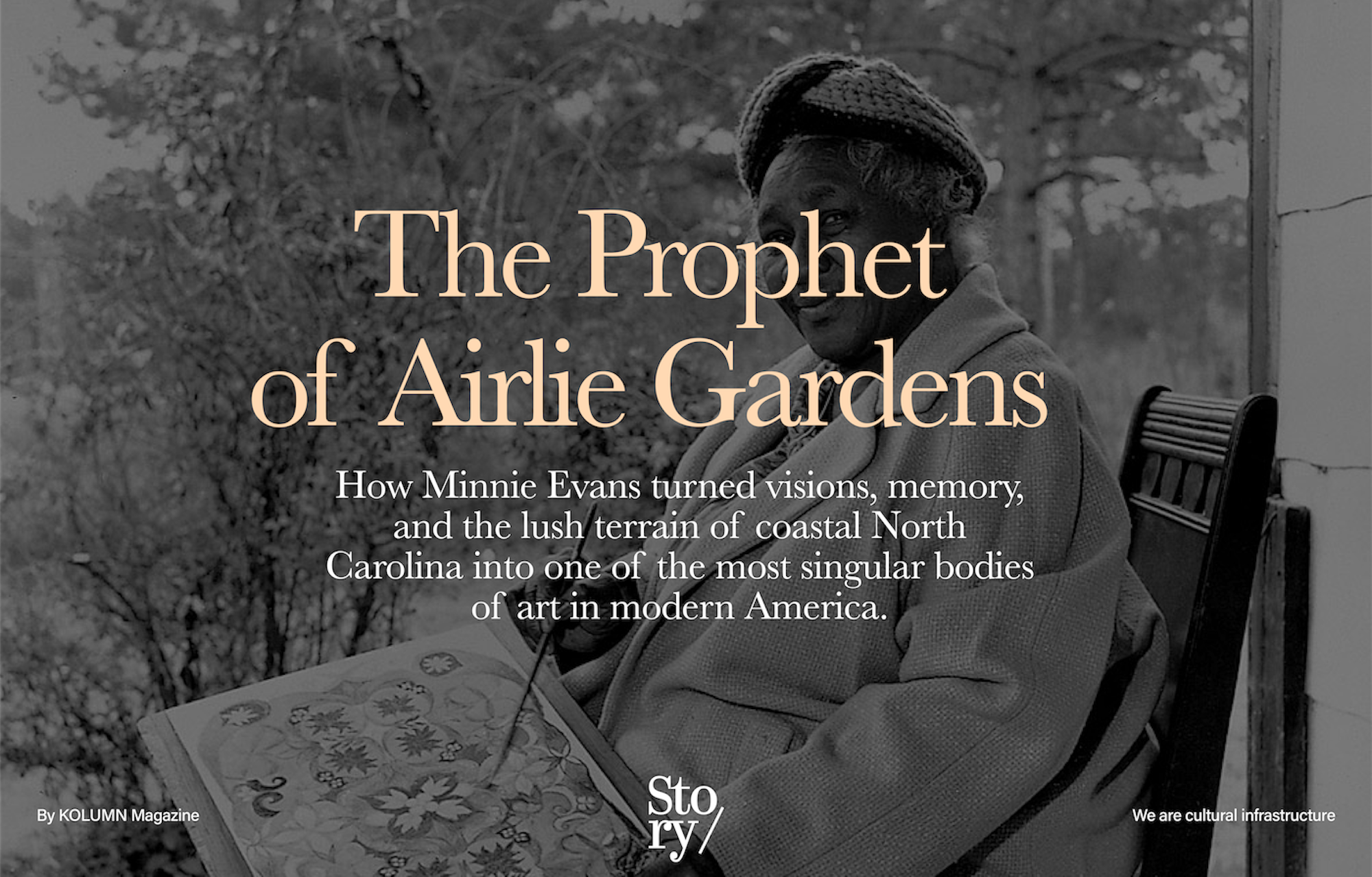
My dreams are in brilliant colors, and I paint the way I remember the dreams.
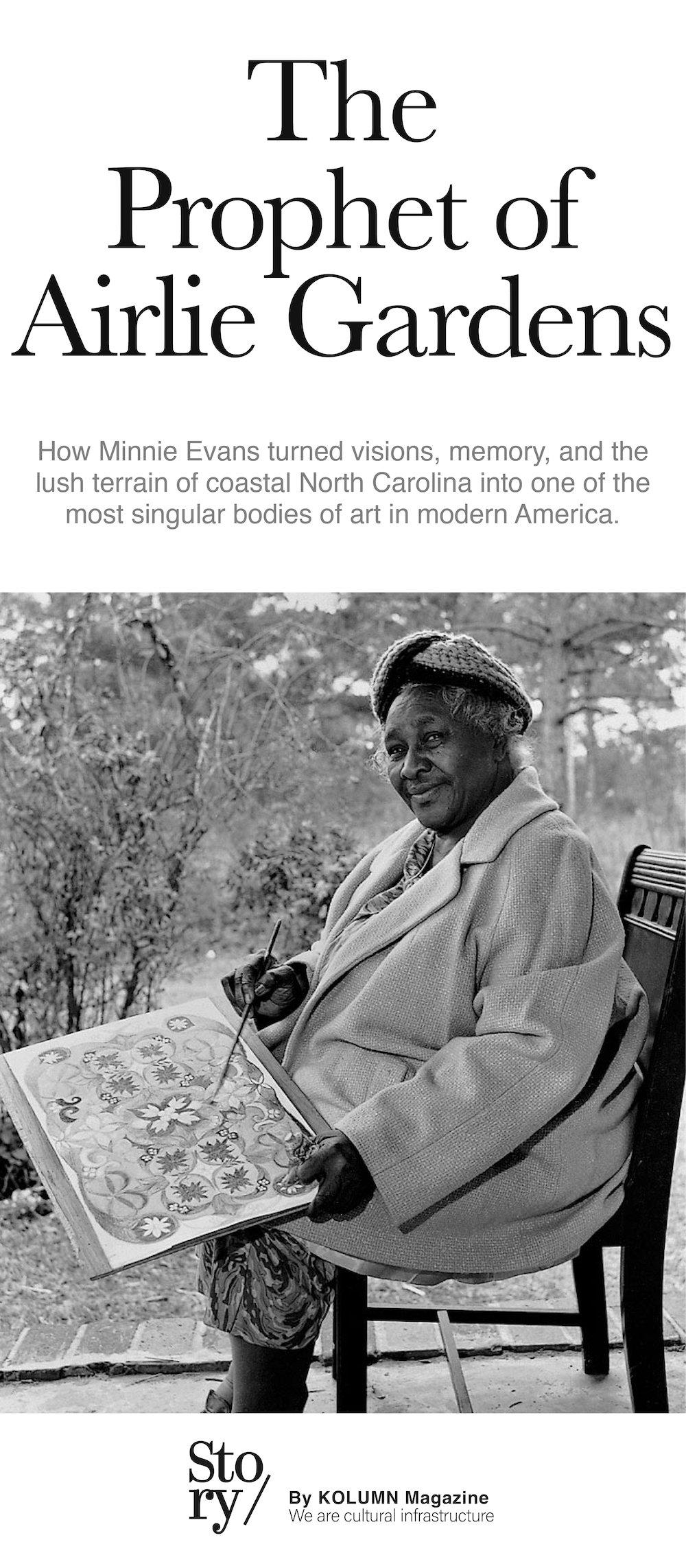
My dreams are in brilliant colors, and I paint the way I remember the dreams.
By KOLUMN Magazine
There are artists whose work feels explained the moment you encounter it. Then there is Minnie Evans, whose drawings and paintings seem to arrive already carrying their own weather, their own theology, their own private system of symbols. Flowers open into faces. Eyes bloom from leaves. Human figures seem less posed than revealed, as if they have emerged from somewhere older than portraiture and more unstable than memory. Looking at an Evans image can feel like standing in front of a stained-glass window, a dream journal, and a botanical record all at once. That quality is not an accident of style. It is the product of a life lived at the crossroads of spiritual experience, Black Southern history, domestic labor, and nature’s abundance.
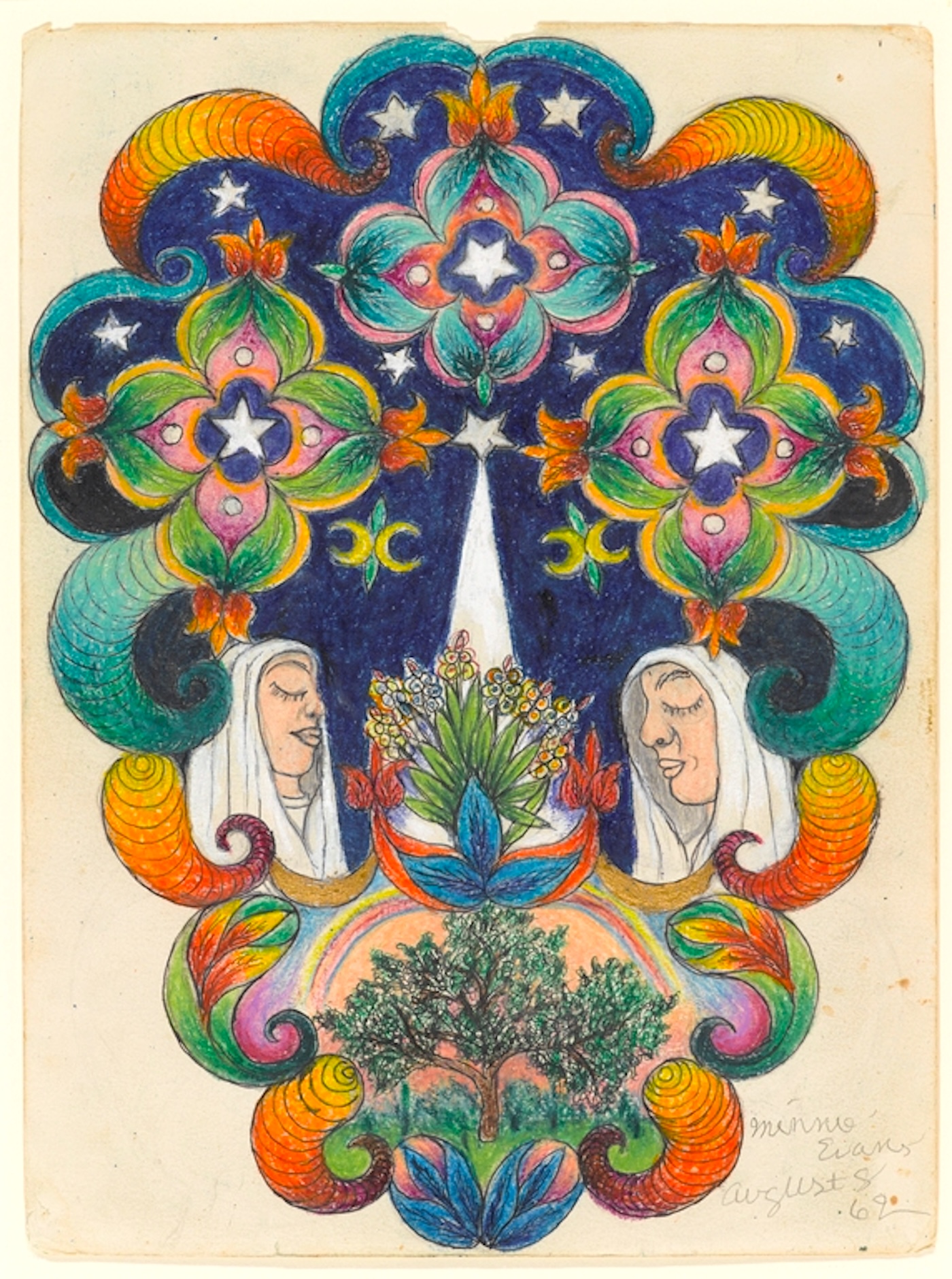
Evans is often described as a visionary artist, a self-taught artist, a folk artist, an outsider artist, even a surrealist. Each term captures something real, and each term falls a little short. The labels help museums classify her, but they do not quite contain her. What matters more is the world she made: a world rooted in Wilmington, North Carolina, and yet never limited by it; a world shaped by dreams and visions, but also by family histories stretching back to enslavement and Trinidad; a world of dazzling ornament that is also shadowed by violence, exile, and survival. In recent years, major institutions including the Museum of Fine Arts, Boston, the High Museum of Art, MoMA, the Smithsonian American Art Museum, and the Whitney have all helped widen the frame through which Evans is seen, confirming what many artists, scholars, and local stewards have long understood: Minnie Evans belongs in any serious account of American art.
Her life story resists the tidy arc that art history often prefers. She did not come up through academies. She did not build her career through the usual metropolitan circuits. She spent decades working as a domestic laborer and later as the gatekeeper at Airlie Gardens, where she made art in the small intervals of a working life and sold pieces for modest sums to visitors. Her renown came late, unevenly, and through the advocacy of others as much as through institutional foresight. Yet the work itself has never felt secondary, amateur, or marginal. It is too rigorous in composition, too daring in color, too unmistakable in imagination.
To understand Minnie Evans, you have to start with that sentence, but you cannot stop there. The dreams mattered. The visions mattered. The famous command she said she received—“draw or die”—mattered immensely. But so did the material conditions around her: Black life in coastal North Carolina after Reconstruction; the memory field left by the 1898 white supremacist coup in Wilmington; the sensory force of gardens, swamps, trees, flowers, birds, and insects; and the difficult dignity of women’s work. Evans did not paint in spite of that world. She painted through it.
A life shaped by Wilmington, work, and inherited memory
Minnie Eva Jones was born in Long Creek, in Pender County, North Carolina, and spent most of her life in Wilmington. Some older museum biographies listed her birth year as 1890, but major institutions now commonly identify it as 1892, and that is the date most frequently used in current scholarship and exhibitions. She attended school through roughly the sixth grade, married Julius Evans, and had three sons. Her family history, by her own account and through later museum interpretation, included a maternal ancestor brought from Trinidad into slavery—an inheritance that scholars and curators have connected to the Caribbean resonances visible in her imagery.
That biographical outline can sound straightforward, but its historical setting was anything but. Evans came of age in the Jim Crow South, in a region where Black life was structured by segregation, labor exploitation, and racial terror. The Museum of Fine Arts, Boston, in its recent exhibition framing, situates her work within a longer community memory of enslavement in Eastern North Carolina and of the 1898 Wilmington coup, when white supremacists overthrew the city’s elected multiracial government and drove Black residents from power and, in many cases, from the city itself. The MFA notes that contemporary accounts described Black faces peering from woods and foliage as people fled into surrounding forests. That image—faces and eyes within leaves and branches—would later become one of the most arresting motifs in Evans’s art.
This matters because Minnie Evans is too often flattened into a story of mystical spontaneity, as though she sprang fully formed from a dream and a box of crayons. But her art did not come from nowhere. It came from a Black Southern life saturated in memory, religion, labor, and environment. The “visionary” label is not wrong; it is just incomplete unless it is tethered to history. Her eyes are spiritual, yes, but they are also watchful. Her foliage is lush, but it can also shelter. Her worlds are radiant, but they are not innocent.
Before the art world found her, Evans worked for years in domestic service. That fact deserves more than passing mention. Domestic labor has historically kept countless Black women close to beauty without allowing them ownership of it—close to carefully kept interiors, decorative objects, gardens, and collections, but at the level of maintenance rather than authorship. Museums and scholars have suggested that Evans’s visual vocabulary may also have been shaped by exposure to fine art and decorative traditions in the homes where she worked, alongside the deep reservoir of her own dreams, religious beliefs, and family lore. The result was a body of work that looks self-generated yet remarkably cosmopolitan in its references.
The command: draw or die
No single phrase is more associated with Minnie Evans than the one she said she heard: “draw or die.” The Cameron Art Museum and the Smithsonian both preserve versions of that account, presenting it not as a cute anecdote but as a turning point in her artistic life. According to those institutional histories, Evans created her earliest works in 1935 after hearing a profound voice urging her to draw. The Smithsonian dates her earliest surviving visual manifestations to Good Friday of that year, when she made two pen-and-ink drawings filled with concentric and semicircular forms.
It is tempting, especially from a contemporary secular distance, to translate that episode into the language of creative compulsion, subconscious release, or untutored genius. But Evans herself framed it in spiritual terms. “My whole life has been dreams,” she recalled, according to MoMA and the Smithsonian’s records of her life and work. She spoke of day visions as well as nighttime dreams, and of images that arrived with such force they demanded expression. She did not present her art as invention in the modernist sense. She presented it as reception.
That command can be read several ways at once. On one level, it is literal testimony: Evans believed she had been called to make images. On another, it is the most concise artist statement imaginable. Draw or die is not a slogan about career ambition. It is a statement about necessity. It suggests that for Evans, image-making was not decorative labor or leisure activity. It was survival. It was a way to live with the visions she carried. It was a way to transform pressure into form.
What followed was not an immediate meteoric career. Evans drew first on whatever materials were available—paper bags, scraps, odds and ends. The Smithsonian describes early works made entirely in wax crayons, with color deployed exuberantly and without apology. Her technique expanded over time to include pencil, ink, graphite, watercolor, oil, mixed media, and collage. But the central fact remained: she began outside the sanctioned channels of art production, making a visual language for herself before the institutions had vocabulary for her.
Airlie Gardens: the gatehouse as studio, gallery, and school
If Evans’s visions gave her subject matter, Airlie Gardens gave her a setting through which to elaborate it. She began working there in 1948 as gatekeeper and remained until 1974. Multiple museums note that the lush botanical surroundings profoundly shaped her art, and that she produced thousands of works during those years, often selling them directly to visitors for a dollar or less. At the MFA, the story is even more specific: the gatehouse was not merely where she clocked in. It was effectively where she made and sold work, an improvised studio-gallery inside a labor site.
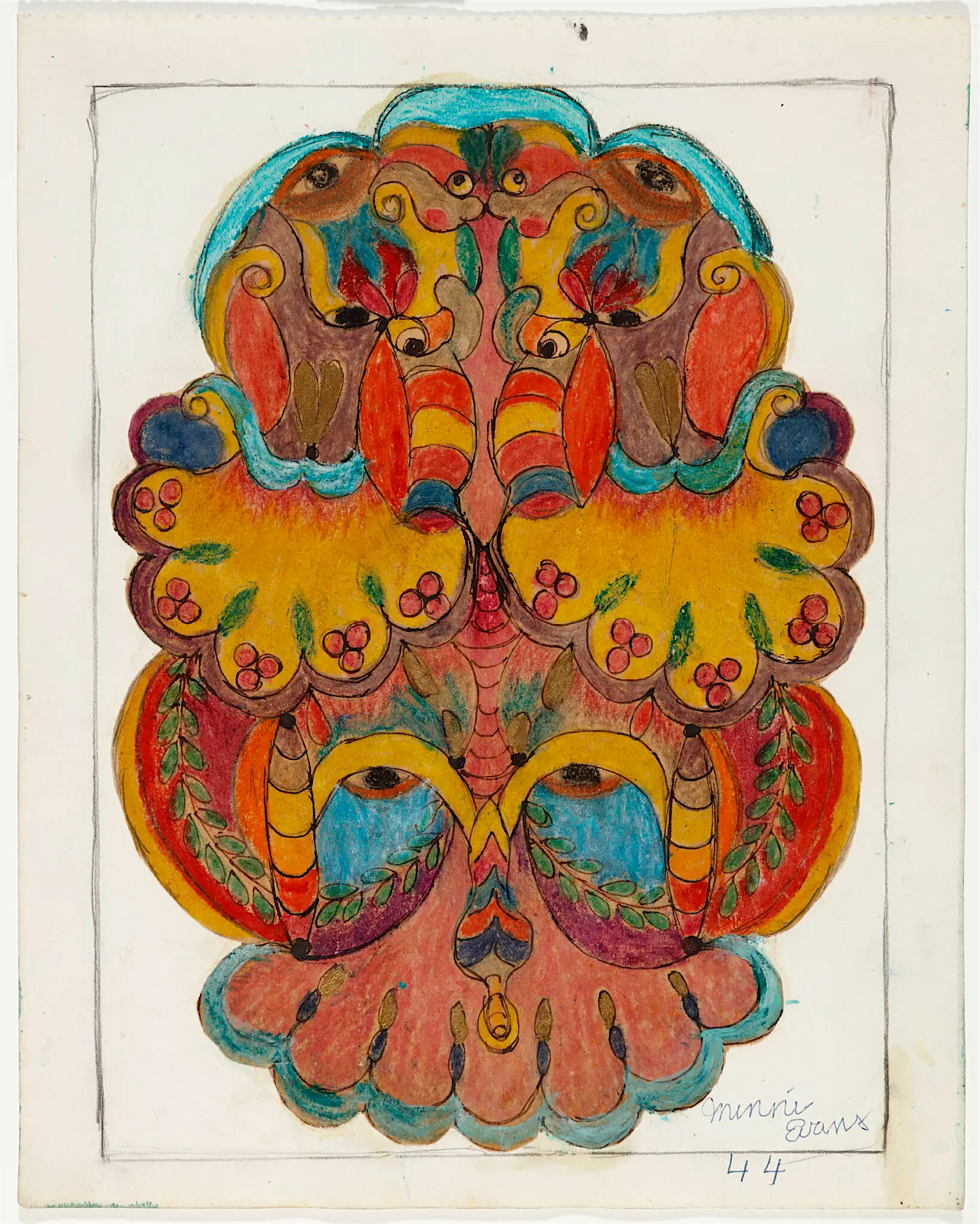
The Airlie setting is so central to Evans that it risks becoming cliché in retellings, but the connection is real and deep. Her images do not simply reproduce flowers and trees as pleasant scenery. They metabolize botanical life into system and symbol. Leaves become facial structures. Petals become halos. Butterflies become architectural elements. Branches create frames within frames. The High Museum’s recent exhibition materials track this evolution: by the 1940s she was painting the beauty of Airlie; by the 1950s and 1960s, with increasing skill and access to materials, single floral or insect-like forms expanded into full kaleidoscopic constellations.
There is a disciplined intelligence in that progression. Evans’s mature compositions often feel spontaneous because they are so alive, but they are also highly ordered. Symmetry matters. Repetition matters. Centrality matters. The face, especially the frontal face, anchors many of the works. Eyes recur with almost liturgical insistence. The Smithsonian notes that Evans associated eyes with God’s omniscience and with the eye as the window of the soul. Once you know that, it becomes impossible to miss the density of looking in her paintings: faces watch, foliage watches, creatures watch, and perhaps the work itself watches back.
In a Minnie Evans composition, seeing is never neutral. It is spiritual, historical, and sometimes haunted.
Airlie also complicates the usual opposition between formal training and raw instinct. Evans was not academy-trained, but she was far from visually isolated. For twenty-six years she worked in one of the most sensorially rich environments imaginable, among azaleas, live oaks, bright greens, seasonal rhythms, insects, birds, and the constantly changing geometry of a cultivated landscape. That is a form of sustained looking. It is also a form of apprenticeship—not to a professor, but to nature, pattern, and repetition.
Style beyond category
The trouble with many accounts of self-taught Black artists is that they slide too quickly from biographical marvel to aesthetic simplification. Minnie Evans deserves better than that. Her work is not important merely because she was “discovered” late or because it emerged outside the academy. It is important because it solved formal problems in ways that remain startling.
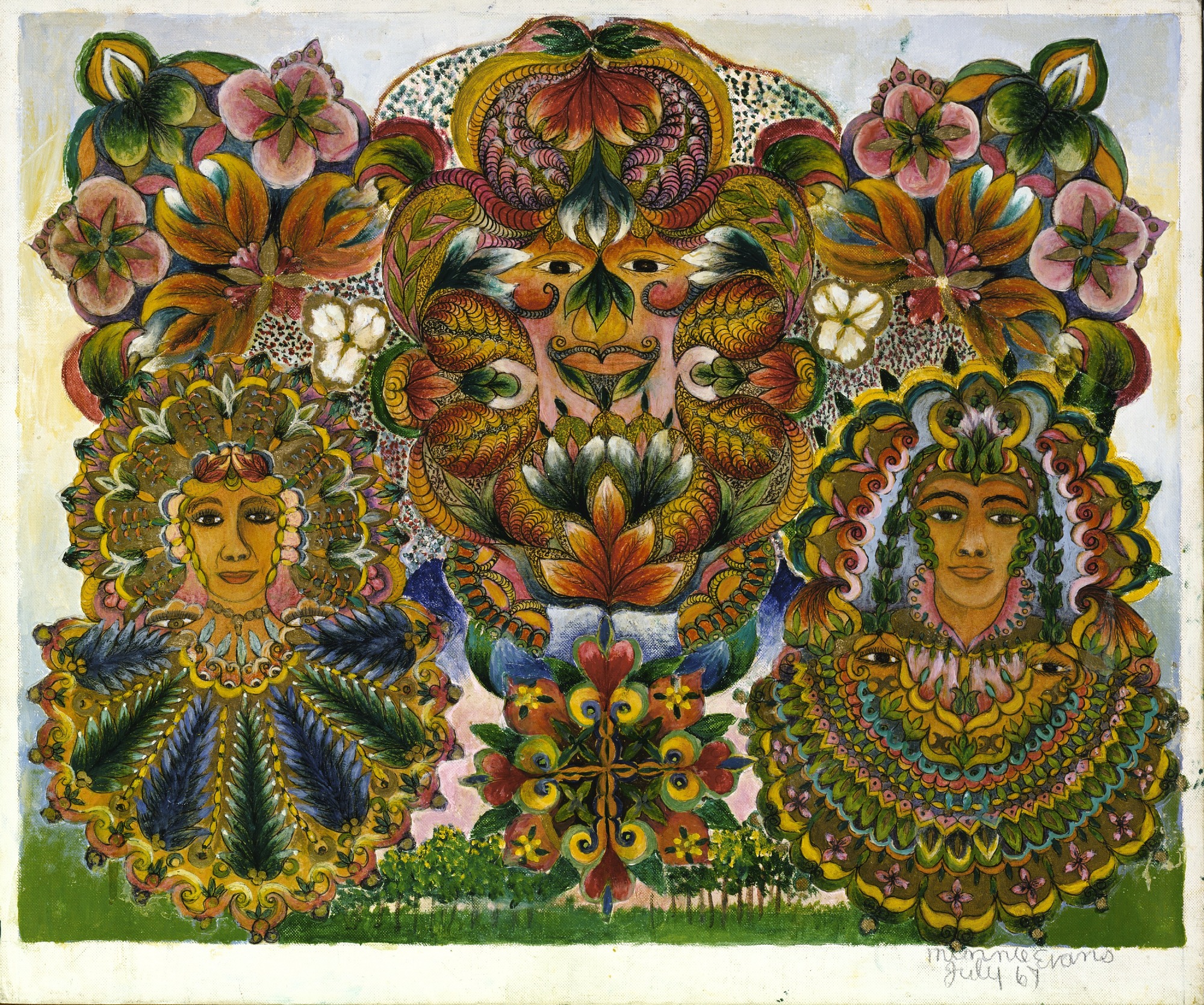
Look closely at the compositions and you find extraordinary control. Evans frequently builds her images around vertical axes, allowing bilateral symmetry to produce a sensation of ceremony. Faces or masklike presences emerge at the center, then radiate outward into vegetal and animal elaborations. The works are often saturated but not chaotic. Color is intense but measured. Curvilinear forms loop and spiral without losing structure. The result is both decorative and metaphysical: the surface pleases the eye while also destabilizing it.
The Smithsonian has long pointed to the broad range of references viewers perceive in her art: Caribbean folk forms, East Indian and Chinese elements, Western motifs, angels, demons, wise figures, and chimerical creatures. The High Museum’s interpretation of Temple by the Sea adds another dimension, connecting the work’s coastal temple image to Trinidad and to the artist’s ancestry, suggesting a rare instance in which place, inheritance, and visionary imagination converge in a nearly autobiographical form. Whether one treats every curatorial link as definitive or interpretive, the larger point is clear: Evans’s art is syncretic without feeling derivative. It gathers visual traditions into its own cosmology.
This is one reason the term “outsider” has always felt insufficient. It can be descriptively useful for market categories, but it also risks implying a distance from art history that Evans’s work simply does not sustain. Her pictures converse with mandalas, religious iconography, botanical illustration, symbolic portraiture, collage, and even modernist abstraction. She may not have entered through the front door of the canon, but her work stands comfortably in its rooms. That is partly why MoMA has kept her in view across multiple exhibitions, and why the Whitney returned to her early with a solo show in 1975 curated by Nina Howell Starr.
Nina Howell Starr and the problem of recognition
Like many Black artists, especially Black women working outside elite networks, Evans’s recognition did not arrive through pure meritocratic inevitability. It required advocacy. In 1962, she met photographer Nina Howell Starr, who became a friend, documentarian, promoter, and crucial intermediary to the wider art world. The Cameron Art Museum credits Starr with helping arrange New York exhibitions in 1966 and with supporting Evans across the rest of her career. Starr also pushed practical matters that are easy to underestimate and impossible to separate from legacy: storing work, selling it beyond local tourist economies, and encouraging Evans to sign and date pieces.
That relationship deserves a nuanced reading. On the one hand, without Starr, it is hard to imagine Evans reaching the Whitney or gaining the level of national exposure she did in the 1960s and 1970s. On the other hand, stories of “discovery” can too easily center the mediator rather than the maker. Evans had already built the work. She had already sustained a discipline. She had already developed a visual language nobody else was making. What Starr did was help institutions perceive value that had been present all along.
There is a broader lesson there about American culture. Black genius is often legible locally before it is acknowledged nationally. Communities know. Families know. Regional museums know. The so-called discovery is frequently less a birth of importance than a transfer of attention. Evans’s first formal exhibition came in Wilmington in 1961, before the New York machinery accelerated. That chronology matters. It suggests that the roots of her reputation were already present at home, even if the market and museum world took time to catch up.
Religion, mystery, and the refusal to over-explain
One of the most compelling things about Minnie Evans is that she did not pretend to have exhaustive explanations for her imagery. The Smithsonian preserves one of her most revealing comments: “When I get through with them I have to look at them like everybody else.” That line should be read as more than charming humility. It is an epistemology. Evans did not approach art as a set of symbols to be decoded into neat meanings. She approached it as revelation—something given, shaped, and then contemplated, even by its maker.
That stance frustrates critics who want everything pinned down. Was she painting Christian visions? Ancestral memory? Nature mysticism? Psychological states? Black Southern history in disguised form? The answer is yes, sometimes, and not always in stable proportions. Her church life mattered. Folkstreams’ materials on The Angel That Stands By Me emphasize the connections between her art, her African Methodist church community, and the spiritual frame through which she understood her gift. But the works are not reducible to doctrine. They are more plural, more hybrid, and more unruly than religious illustration.
Evans did not paint explanations. She painted encounters.
This is part of why the best writing on Evans resists condescension. To describe her as “primitive” or merely intuitive is to miss how sophisticated the mystery is. Her art is not naïve because it does not submit to easy explanation. If anything, the refusal to resolve into a single interpretive key is part of its modernity. Evans’s paintings do what major art often does: they exceed paraphrase.
Black womanhood, labor, and artistic authority
It is also impossible to separate Evans’s significance from the fact that she was a Black woman artist making formidable work in the twentieth-century South without the infrastructures that usually protect and promote artistic ambition. That context matters not for sentimental reasons, but because it changes how we understand authorship.
For much of American history, Black women’s creativity was expected to remain functional, communal, or invisible—channeled into care work, church work, handwork, domestic refinement, beauty, or survival. Evans did all sorts of labor that the art world typically treats as peripheral to art history. Then she made a body of work so singular that the category system had to bend around her. That is not just admirable. It is disruptive.
Her late and partial institutional embrace says as much about the gatekeeping habits of museums as it does about her biography. The Whitney’s 1975 solo show was an important milestone; some recent arts writing has noted that she was among the first Black women artists to receive that level of solo attention there. And yet even with that achievement, her name still does not circulate as widely as many less original artists who fit more comfortably into textbook narratives. The renewed interest in her work—through recent museum exhibitions, scholarship, and documentary projects—therefore feels less like rediscovery than correction.
The afterlife of the work
Evans retired from Airlie Gardens in 1974 because of ill health and died in 1987 at age 95. Cameron Art Museum notes that she left behind an enormous legacy in both artworks and archival material, and that the museum now holds more of her work than any other institution through its Minnie Evans Study Center. Her works also reside in major collections including the Smithsonian American Art Museum, MoMA, the Whitney, and other museums across the country. That institutional spread matters because it signals not niche appreciation but canonical durability.
The afterlife of her art has extended beyond museum walls. In 1983, filmmakers Allie Light and Irving Saraf released The Angel That Stands By Me, a documentary portrait that helped preserve Evans’s voice and spiritual self-understanding. More recently, a new documentary project, Minnie Evans: Draw or Die, has accompanied a wider resurgence of interest in her work. These returns are not incidental. Evans belongs to that class of artists whose relevance grows as the culture becomes more capable of reading what was always there.
The major exhibitions of 2025 and 2026 are particularly telling. The MFA Boston presented The Visionary Art of Minnie Evans. The High Museum mounted The Lost World: The Art of Minnie Evans, the first major exhibition devoted to her in decades, and that show is traveling to the Whitney. This is what institutional seriousness looks like: not a token inclusion, but a sustained effort to frame Evans as a central American artist whose work can bear the weight of deep scholarship and broad public attention.
Why Minnie Evans matters now
Why does Minnie Evans matter now? Because she offers a corrective to so many bad habits in American cultural memory.
She corrects the habit of treating Black Southern life as sociological material rather than as a source of profound aesthetic innovation. She corrects the habit of imagining self-taught artists as somehow less formal, less intellectual, or less worthy of sustained analysis. She corrects the habit of severing spirituality from modern art, as though visionary experience belongs only to the margins. And she corrects the habit of understanding nature as mere backdrop rather than as a field of memory, refuge, terror, and revelation.
She also matters because her work proposes a different model of artistic authority. Evans did not need to master theory before she could matter. She did not require permission to make a cosmology. She did not wait for a market to validate her eye. Her authority came from attention—to visions, to color, to pattern, to faith, to the landscape around her, and to the persistence of images she felt compelled to bring into the world.
And then there is the work itself, which remains gloriously alive. In an era obsessed with spectacle, Evans’s paintings still feel genuinely strange. Not performatively strange. Not market-tested strange. Strange in the older, better sense: uncanny, transporting, irreducible. They do not flatten under reproduction. They do not become fully familiar after one viewing. They keep opening. The flowers keep becoming faces. The faces keep becoming symbols. The symbols keep returning to history.
Minnie Evans made paintings that look like memory after it has passed through prayer, exile, and bloom.
That is her significance in the end. Not merely that she was overlooked and should be better known, though both are true. Not merely that she was a visionary, though she was. It is that she made a distinctly American art without surrendering to any narrow definition of America. Her work carries the South, the Caribbean echo of ancestry, Black church cosmology, garden abundance, working-woman discipline, and dream logic all at once. It is local and vast. Intimate and civilizational. Handmade and metaphysical.
Minnie Evans did not just record visions. She built a visual theology of survival. She made a language in which beauty does not erase history, and history does not extinguish wonder. That is rare. That is lasting. And that is why every new generation that encounters her feels, sooner or later, the same thing: the canon was never complete without her.
More great stories

Before the Renaissance, There Was Dunbar
March 14, 2026
No Comments
Three Days That Changed a State
March 14, 2026
No Comments