



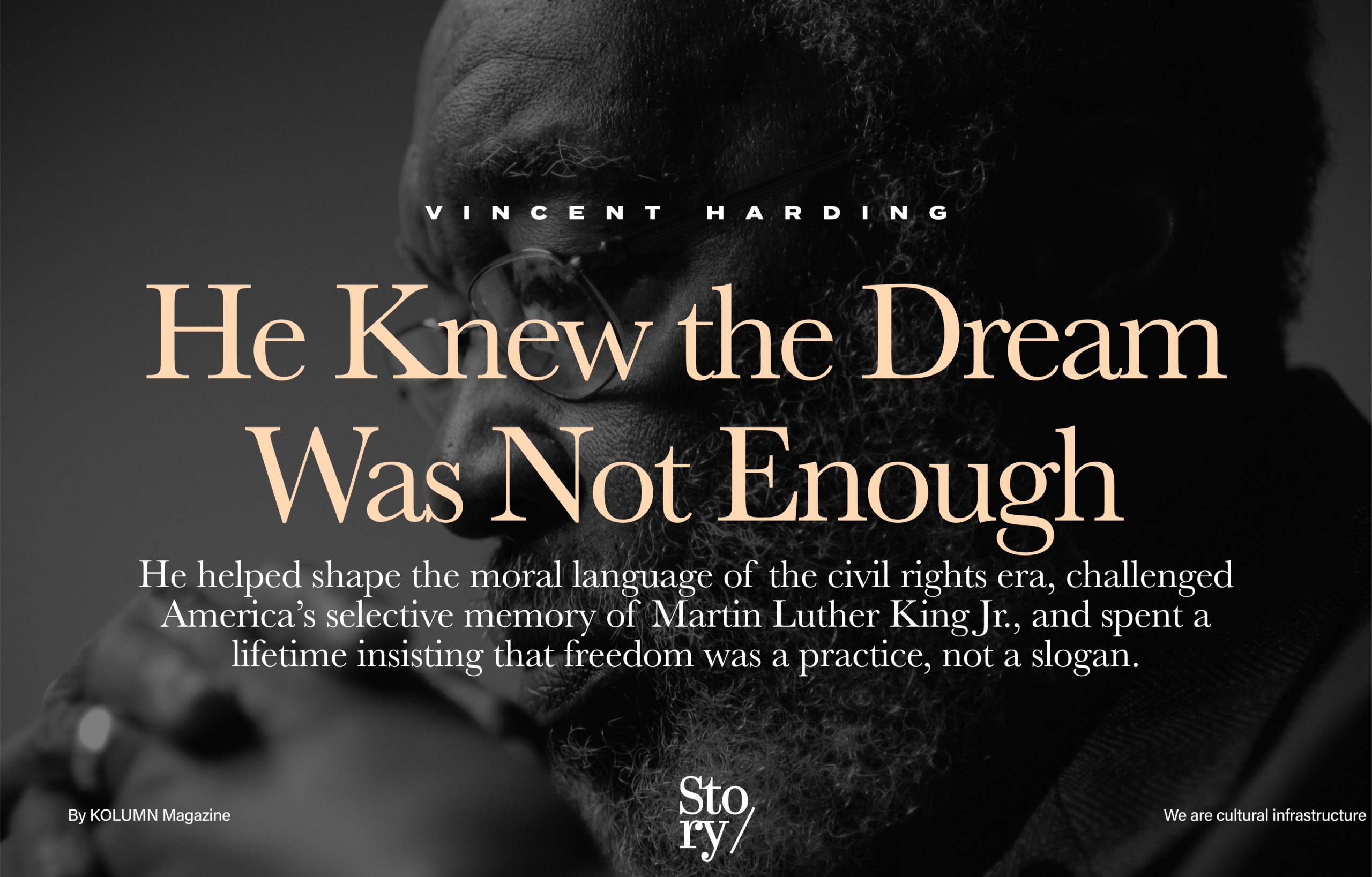
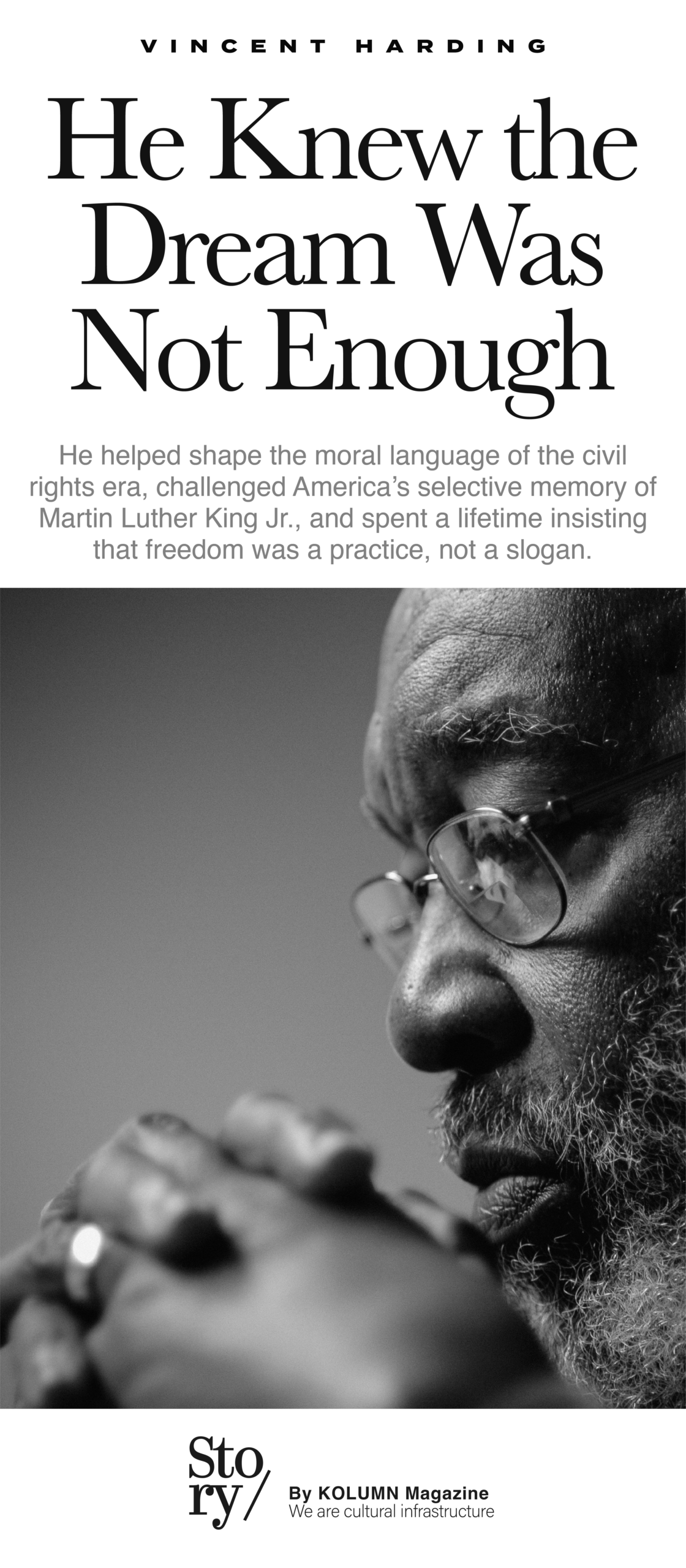
Vincent Harding did not treat history as a safe inheritance. He treated it as an assignment.
Vincent Harding did not treat history as a safe inheritance. He treated it as an assignment.
By KOLUMN Magazine
Vincent Harding spent much of his life doing two things that America often prefers to keep separate: making history and interpreting it. He was a historian with the instincts of an organizer, a minister with the discipline of an archivist, and a public intellectual who never quite accepted the tidy boundaries between scholarship, spirituality, and struggle. If the public knows his name at all, it is often because of one famous fact: he helped draft Martin Luther King Jr.’s 1967 antiwar speech at Riverside Church, the address remembered as “Beyond Vietnam” or “A Time to Break Silence.” That fact matters. But it is also too small for the life. Harding was not merely the man behind one of King’s most controversial speeches. He was one of the clearest moral historians of the Black freedom struggle, a thinker who devoted decades to challenging the country’s habit of reducing living movements into commemorative myths.
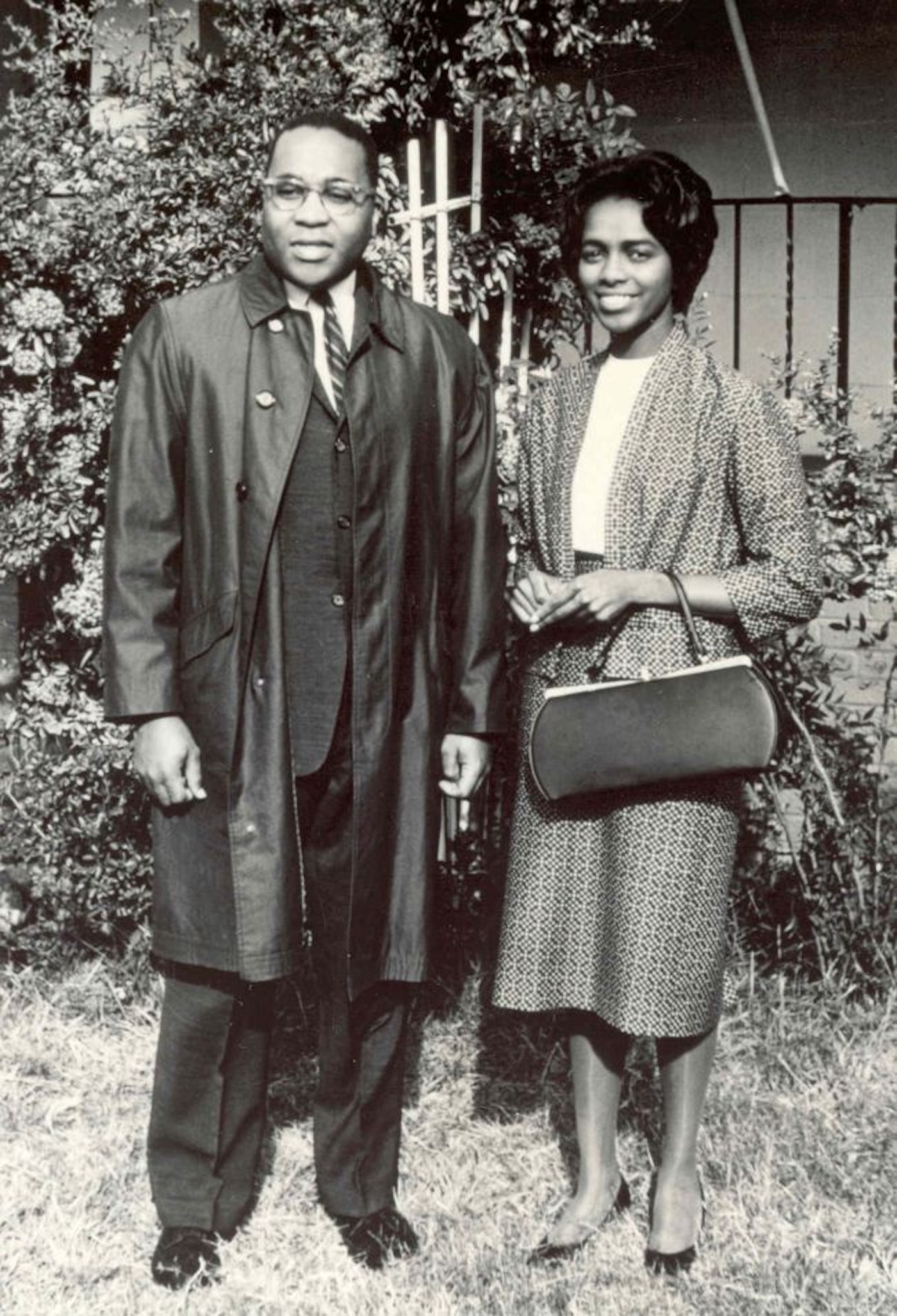
To write about Harding is to write about a form of intellectual work that now feels rarer than it should: scholarship grounded in movement life. He was born in New York City in 1931, educated at City College and Columbia, completed doctoral study in history at the University of Chicago, and went on to teach at institutions including Spelman College, Temple University, Swarthmore, and the Iliff School of Theology. But biography alone does not explain his stature. Harding mattered because he treated history not as a museum exhibit but as a living resource for democratic struggle. He believed that the past could help ordinary people discover what he once called the “possibilities” latent in their own lives, and he returned again and again to the idea that the freedom movement was not a closed chapter but an unfinished river still moving through American life.
That is one reason Harding continues to matter. In an age of flattened memory, when the civil rights movement is often packaged as a morality play with a few acceptable heroes and a happy ending, Harding’s work stands as a correction. He insisted on the language of the “Southern Freedom Movement,” a phrasing that widened the frame beyond a handful of charismatic leaders and underscored the depth, breadth, and collective character of the struggle. He also insisted that Martin Luther King Jr. be remembered whole: not only the dreamer of 1963, but the dissenter of 1967; not only the preacher of interracial possibility, but the critic of militarism, poverty, and empire. Harding understood that public memory is political terrain. Whoever defines the past gains leverage over the future.
Harding was born Vincent Gordon Harding on July 25, 1931, in New York City, and grew up in Harlem and the Bronx in a Black family shaped by migration, work, church, and intellectual seriousness. Later biographical accounts note that his mother had roots in Barbados, part of a broader Black Atlantic world that quietly shaped his sense of history from the beginning. He attended New York public schools, graduated from Morris High School, and earned a B.A. in history from City College of New York in 1952, followed by graduate study in journalism at Columbia. These details can sound merely credentialing, but they matter because they positioned him at the meeting point of several traditions: Black urban life, rigorous secular study, church-based moral formation, and a deep attention to language. Journalism gave him one set of tools; history gave him another; the church and movement life would later fuse them into something distinctive.
He also served in the Army before settling for a time in Chicago, where he pursued graduate work at the University of Chicago and served as a lay minister on the South Side. Chicago was formative. It sharpened his theological interests, grounded his historical imagination, and put him in proximity to a city whose Black life held both northern promise and northern hypocrisy. If the South would become central to his public life, Harding’s interpretive sensibility was not provincial. He understood early that the geography of Black struggle was national, and that racism in the United States could not be quarantined below the Mason-Dixon line. That point would remain central to his later writing, especially when he challenged the tendency to treat the movement as a Southern exception rather than a democratic indictment of the nation as a whole.
By the time Harding completed his Ph.D. in history in 1965, he was already more than a young academic on the rise. He was becoming a thinker of unusual range, shaped by the black church, by pacifist currents, by the discipline of scholarship, and by an expanding commitment to social transformation. The key point is not that he moved between worlds. It is that he refused to let those worlds stay separate. For Harding, the archive and the street had to speak to each other. So did the sermon and the strategy session. So did moral witness and institutional criticism.
Atlanta, Mennonite House, and the Southern Freedom Movement
In 1960, Vincent Harding and his first wife, Rosemarie Freeney Harding, moved to Atlanta as representatives of the Mennonite Church. Together they co-founded Mennonite House, an interracial voluntary service center that became a gathering place for activists, strategists, seekers, and travelers in the movement orbit. That institutional detail is easy to underrate. Mennonite House was not simply a residence or church project. It was part sanctuary, part meeting place, part political crossroads. The Hardings were not arriving as detached observers of the movement; they were entering the struggle as participants and hosts, as bridge-builders in a city that was itself a nerve center of Black political and religious life.
The Southern freedom struggle of the early 1960s required exactly the kind of labor that often goes undercounted in public memory: relationship-building, housing, advising, emotional sustenance, intergenerational conversation, and moral accompaniment. The Hardings provided all of that. They worked with activists linked to the Southern Christian Leadership Conference, the Student Nonviolent Coordinating Committee, and CORE, and they did so in a mode that combined principled nonviolence with a clear-eyed understanding of structural brutality. Harding was arrested during the Albany Movement in 1962 for participating in a demonstration at city hall, a reminder that his role was never merely intellectual. He was willing to put his body inside the argument.
Rosemarie Freeney Harding deserves emphasis here too. Any serious account of Vincent Harding that leaves her in the margins is incomplete. Their partnership shaped the moral and political atmosphere of their work, and together they developed a spiritually grounded model of justice practice that would later inform Veterans of Hope. Their collaborative writing and organizing reflected a shared belief that freedom was not simply about policy change or symbolic breakthrough. It was about creating new human relationships and democratic habits. That perspective mattered in Atlanta, where movement leaders faced not only police repression and white backlash, but also the exhausting internal pressures of sustaining a mass struggle over time.
“He belonged to that tradition of movement elders who knew that revolutions are held together not only by speeches and marches, but by kitchens, guest rooms, arguments, prayer, and disciplined tenderness.”
Harding’s framing of the struggle as the “Southern Freedom Movement” came out of this lived immersion. The phrase shifted attention away from a narrow civil-rights legalism and toward a broader democratic insurgency. It suggested that what was at stake was not just access to public accommodations or voting rights, necessary as those were, but a larger contest over the meaning of citizenship, power, memory, and human dignity. In Harding’s hands, naming was political analysis. He understood that language shapes scale. Call it a civil rights movement and the public may imagine a rights claim for inclusion. Call it a freedom movement and the horizon widens.
The King connection, and the speech that changed the weather
The most famous episode in Harding’s public life remains his relationship with Martin Luther King Jr. and his role in drafting the 1967 Riverside Church speech, “Beyond Vietnam: A Time to Break Silence.” The relationship was real, intimate, and politically consequential. Harding and the King family lived near one another in Atlanta during the 1960s, and Harding became one of the people King trusted for historical, moral, and strategic counsel. Clayborne Carson later described Harding as a longtime friend and adviser, and multiple accounts note that Harding helped draft several speeches for King. But “Beyond Vietnam” remains the defining example because it captured both men at a moment of exceptional clarity and escalating risk.
Harding later recalled that he wrote much of the draft during the Christmas season of 1966. The final speech King delivered at Riverside on April 4, 1967, was only lightly altered from Harding’s original. The address denounced the Vietnam War as a moral catastrophe, named the United States “the greatest purveyor of violence in the world today,” and linked militarism abroad to racial and economic injustice at home. It was one of King’s most consequential speeches and one of his most costly. Press reaction was harsh. Liberal allies recoiled. Editorial boards scolded him for straying beyond civil rights. Harding understood exactly why the backlash came: the speech threatened the American habit of compartmentalization. It refused the lie that one could support racial justice at home while excusing imperial violence abroad.
Harding’s contribution here was not only literary. It was conceptual. He had long seen the struggle for Black freedom as inseparable from larger questions of war, global power, and human solidarity. In interviews years later, he stressed that King’s antiwar position was not some abrupt detour but a natural extension of the same ethical commitments that animated the Southern movement. The poor were being sent to kill other poor people; democratic rhetoric was masking organized violence; the country was celebrating civil rights progress while deepening its commitments to domination. Harding’s thinking gave form to that diagnosis, and King’s pulpit amplified it to the world.
The speech also helps explain Harding’s enduring importance as an interpreter of King. He would spend years warning against a sentimental, selective public memory that elevated “I Have a Dream” while burying King’s critiques of war, capitalism, and state violence. His 1996 essay collection Martin Luther King: The Inconvenient Hero made that case with force. Harding argued that Americans preferred a King who could be safely quoted, not followed; admired, not obeyed; monumentalized, not listened to. That argument has aged remarkably well. Every January, the country stages a predictable pageant of King remembrance. Harding spent much of his career showing why that pageant so often misses the man.
Scholar-activist, not scholar on the sidelines
After King’s assassination in 1968, Harding worked with Coretta Scott King to help establish the Martin Luther King Jr. Memorial Center in Atlanta, serving as its first director. He also participated in the founding of the Institute of the Black World that same year, a major intellectual and political experiment created by Black scholars and activists seeking new frameworks for liberation after King’s death. These twin involvements reveal the dual structure of Harding’s life. He was building institutions of memory and institutions of analysis at once. The King Center would preserve and interpret a legacy; the Institute of the Black World would push Black thought into new political terrain. Harding belonged in both places.
His academic appointments reflected that same synthesis. Harding taught at Spelman College, where he was part of a powerful intellectual environment in Atlanta during a period of extraordinary movement ferment. Later roles at Temple University, the University of Pennsylvania, Swarthmore, and Pendle Hill broadened his reach, while his long tenure at the Iliff School of Theology in Denver established him as an influential teacher of religion and social transformation. He eventually became professor emeritus there, and colleagues remembered him not just as a distinguished scholar but as a moral presence. Colorado Public Radio’s obituary underscored the point: Harding was deeply woven into Iliff’s public identity as a school committed to justice-oriented theological reflection.
What made Harding unusual in academic life was not simply that he had activist credentials. Plenty of institutions celebrate that once it can be safely placed in the past. Harding’s difference was that his scholarship itself bore the imprint of movement accountability. He wrote history with a deep suspicion of professional detachment when detachment became an alibi for moral evasiveness. Yet he was not sloppy, sloganistic, or anti-intellectual. Quite the opposite. His historical writing is careful, textured, and capacious. He simply rejected the conceit that seriousness requires neutrality toward injustice. That made him legible to movement people and credible to scholars, a combination harder to sustain than it sounds.
This is one place where Harding deserves to be situated alongside a wider Black intellectual tradition that includes figures like W. E. B. Du Bois, Ella Baker, Howard Thurman, Lerone Bennett Jr., and James Baldwin, though his sensibility was distinctly his own. Like them, he understood that interpretation is a site of struggle. The question was never only what happened. The question was what story the nation would tell about what happened, and to what end. Harding’s answer was to narrate Black history as a long freedom struggle full of unfinished openings, buried alternatives, recurring betrayals, and durable reservoirs of hope.
There Is a River and the long Black freedom tradition
If one book best captures Harding’s historical imagination, it is There Is a River: The Black Struggle for Freedom in America, first published in 1981. The title alone signals his method. A river is not static. It bends, gathers tributaries, disappears from sight, returns with force, and resists the neat compartmentalization of textbook periodization. Harding used that metaphor to narrate Black history as a centuries-long movement toward freedom, not as a sequence of isolated episodes punctuated by a few famous leaders. The book became one of his best-known works precisely because it gave readers a usable past without smoothing out conflict or complexity.
That river metaphor mattered politically. Harding was writing at a time when public memory of the movement was already hardening into something safer and more consumable. His intervention was to widen the frame dramatically. He connected enslavement, rebellion, religion, migration, emancipation, Reconstruction, Jim Crow, anti-colonial struggles, and modern Black protest into a single interpretive current. Freedom, in this telling, was not granted from above. It was made, defended, reimagined, and passed on by ordinary people in conditions of terror and constraint. Harding’s history did not deny the role of institutions, law, or elite actors. It simply refused to center them at the expense of the people who pushed history forward.
The intellectual stakes of that approach were considerable. Harding was pushing against both triumphalist American history and against narrower versions of Black history that treated “contributions” as the main story. In a HistoryMakers biography and associated oral-history materials, one sees the arc of a man preoccupied with the meaning of Black historical narration itself. He wanted history to do more than decorate the national conscience. He wanted it to clarify conflict, reveal agency, and summon responsibility. That is why so much of his writing feels contemporary even now. In the middle of current battles over curricula, historical memory, and public commemoration, Harding sounds less like a figure from another era than like a guide to the present emergency.
The inconvenient King and America’s preference for saints
Harding’s sustained effort to rescue King from political domestication remains one of his most important contributions. This work was not antiquarian, and it was not fan service. Harding knew King personally, but intimacy did not lead him to sentimentality. Instead, it gave him a sharpened sense of how badly the public record was being distorted. By the 1980s and 1990s, King was increasingly invoked as a national icon in ways that severed him from his deepest commitments. His words were excerpted from context. His militancy was softened into uplift. His antiwar politics were pushed aside. His structural critique of poverty was replaced by generic calls for harmony. Harding objected to all of it.
In Martin Luther King: The Inconvenient Hero, Harding argued that the “dangerous” King was the truer King: the one who confronted militarism, challenged economic injustice, and kept pressing beyond the liberal comfort zone. This was not just a corrective to public memory. It was a strategic intervention in American political culture. Harding believed that how the nation remembered King affected what kinds of dissent remained thinkable. A safe King could be used to discipline contemporary movements. A dangerous King could animate them. That distinction still shadows debates over protest, patriotism, and the acceptable limits of moral criticism in American public life.
One can hear Harding making this case in public interviews. In a 2008 Democracy Now! appearance around the 40th anniversary of King’s assassination, he emphasized how King’s final years had been flattened in popular recollection, especially his economic justice agenda and his opposition to the Vietnam War. Harding was effectively arguing against civic nostalgia. He wanted people to see that memory without conflict becomes a tool of depoliticization. That instinct placed him in a long line of Black critics who warned that commemoration can function as erasure when it strips movements of their demands.
Hope as discipline, not optimism
One of Harding’s most distinctive ideas was hope. Not hope as branding, and not hope as vague emotional uplift, but hope as disciplined social practice. This theme appears throughout his work and perhaps most memorably in the language later associated with Hope and History and in interviews collected by On Being and others. Harding did not deny darkness. He lived through segregation, political backlash, war, disappointment, co-optation, and the repeated narrowing of democratic possibility. Yet he remained committed to what might be called durable hope: a way of seeing the world that begins in struggle, not innocence.
In his conversation with Krista Tippett, Harding used the phrase “live human signposts” to describe people whose lives reveal possibilities others might not otherwise imagine. It is a deceptively simple image. A signpost does not complete the journey for you. It points, orients, invites, and insists that another road exists. Harding saw movement elders that way, but he also believed ordinary people could become such signposts for one another. This is part of what made his thought spiritually compelling without slipping into piety. Hope, for Harding, was inseparable from ethical action, intergenerational responsibility, and democratic imagination.
That framework helps explain the title of the project he later co-founded with Rosemarie Harding: Veterans of Hope. The phrase is a small masterpiece. It echoes movement experience, military language, and spiritual endurance, but it turns them toward democratic renewal rather than state violence. Veterans of Hope gathered stories of activists whose lives embodied resilient, nonviolent struggle and sought to connect those stories to younger generations. The point was not nostalgia. It was transmission. Harding understood that movements survive not only through institutions and slogans, but through narrative inheritance. Somebody has to carry the stories in a way that activates rather than embalms them.
Veterans of Hope and the work of democratic renewal
Founded in 1997, Veterans of Hope became one of the clearest expressions of Harding’s mature vision. Located in part through the Iliff School of Theology, the project focused on religion, culture, participatory democracy, and the stories of justice workers whose lives could guide new generations. It featured oral histories, educational materials, and programming designed to connect movement memory to current struggles. In this sense, Veterans of Hope anticipated many of today’s conversations about public humanities, movement archiving, and intergenerational organizing. Harding was doing that work before such language became fashionable.
There was also something methodologically significant about the project. Harding did not build Veterans of Hope around celebrity alone. He cared about known figures, certainly, but he also cared about the texture of ordinary movement lives: the spiritual practices, small acts of courage, local campaigns, and moral disciplines that make democratic struggle sustainable. That emphasis tracked with his broader historical philosophy. He never believed history was made only by the famous. He believed the archive of freedom had been distorted by fame, and he spent his life trying to widen it.
In the current media environment, where visibility is often confused with significance, Harding’s instinct feels freshly corrective. He would likely have recognized the danger of an attention economy that rewards spectacle while neglecting the patient labor of institution-building and consciousness formation. Veterans of Hope, by contrast, was built around duration. It asked what kinds of stories help people remain human inside long struggles. It asked how moral memory might function as a renewable resource. And it suggested that democracy depends not only on procedures or elections, but on cultures of courage.
Eyes on the Prize, public history, and historical authority
Harding also served as senior academic consultant to the PBS documentary series Eyes on the Prize, the landmark chronicle of the civil rights movement. That role matters because it placed him at the intersection of scholarship and mass public memory. Eyes on the Prize became one of the most influential visual accounts of the movement ever produced, shaping how generations of students and viewers understood the struggle. Harding’s presence in that project signals the degree to which he was trusted not just as a historian, but as an interpreter capable of linking rigor, movement credibility, and narrative clarity.
Public history is often treated as a secondary field, as though translation for broad audiences somehow lowers the intellectual stakes. Harding’s career demonstrates the opposite. He understood that the fight over public understanding is one of the most important fights there is. A nation that misremembers its own democratic struggles will be poorly equipped to recognize them in the present. In that sense, Harding’s influence on Eyes on the Prize aligns seamlessly with the rest of his work. Whether in books, classrooms, speeches, interviews, or collaborative projects, he was always asking a version of the same question: what historical truth might help people act more courageously now?
Faith without sentimentality
Because Harding moved through church, academy, and movement spaces, he is sometimes described in generic terms as a theologian or minister. That is accurate, but incomplete. His faith language was never decorative. It was analytic, ethical, and political. He belonged to a current of Black religious thought that viewed spirituality not as escape from history but as a way of entering it more truthfully. In essays and interviews, he connected nonviolence, democracy, and sacred worth without pretending that any of those commitments were easy or pure.
This helps explain his influence across constituencies. Harding could speak to clergy without collapsing into clericalism, to scholars without hiding behind jargon, and to activists without romanticizing struggle. The moral vocabulary he used was expansive enough to reach people outside formal religious institutions, but rooted enough to retain gravity. That balance made him a rare kind of public voice: someone capable of speaking of love, hope, and spirit without surrendering political seriousness. In a time when public discourse often splits into technocratic policy talk on one side and shallow inspiration on the other, Harding’s example feels especially valuable. He offered language that could hold moral depth and historical specificity together.
Death, remembrance, and the question of legacy
Vincent Harding died on May 19, 2014, at age 82. Obituaries from the Washington Post, Los Angeles Times, Stanford’s King Institute, Sojourners, and others emphasized the now-familiar markers: his role in drafting King’s antiwar speech, his work as a historian, his movement ties, his teaching, and his generous mentorship. All of that is correct. Yet obituaries, by format, tend to compress. Harding’s legacy resists compression because it was not built around one office, one book, or one season of prominence. It was distributed across relationships, institutions, classrooms, sermons, interviews, archival interventions, and a very particular kind of moral companionship.
What survives most vividly is not just his résumé, but his method. Harding teaches that freedom struggles require historians who can think from inside them without losing analytical depth. He teaches that hope is not naïveté but training. He teaches that memory is a political battleground. He teaches that if America is going to quote King, it must also reckon with the King who condemned war and poverty, not just the King who can be safely folded into patriotic consensus. And he teaches that the language of democracy becomes believable only when tethered to ordinary people willing to risk something for it.
That question is still open. In many ways, it is more urgent now than when Harding first asked it. The United States remains locked in fierce battles over voting, war, public memory, education, race, and the meaning of democracy itself. Political leaders still invoke King while avoiding his hardest conclusions. Institutions still celebrate Black history while resisting Black demands. The country still prefers redemption stories to structural analysis. Harding saw all of that coming, because he understood the recurring mechanics of national amnesia. His work remains useful not because it flatters us, but because it doesn’t.
Why Vincent Harding matters now
Vincent Harding matters now because he offers a model for how to live intellectually and politically without fragmentation. Too often, public life trains people to choose one register. Be the scholar, but stay detached. Be the activist, but stay reactive. Be the minister, but stay abstract. Be the historian, but stay safely retrospective. Harding refused those choices. He showed that one could be rigorous without being bloodless, spiritual without being evasive, radical without being shallow, and hopeful without being unserious.
He also matters because he named a problem that still shapes American life: the conversion of radical memory into harmless ceremony. Harding spent decades warning that when movements are remembered only through their most consoling language, the result is not true honor but strategic forgetting. That warning applies far beyond King. It applies to how the nation remembers abolition, Reconstruction, labor struggle, antiwar dissent, Black internationalism, and even recent protest. Harding’s work presses readers to ask not only whether history is being taught, but how it is being framed, by whom, and toward what political end.
Finally, Harding matters because he left behind a vocabulary for democratic seriousness. He wrote about freedom as a river, about hope as a veteran’s discipline, about people as signposts, about movement memory as sacred responsibility. Those were not ornamental metaphors. They were conceptual tools. They helped people imagine themselves inside a longer story, one in which setbacks did not invalidate struggle and victories did not end it. That may be the deepest gift he offered: not consolation, but orientation. Not a shortcut through history, but a way to travel it with more courage.
In the end, Vincent Harding’s significance lies not only in what he did, though he did a great deal. It lies in what he made harder to evade. He made it harder to sentimentalize King. Harder to separate civil rights from war and poverty. Harder to treat Black history as a decorative supplement to American innocence. Harder to confuse remembrance with understanding. And harder to surrender hope to the language of mood rather than the discipline of collective action. That is a substantial legacy. It is also an unfinished challenge. Harding spent a lifetime telling the truth about the freedom struggle in order to widen the future. The least serious response would be to praise him while refusing the work he kept pointing toward. The better response is to follow the signposts.
More great stories
The Students Who Put Atlanta on Trial
March 16, 2026
No Comments
All Power, No Myth
March 16, 2026
No Comments