






Autherine Lucy Foster’s story is not just about being first. It is about what a university, a state, and a nation revealed when a Black woman insisted on her right to learn.
Autherine Lucy Foster’s story is not just about being first. It is about what a university, a state, and a nation revealed when a Black woman insisted on her right to learn.
By KOLUMN Magazine
Autherine Lucy Foster was the first Black student to attend the University of Alabama, and that fact alone would place her in the front rank of American educational history. But the fuller truth is even more consequential: her attempt to study there in 1956 exposed how deeply Southern universities were prepared to resist desegregation, how fragile court victories could be when institutions refused moral responsibility, and how a seemingly “failed” breakthrough could still rearrange the future.
Lucy Foster’s life does not fit neatly into a triumphalist script. She won in court, only to be driven from campus by a white mob. She was admitted, then suspended, then expelled. She became a symbol before she had the chance to become an ordinary graduate student. And yet, that is exactly why her story matters. It reveals that integration was never simply a matter of judges issuing opinions. It depended on whether institutions would obey the law, whether public officials would protect Black citizens, and whether the nation would recognize the violence required to maintain “tradition.”
To write about Autherine Lucy Foster is to write about more than biography. It is to write about the architecture of exclusion in American higher education, the burden placed on Black pioneers to embody grace under siege, and the long, uneasy process by which universities attempt—sometimes sincerely, sometimes inadequately—to make peace with the people they once harmed. Her life stretched from the Jim Crow South into the 21st century, long enough for her to witness the University of Alabama first reject her, then restore her, then honor her, then finally name a building for her. That arc says something about the country. It also says something about how long justice takes when institutions treat it as optional.
A childhood in Alabama, and an education pursued against the grain
Autherine Juanita Lucy was born on October 5, 1929, in Shiloh, Alabama. She grew up in a large family in the Black Belt, the youngest of the children of Milton and Minnie Lucy. Accounts of her early life emphasize both the stability of family and the grind of labor: farm work, limited resources, segregated schools, and the practical discipline common to Black rural households navigating a hostile order. She attended local public schools before continuing at Linden Academy, then Selma University, and ultimately Miles College, the historically Black institution near Birmingham where she earned a bachelor’s degree in English in 1952.
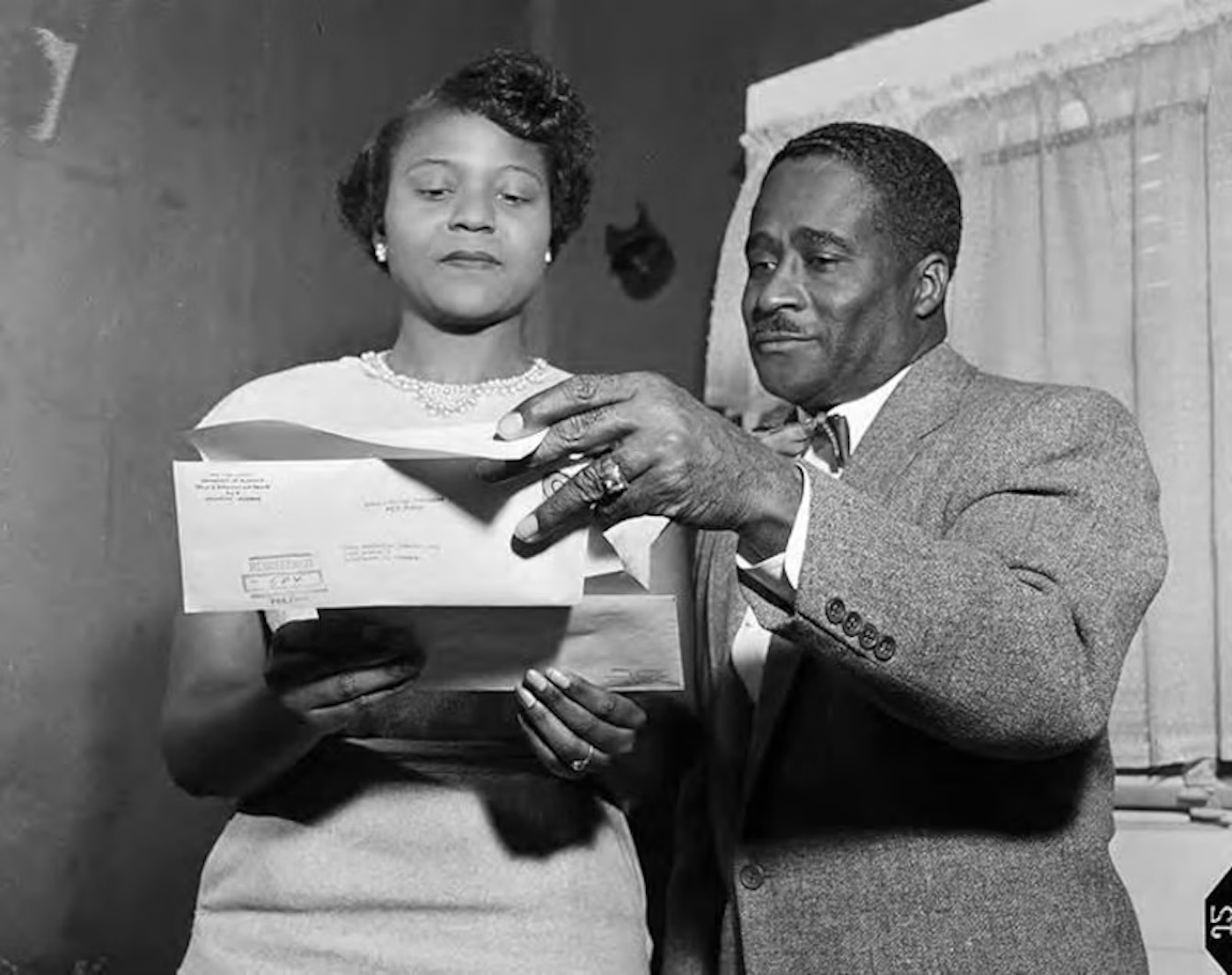
What is easy to miss, looking back, is that her original ambition was strikingly ordinary. She did not begin as a public icon seeking confrontation for its own sake. She wanted access to education unavailable to her under Alabama’s segregated system. Along with her friend Pollie Anne Myers, whom she knew from Miles College, Lucy applied to the University of Alabama in 1952. The two women were initially accepted. Only later, when university officials discovered they were Black, was the acceptance effectively revoked. That sequence matters. It exposed the university’s discrimination with unusual clarity. There was no academic pretext left to hide behind. The disqualification rested on race.
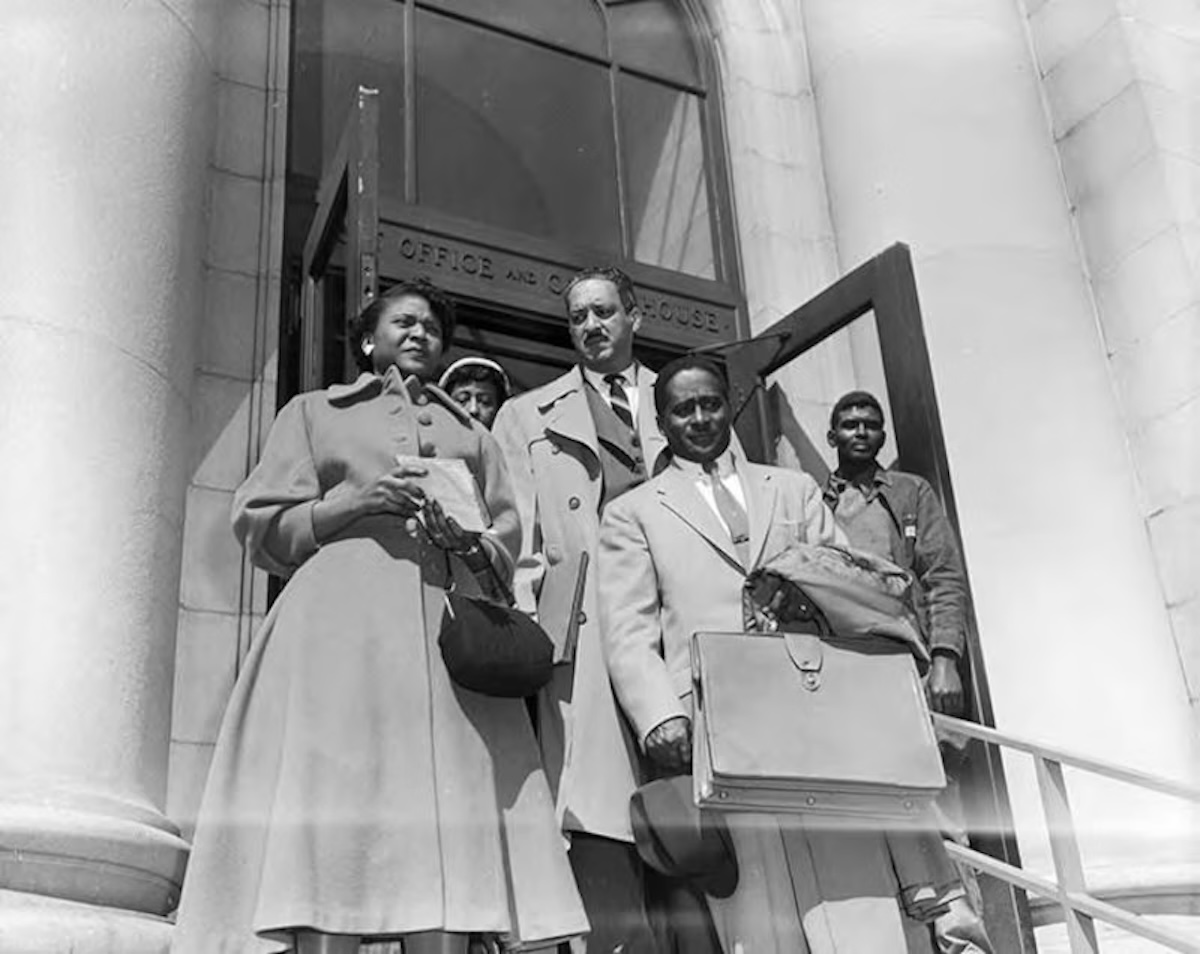
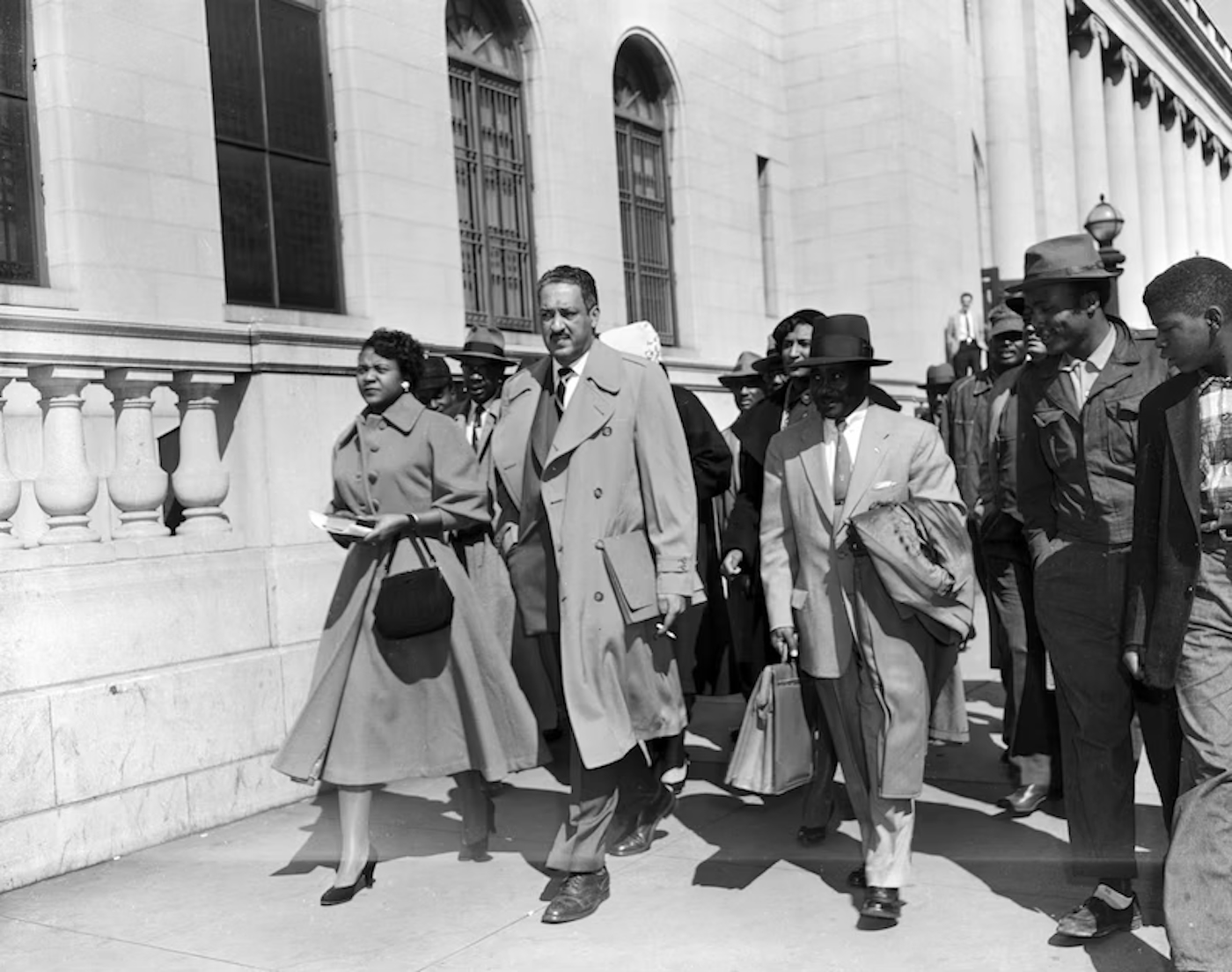
The case that followed, Lucy v. Adams, became a crucial legal challenge to segregated higher education in Alabama. Backed by the NAACP and represented by lawyers including Arthur Shores and Thurgood Marshall, Lucy and Myers sued. In 1955, federal judge Harlan Hobart Grooms ruled that the University of Alabama could not deny them admission solely on account of race, and the U.S. Supreme Court later reinstated that injunction. The legal meaning was clear enough: Alabama’s flagship university could not remain a whites-only institution under the Constitution.
But law, especially in the South of the 1950s, was often the easy part on paper and the hard part in practice. The university found a way to exclude Myers separately. According to the National Women’s History Museum, Alabama disqualified her on a so-called morality ground tied to a pregnancy before marriage. Lucy, however, could not be screened out that way. So the school faced the very result it had spent years resisting: a Black woman arriving to enroll.
The three days that entered history
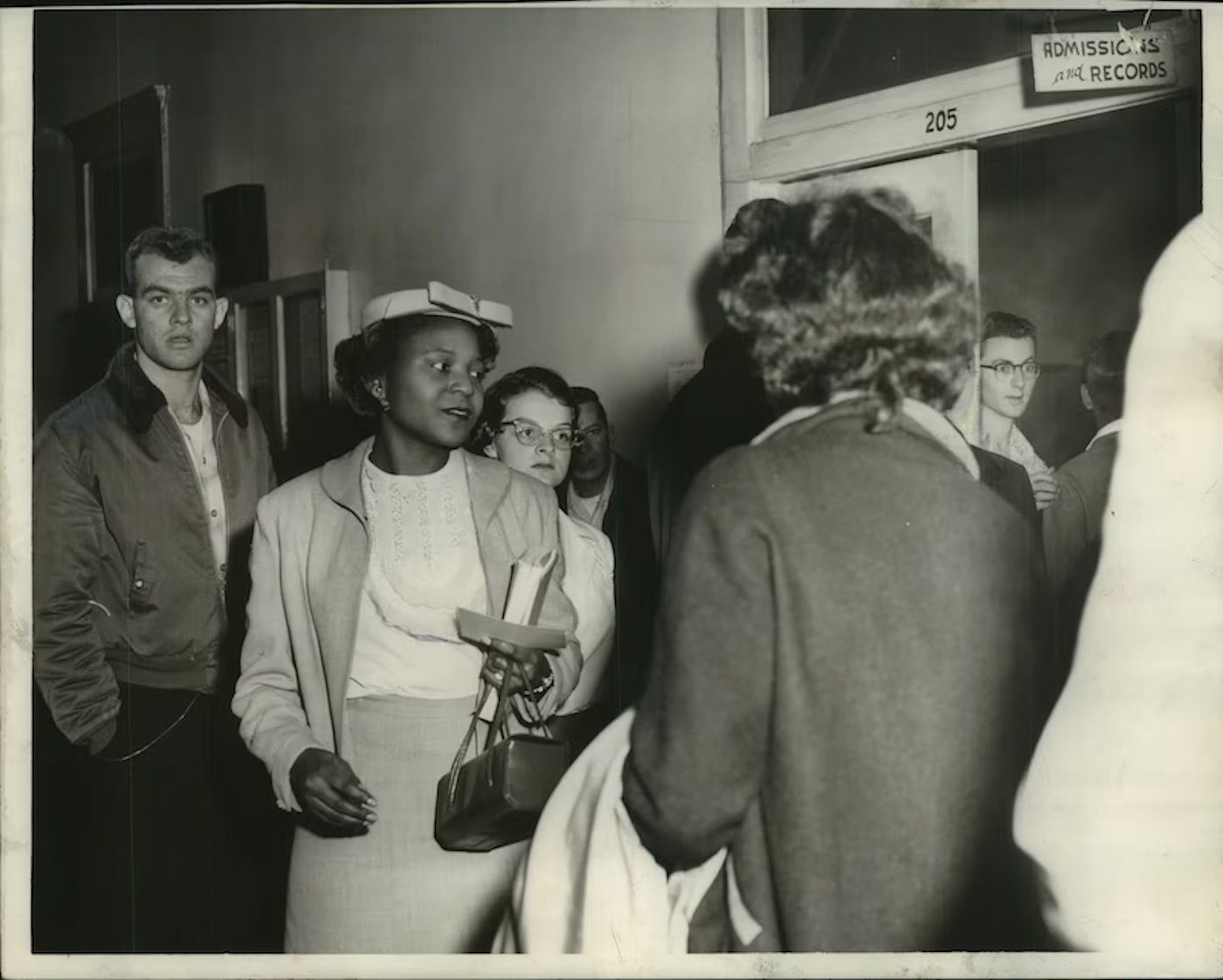
Autherine Lucy enrolled at the University of Alabama on February 3, 1956, entering the College of Education as the first Black student in the school’s history. That sentence is often repeated, but its calmness hides the danger surrounding it. She was not walking into a reluctant but peaceful transition. She was entering a campus and a state shaped by massive resistance, where white officials and white crowds treated integration as a provocation rather than a legal obligation.
Her time on campus lasted only three days. On the first days, hostility grew rapidly. Crowds formed. Threats escalated. On February 6, as she attempted to attend classes, a white mob gathered and turned violent. Reports from later historical accounts describe taunts, thrown objects, and a surrounding atmosphere that made plain the university’s inability—or unwillingness—to protect her. The University of Alabama’s own historical materials acknowledge that demonstrations became so tumultuous that she was suspended and later expelled after only days on campus.
The institutional language used at the time is familiar in the history of racial exclusion: Lucy was removed “for her own safety.” The phrase deserves scrutiny. It has the sound of concern but the function of surrender. Rather than control the mob, punish the rioters, or defend the student whose rights had been affirmed in federal court, the university displaced the burden back onto Lucy herself. The logic was brutal in its simplicity. White violence created danger; Black presence was then treated as the problem.
That formulation remains central to understanding why Autherine Lucy Foster’s story still resonates. It was not merely that Alabama had segregationist policies. It was that once those policies were challenged successfully, the institution still found ways to preserve the segregated order through passivity, procedural maneuvering, and deference to mob rule. The law said she belonged. The institution behaved as though that principle were negotiable.
In the aftermath, Lucy and NAACP lawyers filed claims accusing university officials of colluding with or enabling the mob. The university responded not with introspection but retaliation. Trustees permanently expelled her, citing those accusations as grounds. Judge Grooms later ordered her readmission, but did not overturn the expulsion. The result was one of the crueler paradoxes of civil rights litigation: a woman had proven the university was violating the Constitution, had endured public terror for trying to attend, and still ended up cast out.
What her “failure” actually accomplished
American memory often privileges the visibly successful moment: the graduate crossing the stage, the triumphant return, the sealed moral lesson. Lucy Foster’s experience initially offered none of that. And because it did not, her place in popular memory became more fragile than it should have been. Yet historians and the federal judiciary alike have emphasized that her brief, painful confrontation with Alabama had a lasting effect. The U.S. Courts has described her effort as a failed integration bid that nonetheless left a lasting legacy. That phrasing gets at something essential. A campaign can fail in the immediate sense and still transform the strategic terrain.
Her case established that the university could not lawfully exclude Black applicants because of race. Her treatment on campus exposed the depth of white resistance to even the most minimal compliance. And her removal became a warning, not to Black students, but to the nation: desegregation in higher education would require more than courtroom wins. It would require federal pressure, public scrutiny, and a willingness to confront the complicity of institutions that presented themselves as neutral.
There is also a direct line from Lucy to the later desegregation of the University of Alabama. When Vivian Malone and James Hood enrolled in 1963, the moment became nationally iconic because of Gov. George Wallace’s “stand in the schoolhouse door.” But Malone and Hood did not emerge from nowhere. Alabama had already been forced, years earlier, to reckon with Lucy. The university’s own history notes that Malone and Hood were not the first Black students even to apply or attend. That distinction belongs to Autherine Lucy. Her experience widened the crack in the institution before later students pushed the door further open.
Vivian Malone herself later acknowledged Lucy’s influence. Secondary historical accounts recount Malone saying that Lucy’s effort left an indelible impression on her. That sentiment matters because it frames Lucy not as a tragic prelude, but as part of a relay. Civil rights progress often works that way: one person absorbs the first blow, another carries the victory into public view, and both belong in the story.
There was another kind of accomplishment in Lucy’s life that deserves equal attention. She did not become a symbol full-time. After the public ordeal, she married Hugh Foster in April 1956. The couple lived in several Southern states, and her notoriety made it difficult for her to find teaching work at first. Eventually the family returned to Alabama, and she worked in Birmingham’s school system. That trajectory matters because civil rights history too often treats people as if they cease to exist after the headline moment. Lucy Foster kept living. She kept teaching. She built a family. She remained part of the long Black tradition of educators who, whether or not the nation was watching, treated learning as community work.
Grace, restraint, and the burden placed on Black pioneers
One of the recurring features of Lucy Foster’s public memory is the emphasis on her composure. She was often described as poised, soft-spoken, dignified, measured. Those descriptors are not wrong. They are also revealing. Black pioneers in the Jim Crow era were routinely expected to endure humiliation without public fury, to perform calm in situations designed to break them, and to reassure the country that they remained morally superior to the people tormenting them. Lucy did this with extraordinary discipline. But it is worth noting that such grace was not merely admirable; it was demanded.
That tension is part of what makes her story so modern. American institutions still prefer redemptive narratives in which the injured party returns, forgives, and helps the institution tell a more flattering story about itself. Lucy Foster did eventually return to Alabama, and she did so with a generosity that seems, from a distance, almost superhuman. But generosity should not erase accountability. The university that later celebrated her had once forced her out. The later honors matter. So does the earlier abandonment.
Her own words near the end of her life carried that mixture of humility and moral clarity. At the 2022 dedication of Autherine Lucy Hall, she said, “If I am a master teacher, what I hope I am teaching you is that love will take care of everything in our world.” It is a beautiful line, and one that officials repeated after her death. But it should be heard alongside the circumstances that made such a statement necessary. Love, in her formulation, was not sentimental softness. It was disciplined refusal to let hatred decide the terms of one’s humanity.
Then there is the famous note of consolation from Thurgood Marshall after her expulsion. Marshall told her that her contribution had already been made toward equal justice for all Americans. The line survives because it is both tender and politically exact. Marshall understood that setbacks in civil rights work could still alter the legal and moral landscape. Lucy may have been denied the student experience she sought in 1956, but she had already forced the issue of equal access into public view in a way Alabama could not reverse.
Return, restoration, and the politics of institutional memory
In 1988, the University of Alabama annulled Lucy Foster’s expulsion. A year later, she returned as a graduate student, and in 1991 she completed the requirements for a master’s degree in elementary education. She participated in graduation the following year, at the same time that her daughter Grazia also graduated from the university. It was one of those rare historical scenes that feel almost too symbolic to be real: the woman once forced out by a mob returning to finish her studies beside the next generation of her own family.
The restoration did not come quickly. More than three decades passed between expulsion and return. That delay should shape how one interprets the later honors. Redemption, when it came, was not immediate repentance. It was a slow institutional concession, and then a series of gestures that grew more public over time: a portrait, an endowed fellowship, a clock tower in Malone-Hood Plaza, a historical marker, an honorary doctorate in 2019, and finally the naming of Autherine Lucy Hall in 2022.
Each of those markers has value. They signal that the university now understands Lucy Foster not as an inconvenience in its history but as one of the people who made its modern history possible. Yet the sequence surrounding the building name in 2022 also revealed how messy institutional memory remains. Trustees first paired her name with that of Bibb Graves, a former Alabama governor associated with the Ku Klux Klan. After backlash from students, faculty, and the public, the university system removed Graves’s name and adopted Autherine Lucy Hall alone. The correction was important, but so was the misstep. Even in honoring a civil rights pioneer, institutions can still stumble into arrangements that flatten moral distinctions they should understand perfectly well.
That controversy underscored a larger point. Commemoration is not neutral. Who gets named, how they are named, and alongside whom they are named are all arguments about history. In Lucy Foster’s case, the public pushback suggested that many people understood the stakes better than the first decision-makers did. A woman who had been terrorized for crossing Alabama’s color line should not have had her legacy braided into that of a Klansman. The final renaming mattered because it clarified who the university now claims as a moral ancestor.
Her honorary doctorate in 2019 carried a similarly layered symbolism. The university described her as “the architect of desegregating Alabama’s education systems.” That is grand language, but not inaccurate. It acknowledges that Lucy’s significance extends well beyond a campus anecdote. Her case belongs to the broader history of dismantling segregated public education in the state. The institution that once treated her presence as intolerable eventually had to admit that she helped remake it.
Why her story still matters now
Autherine Lucy Foster died in March 2022 at age 92, just days after attending the dedication of the hall that now bears her name. Obituaries in the Associated Press, The Washington Post, and other outlets noted the starkness of that timing. The woman who had been driven from campus in 1956 lived long enough to hear that campus publicly claim her. There is something moving in that. There is also something instructive. Institutions often move toward truth only after the people who forced them there have spent a lifetime waiting.
Her significance is not limited to Black history month recitations or “firsts” lists. It speaks directly to current debates about higher education, belonging, and memory. Universities today frequently market themselves as inclusive spaces while struggling with the legacies built into their landscapes, admissions histories, donor cultures, and public symbols. Lucy Foster’s life reminds us that access is not the same thing as welcome, and welcome is not the same thing as repair. A student may be admitted on paper and still be left unprotected in practice. A university may celebrate diversity while avoiding the harder work of telling the truth about how that diversity became possible.
She also belongs in the broader lineage of Black women whose labor in civil rights history has often been under-credited. Much of the public canon remains disproportionately oriented around male ministers, male spokesmen, male litigants, and male elected officials. Lucy Foster’s story pushes against that imbalance. She was not a rhetorical celebrity. She was not a governor, judge, or national officeholder. She was a student and educator whose insistence on equal treatment exposed the moral failure of an entire institution. That is a different mode of leadership, but leadership all the same.
There is a temptation, when telling stories like hers, to settle into a softened ending. America was wrong, then America learned, then America honored the pioneer, full stop. But Lucy Foster’s story resists such clean closure. Yes, she was honored. Yes, she earned her master’s degree. Yes, the university finally named a building after her. And yes, the original violence still matters, because later recognition does not retroactively make the institution brave in 1956. It makes the institution more honest decades later. Those are not the same thing.
That distinction may be the most useful thing her legacy offers contemporary readers. Progress is real, but it is often belated. Public reverence for civil rights heroes can coexist with an unwillingness to replicate their courage in the present tense. It is easier to name a building for Autherine Lucy Foster than it was to protect Autherine Lucy Foster when protection would have cost something. The measure of an institution is not only how beautifully it remembers the pioneer, but whether it would have stood with her when memory was still risk.
The meaning of Autherine Lucy Foster
So what, finally, does Autherine Lucy Foster signify?
She signifies the distance between constitutional principle and institutional behavior. She signifies the peculiar American tendency to celebrate courage after first punishing it. She signifies the role of Black women in forcing open spaces that were never designed for them, and then being asked to smile when those same spaces later claim enlightenment. She signifies the fact that educational access in the United States was not expanded by goodwill alone, but by people willing to endure isolation, humiliation, and danger for rights that should never have required heroism in the first place.
And she signifies something else, too: endurance without erasure. She did not remain forever frozen in February 1956. She became a wife, mother, educator, graduate, honoree, elder, and witness to the institution’s long-delayed reckoning. That full life matters because it restores her humanity beyond the moment of spectacle. The mob wanted to reduce her to an intrusion. History should remember her as something larger: a teacher, a litigant, a pioneer, and one of the key figures in the desegregation of Southern higher education.
At the University of Alabama, her name now sits on a hall rather than on an expulsion order. That is no small thing. But perhaps her deeper legacy lies in what still unsettles. She makes it harder to tell easy stories about progress. She reminds us that sometimes the person who changes history is not the one granted the clean victory scene, but the one who reveals the nation to itself before the nation is ready to look.
Autherine Lucy Foster was first, and she was forced to be first almost alone. That aloneness is part of the indictment. Her determination is part of the inheritance. And the door she reached—before Alabama, before many universities, before much of the country was prepared to honor what she represented—did not close behind her, no matter how fiercely others tried.
More great stories
What America Saw in Fred Hampton—and What It Feared
March 15, 2026
No Comments

Before the Renaissance, There Was Dunbar
March 14, 2026
No Comments