




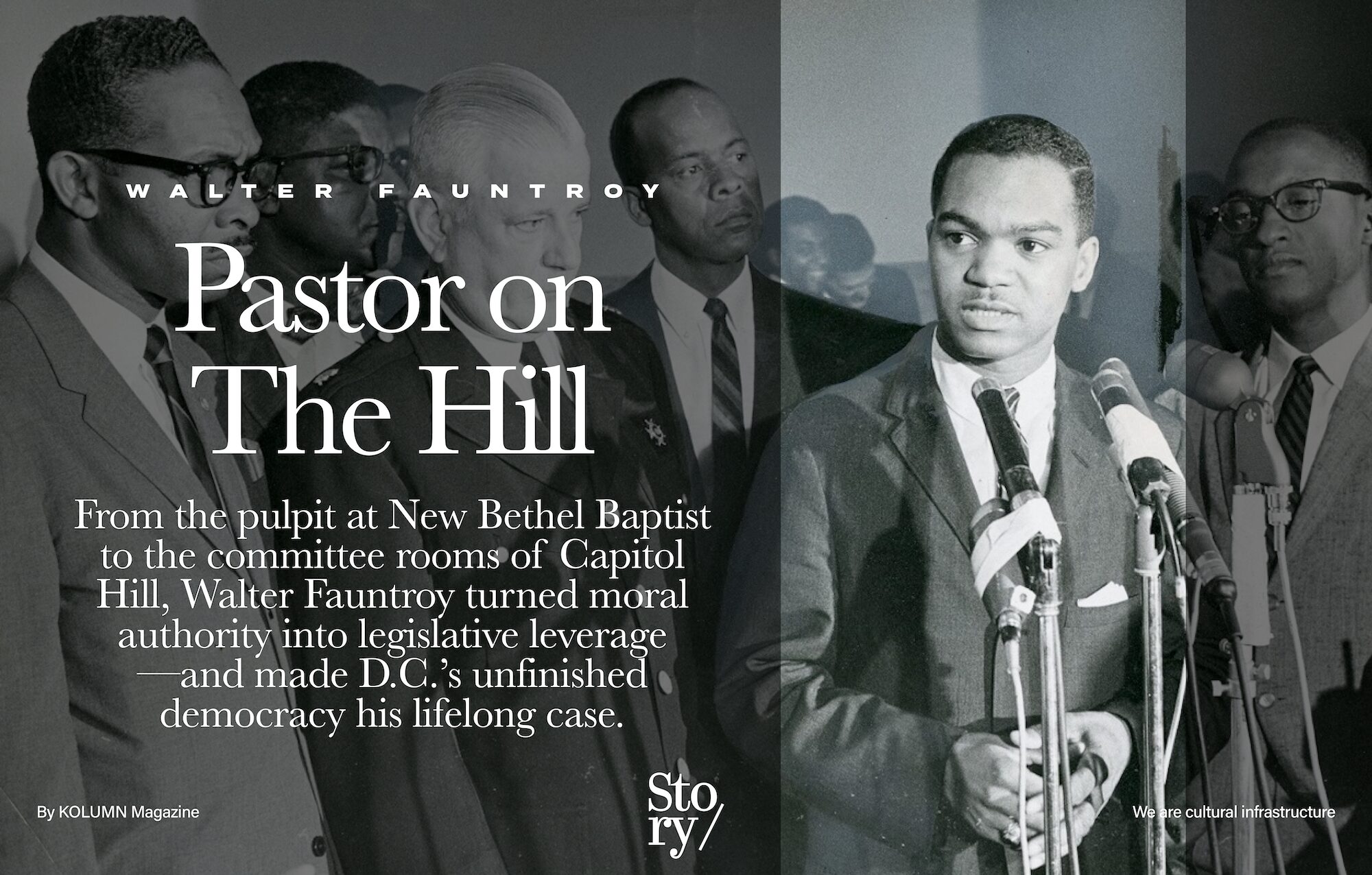
A form of leadership that treats representation as a moral obligation.
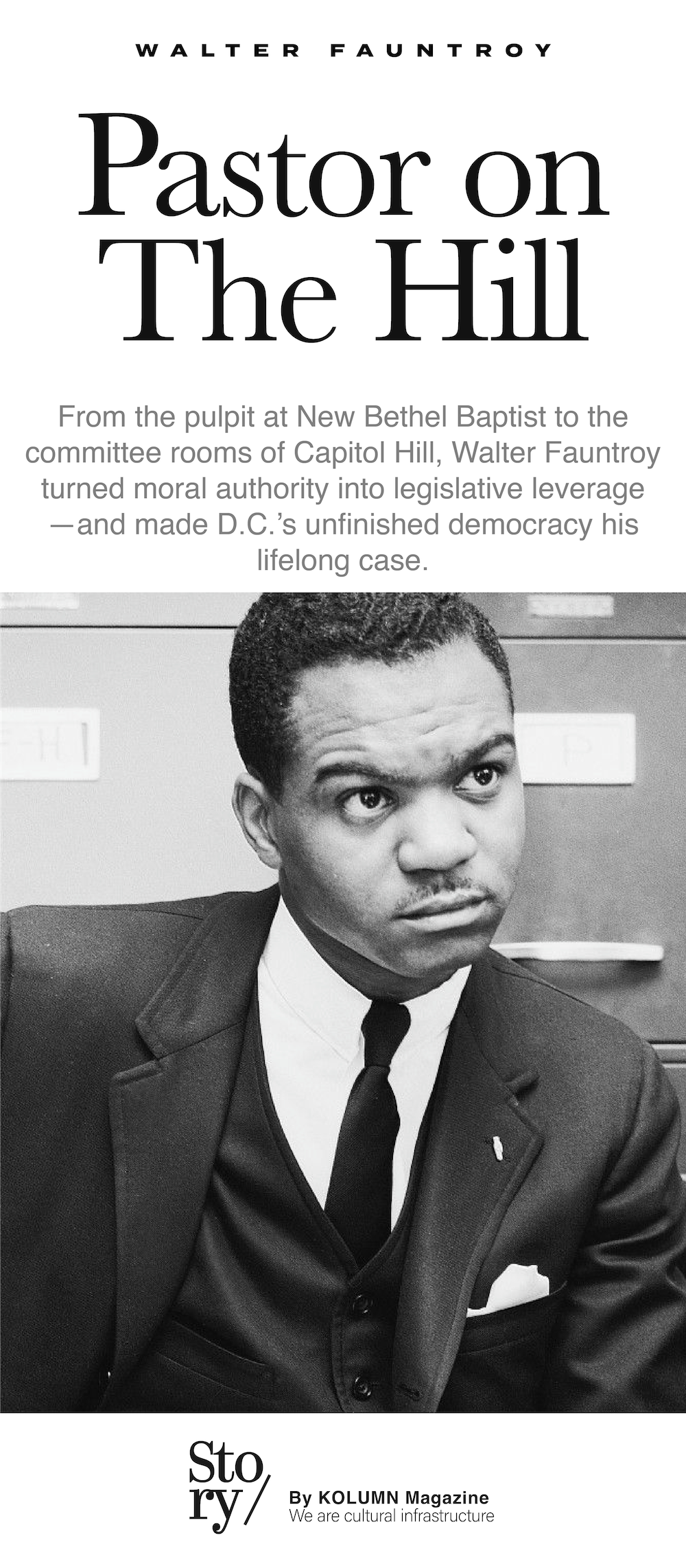
A form of leadership that treats representation as a moral obligation.
By KOLUMN Magazine
Walter Edward Fauntroy Jr. has never fit neatly into a single American role. He is, simultaneously, a Baptist minister and a movement strategist; a political pragmatist and an organizing preacher; a congressional pioneer who entered the House as the District of Columbia’s first modern, nonvoting delegate and a man whose later life drifted into prolonged absences, legal trouble, and bewildering headlines. To write his life straight through is to watch the American experiment flicker between its lofty claims and its daily constraints. In Fauntroy’s case, those constraints were literal: for two decades he sat inside Congress without the full franchise of a floor vote—an embodiment of D.C.’s peculiar status and the nation’s habit of celebrating democracy while rationing it.
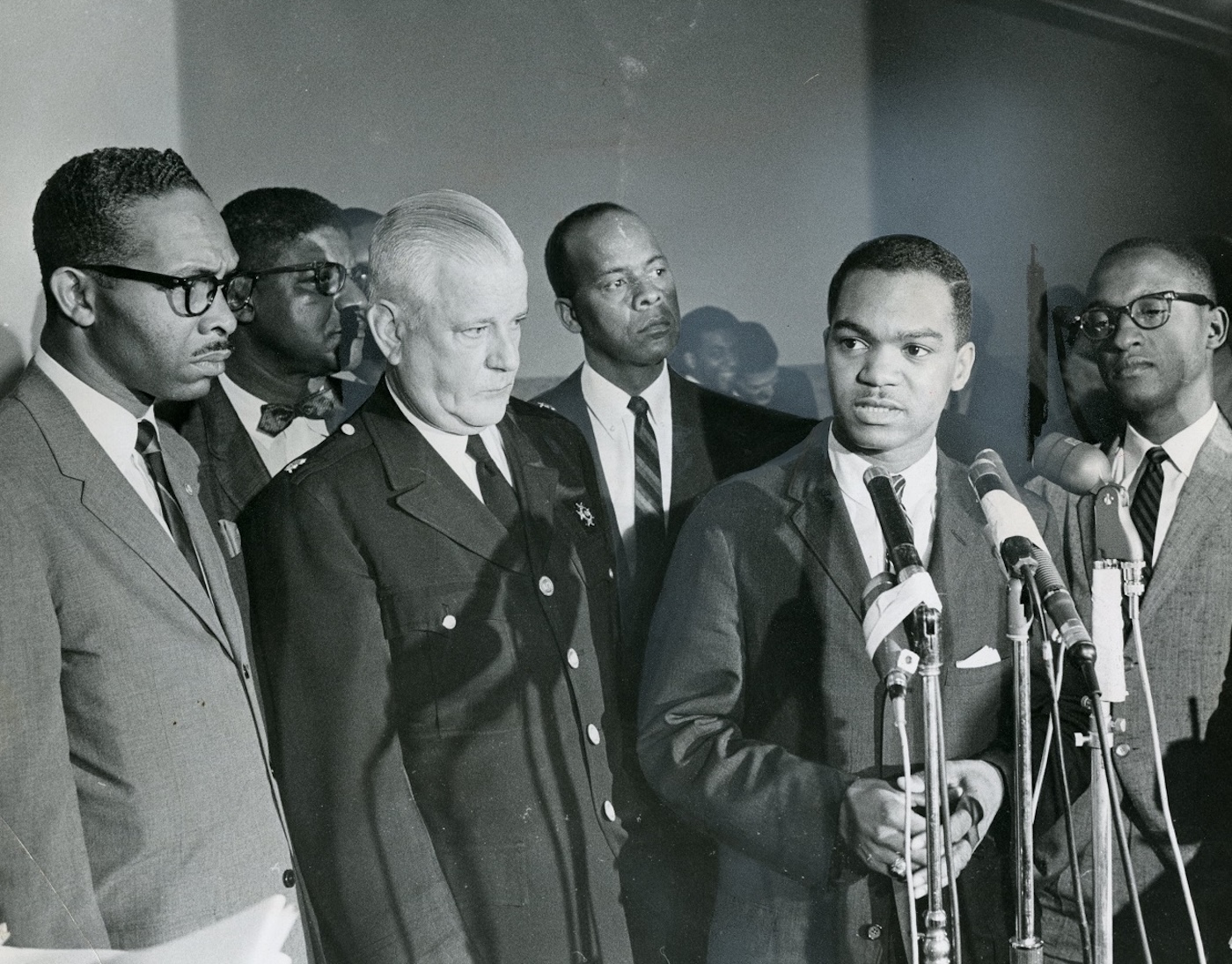
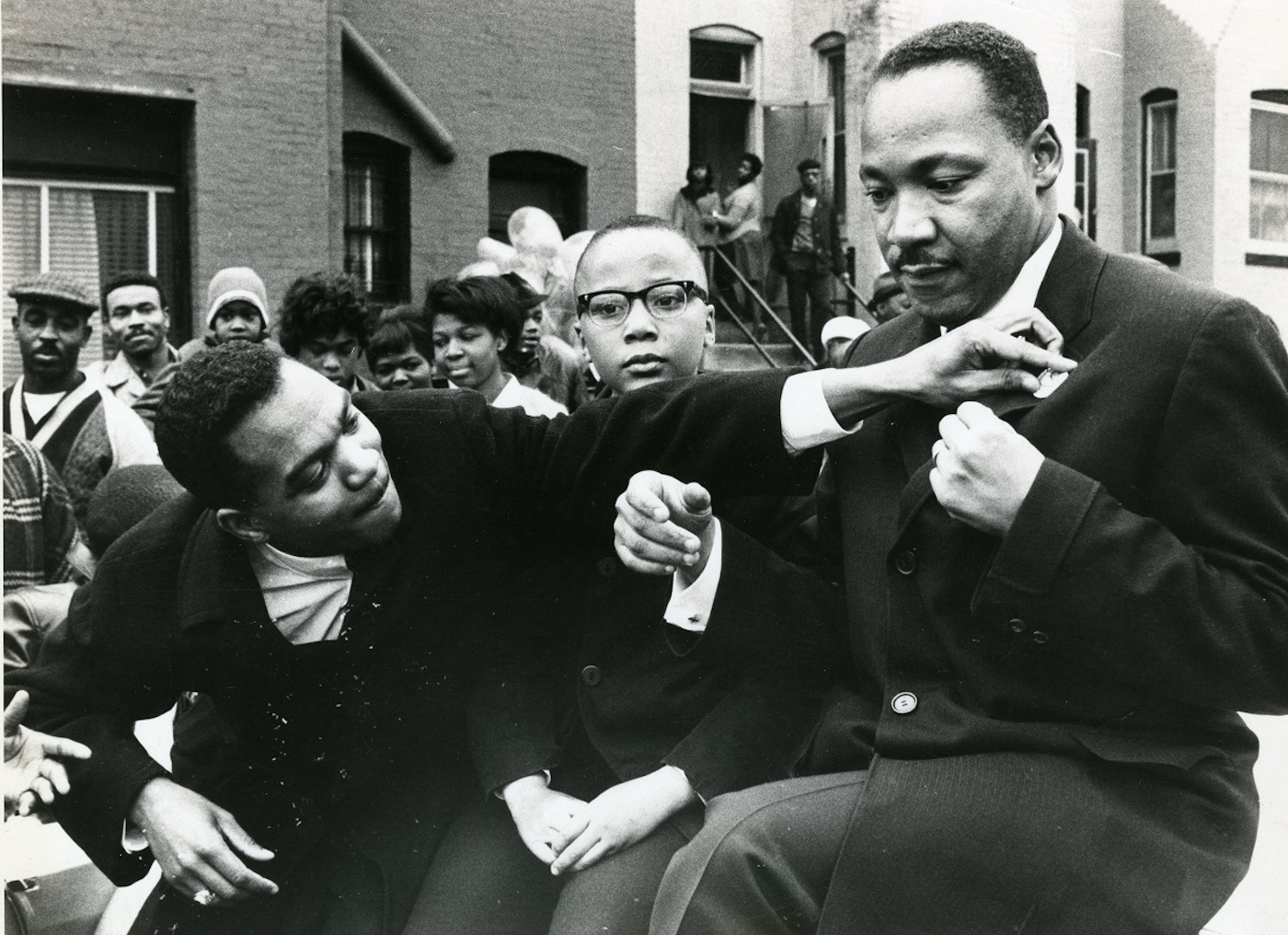
Yet his significance is larger than the office he held. Fauntroy’s career forms a connective tissue between the civil rights movement’s peak years and the Black political institution-building that followed. Martin Luther King Jr. and the Southern Christian Leadership Conference tapped him to build influence in Washington—first through a D.C. bureau and then through congressional lobbying. That apprenticeship, rooted in the moral theater of the Black church and sharpened by the arithmetic of Capitol Hill, positioned Fauntroy to become a rare figure: a pastor fluent in legislative process, and a legislator trained in the tactics of nonviolent direct action.
His story is also a story about what “representation” means when the usual mechanisms—votes, states, equal standing—are missing. As delegate, Fauntroy could introduce bills and vote in committee, but could not cast a vote on final passage on the House floor. That limitation might have made the job purely symbolic. Instead, he treated it as a strategic challenge: if D.C. could not command power in the ordinary way, it would have to accumulate power through coalition, persuasion, committee work, and public pressure. The lesson is not only about the District. It is about how American democracy often works for people who are present in the room, but not fully counted.
A Washington childhood, a preacher’s training, and the making of a public pastor
Fauntroy was born in Washington, D.C., in 1933, raised in the city’s public schools, and came of age in a capital that was both seat of government and a segregated Southern town in practice, with Black residents frequently shut out of political control over their own streets. His education carried him through Virginia Union University and then Yale Divinity School, forming a clerical identity that was intellectually ambitious and publicly engaged. In 1959, he was called to the pulpit of New Bethel Baptist Church in Washington, a role he would hold for decades and that would anchor his authority even as he moved into national politics.
The mid-century Black church did not simply produce sermons; it produced institutions and leaders capable of operating in multiple registers at once—spiritual care, social service, political strategy, moral suasion, and, when necessary, confrontation. Fauntroy’s ministry matured in the years when the pulpit became an organizing platform across the South and in Northern cities with Southern conditions. From his church base, he developed what later colleagues would recognize as a particular skill: translating the ethical urgency of civil rights into the procedural language of Washington—hearings, amendments, relationships, votes counted in committee, and meetings where the loudest person is not always the one who wins.
That skill did not arrive by accident. It was cultivated inside a movement that understood D.C. as both a target and a stage. A march in Washington was not merely a demonstration; it was a demand delivered to the federal government’s front door, a spectacle meant to move public opinion and, eventually, federal law.
King’s man in Washington: organizing the capital, lobbying Congress
Fauntroy’s national importance begins with the fact that Martin Luther King Jr. chose him. King tapped the young Washington minister to serve as director of the SCLC’s bureau in the District, placing him at the intersection of movement leadership and the federal apparatus. The House historian’s account of Black leaders’ “precongressional experience” describes this period plainly: Fauntroy became the SCLC’s congressional lobbyist, an assignment that honed his coalition-building skills and foreshadowed his later electoral path.
This matters because the civil rights movement is often narrated as an outside force pushing against institutions. Fauntroy’s role illustrates the inside-outside dynamic that made the movement effective. The movement needed marches and sit-ins, but it also needed people who could track legislation, interpret congressional moods, and convert street pressure into statutory language. The work was not glamorous. It required patience with small meetings, long days, and the kind of incremental bargaining that can feel morally inadequate until the moment it produces a breakthrough.
Fauntroy is frequently linked to the planning and coordination ecosystem surrounding the 1963 March on Washington—an event now fossilized in the public imagination as a single speech and a single day, but in reality a complex coalition effort of organizations, logistics, demands, and negotiations with power. Later accounts of his movement work, including profiles and retrospectives, repeatedly position him as one of the movement’s Washington operators—someone entrusted with the political and logistical side of mass mobilization.
After King’s assassination in 1968, the movement’s center of gravity shifted, and so did Fauntroy’s responsibilities. Stanford’s King Institute notes that he served as national director of the Poor People’s Campaign after King’s death, eventually leaving the SCLC in 1971. If the March on Washington was a demand for civil rights, the Poor People’s Campaign was an escalation: a confrontation with economic injustice and the structure of poverty itself. To lead that effort in the aftermath of King’s death required not only courage but institutional discipline—keeping a coalition intact when grief and fragmentation threatened to splinter it.
The Delegate Act and a job built from a democratic contradiction
In 1970, President Richard Nixon signed the District of Columbia Delegate Act, creating a nonvoting delegate seat in the House for the District—formal representation of a sort, but not equality. Fauntroy wanted the position and, in 1971, won election, becoming the first delegate to represent D.C. residents in Congress in nearly a century. The House’s historical profile emphasizes both the novelty and the limitations: he could not vote on the House floor, but he could vote in committee and introduce legislation.
That arrangement—presence without full power—was not simply a technicality. It was a civic wound. D.C. residents paid federal taxes, served in the military, and lived under laws shaped by Congress, yet lacked voting representation equivalent to states. Fauntroy’s entire congressional project can be read as an attempt to expose the contradiction by working inside it: to use the delegate’s limited tools to push for home rule, voting rights, and ultimately statehood-like equality.
He moved quickly on a central promise: self-government for the District. The House’s history of his tenure notes that he used his seat and relationships—especially within the committee structures concerned with the District—to build support for home rule. In the background was a long D.C. struggle: local residents governed by a federal city charter and congressional oversight, with limited local autonomy. Home rule was not a symbolic prize; it was a mechanism for daily dignity—control over schools, policing, budgets, and services.
Fauntroy’s advocacy also made him, inevitably, a translator between D.C.’s municipal reality and Congress’s national preoccupations. D.C. in the 1970s and 1980s carried the weight of urban policy debates: crime, public housing, public health, fiscal stress, and racialized narratives about cities. As the District’s representative, he had to defend the city from congressional caricature while also grappling with genuine governance challenges at home.
Building Black political power: the Congressional Black Caucus and a new era
Fauntroy’s significance is not confined to D.C. governance. He was also a founding member of the Congressional Black Caucus (CBC), part of the cohort that formalized a collective Black legislative identity within Congress. Stanford’s King Institute notes his role as a founding member and later chairman of the CBC from 1981 to 1983. This was the era when civil rights victories had opened doors but had not transformed the underlying structure of inequality. The CBC became one of the most influential vehicles for Black policy priorities—education, employment, civil rights enforcement, and international human rights—within a Congress often indifferent to Black constituencies.
Chairing the CBC required more than rhetorical leadership. It required managing internal diversity—different regions, ideologies, and constituencies—while presenting a unified front to House leadership, committee chairs, and administrations. In practical terms, it meant a continual negotiation over agenda-setting: what to prioritize, how to frame it, and how to attach it to broader coalitions without losing its substance.
Fauntroy’s own political style leaned toward coalition-building. That made sense for a delegate whose formal power was constrained and for a movement veteran trained to build alliances across unions, clergy networks, student organizations, liberal lawmakers, and international human rights advocates. The CBC’s influence in those years reflected a broader trend: the movement’s energy flowing into institutions, not as surrender but as strategy.
Anti-apartheid activism and the power of arrest as message
Fauntroy’s moral politics extended beyond U.S. borders, most visibly in the anti-apartheid movement. Stanford’s King Institute notes that in 1984 he was arrested after conducting a sit-in at the South African embassy in protest of U.S. policy toward apartheid. (That act is not an anecdote; it is a case study in his method. Even as a federal official, he used the repertoire of civil rights protest—sit-in, arrest, moral spectacle—to confront international injustice and domestic complicity.
A contemporaneous account from Sojourners describes how the embassy sit-in with Fauntroy, TransAfrica’s Randall Robinson, and Mary Frances Berry helped ignite a broader “Free South Africa Movement” and a wave of nonviolent direct action aimed at shifting U.S. policy. Here again is the inside-outside strategy: a member of Congress adopting the tactics typically associated with outsiders to pressure the executive branch and influence national sentiment. The embassy became a stage; the arrest became a signal that incremental diplomacy was insufficient.
In the long arc of U.S. anti-apartheid activism, these moments mattered because they normalized the idea that international human rights could be treated as a domestic moral question, not merely a matter of Cold War alignment. Fauntroy’s presence also reminded Americans that apartheid was not an abstract foreign evil; it was a cousin to segregation, sustained by similar logics and challenged by similar tactics.
D.C. voting rights, statehood dreams, and the politics of “almost”
The District’s struggle for equal representation predates Fauntroy and outlasts him, but he helped define a modern phase of it. The Atlantic has noted that in 1978 he led a broad, bipartisan coalition to pass the D.C. Voting Rights Amendment, which would have treated D.C. as though it were a state for purposes of representation in Congress—an effort that ultimately failed to secure enough state ratifications. The episode is emblematic of D.C.’s recurring pattern: advances that come close, then stall in the machinery of federalism and partisan calculation.
What Fauntroy’s career demonstrates is how D.C. representation is perpetually subjected to national politics. In some eras, it becomes a civil rights issue; in others, it becomes a partisan chess piece. The District’s demographics—majority-Black for much of the late 20th century, heavily Democratic—ensure that the debate is never purely constitutional. Fauntroy’s ministry and movement background made it difficult for him to accept the “neutral” framing that D.C.’s status is simply an administrative quirk. He treated it as a moral deficit: citizens denied equal standing in the very city that claims to represent democracy to the world.
The defeats and the costs of public life
Fauntroy’s congressional career ended in 1991, after two decades in office. The end of a long tenure is rarely the end of a public identity, especially for someone whose legitimacy also rested on the church. He remained a figure in D.C.’s civic memory—invited to speak, cited as an elder, sometimes criticized as a relic of earlier political eras. The Black press continued to place him in the lineage of local advocacy and national civil rights history.
But his later decades also reveal the vulnerabilities that can accompany revered status. A life built on moral authority does not immunize a person from financial trouble, misjudgment, or the slow erosion of institutional support. By the 2010s, public reporting depicted him as facing mounting legal and financial problems and leaving the country in 2012, prompting deep concern and confusion among friends and family. A Washington Post account described his prolonged absence and the strain on those around him, noting that he was believed to be in Dubai. Other reporting, including Roll Call, summarized the legal situation: warrants tied to failure to appear and fraud allegations, connected in part to unpaid debts and a bad check, and his eventual arrest in 2016 after returning through Dulles airport. DCist similarly covered his return and the years abroad.
These facts can be handled sensationally, but the more honest journalistic approach is to treat them as part of a larger story about what happens to movement elders when the spotlight dims and the infrastructure that once held them up—organizations, staff, steady income, political power—weakens. Fauntroy’s disappearance was not merely gossip; it was a public crisis because his life symbolized so much. When such a figure falls into disorder, it forces a community to confront uncomfortable questions: How do we care for leaders after their most productive years? How do we distinguish accountability from abandonment? What do we do with contradiction when it arrives in a familiar face?
Libya, spectacle, and a late-life return to the world stage
Even before the Dubai years, Fauntroy periodically resurfaced in unexpected international episodes. During Libya’s 2011 upheaval, he was reported to be detained alongside journalists at Tripoli’s Rixos Hotel. The Atlantic described him as being on a self-appointed “peace mission,” surprising the State Department and becoming entangled in the chaos of a collapsing regime. The Guardian, reporting on the Rixos detentions and releases, also noted his presence among those trapped and later freed.
The episode had a surreal quality: an aging former lawmaker and civil rights leader appearing amid foreign conflict, framed as a kind of freelance emissary. It echoes a pattern common to certain movement veterans who spent their youth at the center of history: a belief that moral authority and personal courage can substitute for formal diplomatic channels. Sometimes that instinct produces genuine breakthroughs; sometimes it produces confusion and risk.
In Fauntroy’s case, it contributed to an already complicated late-life public narrative—one in which the boundary between principled activism and erratic improvisation became harder for outsiders to parse.
What his life tells us about D.C., about movements, and about American memory
Walter Fauntroy’s life is not a simple arc from heroism to decline, nor a neat morality tale. It is, instead, a record of how American power works—and how it does not—when filtered through race, geography, and institutional design.
First, his career underscores that D.C. is not merely a city; it is a constitutional compromise with human consequences. The delegate seat he held was a symbolic admission that the District’s exclusion was untenable, paired with a structural refusal to fix it fully. Fauntroy’s most enduring significance may be that he inhabited that contradiction publicly, turning the job itself into an argument: if democracy is the national creed, then the capital should not be the place where democracy is least complete.
Second, his life shows how the civil rights movement’s tactics migrated into later causes. The anti-apartheid embassy sit-in is a direct inheritance from lunch-counter sit-ins and courthouse protests, adapted to a new target and a new moral battlefield. His willingness to be arrested as an elected official was not performative bravado; it was a deliberate use of personal risk to force public attention.
Third, Fauntroy embodies the shift from movement to institution. King’s congressional lobbyist becomes a congressional member; the organizer becomes the legislator; the preacher becomes the policymaker. That transition is often celebrated as progress, and it is. But it also comes with compromise: bureaucratic battles instead of marches, committee language instead of prophetic speech, and constant negotiation with people who do not share the movement’s moral commitments. Fauntroy’s career invites a more nuanced understanding of that shift—one that honors the labor of institutional politics without romanticizing it.
Finally, his later troubles complicate how we remember leaders. American culture often prefers its elders either sainted or discarded, with little room for the messy middle: revered figures who age into vulnerability, make damaging choices, or lose their footing. The reporting on his absence and arrest made clear that the public did not know how to hold his full story at once—movement hero and debtor, pastor and fugitive, institution-builder and wandering elder.
A serious accounting does not erase his earlier work to accommodate the later chapters, nor does it excuse the later chapters as the inevitable price of greatness. It does what Fauntroy’s own movement taught the country to do: insist on truth, even when it is uncomfortable, and then ask what justice requires in response.
The enduring measure: a politics built from moral insistence
If you want a single image of Walter Fauntroy’s significance, it is not a photograph from the House chamber, because the House floor was the place where his vote did not count. It is the image of a man moving between worlds: pulpit and committee room, protest line and legislative drafting, local D.C. grievances and global human rights fights. His influence rested in that motion—in the ability to convert moral clarity into political leverage, especially when formal power was limited.
The District of Columbia still lacks voting representation in Congress. The causes Fauntroy championed—economic justice, civil rights enforcement, an expansive view of human rights—remain contested terrain. In that sense, his career can feel like an extended argument that has not yet persuaded the jury. But his life also proves something essential: that constraints do not preclude agency, and that the struggle for full citizenship can be waged even from a seat designed to be partial.
Fauntroy’s legacy, then, is not only the legislation he pushed or the offices he held. It is the model he offered: a form of leadership that treats representation as a moral obligation, protest as a legitimate tool of governance, and the capital city as a test of whether the United States believes its own democratic language.
More great stories
The Man With the Million-Dollar Voice
March 10, 2026
No Comments
How Jesmyn Ward Made the South Speak Back
March 9, 2026
No Comments