





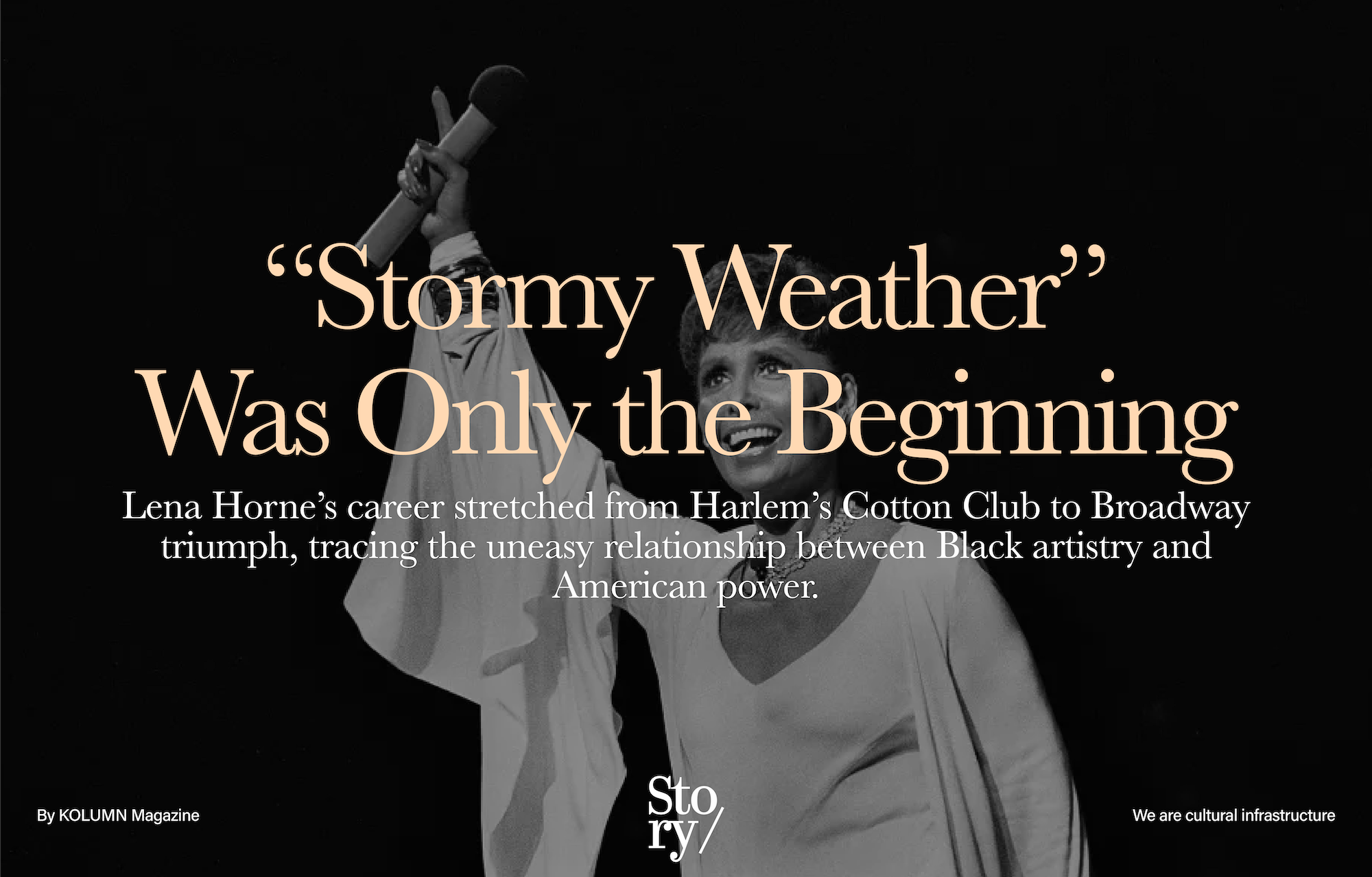
. She stood where the country’s fantasies about race, sex, patriotism, beauty, and success met their own hypocrisies.
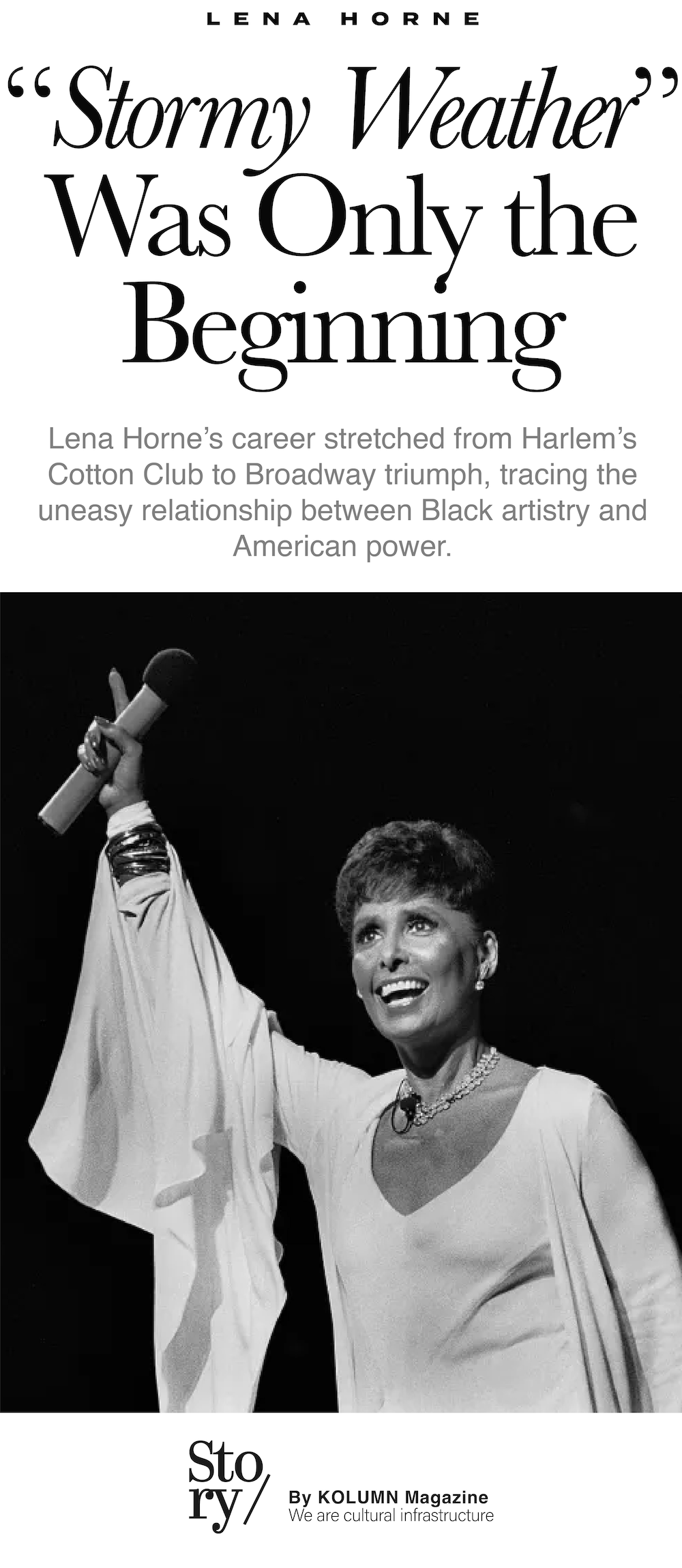
. She stood where the country’s fantasies about race, sex, patriotism, beauty, and success met their own hypocrisies.
By KOLUMN Magazine
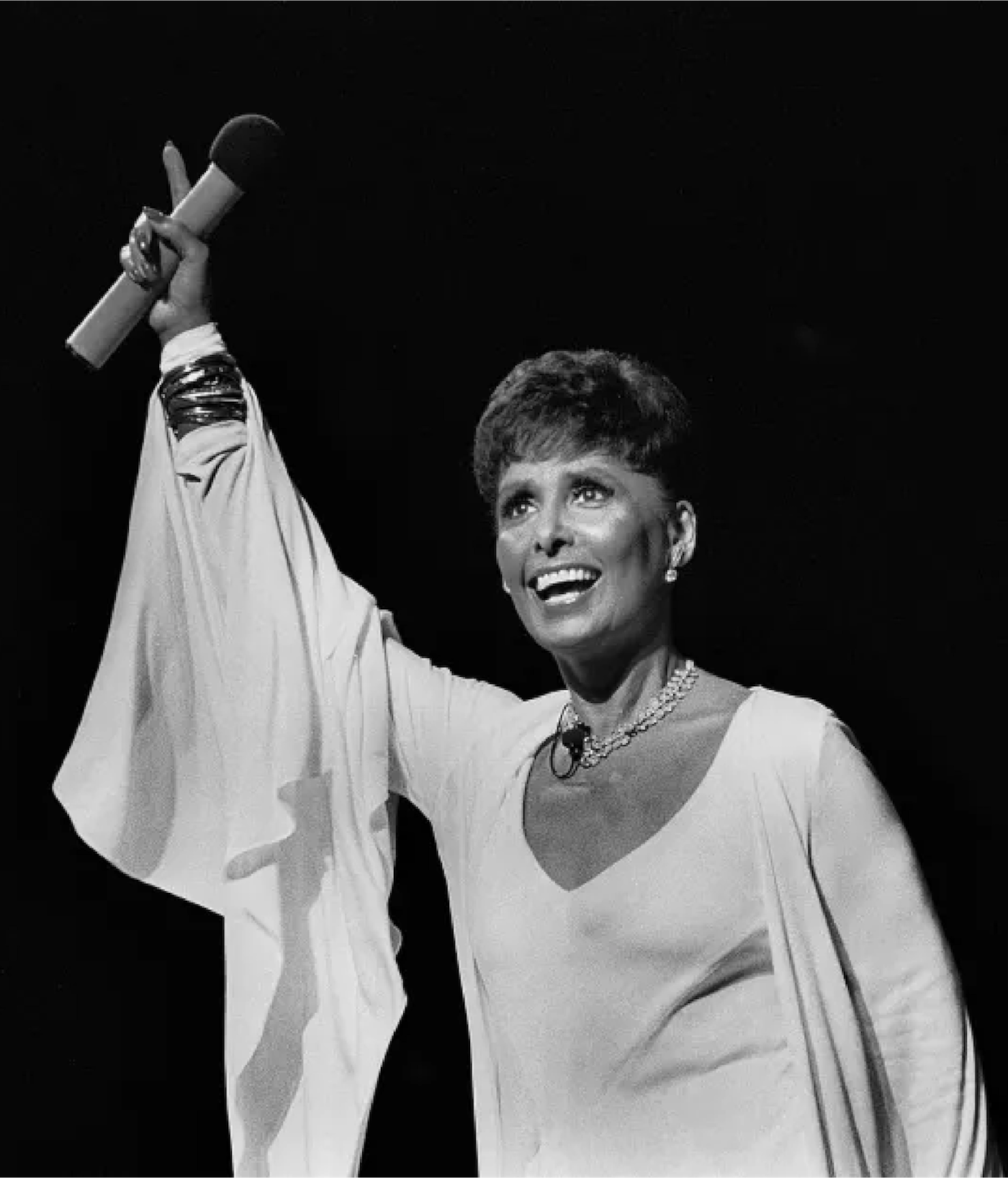
Lena Horne’s legend can be flattened too easily. Popular memory tends to preserve her in fragments: the face in a studio portrait, the voice behind “Stormy Weather,” the glamorous star who seemed to glide through film musicals with astonishing control. But Lena Horne was not merely a glamorous survivor of old Hollywood, nor simply a singer with movie-star looks and a sharp sense of self-preservation. She was one of the most consequential Black performers of the 20th century precisely because her life exposed the costs of American entertainment’s racial order. She became famous inside a system that wanted her visible but not too present, admired but not too powerful, elegant but not outspoken. The achievement of Lena Horne is that she learned how to use the spotlight without ever mistaking it for freedom.
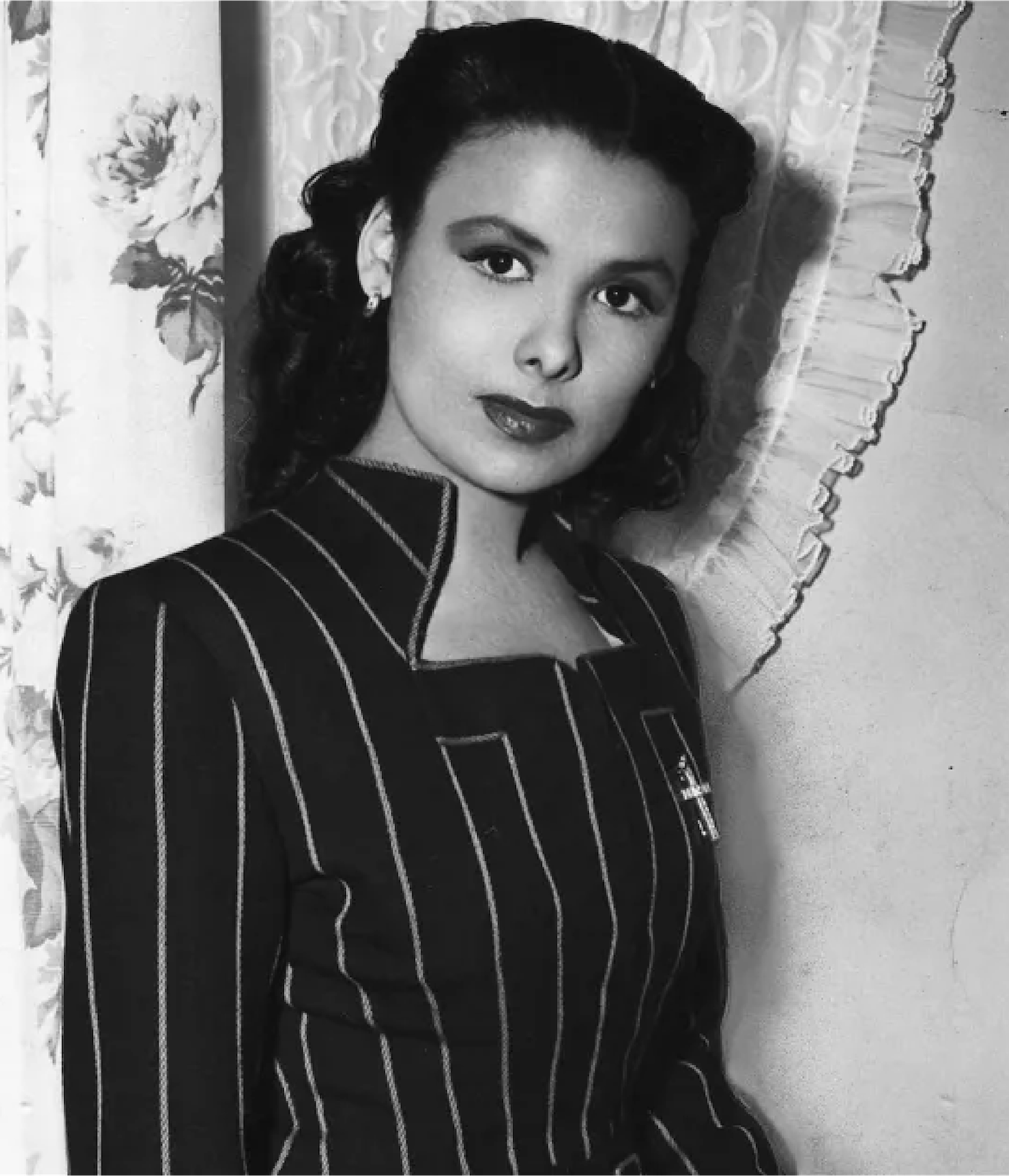
That distinction matters. Horne’s career ran across the Cotton Club, integrated nightclubs, radio, wartime performance circuits, MGM musicals, Broadway, television, and the civil rights movement. She lived long enough to see herself become a symbol of dignity, then a cautionary tale about Hollywood tokenism, then an elder stateswoman whose life could be read as a bridge between the era of Jim Crow spectacle and the modern language of representation. Yet what made her singular was not simply that she broke barriers. Plenty of people use that phrase as a kind of historical shortcut, a way to honor the past without dwelling on the mechanism of exclusion. Horne’s story is more demanding than that. She did not break a barrier once. She kept encountering new versions of the same barrier, in new rooms, with new consequences, and refusing it over and over again.
She was born Lena Mary Calhoun Horne in Brooklyn on June 30, 1917, into a Black family whose history complicated any simple narrative of poverty or deprivation. Her people were educated, connected, and conscious of status; hers was not a story of arriving in culture from outside it. But stability was another matter. Her father was a hotel and restaurant entrepreneur with a gambler’s streak. Her mother was an actress who traveled often. Horne spent much of her childhood being passed among relatives, especially her grandparents, and that unsettled early life left deep marks: a wariness of dependency, a powerful need for self-command, and a tendency to convert vulnerability into polish. Encyclopaedia Britannica and PBS both emphasize that mixture of cultivated background and emotional instability, a combination that helps explain the Horne the public later saw: controlled, immaculate, and hard to wound in plain view.
That poise, in other words, was not decorative. It was architecture.
Learning to perform in a world already staged against her
At 16, Horne joined the chorus line at Harlem’s Cotton Club, one of the most revealing stages in American cultural history. The club featured Black performers for white audiences, packaging Black musical brilliance inside a segregated economy of pleasure. Horne later spoke bluntly about the club’s ugly racial logic and poor working conditions. It offered opportunity, yes, but on humiliating terms. The Cotton Club taught her how American entertainment worked before Hollywood ever did: Black talent could generate atmosphere, heat, novelty, and sound, but the terms of access, control, and dignity were set elsewhere.
From there she moved through the circuits that shaped ambitious Black entertainers in the 1930s and early 1940s. She sang with Noble Sissle’s orchestra, made early recordings, toured, and developed into a nightclub performer of unusual sophistication. Her break at Café Society in New York was especially important. That venue has been widely recognized as the city’s first racially integrated nightclub, and it gave Horne something the Cotton Club never could: an audience arrangement that did not require Black artistry to be filtered through formal segregation. Café Society mattered not only because it was integrated, but because it placed Horne in an atmosphere where political consciousness, modern performance, and interracial bohemia could meet. That mattered for her art, and it mattered for the kind of public figure she became.
“I was unique in that I was a kind of black that white people could accept … I had the worst kind of acceptance.”
That insight would haunt her entire career. Horne understood early that colorism, glamour, and the white imagination were operating together. She was often described in language that revealed as much about the industry as it did about her: beautiful, refined, “acceptable,” elegant enough to be sold to white audiences without too directly challenging the racial hierarchy those audiences inhabited. That kind of acceptance could open a door, but it came with a condition: the person entering must never forget why the door opened. Horne never fully forgot it.
Hollywood wanted the image, not the woman
When MGM signed Lena Horne in 1942, it was a landmark moment. The National Portrait Gallery notes that she became only the second African American woman to receive a long-term contract from a major Hollywood studio. The deal announced progress, but the studio system’s idea of progress was narrow and strategic. Horne was not brought in to overturn Hollywood’s racial order. She was brought in to decorate its edges while giving the industry a modern, liberal sheen.
Her film career from that point became a study in both visibility and containment. She appeared in pictures including Cabin in the Sky and Stormy Weather, and later in MGM productions where her performances were often detachable from the plot. This was not an artistic accident. Studio executives frequently placed Black performers in isolated musical numbers that could be cut for Southern exhibition. Horne’s brilliance was permitted, but it had to remain technically removable. The camera loved her, audiences loved her, and the system still insisted on building escape hatches around her presence.
That is one reason Horne’s screen image carries such tension even now. She appears composed, dazzling, often untouchable. But the untouchability was not merely style; it was also the residue of structural insult. She once described herself as becoming “a woman the audience can’t reach and therefore can’t hurt,” a line remembered in reporting after her death. It is one of the clearest keys to her public manner. She did not invent distance because she lacked emotional range. She invented it because the business around her treated intimacy as vulnerability and vulnerability as something to exploit.
There was also the matter of roles. Horne refused many of the parts historically reserved for Black actresses, especially maids and prostitutes. The Atlantic later described this refusal as one of the factors that narrowed her opportunities in Hollywood. That choice came at a cost. Refusal always does. But the refusal is central to understanding why Horne’s legacy exceeds nostalgia. She was not merely waiting for a better industry to arrive. She was imposing limits on what the existing one could do with her.
Hollywood could market Lena Horne’s beauty. It had no real idea what to do with her self-respect.
Her marriage to MGM music director Lennie Hayton, a white man, exposed another brutal dimension of midcentury America. They married in Paris in 1947 and kept the marriage quiet for years because interracial marriage remained legally and socially perilous in the United States. Horne later acknowledged, with unusual candor, that ambition shaped her initial thinking about the marriage, though she also said she grew to love Hayton deeply. The facts of the marriage resist tidy moralizing. What matters most is what the marriage reveals: for a Black woman in Horne’s position, even private life was entangled with professional survival and public danger. The line between romance, strategy, stigma, and loneliness was never clean.
War, patriotism, and the lie of second-class sacrifice
If Hollywood demonstrated the limits of liberal glamour, World War II exposed the hypocrisy of democratic patriotism. Horne did entertain troops and appeared on wartime radio programs, but she also became furious at the treatment of Black servicemen. Multiple accounts, including the National Park Service and PBS-related materials, describe her refusal to perform under segregated conditions and the famous incident in which German prisoners of war were seated in front of Black American soldiers. In one version of the story, she walked off and repositioned herself to perform directly for the Black troops. Whether retold with slight variations or not, the essential truth is clear: Horne refused to treat anti-Black humiliation as the price of morale-building patriotism.
That moment is often remembered as anecdote, but it deserves to be understood as political formation. Many Black entertainers of Horne’s generation navigated a punishing contradiction during the war: they were expected to uplift the nation while the nation maintained segregation in uniform. Horne’s response to that contradiction was increasingly public. She did not merely register private resentment. She chose confrontation, complaint, and solidarity with Black soldiers. In historical retrospect, her activism can seem inevitable because it fits the image of the principled icon. At the time, though, it was risky. The entertainment industry did not reward women—especially Black women—for becoming difficult in public.
This is also where Lena Horne’s significance expands beyond celebrity biography. She belongs to a tradition of Black performers who understood that their audiences did not stop at the nightclub door or movie palace ticket booth. There were audiences in uniform, audiences in movement spaces, audiences in Mississippi, audiences on the mall in Washington, audiences who required not just songs but evidence that fame could be used against the grain of power. Horne increasingly chose those audiences too.
From stylish star to civil rights witness
By the 1950s, Horne’s career was contending with two intertwined American paranoias: anti-Black racism and anti-communist hysteria. Her associations with politically active artists and civil rights causes helped mark her, as PBS notes, as a Communist sympathizer during the blacklist era. The Atlantic’s account of the “red-baiting” of Lena Horne shows how easily a Black woman’s insistence on dignity and equality could be recoded as ideological suspicion. In Cold War America, racial justice itself was often treated as a dangerous contagion if voiced too forcefully or by the wrong people.
And yet Horne did not retreat into the safe role of glamorous neutral. She deepened her public commitments. She worked with Paul Robeson. She supported anti-lynching efforts. She appeared at rallies. According to the National Park Service, she even financed her own travel to entertain Black troops after MGM pulled her from touring. She was in Jackson, Mississippi, at an NAACP rally with Medgar Evers the weekend before his assassination. She participated in the March on Washington in 1963, where Library of Congress materials place her among the notable figures present; one recollection preserved by the Library remembers Horne declining press attention so younger activists could be heard instead. That detail is telling. By then Horne understood the distinction between celebrity presence and movement work.
At the March on Washington, Lena Horne did something rarer than appearing: she made room.
That habit of refusing to let symbolic importance eclipse political purpose is a major reason she still matters. Modern culture often celebrates the idea of the “artist-activist,” but Horne came up in a period when activism was not branding. It could cost you jobs, access, bookings, protection, even narrative sympathy. TIME’s reporting on the Lena Horne Prize years later gets at this point indirectly through reflections from those honoring her legacy: Horne belonged to a generation in which public Black artistry and civic struggle were inseparable because the structure of the country made separation impossible.
It is worth saying plainly that Horne’s activism was not always neat, universally legible, or free from contradiction. She was not a movement theoretician, nor did she present herself as a saint. She was angry, proud, strategic, and capable of compromise in one season and confrontation in the next. That complexity is not a flaw in the record; it is the record. Too often the lives of Black women in public life are cleaned up into moral instruction. Horne was more interesting than that. Her politics came from bruised experience, class consciousness, racial injury, and a lifetime of seeing institutions try to aestheticize her while containing her.
Reinventing the self, again and again
One of the quiet marvels of Lena Horne’s life is that she kept changing mediums without losing authorship. If old Hollywood could not fully imagine what to do with her, the nightclub circuit and later recording career offered greater room for self-definition. Her 1957 live album Lena Horne at the Waldorf-Astoria became a major commercial success; Britannica calls it a longtime best seller. In that arena, she could shape tempo, mood, repertoire, and relation to audience more directly than film ever allowed. The nightclub was not free of racism, but it gave her something like interpretive sovereignty.
That sovereignty deepened with age. Horne’s later artistry is often overshadowed by fascination with her youthful beauty, which says more about American habits of looking than about her work. The older Horne became, the more expressive, candid, and musically adventurous she often seemed. PBS interview material captures her reflecting on audience, focus, and emotional connection with unusual openness. She described learning to bring the audience into herself rather than simply standing before it. That is the opposite of the early studio image of beautiful remove. It suggests an artist who spent decades dismantling, or at least retooling, the defenses that fame and racism had required her to build.
The culmination of that long process arrived on Broadway with Lena Horne: The Lady and Her Music. The show opened in 1981 and ran for 333 performances, according to the Internet Broadway Database. It was not merely a comeback vehicle, though the culture often framed it that way. It was an artistic reclamation project. Horne used the one-woman format to narrate a life, revisit standards, reinterpret memory, and assert that the story of Lena Horne belonged, finally, to Lena Horne. The performance became the longest-running solo show in Broadway history at the time and won her a Special Tony Award; the cast album also earned Grammy recognition.
That achievement matters not only for its awards but for its form. Broadway audiences were not simply applauding old songs. They were encountering a senior Black woman artist commanding the stage on her own terms, with biography as material rather than burden. She was not there as somebody’s supporting glamour, not a detachable number, not a prestige adornment in someone else’s production logic. She was the production logic.
The private toll behind the public control
Any truthful account of Horne’s life has to acknowledge grief and psychic strain. Her personal life included divorce, the pressures of an interracial marriage under public scrutiny, the death of her son Edwin in 1970, and periods of depression and isolation described in various biographical accounts. The point is not to pathologize her, nor to retrofit modern therapeutic language onto every struggle. It is to remember that the immaculate public surface came with a cost. A woman can spend a lifetime making herself unreadable to hostile institutions and still pay for the discipline that unreadability requires.
Her daughter Gail Lumet Buckley and granddaughter Jenny Lumet have helped preserve a fuller sense of Horne as a New Yorker, a family figure, a woman with wit, ferocity, and private standards that extended beyond the stage. Jenny Lumet, reflecting on her grandmother in The Root, emphasized that Horne’s spirit was as formidable as her talent. Those family recollections matter because they rescue Horne from monumentality. They return force, humor, and sharpness to a figure too often embalmed in admiration.
There is a temptation, especially in legacy writing, to make elegance synonymous with ease. Lena Horne spent her life disproving that equation. Her elegance was labor. Her self-possession was labor. Her strategic ambiguity was labor. Even her glamour, which American culture consumed so greedily, was inseparable from the knowledge that she was being read, sorted, and used within a racial system that preferred Black women either as servants or symbols. Horne was determined to be neither, though she was forced at various moments to perform around both expectations.
Why Lena Horne still feels contemporary
The clearest sign of Horne’s continuing relevance is how current her dilemmas remain. She dealt with token representation long before the term became common. She understood the danger of being celebrated for being “acceptable.” She knew that institutions often prefer the image of diversity to the reality of shared power. She experienced how political engagement could be praised in retrospect and punished in real time. These are not antique problems. They are modern ones, still with us, merely updated in language and platform.
That is why her later honors feel significant but not sufficient. Horne received the Kennedy Center Honors in 1984 and a Grammy Lifetime Achievement Award in 1989. In 1983, she received the NAACP’s Spingarn Medal. In 2022, a Broadway house was renamed the Lena Horne Theatre, making it the first Broadway theater named for a Black woman. These recognitions matter; institutions do not erase history, but they do record changing standards of public gratitude. Still, honor can never fully compensate for what a person had to survive in order to become honor-worthy in the first place.
A theater now bears her name. For decades, entire systems behaved as though even her presence needed an exit strategy.
There is also something instructive in the way contemporary artists continue to invoke her. The Lena Horne Prize for Artists Creating Social Impact was established to honor the intersection of art and activism, a framework that fits her career unusually well. Not because Horne treated art as propaganda or politics as performance, but because she understood that public art made by Black people in America was always already entangled with civic meaning. Her life gave that entanglement elegance, heat, and discipline.
For Black women in particular, Horne’s legacy is not simply that she was first in certain rooms. It is that she refused to let those rooms define the entirety of her value. She moved from chorus girl to studio star to blacklisted figure to civil rights witness to Broadway triumph, and each phase revised the last. She did not remain fixed in the image that first made America comfortable enough to applaud her. That may be the most radical part of her story. She changed faster than the culture’s stereotypes could hold.
The real significance of Lena Horne
So what, finally, was Lena Horne’s significance?
She changed what Black female elegance could mean in American public life. Before Horne, elegance could be tolerated as spectacle, but she turned it into intelligence, critique, and leverage. She proved that refinement did not require political quiet. She also altered the grammar of stardom for Black performers by showing that visibility without dignity was too small an ambition. She may not have been given the full range of roles her talent deserved, but she made the deprivation visible. That, too, is a historical contribution. Sometimes an artist’s significance lies not only in what she was permitted to do, but in how clearly her career exposes what the culture refused to imagine.
She mattered because she was a magnificent interpreter of song, yes. She mattered because “Stormy Weather” became more than a standard in her hands, because she could make sophistication feel intimate and steel-edged at once. She mattered because she was a Broadway force, a recording artist of real consequence, and a screen presence whose few fully realized film opportunities still register. But she matters most because she converted personal style into public argument. Every time she refused a degrading role, objected to segregated seating, stood with activists, or reshaped her own narrative onstage, she was making the same point in different forms: beauty without freedom is decoration; fame without self-definition is captivity.
Lena Horne did not live to see every contradiction resolved. No serious person could claim that she did. But she helped force American culture into a more honest encounter with itself. She made it harder for Hollywood to pretend that glamour erased racism. She made it harder for wartime patriotism to hide segregation. She made it harder for liberal applause to stand in for justice. And because she did all of that while remaining, unmistakably, an artist of immense allure and discipline, her example has endured in a way that neither pure celebrity nor pure sainthood could sustain.
In the end, perhaps the best way to understand Lena Horne is to stop thinking of her as a decorative first and start seeing her as a pressure point in American history. She stood where the country’s fantasies about race, sex, patriotism, beauty, and success met their own hypocrisies. She sang there. She argued there. She survived there. And across a career that lasted roughly seven decades, she left behind not just performances but a standard: do not confuse admission with belonging, and do not confuse admiration with equality. That lesson, like her, still has not lost its edge.
More great stories
David Fagen Against the Empire
March 8, 2026
No Comments
The laws that codified bondage
March 8, 2026
No Comments