




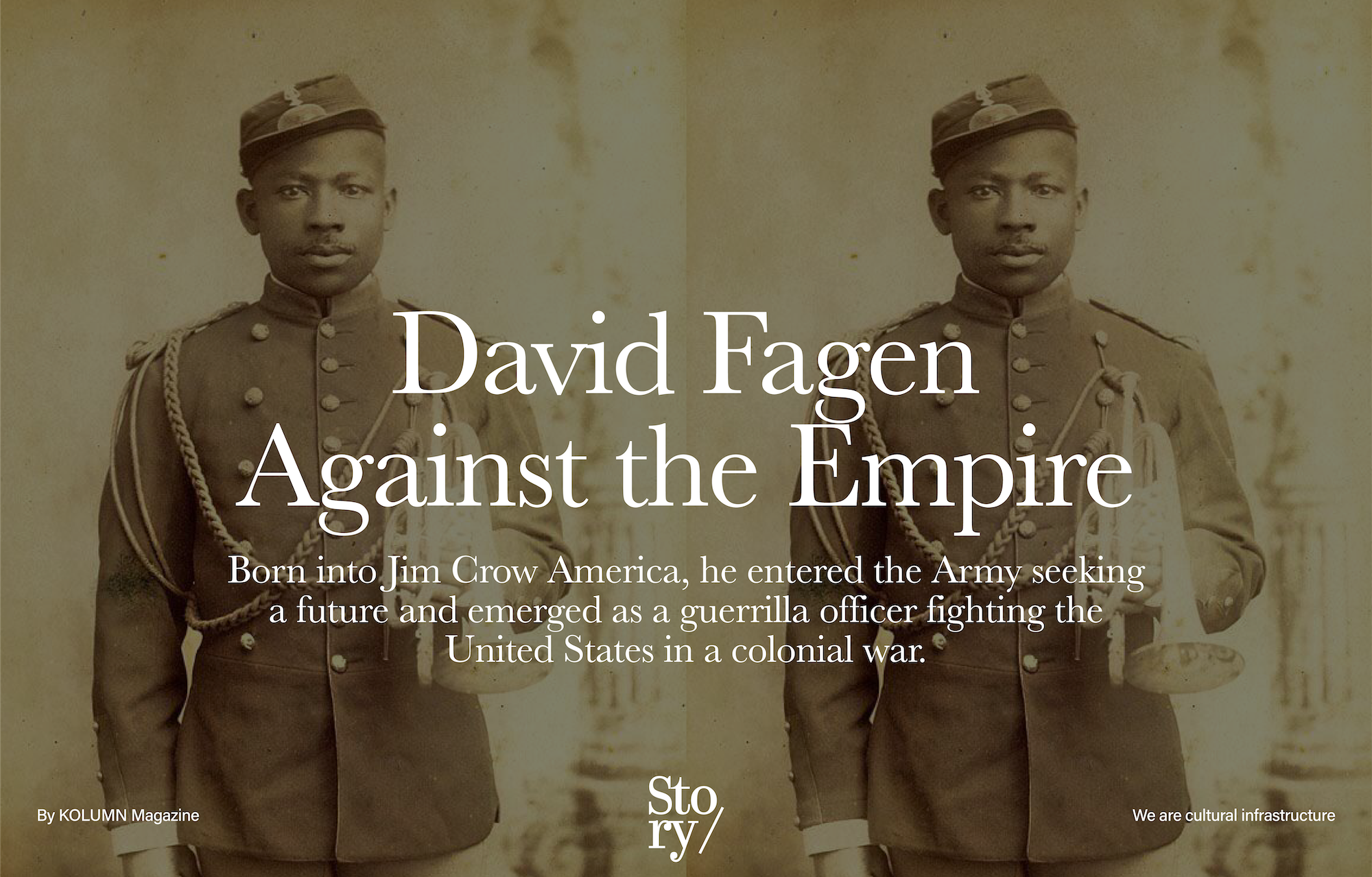
Part soldier, part dissenter, part legend, he remains one of the clearest challenges to the moral mythology of American expansion.
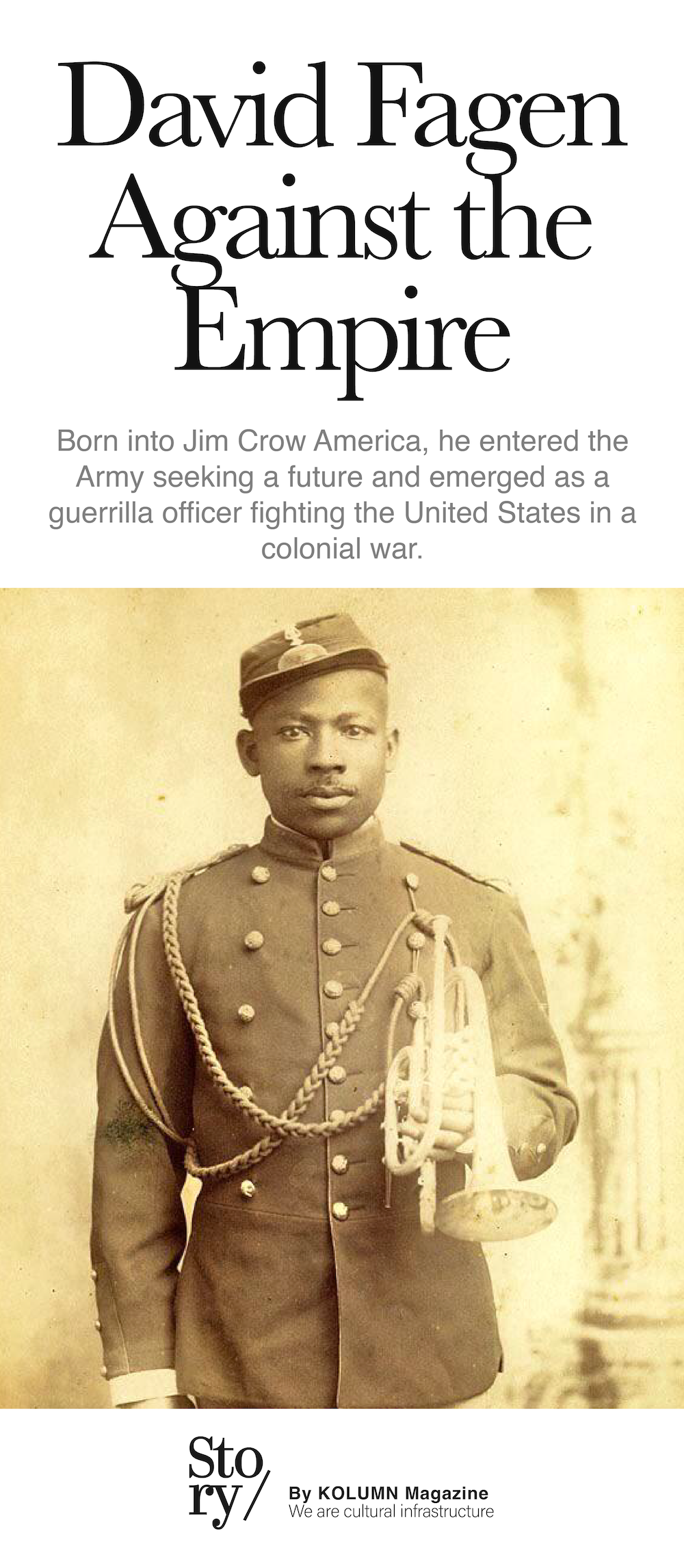
Part soldier, part dissenter, part legend, he remains one of the clearest challenges to the moral mythology of American expansion.
By KOLUMN Magazine
David was too insurgent for patriotic memory, too complicated for easy myth, and too important to remain marginal. Born in the post-Reconstruction South, hardened by Jim Crow, enlisted into one of the United States Army’s segregated Black regiments, and then remade in the Philippines as a guerrilla officer fighting against American troops, Fagen lived a life that reads like an argument with the nation that produced him. His story is not simply dramatic. It is revelatory. It forces a confrontation with the relationship between Black military service and American empire, between citizenship and coercion, between loyalty and moral refusal.
At the dawn of the twentieth century, the United States was discovering itself as an overseas empire. After defeating Spain in 1898, Washington acquired Puerto Rico, Guam, and the Philippines, with Spain ceding the Philippine Islands to the United States under the Treaty of Paris for $20 million. The official language surrounding the takeover was paternal and self-congratulatory. President William McKinley’s administration described American rule as a form of uplift, even “benevolent assimilation.” But Filipinos who had fought Spain for independence did not understand themselves to be entering a tutelary relationship. They understood themselves to be exchanging one empire for another, and they resisted. Fighting broke out in February 1899, touching off what became a brutal colonial war that cost more than 4,200 American lives, roughly 20,000 Filipino combatant lives, and, by some estimates, as many as 200,000 Filipino civilian lives.
Black troops were central to that war. More than 6,000 Black American soldiers served in the Philippine conflict, including members of the 24th and 25th Infantry and the 9th and 10th Cavalry, the units collectively remembered as Buffalo Soldiers. They served within a segregated Army, under white officers, in a nation that still denied Black Americans full political and civic equality. The contradiction was impossible to miss. In the United States, Black communities were contending with disenfranchisement, segregation, racial terror, and lynching. In the Philippines, Black soldiers were being told they were instruments of civilization. Some believed service might advance the cause of Black citizenship at home. Others saw the war for what it was: a campaign of conquest against another people of color. David Fagen would become the most famous embodiment of that second recognition.
Archival photo placement: A period image of Buffalo Soldiers in formation, ideally the 24th U.S. Infantry at drill, Camp Walker, Philippine Islands, c. 1902. A strong reproduction is referenced through Digital Commonwealth and also appears via JSTOR Daily’s use of a Wikimedia Commons image.
The making of David Fagen
The record of Fagen’s early life is incomplete, but the outlines are firm enough to matter. He was born in Tampa, Florida, in 1875, though some later accounts give 1878. Modern accounts and the work of historians summarized in later scholarship place him in Tampa’s Black working-class world, the son of formerly enslaved parents and, for a time, a laborer for Hull’s Phosphate Company before enlistment. Reporting from WUWF, drawing on author Phillip Thomas Tucker’s research, places him in “The Scrub,” a Black section of Tampa shaped by labor extraction, racial hierarchy, and the rough demands of the New South economy. Hoffman described him as a manual laborer performing punishing phosphate work and as a young man already marked by violence and brawling. Even where sources differ on exact biographical details, they agree on the larger setting: Fagen came of age in a racial order that offered Black men little security and even less dignity.
That background matters because it clarifies the stakes of enlistment. For many Black men in the late nineteenth century, the Army represented one of the few institutions that could provide regular pay, meals, clothing, and an official identity. It was not equality. It was structure. Buffalo Soldiers carried the burden of symbolic representation for a country that often preferred them at a distance: useful in war, constrained in peace, and led almost entirely by white officers. The National Museum of African American History and Culture notes that Buffalo Soldiers were both historical actors and enduring symbols, men whose service helped define the military experience of African Americans even as it unfolded under deeply unequal conditions. Their proud record is real. So is the contradiction that they were often tasked with extending the reach of a state that did not fully recognize them.
On June 4, 1898, at age twenty-three Fagen enlisted in the 24th Infantry. WUWF’s reporting places his enlistment during the burst of martial excitement surrounding the Spanish-American War. The regiment belonged to the small cadre of Black regular units whose discipline and combat reputation made them central to American military operations. Yet to enter the Army was not merely to seek a livelihood; it was to submit oneself to a hierarchical institution that mirrored much of the country’s racial order. The Army might clothe a man in uniform, but it did not erase the nation’s caste lines.
The war that clarified the contradiction
The Philippine-American War did not begin as an abstract debate over strategy. It began in the wreckage of a broken expectation. Filipino revolutionaries under Emilio Aguinaldo had fought Spain and anticipated independence. Instead, the Treaty of Paris transferred control of the islands to the United States. The Office of the Historian notes that fighting between U.S. forces and Aguinaldo’s nationalists began on February 4, 1899, just before the Senate ratified the treaty. What followed was a protracted war that shifted from conventional fighting to guerrilla conflict, dragging the United States into a harsh campaign of pacification and counterinsurgency.
For Black troops, the war had an unmistakable racial script. American politicians and officers often described Filipinos in language that echoed the dehumanizing rhetoric aimed at Black Americans at home. JSTOR Daily, summarizing historian Timothy D. Russell’s scholarship, notes that African American soldiers were caught in an “ironic bind” between soldierly duty and sympathy for another population experiencing domination under white power. The article emphasizes how Black soldiers became frustrated by the treatment of Filipinos and by the migration of Jim Crow logic into the islands. That insight is critical. The Philippines was not separate from the racial order of the United States; it was one of the places where that order was projected abroad.
Black public opinion reflected those tensions. The National Park Service preserves the split in Black editorial life at the time. Some newspapers argued that Black men should fight in the Philippines because patriotism demanded it and because national service might strengthen claims to equality. Others insisted that Black Americans should not help crush a people seeking freedom when Black freedom remained so incomplete at home. The debate was neither fringe nor academic. It was a live question in Black political thought: whether participation in empire would purchase belonging, or whether it would simply conscript Black bodies into a project of domination.
Filipino revolutionaries recognized that contradiction immediately and weaponized it. As the National Park Service recounts, insurgents distributed posters and leaflets directed specifically “to the Colored American Soldier,” reminding Black troops of lynching and racial discrimination in the United States and urging them not to serve as the “instrument” of white masters against another “people of color.” These messages promised that Black deserters would be welcomed and given responsibility within the Filipino cause. This was not crude propaganda. It was politically astute. It spoke directly to the unresolved question of whether racial solidarity could cross national lines.
Desertion as political rupture
Most Black soldiers did not desert. That fact matters. The desertion rate among Black regulars was generally low, and the majority of Black servicemen in the Philippines stayed with their units even as they wrestled with the war’s moral burden. But a small number crossed over, and David Fagen became the most famous of them. Estimates vary. The National Park Service says fifteen U.S. soldiers defected during the conflict, six of them Black. Asia Matters for America cites broader figures suggesting roughly thirty Buffalo Soldiers deserted, with up to fifteen joining Filipino nationalists. The precise number remains debated, but the larger meaning does not. Fagen was part of a small, dramatic minority whose actions punctured the Army’s image of cohesion and exposed the instability of racial loyalty within an imperial war.
Fagen deserted on November 17, 1899, according to multiple summaries. Accounts connected to later scholarship report repeated conflicts with a white officer, Lt. James Alfred Moss, and mounting disciplinary penalties. Some sources say he stole a horse and revolvers before leaving. Even where details diverge, the chronology is clear: he left the 24th Infantry in late 1899 just as the Filipino resistance was moving decisively into guerrilla warfare. The timing proved consequential. The Americans had superior firepower and organizational capacity in conventional engagements. The insurgency’s survival depended on mobility, local knowledge, and tactical adaptation. In that environment, a deserter trained by the U.S. Army could become invaluable.
This is the moment when Fagen ceases to be merely a renegade and becomes historically exceptional. Desertion itself is not uncommon in war. What distinguished Fagen was that he did not simply vanish or attempt to return home. He joined the Filipino side, won enough trust to remain within it, and then converted his Army experience into insurgent advantage. Later accounts say he helped train Filipino fighters and rose to the rank of captain. American officials, hostile though they were, repeatedly referred to him as “Captain Fagen,” inadvertently confirming his status.
To American authorities, this was an embarrassment and a threat. A Black American soldier had not only repudiated U.S. command but had chosen the side the United States was trying to reduce to submission. He exposed the limits of discipline and the fragility of imperial mythology. He also contradicted the assumption that Black military service automatically produced identification with the state. In that sense, his act was political even if it began as something more immediate: anger, disgust, moral recognition, self-preservation, or some combination of all four. Historians must be careful not to overstate what cannot be directly documented. Fagen did not leave behind a manifesto. But the context is sufficiently strong to make one point clear: his desertion cannot be understood apart from race, empire, and the coercive contradictions of American service.
Captain Fagen
The most astonishing part of Fagen’s story is what came after. He did not disappear into folklore immediately. He became a military problem. By 1900, American reports described him as a capable guerrilla commander harassing U.S. troops in Luzon. A Spokane Public Library historical essay, summarizing contemporary coverage, notes that a New York Times story from October 29, 1900 described him as a “cunning and highly skilled guerrilla officer” who repeatedly evaded large American forces. That same essay recounts at least eight known engagements involving Fagen between August 1900 and January 1901, including raids and successful escapes that frustrated U.S. commanders. Even in the language of his enemies, one hears reluctant professional respect.
Some reports cast him almost as a phantom of the colonial frontier: appearing suddenly, striking a detachment, withdrawing into difficult terrain, taunting pursuers, and refusing capture. Frank Schubert’s research on the search for Fagen repeats a story that he shouted at U.S. troops during combat, mocking them as he maneuvered in close. Whether every anecdote attached to his name can be confirmed is less important than the accumulated pattern. American forces came to see him as both a tactical irritant and a symbolic affront. His success mattered because it suggested that military training and martial legitimacy were not the exclusive property of empire.
The Army eventually put a $600 bounty on his head. The National Park Service confirms both the bounty and his notoriety, noting that he became famous as an “Insurecto Captain.” Bounties tell us something about military priorities, but they also reveal psychic anxieties. The United States was not placing a bounty merely on a deserter. It was placing a bounty on a Black man who had refused his assigned place and was now using American military knowledge to contest American power. Capturing him promised a symbolic restoration of hierarchy.
Archival photo placement: A period map of Luzon with Pampanga and surrounding guerrilla zones marked, paired with any archival image of U.S. detachments in the Philippine countryside. This allows readers to visualize the space in which Fagen became difficult to catch. The suggested map can be created from a public-domain historical base map while maintaining period typography.
The Black press and the argument over loyalty
One reason Fagen still matters is that his story was never interpreted in just one way. Within Black America, he became a subject of argument. That debate is worth dwelling on because it illuminates the complexity of Black political thought in the era. For some Black observers, Fagen’s defection was indefensible. Military service, however unequal, remained a path to citizenship claims and public legitimacy. To desert in wartime and take up arms against the United States invited not only punishment but a crisis of patriotic respectability.
Yet the critiques were rarely simple. The National Park Service quotes the Indianapolis Freeman’s 1901 judgment: “Fagen was a traitor and died a traitor’s death,” but also “a man no doubt prompted by honest motives” to help a weakened side to which he felt allied by “bonds that bind.” This sentence is astonishing for its layered moral vision. It does not absolve him, but neither does it deny the logic of his action. It recognizes affinity across oppression while still struggling with the grammar of national loyalty. That ambivalence is precisely what makes the episode so revealing. It shows that Black America did not speak with one voice on empire, nor did it treat loyalty as an uncomplicated virtue.
JSTOR Daily’s account of Sergeant Major John W. Calloway adds another dimension to this world of Black unease. Calloway did not defect. He merely wrote sympathetically about Filipinos and expressed remorse about America’s role in crushing their hopes. For that, he was stripped of rank and dishonorably discharged, without the court-martial he requested. His case helps clarify the environment in which Fagen acted. The Army’s concern was not only desertion. It was Black empathy. It was the possibility that Black troops might see too clearly what the war represented.
That anxiety reached upward into colonial administration. JSTOR Daily notes that William Howard Taft, then governor of the Philippines, believed Black troops got along too well with Filipinos and wanted Black regiments sent home quickly. The meaning is hard to miss. The problem, from the perspective of rule, was not merely discipline. It was proximity. The empire preferred that the people enforcing domination not identify with those being dominated. Fagen’s life is what happened when that separation failed.
The uncertainty of his end
The official U.S. account of Fagen’s death is grisly and, even now, unresolved. In late 1901, American authorities announced that the bounty had been collected after a Filipino hunter turned in the decomposed head of a man said to be Fagen. The National Park Service repeats that version, which has long circulated in military and popular retellings. But scholars have never treated the matter as entirely settled. Frank Schubert’s work on Fagen’s Florida roots and later studies of the legend emphasize uncertainty about whether the head was truly his. Some accounts even preserve the possibility that he survived and disappeared into the Philippine interior.
That uncertainty is not an incidental curiosity. It is part of why his legend endured. History is full of rebels whose deaths are narratively useful to the states that hunt them. A severed head promises closure. It allows an authority to say the problem has been solved and the order restored. But with Fagen, closure remains elusive. Whether he died in 1901 or lived beyond the official story, the archival haze has permitted him to survive as a figure of unresolved dissent, not fully claimed by the American record and not fully extinguished by it.
This uncertainty should not be romanticized into certainty of survival. The most responsible historical position is simpler: his final fate remains disputed. But even that dispute tells us something. Fagen was not merely killed or forgotten. He became difficult to pin down in death just as he had been difficult to capture in life. That quality has made him especially resonant in both Black radical memory and Filipino anti-colonial remembrance.
Archival photo placement: A facsimile of a period American newspaper account announcing Fagen’s alleged death, paired with a short editorial note explaining that later historians have questioned whether the remains were conclusively identified.
Why David Fagen belongs in the center of the story
Fagen’s significance extends well beyond biography. He matters because he alters the architecture of the period. Standard narratives of Black military history often emphasize service, sacrifice, competence, and the slow, uneven march toward recognition. Those narratives are important and true. But if they stand alone, they flatten the range of Black political response to the American state. Fagen restores the missing category of refusal. He reminds us that some Black Americans saw military service not only as a path to citizenship but also as a site of moral crisis.
He also broadens the story of Black internationalism. Long before the twentieth century’s better-known movements of anti-colonial solidarity, Pan-African congresses, Bandung politics, or Black-Asian coalition building, Fagen embodied a startlingly direct form of transnational recognition. Filipino insurgents appealed to Black soldiers as fellow sufferers under white supremacy. Most did not answer the call. Fagen did. That choice does not make him a modern theorist. It makes him something rarer: a man whose politics were enacted under fire.
His life also reframes the Philippine-American War itself. In U.S. memory, that war is often minimized, if it is remembered at all. Yet it was one of the formative conflicts in the making of American global power. It tested doctrines of overseas occupation, produced justifications for empire, and revealed how readily democratic rhetoric could coexist with coercive rule. Through Fagen, the war becomes impossible to describe as a simple overseas campaign. It becomes a site where domestic racism and foreign conquest fused into one political project.
There is another reason Fagen remains urgent. His story poses a question that recurs across American history: what does a marginalized person owe a nation that withholds full belonging, especially when that nation demands participation in the subordination of others. That question has haunted Black military service from the Civil War through World War I, World War II, Vietnam, and beyond. Fagen did not resolve it for everyone. He made one choice. But his choice revealed that obedience is not the only possible answer to exclusion.
The problem of memory
Why, then, is David Fagen not more widely known? Part of the answer lies in how nations curate usable heroes. Fagen does not fit the preferred American script of Black military uplift. He cannot be presented as proof that patriotic service naturally leads to democratic inclusion, because he reached the opposite conclusion. Nor does he fit neatly into a liberal narrative of gradual improvement. He was too disruptive, too international, too willing to put action behind critique. He had to be pushed to the margins if the larger story was to remain flattering.
Yet he was not entirely erased. Scholarly work, museum interpretation, and renewed public interest have brought him back into view. NPS materials, BlackPast, JSTOR Daily, and recent historical writing have all contributed to that recovery. The effect is not simply commemorative. It is analytic. Fagen helps scholars and readers see that Black resistance to white supremacy did not always take the form of petitions, editorials, or domestic organizing, though it certainly included all of those. Sometimes it took the form of mutiny, escape, alliance, and armed refusal.
KOLUMN’s interest in a figure like Fagen is therefore not antiquarian. It is structural. His life illuminates the architecture of race and power at a moment when the United States was teaching itself to be an empire. He reveals that Black service and Black dissent were not opposites but intertwined possibilities, born of the same encounter with a nation that offered uniform without equality. He also reveals that solidarity across borders is not a contemporary invention. It has a deeper, riskier history than conventional memory allows.
The soldier who would not stay in place
In the end, David Fagen remains difficult by design. He resists reduction to patriot, traitor, hero, victim, or adventurer. He was a Black man from Tampa who entered the U.S. Army in search of a future, encountered the realities of American race and empire in the Philippines, and decided that the side he was on was the wrong one. He crossed over. He fought. He embarrassed an imperial power. He vanished into uncertainty. That is already enough to make him memorable. But what makes him indispensable is the way his life breaks the moral symmetry of official history.
Fagen’s story insists that freedom cannot be measured solely by flags, and that service cannot be understood apart from the purposes it serves. It reminds us that Black history is not only a history of endurance or contribution. It is also a history of refusal: refusal to accept the nation’s definitions of duty, refusal to confuse empire with liberty, refusal to believe that obedience is the highest form of belonging. The United States sent David Fagen abroad as a soldier. The Philippines made visible a different possibility. He became, instead, one of the earliest and most unsettling witnesses against American empire.
More great stories
The Printer Behind the Movement
March 7, 2026
No Comments
Frederick J. Brown’s American Dream Was Loud
March 7, 2026
No Comments