





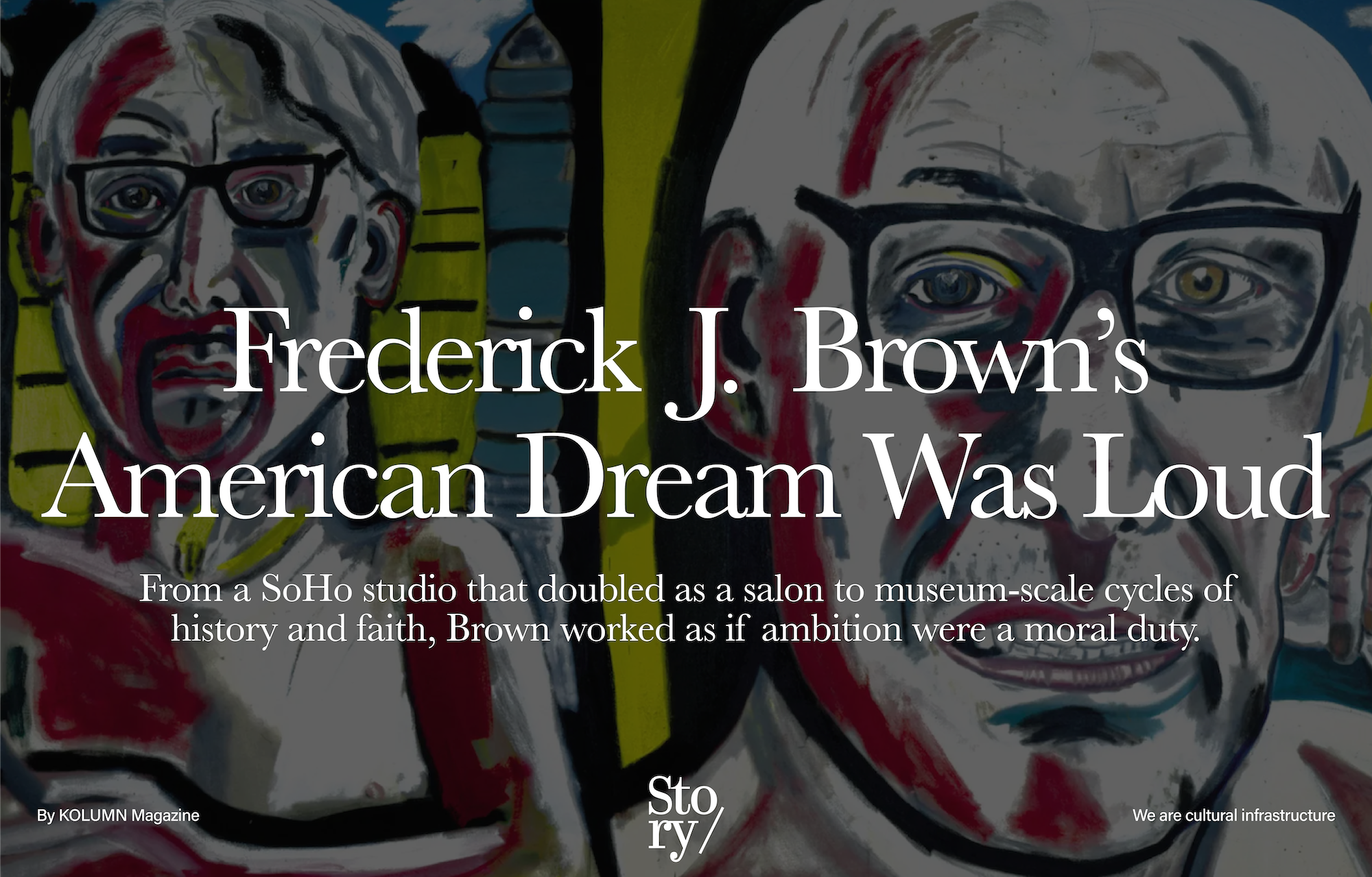
Brown’s work moved between images that treat the canvas as a field of emotion and images that treat it as a stage for narrative.
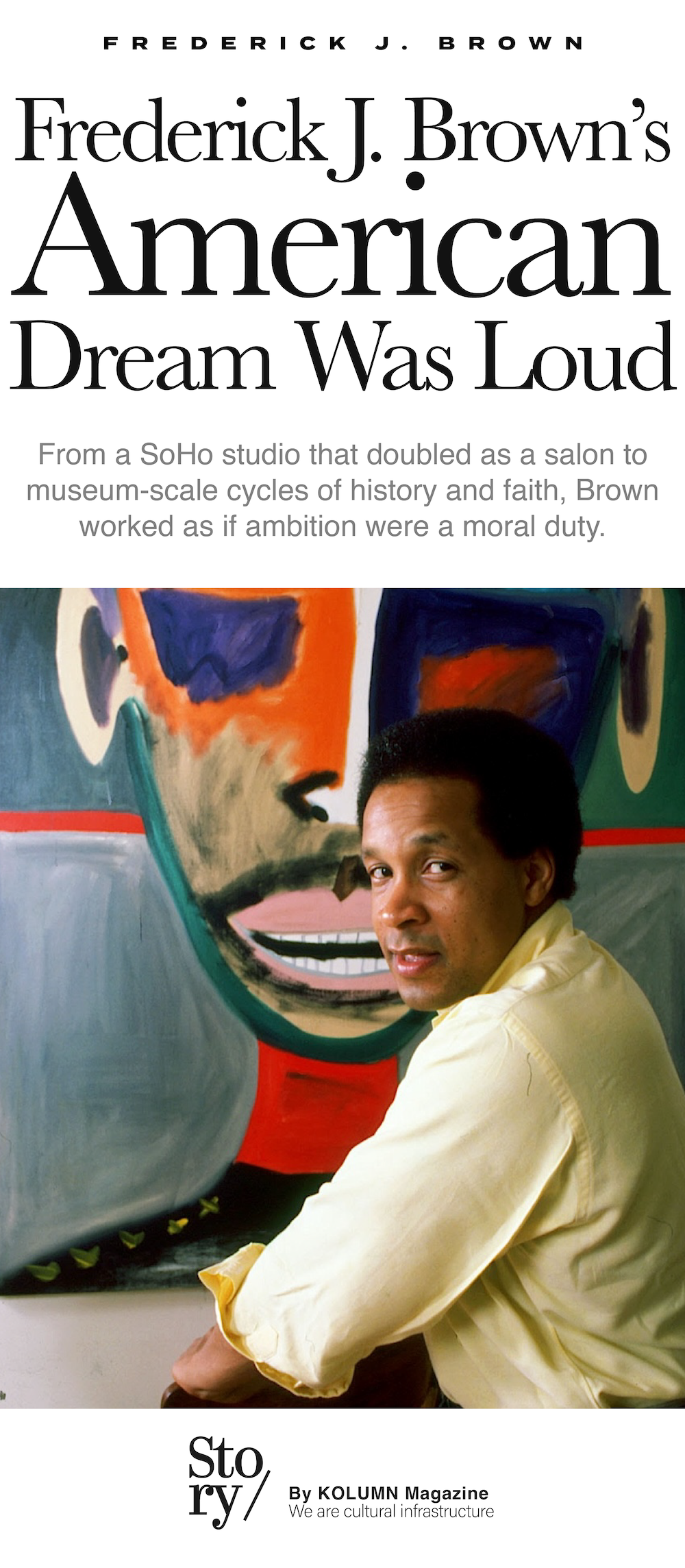
Brown’s work moved between images that treat the canvas as a field of emotion and images that treat it as a stage for narrative.
By KOLUMN Magazine
Frederick J. Brown’s career can be read as a long argument with American taste—an insistence that the country’s most sophisticated art is not only the art that flatters institutions, but also the art that remembers who built the soundtrack, who carried the stories, and who kept making beauty under pressure. Born in 1945 and active across the final decades of the twentieth century and into the early twenty-first, Brown was a painter of range and appetite: an expressionist who could fling color with bravura, a portraitist who could distill a life into a face, and a maker of large-scale projects who treated ambition as a kind of responsibility.
If his name has sometimes traveled more easily within museum circles and among collectors than in the larger public imagination, it is not because the work is quiet. Brown’s paintings are frequently loud—chromatically, emotionally, historically. They contend with music, religion, urban life, and the shape of “America” as both promise and trap. A single glance at his output makes clear that he was not interested in modesty. He was interested in presence.
That appetite for presence is why Brown’s art so often takes the form of series and cycles: projects that accumulate meaning by repetition, variation, and scale. It is why he returned, again and again, to the faces of jazz and blues musicians, creating an extensive body of portraits that reads like an alternative cultural archive—one built not from text and recordings, but from paint. Museums and cultural institutions now summarize his achievement in that register: as an artist who grew up with the sounds of the South Side of Chicago and carried those sounds into a lifelong practice, using portraiture to celebrate figures who shaped contemporary culture.
To talk about Frederick J. Brown seriously is to talk about translation: the translation of sound into color, history into image, spiritual inheritance into contemporary form. It is also to talk about the social life of art—about studios as meeting places and museums as sites of negotiation. In Brown’s story, the studio is not just where paintings are made; it is where a community gathers. One exhibition text describing his SoHo years notes that his Manhattan studio at 120 Wooster Street became a hub for musicians, writers, and visual and performance artists in the 1970s and 1980s. The work, in other words, did not come out of isolation. It came out of conversation—sometimes literal conversation, sometimes the more mysterious conversation between a painter and the music he loves.
From the South Side to a wider map
Institutional biographies generally agree on the basic arc: Brown was born in Greensboro, Georgia, raised in Chicago, and became a New York–based artist whose work moved between abstraction and figuration. He studied at Southern Illinois University Carbondale, and later built a life that crossed regions and scenes, eventually splitting time between New York and Arizona. The details that matter most, though, are not only geographic. They are aesthetic.
Brown emerged after the heroic era of Abstract Expressionism had already been mythologized and commodified, and after Minimalism had sharpened the terms of seriousness into a language of restraint. Yet he refused the idea that seriousness requires coldness. He worked with a “distinctively vivid expressionist approach,” as one gallery biography puts it, applying that approach to both figurative and abstract work over four decades, unafraid of scale, and drawn to big themes.
What this meant in practice was a painter who could move—sometimes within the same period—between images that treat the canvas as a field of emotion and images that treat it as a stage for narrative. It meant a painter who could make portraits that function like icons without turning them into sentiment. And it meant a painter who approached the canon not as a list of authorities but as a material to be remixed.
There is a temptation, when describing artists who combine abstraction and figuration, to frame that movement as stylistic indecision, as if the artist has not chosen a side. Brown’s career argues for a different reading: that the movement itself is the point. The oscillation between abstraction and figuration becomes a way of holding contradictory truths—private feeling and public history, the singular face and the collective story, the spiritual and the political—within the same body of work.
The portraits: making a visual archive of sound
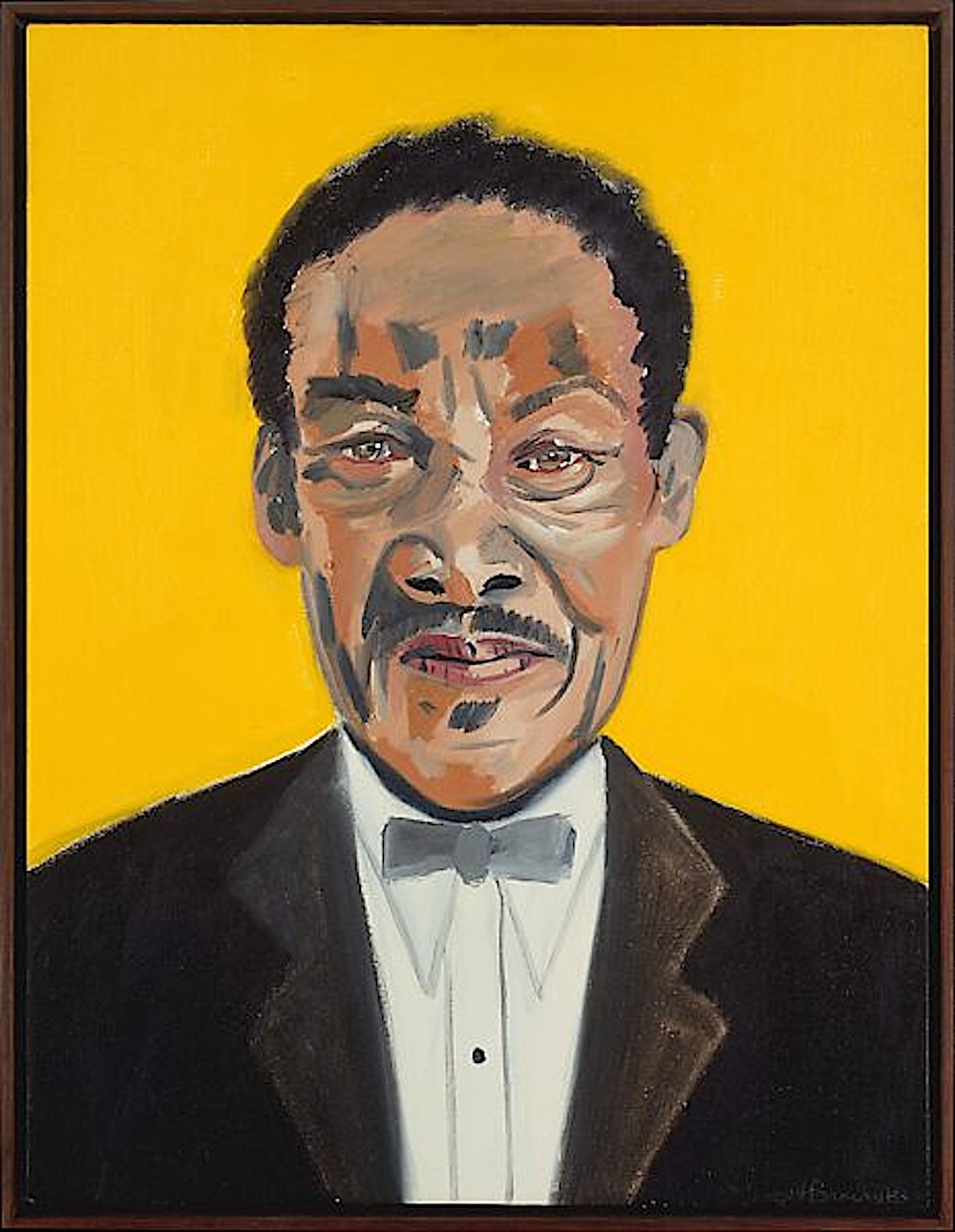
For many people, the first encounter with Frederick J. Brown comes through the jazz and blues portraits. Even in compressed institutional summaries, the emphasis appears quickly: he is “noted for his extensive portrait series of jazz and blues musicians.” That series is more than a motif; it is a method of cultural documentation. In a country that has repeatedly consumed Black music while discounting Black authorship, Brown’s portraits operate as insistence. They say: these are the makers. These are the architects. Look at them.
An obituary account circulated in the art press after Brown’s death described him as a painter who created portraits of hundreds of jazz and blues artists, naming a roll call of subjects—Ornette Coleman, John Coltrane, Dexter Gordon, Thelonious Monk, Jelly Roll Morton, Bessie Smith—figures whose music helped form the vocabulary of modern life. The point is not merely celebrity. Brown painted musicians as if portraiture could be a form of listening.
Listening, in Brown’s case, did not translate into photorealism. His portraits are often expressionist: the face simplified or amplified, the color heightened, the mood carried by the brushwork as much as by resemblance. He does not so much reproduce a likeness as produce an atmosphere. You can see why this approach suited the subject matter. Jazz is not only melody; it is timbre, rhythm, improvisation, the grain of a voice, the weight of silence between notes. Brown’s portraits attempt to give that grain a visual equivalent.
The series also places Brown within a lineage of Black artists who understood portraiture as both record and revision. To paint the faces of musicians is to paint the faces of labor: people who made their living shaping sound, often under exploitative conditions, often in venues where their genius was treated as entertainment rather than as art. Brown’s paintings refuse that demotion. They make the musician’s face a site of contemplation.
This is one reason museums have treated his portraiture not as genre work but as a significant project. A Kemper Museum exhibition description, reflecting on a multi-decade span, positions Brown as a force reclaiming the importance of figuration after periods dominated by minimalism and abstraction. The argument embedded there is larger than Brown: it is about what kinds of images get to count as “serious,” and who gets to define the criteria.
The studio as a salon: 120 Wooster Street
If the portraits make Brown legible as an archivist of music, his SoHo studio years make him legible as a social artist—someone whose practice depended on proximity to other makers. The Sugar Hill Children’s Museum of Art & Storytelling, in framing a major exhibition of Brown’s work, describes his SoHo studio at 120 Wooster Street as a “central gathering place for musicians, writers, and visual and performance artists.”
That detail matters because it clarifies how Brown’s portraits were not simply acts of admiration from afar. They were part of a world in which musicians and artists shared space, time, and conversation. The studio becomes a node in a network: a place where art forms cross-pollinate. Brown’s work is often discussed as a translation of music into paint; the studio context suggests that this translation was not metaphorical only. It was lived.
This also helps explain why Brown’s art does not feel like the product of a single narrow art-historical allegiance. He was aware of the avant-garde, and he worked in New York during decades when the city’s art world was both intense and unforgiving. Yet his themes—spirituality, Americana, urban life, historical narrative—indicate a refusal to let the scene’s fashions determine his subject matter. The work is worldly rather than sectarian.
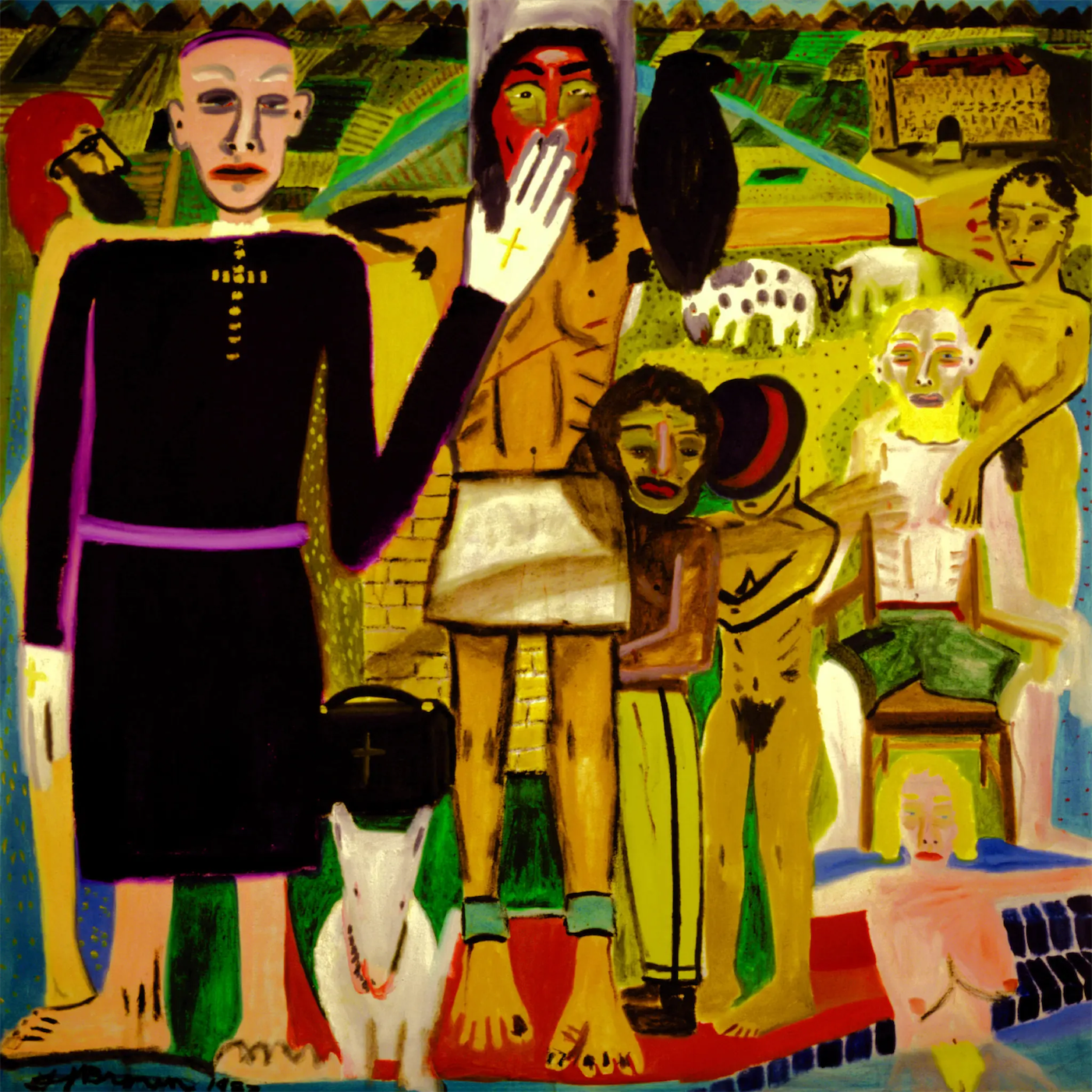
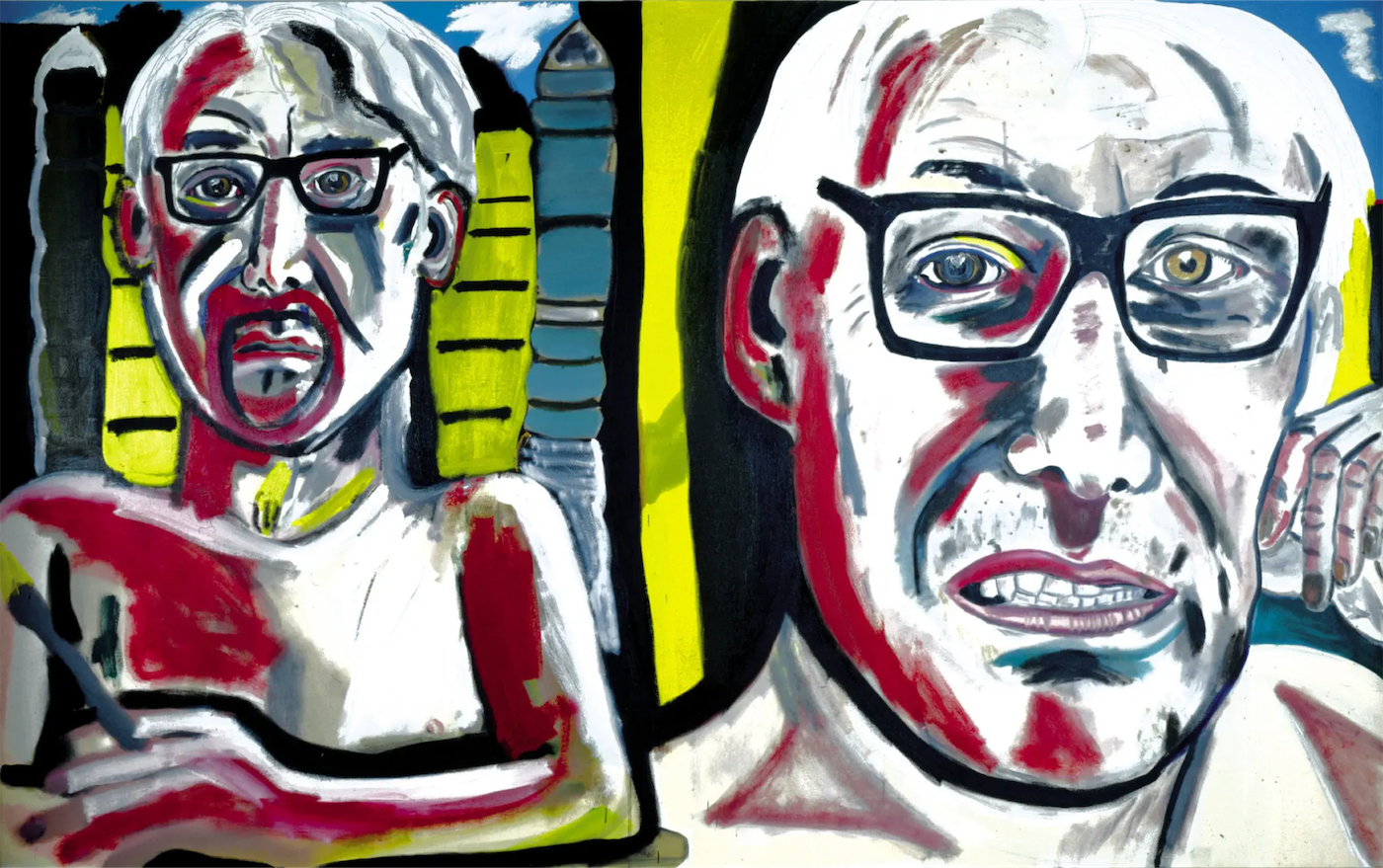
Big works for big ideas: faith, history, and “the American Dream”
Brown’s public reputation tends to orbit the portraits, but his significance expands when you consider the monumental projects: works that operate less like individual paintings than like environments, fresco cycles, or visual essays. Several sources—museum texts and the artist’s own foundation site—point to a set of major projects that function as anchors in his career: his version of The Last Supper (1983), The Assumption of Mary (completed in the early 1990s and installed at Xavier University of Louisiana), and The History of Art, a sprawling, site-responsive installation at the Kemper Museum of Contemporary Art.
Each of these projects reveals a different dimension of Brown’s ambition.
The Assumption of Mary is frequently described in terms that border on the unbelievable if you have not seen it: a three-story-high painting on a single canvas, permanently installed in Xavier University’s library in New Orleans. The sheer scale signals a desire to reclaim the public grandeur historically reserved for religious art in Europe and for civic murals in America, and to place that grandeur in a Black Catholic educational context. Even the brief descriptions emphasize that the work is not only devotional but culturally specific—linking faith to Black musical contribution and American life.
The History of Art might sound, from its title, like a canonical survey. Brown makes it something else: a personal interpretation of the progression of art “through human history,” rendered as 110 shaped, interlocking paintings installed across the walls of Café Sebastienne at the Kemper Museum. It is a project that turns a museum restaurant into a permanent, immersive encounter with painting—an everyday space transformed into a kind of living gallery.
To dine in that room, as local coverage has noted, is to sit inside Brown’s interpretation of the canon, with the paintings covering irregular walls and forming an environment rather than a single image. There is something quietly radical about that placement: not in the sense of shock, but in the sense of refusing the hierarchy that places “serious art” behind velvet ropes. Brown’s project is serious art where people eat, talk, celebrate. It is canon-as-background and canon-as-companion.
These monumental works also show Brown’s willingness to handle themes—religion, history, aspiration—that many contemporary artists avoided for fear of seeming didactic. Brown embraced the risk. In doing so, he joined a lineage of artists for whom big themes are not embarrassing but necessary.
Beijing, 1988: American art in a foreign political theater
One of the most striking facts in Brown’s biography is also one of the least absorbed into the broader public narrative: in 1988 he had a solo retrospective at the Museum of the Chinese Revolution (now the National Museum of China) in Tiananmen Square, Beijing—an unusual achievement for an American artist, and one loaded with geopolitical implication.
The artist’s foundation site includes documentation of the exhibition, including images of crowds queueing to see it. The Wikipedia summary frames it as the “first solo exhibition by a Western artist” at that museum, a claim repeated in several biographical accounts.
We should be careful with superlatives—“first” claims are notoriously hard to verify without primary institutional records—but the underlying point stands: Brown’s exhibition took place within one of the most symbolically charged civic spaces in the world, at a moment when cultural exchange carried political weight. The late 1980s were a period of shifting relations, and exhibitions were never just exhibitions; they were signals.
A secondhand citation list on an artist-focused site points to a contemporaneous New York Times report about mixed reactions in Beijing, suggesting that Brown’s presence there was not merely ceremonial but contested—art seen through the lens of ideology and public mood.) Because direct access to New York Times pages is blocked in this environment, I cannot quote or independently verify the full text of that report here. What can be said responsibly is that Brown’s 1988 Beijing retrospective is consistently treated by multiple sources as a major marker of his international visibility, and that the museum context alone would have ensured the show was interpreted as more than personal triumph.
Institutions and collections: where the work lives now
One measure of an artist’s long-term cultural placement is where the work ends up—not only in private collections, but in institutions that function as custodians of national memory. Brown’s work is held by the Smithsonian American Art Museum, which lists him in its artist database and notes his Chicago upbringing and New York activity. The Metropolitan Museum of Art’s collection includes at least one work by Brown (The Ascension appears in the Met’s online catalogue).
The Kemper Museum’s holdings are especially significant because they include The History of Art as a permanent installation—an unusual level of institutional commitment to a single artist’s environment. The museum’s collection page specifies the scale and structure of the work: 110 shaped, interlocking paintings, oil and acrylic, dimensions variable, installed as an integrated whole.
And the Sugar Hill Children’s Museum exhibition, mounted decades into Brown’s career and after his death, frames him as a “pioneering expressionist,” emphasizing the diversity of his approaches and the thematic reach of his work—from imagined landscapes to aspiration to the idea of “the American Dream.”
Put together, these institutional touchpoints tell a coherent story: Brown is not a marginal figure who happens to have a few advocates. He is an artist whose work has been absorbed into multiple narratives—American art, Black cultural history, museum practice, and the ongoing argument about figuration’s place in contemporary painting.
The question of style: expressionism as a cultural technology
“Expressionism” can become a lazy label, used to mean nothing more than bright color and loose brushwork. In Brown’s case, expressionism functions as a technology: a way of encoding intensity without flattening complexity. His color is not decorative. It is structural. It carries meaning the way harmony carries meaning in music.
That musical analogy is not imposed from outside; it is built into the way Brown is remembered. The obituary framing reproduced in secondary sources describes him explicitly as an artist who explored the relationship between music and painting. The Smithsonian biography emphasizes portraiture as celebration of cultural contributors. Sugar Hill’s exhibition text ties his early exposure to blues and jazz to his later themes of urban fabric, spirituality, and Americana.
If you take those framings seriously, then Brown’s stylistic choices become legible as ethical choices. To paint musicians with expressive distortion is to refuse the idea that accuracy equals truth. It is to prioritize feeling, rhythm, and psychic presence—the things music transmits better than photography ever could. Brown’s portraits do not pin their subjects down. They let them vibrate.
Legacy after death: the afterlife of a body of work
Frederick J. Brown died in 2012 in Scottsdale, Arizona, at the age of 67. Secondary accounts summarizing the New York Times obituary report that the cause was cancer and that his wife, Megan, confirmed it. Again, because direct New York Times access is blocked here, I am relying on reputable secondary reproductions of that obituary’s core factual claims rather than quoting the original article.
In the years since his death, Brown’s legacy has been curated through exhibitions and institutional stewardship. The Sugar Hill exhibition, mounted from 2019 to 2020, explicitly positions his career as spanning nearly 50 years and frames his work through lenses of landscape, aspiration, and “the American Dream.” The foundation site continues to document exhibitions and projects, functioning as a resource that consolidates his biography and major works.
Meanwhile, the Kemper Museum’s ongoing presentation of The History of Art ensures that Brown’s work remains part of daily public experience, not only special-occasion museum going. Local writing about Café Sebastienne repeatedly returns to the fact that the paintings cover the space, creating immersion rather than mere display.
This matters because artists like Brown—artists who refused narrow categories—can be at risk of being remembered only for their most easily marketable component. The portraits are seductive and accessible; they can circulate as individual images. The monumental installations and religious works require travel, context, and sustained attention. Yet those works may be where Brown’s ambition becomes most historically significant. They show an artist not merely responding to culture but attempting to build cultural infrastructure: places where art, history, faith, and community can coexist.
Why Frederick J. Brown matters now
So what is Brown’s significance, in the larger story of American art?
One answer is that he offers a model of the artist as cultural historian. In The History of Art, he takes the canon—often treated as a closed room guarded by institutions—and remakes it as an environment filtered through a Black American painter’s sensibility, installed not in a sanctified gallery but in a space where the public eats and talks. He turns “art history” from a textbook into a lived surround.
Another answer is that his portraiture constructs an alternative archive of modern music, insisting that jazz and blues are not peripheral pleasures but central intellectual achievements. The portraits function like a museum of faces—one that honors not only fame but contribution.
A third answer is that Brown’s practice disrupts the false choice between abstraction and figuration, between formal experimentation and social content. He demonstrates that you can be painterly without being evasive, political without being programmatic, spiritual without being sentimental. His expressionism carries history; his narrative carries color.
And finally, Brown matters because he believed in large-scale public ambition at a time when irony often passed for sophistication. To paint a three-story canvas of Mary for a university library is to wager that faith and Black cultural life deserve monumental form. (Sugar Hill Museum) To mount a major show in Tiananmen Square is to step into the theater of politics whether you want to or not. (Frederick J. Brown) To make hundreds of portraits of musicians is to insist that cultural genius is not an abstraction; it has names, bodies, faces.
Brown’s career, taken as a whole, reads like a refusal to let America forget what it has made—and who has made it. In that sense, the work is not only art. It is civic memory, painted.
More great stories
Frankie Muse Freeman Never Waited for Permission
March 7, 2026
No Comments
When the Bridge Became a Battlefield
March 7, 2026
No Comments