





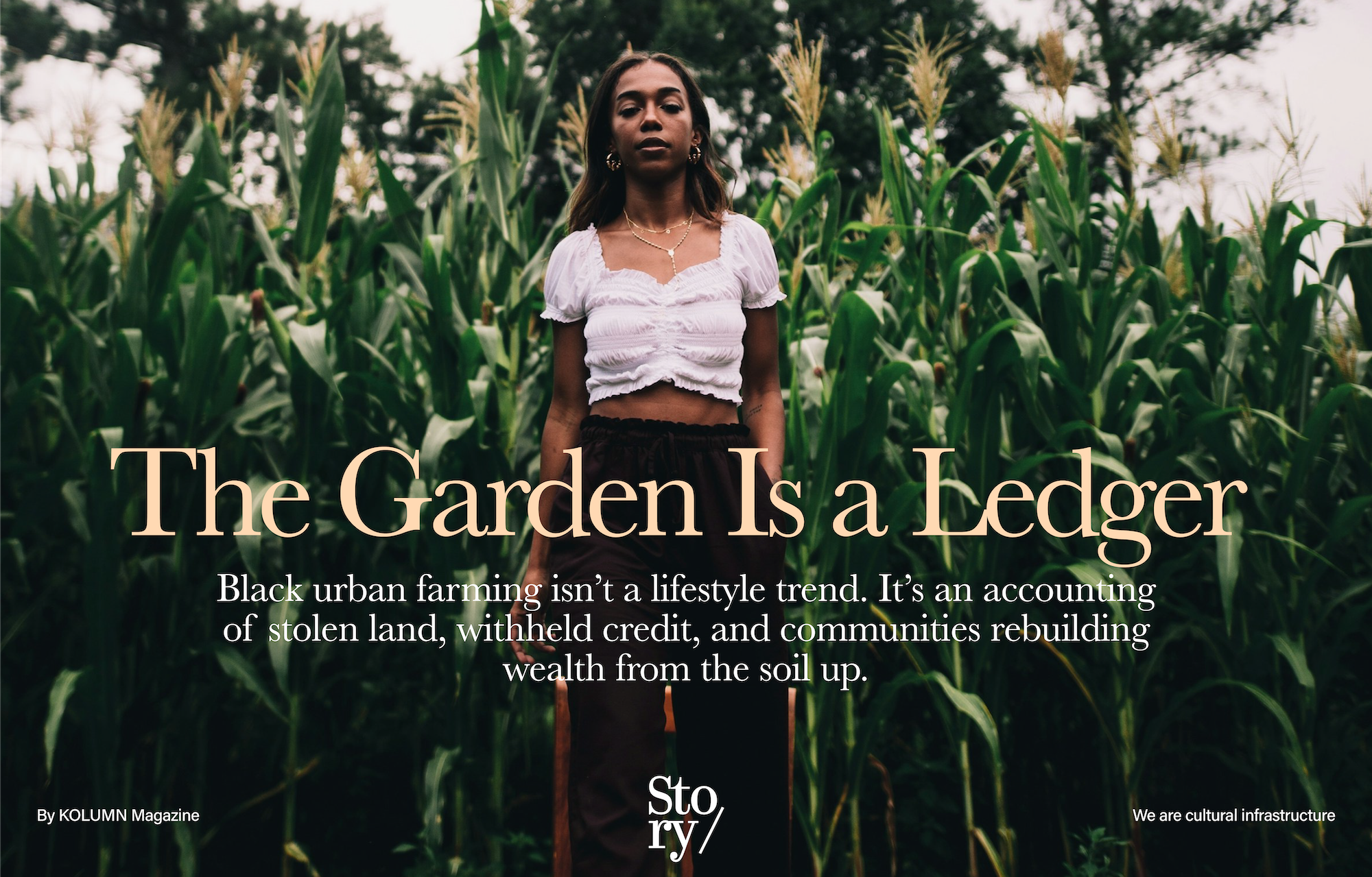
Black urban farming is not just a set of local projects—it is an organized field with shared language, strategy, and political demands.
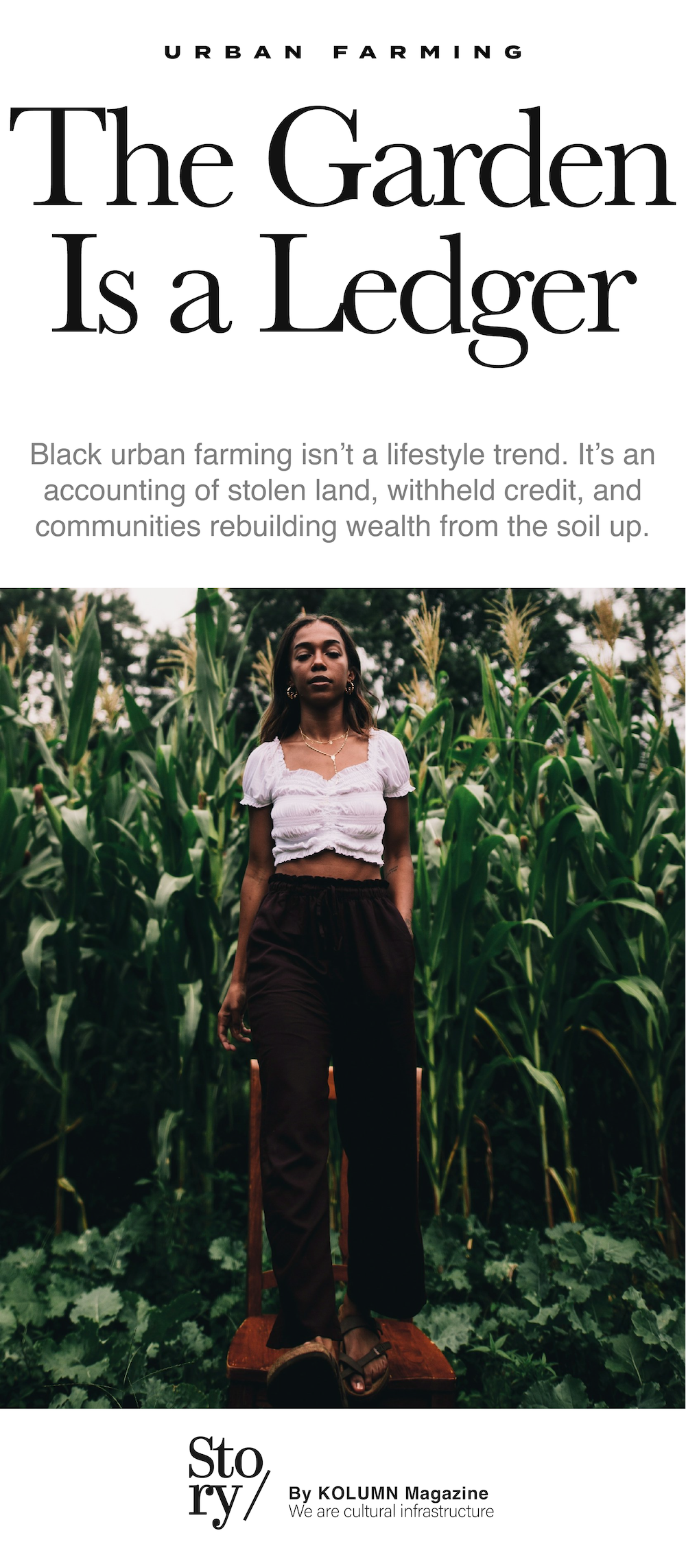
Black urban farming is not just a set of local projects—it is an organized field with shared language, strategy, and political demands.
By KOLUMN Magazine
In American cities, you can still find the old logic of abandonment written in the landscape. There are blocks where the streetlights work but the supermarkets don’t. Where liquor stores glow at the corners and the nearest produce looks like a rumor. Where vacant land, instead of being a civic wound, becomes a kind of invitation: a place where anything can happen because nothing is being protected.

Black urban farming begins in that gap—between what a neighborhood needs and what the market is willing to supply. But the practice is not new, and it is not merely about food. It is an inheritance of rural skill carried into the city through forced migration and economic necessity; a political response to segregation, disinvestment, and unequal health outcomes; and, increasingly, a contest over land tenure in neighborhoods that become “valuable” only after residents have made them livable.
To understand the significance of Black American urban farmers, you have to hold two stories at once. One is intimate and practical: grandparents teaching children to pinch tomato suckers and read weather, the quiet pride of a corner-lot garden that turns into dinner. The other is structural and national: the long, documented history of Black land loss and exclusion from agricultural credit and support, and the way those forces echo inside cities as food access, public health, and zoning policy. The garden is never just a garden; it is a civic argument, made in compost and labor.
From land theft to city lots: why “urban” is part of the story
Black agricultural knowledge in the United States is braided through coercion. Enslaved people cultivated rice, cotton, indigo, tobacco—commodities that built American wealth—while also tending provision gardens that sometimes made the difference between hunger and survival. After emancipation, many Black families pursued landownership as the clearest path to autonomy. And for a brief period, Black farmers did acquire land in meaningful numbers across the South.
Then came the backlash: violence, discriminatory lending, legal chicanery, forced partition sales, and a federal apparatus that too often treated Black farmers as applicants of last resort. The result was not a natural decline but a systematic dispossession. The Atlantic’s reporting on Black land theft in the Mississippi Delta is blunt about what was taken and how: land was stripped through courts, local power, and policy, collapsing an agrarian foothold that had been central to Black wealth-building.
This history matters for urban farming because the Great Migration—millions of Black Southerners moving into northern and western cities—carried farming skills into places that would soon be shaped by redlining, industrial restructuring, and uneven municipal investment. In other words: many Black urban farmers are not “new” to agriculture. They are the descendants of people pushed off land, or squeezed out of rural opportunity, who remade farming on the margins of the city.
Even today, the legacy of discrimination in agricultural support systems shadows Black farming broadly, rural and urban alike. A 2013 Congressional Research Service report on the Pigford litigation—a class action case over alleged USDA discrimination in farm loans and assistance—documents both the scale of the legal settlement and the underlying patterns that produced it, including findings from a USDA-commissioned study that reported stark disparities in program participation and disaster payments. The details are wonky, but the lived experience is simple: when public institutions decide who is “bankable,” they decide who gets to keep farming.
Urban agriculture often sits outside the formal definitions that shape federal farm policy, which can make it feel, politically, like a loophole—small enough to be ignored, local enough to be romanticized. But for many Black growers, urban farming is part of the same continuity of struggle over land, capital, and legitimacy.
The freedom-farm lineage: agriculture as self-determination
Long before “food justice” became a recognized term in philanthropic and academic circles, Black organizers treated food as a civil rights issue. The Freedom Farm Cooperative associated with Fannie Lou Hamer is a canonical example: created as an economic development project aimed at helping Black families meet basic needs in an era when political organizing could cost you your job, your home, or your safety. Archival accounts and civil rights repositories describe Hamer’s effort to purchase land and use it to support community self-reliance—food, housing, dignity—rather than dependence on hostile local power structures.
That lineage—agriculture as resistance, as mutual aid, as infrastructure—shows up repeatedly in Black urban farming. It also complicates the way the broader public sometimes reads urban agriculture as a lifestyle hobby. For many Black communities, growing food has been a strategy for survival within systems designed to make survival expensive.
The point is not nostalgia. It’s continuity. When a city neighborhood organizes around a farm or garden today, it is often building a modern version of the same promise Hamer pursued: if institutions fail to deliver the basics, people will produce them, collectively.
The rise of contemporary Black urban farming networks
By the late 20th century, community gardens proliferated in many U.S. cities amid fiscal crises, deindustrialization, and waves of vacant property. Black residents were among those who reclaimed lots, planted, and organized—sometimes with municipal support, often without it. Over time, what looked like informal gardening grew into a more explicit movement: Black-led food sovereignty, cooperative economics, and health equity.
One of the clearest signals of that shift is the development of national convenings and networks created specifically for Black growers. Black Urban Growers (BUGs), for example, emerged as a response to the isolation many Black farmers and gardeners felt within predominantly white “local food” spaces, creating a national gathering for education, networking, and advocacy. The organization’s own account frames BUGs as a project to nurture Black agrarian leadership and reimagine Black futures. A recent profile by WhyHunger similarly describes BUGs as a connective institution built to address land loss, underinvestment, burnout, and the loneliness of doing this work without a wider, culturally affirming ecosystem.
The existence of these networks is itself significant. It reveals a truth that often gets missed: Black urban farming is not just a set of local projects—it is an organized field with shared language, strategy, and political demands.
“Food apartheid” and the insistence on accurate language
Karen Washington, a farmer and organizer associated with the Bronx and broader regional farming efforts, has become one of the most influential figures in this landscape, in part because she insisted that the problem be named correctly. Rather than “food deserts,” which can sound like a natural phenomenon, Washington popularized “food apartheid,” a phrase meant to emphasize policy, power, and segregation.
The shift in language matters. “Food desert” suggests absence; “food apartheid” suggests design. It reframes grocery scarcity as the downstream effect of zoning, lending, transportation access, and corporate investment decisions. It also turns the urban farm into something more than a produce source: it becomes a site of civic education, where residents learn not only how to grow but why they had to.
This is why Black urban farmers so often talk like organizers. Their farms are not neutral. They are interventions in systems that distribute health and illness unevenly.
Detroit and the politics of a vacant-lot city
No city is more frequently invoked in modern urban agriculture than Detroit, where population loss and disinvestment left an extraordinary amount of vacant land—and where residents built a dense ecosystem of gardens and farms. But the story Detroit tells is not simply one of opportunity. It is a story of control: who gets to decide what vacant land becomes, and who benefits from the value created when residents turn blight into beauty.
The Detroit Black Community Food Sovereignty Network (DBCFSN) is emblematic. Its D-Town Farm operates on several acres within the city and describes its work as part of a broader project: food security, food justice, and food sovereignty rooted in principles of self-determination. The farm is not merely an agricultural site; it is a cultural statement and a governance claim. In cities where development often arrives as something done to a community, Black-led farms argue for a different model: development as something done by a community, for itself.
Detroit also illustrates a central paradox of urban farming: the better you make a place, the more you may invite outside interest that threatens the very residents who did the making. Land in many cities becomes “valuable” only after longtime residents have invested sweat equity into the neighborhood. For Black urban farms, the question becomes brutally practical: can you hold onto the land long enough for the farm’s benefits to compound?
Land security: the fight beneath the tomatoes
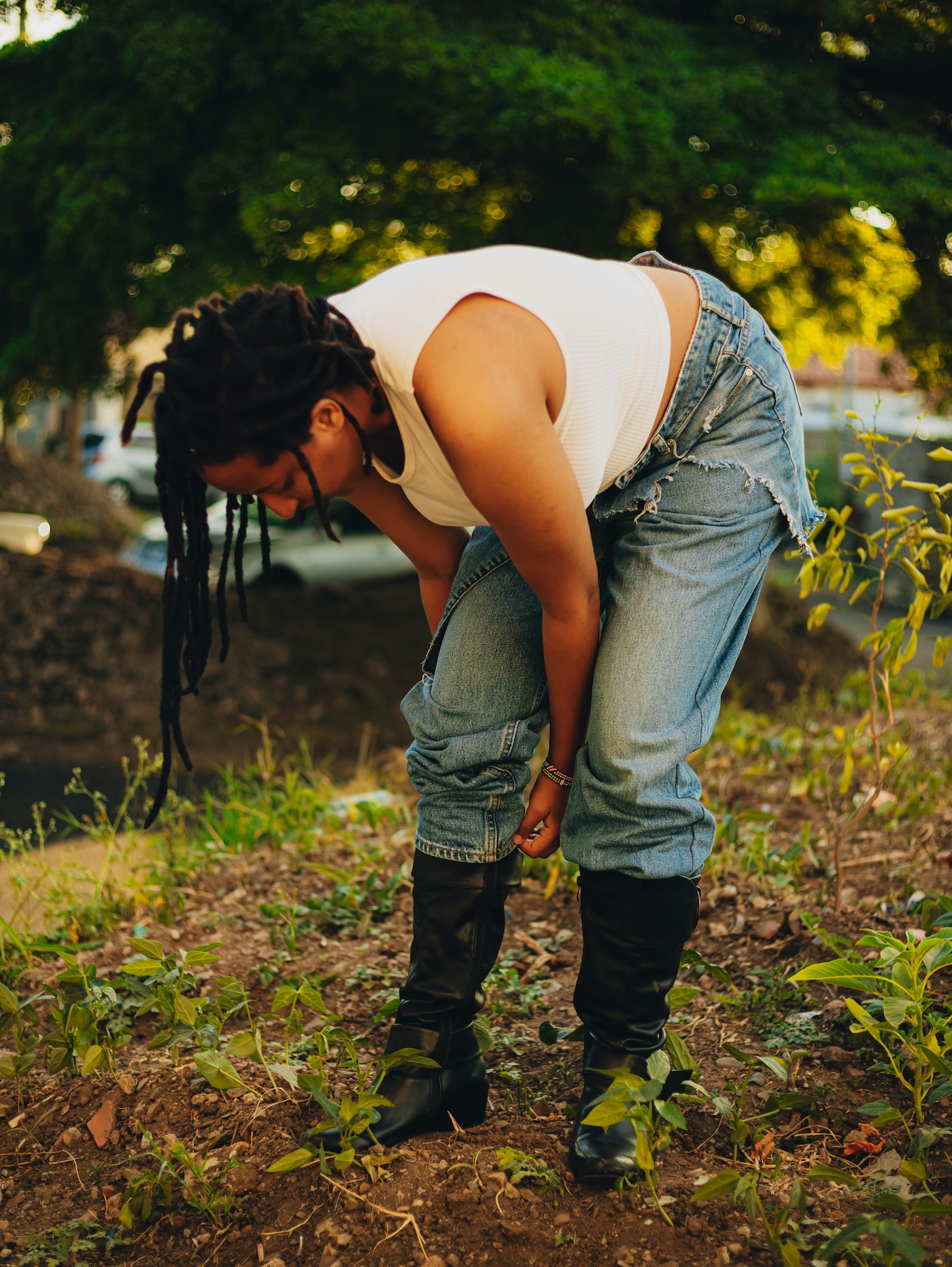
A recurring theme in reporting on Black-led urban farms is land precariousness—short-term leases, uncertain municipal policy, and development pressures that can erase years of work. A Guardian report on Black-led urban farms describes this vulnerability directly, noting how farms that stabilize neighborhoods can be undermined by the very land dynamics they help transform.
This is not an abstract concern. Perennial crops, orchards, soil remediation, and community programming all require time—often many seasons—to mature. When land tenure is unstable, the farm is forced into a constant state of contingency, planning not only for harvest but for survival. In some neighborhoods, farms function like pop-up infrastructure, providing consistent benefits on land that might be taken as soon as it becomes profitable to do so.
The significance of Black urban farming, then, includes a legal and policy dimension: farms are forcing cities to confront land as a public good, not only a speculative asset. The most effective projects increasingly pair agriculture with land trusts, cooperative ownership, or long-term municipal agreements—structural solutions to a structural problem.
Training, memory, and the rebuilding of an agrarian pipeline
If land is one bottleneck, knowledge and labor are another. Black farming knowledge has been interrupted—through dispossession, through migration, through the way mainstream agricultural education often excluded Black students and farmers. Modern Black-led farms and training centers have responded by treating education as core infrastructure.
Soul Fire Farm, an Afro-Indigenous-centered farm and training organization, frames its mission as “uprooting racism” and “seeding sovereignty” in the food system, using training programs and resources to support farmers and communities. While Soul Fire Farm is not “urban” in a narrow city-limits sense, its impact is profoundly urban because many trainees bring skills back to city neighborhoods, building gardens, mutual-aid distribution systems, and cooperative markets.
The point is not simply to teach people to grow. It is to restore a lineage. Training becomes a form of reparative cultural work: reconnecting communities to land-based practices that were historically disrupted, then leveraging those practices to build health and local economic capacity.
The farm as a public-health institution
Black urban farms routinely operate as informal clinics—not because they provide medical care, but because they intervene in chronic disease patterns tied to diet, stress, and environmental conditions. Word In Black, for instance, has covered Black women farmers engaged in food justice efforts, emphasizing how inadequate access to nutritious food is linked to health risks and how urban growers address these disparities through direct provision and community engagement.
This is where the farm becomes legible as policy. It is doing work that public systems often fail to do: increasing access to fresh produce, creating youth programming and job pathways, and strengthening social cohesion. The farm’s output is not only vegetables; it is reduced isolation, local leadership development, and an everyday demonstration that community needs can be met through collective action.
Ebony has profiled Black-led urban agriculture leaders in similar terms, highlighting farms that provide job training and economic opportunity while working at the intersection of sustainability, community, and equity. In these accounts, the farm is an anchor institution, especially in neighborhoods where traditional anchors—hospitals, grocery stores, banks—may be absent, predatory, or inaccessible.
The economic argument: jobs, co-ops, and keeping value local
Food justice rhetoric can sometimes flatten into symbolism, as if the garden is meaningful primarily because it is beautiful. But many Black urban farmers are making explicitly economic claims. They are building businesses, cooperatives, and value chains that keep money circulating locally.
Cooperative food buying clubs, community markets, and shared distribution systems show up frequently in Black food sovereignty organizations. Detroit’s DBCFSN, for example, has described cooperative structures as part of its broader work, reflecting a long tradition of Black cooperative economics—an approach with roots in mutual aid societies, collective purchasing, and the survival economics of segregation.
The significance here is strategic: if urban farming is only charitable—only donation-based, only seasonal—it can become dependent on outside funders and vulnerable to shifting political moods. But if it is also an economic engine, it can build durability: paid roles, apprenticeship pipelines, and revenue models that support land acquisition and long-term stability.
The federal backdrop: repair efforts and renewed conflict
Black urban farming also lives within a volatile federal context. Even when farms are small, they exist inside a national system shaped by USDA policy, civil rights enforcement, and definitions of who qualifies for support. Recent years have included both attempts at repair and renewed conflict.
Reuters has reported on USDA efforts to provide financial assistance to tens of thousands of farmers and landowners impacted by discrimination in lending programs, describing the initiative as an attempt to address historic bias and rebuild trust. At the same time, Reuters has also reported on USDA actions to discontinue the use of race and sex as criteria in many programs—an institutional shift that critics argue could undermine targeted efforts to address entrenched inequities.
This tension—between repair and retrenchment—shapes the practical environment in which Black farmers operate. For urban farmers seeking access to capital, technical assistance, or land-related support, the difference between targeted eligibility and “race-neutral” policy can translate into whether long-standing barriers are acknowledged or ignored.
The Pigford cases remain a reminder of why this matters. The CRS report documents not only the settlement mechanisms but also the earlier failures—backlogs, closed civil rights offices, and data deficiencies—that allowed discrimination claims to accumulate unresolved. That history is not merely historical; it is the context in which contemporary trust is either rebuilt or broken.

Culture, not trend: why Black urban farming resists simplification
There is a way urban agriculture gets narrated in mainstream culture: as a feel-good story about “revitalization,” or a marker of a neighborhood’s “renaissance.” Black urban farmers often resist that framing because it can erase the politics of why the neighborhood needed revitalizing in the first place—and who gets to stay once it becomes desirable.
Black urban farming is culture-making. It preserves culinary heritage—greens, okra, sweet potatoes, herbs—and the knowledge embedded in those foods. It also creates public space that functions as memory. Many gardens serve as informal community centers where elders teach, children play, and neighbors organize. In that sense, the farm is a form of placekeeping: maintaining a community’s identity against the forces that treat neighborhoods as interchangeable real estate.
A recent Guardian essay on food justice critiques the ways dominant “healthy eating” narratives can patronize communities of color, arguing that the issue is not ignorance but structure—access, power, and the political economy of food. Black urban farms respond to that critique by making structure visible. They show, in real time, that the barrier is not desire but distribution: who gets investment, who gets transport, who gets safe and affordable options.
The fight for permanence: toward food sovereignty in the city
In the most ambitious Black-led urban farming projects, the goal is not only to grow food but to govern the food system—to shift decision-making power about land, distribution, and health into community hands. That is the meaning of “food sovereignty,” a term increasingly used by Black food system organizations and alliances.
The National Black Food & Justice Alliance describes itself as an intergenerational network of Black farmers, organizers, and land stewards working toward food sovereignty and the protection of Black land, connecting rural and urban struggles into one movement. The framing is expansive on purpose. It argues that urban farms are not isolated projects; they are part of a national terrain where land and food policy shape racial wealth, health, and political agency.
What would it mean for a city to take that framing seriously? It would mean treating urban farms not as temporary beautification projects but as essential infrastructure. It would mean zoning that protects agricultural use, municipal land disposition policies that prioritize community ownership, and funding mechanisms that recognize farms as public-health interventions. It would mean procurement systems that allow local growers to sell to schools and hospitals without being crushed by compliance burdens. It would mean long-term leases, land trusts, and cooperative ownership structures that prevent farms from becoming the first casualties of “development.”
It would also mean acknowledging a hard truth: the United States has asked Black people to feed the nation while repeatedly undermining Black control of land. Black urban farming is one way communities have answered that contradiction—by rebuilding an agrarian practice inside the city, where land is scarce, policy is messy, and the stakes are often visible block by block.
Why this matters now
The most important thing to understand about Black American urban farmers is that they are building the future in places the future has historically overlooked. They are doing it in neighborhoods where the public sector has too often outsourced wellbeing to charity, or to the uneven generosity of private capital. They are doing it under land pressures that can turn success into vulnerability. They are doing it amid national debates about whether racial equity efforts are repair or favoritism, whether targeted programs are justice or “politics.”
But the farms persist because the need persists—and because the farm offers something rare in American civic life: a tangible, local form of power. It is hard to argue with a harvest. It is hard to dismiss a youth program that keeps teenagers safe and employed. It is hard to ignore a community that can feed itself when supply chains break, prices rise, or storms hit.
Black urban farming is not a substitute for systemic reform. No amount of kale can replace fair lending, living wages, or anti-displacement policy. Yet the farms are significant precisely because they are not merely symbolic. They are institutions built from below, offering an alternative blueprint for what a neighborhood can be when residents control land and convert it into care.
In a country where so many civic promises arrive late—or never—Black urban farmers have become experts in delivering what they can, where they are, with what they have. And they have made a quiet proposition that is, in its own way, radical: if the city will not nourish us, we will build nourishment ourselves—and then we will fight to keep it.
More great stories
The Precinct Trap
March 4, 2026
No Comments
Columbia’s Forgotten Flashpoint
March 4, 2026
No Comments