





This effort to suppress the vote, to confuse and inconvenience voters, is having its intended effect as people are being turned away from the polls.
This effort to suppress the vote, to confuse and inconvenience voters, is having its intended effect as people are being turned away from the polls.
By KOLUMN Magazine
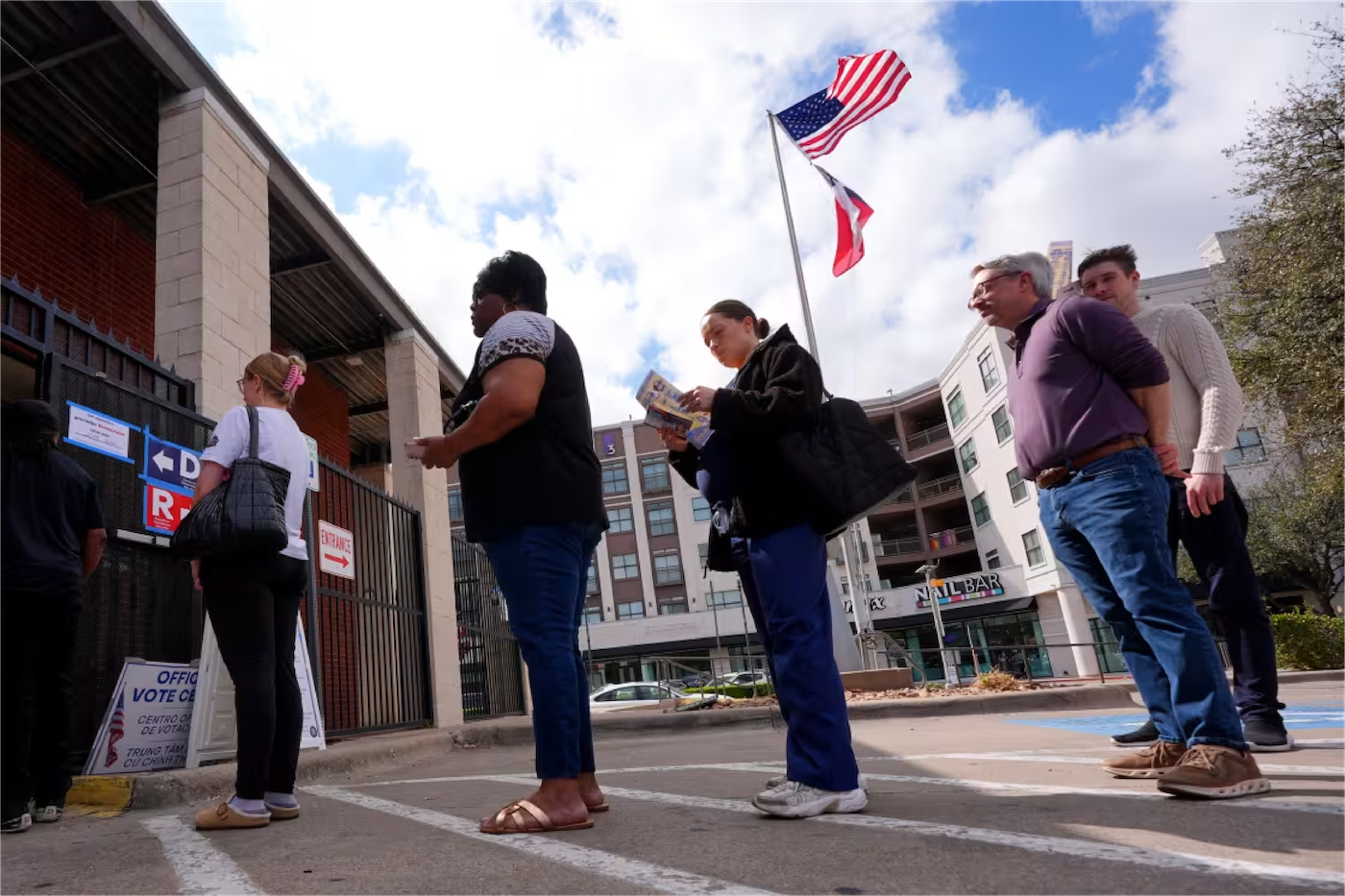
In Texas politics, the most consequential fights over democracy rarely announce themselves with the language of denial. They arrive instead as “procedures,” “confidence,” “integrity,” and “administration”—the small-bore vocabulary of forms, maps, and compliance. That is why the images from Tuesday’s primaries in Dallas and Williamson Counties—voters turned away, redirected, and left squinting at precinct assignments they hadn’t needed to know for years—matter beyond the day’s tallies. The story is not simply that a voting system changed. It’s how it changed, who demanded the change, and who paid for it in time, uncertainty, and missed ballots.
The changes were, on paper, a reversion: on Election Day, voters in both counties were required to vote at their assigned precinct polling place, rather than at countywide vote centers where any eligible county voter could cast a ballot. In practice, it operated as a trapdoor—especially in populous places where residents have grown used to the flexibility of vote centers and where long commutes, irregular work schedules, and childcare responsibilities make convenience inseparable from participation.
The immediate consequence was confusion severe enough in Dallas County that a judge ordered polls to stay open beyond their scheduled closing time, after a petition from the local Democratic Party argued voters had been thwarted by the sudden precinct-only requirement. Reports described county election systems overwhelmed—calls flooding in, voters arriving at familiar locations only to be told they could not vote there, and online tools strained under demand.
And then there was the asymmetry embedded in what came next: Dallas County’s Democratic primary voting hours were extended into the evening, while Republicans did not seek the same relief, meaning the legal system’s emergency valve was activated specifically where the disruption was being most loudly felt and documented—among Democratic voters trying to navigate an imposed obstacle course.
If you want to understand the modern Texas approach to vote suppression, start here. Not with the caricature of a locked door, but with a maze. The question is not whether the rules were “legal.” The question is whether they were designed—predictably, repeatably—to reduce participation by making voting harder, especially in the state’s big, diverse, Democratic-leaning counties.
The decision that set the day on fire: Refusing a joint primary
What turned a procedural change into a countywide scramble was a political decision by local Republican parties: the Dallas and Williamson County Republican Parties refused to agree to a joint primary election with local Democrats. Under Texas rules for primaries, that mattered because both parties must agree on key administrative choices—like whether countywide vote centers will be used on Election Day. If Republicans won’t sign on, Democrats can’t unilaterally keep the system.
Texas Tribune reporting in January made the stakes plain: Republicans in both counties intended to eliminate countywide voting sites on Election Day for the March 3 primary, forcing both Republican and Democratic voters back into assigned neighborhood polling places.
The GOP’s stated rationale was confidence and community-based verification. Michelle Evans, the Williamson County GOP chair, argued that requiring voters to cast ballots at assigned polling locations brought “a higher level of confidence” that voters were registered in that area.
It’s the kind of statement that sounds like common sense—until you examine what it does in real life. Voting is not a neighborhood potluck. Registration is already verified through the voter rolls; eligibility is checked at check-in; IDs are scrutinized where required. What “precinct-only” actually adds, in large modern counties, is friction: the demand that every voter correctly identify their assigned site, travel there on a specific day, and absorb the cost of being wrong. And in a state where the myth of rampant voter fraud has been used for years to justify restrictive laws, the word “confidence” often functions less as a safeguard than as political cover.
“This effort to suppress the vote”: Crockett’s warning as the lines grew
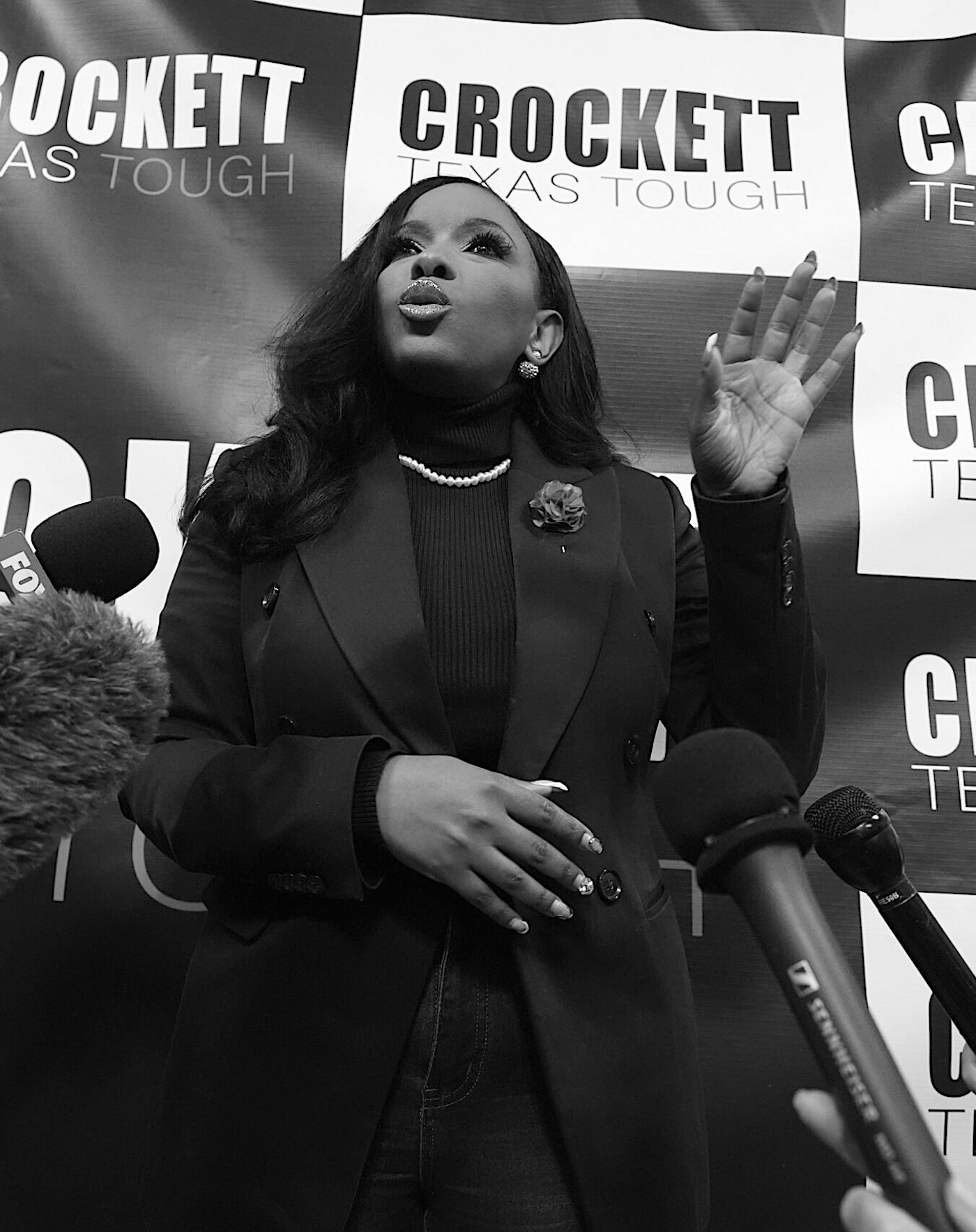
As the reports piled up on primary day, Rep. Jasmine Crockett—whose political base is in Dallas and who has been a leading Democratic voice nationally—framed the chaos in the clearest terms. In a statement reported by NBC DFW, Crockett said: “This effort to suppress the vote, to confuse and inconvenience voters, is having its intended effect as people are being turned away from the polls.”
That sentence is doing more than venting outrage. It describes a well-documented mechanism of suppression: reduce participation not by denying the right outright, but by increasing the cost of exercising it. The cost can be time (hours in line), money (transportation, missed work), stress (public confusion, uncertainty), or privacy (having to declare party affiliation in a split-site primary). In Dallas County, even the logistics of separate party administration raised concerns that the new arrangement made voting less private—another subtle deterrent, especially in polarized environments.
Crockett’s critique also landed in a state with a long record of voting restrictions justified by “integrity” rhetoric. Texas’ 2021 omnibus voting law (S.B. 1) rolled back local innovations that made voting easier—particularly those used heavily by voters of color—while expanding partisan poll-watcher power and tightening rules around assistance and mail voting.
A voter can be forgiven for seeing the pattern.
Why Dallas County is the test case Republicans keep coming back to
Dallas County is not just large; it is demographically diverse and politically consequential—a place where small changes to participation can shift margins across multiple contests.
On race and ethnicity, the U.S. Census Bureau’s QuickFacts estimates Dallas County at roughly 65% White alone, 23.6% Black, and 7.9% Asian, with Hispanic/Latino residents comprising about 40% of the population (Hispanic is measured separately from race).
Politically, Dallas County is a Democratic stronghold. In the 2024 presidential election, Dallas County’s reported results show Kamala Harris winning about 60% of the vote there (with Trump well behind).
Those two facts together explain why administrative barriers that “hit everyone” on paper can hit Democratic constituencies hardest in practice. In a heavily Democratic county, a policy that increases the rate of voters who give up, leave, or get turned away—even slightly—predictably damages Democrats more. And because the state’s statewide races are often decided by turnout math across metro counties, the incentive to inject friction into blue urban centers is structural, not accidental.
The Washington Post flagged this dynamic years ago when Texas lawmakers debated restrictions that critics argued would disproportionately burden Black and Latino voters—targeting methods associated with high-turnout, diverse counties.
Williamson County: The suburban battleground where convenience matters
If Dallas represents entrenched Democratic power, Williamson County represents something Republicans fear more: a fast-growing, diversifying suburban county where margins can flip.
Demographically, Williamson County is still majority White, but far less monolithic than it was a generation ago. Data sources tracking Census-derived estimates put Williamson County at roughly about a quarter Hispanic/Latino, with growing Asian and Black populations.
Politically, Williamson has been a swing canvas. In the 2024 presidential results reported at the county level, Trump carried Williamson by a narrow margin—about 50.35% to 47.90% for Harris. That tightness is exactly why turnout mechanics matter. In a county where the margin is single digits, any rule that makes voting more confusing or time-consuming can function as an outcome-shaper.
KUT reported ahead of the primary that Williamson would keep countywide voting for early voting but require assigned polling locations on Election Day—precisely the split that creates a “two systems” problem for voters: the habit built during early voting no longer works on the one day most casual voters show up.
“Voter confusion so severe”: The court order as an emergency indictment
The most revealing detail from Tuesday is not partisan spin; it is judicial action triggered by operational breakdown.
According to reporting on the ground, a Dallas County judge extended poll hours after finding confusion serious enough that voters were being misdirected and systems were overwhelmed—an extension sought by Democrats in response to precinct-only Election Day rules.
In practical terms, court-ordered extensions are an admission that a voting process failed its core democratic function: making it possible for eligible voters to cast ballots without unreasonable obstruction. They are extraordinary remedies for ordinary rights.
They also underline a central truth about suppression-by-process: it doesn’t require malice at every step. It requires predictability. If you know that changing a familiar system—especially in densely populated counties—will produce confusion, and you choose it anyway, you have chosen the consequences. When those consequences are foreseen and politically advantageous, the “mistake” becomes strategy.
The hidden architecture behind the chaos: Separate primaries, strained staffing, late-finalized locations
Dallas County didn’t stumble into this. Local reporting documented how the decision to separate the primaries strained election planning. KERA reported that the elections administrator described separate Republican and Democratic elections as a “severe strain” on the office, complicating logistics and public communication just weeks before Election Day.
And behind the separation was months of GOP agitation around election machinery itself. Votebeat reported on the Dallas County GOP’s push to hand-count ballots—an effort presented as restoring confidence, but one that would have required thousands of workers and massive logistical expansion. Even after that plan was ultimately abandoned, the impulse toward separate administration remained, keeping the precinct-only framework in place and forcing both parties into it.
This matters because administrative complexity is itself a turnout suppressant. When locations aren’t finalized early, voter education becomes harder. When staffing is strained, lines grow. When the system changes right as voters arrive, people walk away.
And when people walk away, the democracy shrinks—not evenly, but along the fault lines of race, class, work flexibility, transportation access, and partisan geography.
How suppression operates in the modern GOP playbook: law, procedure, and “integrity” narratives
Texas is not inventing this approach in 2026; it is refining it.
After 2020, Republicans in Texas—and across the country—pursued restrictions framed as election integrity measures despite little evidence of widespread fraud. In Texas, S.B. 1 became a flagship: limiting certain local voting expansions, tightening mail ballot rules, empowering partisan poll watchers, and constraining voter assistance.
Civil rights groups and federal authorities have repeatedly argued that Texas voting rules can carry discriminatory effects, especially on Black and Latino voters, and courts have at times agreed in major cases involving voter ID and parts of S.B. 1.
The precinct-only Election Day shift in Dallas and Williamson fits this ecosystem. It is not a statewide statute, but it operates the same way: it increases the “cost” of voting in counties where Democratic strength is built on diverse, urban, and suburban coalitions.
The GOP argument—confidence, fraud prevention, community verification—also fits a familiar mold. The Atlantic chronicled earlier eras of “ballot security” campaigns that critics argued were aimed less at fraud than at discouraging turnout among targeted groups.
There is no need to claim a secret conspiracy when the incentives are open and the effects are observable. A system that produces predictable confusion—especially after years of voters being trained to use countywide sites—will predictably reduce participation. And in Dallas County, reduced participation predictably means reduced Democratic votes.
The racial geography of impact: Why “confusion” is not neutral
In Dallas County, population and political power are not evenly distributed; they map onto history.
The county’s large Black and Latino populations, alongside growing Asian communities, are concentrated in areas that have long faced disparities in transportation access, time flexibility, and institutional trust. The effect of a rule change is never just the rule; it is the rule applied to real lives: a nurse getting off shift, a parent without childcare, a bus rider navigating cross-county routes, a voter whose English is not the language of government forms.
Williamson County, too, is in demographic transition. That transition is political: as diverse suburbs grow, Republican margins tighten. In that context, making Election Day less convenient is not simply “administration.” It is a way of shaping who shows up.
Republicans say it’s about legality and logistics. Democrats say it’s about power.
Republicans and their allies insist the changes are lawful and, in some cases, necessary. In Dallas County, GOP chair Allen West disputed claims that some combined precinct arrangements violated state law and said the party had received state-level blessing for its approach.
But “lawful” is not the same as “democratic.” Much of America’s most effective suppression has been legal at the moment it was applied. The moral question is whether officials and party leaders are acting to broaden participation or narrow it.
When Democratic leaders describe this as suppression, they’re describing a lived reality: voters being turned away, redirected, and forced to spend Election Day solving a bureaucratic riddle.
And when Crockett describes suppression by confusion, she’s naming what the modern fight looks like: not billy clubs at polling places, but policy knobs turned toward inconvenience.
What the court order reveals about the future
Texas is entering a period where election administration itself is becoming a partisan battlefield—precinct structures, vote centers, hand counts, poll watchers, voter assistance rules, and the litigation that inevitably follows.
The primary-day order to extend hours in Dallas County is a warning flare. It suggests that as parties pursue divergent visions of “integrity,” voters will increasingly be asked to absorb the costs of political experimentation—costs that fall hardest on the people with the least time, least flexibility, and least tolerance for being told, at the door, that they’re in the wrong place.
In a state where the electorate is rapidly diversifying and where the margins in key counties are tightening, the incentive to weaponize inconvenience will remain strong.
The story of Dallas and Williamson is not only about one primary day. It is about a governing philosophy that treats access as negotiable, friction as acceptable, and confusion as collateral. And it is about the quiet truth that, in the math of turnout, collateral is never evenly distributed.
More great stories

Pleasure and Leisure Policed
March 4, 2026
No Comments
After the Ballots, the Movement
March 4, 2026
No Comments