




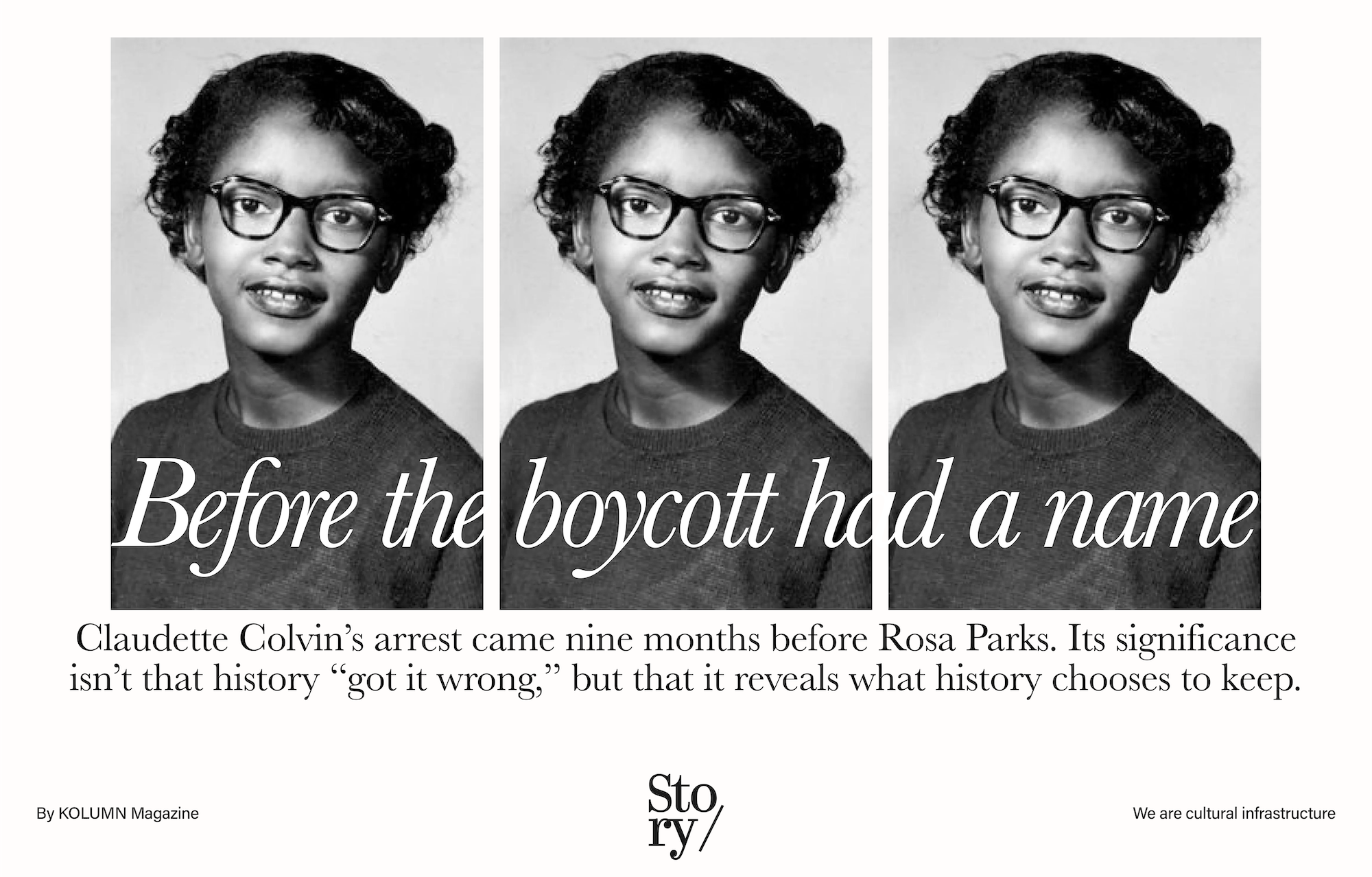
On March 2, 1955, Claudette Colvin was not trying to become a symbol. She was trying to remain a person—seated, yes, but also standing in the only way the system allowed a Black girl to stand: by refusing to move.
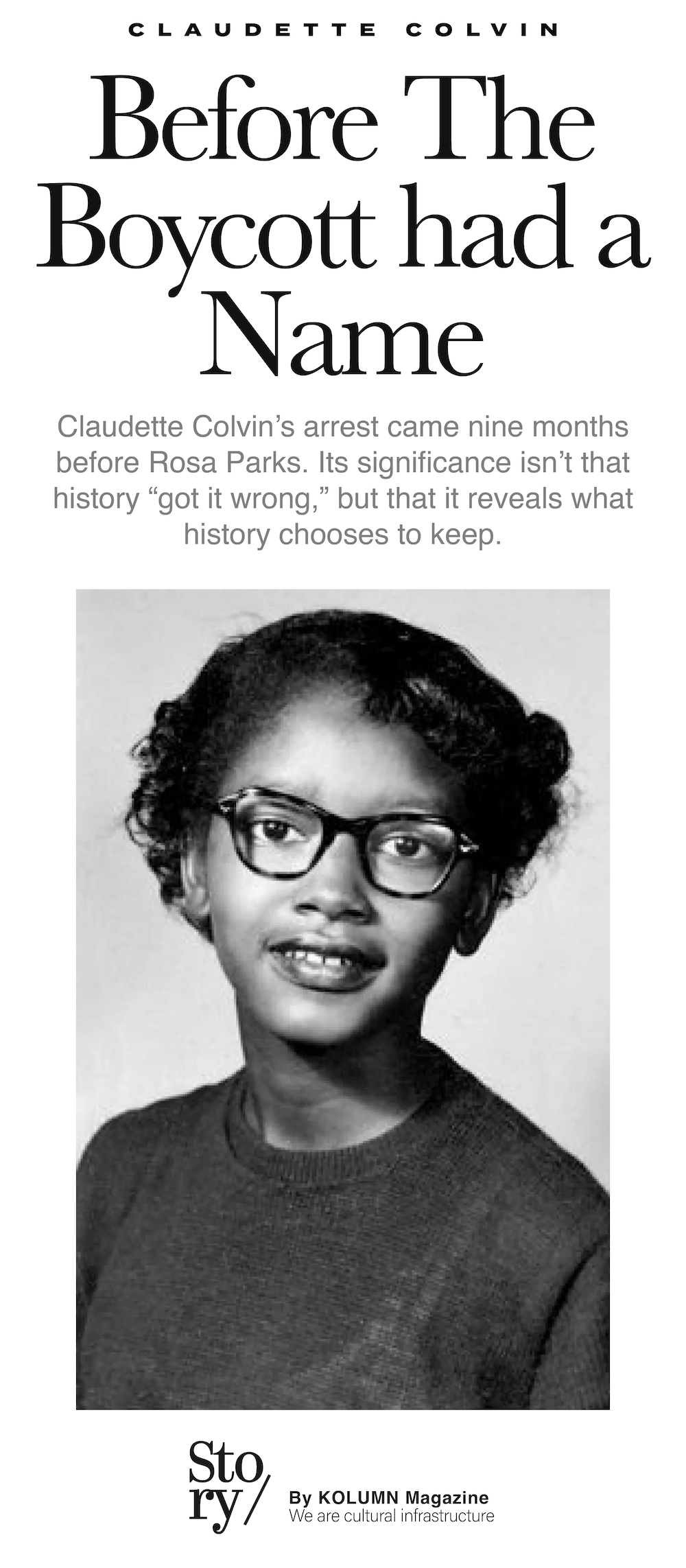
On March 2, 1955, Claudette Colvin was not trying to become a symbol. She was trying to remain a person—seated, yes, but also standing in the only way the system allowed a Black girl to stand: by refusing to move.
By KOLUMN Magazine
The story most Americans inherit about the Montgomery Bus Boycott has the clean geometry of legend. A tired seamstress refuses to move. A community rises. A young minister emerges. The Supreme Court ends bus segregation. The modern civil-rights movement begins.
But the city’s buses had been a battleground long before the boycott gained its name, and Montgomery’s Black residents had been rehearsing resistance in their bodies—counting stops, calculating risk, absorbing humiliation—long before the cameras arrived. A year before Rosa Parks was arrested, the Women’s Political Council had already pressed city officials about abusive treatment on public transit. The NAACP had been watching for the right case. Local activists were studying not only what Jim Crow did, but how it could be made to fail.
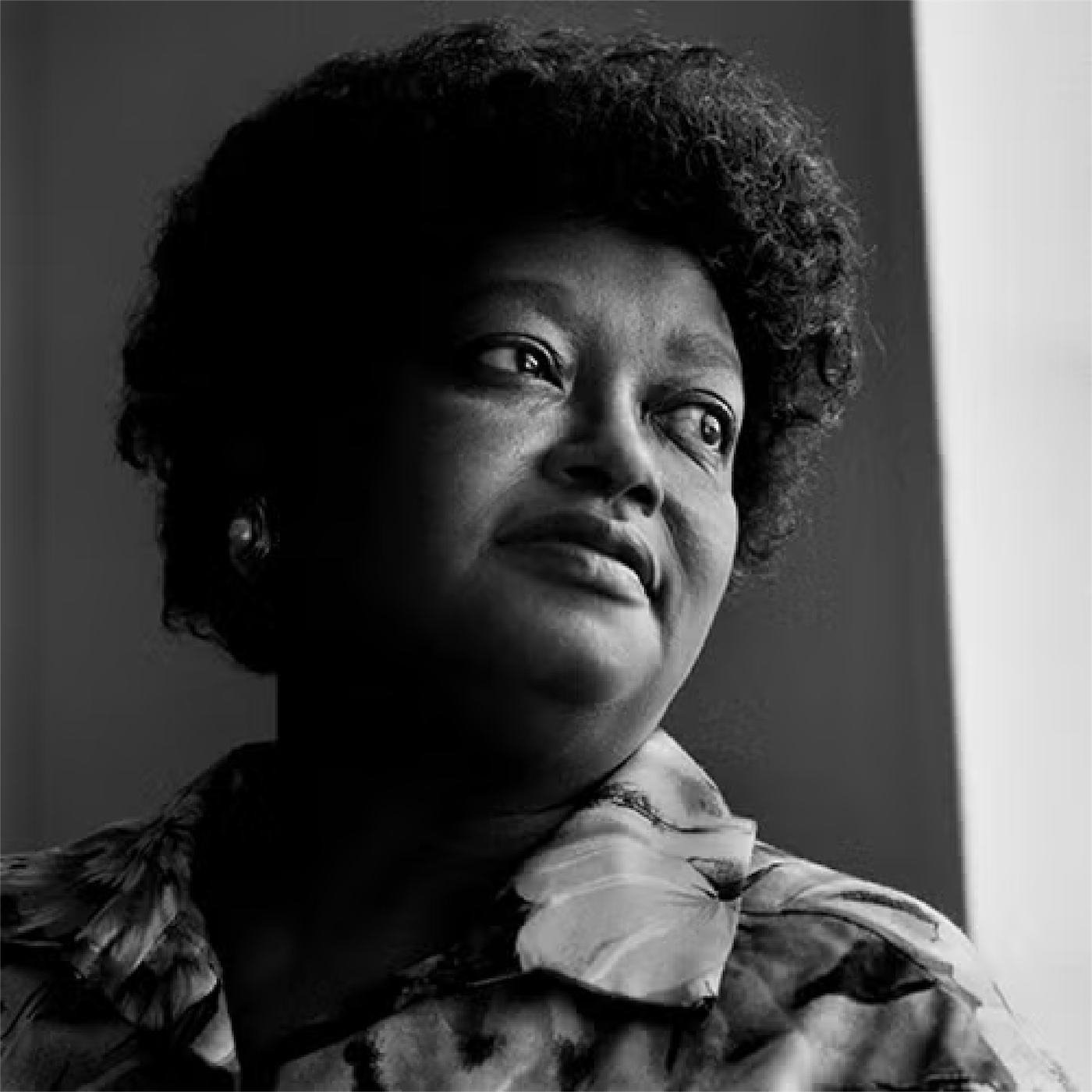
On March 2, 1955—nine months before Parks—Claudette Colvin, a 15-year-old Black student, refused to surrender her seat on a segregated Montgomery bus. She was arrested, hauled to jail, and pulled into a legal and political apparatus designed to make a child regret her own dignity. In the simplest retelling, Colvin is “the one before Rosa Parks,” a prologue to a more famous chapter. But the deeper truth is more unsettling: Colvin’s arrest exposes how movements, media, and institutions decide whose defiance is legible, whose anger is “strategic,” whose youth is an asset, and whose life is treated as a complication.
If Parks’ story is often told as a moral fable about individual bravery, Colvin’s arrest is a case study in the messy reality of collective struggle. It’s about a Black girl whose sense of citizenship was so vivid—so immediate—that it startled not only the white authorities who moved to punish her, but also the movement elders who were trying to build a campaign that could survive the South’s brutality and the nation’s appetite for “respectable” heroes.
This is the history and significance of that arrest: not merely what happened on a bus, but what the reaction to it reveals about the architecture of American memory.
Montgomery’s buses: The everyday theater of Jim Crow
To understand why March 2, 1955 mattered, you have to picture the bus not as a neutral vehicle but as a moving stage for segregation—a place where Black riders made up the majority of fares, yet were disciplined as if they were guests in their own city. Montgomery’s seating rules were both rigid and improvisational: “White” sections could expand on demand, swallowing rows that had been available to Black passengers minutes earlier, depending on how many white riders boarded and whether they wanted to sit.
That flexibility is part of what made the system psychologically violent. The rules were not simply posted; they were performed—enforced by drivers who could decide, in real time, whether a Black rider’s body was out of place. In a city where the law and custom partnered so closely, the driver’s authority could feel like a municipal badge. Riders learned to anticipate the moment when a seat would stop being theirs.
Claudette Colvin was a teenager in this world, a student at Booker T. Washington High School, raised in Montgomery’s segregated order, riding buses because her family did not have a car. She was also, by multiple accounts, a bright student immersed in Black history and civics—learning, in school and youth groups, the language of constitutional rights that segregation demanded Black people treat as theory rather than reality.
That combination—youth, intellect, and a sharpened sense of injustice—often shows up in the way people remember Colvin’s voice from that day. Not soft. Not cautious. Not curated. It was the kind of voice Jim Crow was built to silence early.
March 2, 1955: The moment the script broke
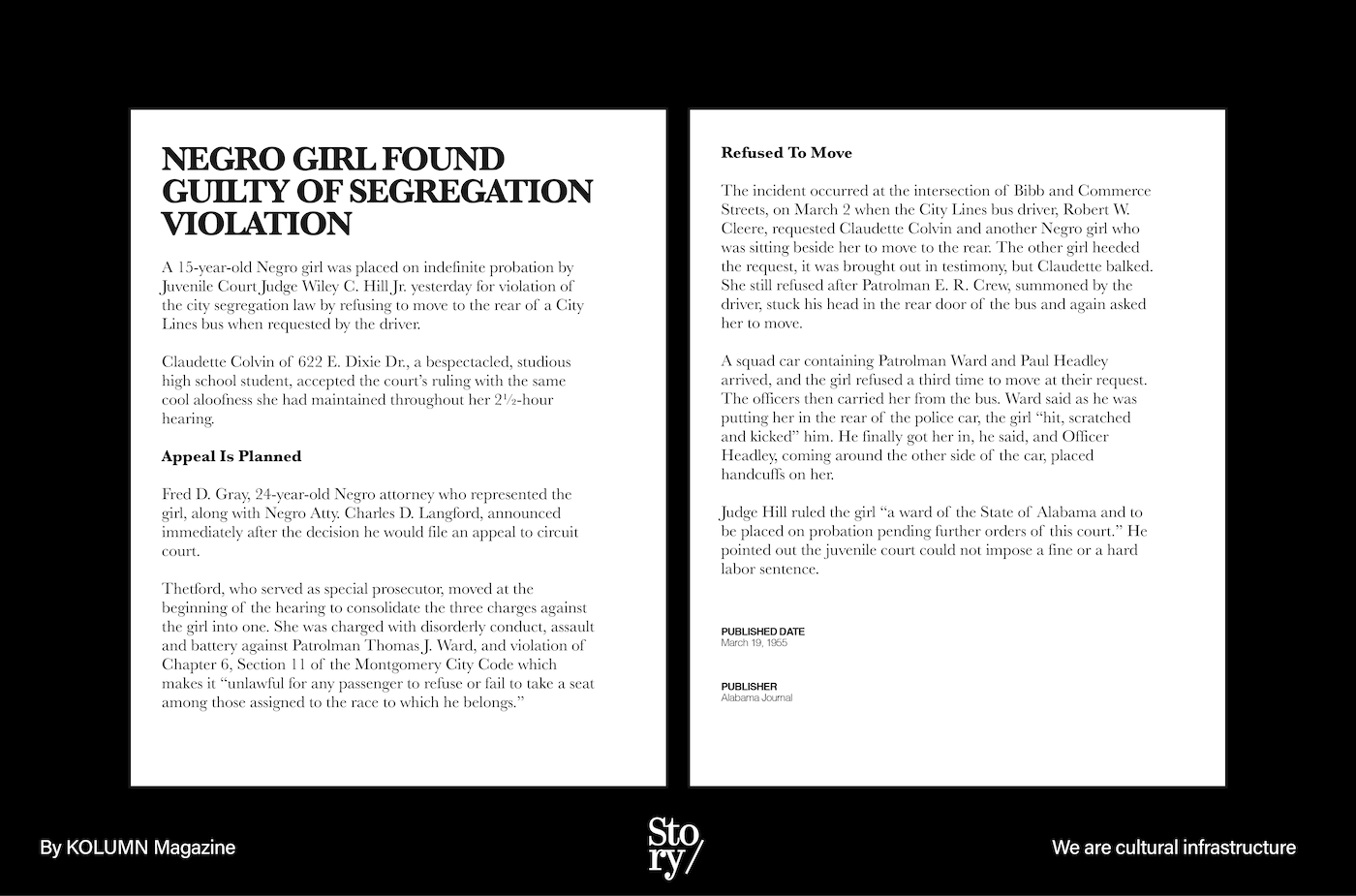
Accounts vary in small details, but the core sequence has remained consistent across historical retellings. After school on March 2, Colvin boarded a city bus with other students. They sat in the section behind the front rows reserved for white passengers. As the bus filled, a white woman was left standing. The driver demanded that Colvin and other Black riders give up their seats. Some complied. Colvin did not.
What happened next is the part that turns a refusal into an arrest. Police were called. Colvin was removed from the bus, handcuffed, and taken to jail. In later years, Colvin described the experience as both terrifying and clarifying: the fear of what police power could do to a Black girl, and the simultaneous certainty that she was right to resist. National Geographic’s more recent retelling underscores the speed with which a routine bus ride became a scene of coercion—handcuffs, physical removal, detention—because a teenager chose not to cooperate with a racial caste system.
The arrest produced charges that speak volumes about how the state framed Black resistance. Colvin was not simply accused of violating a seating ordinance. She was charged in ways that recast her refusal as disorder and threat—charges that, in many retellings, include violating segregation laws and allegations related to disturbance or assault, with at least one conviction associated with assaulting an officer while other charges were dropped. Even in death notices and obituaries, that legal framing remains part of the record: the state’s insistence that a girl’s refusal to move was, in itself, a kind of violence.
This is one reason the arrest matters. It shows how segregation relied not only on separation, but on criminalization—turning Black dignity into an offense that could be documented, prosecuted, and carried as a stigma.
The movement’s dilemma: Courage, but not “the right” kind
In the months after Colvin’s arrest, Montgomery’s Black leadership did not ignore what happened. They debated it, weighed it, interrogated it the way communities do when they know the next move could invite reprisals.
What many later accounts make plain is that Colvin’s case surfaced the movement’s internal calculus about “winnability”—a calculus shaped by racism, sexism, and class judgments as much as by legal strategy. Colvin was young. She was from a working-class family. And, soon, she would become pregnant—an experience that, in the moral politics of the era, could be weaponized against her.
It is easy, from the present, to cast this as betrayal: why didn’t the movement rally around the first girl who refused? But this is where a seasoned view of history matters. Montgomery in 1955 was a place where white officials could destroy livelihoods with a phone call, where police could enforce “order” with fists, and where the courts were often hostile terrain. Organizers understood that a test case would be attacked not only with law but with narrative—by smearing the person at its center until “rights” looked like a cover for “bad behavior.”
The Atlantic, reflecting on Colvin’s story, put the dilemma bluntly: she was seen as too volatile, too unwilling to perform the calm demeanor that white America had been trained to read as “deserving.”
The point is not that Colvin lacked discipline. The point is that “discipline” was being defined by a society that demanded Black people prove their humanity by acting unbothered while being harmed. Colvin’s refusal did not only challenge bus segregation. It challenged the expectation that Black pain must be polite to be believed.
Rosa Parks, by contrast, fit a profile that movement strategists believed could better withstand the coming storm: an adult, employed, married, long connected to civic networks. As later commentary and historical analysis have noted, leaders made choices based on what they believed courts and the public might accept.
This is not a story about one woman versus another. It is a story about the violence of “respectability politics” as a survival strategy—how it can protect a movement in the short term while erasing the people whose lives don’t fit the preferred template of heroism.
A legal turning point hiding inside a local humiliation
Even if Colvin did not become the public face of a mass campaign in March 1955, her arrest became something else: evidence. It created a record—an encounter between a citizen and the state that could later be used to expose how segregation operated in practice.
And, crucially, it helped strengthen the movement’s growing belief that Montgomery’s bus system could be attacked not only through boycott but through federal litigation. The boycott, when it came, would demonstrate collective power. The lawsuit would target the legal foundation of segregation itself.
The landmark case was Browder v. Gayle, filed in federal court on February 1, 1956 by attorney Fred Gray and others on behalf of Black women who had been mistreated on Montgomery’s buses. Colvin would become one of the plaintiffs whose experiences demonstrated the routine constitutional harms baked into the system.
Here, the significance of Colvin’s arrest expands beyond Montgomery. The Browder strategy did something the bus ordinances did not anticipate: it reframed segregation as a federal constitutional issue, not a local custom. The case moved through the courts, and in 1956 a three-judge federal panel ruled against Alabama’s bus segregation laws. The U.S. Supreme Court upheld that result later in 1956. The ruling effectively ended bus segregation in Montgomery, helping bring the boycott to its close and forcing the city and state to change.
The bus boycott is often remembered as the engine. Browder is sometimes treated as paperwork that arrived afterward to formalize victory. But the lawsuit was not an afterthought. It was the mechanism that made desegregation durable—turning moral protest into enforceable law.
And because Colvin was part of that legal challenge, her arrest becomes foundational in a way that popular memory has often missed: she was not only a spark of resistance. She was part of the legal architecture that ended the very practice she resisted.
What the court record reveals about “ordinary” brutality
Legal decisions can feel sterile compared to the human drama of arrests and boycotts, but Browder v. Gayle is valuable precisely because it captures how the segregation system worked day to day—how rules were applied, how officials defended them, how institutions justified indignity.
Educational resources that preserve the case, including archival teaching materials, explicitly connect Colvin’s March 2 arrest to the larger legal fight that followed. The paper trail matters: it shows that Montgomery’s bus segregation was not merely a matter of individual prejudice but a coordinated system supported by statutes, ordinances, and agencies tasked with regulating transit.
In other words, Colvin’s arrest wasn’t a misunderstanding. It was the system functioning as designed.
The often-misread role of youth: Why a 15-year-old mattered more than anyone admitted
There is a particular discomfort in America’s civil-rights memory when it comes to children. We like youth when it can be framed as innocence, not when it arrives as confrontation. We celebrate young people when they are symbols, not when they are complicated humans with anger, fear, sexuality, mistakes, and needs.
Colvin was not a mascot. She was a teenager with opinions, a student shaped by the stories she’d been taught about Black resistance, and a girl who could not—or would not—flatten her feelings into something palatable for white observers. That is part of why her story matters now. It forces us to notice that the civil-rights movement was not only made by ministers and seasoned organizers, but also by children whose bodies were often the first to be punished by the state.
The arrest also foreshadows a contemporary conversation about how Black girls are disciplined—how schools, police, and courts interpret Black girlhood as inherently less innocent, more defiant, more “adult,” and therefore more punishable. The Atlantic has used Colvin’s case as a historical anchor for that argument: a reminder that long before modern debates about school policing, the criminalization of Black girls was already shaping what kinds of resistance were allowed to count.
Colvin’s arrest is significant, then, not only as civil-rights history but as a lens on the intersection of race, gender, and youth—on how a Black girl’s refusal can be treated as a threat requiring containment.
The long shadow of a juvenile record
For decades, Colvin lived with the consequences of that arrest in ways that did not make it into the simplified public narrative of the movement. After Browder, she struggled to find stable work in Montgomery and eventually moved to New York, where she worked for years as a nurse’s aide. The arc resembles that of many “ordinary” participants in extraordinary movements: they help bend history, then return to a society still structured to punish them for having done so.
The most concrete symbol of that punishment was the record itself. In 2021, Colvin sought to have her juvenile record expunged. A judge approved the request. Coverage of the expungement emphasized the emotional weight of carrying, for a lifetime, a legal stain incurred by refusing segregation as a child.
That expungement is not merely a feel-good coda. It is part of the significance of the arrest: it demonstrates how the state’s paperwork can outlast the state’s ideology. Segregation on buses ended in law in 1956, but the criminal label attached to Colvin’s resistance lingered for decades—an echo of the era when the state defined Black citizenship as something that needed permission.
Why the Colvin story re-emerged—and why it matters that it did
Colvin’s relative obscurity was never purely accidental. It was produced by a set of incentives: media that prefers singular heroes, civic storytelling that favors tidy icons, and movement narratives that sometimes compress complexity for the sake of mobilization.
In the past two decades, that compression has begun to loosen. Books, museum debates, classroom curricula, and renewed reporting have pressed the question: how did we build a national civil-rights mythology that could hold Rosa Parks but not Claudette Colvin?
Even that framing can be misleading, because there is room for both. Parks’ significance is not threatened by Colvin’s. If anything, Colvin’s story clarifies what Parks was up against and what Montgomery’s organizers were trying to do: construct a campaign that could survive white retaliation, win in court, and capture national attention.
But the re-emergence of Colvin’s story matters because it corrects a deeper distortion: the idea that movements begin when the nation notices them. Colvin’s arrest shows the movement already in motion—already incubating in youth councils, classrooms, churches, and kitchen-table conversations. It shows that public recognition is not the same as political origin.
KOLUMN Magazine’s recent reflection on Colvin emphasizes this truth in language that aligns with a wider archival project: to treat her not as a footnote but as a central figure who “helped end bus segregation in court,” while also acknowledging the personal cost of carrying the state’s label for an act now celebrated.
That is what a fuller history does. It doesn’t swap one hero for another. It widens the frame until the movement looks like what it was: a chorus—some voices amplified, others muted, all essential.
The arrest as a hinge point in civil-rights strategy
So what, precisely, is the historical significance of March 2, 1955?
First, it is an early, documented challenge to Montgomery’s segregated transit system that pre-dates the more famous Parks arrest and demonstrates that resistance was already present among young people.
Second, it illuminates the movement’s strategic decisions, including the painful reality that leadership sometimes filtered potential symbols through standards shaped by respectability, optics, and vulnerability to smear campaigns. That is not a moral condemnation; it is a historical fact with ethical implications that still resonate.
Third, it becomes significant through its connection to Browder v. Gayle, the federal case that struck down bus segregation and helped end the boycott by transforming protest into enforceable constitutional doctrine. Colvin’s role as a plaintiff ties her directly to one of the most decisive legal victories of the era.
Fourth, it offers a framework for understanding the criminalization of Black girlhood—how the state responds to Black girls’ resistance not as civic participation but as disorder, and how those labels can persist long after the underlying injustice has been repudiated.
Finally, the arrest’s significance lives in its afterlife: the decades of relative silence, the late recognition, the expungement, and the ongoing public work of telling the story correctly—not as trivia, but as a key to understanding how America edits its own past.
What changes when we center Claudette Colvin
Centering Colvin does not demote Parks. It changes the genre of the story.
Instead of a single perfect protagonist, we get a movement with multiple entry points: a teenage girl whose refusal is loud and immediate; seasoned organizers who translate outrage into strategy; a working community that sustains a boycott; lawyers who force constitutional arguments into federal court; women whose names do not become national shorthand but whose experiences become legal leverage.
And we get a more accurate understanding of courage. Courage is not always calm. Sometimes it is furious. Sometimes it is adolescent. Sometimes it happens before anyone has agreed on the messaging.
On March 2, 1955, Claudette Colvin was not trying to become a symbol. She was trying to remain a person—seated, yes, but also standing in the only way the system allowed a Black girl to stand: by refusing to move.
The arrest that followed tells us what segregation required to survive: compliance extracted through fear. The history that followed tells us what it required to fall: ordinary people—some famous, some forgotten—who decided the rules were not legitimate and behaved accordingly.
More great stories
The Eminent Colored Men
March 2, 2026
No Comments
The Children’s Lobbyist Who Treated Policy Like a Conscience
March 2, 2026
No Comments