




One case is treated like a crisis, the other becomes a story whose oxygen supply depends on family fundraising, local outlets, and the occasional burst of attention.
One case is treated like a crisis, the other becomes a story whose oxygen supply depends on family fundraising, local outlets, and the occasional burst of attention.
By KOLUMN Magazine
On January 31, 2026, Nancy Guthrie—84 years old, the mother of “Today” co-host Savannah Guthrie—was last seen at her home in Tucson, Arizona. Within days, her front porch became a nationally televised threshold: a place where blood was found, where investigators said there was “no proof of life,” where the case hardened from “missing” to suspected kidnapping, and where a web of evidence—surveillance footage, alleged ransom notes, DNA not belonging to the victim or her close contacts—spooled outward into a multi-agency response.
There are missing-person cases that remain local even when they are desperate. And there are missing-person cases that become a kind of public event, with press conferences, reward announcements, viral clips, and the unmistakable choreography of law enforcement signaling to the public: we are working this, we are here, we are trying. Nancy Guthrie’s case, from the earliest public accounts, belonged to the second category. Pima County deputies and FBI personnel were described as present at the scene; the house was treated as a crime scene; and the FBI publicly attached a reward that grew—reportedly reaching $100,000—for information leading to recovery or arrest.
That kind of response is often defended, reasonably, as situational: an elderly person in poor health, potential abduction, physical evidence suggesting violence, and the ever-shrinking window of survivability when medication is involved. But the public can hold two ideas at once. First, that a vigorous response is appropriate when authorities fear kidnapping. Second, that vigor is not evenly distributed—especially when the missing person is Black, poor, not famous, not connected to celebrity, or categorized early as someone who “left voluntarily.”
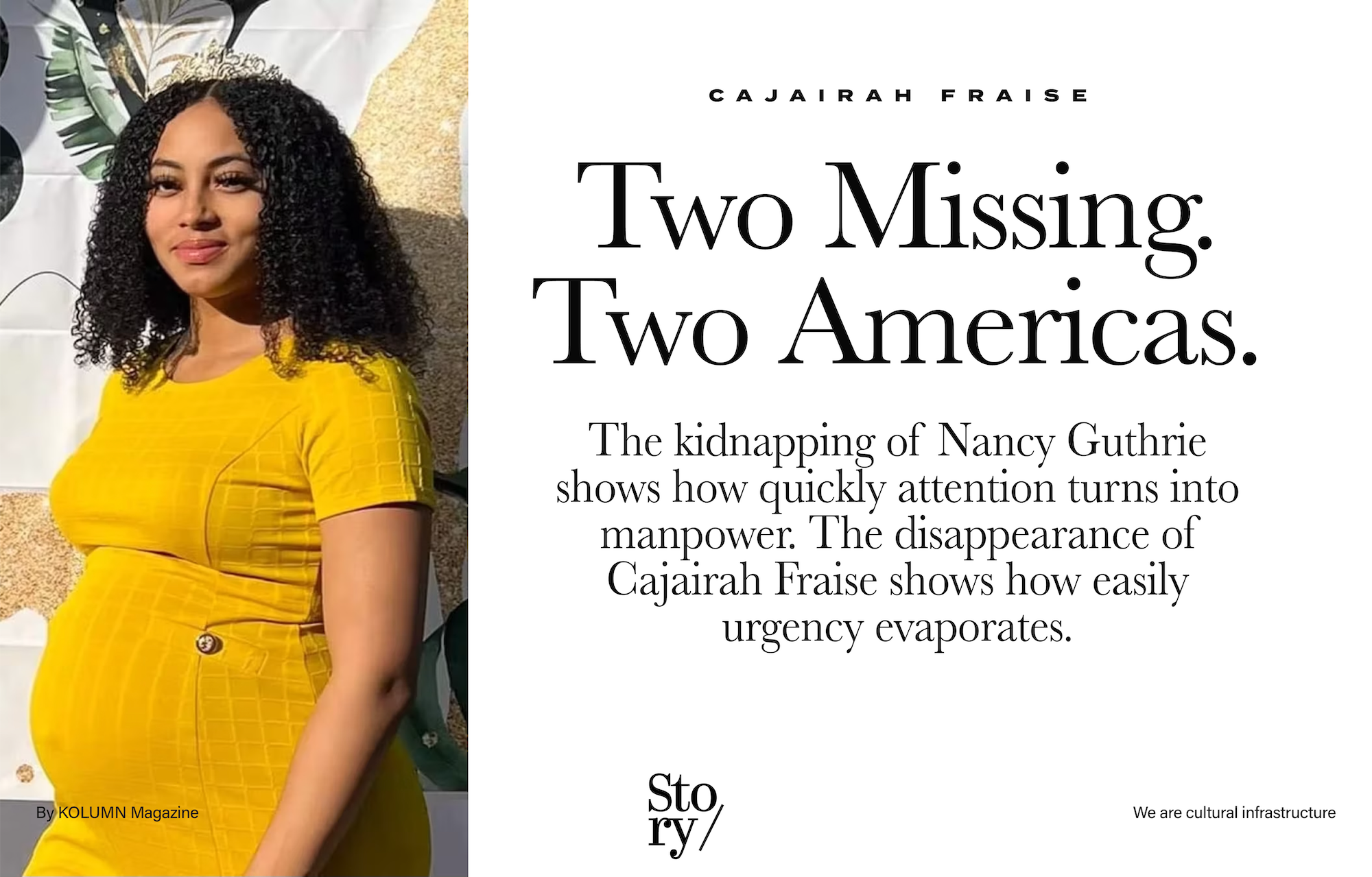
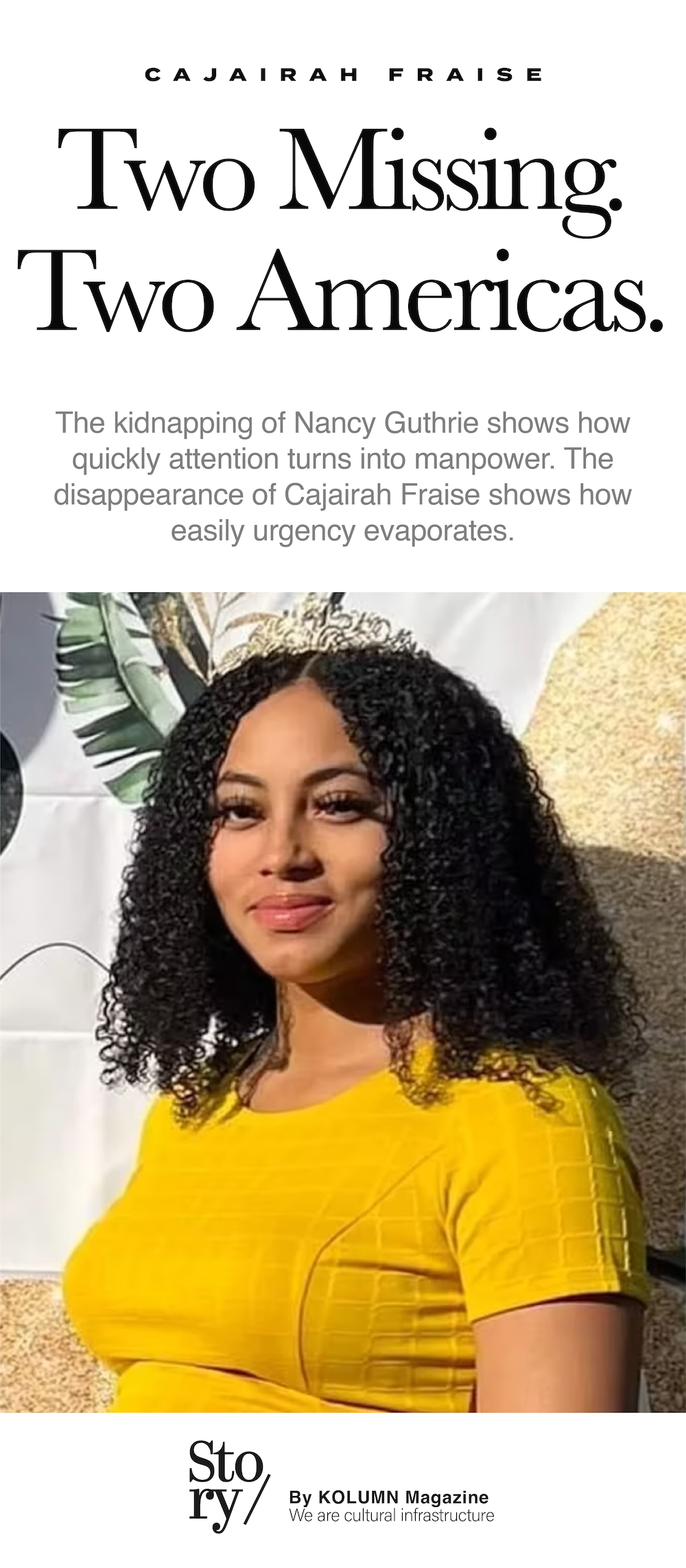
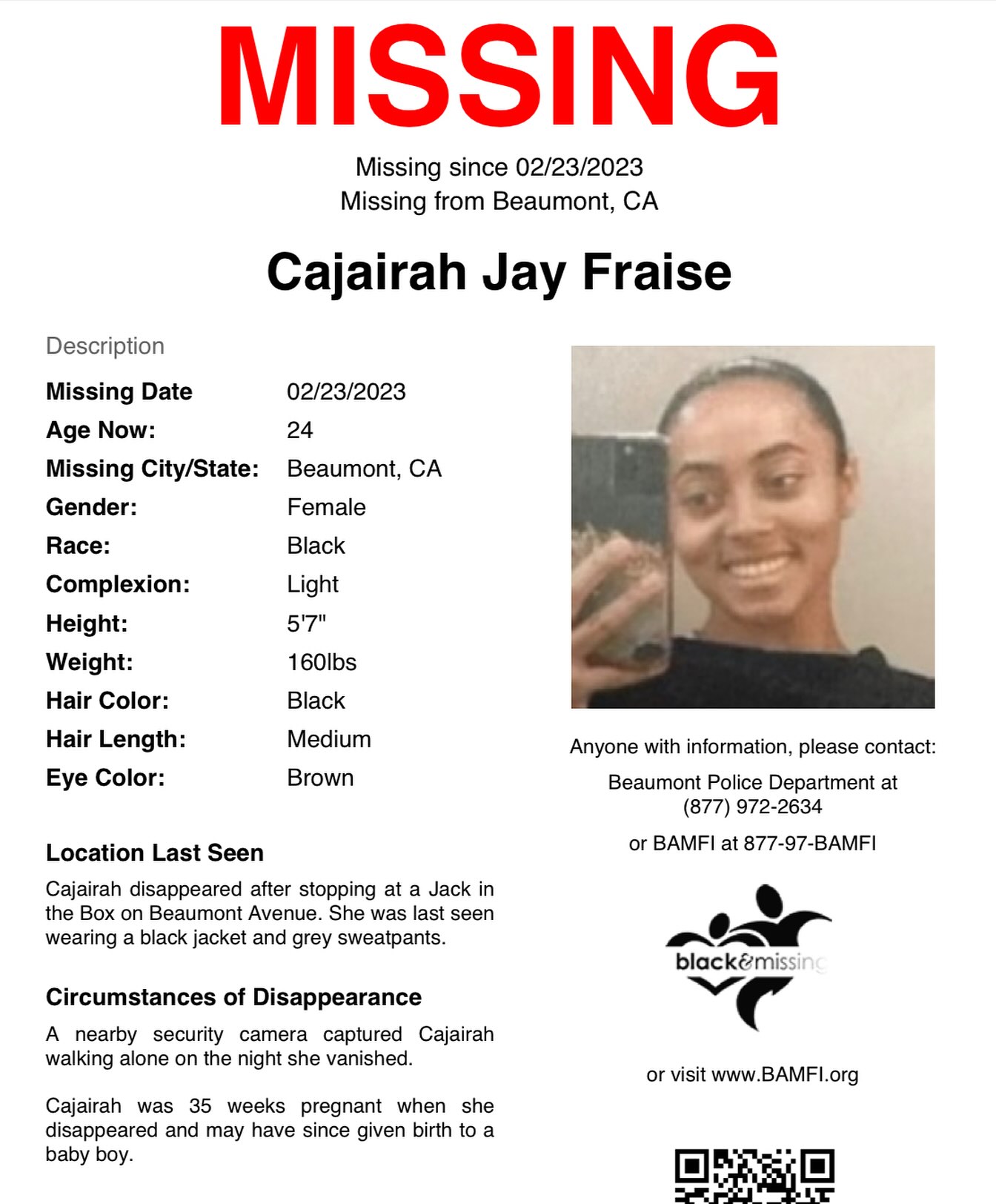
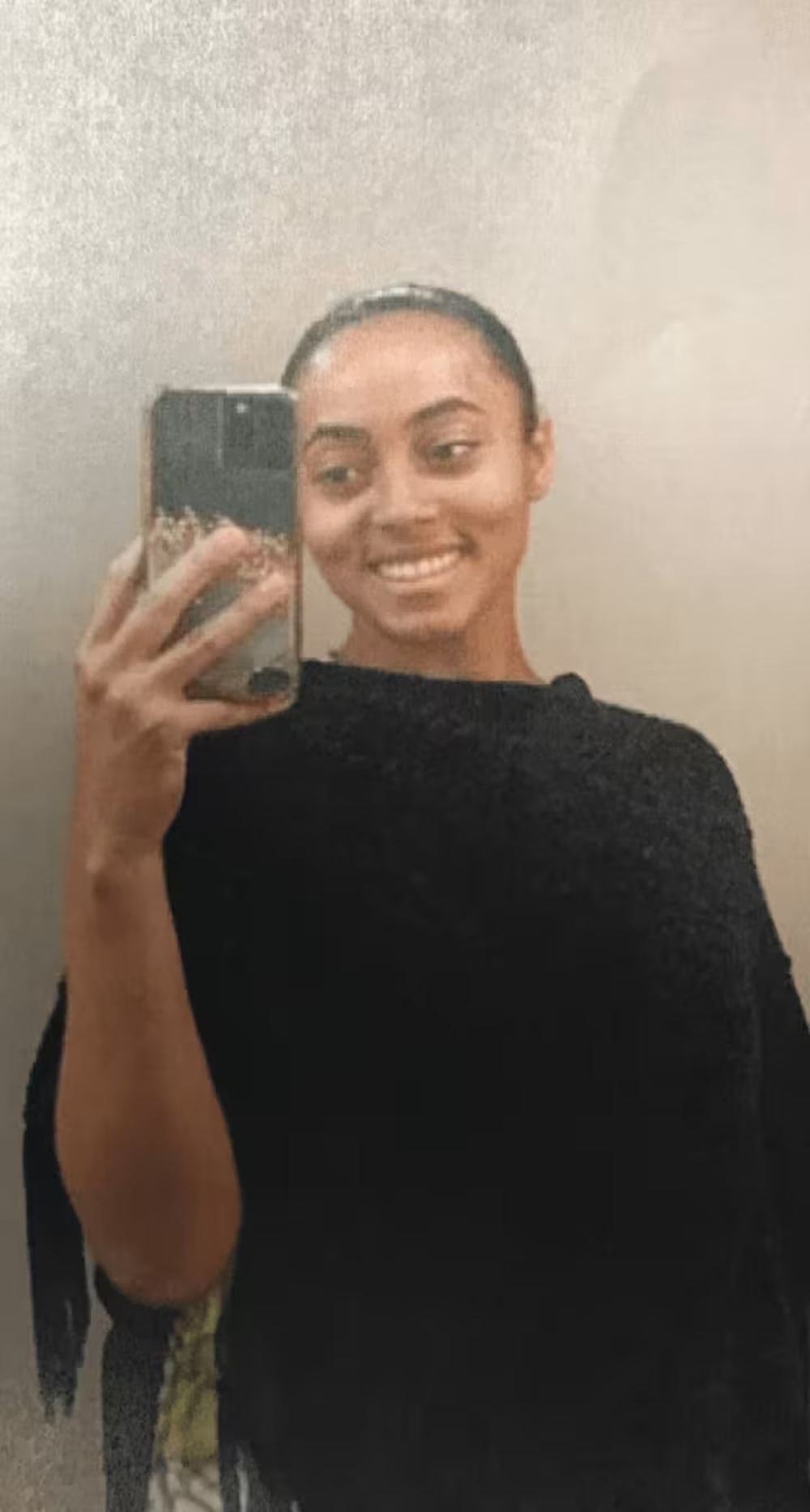
To see the disparity in relief, you don’t need an abstract debate about news values. You can track the arc of another disappearance: that of Cajairah Jae Fraise, a 22-year-old Black woman, 35 weeks pregnant, who vanished in Beaumont, California, on February 23, 2023.
You can put the cases side by side—not because they are identical (they are not), but because comparison is often the only way the system’s hidden assumptions become visible.
One case is treated like a crisis that implicates the entire community, a threat to public order that warrants federal involvement and repeated national coverage.
The other becomes a story whose oxygen supply depends on family fundraising, local outlets, and the occasional burst of attention from a regional station or a social-media account dedicated to the missing.
The public learns, through repetition, what is supposed to matter. And then the system allocates resources accordingly.
Cajairah Fraise leaves a van, and then the record begins to thin
Cajairah Fraise’s last confirmed sighting is described in official updates as occurring late at night at a Jack in the Box on Beaumont Avenue. Her parents were present. The Beaumont Police Department later wrote that she was last seen “voluntarily walking away” from her parents’ van shortly after arrival, while her parents were inside the restaurant. (Beaumont CA)
In the early handling of her case, a phrase appears that carries enormous practical consequences: “voluntary missing adult.” In the city’s March 2023 public alert, officers reported that she was entered into California’s Missing and Unidentified Persons Section database, and that detectives began follow-up with family and sought surveillance footage “in hopes of finding additional information.”
It is not that nothing happened. Police wrote that the case was assigned to detectives, that they pursued footage, and that the classification changed as the seriousness became harder to ignore. NBC Los Angeles reported that she was initially listed as a voluntary missing adult but later considered “critical missing,” a label that more accurately reflects the reality of a heavily pregnant woman disappearing days from delivery.
But the question families ask in these cases is rarely whether police did anything. It is whether the system treated the disappearance as an emergency requiring extraordinary mobilization, or as a problem to be managed.
In a one-page statement circulated in response to a police press release, Cajairah Fraise’s family made a claim that echoes through countless cases involving missing Black girls and women: that there was a “low sense of urgency,” that investigative focus was constrained, and that the family was forced into the role of publicist and pressure campaigner.
In June 2023, KESQ reported that the family offered a $100,000 reward for information leading to her safe return, an extraordinary sum for most families to assemble, and a stark illustration of how often private citizens must subsidize public attention.
Contrast that with what the Guthrie family’s public profile effectively guaranteed: immediate access to national platforms, a pre-existing relationship with mass media, and a built-in audience trained to treat the case as both heartbreaking and inherently newsworthy. People magazine’s reporting describes press conferences, FBI participation, public pleas, ransom notes sent to media outlets, and the investigative release of surveillance footage showing a masked individual tampering with a camera.
Even if we accept that the underlying facts differ, the difference in amplification is not incidental. Amplification is itself a form of resource.
The resource that looks like “attention” but functions like manpower
When Dr. Karen Shalev Greene, director of the Centre for the Study of Missing Persons at the University of Portsmouth, writes about “missing white woman syndrome,” she points to a familiar pattern: coverage that privileges white victims—especially those perceived as young, attractive, and middle-class—while minimizing or flattening the stories of people of color. She notes that the bias is not only about volume, but also the “content and quality” of coverage: which cases make front pages, how many words get devoted, and what language frames the missing person as sympathetic or suspect.
Her key argument is the one journalists often resist because it implicates their own industry: in an “attention economy,” engagement is monetized. News organizations align stories with the demographics and assumptions of their audiences because clicks and viewers translate into advertising revenue.
This is not simply a media critique. It is a policing critique, too, because publicity works as a force multiplier. In the same Portsmouth essay, Shalev Greene emphasizes that missing-person investigations are “resource intensive,” and that publicity appeals help progress investigations—both by generating tips and by signaling to families and the public that “everything is being done.”
Put more plainly: attention is an input that can become leads, which become search warrants, which become arrests, which become closure.
When the media pours attention into a case, it can change the behavior of institutions. Elected sheriffs feel scrutiny. Command staff allocate overtime differently. Tip lines get more calls. Surveillance requests to nearby businesses gain urgency. A case file becomes something you can’t quietly back-burner.
When attention is withheld, a case is left to fight for itself.
That fight is unevenly distributed.
What the research says about who comes home
If “missing white woman syndrome” captures the cultural phenomenon, empirical research shows a measurable consequence: different recovery rates.
A widely cited study published in PLOS ONE and indexed by the U.S. National Institutes of Health analyzed recovery chances for missing children and found that Black children had lower daily recovery rates than non-Black children. In the authors’ modeling, the hazard rate at which Black children were found was estimated to be substantially lower—about 24% lower in one model—than the rate for non-Black children, and Black children were described as “about twice as likely” to remain missing by the end of the study’s observation period.
The study is careful about causality. It does not claim a single mechanism explains the disparity. Instead it lays out plausible pathways: differential media attention, socioeconomic differences that shape access to institutional power, and race-dependent law enforcement responses, including the possibility—documented in other crime contexts—that higher-status victims receive more “law,” meaning more investigative effort.
That cautious framing matters. It allows us to avoid simplistic villain stories—one racist editor, one negligent detective—and instead consider a more insidious reality: disparities can emerge from the accumulation of “reasonable” decisions made inside unequal structures.
A case is labeled voluntary because the person is an adult and there is no immediate proof of abduction. A newsroom assigns fewer reporters because the victim has no celebrity hook. A police department balances staffing because the jurisdiction has limited detectives. The public’s memory, shaped by a thousand true-crime specials centered on white victims, makes certain faces feel more familiar, more “urgent.”
And the outcome is that some children are recovered faster, and some remain missing longer.
What’s “appropriate” in one case becomes “exceptional” in another
In the Guthrie case, the public record—based on press reports—shows the machinery of escalation.
Authorities described the scene as concerning. Blood at the exterior porch was publicly confirmed to match Nancy Guthrie’s DNA. Investigators addressed alleged ransom notes that had been sent to media outlets. The FBI offered a reward—reported initially at $50,000 and later at $100,000. And law enforcement executed a federal, court-ordered search warrant on a nearby residence based on a lead, while also conducting traffic stops and towing a vehicle near the search area.
In other words: public evidence, public updates, public mobilization.
In Cajairah Fraise’s case, the public record reads differently. Police updates emphasize database entry, follow-up interviews, and requests for surveillance footage, with later messaging framed as “continuing efforts.” The state attorney general’s missing-person page provides basic descriptors and a contact number—an important tool, but also a minimalist one, the kind of standardized template that can feel like both lifeline and bureaucratic endpoint.
This contrast is not proof that one department cared and the other didn’t. It is proof that the system can dramatically expand—or constrict—what “all hands” looks like, and that the triggers for expansion are not evenly available to everyone.
Savannah Guthrie’s family could command an audience. Cajairah Fraise’s family had to build one.
The throughline: Two timelines, two megaphones
A useful way to think about resources is to track what happens in the first week, because early momentum shapes everything that follows.
In a high-profile case, the first week often includes daily coverage, prominent photos, repeated identification of the missing person, calls for tips, clear contact information, and sometimes dramatic public pleas that help keep the story alive. In the Guthrie case, People’s reporting describes press conferences, repeated national updates, dissemination of investigative details, and a rapid evolution of the narrative into a kidnapping with an active manhunt feel.
In a low-profile case, the first week can be where the story quietly dies. Even when law enforcement works diligently, the public may never know. News cycles move. Posters circulate in a limited radius. Social media posts sink. The missing person becomes a name known intimately by family and friends—and scarcely at all by everyone else.
Cajairah Fraise did receive local coverage, including by NBC Los Angeles. But “local coverage” is itself a category of inequality: it depends on geography, newsroom staffing, and whether an editor decides a missing pregnant Black woman is a story that “travels.”
Nancy Guthrie’s story traveled immediately because the media infrastructure to carry it already existed.
This is the hard truth about representation. It is not only who appears on the news. It is who is granted the capacity to summon the nation.
The numbers that don’t comfort, but do clarify
National missing-person data is often misunderstood because “missing” includes everything from runaways to custody disputes to endangered disappearances. But the FBI’s NCIC reporting provides one crucial anchor: volume.
In 2024, NCIC had 93,447 active missing-person records as of December 31, and more than 533,000 records entered during the year. For juveniles (0–17), NCIC’s 2024 entry table shows large counts across race categories, with tens of thousands of entries for Black children as well as White children—a reminder that “missing” is not a rare edge case, but a persistent feature of American life.
The National Center for Missing & Exploited Children, which assists with cases nationwide, reports extensive involvement in missing-child reports—including a major share related to children missing from care—and publishes breakdowns by age, race, and state.
These statistics do not tell us why a particular family feels abandoned. But they do tell us that the scale of the problem demands more than episodic sympathy. If hundreds of thousands of records are entered in a year, then media attention will always be selective. The only question is whether selectivity will mirror racial hierarchy—or resist it.
How narratives decide who is “innocent enough” to search for
In missing-person coverage, “innocence” is often constructed through a familiar set of cues: a wholesome photograph, a tidy backstory, a stable family structure, a neighborhood that reads as “safe,” and a public perception that what happened is an intrusion into an otherwise orderly life.
In the Guthrie case, public reporting emphasizes vulnerability: age, health, lack of medication, a church service she missed, and a family pleading for answers. The narrative is legible to mainstream audiences because it aligns with a cultural script in which victimhood is unquestioned.
In cases involving Black girls and young women, especially those who are poor or presumed to have left voluntarily, the narrative is frequently contaminated by suspicion. If she walked away, was she running? If she was outside late, was she involved in something? If her family isn’t polished, is the story “messy”? If she is older than 18, does she “count” as endangered?
These questions are not neutral. They are the mechanisms through which empathy is rationed.
And once empathy is rationed, resources follow.
The PLOS ONE study does not require us to believe that every investigator is biased; it only requires us to admit that outcomes vary systematically by race. The Portsmouth analysis does not require us to believe that journalists consciously choose whiteness; it only requires us to see how media economics and audience assumptions reward certain stories.
Together, they map the terrain where families live: a place where “missing” is not a single category, but a hierarchy of urgency.
The family as search engine
When Cajairah Fraise’s family offered a $100,000 reward, it functioned as more than an incentive. It was a substitute for the megaphone they did not have.
Rewards are often portrayed as a law-enforcement tool. In practice, in many cases involving marginalized families, rewards are a form of privatized policing: families funding the public’s attention, paying for billboards, printing flyers, traveling to organize searches, hiring private investigators if they can. The family becomes its own media team and investigative coordinator, because the system’s default posture is not expansion but triage.
In the Guthrie case, the reward is attached to federal authority and amplified through national reporting. In the Fraise case, the reward becomes a story in itself—a local headline that briefly spikes attention but cannot guarantee sustained coverage.
This is one of the cruel paradoxes of missing-person cases in America: the families with the least money often need the most amplification, and the families with the most amplification are often the ones least forced to pay for it.
Why “representation” is not the soft part of this story
There is a tendency to treat media bias as an ethical issue—important, but ultimately about tone, fairness, optics. The harder argument is that representation can affect outcomes.
Shalev Greene writes that publicity appeals help find missing persons and progress investigations, and that they also reassure families that “everything is being done.” Reassurance is not trivial. It is a component of trust, and trust is a component of cooperation. Families who believe they are being dismissed may be less willing to share sensitive information; investigators who feel unsupported may be more cautious about allocating overtime; communities who see a pattern of neglect may disengage from institutions.
The PLOS ONE study points directly to differential media attention and differential police resources as plausible reasons why race and gender differences in recovery might exist.
So when the media overrepresents one demographic category—white victims—and underrepresents Black children and women, it is not merely telling an incomplete story about American suffering. It is potentially reshaping the probabilities of return.
That is the part of “missing white woman syndrome” that deserves to be said without euphemism: attention can be a lifeline, and the lifeline is unevenly handed out.
What would it look like to make the system behave the same way for everyone?
If the Guthrie case represents the system at its most mobilized—rapid escalation, federal involvement, high-dollar reward, repeated briefings, aggressive pursuit of leads—then the question is not whether that response is “too much.”
The question is why it is treated as special.
A pregnant 22-year-old disappearing days from delivery is, on its face, an emergency. Yet the early classification as voluntary missing adult suggests how easily the system’s first interpretation can narrow what follows.
Reform proposals often focus on a single lever: make the media cover more cases; train police on bias; increase funding for missing persons units; standardize AMBER Alert-like tools. Each matters. But the deeper work is structural: building processes that do not rely on celebrity adjacency, whiteness, or audience familiarity to justify urgency.
It would mean that the default assumption in a disappearance—especially where vulnerability is present—tilts toward endangered status until proven otherwise, rather than “voluntary” until tragedy is undeniable.
It would mean that newsrooms treat missing Black children as a standing beat—covered with the same persistence and narrative care given to high-profile white victims—rather than as occasional exceptions that require a viral hook.
It would mean that databases and posters are not the endpoint of institutional effort, but the baseline.
And it would mean acknowledging, as Shalev Greene urges, that journalists and editors have agency: they can choose to “expose us to more cases from a variety of ethnicities and social groups,” and they can do so in ways that change what the public thinks missingness looks like.

The hardest comparison: What the public is taught to imagine
In the Guthrie case, the public is given a cinematic frame: a masked figure, a tampered camera, ransom notes, blood on a porch, agents moving through a crime scene. The story is built for television and for a social-media timeline: clear stakes, clear villainy, a family with a recognizable face to deliver the plea.
In the Fraise case, the public is given ambiguity: a young woman “walking away,” a late-night drive-thru, a family demanding urgency, and a case that slips in and out of local coverage. Ambiguity is not an argument against coverage; it is often the reason coverage is necessary. But ambiguity is harder to package. It requires more reporting, more time, more commitment to a person whose story does not arrive pre-scripted.
So the public learns, again and again, to imagine missingness in one dominant form: a white victim who looks like the audience’s daughter, sister, neighbor, self.
And that imagination, repeated across years, shapes what feels “urgent,” what feels “tragic,” what feels like “news,” and what feels like background noise.
When Black children go missing, the nation is often not trained to see it as a rupture. It is trained to see it as part of the landscape.
That training is lethal.
What accountability looks like when there is no closure
It is possible that Nancy Guthrie will be found, and that the public will eventually learn what happened. It is possible, too, that her case will join the long list of disappearances that never resolve, even with enormous attention.
But attention changes the afterlife of a case. It creates a record. It forces periodic updates. It builds an archive that makes institutional neglect harder to hide.
In Cajairah Fraise’s case, the public archive is thinner and more fragmented: a police alert, an update, a state database page, a family statement, intermittent local reporting.
If you want to understand the lived experience of racial disparity, look at who has to assemble their own archive while grieving.
This is why families talk about representation as if it were oxygen. Because it is.
A final measure of urgency
The most uncomfortable part of this story is that the Guthrie response shows what the system can do. It shows what is possible: rapid escalation, persistent coverage, multi-agency coordination, and public-facing communication that treats the missing person as someone the public has a duty to help bring home.
The Fraise disappearance shows what the system too often chooses to do instead: narrow the frame, limit the amplification, and leave families to fight for attention in a market that prices Black suffering cheaply.
Research helps name the pattern. The Portsmouth essay calls the phenomenon what it is: racial bias, reinforced by the business model of media, and expressed in who gets covered and how. The NIH-indexed study quantifies the consequence: lower recovery odds for Black children, even after accounting for other factors the researchers can measure.
But families do not need studies to know what they are living.
They know it in the silence after they call a newsroom and no one calls back.
They know it in the way “voluntary” clings to a file, reshaping the urgency of every next step.
They know it in the way posters fade on telephone poles while a national story refreshes itself every day.
And they know it because, in America, being missing is not the only crisis.
Being unseen is the other one.