




Can we look at the bridge and see not only the spectacle that was staged there, but the life that had to continue afterward—somewhere, somehow.
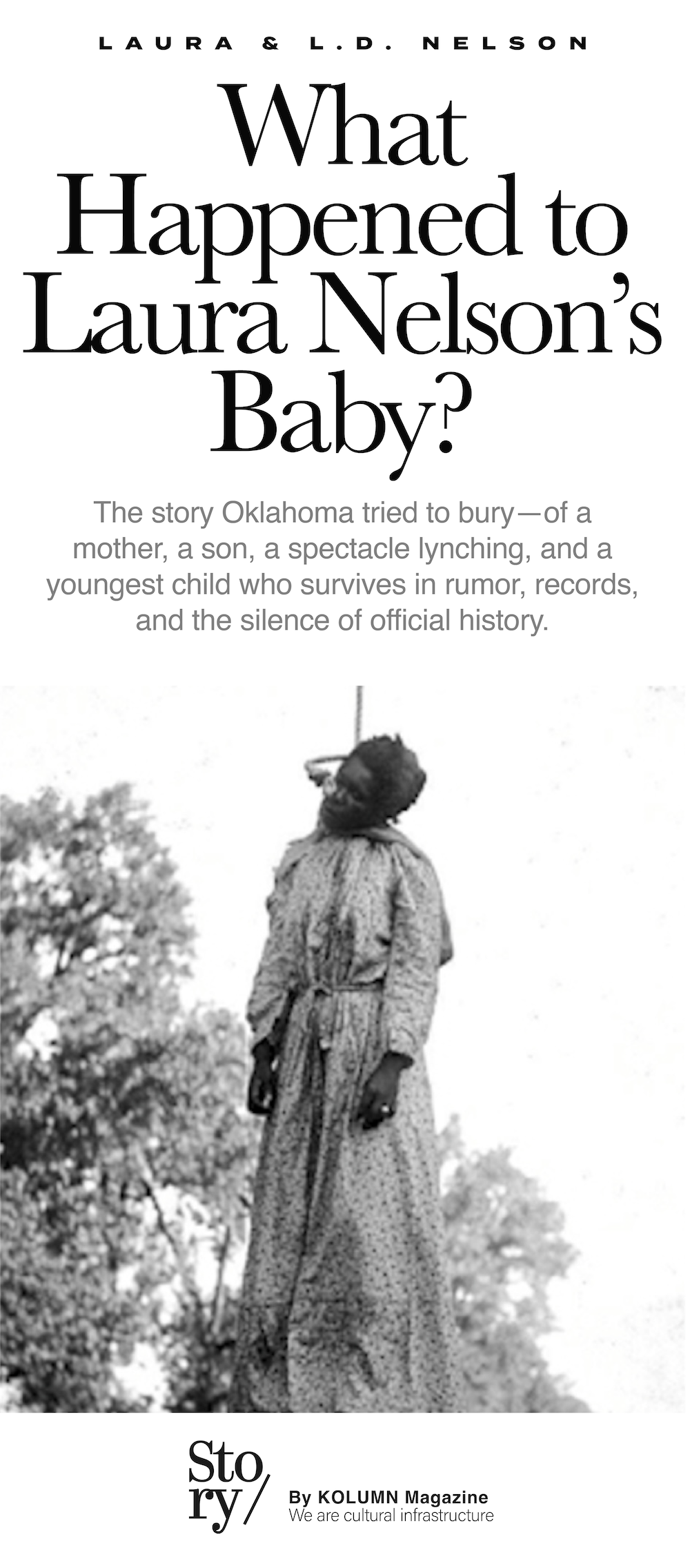
Can we look at the bridge and see not only the spectacle that was staged there, but the life that had to continue afterward—somewhere, somehow.
By KOLUMN Magazine
If you want to understand how racial violence functioned as governance in early Oklahoma, you don’t begin with a court docket. You begin with a bridge.
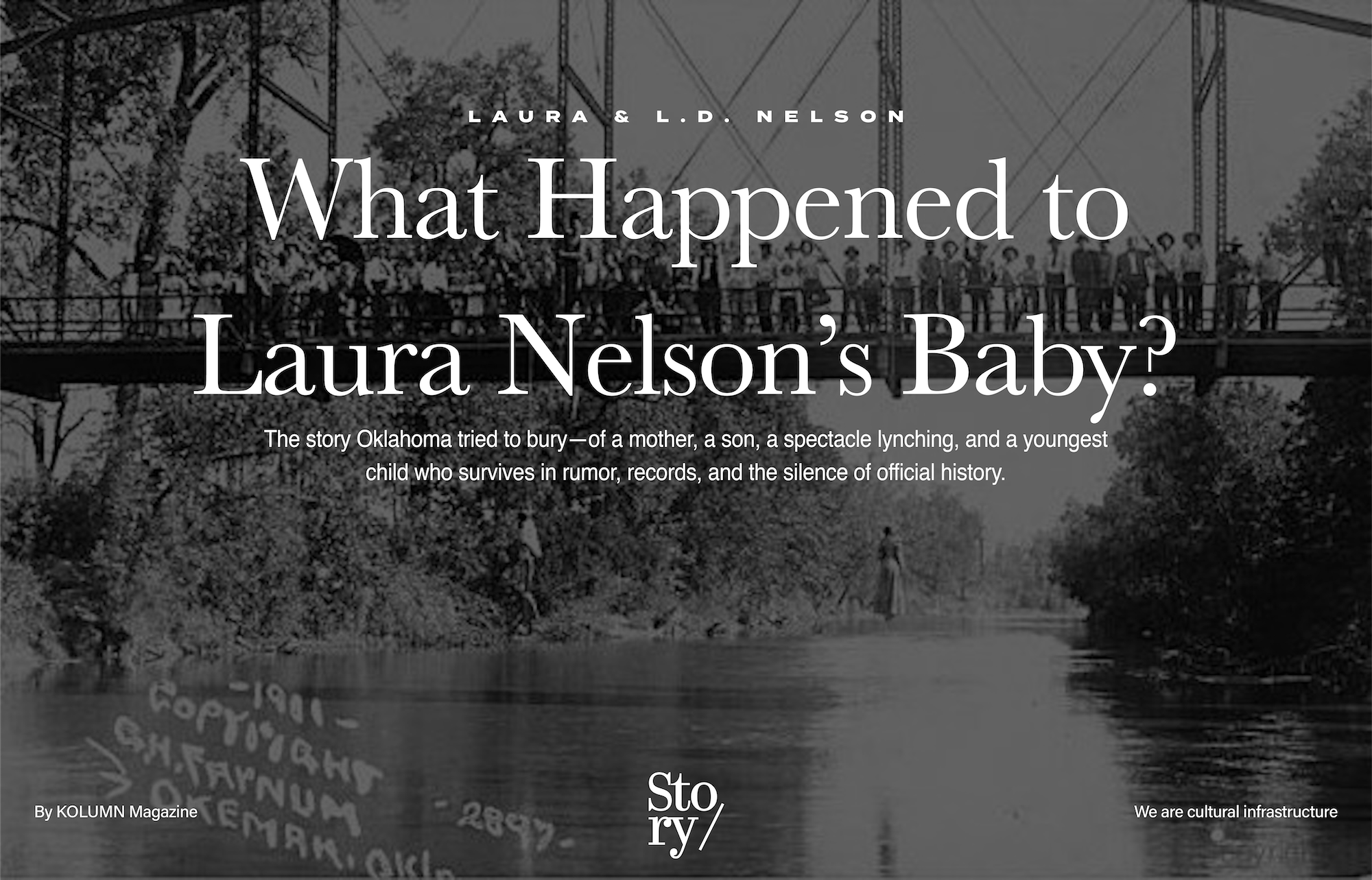
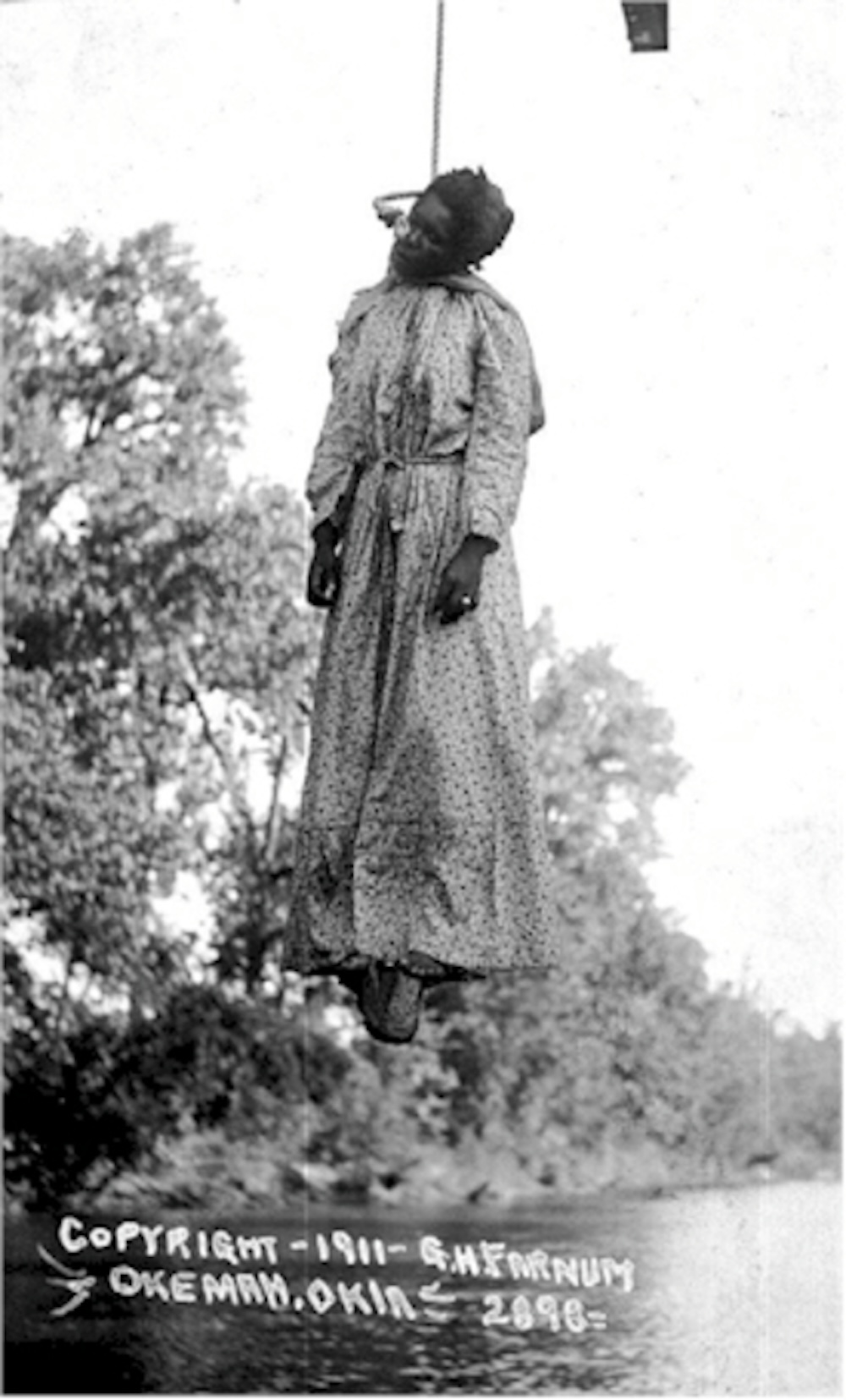
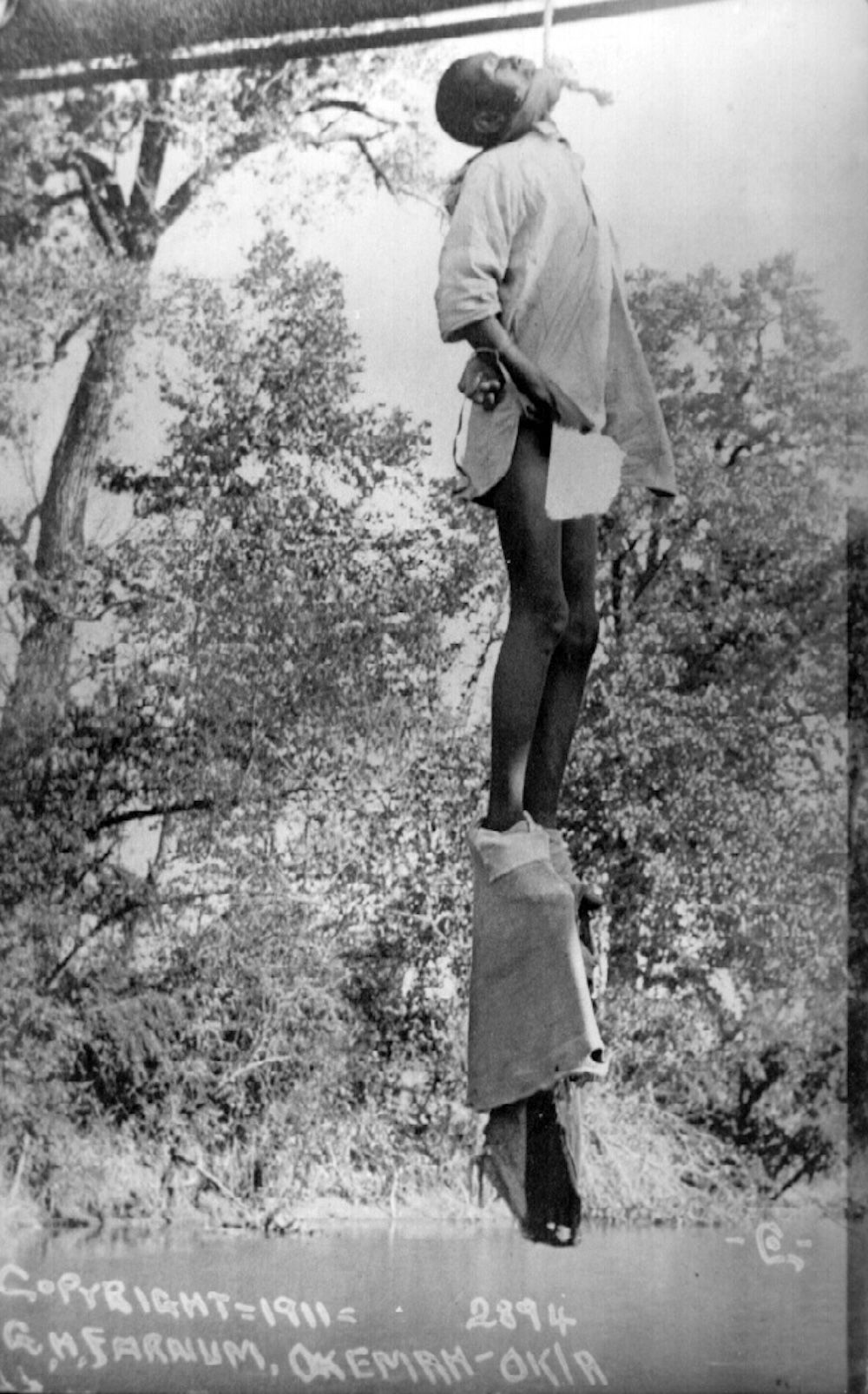
The structure stood at Yarbrough Crossing on the North Canadian River—also called the Canadian in many accounts—along what local reporting described as the old Schoolton road, several miles from Okemah. On the morning of May 25, 1911, after Laura Nelson and her son, L.D., had been hanged beneath the bridge’s center span, residents gathered as if attending a public ceremony. In at least one surviving image, the bridge becomes a stage: a line of onlookers, clustered shoulder to shoulder, staring out toward the photographer’s position; the river below; and, suspended beneath, two bodies reduced to an object lesson.
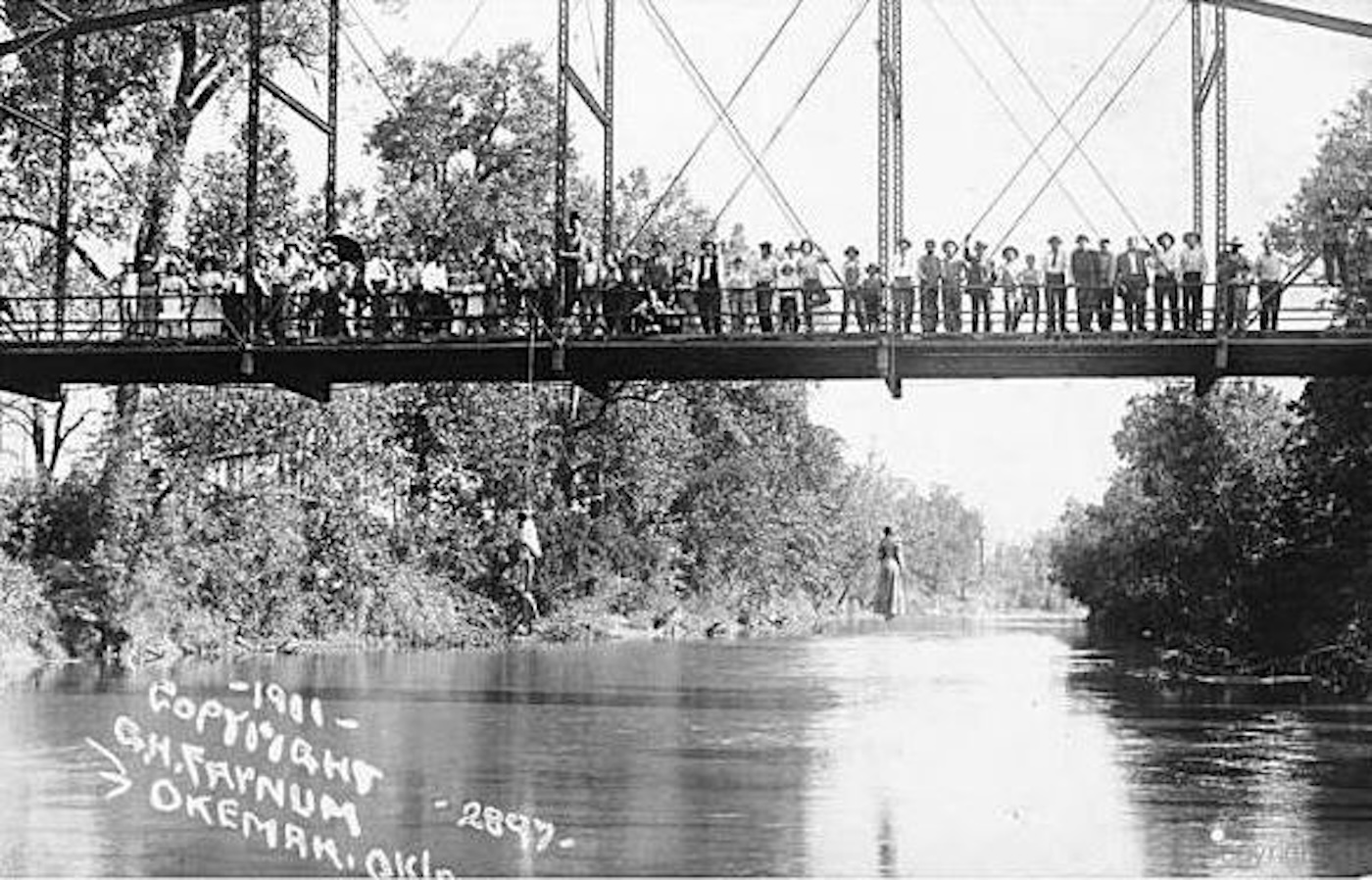
The photographer was George Henry Farnum, proprietor of Okemah’s photography studio. The pictures did not simply document a crime. They became commodities—reproduced as postcards, circulated beyond county lines. The crowd and the camera collaborated to turn murder into a civic performance. The event was not merely tolerated; it was packaged. A terror ritual, developed, printed, sold.
That is part of what makes the lynching of Laura and L.D. Nelson so enduringly disturbing: the evidence survived. Unlike so many acts of racial terror—whispered about, half-denied, buried in local euphemism—this one left an archive of images that refuses to let Oklahoma pretend it does not know. The photographs are among the few known surviving images of a Black woman lynching victim, a rarity that has forced historians to confront what communities worked to normalize: the public killing of a mother.
But the images also intensify a second horror, one less visible than rope or river: the possibility that a youngest child was present—an infant or toddler—when the mob took Laura and L.D. from the Okfuskee County jail. Depending on which account you follow, that child was either left alone at the lynching scene, later carried into town by someone in the crowd; or found in the river; or raised quietly by a local Black family; or absorbed into the paper-shredding machinery of “informal adoption,” name changes, and censuses that reduced Black children to blanks.
In other words: the most important witness to the lynching may have survived it, and then disappeared anyway.
That is the throughline this story demands: not just what happened on the bridge, but what happened after—to the child who, if the reports are true, lived because the mob was finished with her, not because anyone protected her. And because Oklahoma’s racial violence was never only about the dead. It was about the living—especially the children—forced to reorganize their lives around terror, absence, and an official record that rarely bothered to keep them whole.
Oklahoma’s founding bargain: Land, law, and the management of race
Oklahoma entered the Union in 1907 with booster mythology: a new state, new towns, opportunity on the plains. But the reality was a founding bargain with white supremacy. The legal architecture of Jim Crow was not an imported disease that arrived later; it was written into early governance, normalized with speed, and defended in the language of “order.”
One of the first and most symbolic moves was segregation in public life. Oklahoma’s Senate Bill One—passed soon after statehood—codified racial segregation in rail travel and signaled a broader intent: that the state would modernize without democratizing. Black Oklahomans protested; the law stood for years, a state-sanctioned assertion that citizenship would be tiered.
At the ballot box, the state pursued the same objective through different means. In 1910, Oklahoma adopted a voter registration scheme that paired literacy tests with a “grandfather clause,” crafted to exempt many white voters while ensnaring Black voters—an attempt to nullify the Fifteenth Amendment without saying so out loud. The U.S. Supreme Court struck the scheme down in Guinn v. United States (1915), but the damage was both immediate and instructive: Oklahoma’s leaders were willing to engineer democracy to keep Black political power small.
This was the environment in which all-Black towns like Boley existed—extraordinary experiments in self-governance, business creation, and mutual aid, and also refuges from a state that signaled, again and again, that Black advancement would be treated as a problem to be managed. Boley’s fame as a place of Black autonomy did not protect its residents from the spillover of terror in neighboring communities. In fact, the existence of Black towns often sharpened the resentment of white counties eager to remind Black Oklahomans where power truly resided.
Statehood-era Oklahoma also sat at the intersection of other violent histories. It was built atop Indigenous dispossession: the Indian Removal era, then allotment policies that broke communal lands, then the land runs and settlement mania that repackaged theft as opportunity. The result was a jurisdiction obsessed with property, race, and control. When violence came—as it did repeatedly—it was often justified as protection of the social order, the sanctity of white womanhood, the integrity of law. Yet the violence frequently occurred with law enforcement nearby, law enforcement participating, or law enforcement shrugging afterward.
This is what racial terror lynching functioned as: a shadow legal system, public enough to intimidate, unofficial enough to evade accountability. The Equal Justice Initiative, which has documented racial terror lynchings nationally, places Oklahoma among the states where this violence was not an anomaly but a pattern—dozens of victims across decades, with local impunity as a recurring feature.
Laura Nelson’s story unfolded inside that founding bargain. The question of her child’s fate is inseparable from it.
The Nelson family: Migration, poverty, and the precarity of being Black in “new” Oklahoma
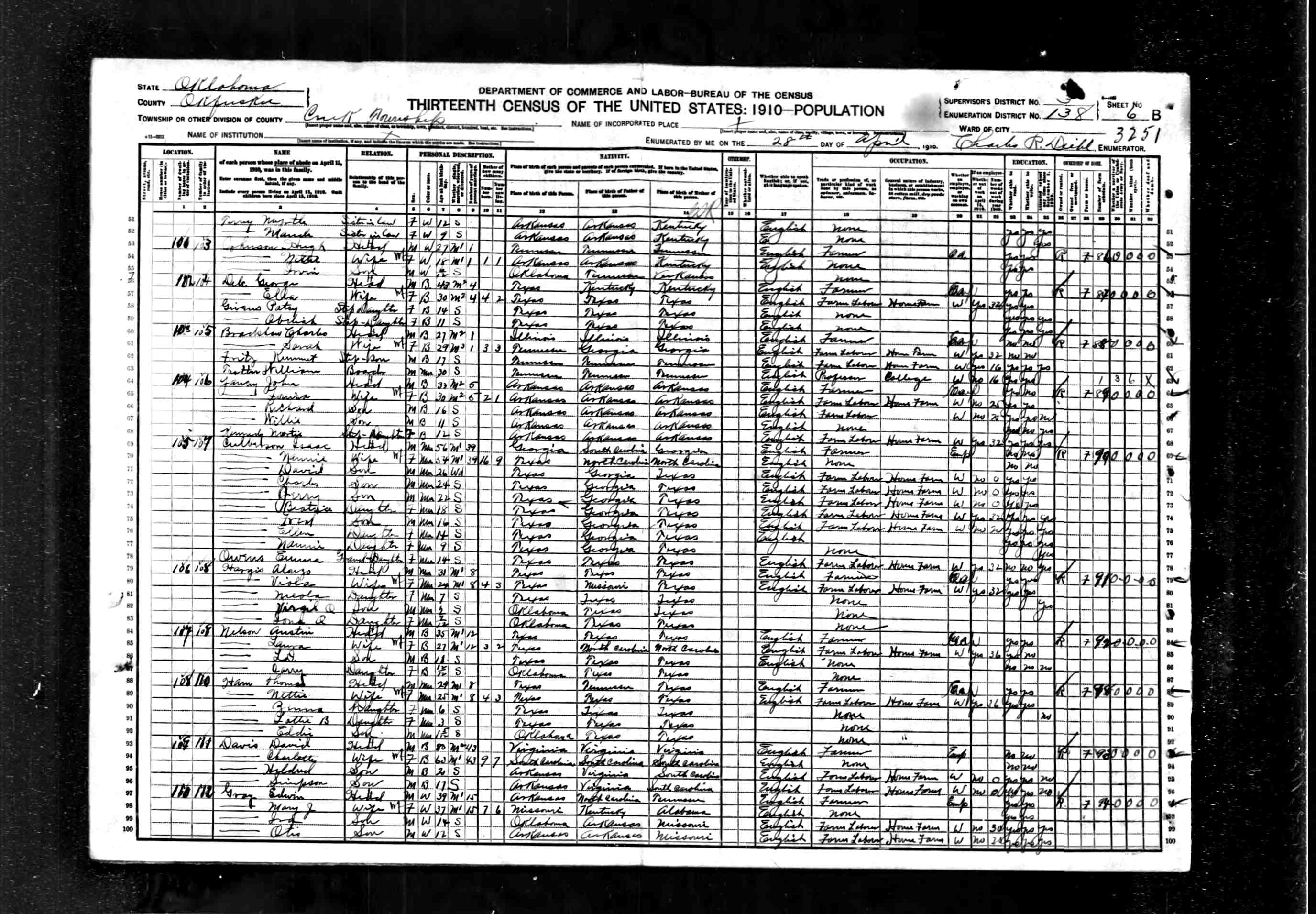
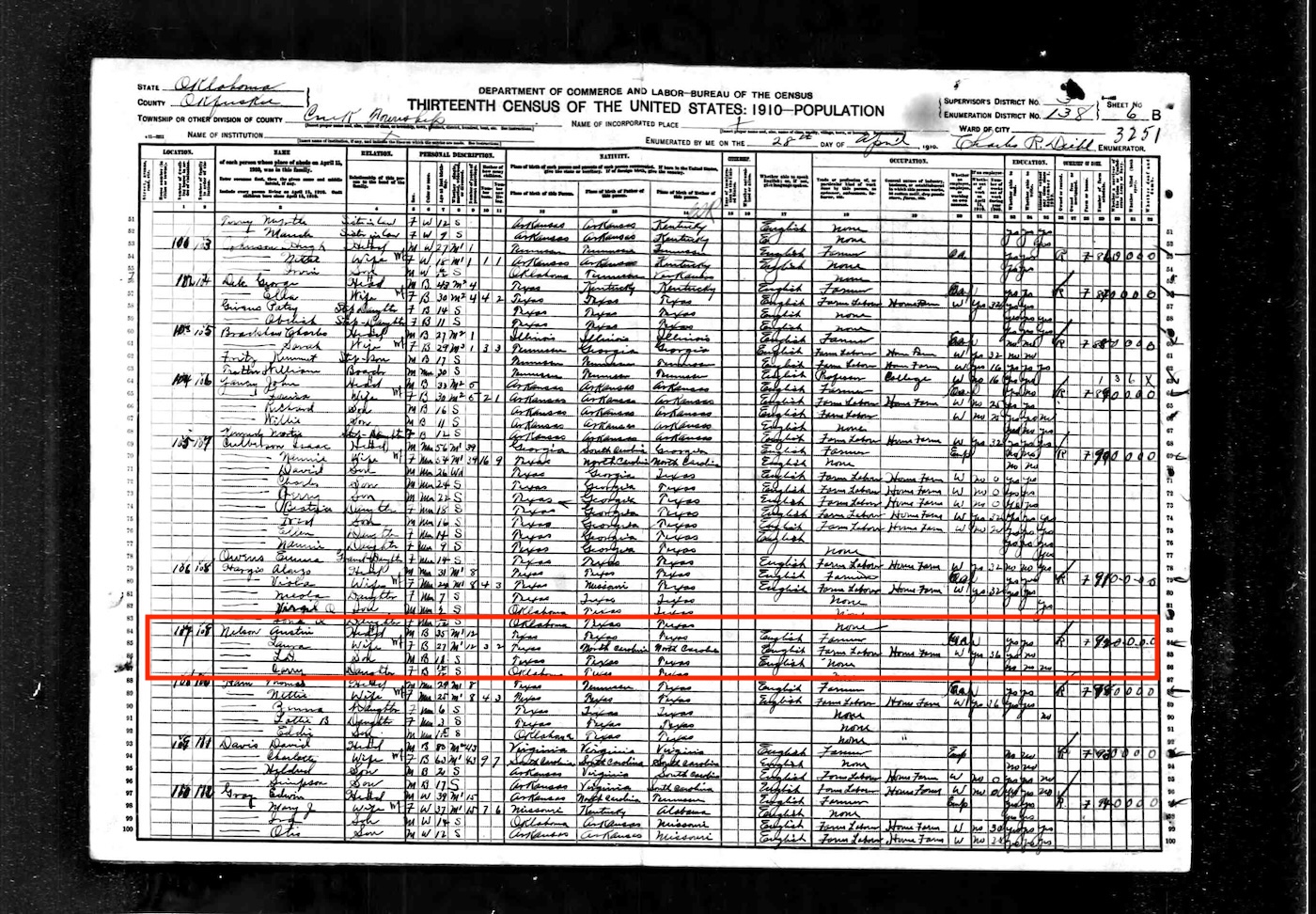
Laura Nelson and her husband Austin appear in records as part of a broader Black migration within the post-Reconstruction South and Southwest: families moving in search of land, work, and a degree of safety they could not find elsewhere. According to census-based research, the Nelsons were connected to Bosque County, Texas, before living in Okfuskee County, Oklahoma by 1910, with children including L.D. and a young daughter, Carrie.
The details matter because they illuminate the family’s vulnerability. They were not insulated by wealth. They were not protected by political connections. They lived in a state where Black poverty could be read as criminality, and where accusations—especially those involving alleged violence against white Oklahomans, could lead to state-sanctioned death sentences, whether or not a trial ever occurred.
The precipitating incident: A search, a shot, and the speed of Oklahoma’s “justice”
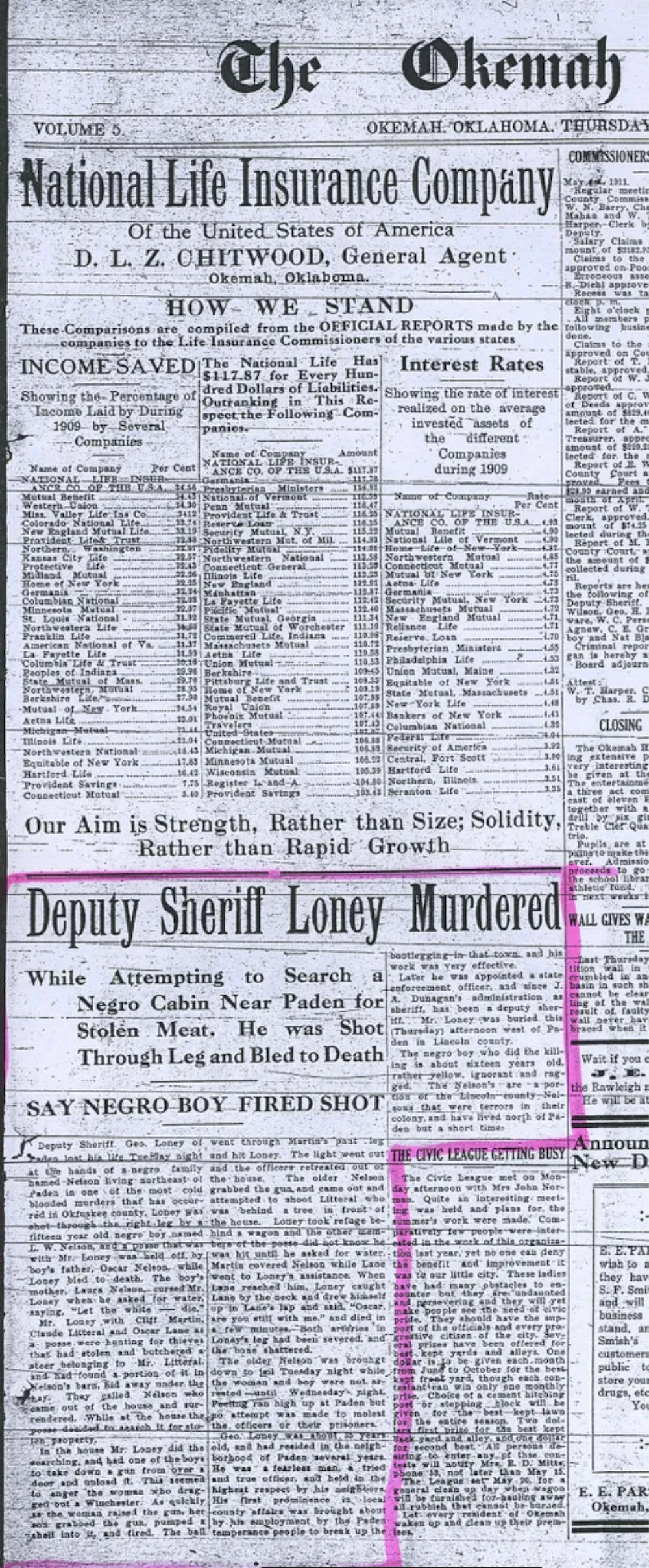
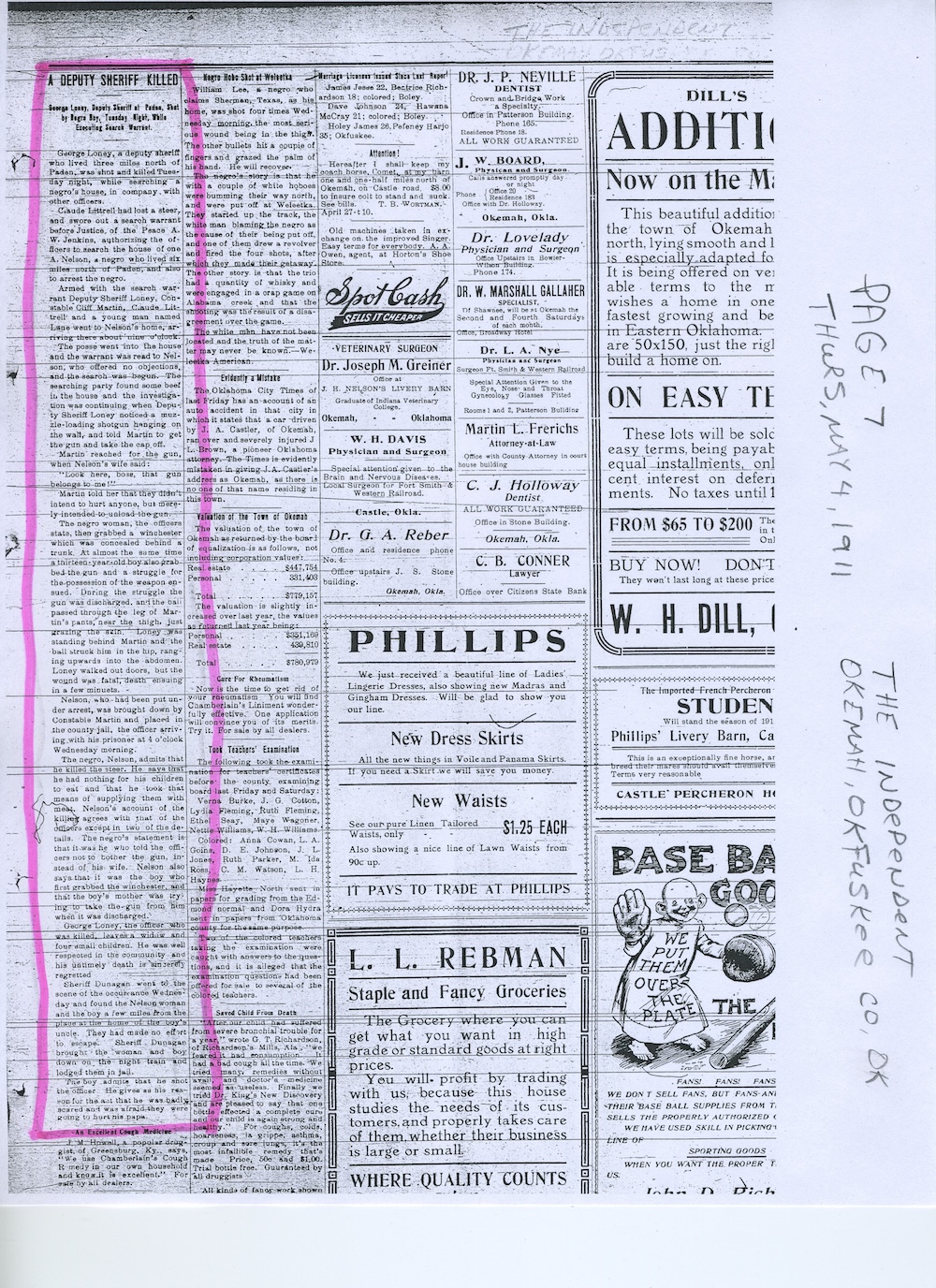
The official chain of events that culminated in the lynching of Laura and L.D. Nelson began, according to contemporaneous reporting and later historical reconstructions, with an allegation of livestock theft and a late-night confrontation at the Nelson family’s rural home near Paden in Okfuskee County. The details, drawn from period newspapers and summarized in modern accounts, illustrate how quickly a localized dispute escalated into a capital crime narrative that placed the entire Nelson family in mortal danger.
On the evening of May 2, 1911, Deputy Sheriff George Loney, accompanied by Constable Barney Burkhart (sometimes spelled differently in various accounts), went to the Nelson residence to execute a search warrant. A white farmer in the area, Charles Cox, had reported the theft of livestock—most commonly described as a steer or cow. Authorities suspected that stolen meat or evidence of the missing animal might be found at the Nelson property. Such accusations were not uncommon in early statehood Oklahoma, where disputes over livestock were treated seriously and where Black families were especially vulnerable to suspicion.
What happened next was described in conflicting but broadly consistent terms: during the attempt to serve the warrant, a confrontation occurred inside or near the Nelson home. Shots were fired. Deputy Loney was struck by a bullet and later died from his wounds. Some accounts assert that L.D. Nelson, approximately fourteen years old at the time, fired the fatal shot; others suggest that Laura Nelson herself may have fired in defense of her son or in response to the intrusion. The precise sequence—who fired first, under what immediate threat, and whether the officers properly identified themselves or escalated the encounter—remains uncertain, filtered through white press accounts that often presumed Black guilt and downplayed context.
What is clearer is the speed with which the criminal narrative hardened. Following Loney’s shooting and subsequent death, arrests were swift. Laura Nelson and L.D. were taken into custody and transported to the Okfuskee County jail in Okemah. Laura’s husband, Austin Nelson, was also arrested but ultimately prosecuted separately and sent to the state penitentiary in McAlester. Laura and L.D., by contrast, were held in the county facility, facing charges connected to the deputy’s death. In the racial climate of early twentieth-century Oklahoma, the charge itself—killing a white law enforcement officer—functioned less as an accusation to be adjudicated than as a public trigger. The presumption of guilt was immediate and total.
The jail in Okemah, modest and poorly fortified by modern standards, became the site of a familiar drama in lynching-era America: official custody that provided the appearance of due process while offering little real protection. Reports suggest that tension mounted in the days after Loney’s death. White residents demanded swift retribution. The language in local newspapers signaled outrage and foreclosed nuance. In similar cases across the South and border states, sheriffs sometimes moved prisoners secretly to prevent mob action. In this instance, there is no evidence that Laura and L.D. were relocated to a safer facility, despite the obvious volatility of the charge.
On the night of May 24, 1911, a group of masked men—estimates vary but typically range from a dozen to several dozen—approached the Okfuskee County jail. According to later summaries the mob overpowered or otherwise neutralized the jailer, entered the facility, and removed Laura and L.D. from their cells. The act required coordination: knowledge of the jail’s layout, timing, and the absence or compliance of meaningful resistance. As in many lynching cases of the period, official accounts afterward would characterize the perpetrators as unidentified, their faces concealed, their identities unknown.
Once seized, Laura and her teenage son were transported several miles from Okemah to the North Canadian River bridge at Yarbrough Crossing. There, under cover of darkness, they were hanged from the structure’s span. By dawn, their bodies were discovered suspended above the river, initiating the macabre procession of spectators and photographers that followed.
The progression—from search warrant to gunfire, from arrest to mob abduction, from jail to bridge—unfolded in less than a month. It exemplified the elasticity of “justice” in Jim Crow Oklahoma: formal charges filed, incarceration achieved, and then the law abandoned when public vengeance demanded spectacle. The killing of Deputy Loney became the legal pretext; the lynching of Laura and L.D. became the extralegal verdict.
The missing child: What the sources say—and what they cannot prove
The most emotionally and historically fraught question in the Nelson case is not simply who killed Laura and L.D. It is: was there a youngest child with Laura in jail, and if so, what happened to that child after the lynching?
The answer is contested, and responsible reporting has to say that clearly. We are dealing with a mix of sources: contemporaneous press; Black press commentary; later historical work; community memory; and modern investigative efforts.
Here is what can be said, carefully, from the strongest available record:
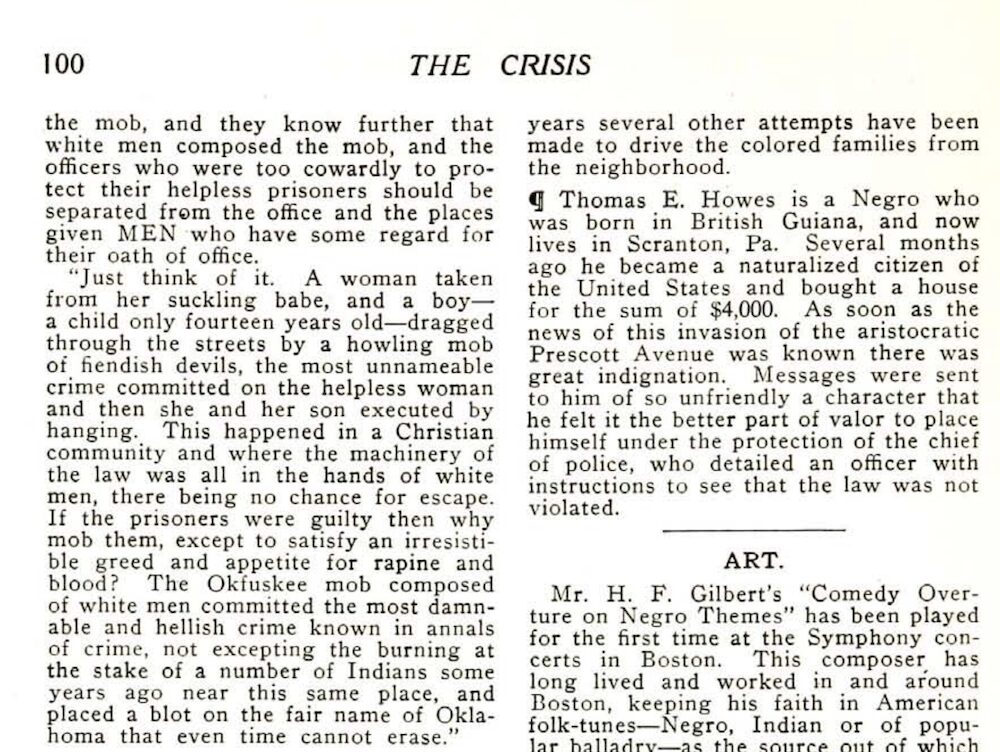
The Black press described a “suckling babe”
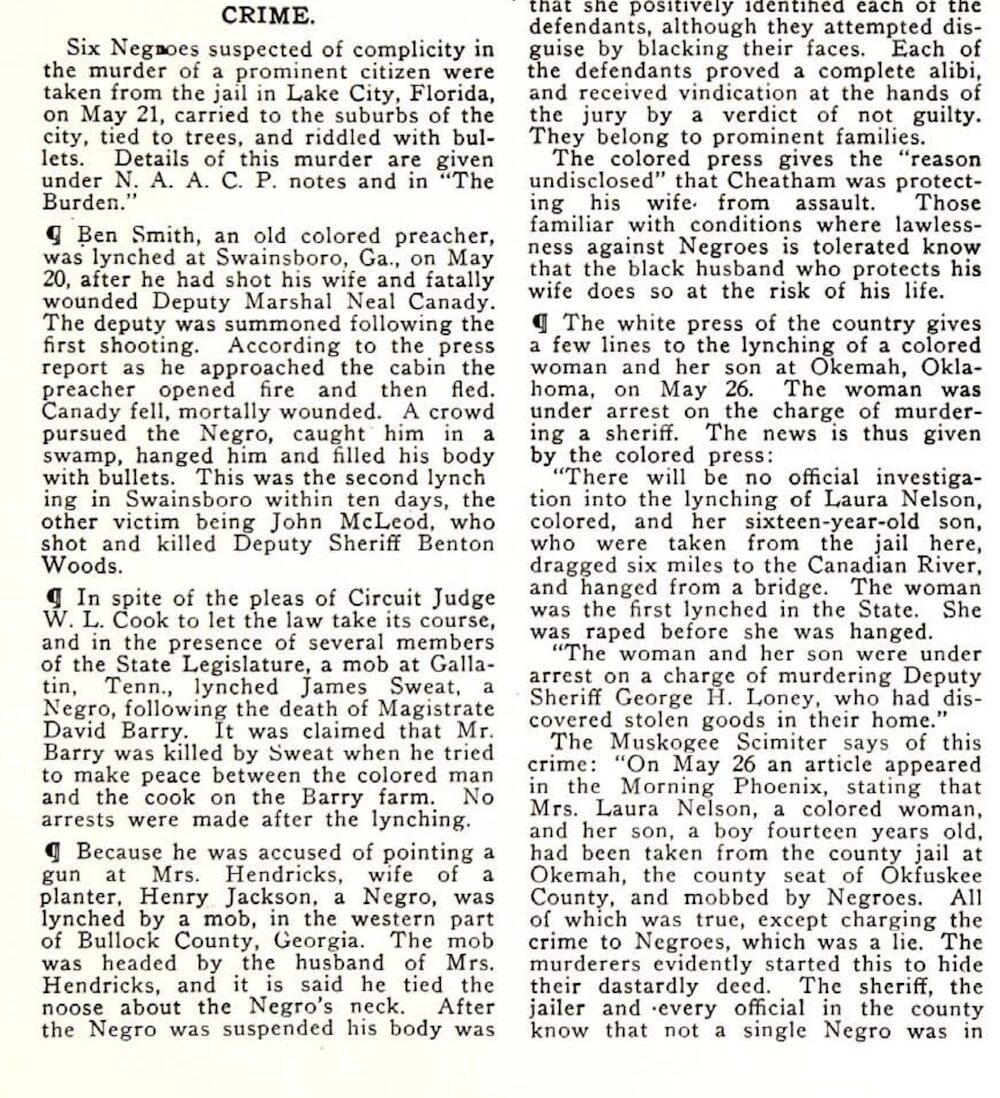
A key strand comes through early NAACP-affiliated reporting and The Crisis, the NAACP magazine, which relayed an account (including a quotation attributed to the Muskogee Scimitar) describing Laura as having been taken from her “suckling babe.” The language is pointed: it frames the lynching not only as murder but as the violent interruption of motherhood—an assault on the idea that Black women’s care relationships deserved protection.
This is not the same as a birth certificate or a court order. But it is significant because it shows that, within weeks or months of the lynching, Black institutions understood (or believed) that an infant had been part of the story—and that white press coverage was inadequate, evasive, or morally anesthetized.
Census evidence shows a young daughter, Carrie
Census-derived summaries indicate that Laura and Austin had children including L.D. and a younger daughter, often identified as Carrie, who was small in 1910. That aligns with the possibility that a toddler-aged child existed in 1911. It does not prove the child was present at the jail or the lynching scene. It does, however, establish that the “child question” is not purely mythic: there was, at minimum, a plausible candidate child in the household.
EJI records “unconfirmed reports” of the child’s fate
The Equal Justice Initiative’s calendar entry on the Nelson lynching states that accounts vary and that reports are unconfirmed regarding the fate of the Nelsons’ young daughter—some claiming she was found drowned in the river, others claiming she was found alive and raised by a local Black family. That summary is valuable precisely because it does not oversell certainty; it preserves the contradiction as part of the historical wound.
Later historical recollections suggest the child was left at the scene and taken in
Secondary accounts compiled in later decades cite a witness description: after Laura and L.D. were hanged, the mob left, and a baby was left there—picked up by someone who brought the child into town, where community members “took care of it.” The version circulating in modern summaries often originates from mid-20th-century retellings and oral memory that may compress details but insists on a core claim: a child survived and was absorbed into local care networks.
Modern Oklahoma reporting emphasizes the “open secret” and continuing investigation
Recent reporting in Oklahoma, including a 2021 NonDoc article about a public panel in Okemah, describes the lynching as an “open secret”—widely known locally but absent from formal curricula and public commemoration. The panel centered work by retired Langston University professor Benjamin Bates and others seeking to surface documentation, memory, and accountability long deferred. While such reporting does not resolve the child’s fate by itself, it demonstrates that the community is now in an active phase of historical reckoning—asking questions that institutions avoided for a century.
Put together, these strands produce the most honest conclusion available today:
There is credible historical reason to believe Laura Nelson had a very young child connected to her custody at the jail in 1911. What happened next is not established with definitive documentation. Competing accounts—drowning versus survival and informal adoption—coexist because the period’s recordkeeping did not prioritize Black children’s continuity, and because terror itself produces disappearance.
That uncertainty is not a scholarly inconvenience. It is part of the crime.
What it meant to “leave a child behind” in Jim Crow Oklahoma
To modern readers, the idea that an infant could be left on the ground at a lynching site sounds impossible—too monstrous to fit into ordinary life. But “ordinary life” in Jim Crow America made room for monstrosity by distributing responsibility until no one claimed it.
A mob could storm a jail. A jailer could say he was helpless. A judge could convene a grand jury. Jurors could fail to “identify” the killers. White residents could bring their children to the bridge to look. A photographer could sell the image. Business could continue.
And if a child survived, the child’s survival could become one more story told in fragments: a neighbor picked her up, someone raised her, she grew up “here,” as one version has it. The community could comfort itself with the thought that the baby did not die, without confronting what it means to have to “pick up” a baby after a lynching like an abandoned object.
But for Black communities, “left behind” had a sharper meaning. It described a recurring afterlife of racial terror: widows, orphans, displaced families, stolen property, and the long administrative erasure that followed. The rope ended a life; the aftermath reorganized many.
In Oklahoma, that reorganization occurred in a state that was actively narrowing Black political power and legitimizing segregation. The lynching of Laura Nelson was not an isolated rural eruption. It was one note in a larger chord: a state defining itself as white-governed, white-protected, and willing to use violence—formal or informal—to keep it that way.
Children bore the costs in specific ways:
They learned that law would not protect their parents.
They learned that “crime” could be a story told about them, regardless of facts.
They learned that their names could be changed, their family lines rewritten, their presence reduced to rumor.
They learned that photographs could outlive them, while their paperwork vanished.
If Laura Nelson’s youngest child was Carrie, and if she survived, then her life would have been shaped by an unusual contradiction: she might have been a living witness to a nationally circulated image of her mother’s death, in an era where white souvenir culture treated that death as entertainment. That is a psychological burden so severe that communities often respond by doing the only thing they can: not speaking of it.
Silence becomes a shelter—and also a trap.
The spectacle and the souvenir: why the postcard matters
The lynching photographs are not only evidence; they are sociology.
In the EJI account, hundreds of white residents came to view the bodies, and some posed for photographs on the bridge. The images later circulated as postcards—an established practice in the lynching era, where the act of mailing the image extended the terror beyond the town limits.
To understand what that means, you have to recognize the dual audience. The postcard was, for many white Americans, a trophy of racial order. For Black Americans, it was a warning delivered through the mail.
The Guardian, writing about lynching’s sadism and the way images circulated, uses Laura Nelson’s postcard as an emblem of how normalized this violence became—so normalized that a stamp could mark it “unmailable,” while the country still found ways to distribute the message.
This is crucial to the “whereabouts of the child” question, because it clarifies what the mob was doing. The mob was not only killing. It was creating a story of domination.
And in that story, a surviving child is a problem—because a child survives to complicate the clean finality of terror. A child grows up and remembers. A child’s existence is proof that the victim had a life beyond the accusation. A child raises the possibility of accountability.
So even if the mob did not intend to “spare” a baby, the system that followed had every incentive to make that baby hard to find later: through informal custody arrangements, through name changes, through the social pressures that taught Black families to protect children by shielding them from the full truth.
A missing child is not a historical accident. It is a predictable outcome of a world structured to erase Black continuity.
The long arc in Oklahoma: From lynching to massacre to political power
It would be a mistake to treat the Nelson lynching as a prelude to “later” violence, as though Oklahoma became racially violent only in the 1920s. Oklahoma was already building a repertoire.
The Oklahoma Historical Society’s encyclopedia notes that segregation was not incidental but systematized; violence and intimidation flared in multiple locales; and the state’s political culture frequently treated Black presence as something to be contained.
The Ku Klux Klan, which gained major strength in Oklahoma in the early 1920s, did not invent this climate. It capitalized on it—presenting itself as a guardian of “Americanism,” morality, and white Protestant power, while practicing intimidation and coercion that reinforced racial hierarchy.
Then came Tulsa.
In 1921, a white mob attacked the Historic Greenwood District—“Black Wall Street”—destroying homes and businesses, killing scores of people (with estimates ranging widely), and leaving thousands homeless. The Oklahoma Historical Society describes the scale plainly: more than a thousand homes and businesses destroyed, and deaths credibly estimated from roughly fifty to three hundred.
Tulsa differs from Okemah in scale, but not in logic. In both, white violence functioned as correction: a punitive act meant to reassert hierarchy. In both, law enforcement’s role has remained a contested and painful subject, with modern reviews describing credible evidence of official failure and, in some accounts, participation.
The connective tissue between 1911 and 1921 is not only ideology. It is technique:
Public intimidation.
Narratives that criminalize Black victims.
After-the-fact investigations that yield no accountability.
Community silence enforced by fear and civic denial.
And, for children, the same brutal inheritance: survival paired with displacement, loss, and the knowledge that public institutions may not treat their suffering as urgent.
When you zoom out, the Nelson child becomes a representative figure—an emblem of how Oklahoma’s racial violence reproduced itself. Not only by killing adults, but by destabilizing Black family structures, scattering children, and creating generations whose genealogies contain sudden breaks: a mother gone, a father imprisoned, a child reappearing in records—if at all—under a different name or household.
So where did the child go? A responsible reconstruction of possibilities
Without claiming certainty the evidence does not support, it is possible to map the most plausible scenarios consistent with the record:
Possibility 1: The child drowned or was killed and later “found in the river”
This version appears in some retellings summarized by institutions like EJI as an “unconfirmed report.”
If true, it would represent the bleakest outcome and would help explain the disappearance: dead children do not appear in later censuses, and the bureaucracy of Jim Crow counties rarely handled Black death with meticulous documentation.
Possibility 2: The child survived and was taken in by a local Black family
This is the competing EJI summary and aligns with later recollection narratives that describe someone picking up the baby and bringing her into town. If true, the child’s later trace would depend on whether she retained her birth name, whether caregivers formalized guardianship, and whether the community maintained silence to protect her.
Possibility 3: The “suckling babe” language refers to a child not consistently captured in surviving records
It is possible the child described in The Crisis reporting was not the same as the daughter identified in census summaries, or that ages and relationships were misreported or compressed. In early 20th-century Black life, record mismatch is common: enumerators guessed; families concealed details for safety; and the paper trail was often less a portrait than a shadow.
Possibility 4: The child survived but was effectively “disappeared” by the mechanisms of informal custody
This is a sociologically plausible scenario even without a single “smoking gun” document. In the Jim Crow South and border states, Black orphans were frequently absorbed into extended kin networks or community care without legal paperwork. The child might appear later as a “niece,” “boarder,” “adopted,” or simply as a child in a household with no indication of her origin.
Each possibility underscores the same reality: the state that could marshal a grand jury could not—or would not—marshal a welfare record that preserved a Black child’s continuity.
That is why the whereabouts question remains unresolved in the public mind: the systems designed to track property and prosecute crime were never designed to protect Black kinship after white violence.
Why the mystery persists: The record as a form of violence
It is tempting to treat the unanswered question as an archival problem. But “missingness” is part of racial terror’s design.
Consider what the Okemah photographs accomplish even today. They preserve the spectacle of death with extraordinary clarity. They do not preserve, with anything like the same clarity, what happened to the baby.
That imbalance is not accidental. White communities that produced lynching postcards were creating a record of domination. They did not create a record of repair.
And the official systems—courts, sheriffs, county clerks—did not rush to preserve Black family narratives either. Instead, they produced familiar outcomes: no indictments, no prosecutions, and a story that dissolves into “unknown men,” even when the community almost certainly knew.
What survives, then, is a grotesque hierarchy of documentation:
The image survives because it served white souvenir culture.
The names of killers disappear because impunity required amnesia.
The child disappears because the state did not recognize her as a subject worth tracking.
This is how terror becomes multigenerational. A lynching kills in one night; the recordkeeping kills again over decades, by denying descendants the ability to fully know where they came from.
Modern reckoning in Okemah: From “open secret” to public history
In recent years, Oklahomans have begun pushing the Nelson case back into public view—not as trivia, not as scandal, but as an indictment of what communities normalized.
NonDoc’s coverage of a 2021 public panel frames the work as part of a broader process: communities can “heal” only by accepting and studying what happened, including details long kept out of textbooks. Benjamin Bates and the Laura Nelson Project are described as attempting to surface the story precisely because the silence has been a form of ongoing harm.
This matters because it changes what “whereabouts” means. We are no longer only asking: where did the child go in 1911? We are asking: where has Oklahoma placed this story in its own identity? What does it mean that a lynching with postcards could be both widely known and formally absent? What does it mean that children in the crowd were visible, but the victim’s child was not?
Public history cannot reverse a lynching. But it can reverse a lie: the lie that these events were aberrations, or unknowable, or irrelevant. It can also model a more ethical relationship to uncertainty. A responsible memorial culture does not invent a neat ending for the baby simply to soothe the living. It holds the contradiction up to the light and says: the absence is part of what was done.
The child as a lens on Oklahoma’s racial violence
Why focus so intensely on a single child?
Because the child forces the story out of abstraction.
Lynching history can become numbers, maps, dates, grim lists. But a child—nursed in jail, if the reports are true; present at the scene, if the witness recollection is true—makes the violence intimate in a way the crowd photograph paradoxically does not. The crowd photo shows many faces, but it can still be processed as “history.” The idea of a child left behind collapses the safe distance.
It also clarifies what racial violence targeted. Terror was not only punitive. It was reproductive: it disrupted Black families so thoroughly that the next generation would grow up inside a lesson.
In Oklahoma, that lesson was reinforced through multiple channels:
Segregation statutes that marked Black life as subordinate.
Voter suppression mechanisms that restricted Black political power.
White supremacist organizing, including the Klan’s rise, that embedded intimidation into civic life.
Mass violence like Tulsa that destroyed Black wealth and displaced Black residents on a massive scale.
Against that panorama, the Nelson child becomes a symbol of a specific Oklahoma inheritance: a state where Black children could be raised in communities that built remarkable institutions—schools, businesses, all-Black towns—while also living under the constant knowledge that law could be turned off, and mobs could become policy.
What ethical reporting can—and cannot—claim
A final note is necessary, because this story is emotionally combustible and historically exploited.
It is possible—too easy, in fact—to turn the missing child into a narrative hook: a mystery that journalism “solves,” a reveal that gives readers closure. But closure is not a journalistic obligation. Accuracy is.
The record—at least the public record available through major institutional summaries supports the existence of a youngest child as a credible possibility and preserves multiple conflicting outcomes.
But without definitive documentation—guardianship papers, later census continuity with unambiguous identifiers, family testimony tied to verifiable records—the most ethical position is to name the possibilities, rank them by evidentiary strength, and explain why certainty is elusive.
That is not a weakness. It is the point.
Because the uncertainty is not random. It was produced by the same racial order that made a lynching a postcard and made a baby an afterthought.
What a bridge remembers, what a state forgets
There are places in America where the landscape seems to hold memory even when people do not. A river crossing. A county jail site. A demolished bridge whose replacement carries traffic without ceremony. In those places, “history” can feel like a polite word for what was never accounted for.
In May 1911, a mob took Laura Nelson and her son from a jail cell and hanged them under a bridge. People gathered. Children watched. A photographer did his work. A grand jury produced nothing. The images survived.
And somewhere inside the story, like a held breath, is the figure of a child—Laura’s youngest—described as a “suckling babe” in Black press accounts, summarized in modern institutional writing as the subject of “unconfirmed reports,” remembered in oral retellings as living, taken in, grown.
If she drowned, the river took her.
If she lived, the state’s recordkeeping did not bother to keep her legible.
Either way, the lesson is the same: racial terror did not end when the bodies were cut down. It continued in what came after—the orphaning, the silence, the disappearance, the forced reinvention of identity.
Oklahoma’s racial violence from its founding through Jim Crow was not only episodic brutality. It was an ecosystem of power: law when convenient, lawlessness when useful, and a silent commitment to protect the living descendants of perpetrators while leaving Black descendants to build their family trees around gaps.
A century later, those gaps are not merely academic. They are spiritual. They shape what communities can mourn, what they can name, what they can pass on without flinching.
So the question—what happened to Laura Nelson’s child?—is not a footnote. It is the story’s moral center. Because it asks whether Oklahoma, and the country, is willing to treat a Black child’s continuity as historically important, not just a tragic aside.
It asks whether we can finally look at the bridge and see not only the spectacle that was staged there, but the life that had to continue afterward—somewhere, somehow—for a child who did not choose to become the most haunting unresolved line in Oklahoma’s Jim Crow archive.
More great stories
The Strategist in Plain Sight
February 27, 2026
No Comments
Power, and a New Kind of Politics
February 27, 2026
No Comments