



Progress is not merely the product of moments; it is the product of memory, institution-building, and the willingness to teach new generations how power actually moves.
Progress is not merely the product of moments; it is the product of memory, institution-building, and the willingness to teach new generations how power actually moves.
By KOLUMN Magazine
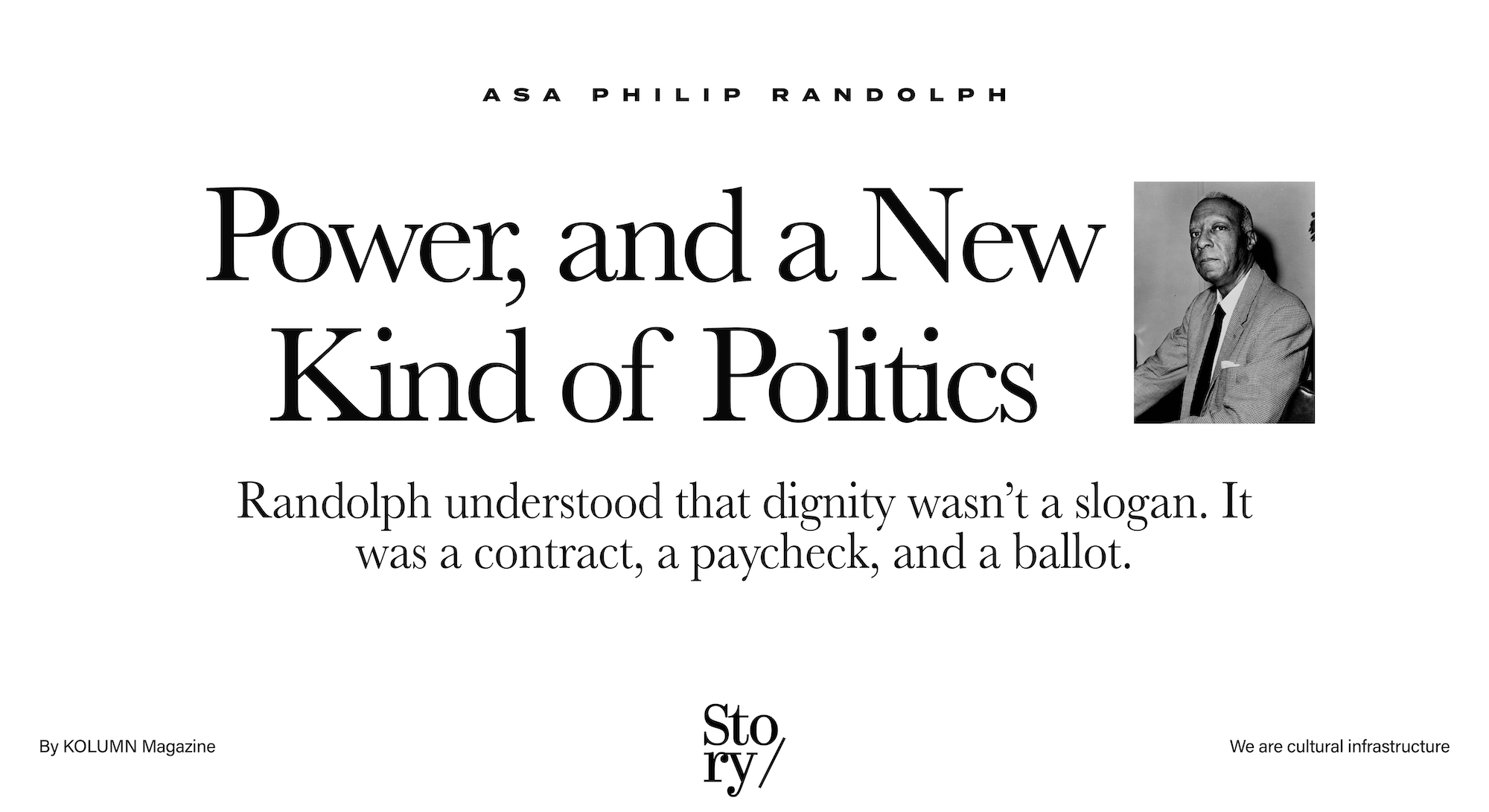
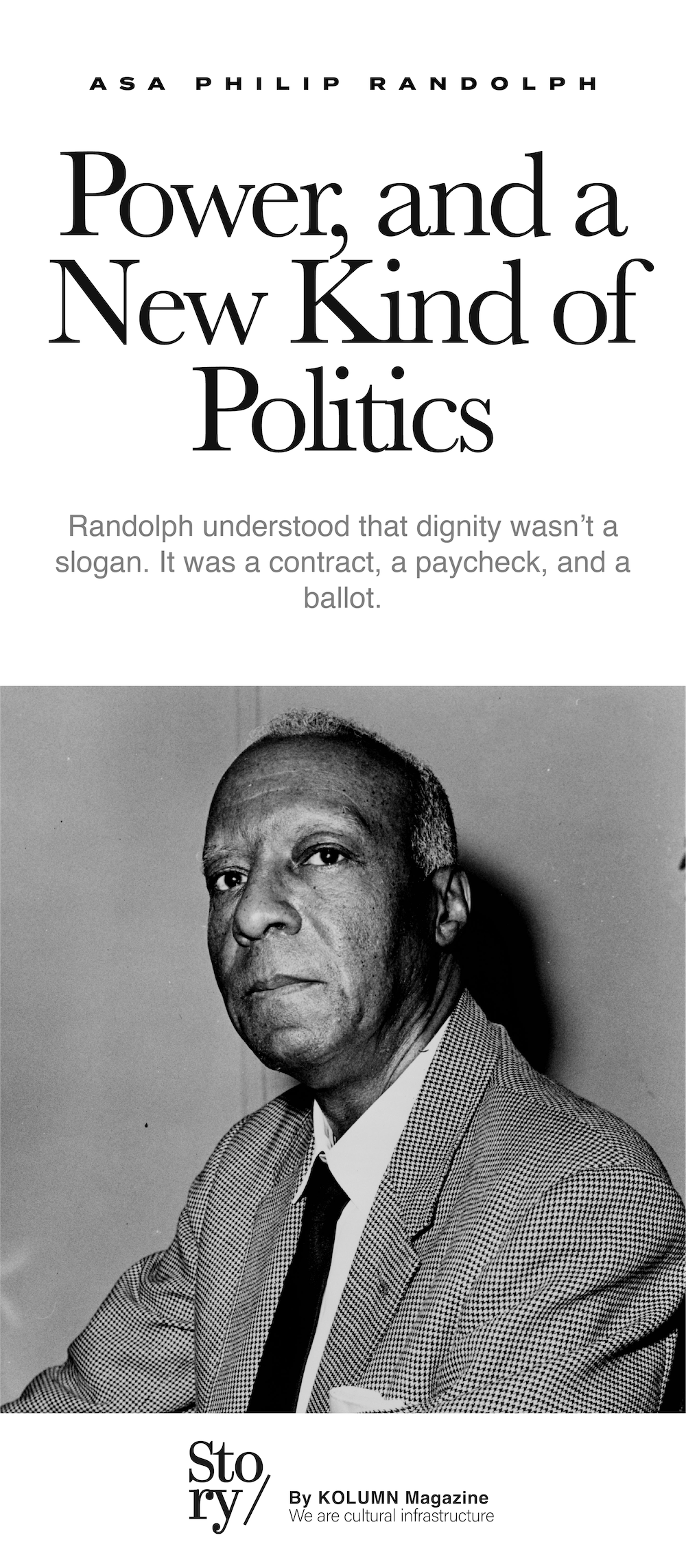
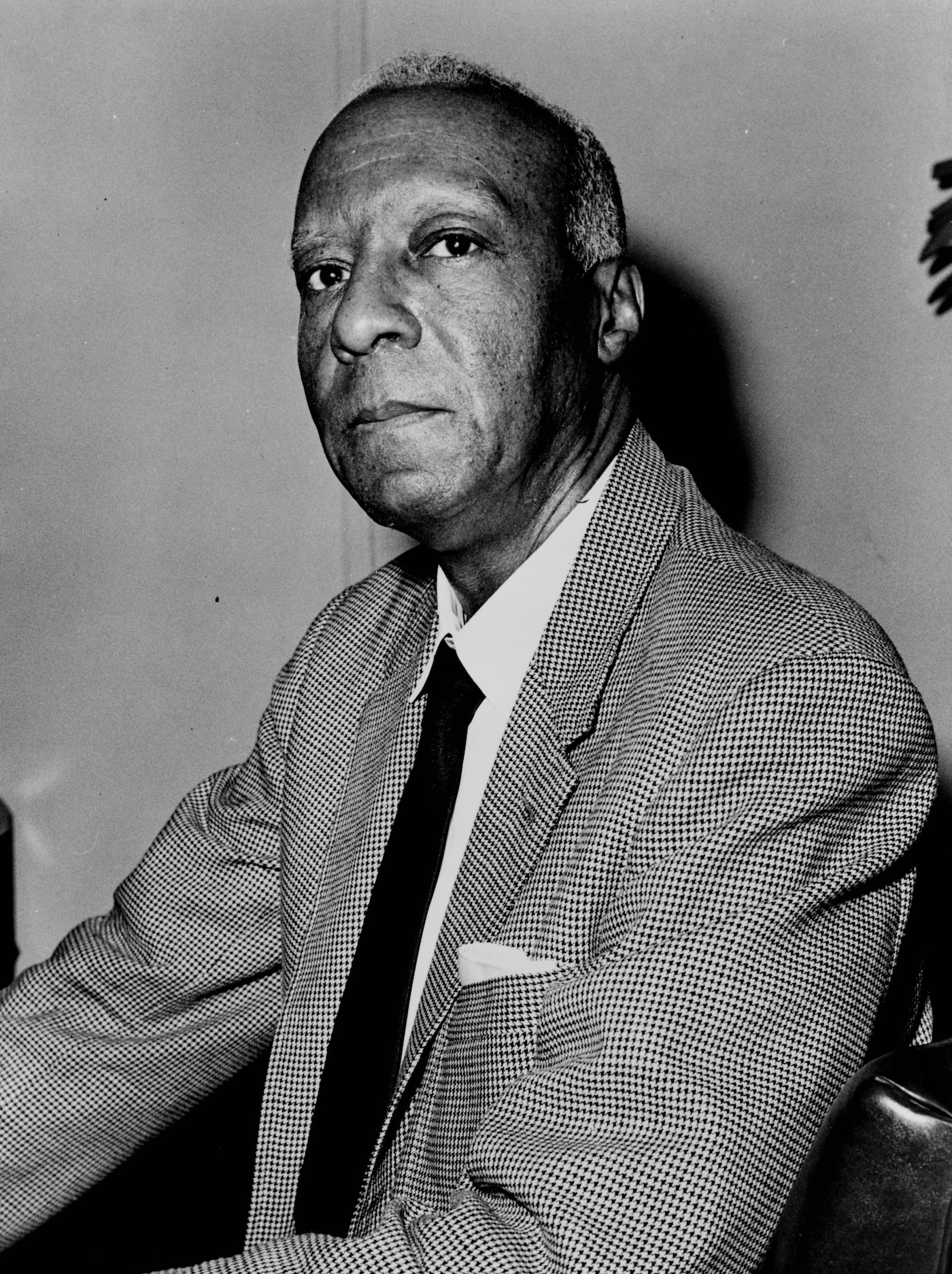
The photograph of A. Philip Randolph that endures most stubbornly is not a portrait softened by time. It is a face set against the pressure of history—broad, unblinking, unseduced by applause. He looked like a man who had learned, through repetition, that the country’s grand ideals were negotiable only when people without power found a way to make themselves costly to ignore. Randolph did not invent the moral language of Black freedom. What he helped invent—patiently, and with an organizer’s suspicion of symbolism unbacked by structure—was the machinery that could convert that language into institutional change.
In American memory, the civil rights movement is often narrated as a sequence of public awakenings: the bus boycott, the sit-ins, Birmingham, Selma, the March on Washington, the legislative triumphs that followed. Randolph sits in that story like a foundational beam—present, essential, and too rarely inspected. He was a labor leader as much as a civil rights leader, and the distinction mattered. In Randolph’s worldview, the struggle was not only about desegregated lunch counters and equal protection under law, but about wages, hiring, training, seniority, and the right to bargain. These were the gears that determined whether a family could eat, whether a child could stay in school, whether a community could build institutions that lasted.
His signature achievement—the Brotherhood of Sleeping Car Porters—was, on paper, a union. In practice it became an education in citizenship for thousands of Black men whose working lives had been engineered to demand deference, invisibility, and near-constant labor. Founded in 1925 to organize porters employed by the Pullman Company, the Brotherhood fought for more than a contract; it fought for the premise that Black workers were entitled to the same rights white workers claimed as a birthright. The victory that came later—recognition and a landmark agreement in the late 1930s—helped legitimate Black unionism inside a labor movement that frequently excluded Black workers or treated them as a threat.
Randolph’s life mattered because he proved something the nation repeatedly denied: that the most marginalized Americans could force the federal government to act, not by pleading for conscience, but by organizing consequences. His most famous threat—a planned mass march on Washington during the run-up to World War II—pushed President Franklin D. Roosevelt to issue Executive Order 8802, banning discrimination in defense industries and establishing a federal body to enforce fair employment policy. It was not the end of discrimination. But it was a precedent: a presidential directive on race and employment that arrived not as a gift, but as a concession wrested from pressure.
To understand Randolph is to understand the movement not only as a moral uprising, but as a political technology—one built from membership rolls, dues, meetings, coalition discipline, strategic threats, and a willingness to endure years of slow, grinding resistance. Randolph’s greatness can feel unromantic because it was operational. He believed, and demonstrated, that freedom required infrastructure.
A Southern childhood and a Northern education in reality
Asa Philip Randolph was born in 1889 in Crescent City, Florida, and grew up in a region where white supremacy was not only a social order but an enforcement regime. His parents—his father a minister and his mother a seamstress—taught him the value of education and self-possession, and he carried from that upbringing a lifelong insistence that Black dignity was nonnegotiable.
When Randolph moved north, eventually settling in Harlem, he arrived during an era when Black migration collided with urban industrial capitalism. The North offered wages and the possibility of political voice, but it also offered new forms of segregation—housing discrimination, job ceilings, union exclusion, and the constant message that Black labor was welcome only when it remained cheap and pliable. Randolph’s political imagination matured in this landscape. Harlem was not merely a neighborhood; it was a ferment of art, ideology, and argument. Randolph became part of the radical press and the socialist movement, learning to treat economics as a civil rights battlefield and to treat organizing as a discipline.
With Chandler Owen, he co-founded The Messenger in 1917, a publication that insisted Black workers had interests distinct from—and often betrayed by—both conservative racial leadership and white labor establishments. The magazine’s early politics were uncompromising: antiwar, pro-labor, and skeptical of the American state’s promises. Randolph’s socialism was never merely a youthful pose. It was a framework that shaped his later strategy: he saw racial hierarchy as intertwined with economic exploitation, and he believed the solution required power organized on the job.
That ideological clarity came with liabilities. In the Red Scares and the long American tradition of criminalizing radicalism, socialism could be used to marginalize, surveil, or discredit. Randolph would spend his career navigating that reality—tempering rhetoric when necessary, maintaining coalitions across ideological lines, and yet refusing to surrender the core argument that civil rights without economic rights was a partial freedom.
The Pullman porters and the challenge of organizing the “servant class”
The Pullman porter occupied a peculiar place in American life. These were Black men who worked on luxury rail cars, responsible for the comfort of mostly white passengers—making beds, carrying luggage, shining shoes, anticipating needs before they were spoken. The job carried status in Black communities because it offered steady employment and travel, but it also carried indignities that were structural: long hours, dependence on tips, surveillance by supervisors, and a corporate culture that often treated workers as interchangeable and subordinate.
Organizing such a workforce was not straightforward. Pullman porters were geographically dispersed, constantly moving, and vulnerable to retaliation. The company had every incentive to crush unionization. Randolph, who was not himself a porter, became the Brotherhood’s leader in part because the porters wanted an advocate with distance from Pullman’s internal discipline—someone who could not be fired by the company.
The Brotherhood of Sleeping Car Porters was founded in 1925, and its early years were defined by attrition and intimidation. Pullman resisted recognition. The broader labor movement was hardly a safe harbor; many unions excluded Black workers or used them as strikebreakers, worsening racial tensions and reinforcing segregation in the labor market. Randolph’s work, then, was doubly confrontational: he fought a powerful corporation and also pushed a frequently racist labor establishment to recognize Black workers as legitimate partners.
When the Brotherhood eventually secured recognition and collective bargaining gains—often dated to the late 1930s—its significance went beyond wages. (Word In Black) The union became proof of concept that Black workers could build durable organizations and win against entrenched power. It also created a cadre of disciplined, politically engaged members whose experience in union governance—meetings, elections, negotiations—became training for civic participation. The porters, as a class, were also conduits of information. Their travel and contact across cities made them informal messengers within Black America, carrying newspapers, news, and opportunity along rail lines—an infrastructure of movement in an era when Black mobility was constrained. (Condé Nast Traveler)
The Brotherhood’s success helped shift how the nation had to think about Black labor. It was no longer possible to argue, with credibility, that Black workers were unorganizable or inherently docile. Randolph had helped produce a disciplined counterexample.
“Ten, twenty, fifty thousand”: The 1941 threat that forced a president’s hand
Randolph’s most consequential insight may have been this: moral claims become politically legible when they are paired with disruption. By 1941, the United States was mobilizing for a global war, and defense industries were expanding rapidly. Black Americans, migrating in large numbers to industrial centers, found themselves locked out of the best jobs—excluded by employers, unions, and government practices. Roosevelt needed production; the nation needed unity; Randolph saw leverage.
He called for a March on Washington—tens of thousands of Black Americans descending on the capital to protest employment discrimination in defense industries. The threat was not rhetorical theater. It alarmed the administration precisely because it could embarrass the country internationally and complicate war mobilization at home. Negotiations culminated in Executive Order 8802, which prohibited discrimination in defense industries and established the Fair Employment Practices Commission. Randolph called off the march after the order, but the lesson remained: a mass mobilization, credibly planned, could produce federal action.
The National Archives’ documentation of the order is explicit about the context: defense production expanded, Black workers were often met with discrimination and violence, and Randolph and other leaders pressed the administration with demands—backed by the threat of large-scale protest. The order was significant not because it solved the problem, but because it made the federal government an actor in the employment discrimination debate. It acknowledged, in official language, that discriminatory hiring was a national issue, not merely a regional custom or private choice.
Critics then and since have noted the FEPC’s limitations—constrained authority, political backlash, uneven enforcement. Those critiques are valid and necessary. But Randolph’s achievement was also to establish precedent and to model a technique. Once the federal government can be forced to act on employment discrimination during wartime, it becomes harder to argue that the government is powerless in peacetime. Randolph widened the policy imagination.
This was also a moment when the civil rights movement’s center of gravity shifted. Older strategies—petitions, elite lobbying, lawsuits alone—were supplemented by mass protest as a bargaining instrument. Randolph did not invent mass protest, but he helped normalize it as a lever against the state. The 1963 March on Washington would later sit in this lineage; so would the movement’s later escalations.
Linking labor and civil rights: Coalitions, conflicts, and the slow work of legitimacy
Randolph’s insistence that racial justice and economic justice were inseparable placed him in a complicated relationship with both major movements of his time. Within civil rights leadership, there were debates about emphasis: education versus jobs, litigation versus protest, integration versus nationalist alternatives, coalition-building versus separatism. Randolph was not a doctrinaire simplifier. He could work with church leadership and secular radicals; he could collaborate with liberals and argue with them in the same breath. Yet he did not hide the through-line: a racially just society required power at work.
Within organized labor, Randolph’s presence forced uncomfortable questions. The AFL and other institutions had long histories of segregation and exclusion. Randolph’s union became a wedge that challenged the “color line” inside labor itself, and his later roles within the broader labor movement reflected both progress and constraint.
The Black labor tradition Randolph helped shape was not merely symbolic representation. It was an argument about strategy: that Black political gains would be fragile without economic leverage, and that economic leverage could be built through union organization and collective bargaining. Word In Black, reflecting on the Black press and the Black labor movement, points to Randolph as a figure who embodied that linkage—organizing victories like the Brotherhood’s landmark agreement and representing a leadership model grounded in working-class concerns.
Randolph also understood media. From The Messenger to his public speeches, he treated narrative as part of organizing—an instrument for clarifying who had power, who was exploited, and what could be demanded. But he did not confuse narrative with victory. For Randolph, the story had to be followed by structure.
The second March on Washington: “For Jobs and Freedom,” not only for a dream
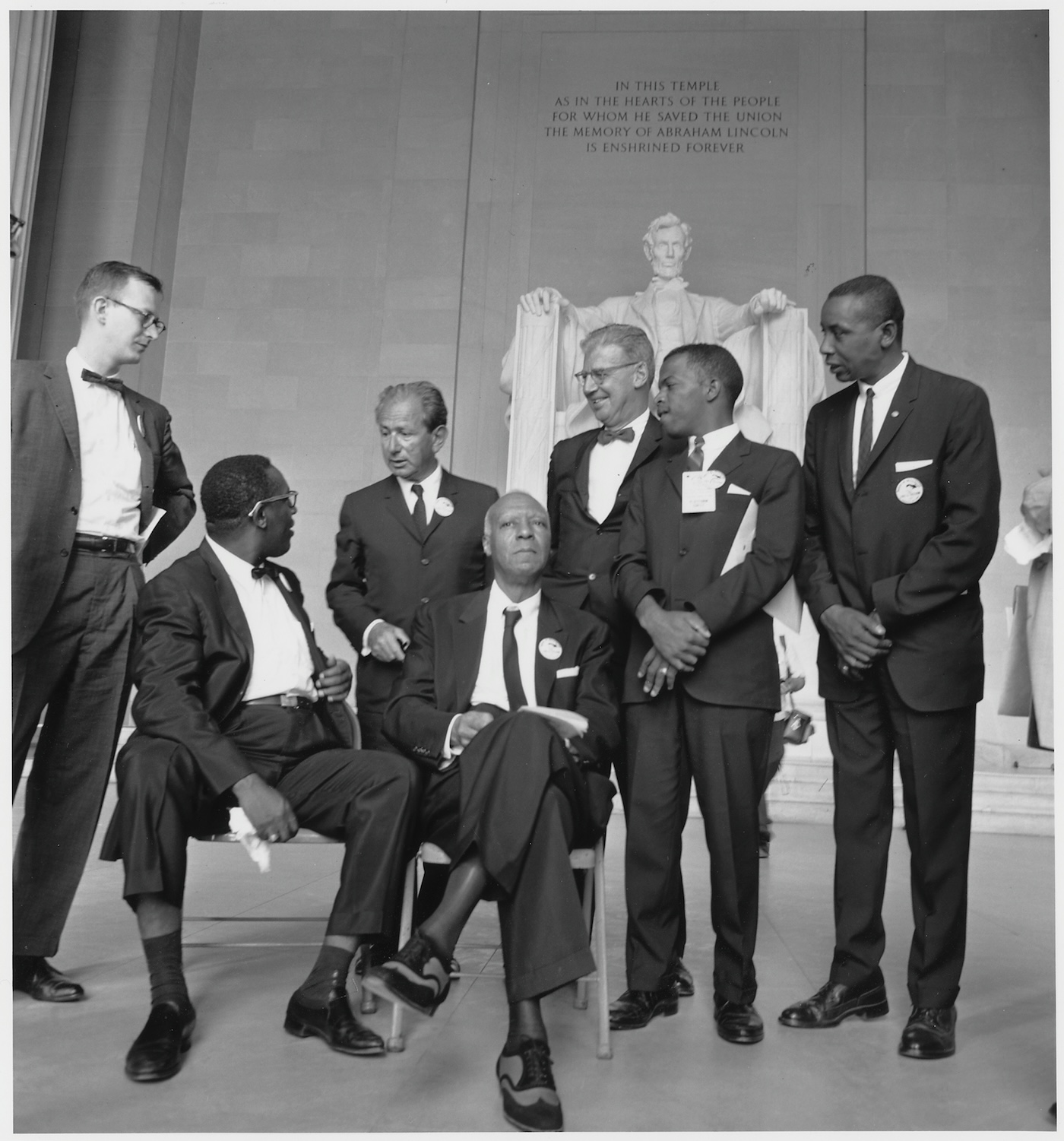
If the 1941 threatened march demonstrated leverage, the 1963 March on Washington demonstrated scale and coalition sophistication. It is now remembered primarily through Martin Luther King Jr.’s “I Have a Dream” speech. That speech deserves its place in history. But the march’s full title—March on Washington for Jobs and Freedom—was a Randolph title, reflecting Randolph’s insistence that employment and dignity were fused demands.
Randolph served as a central figure in the march’s leadership, and Bayard Rustin, his close collaborator, handled much of the logistical orchestration that made the gathering possible. Contemporary retrospectives emphasize that Randolph had been considering a march model since the 1940s and that the 1963 mobilization drew from that earlier lineage.
The march itself was a feat of coordination: hundreds of thousands of people arriving in segregated America to demand federal action, in an event that was widely described as peaceful, disciplined, and strategically framed. Randolph’s presence mattered because he embodied continuity—a bridge between the labor-focused mobilizations of the interwar and wartime years and the civil rights mass movement of the 1950s and 1960s. He brought the credibility of someone who had already forced a president’s concession. He also brought the labor movement’s institutional capacity: unions could supply money, transportation, and organizational muscle in a way that purely volunteer movements often struggled to sustain.
The march’s demands were not modest. They included civil rights legislation, desegregation, voting rights, and jobs programs. That economic emphasis—too often reduced in memory—was central to Randolph’s worldview. He believed the movement’s moral urgency required an economic program, not merely legal reforms.
The elder statesman and the problem of credit
Randolph lived long enough to see his own influence both honored and obscured. When he died in 1979, major newspapers described him as a founder of the first major Black labor union and a key figure in civil rights—language that captured the breadth of his role but could not fully convey its depth. The problem was partly structural: American culture tends to reward charismatic public-facing leadership over the long, slow work of building institutions. Randolph was capable of public rhetoric, but his genius was in strategy and discipline.
Even within the movement, attention tilted toward those whose leadership aligned with the era’s dominant imagery: the preacher at the pulpit, the student at the lunch counter, the martyr on the bridge. Randolph was older, secular, labor-rooted, and ideologically complex. His socialism did not fit easily into Cold War patriot narratives, and his victories—contracts, executive orders, commissions—were bureaucratic enough to feel less cinematic than a confrontation captured on film.
Yet the story of Randolph is precisely the story that should complicate any simplistic reading of social change. He shows how movements win: by building membership and legitimacy, by threatening disruption, by negotiating when necessary, by sustaining pressure, and by translating protest into policy.
Building a Black-labor alliance: The A. Philip Randolph Institute and the long tail of organizing
In 1965, Randolph and Rustin founded the A. Philip Randolph Institute (APRI), an organization intended to strengthen the alliance between civil rights and labor and to continue pushing for social and economic justice. APRI’s own institutional history frames its mission as a continuation of that Black-labor coalition tradition and highlights the organization’s role in the broader fight for political participation and economic rights.
The timing matters. The mid-1960s were years of landmark legal change—Civil Rights Act, Voting Rights Act—yet also years when economic inequality and urban disinvestment were deepening fault lines. Randolph’s response was not to declare victory and retire. It was to formalize an institution that could keep fighting, particularly within the labor movement and through political engagement. APRI represented Randolph’s belief that the movement’s next stage required sustained coalition-building and attention to the economic dimensions of freedom.
This insistence on durability connects to Randolph’s earlier union work. The Brotherhood of Sleeping Car Porters had taught him that wins could be reversed without structure. A union contract had terms; it had enforcement mechanisms; it created expectations and leverage. Randolph’s civil rights work sought similar solidity. Executive orders and commissions were imperfect, but they established an official basis for claims. Mass marches were symbolic, yes, but they were also demonstrations of capacity—proof that the movement could mobilize bodies, money, media attention, and, crucially, discipline.
Randolph’s method: Nonviolence, but not passivity
Randolph’s political style can be misread as moderate because he emphasized nonviolent tactics and coalition-building. But there is a difference between nonviolence and deference. Randolph’s method was nonviolent pressure—what some later scholars and organizers would describe as nonviolent coercion: disruption without armed conflict, moral argument paired with strategic leverage, and negotiation backed by the credible threat of escalation.
His 1941 maneuver is a classic case. The march threat was not an appeal to Roosevelt’s conscience alone; it was a strategic risk imposed on the administration. The resulting executive order—documented and archived as a milestone in federal policy—was the payoff of that strategy.
Similarly, the 1963 march’s discipline was not merely a performance of respectability. It was strategic: a demonstration that the movement could occupy the nation’s capital at scale without giving opponents an excuse to dismiss the cause as chaos. Randolph understood optics, but he was never captive to them. The march’s title insisted on “Jobs” alongside “Freedom,” refusing to let civil rights become purely symbolic integration without economic transformation.
Why Randolph still matters now
Randolph’s relevance in the present is not a matter of nostalgia; it is diagnostic. His life clarifies how structural inequality reproduces itself and how it can be contested. When contemporary debates treat labor rights and civil rights as separate arenas, Randolph’s record argues the opposite: that discrimination is enforced not only by social norms but by labor markets, hiring pipelines, training access, and union rules. Randolph helps explain why victories that change language but not institutions often fail to change lives.
He also offers a corrective to the modern fetish for spontaneity. Randolph respected protest, but he treated it as one instrument in a larger campaign. He built organizations that could negotiate, fundraise, train leaders, and sustain pressure over years. That kind of slow infrastructure is less glamorous than viral moments, but it is often what makes the difference between attention and change.
Finally, Randolph’s story complicates the myth that progress is granted by enlightened leaders. His most famous federal victory—Executive Order 8802—was a concession to organized threat. His most famous mass demonstration—the 1963 march—was not merely a moral gathering; it was a coalition of labor, civil rights groups, faith organizations, and strategists like Rustin, brought together through painstaking planning and political negotiation.
This is an uncomfortable lesson for a culture that prefers heroic narratives of individual benevolence. Randolph insists on a different story: that ordinary people, organized, can force extraordinary outcomes.
The legacy written into places, archives, and institutions
Randolph’s legacy is not only abstract. It is housed in archives and museums, in institutions that preserve the story of Black labor and its contribution to American democracy. The New York Public Library holds collections of Randolph’s speeches and statements, a reminder that his work was as much intellectual and rhetorical as it was organizational. The National A. Philip Randolph Pullman Porter Museum—founded in 1995—exists to preserve and interpret the history of Pullman porters and the union Randolph helped lead, underscoring the idea that labor history is civil rights history.
In this way, Randolph’s life continues to instruct: progress is not merely the product of moments; it is the product of memory, institution-building, and the willingness to teach new generations how power actually moves.
Randolph died in 1979, but the central problem he spent his life confronting remains unresolved: whether American democracy will treat economic security as a right or as a reward rationed by race and class. His answer was practical, not poetic. Build power where people live and work. Make injustice expensive. And never confuse symbolism for structure.
More great stories
The Strategist in Plain Sight
February 27, 2026
No Comments
What Happened to Laura Nelson’s Baby?
February 27, 2026
No Comments