





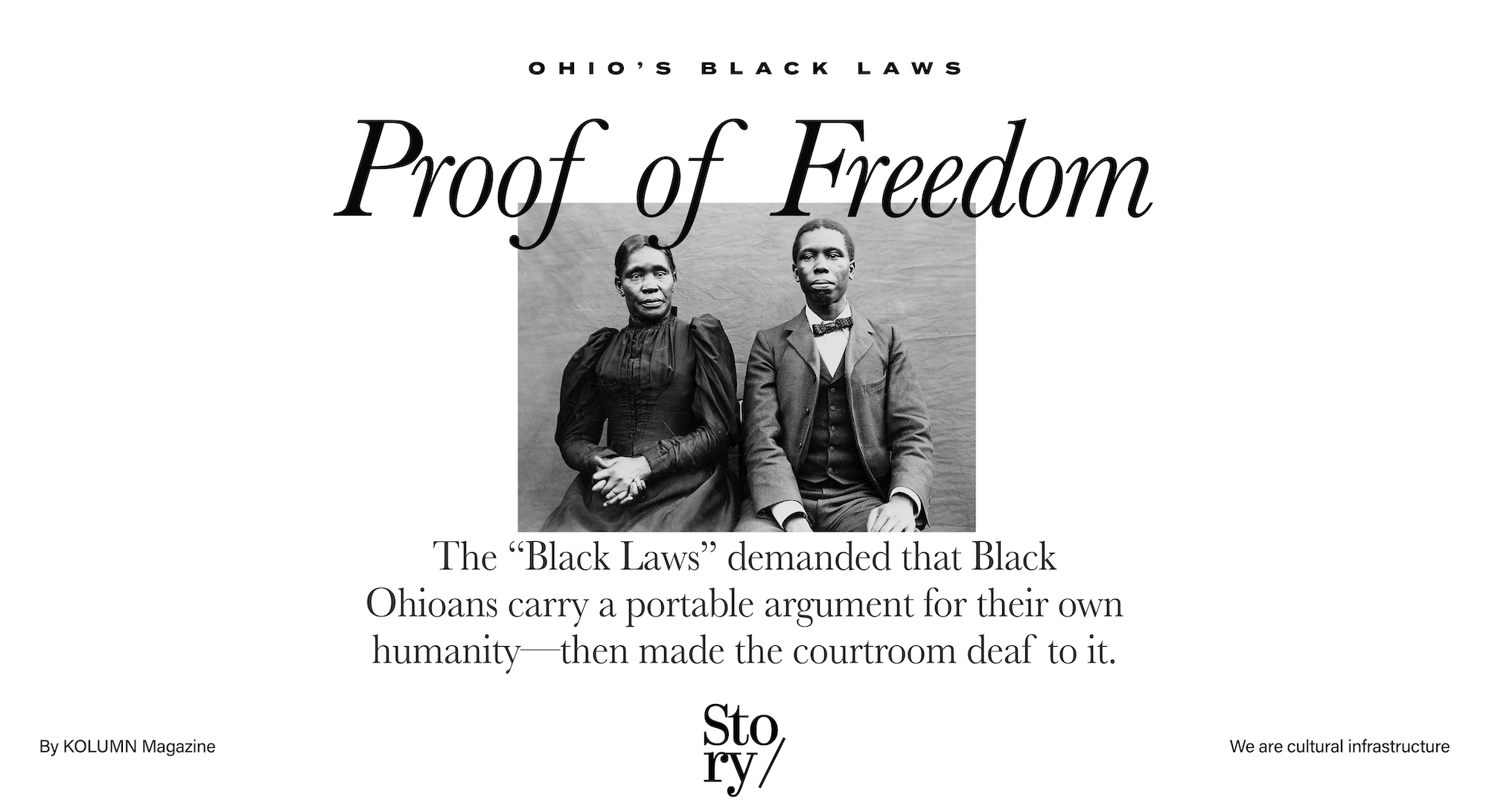
What society did when Black people arrive, settle, work, worship, organize, and insist on remaining
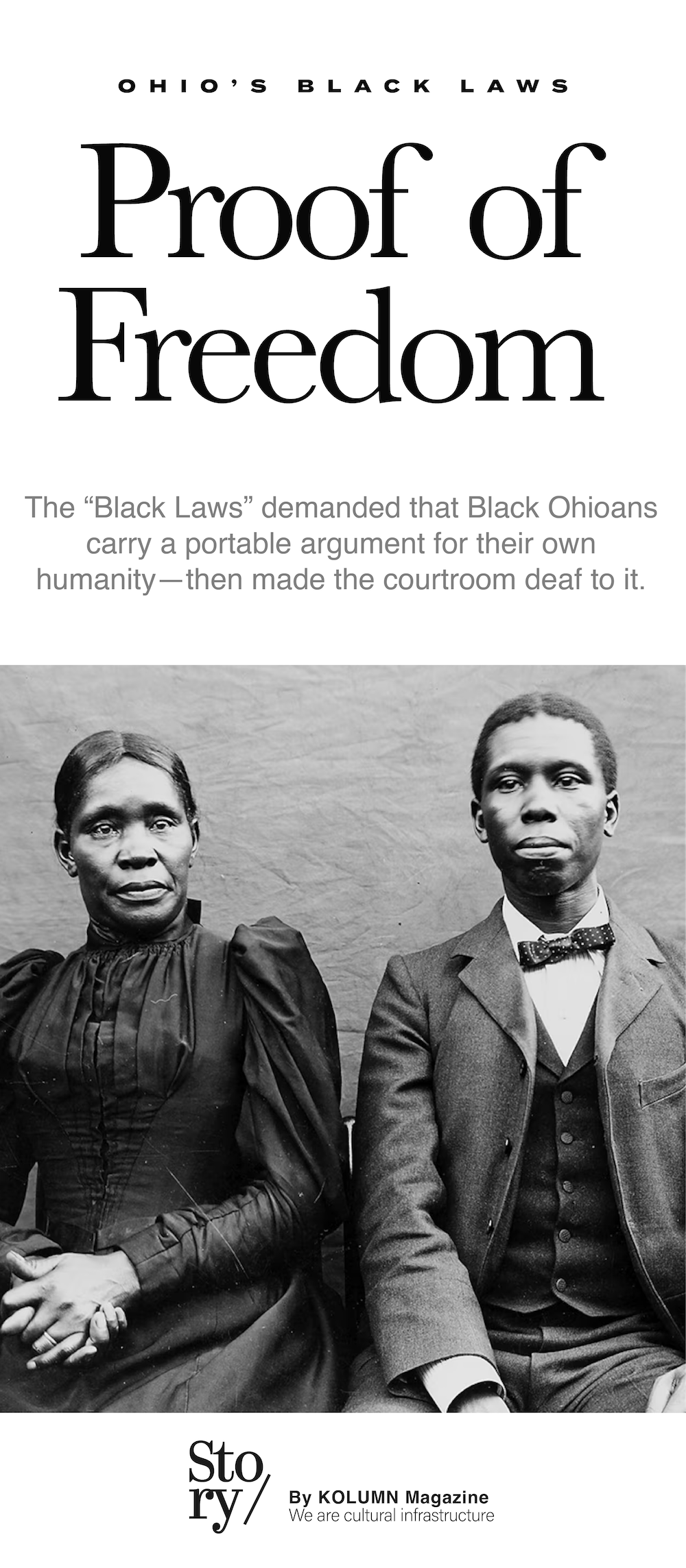
What society did when Black people arrive, settle, work, worship, organize, and insist on remaining
By KOLUMN Magazine
If you stood on Portsmouth’s public landing in the 1830s—watching the Ohio River carry flatboats, ferries, and rumors—you would have learned quickly that borders are not only geography. They are paperwork. They are who can speak and who must stay silent. They are the price of moving through a place that calls itself “free.”
Portsmouth sat at a confluence, the Scioto pouring into the Ohio, a watery intersection that made the town commercially significant and morally exposed. Across the river lay Kentucky, a slave state whose economic and political gravity pulled at southern Ohio. On the Ohio side, statehood came with a promise: slavery was prohibited. But that promise was paired—almost immediately—with a different legal project: making Black life administratively fragile.
Ohio’s “Black Laws,” begun in 1804 and sharpened in 1807, were designed to discourage Black settlement and to restrict the rights of Black residents already there. They demanded proof of freedom, required registration with local officials, imposed financial barriers that were enormous by any working standard, and barred Black testimony in cases involving white parties—an exclusion that effectively told Black Ohioans: even if you are free, the law will not reliably hear you.
In big cities like Cincinnati, officials used these laws to discipline labor and demography, and violence frequently arrived as the unofficial companion to official enforcement. But smaller river towns carried their own intensity. In Portsmouth, the “Black Laws” were not an abstraction or a footnote in legislative history. They became a local mechanism for removal—an assertion that a community could cleanse itself of Black neighbors by invoking the state’s authority.
The 1830s story of Portsmouth’s “Black Laws” is therefore not only about statutes. It is about the conversion of law into mood, and mood into action: the transformation of white anxiety, economic competition, and pro-slavery influence into civic consensus. It is about how a “free” state can construct a caste system without the explicit ownership of human beings—and how a town can enforce that caste system with the force of community will.
What Ohio built: A legal scaffold for exclusion
The central fact about the “Black Laws” is their dual nature. They were simultaneously mundane—fees, bonds, clerks, certificates—and existential. Because what they demanded was not merely compliance; it was vulnerability.
The 1804 act required Black residents arriving in Ohio to register with the county clerk and to present documentation proving they were free. The law also penalized white employers who hired Black workers who lacked the required certification, turning employment into a regulated privilege rather than a contract.
Then came the 1807 law, which required incoming Black residents to post a bond of $500—an “impressive sum,” as later scholars have described it, particularly in an era when capital was scarce and credit was relational. The bond did not function as a neutral guarantee. It operated as a deterrent and a gatekeeping device, often requiring white sponsorship (or at least white cooperation) and reflecting a presumption embedded in law: that Black migration was a threat, and that Black poverty would become a public burden.
The testimony restriction was its own kind of coercion. Beginning in 1807, Black people were barred from testifying in cases in which one party was white. In practical terms, this meant that the law could not reliably protect Black Ohioans from white fraud, assault, kidnapping, or coercion. The courtroom—the place where a society claims to adjudicate truth—was, by design, structurally inaccessible.
This architecture of restriction was not accidental. It emerged from an Ohio political culture shaped by migration from slave states and by the border-state anxieties of a region that wanted slavery’s profits without slavery’s formal commitments. The Equal Justice Initiative’s overview of Ohio’s “Black Laws” underscores that many early lawmakers came from slave states and carried pro-slavery assumptions into a “free” state’s governance—an inheritance that made Black rights negotiable and conditional.
A modern reader might be tempted to treat these laws as relics—evidence of a benighted era corrected by later reforms. But Ohio’s “Black Laws” persisted for decades and were contested repeatedly before their major repeal in 1849. The longevity matters. It suggests that the system was not merely tolerated; it was defended.
And nowhere did defense become more legible than in southern Ohio counties where Black communities were small enough to be targeted but visible enough to be scapegoated—places like Portsmouth.
Portsmouth’s location: commerce, slavery’s shadow, and the border’s temptations
Portsmouth’s geography did not simply place it near slavery; it placed it in conversation with slavery every day.
River towns were information markets. They traded in goods, of course, but also in notices: who had run, who was suspected, who was being sought, who was said to have “papers,” who didn’t. In Scioto County’s historical record, fugitive slave advertisements appear in local newspapers through the period, reminding us that slavery’s reach extended north of the river through claims, agents, and the constant threat of capture.
The same local historical document that records these notices also preserves a story from 1834: a slave coffle—men handcuffed and tied, women and girls roped together—landing publicly in Portsmouth. The account describes white men with guns, whips, and pistols, and it notes the threat leveled at Black onlookers: speak to the captives and you could be shot. The coffle was held in the Portsmouth jail overnight before being sent downriver.
Whether every detail can be independently corroborated today is a question any careful journalist must keep open; local memory can compress events or sharpen them into emblem. But the narrative fits the broader reality of the Ohio River corridor: a zone where enslavers moved people and where “free” territory did not guarantee safety. The legal environment made such coercion easier. If Black testimony was barred when white parties were involved, and if local officers could be incentivized by fees paid by enslavers or their agents, the line between law enforcement and slave catching could become perilously thin.
Against that backdrop, Portsmouth’s Black residents lived with an unstable status. They were free, but required to prove it repeatedly. They could work, but their employment could be criminalized for others. They could build lives, but their right to remain could be challenged not through individualized wrongdoing, but through collective enforcement of exclusionary statutes.
It is in this setting that Portsmouth’s most infamous episode enters the record—remembered as “Black Friday.”
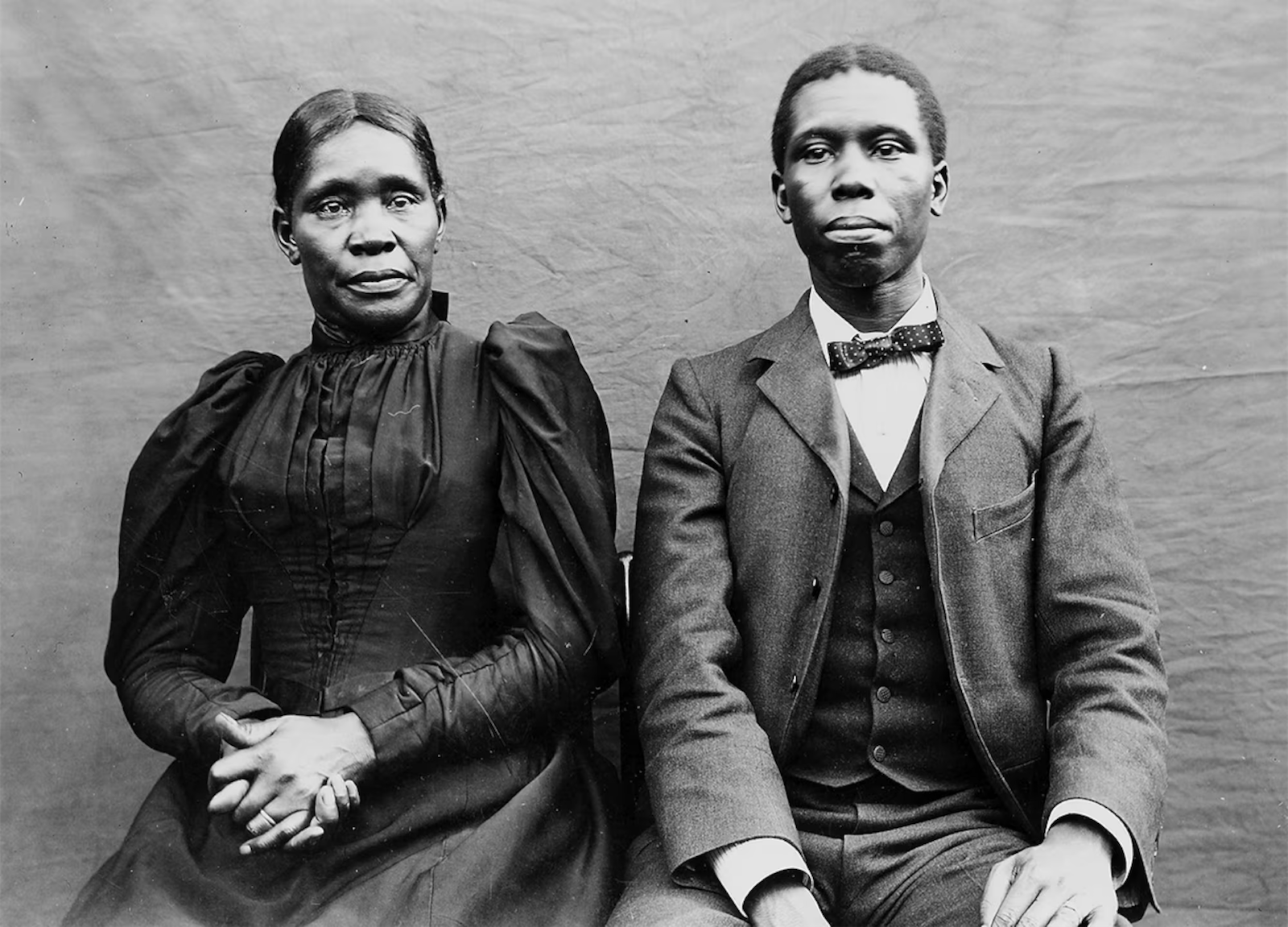
“Black Friday”: When enforcement becomes expulsion
The name itself is a kind of indictment. “Black Friday” suggests a day when ordinary time broke—when the rules of neighborliness collapsed into a public demonstration of power.
The documentary trail contains a tension on the date, and that tension is instructive rather than inconvenient. One local historical summary identifies January 21, 1830, as the day “an estimated 80 Black citizens were deported from Portsmouth by the town authorities,” describing a petition signed by “between 100 and 200 households” demanding the removal of Black and “mulatto” residents who lacked the required certification.
The Equal Justice Initiative, drawing on other reporting and archival references, places a major Portsmouth expulsion on January 21, 1831, when an announcement appeared in the Portsmouth Courier stating that “the citizens of Portsmouth are adopting measures to free the town of its colored population,” and it similarly notes a petition of white residents vowing to expel Black neighbors who had not complied with registration and bond requirements—prompting roughly 80 Black residents to leave.
Rather than “solving” this discrepancy by choosing one date and discarding the other, the more plausible—and historically grounded—interpretation is that Portsmouth experienced multiple removal pressures or expulsions around this period, with later accounts describing “Black Friday” as either a single climactic event or as part of a pattern. Even the concept of a “second recorded expulsion,” referenced in local historical materials about Portsmouth, reinforces the likelihood that enforcement did not occur only once.
What does not change across versions is the core mechanism: the “Black Laws” provided a legal rationale, but the driving force was local mobilization—white residents organizing, petitioning, and applying economic pressure through pledges not to employ or to tolerate Black residents who could not meet the law’s demands.
This is one of the clearest ways to understand what the “Black Laws” were for. The statutes were not only about regulating Black people; they were also about deputizing white society. They encouraged informants. They made harboring and employing a potential offense. They invited a community to treat Black residence as conditional and revocable.
In Portsmouth, the result was displacement: Black families “forced to leave their homes and belongings,” as the local summary describes it, under threat of enforcement. The violence here is not only physical. It is civic. It is the violence of making a life untenable: threatening work, housing, and community continuity until leaving becomes the only rational choice.
The story also reveals a particular cruelty of border-town “freedom.” Portsmouth could declare itself “free” from slavery while actively collaborating with slavery’s wider ecosystem—through tolerance of slave catchers, through the policing of Black mobility, and through legal structures that presumed Black people’s illegitimacy as residents.
“Black Friday,” in other words, is not simply a local embarrassment. It is an example of how a free state can still engineer racial expulsion—and how quickly a community can accept that engineering when economic anxiety and racial ideology align.
After the expulsions: Black settlement, adaptation, and the making of Huston Hollow
Expulsion is never the end of a story; it is the beginning of a different geography.
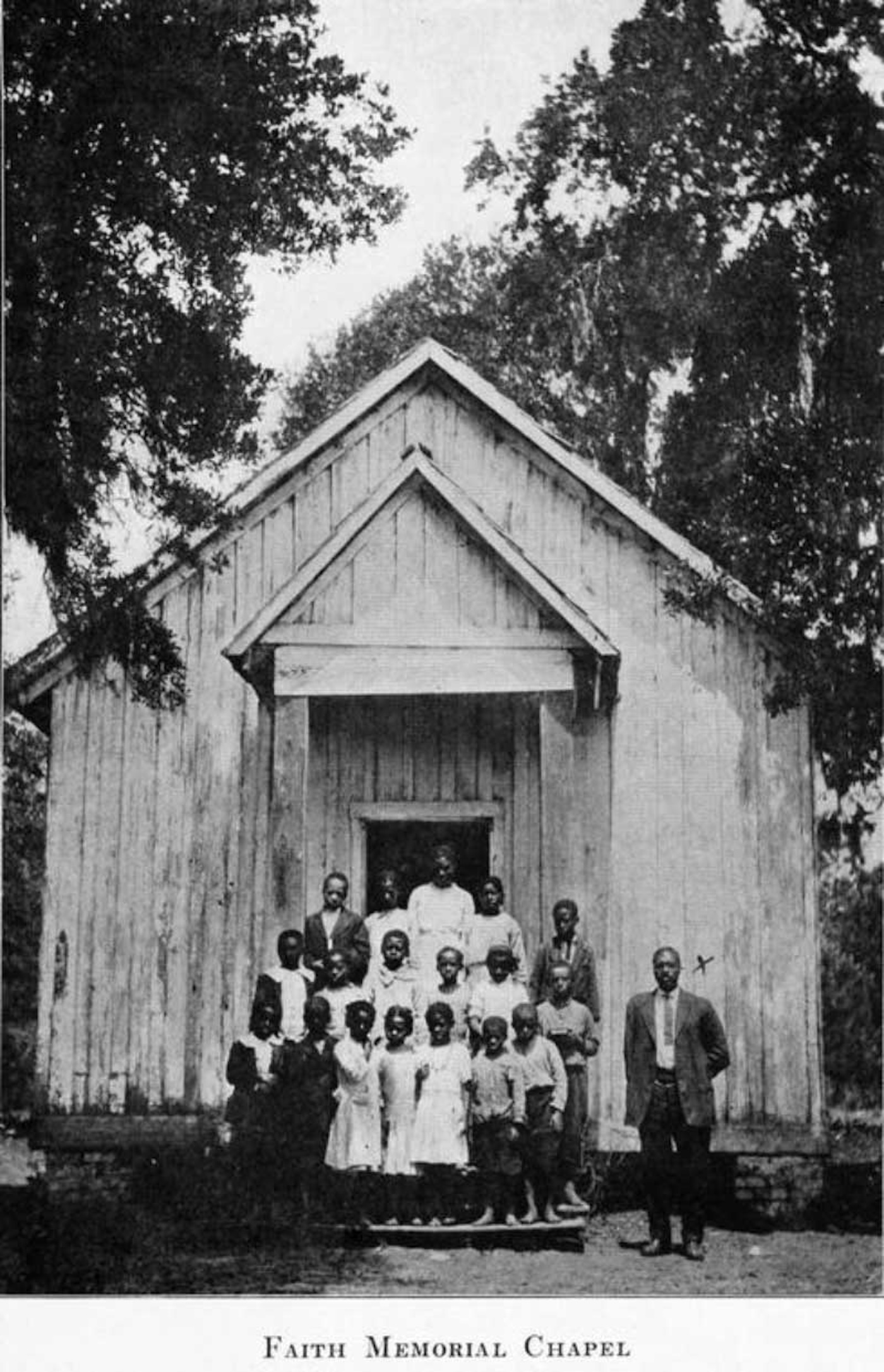
Accounts tied to Portsmouth’s later Black history describe displaced residents resettling outside the town in an area that became known as Huston Hollow, north of Portsmouth along the Scioto River—a community that would later connect to Underground Railroad activity.
The shift matters. It suggests not only removal from the center of town life but also the creation of Black space under pressure—communities shaped by the necessity of distance, discretion, and collective support. When people are forced out, they do not simply vanish. They reorganize. They build institutions where they can. They form new networks of mutual aid. And in border regions, they often become part of the infrastructure of escape for others.
This dynamic is consistent with broader patterns across the antebellum North. Black communities, constrained by discriminatory law, frequently responded by constructing parallel institutions: churches, schools, self-help societies, and political organizing efforts that treated citizenship not as a gift but as a project.
What makes Portsmouth’s case especially telling is that it sits at the intersection of three forces: a state-level legal regime designed to discourage Black settlement; a local political culture willing to enforce that regime aggressively; and a border economy in which slavery’s presence—through ads, agents, and intimidation—was never far away.
Huston Hollow, viewed through that lens, is not merely a quaint historical footnote. It is the geographic evidence of a community adapting to white exclusion, creating continuity where the town tried to create rupture.
The 1830s: A decade of tightening and backlash
Nationally, the 1830s were years of sharpened sectional rhetoric, intensified abolitionist organizing, and deepening pro-slavery defensiveness. In Ohio, these years coincided with both heightened enforcement and heightened resistance. The Smithsonian account of Ohio’s Black activism emphasizes that even though Black Ohioans constituted a small percentage of the population, the 1830s became a crucial period of petitioning, convention organizing, and coalition-building aimed at dismantling racist laws.
At the same time, the risks were acute: violence against abolitionist presses and Black neighborhoods, and legal disabilities that made redress difficult. The National Park Service’s discussion of “Northern Unfreedom” highlights that Black residents living under “black laws” often faced white violence with limited legal recourse, and it notes that Ohio’s laws could even restrict Black petitioning in 1839.
Portsmouth fits cleanly into this matrix. A river town with active commerce, near a slave state, could be both a corridor for fugitives and a theater for exclusion. The same location that made Portsmouth “a hotbed of Underground Railroad activity,” as one academic thesis on Scioto County history puts it, also made it a crossroads for “racial sentiment”—a place where abolitionist and pro-slavery impulses collided in daily life.
Seen this way, “Black Friday” is not an anomaly. It is an expression of a decade’s political chemistry: local majorities using law to enforce racial boundaries, and Black communities responding by relocating, organizing, and, in many instances, assisting others in flight from slavery.
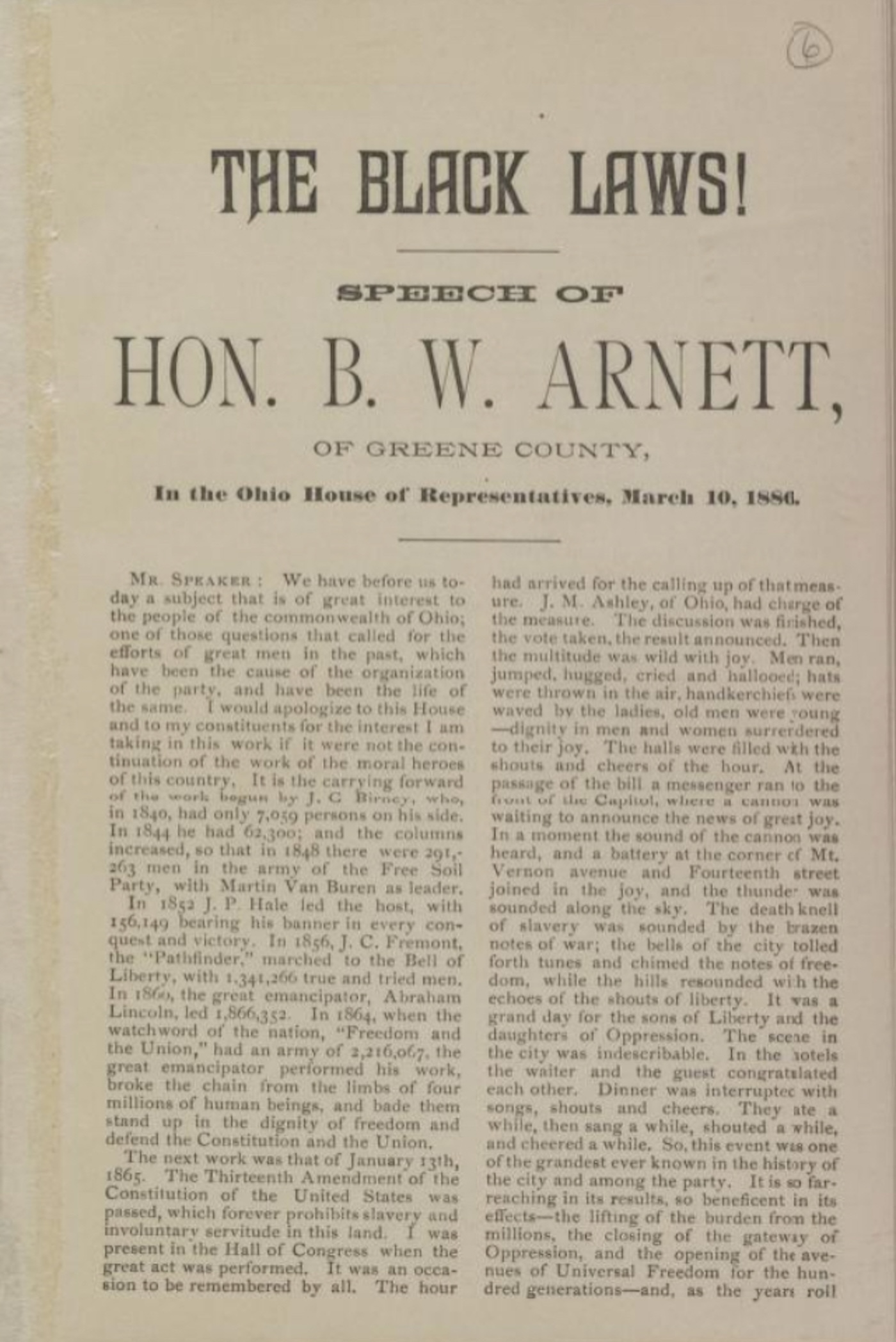
The politics behind the statutes: who defended the “Black Laws,” and why
When laws persist for decades, the key question is not simply “Who wrote them?” but “Who kept them alive?”
Ohio’s “Black Laws” were repeatedly debated and contested before their major repeal. Historical scholarship on repeal attempts emphasizes that geography and racial demographics influenced legislators’ positions: representatives from southern counties, closer to the Ohio River border and with different labor anxieties, often framed Black presence as an “evil” that northern counties did not understand.
This rhetorical framing did more than describe; it justified. It cast exclusion as practical governance. It made racism sound like administration.
Another layer was colonization—the idea that free Black people should be resettled outside the United States, often in Africa. Scholarship on early Ohio racial politics notes that colonization gained official support in Ohio as early as 1818, combining purported humanitarianism with unmistakably racist assumptions about belonging. In practice, colonization ideology strengthened the notion that Black residents were temporary guests rather than permanent constituents.
And then there was the border: the constant fear, in pro-slavery imaginations, that free Black communities would aid fugitives and destabilize slavery. Ohio’s laws, including penalties connected to harboring fugitives and obligations on local officials, could make the state’s “free” institutions function as tools for slaveholders—what the Equal Justice Initiative describes as turning courts, constables, and sheriffs into instruments that served Southern enslavers.
For Portsmouth, these political dynamics had local consequences. When a town enforces an exclusionary law, it is not merely “following the law.” It is choosing to activate a particular kind of governance—a governance that treats Black residence as a problem to be solved.
Black resistance in Ohio: conventions, petitions, and the demand to be heard
One of the most essential correctives to the “Black Laws” story is remembering that Black Ohioans were not passive subjects of restriction. They were strategists.
In the late 1830s, Black activists in Ohio mobilized to petition the state legislature to repeal discriminatory laws and to secure educational rights for their children. The Smithsonian narrative traces this as part of an early civil rights movement—decades before the better-known campaigns of the twentieth century—emphasizing the sophistication and persistence of Black organizing.
The Washington Post’s discussion of antebellum rights struggles similarly underscores that Black Ohioans, lacking the vote and constituting a small percentage of the population, relied on organizing and petitioning—appealing to moral principle, constitutional promises, and white allies willing to introduce their petitions.
These efforts matter in a Portsmouth-centered story because they reveal what expulsion tried to interrupt: not merely settlement, but political voice. If the “Black Laws” were designed to keep Ohio “as lily white as possible,” as scholarship bluntly puts it, then Black activism represented a direct challenge to the state’s racial self-conception.
Portsmouth’s “Black Friday” can therefore be read as both local and statewide: a local action enabled by state law, but also a local reaction against the broader possibility that Black presence would become permanent, organized, and politically consequential.
The lived experience of legal disability: what it meant to carry “freedom” on demand
To understand the “Black Laws” in Portsmouth, it is not enough to list their provisions; you have to imagine their daily psychological regime.
A registration requirement is not merely a bureaucratic step when your ability to remain in a place depends on it. It turns ordinary movement—visiting family, taking a job, settling near the river’s commerce—into an event that must be justified to an official. It makes the county clerk not simply an administrator but a gatekeeper of residency.
A bond is not merely financial when it is set at a level designed to be prohibitive. It is a structural message: you are presumed likely to be a “charge,” a burden, a problem. It positions Black people as potential liabilities to be insured against.
A testimony ban is not merely procedural. It is a declaration of epistemology: in disputes involving white people, Black truth does not count. That means any conflict—wages withheld, property stolen, assault threatened—carries a terrible calculus. Reporting wrongdoing can be dangerous when the legal system is designed not to recognize your account of events.
These dynamics also help explain why a petition campaign in Portsmouth could have such force. If white residents pledged not to employ Black residents who lacked compliance, the law’s coercion multiplied. Economic life, already precarious, could be strangled without a single act of overt violence—though violence always hovered nearby, as river-border slavery networks made clear.
When a community’s Black residents then left—whether in 1830, 1831, or through a sequence of pressures around those years—they were responding not only to a letter of law but to a comprehensive civic environment designed to make them removable.
Portsmouth in the longer arc: Repeal, memory, and what the “Black Laws” leave behind
It is important, in a story like this, not to end with expulsion—because expulsion was precisely what the “Black Laws” aimed to accomplish: disappearance.
The longer arc includes repeal efforts and the eventual rollback of major portions of the “Black Laws” in 1849, after years of petitioning, coalition-building, and political bargaining—an outcome documented in both popular historical narratives and scholarly treatments of Ohio’s legal reforms. But repeal did not retroactively repair what was done in Portsmouth. Laws that are later modified can still leave permanent marks on settlement patterns, wealth accumulation, educational access, and community geography.
In Portsmouth, one of those marks is the very existence of places like Huston Hollow in local memory: evidence of a Black community pushed to the margins, then forced to build from the margins, often becoming part of the moral infrastructure that the town itself could not provide.
Another mark is the persistence of the narrative itself—“Black Friday” remembered as a civic act, and the “Black Laws” remembered not as distant statutes but as local enforcement. The tension in dates across sources is not simply a historian’s irritation; it is a reminder that communities remember in layers, that expulsions can be repeated, that official records and lived experience do not always align cleanly, and that the impulse to remove can recur whenever law provides a ready-made excuse.
Finally, Portsmouth’s story is a corrective to a popular national myth: that the North was simply “free” and the South simply “slave.” The historical reality, as the National Park Service puts it, includes a broad regime of “Northern Unfreedom”—black laws that denied citizenship and constrained rights, often accompanied by violence and the inability to seek redress.
Portsmouth, in the 1830s, is one of the clearest places to see that reality. The town’s position on the river made it a border not only between states, but between ideals and practice. On paper, slavery was outlawed. In daily life, Black freedom could be conditioned, priced, and revoked.
That is what Ohio’s “Black Laws” meant in Portsmouth: a freedom that could be made provisional—by a clerk, by a bond, by a petition, by a crowd that called itself “the citizens,” and by a state that allowed citizenship to be enforced as exclusion.
And if the lesson of Portsmouth is uncomfortable, it is also clarifying. It tells us that the question is not merely whether a society declares itself free. The question is what that society does when Black people arrive, settle, work, worship, organize, and insist on remaining.
In Portsmouth in the 1830s, too many white Ohioans answered that question with law—and with removal.
More great stories

The Strategist in Plain Sight
February 27, 2026
No Comments
Power, and a New Kind of Politics
February 27, 2026
No Comments