






What does it take to make citizenship real?
What does it take to make citizenship real?
By KOLUMN Magazine
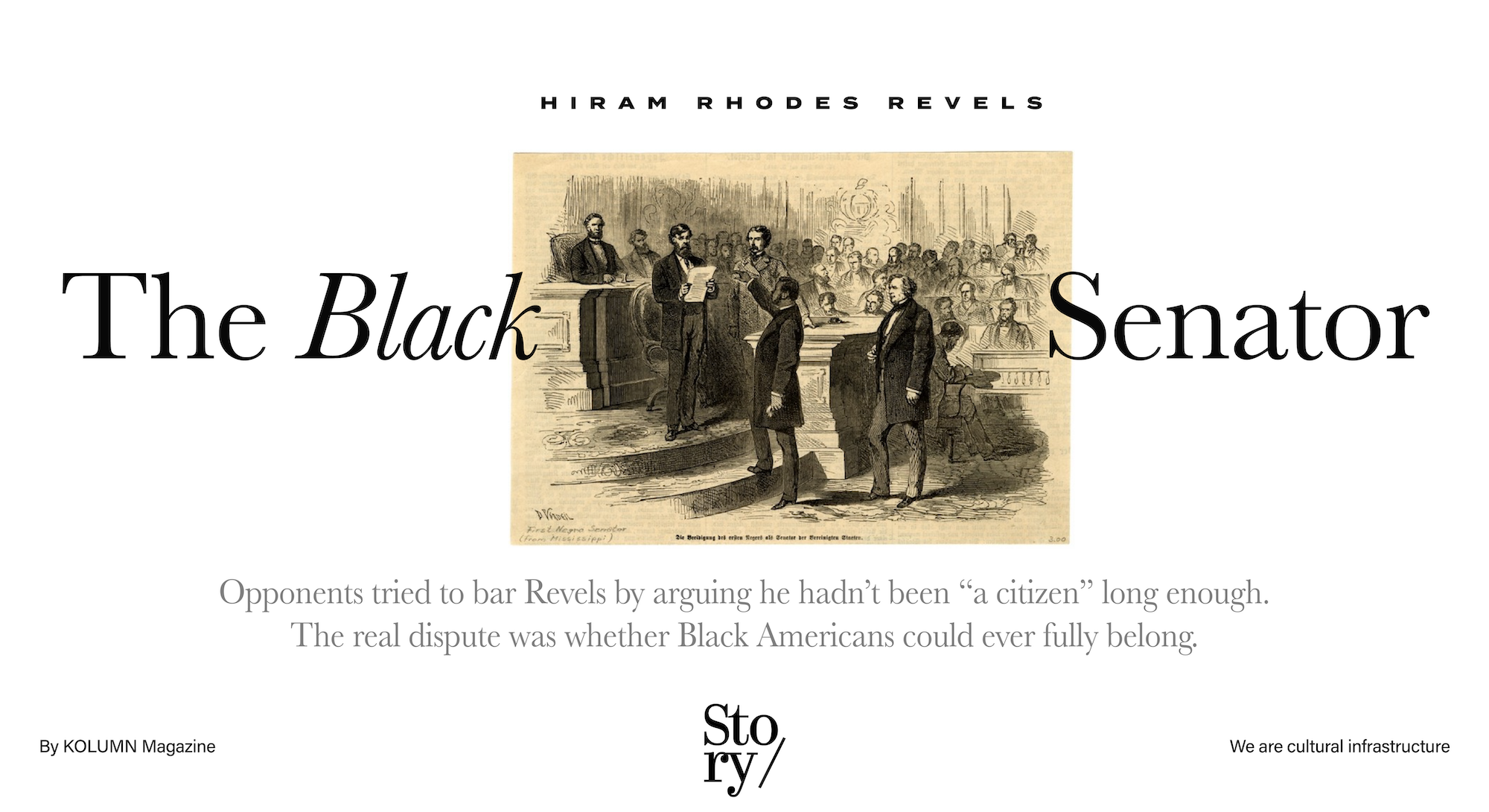
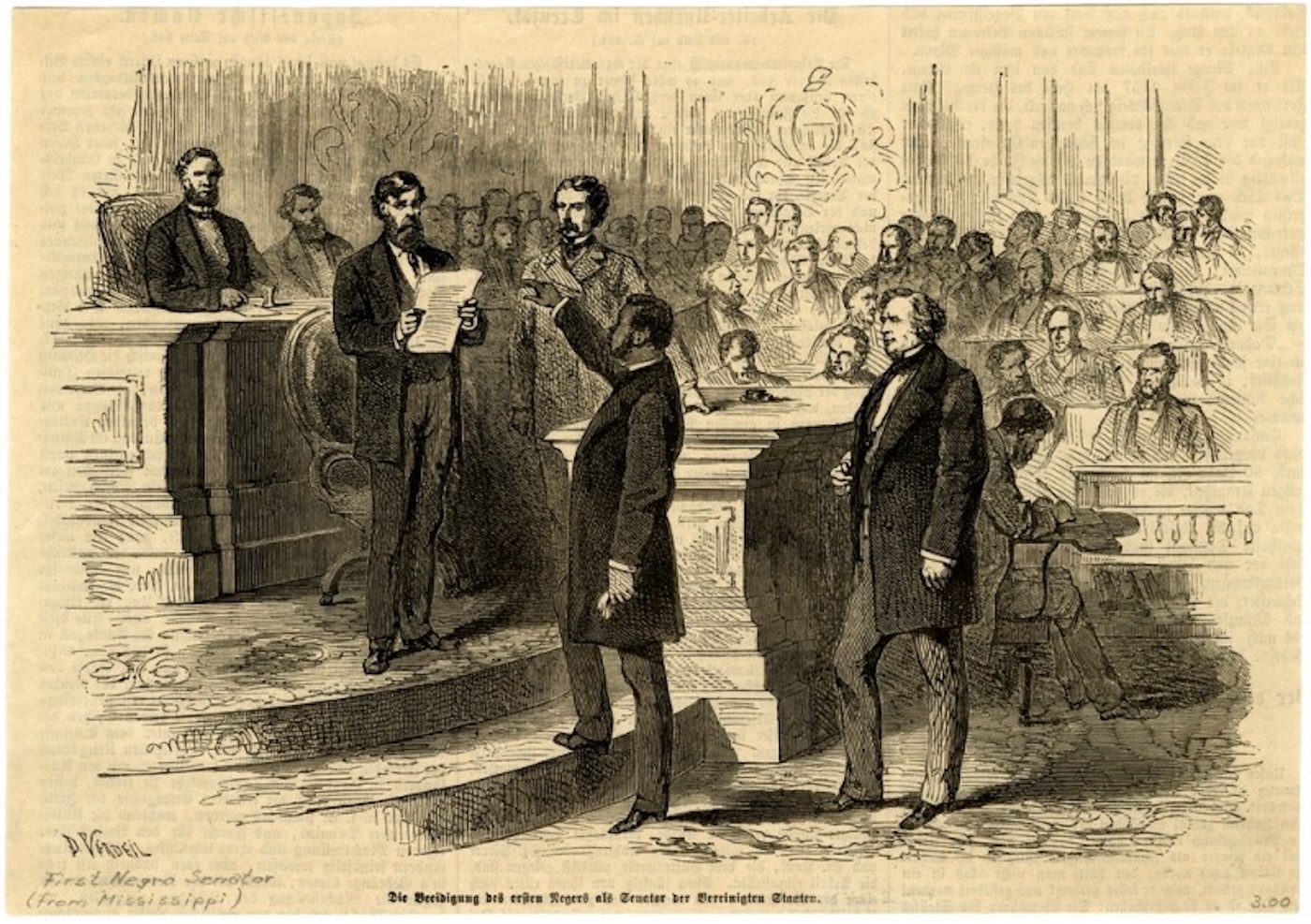
On a winter day in Washington—February 25, 1870—the United States Senate became a theater of national meaning. The galleries were packed. When Hiram Rhodes Revels entered the chamber to take the oath of office, visitors broke into applause, an eruption that was both celebration and provocation. Revels, a Mississippi Republican and a minister by vocation, was about to become the first African American to serve in the U.S. Congress.
The moment was stitched tightly to an argument that had consumed the nation since the Civil War ended: what did emancipation actually require? Not simply the legal abolition of slavery, but the construction of a new civic order—one that could withstand the ingenuity of white resistance, the fatigue of Northern will, and the opportunism that thrives in any power vacuum. Revels’s presence in the Senate did not resolve that argument. It dramatized it. His election was proof that Reconstruction could produce something radical and real: Black political authority in the former Confederacy, asserted within the highest institutions of American government. And yet even as Revels took his seat, the country was already rehearsing the backlash that would make his achievement look, in hindsight, like a bright flare before a long dark.
The Senate Historical Office captured that sense of simultaneity—triumph and fragility—by noting that Revels’s oath came just weeks after the ratification of the Fifteenth Amendment, which prohibited disfranchising voters “on account of race, color, or previous condition of servitude.” A contemporary abolitionist, Wendell Phillips, called Revels “the Fifteenth Amendment in flesh and blood,” a phrase that did more than praise a man. It acknowledged what the postwar fight had become: a contest over whether constitutional promises would be embodied—made enforceable in courthouses, polling places, and legislative chambers—or left as ink on parchment.
To understand the life and significance of Hiram Rhodes Revels is to trace that contest from its origins: the collapse of slavery, the improvisation of freedom, the fierce legislative struggle over citizenship and voting rights, and the local battles—especially in Mississippi—where those national decisions were either implemented or undermined. Revels did not invent Reconstruction, and he did not control its fate. But his career illuminates its central dilemma: how to build a democracy out of a society that had been organized, economically and psychologically, around Black exclusion.
A free man in a slave republic
Revels was born free in Fayetteville, North Carolina, on September 27, 1827—an origin that complicates the popular shorthand that imagines all Black life in the antebellum South as uniformly enslaved. The Senate’s biographical material describes him as the son of a Baptist preacher who received early instruction at a private school run by an African American woman, then traveled north for further education. That arc—local learning under restriction, then movement across state lines in search of opportunity—was familiar to many free Black families navigating a nation that treated Black literacy as a threat and Black mobility as a problem.
Education mattered in Revels’s world not only as personal advancement but as protection: a credential, a network, a form of authority that could be carried from town to town. Revels attended seminaries in Indiana and Ohio and studied theology at Knox College in Illinois. He became a minister in the African Methodist Episcopal tradition—part of a church culture that, for many Black Americans, functioned as a parallel civic infrastructure. The pulpit was a platform; the congregation was a constituency; the church was a meetinghouse where politics could be discussed in the language of morality and collective survival.
Those years of itinerant ministry placed Revels in the currents of antebellum America: a country expanding westward, tightening slave law, and lurching toward war. The U.S. House’s historical profile notes that he was a preacher and educator in at least nine states before entering office in Mississippi—experience that made him both adaptable and legible to different Black communities, and, crucially, capable of speaking across factions.
When the Civil War came, Revels’s role reflected a broader transformation: Black men, long excluded from political power, became essential to the Union war effort. The Senate biography records that Revels helped raise two Black regiments and fought at Vicksburg—an association with Union victory that mattered profoundly in Mississippi, where war’s outcome would soon be translated into a political struggle over the meaning of defeat.
If Reconstruction can be described as the project of converting Union victory into a new social order, then Revels’s wartime service situated him on the side of conversion: he was not merely a beneficiary of freedom but an agent in the process that forced the nation to confront slavery’s end.
Reconstruction begins: Freedom, then the fight over its terms
Reconstruction is often narrated as a policy era, but it began first as a set of human emergencies. The Confederacy collapsed, and four million formerly enslaved people faced the question that emancipation never automatically answers: how do you live free in a place where your labor was once owned, your family ties were once legally fragile, and your movement was once criminalized? The federal government improvised solutions through institutions like the Freedmen’s Bureau, while southern states improvised resistance through Black Codes and other restrictions designed to control labor and limit mobility. Congress and President Andrew Johnson collided over who would set the terms of the postwar South.
By 1867, that collision produced a decisive shift toward what historians often call “Congressional” or “Radical” Reconstruction. The U.S. Senate’s historical overview of readmission explains that the Reconstruction Act of 1867 divided former Confederate states (except Tennessee) into five military districts and required each state to write a new constitution approved by voters—including African Americans—and to ratify the Fourteenth Amendment. Those requirements were not bureaucratic hurdles; they were an attempt to enforce a new definition of belonging, backed by military power when necessary.
The Fourteenth Amendment mattered because it addressed citizenship and equal protection, directly countering the infamous Dred Scott decision’s logic that Black people could not be citizens. That legal history would become more than background in Revels’s case—it would become ammunition for his opponents when he was elected to the Senate.
The Fifteenth Amendment, passed by Congress in 1869 and ratified on February 3, 1870, extended Reconstruction’s logic to voting rights—declaring that the right to vote could not be denied on the basis of race. The timing is critical: Revels’s swearing-in came at the hinge of constitutional change, when the legal architecture of Black political participation was being built even as violent and procedural strategies to undermine it were forming in parallel.
Mississippi, where Revels would rise, illustrates Reconstruction’s complexity in concentrated form. The state had been a core engine of the slave economy and then a site of brutal wartime conflict. Under Congressional Reconstruction, it faced federal demands for a new constitution and broader political participation. Mississippi’s Department of Archives and History notes that Reconstruction plans issued by Congress required Black male suffrage, shaping the composition of Mississippi’s 1868 constitutional convention. That constitution, in turn, extended full rights of citizenship and voting to African Americans—at least on paper—during a period when Black civic life was rapidly expanding and equally rapidly targeted.
It is easy to forget, from a distance, how revolutionary these changes were. For white Mississippians accustomed to slavery’s hierarchy, Black voting and officeholding threatened not just political control but social identity. For freedpeople, political participation was not an abstraction; it was a means of protecting families, securing education, and defending labor rights. The ballot became a shield—and therefore a target.
Mississippi’s “biracial democracy,” built under pressure
The phrase “biracial democracy” appears in modern accounts because it captures a brief, volatile reality: in parts of the South, Black men voted in large numbers, Black officeholders were elected, and governments formed that included both Black and white Republicans. The Washington Post, reflecting on Revels’s era, described his arrival in Washington as the beginning of a “remarkable (albeit short-lived)” period of biracial democracy in the Reconstruction-era Deep South—one that historians like Eric Foner call pivotal even though it was “shortly overthrown.”
Mississippi’s own historical institutions document the scale of Black political participation in those years. The Mississippi Civil Rights Museum notes that from 1867 to 1869, Mississippians elected Black state senators and representatives in significant numbers, and that Mississippi sent Hiram Revels and later Blanche Kelso Bruce to the U.S. Senate when senators were still chosen by state legislatures. These details matter because they rebut the lazy myth that Reconstruction was merely a Northern imposition. It was also local organizing, local elections, local governance—conducted amid intense intimidation.
Adelbert Ames, the Union general who served as military governor and later a central figure in Reconstruction Mississippi, represents the entanglement of federal authority and local politics. Mississippi historical sources describe how Ames functioned within the Reconstruction military district system and how his governance intersected with the reestablishment of civil authority. His presence underscores a basic truth: Reconstruction governments often operated under the shadow of violence and contested legitimacy. White supremacist terrorism—through organizations like the Ku Klux Klan and other paramilitary groups—was not incidental. It was a political strategy designed to make Black participation costly, then impossible.
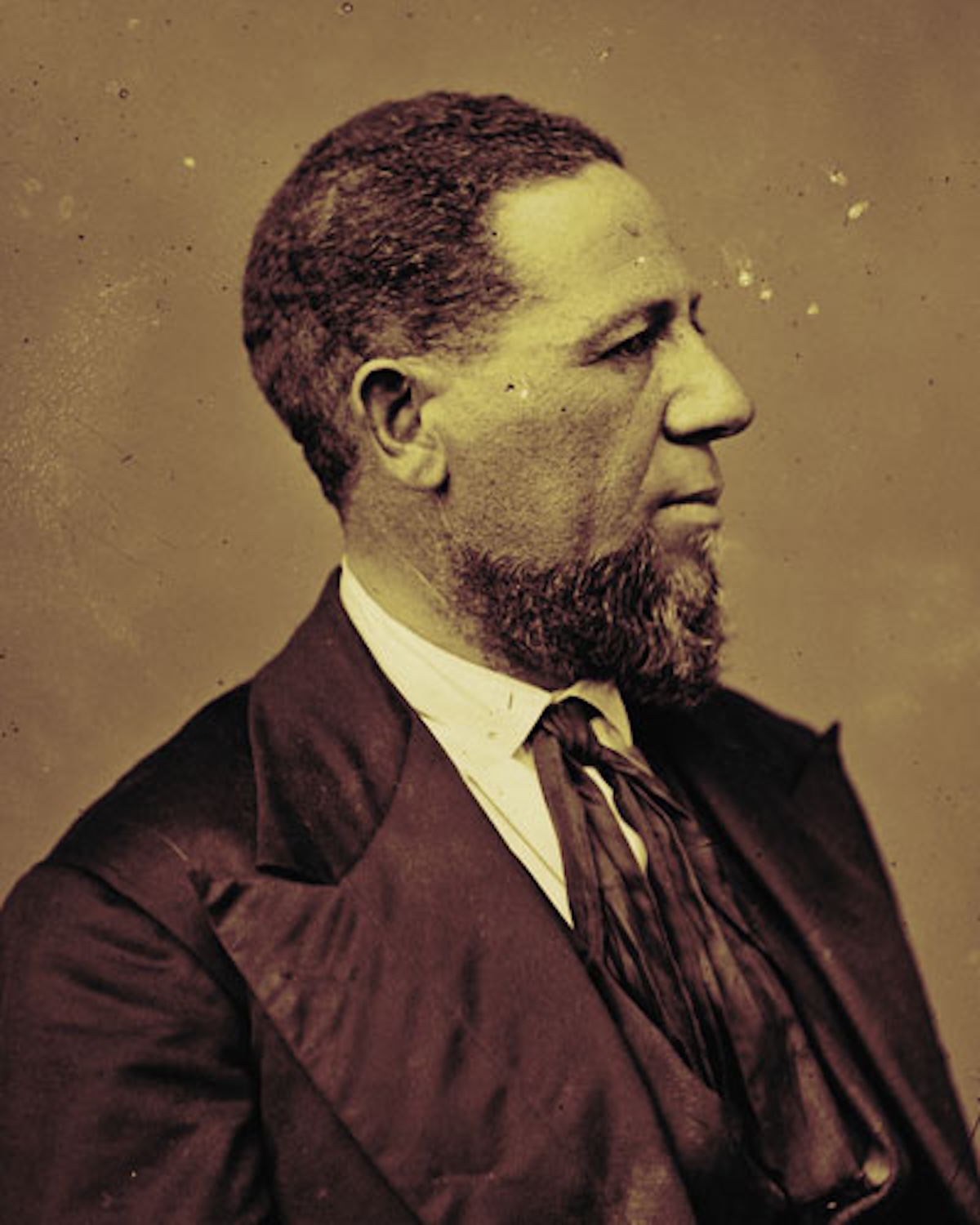
Revels entered Mississippi politics in this context, not as a career politician but as a minister whose authority came from community trust and oratorical skill. The National Park Service notes that in 1869, encouraged by John Roy Lynch (who would later serve in Congress), Revels won a seat in the Mississippi state senate. Lynch’s involvement is itself a clue: Reconstruction leadership in Mississippi was a network of Black organizers, ministers, veterans, and emerging politicians who understood that political power was the mechanism through which rights could be defended.
That same NPS account emphasizes the scale of Black representation in the Mississippi legislature under Reconstruction—more than 30 African Americans among the state’s 140 legislators—an astounding number given the state’s prewar political order. was therefore not an isolated “first” plucked from obscurity; he was part of a broader Black political surge, one built through institutional openings created by federal law and sustained by local mobilization.
The road to Washington: Readmission, vacancies, and a deliberate choice
One of the paradoxes of Revels’s Senate election is that it depended on the very machinery that Confederate secession had broken. When Mississippi left the Union in 1861, its Senate seats became vacant. In the Senate Historical Office telling, those vacancies remained empty until Mississippi’s readmission approached, at which point the newly convened Mississippi legislature moved quickly to fill them.
Mississippi was officially readmitted on February 23, 1870—two days before Revels took the oath—according to the U.S. Senate’s Civil War and Reconstruction account. The timing compresses what can otherwise feel like a long, hazy era into a specific chain of events: federal requirements for readmission, state political organization, legislative elections, and then the rapid elevation of a Black minister to the Senate.
The Senate Historical Office provides a striking detail about the internal dynamics of Mississippi’s legislature. When the legislature convened on January 11, 1870, filling Senate vacancies was one of its first priorities. Black legislators—about a quarter of the body—insisted that one of the vacancies be filled by a Black Republican. Revels later recalled that the Black members consulted among themselves and agreed that electing someone of their own race would weaken “color line prejudice.”
That insistence is one of Revels’s most important contexts. His election was not simply a benevolent gift from white Republicans. It was also a demand from Black legislators exercising power within the system Reconstruction had made possible. That demand, in turn, shows how Reconstruction’s meaning was contested even inside Republican coalitions. Black Mississippians did not simply want representation in the abstract; they wanted it embodied in a person who could not be mistaken for a symbolic proxy.
Revels’s selection was also shaped by political compromise. Mississippi had two Senate vacancies; the shorter term, expiring in March 1871, went to Revels. The Smithsonian account of his election notes bargaining within the legislature and the calculation that seating a Black senator would strike a blow against prejudice even as some opponents hoped it might damage Republicans politically. In other words, Revels’s election was simultaneously moral and transactional, rooted in genuine aspiration and strategic math. That is often how political breakthroughs occur: conviction meets opportunity, and each side imagines it can manage the consequences.
The symbolism was unavoidable. Revels was to occupy a seat associated—by memory and narrative, even if not strictly by the precise vacancy mechanics—with Jefferson Davis, the former Confederate president and Mississippi senator. Washington Post and Atlantic accounts emphasize the reversal: a Black man entering the Senate in the wake of the Confederacy’s defeat, arriving during a brief apex of Black political participation. The point was not simply that Davis was gone; it was that the world Davis fought to preserve had been legally repudiated, at least for the moment, by constitutional change and federal enforcement.
The citizenship challenge: A debate that exposed the era’s fault lines
Revels’s elevation did not pass without contest. Almost immediately, senators challenged his eligibility by arguing that he had not been a U.S. citizen for the constitutionally required nine years. The U.S. Senate’s Civil War and Reconstruction account notes that after Mississippi’s readmission, Senator Henry Wilson presented Revels’s credentials, and “three senators issued a challenge” on citizenship grounds.
This argument was not a technical quibble. It was an attempt to resurrect, through procedural means, the premise that Black citizenship was new, conditional, and therefore easily denied. Opponents leaned on the idea that Black Americans had not been citizens prior to the Fourteenth Amendment—echoing Dred Scott’s logic—and thus could not meet the nine-year requirement for Senate service. Revels’s supporters rejected that framing, arguing that the Fourteenth Amendment had nullified Dred Scott and that Revels had voted in Ohio well before the mid-1860s, demonstrating the practical reality of his citizenship.
Charles Sumner, one of the Senate’s strongest advocates for civil rights, delivered a speech that helped end the debate. The Senate Historical Office records Sumner invoking the Declaration of Independence—“All men are created equal”—and framing Revels’s seating as making that claim real. The Senate voted 48 to 8 to seat him.
In a deeper sense, the challenge and its defeat reveal Reconstruction’s legal architecture in action. Constitutional amendments were not self-enforcing. Their meaning had to be defended in debates, votes, and institutional practices. Revels’s seating was therefore a live demonstration of the new constitutional order: not merely that Black men could vote, but that Black men could legislate at the national level, and that the Senate could be forced to acknowledge their eligibility as citizens.
That debate also hints at why Reconstruction would ultimately falter. If opponents were willing to contest Revels’s citizenship—despite his free birth and his public record—then no amount of constitutional text would automatically produce acceptance. The struggle was over the very idea of who “counted” as American, and institutions could be used either to expand that category or to police its boundaries.
What Revels represented: Moderation, capability, and a politics of repair
Revels served in the Senate from February 25, 1870, to March 3, 1871. In length, his tenure was short. In meaning, it was outsized. The temptation is to treat “first” as a category unto itself, a ceremonial label. But Revels’s significance depends on what he did with the office and what others projected onto him.
Contemporary and later accounts often describe Revels as relatively moderate—an orientation shaped by his ministerial background and his role as a bridge figure in a politically combustible environment. The National Park Service emphasizes his oratorical skills, honed through preaching, and his ability to navigate a hostile political landscape. His moderation, however, should not be confused with timidity. In Reconstruction Mississippi, simply insisting on Black political equality and occupying high office was confrontational by definition.
Revels’s very presence challenged the racist theories that had long justified slavery and later justified Black exclusion: claims that Black men lacked the intelligence, discipline, or civic virtue required for governance. The Washington Post account underscores this point by situating Revels among a wave of Black officeholding after the Civil War—courthouses to Capitol Hill—before backlash narrowed the possibilities.
Revels also mattered because he illustrated a particular form of postwar Black leadership: rooted in religious institutions, education, and the pragmatic needs of freedpeople. The Atlantic, writing about Reconstruction memory and the National Park Service’s efforts to interpret it, notes that Revels’s church functioned as a central meeting place where freedmen organized and asserted political power. In that framing, Revels is less a lone trailblazer than a representative of collective civic infrastructure—churches, schools, mutual aid, political clubs—built by Black communities as both refuge and platform.
The public response to his swearing-in—the applause in the galleries—suggests that many Americans understood the symbolic weight of the moment. Yet the speed with which his eligibility was challenged and the brevity of his Senate term also suggest how precarious those breakthroughs were.
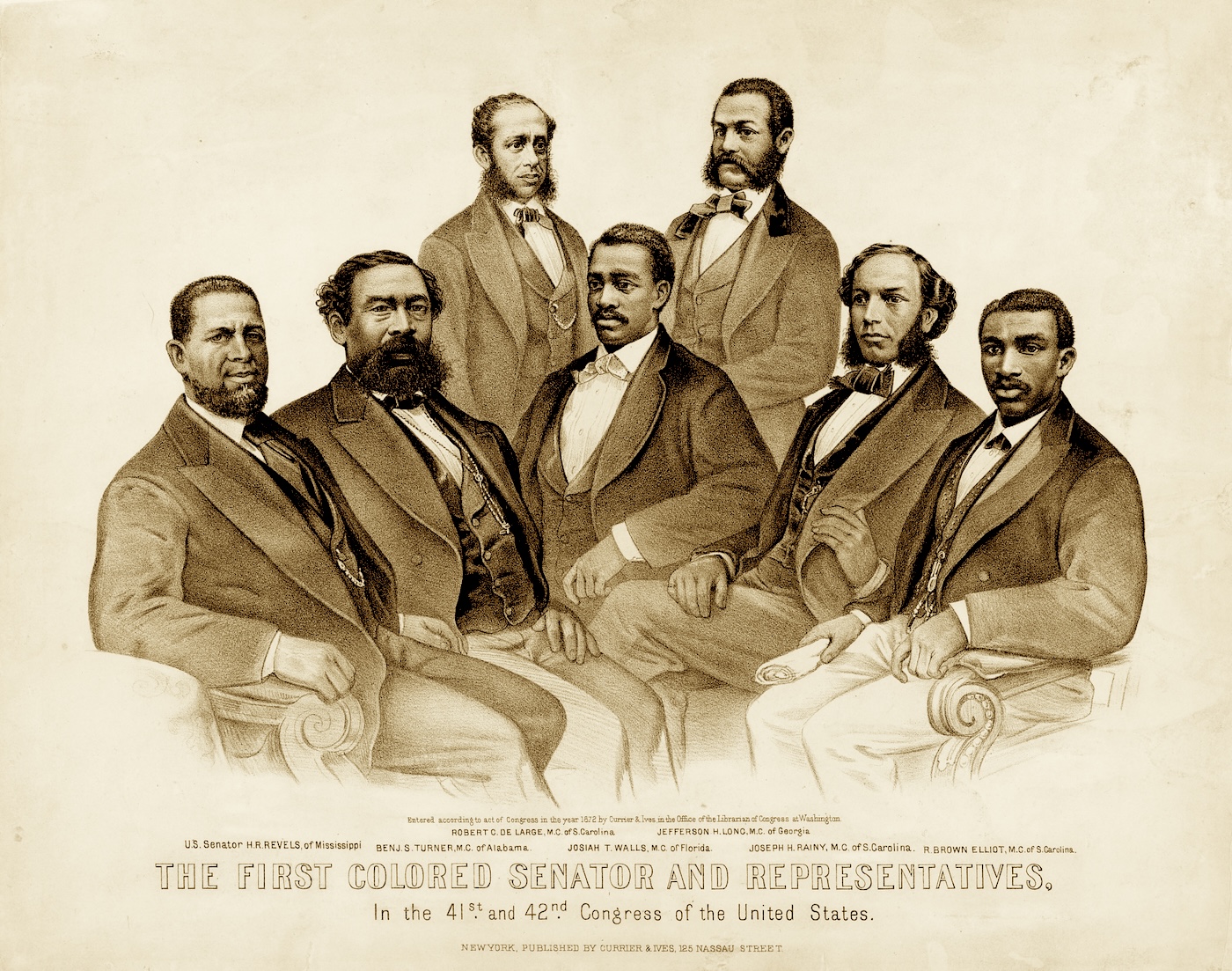
After the Senate: Building institutions in a hostile landscape
Revels’s post-Senate career underscores another essential aspect of Reconstruction: political representation was only one part of freedom’s infrastructure. Education—especially higher education—was a second front. After leaving the Senate, Revels became the first president of Alcorn Agricultural and Mechanical College, now Alcorn State University, a historically Black institution founded during Reconstruction.
That move can be read as a strategic shift. Federal power and national attention could open doors, but lasting change required durable institutions in the South—schools that could produce teachers, ministers, lawyers, and political leaders capable of sustaining Black citizenship beyond the immediate protections of military Reconstruction. The existence of Alcorn itself reflects Reconstruction’s generative capacity: despite corruption and conflict, it created new public goods and new possibilities.
Revels’s work as an educator also complicates simplistic narratives that frame Reconstruction leaders as either noble heroes or cynical opportunists. The era did include profiteers and factional conflict, and Black communities themselves often had to navigate alliances with white Republicans, including “carpetbaggers,” under conditions of extraordinary pressure. But the institutional legacy—schools, constitutions, brief experiments in inclusive governance—remains real.
Mississippi’s record of Black officeholding during Reconstruction, documented by state history institutions, shows that Revels was part of a cohort that included legislators and statewide officials. The significance of that cohort is not only the offices held but the precedent established: for a period, Black political leadership was normal in places where slavery had once insisted Black humanity was legally irrelevant.
The counterrevolution and the long shadow of abandonment
If Revels’s rise illustrates Reconstruction’s possibilities, Mississippi’s later history illustrates its rollback. The mechanisms of counterrevolution varied—violence, legal restriction, economic coercion—but the result was a systematic narrowing of Black political power. The Washington Post’s description of biracial democracy as “short-lived” is not rhetorical flourish; it is an assessment backed by the historical record of disenfranchisement and the end of federal commitment to enforcing Black rights in the South.
Even in the twenty-first century, Mississippi’s voting rights landscape bears marks of those post-Reconstruction choices. Modern reporting and scholarship trace how laws rooted in the Jim Crow era continued to structure disenfranchisement. While this is beyond Revels’s lifetime, it clarifies the stakes of his era: the fight was never only about who could be seated once, but whether Black political participation would be protected as a permanent feature of American democracy.
The Equal Justice Initiative’s work on Reconstruction’s end emphasizes that the collapse of federal protection enabled violent suppression and the entrenchment of racial hierarchy under new names. That history reframes Revels’s Senate term not as the end of a struggle but as an early summit in a longer climb—one that would include the nadir of Jim Crow, the long civil rights movement, and ongoing battles over voting access.
In a sense, the question Revels’s life raises is brutally simple: what does it take to make citizenship real? The Reconstruction Amendments supplied legal answers—abolition, equal protection, voting rights. Revels supplied an embodied answer: citizenship also requires presence, participation, and power exercised in public view. And the backlash supplied a warning: without enforcement, rights can be rewritten into ritual.
Why Revels still matters
Hiram Rhodes Revels can be remembered in at least three overlapping ways, each instructive.
First, he is a figure of political firsts, the man who crossed a formal barrier and made it impossible for the nation to pretend that its institutions were naturally white. The Senate vote to seat him, after an attempt to exclude him through a citizenship argument, is a concrete reminder that equality has often had to be argued into existence—one debate, one vote, one oath at a time.
Second, Revels is a case study in Reconstruction’s political mechanics. His election was enabled by federal law, military oversight, constitutional amendments, and a state legislature in which Black lawmakers were numerous enough to insist on representation that looked like them. It was not inevitable. It was constructed.
Third, and perhaps most enduring, Revels is a symbol of how Black civic institutions—especially the church and the school—served as engines of political transformation. His ministerial background was not incidental to his success; it shaped how he spoke, how he led, and how he could be trusted by communities emerging from slavery into an uncertain freedom.
There is a tendency, in American memory, to treat Reconstruction as either a tragic mistake or a noble experiment that simply “failed.” Revels’s life argues against both simplifications. His achievement was not a mistake; it was the logical outcome of emancipation when paired with constitutional commitment and, however briefly, federal enforcement. And it did not merely fail; it was actively dismantled by a counterrevolution that understood exactly what was at stake when Black men voted and governed.
On February 25, 1870, applause rang out in the Senate galleries because a crowd recognized history as it happened. The harder work is recognizing what that applause demanded of the future: not admiration for a “first,” but the continuation of the conditions that made him possible.
More great stories

The Man Who Could Get You in the Room
February 24, 2026
No Comments

Jane Crow’s Author
February 24, 2026
No Comments