



Shabazz’s work models an insistence that Black life is worthy of meticulous attention.
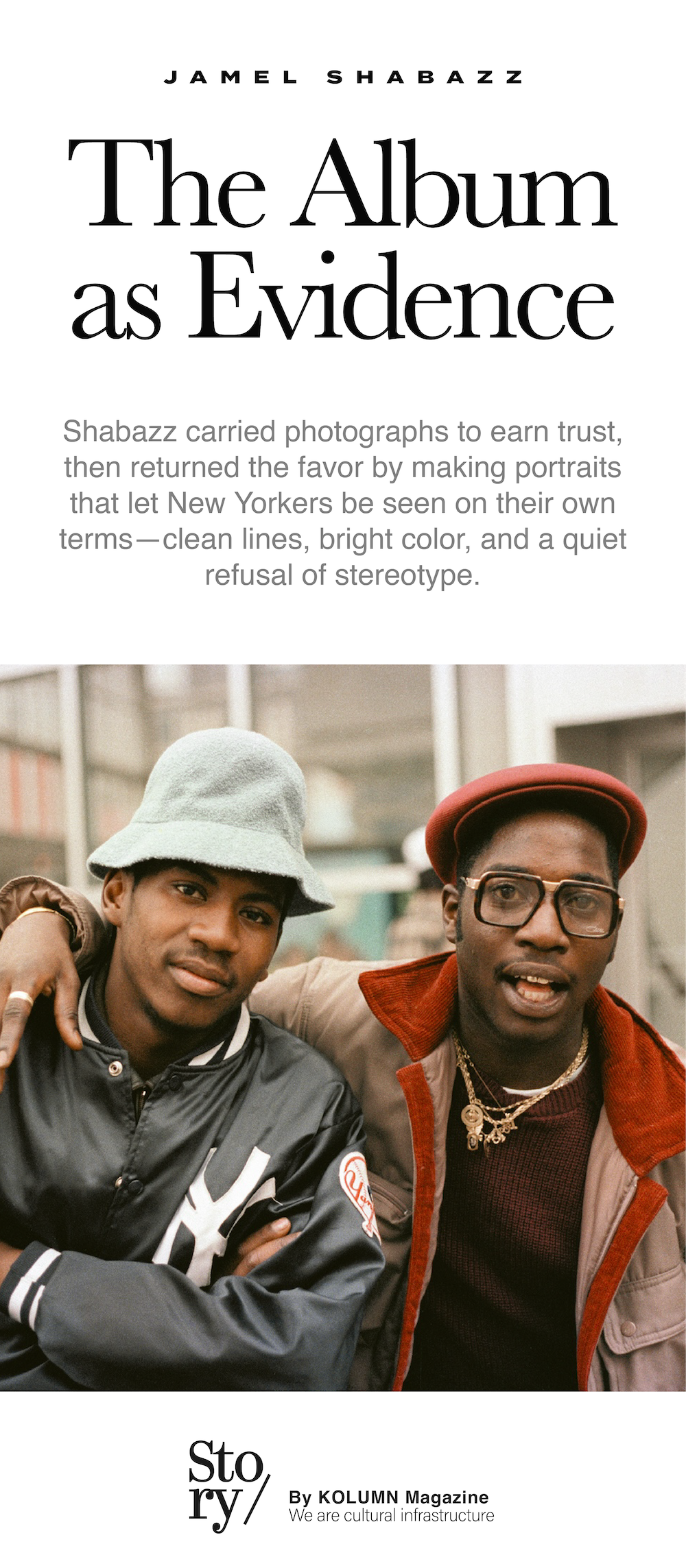
Shabazz’s work models an insistence that Black life is worthy of meticulous attention.
By KOLUMN Magazine
Jamel Shabazz’s photographs are often described as a love letter to New York, but that shorthand can flatten what is, at its core, a disciplined act of public memory. Love letters are private; Shabazz has spent decades building something closer to an archive—one constructed from handshakes, small talk, and the subtle negotiations of the sidewalk.
A Black soul of the 80s can immediately hear the funk-forward electric guitar intro of Kurtis Blow’s The Breaks; relate to the depths of struggle and warning in Grandmaster Flash & The Furious Five’s The Message and recall the weight of a JVC on the shoulders after moving through blocks.
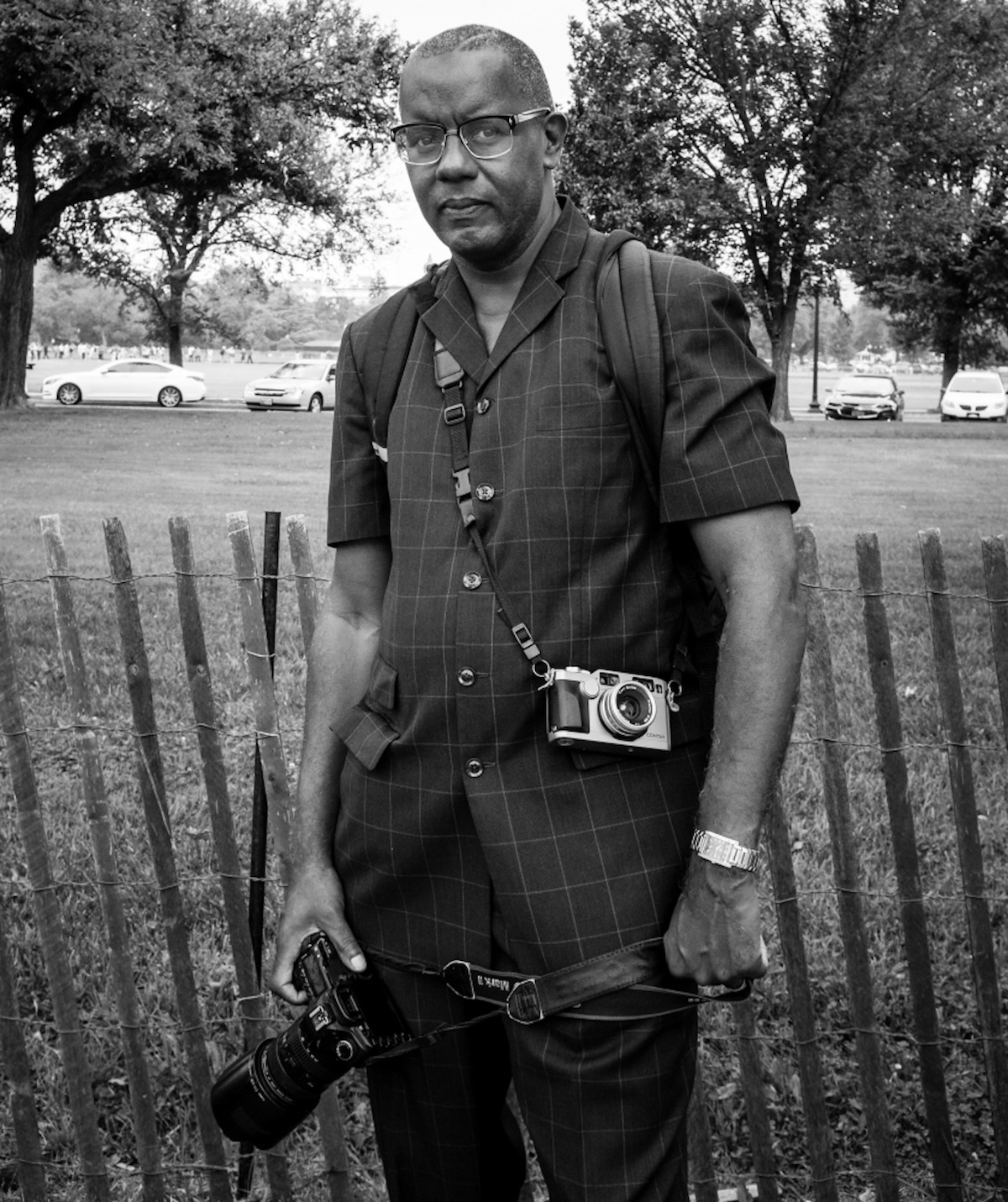
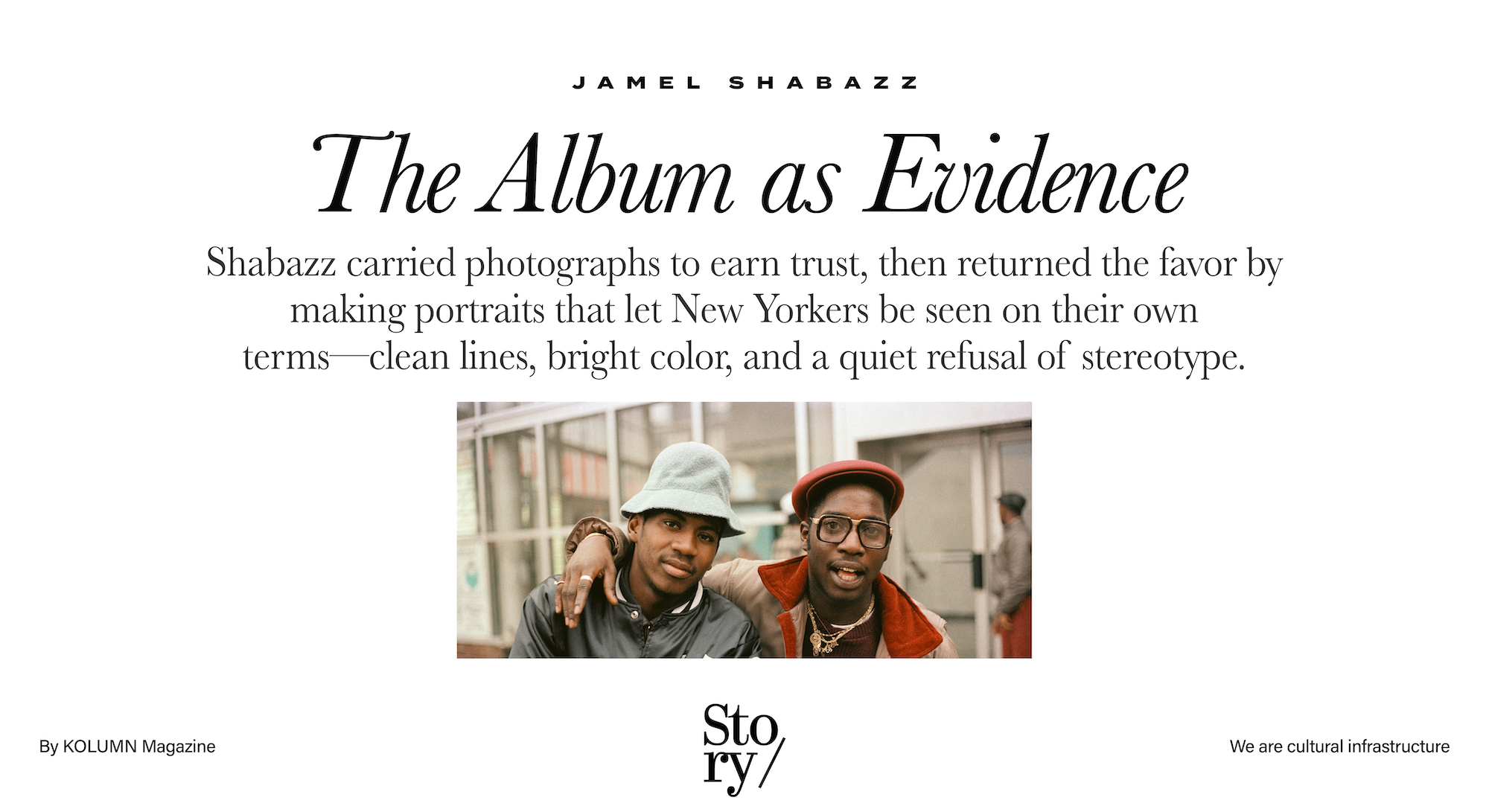
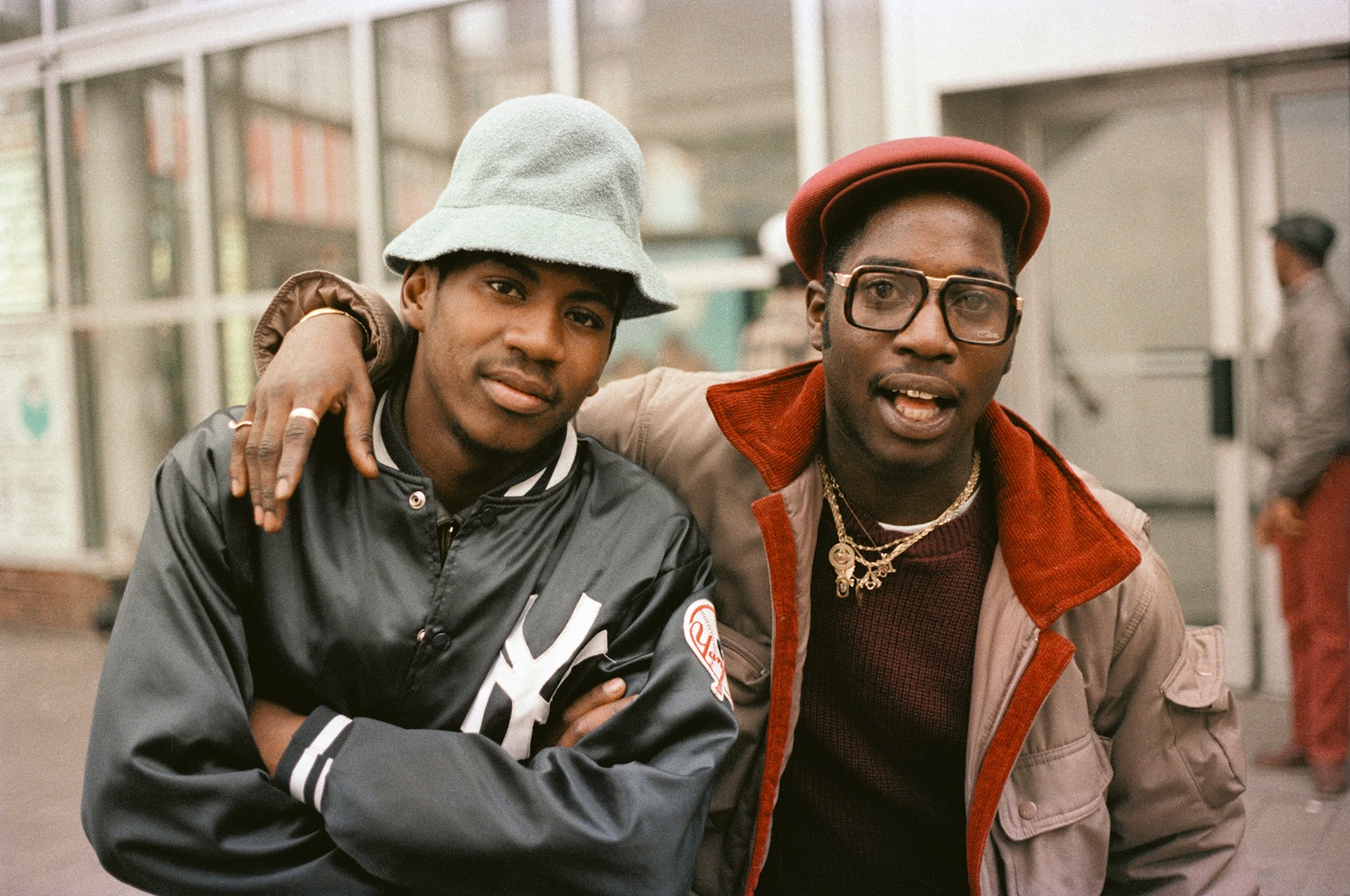
Since the early 1980s, he has photographed Black and brown New Yorkers with an intimacy that is not accidental but practiced: the kind that comes from asking, listening, and returning to the same blocks long enough to be recognized. His portraits, whether made on a subway platform, a Brooklyn avenue, or the open calm of Prospect Park, are suffused with style and ease. Kangols up top and Adidas below (no slight against Puma intended, but…it was what it was), frame each moment of New York’s 80s culture, unstaged, raw and refusing to not be seen and heard. Yet their deeper significance lies in how they revise the visual record of an era when mainstream imagery of Black city life leaned hard on crisis, menace, and pathology.
To understand Shabazz’s cultural importance, it helps to start with what his pictures do not do. They do not treat the street as a hunting ground. They do not pretend the photographer is invisible. They do not reduce their subjects to symbols. Instead, they present people as self-possessed collaborators in their own representation—camera-ready not because the lens has stolen something, but because the exchange has produced something. Curbed captured the essence of this ethic in a simple line: Shabazz will always ask before taking your picture. That posture—consent as craft, rapport as method—has become a central part of his reputation and a key reason his photographs read less like surveillance and more like community portraiture.
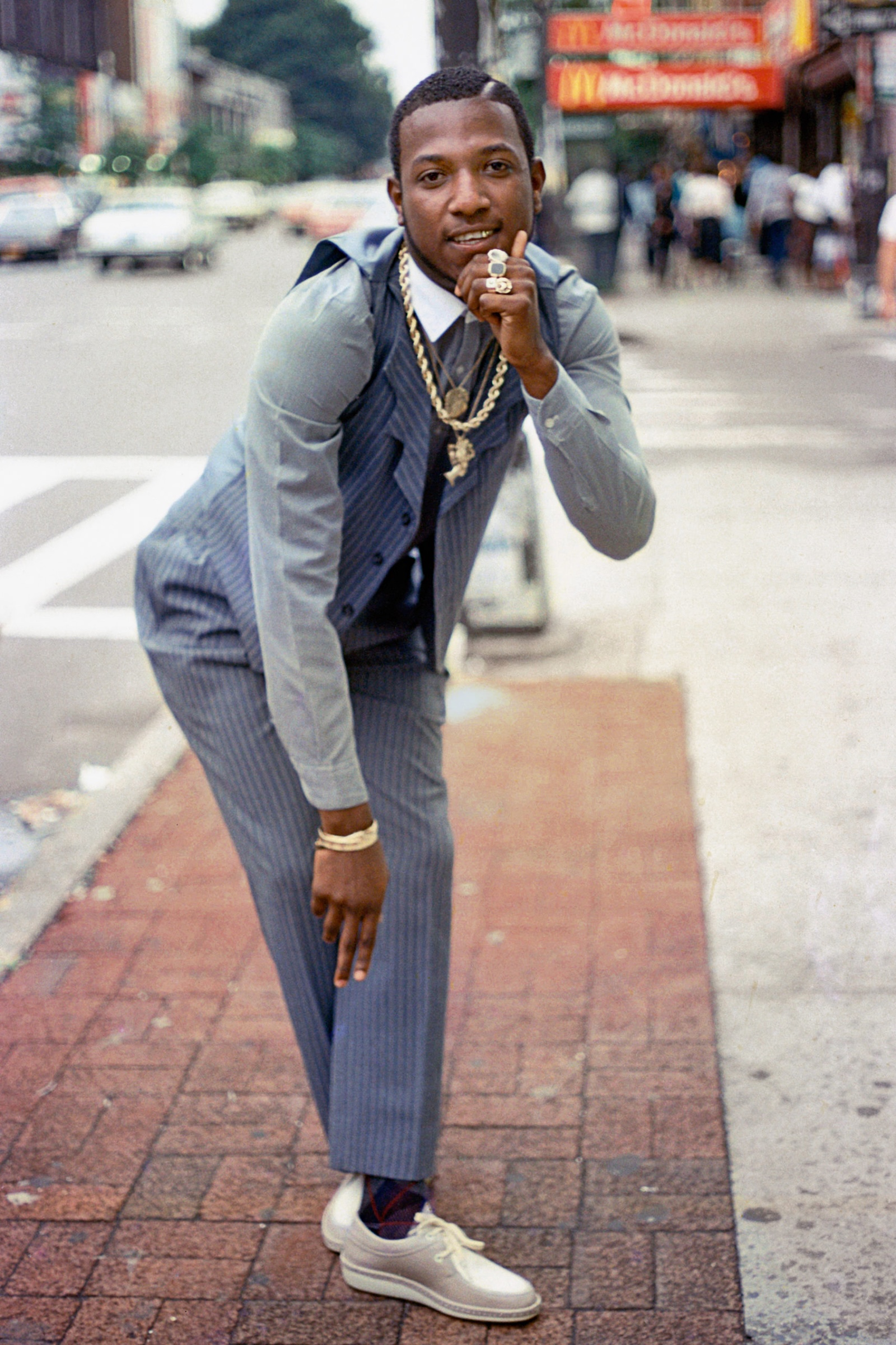
The results are, on first glance, irresistibly aesthetic. The chain was status, and ever-present in Shabazz’s photos, a bold and weighted statement of accomplishment… The larger the rope, the better. Vogue, reflecting on Shabazz’s street photography, framed fashion in his images as a kind of resistance and dignity, an insistence on self-definition in neighborhoods too often defined from the outside. But to stop at style is to miss the politics embedded in the act of depiction. Shabazz’s portraits argue—quietly but relentlessly—that the people who live through the city’s hardest decades still contain joy, order, tenderness, humor, romance, kinship, and pride. He photographs those qualities not as exceptions but as baseline truths.
This is why his work has traveled from the street to the museum without losing its pulse. A first-time viewer might assume that institutional acclaim required Shabazz to be “discovered” by curators or elevated by cultural gatekeepers. In reality, the arc is more reciprocal: museums have come to recognize that he has been doing, for a long time, what institutions claim to do—preserving culture, documenting communities, and shaping a usable history. The Studio Museum in Harlem has noted his exhibitions there, including a solo presentation, and listed the wide geographic reach of his inclusion in shows from Brooklyn to the Bronx to London’s Victoria and Albert Museum. (Studio Museum in Harlem) The Bronx Museum staged a major celebration of his career, highlighting the scale of his street-life documentation. (The Bronx Museum) The Brooklyn Museum has placed his photographs in public view in an outdoor presentation that reads like a homecoming, emphasizing four decades of work and the endurance of his themes—vitality, community, and joy. (Brooklyn Museum)
But long before these institutional acknowledgments, Shabazz was already working with the conviction that images matter because narratives matter. The question is always: whose narrative? In the 1980s, New York was a city in the grip of both myth and upheaval. The mythology—fueled by tabloids, television, and political rhetoric—cast Black neighborhoods as places of danger and disorder. Shabazz’s camera moved in the opposite direction. He photographed people “cold chillin’” and hanging out, the everyday social life that does not make headlines but makes a city livable. PowerHouse, the publisher of one of his most influential books, describes Back in the Days as a document of the emerging hip-hop scene from 1980 to 1989—before corporate planning, before the multinational industry. That “before” is doing heavy work: it signals an urgency to preserve what mass culture will later commodify.
A Brooklyn apprenticeship in photography and memory
Shabazz is Brooklyn-born, and his origin story is often told as an inheritance. In an interview with The Art Newspaper, he spoke about growing up around cameras and photography books because his father was a professional photographer who turned their apartment into a studio on weekends—photographing family, friends, weddings—and maintained an extensive library of photo books. That detail matters because it places Shabazz’s later obsession with albums and archives in a family tradition: photography as both livelihood and lineage, an intergenerational practice of keeping.
The Washington Post, in a piece about Gordon Parks’s artistic heirs, offers a similar glimpse into Shabazz’s early relationship to the camera—one shaped by access and constraint. His father’s professional Nikon equipment was off-limits, but his mother’s Kodak Instamatics were available, a small domestic technology that opened a door to a larger way of seeing. Shabazz described the experience of pressing the shutter as “almost magical,” a shift in perception that allowed him to recognize beauty he hadn’t known existed. These accounts, repeated across interviews, are not just charming biographical notes. They are the scaffolding of an artistic philosophy: photography as a tool for attention, attention as a form of respect.
As a teenager and young man, he is often described as taking pictures in and around his neighborhoods—Brooklyn, Flatbush, the places that later become synonymous with his eye. Curbed notes he first picked up a camera at 15 and has been documenting city life ever since, a timeline that makes his archive less like a project than a life’s work. If you accept that premise, then Shabazz’s photographs are not simply “of” New York; they are “with” New York, made in the long duration of acquaintance.
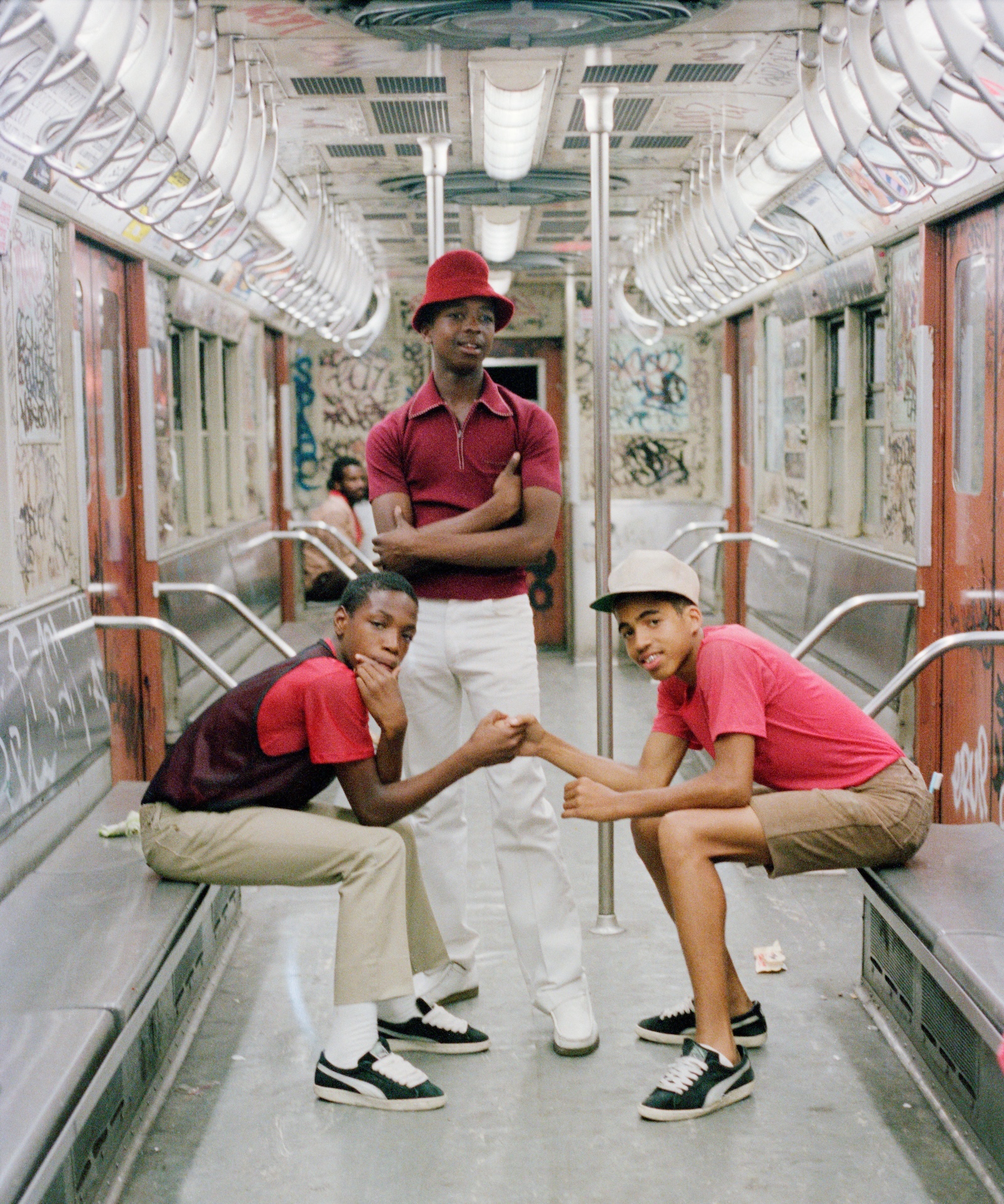
That longevity is also what gives his work a rare ability: it allows viewers to track cultural change without losing sight of continuity. In Shabazz’s images, the 1980s are not a costume party. They are a lived world. People pose with the seriousness of those who understand how rarely they are offered the chance to be represented with dignity. Friends lean into each other with a choreography of closeness. Couples and siblings appear not as isolated individuals but as relational beings, a point the Studio Museum underscores in its discussion of his “Deuce” portraits—images that present pairs (twins, lovers, friends, siblings) as visual testaments to Black relationships. The word “relationship” is central here: Shabazz photographs the bonds that hold communities together, and in doing so, he photographs an infrastructure of care.
The street portrait as collaboration, not capture
Street photography has long been haunted by an ethical tension: the photographer’s freedom versus the subject’s autonomy. Much of the genre’s mythology celebrates the decisive moment snatched from life, the candid frame taken without permission, the idea that authenticity requires a subject to be unguarded. Shabazz offers a different model—one that treats posing as part of truth rather than a betrayal of it. His portraits are often explicitly staged, but they do not feel artificial. They feel consensual.
This is where the details of method become part of the meaning. The Atlantic’s 2023 feature on his photographs describes him moving through the city armed with his camera and a collection of albums. The albums function as introduction and proof: they show potential subjects how he sees people, and they also demonstrate that he returns value to those he photographs by placing them inside a broader story. In other words, the album is a tool for trust. It is also a declaration of seriousness: this is not a drive-by image; this is part of a long, continuous record.
In the Aperture essay that argues for Shabazz as one of New York’s most vital street photographers, the emphasis falls on the energy of street life and hip-hop culture, and the making of indelible images of joy, style, and community. “Vital” is the right adjective not only because his photographs are lively but because they function like vital records—birth certificates of a culture that mainstream institutions were slow to validate. The style in these images is not mere decoration; it is a language. For young Black men and women in 1980s New York, to be “fresh” was to be legible to one’s peers, to stake a claim to presence. Shabazz understood that language from the inside, and his camera translates it for the archive without stripping it of context.
This is why the images have become a touchstone for hip-hop’s visual history. Back in the Days is frequently described as a documentation of the emerging scene, but the book’s deeper focus is on the people who made the scene possible—kids on corners, dancers, friends in groups, the street as both stage and social network. PowerHouse frames the era in vivid contrasts: battles by breakdancing rather than guns, standards for style set by the streets rather than corporations. Whether or not one accepts that contrast as universally true, the point is that Shabazz’s photographs preserve a moment when cultural production felt local, embodied, and improvisational.
What makes these images endure, however, is not nostalgia. It is their refusal of the easy narrative that says the city’s 1980s were only decay. Shabazz’s work can hold contradiction: hard conditions and soft moments; struggle and elegance; public stress and private poise. Even when his photographs take up difficult subjects—social conditions, epidemics, the aftermath of drugs—his eye remains oriented toward humanity rather than spectacle, a sensibility echoed in profiles that credit him with “crushing stereotypes” and shining light on the people he saw.
A complicated day job: The carceral state and the photographer’s gaze
One of the most striking facts about Shabazz’s biography is that, for many years, his artistic life ran alongside work inside the carceral system. In the interview with The Art Newspaper, he speaks about spending 20 years working as a prison guard at Rikers Island, a detail that complicates any romantic notion of the street photographer as a carefree flâneur. The Guardian’s recent reporting on his Prospect Park project also notes his decades-long career as a corrections officer and positions the park, in part, as a counterbalance—an oasis against the psychic weight of that labor.
This dual identity—photographer of joy, worker in punishment—raises uncomfortable questions, and it is precisely those questions that make Shabazz’s ethic of consent and dignity feel more consequential. To spend days in an institution structured around control and coercion, then spend personal time building images around collaboration, suggests a deliberate moral choice: a decision to practice, through art, a different kind of social relation.
It is tempting to turn that into a neat narrative—photography as redemption—but Shabazz’s work resists easy moral packaging. Instead, it demonstrates a more subtle truth: that someone who has seen the state’s harshest mechanisms up close might be especially attuned to the ways everyday people protect their selfhood. In his portraits, self-presentation is not vanity; it is armor and affirmation. Pride in appearance becomes a visible insistence that one’s life contains value.
That insistence is part of what made Shabazz’s images resonate far beyond New York. They speak to the broader Black urban experience in late 20th-century America—the sense of being watched by institutions but unseen as a full person. Shabazz offers visibility on different terms.
Books that became portable museums
If museums are one way Shabazz’s work travels, the other is the photobook. His books function as portable exhibitions, passed hand to hand, placed on coffee tables, used as reference points for artists and stylists, and treated as evidence of how people lived and looked. The Root’s roundup of books by Black authors, for example, describes Jamel Shabazz: Albums as a collection of photos taken around New York from the 1970s through the 1990s, emphasizing the beauty of Black people and the book’s place as a coffee-table staple. Ebony likewise frames Shabazz’s work as essential to understanding hip-hop and Black New York, noting his role in capturing the “intrinsic beauty” of street style.
Back in the Days remains the title most frequently invoked when people explain Shabazz’s impact. Its initial publication in 2001, and the later “remix” edition with additional photographs and new material, reflects how the archive keeps expanding—and how demand for it persists. The timing is notable. A book about 1980s street culture appearing in 2001 arrives at a moment when hip-hop is entering new global saturation. Shabazz’s images then become a kind of corrective—proof of origins that are not corporate, not sanitized, not easily reduced to brand identity.
But Back in the Days is not only an origin story for hip-hop. It is also a study in everyday social aesthetics. The clothes are important, yes. So are the gestures: the way friends hold each other, the way a teenager meets the lens with a mix of skepticism and pride, the way a group forms a small geometry of belonging on a sidewalk. Shabazz’s camera makes these micro-gestures legible. He photographs how people inhabit public space—how they claim it, decorate it, survive it.
Over time, his books have mapped distinct themes and neighborhoods. A later project focused on Prospect Park, framed as a decades-long meditation on the park as sanctuary and muse. The Guardian describes the park images as “visual medicine,” rooted in Shabazz’s discovery—while combing his archive during Covid lockdown—that Prospect Park kept reappearing as a backdrop for reflection, joy, and community. Wallpaper’s review similarly emphasizes the park as both sanctuary and studio, and notes Shabazz’s insistence on empathy and human connection, even as he resists narrow labels like “street” photographer in favor of describing himself as a “documentarian.” PowerHouse Arena’s event description of the Prospect Park book reinforces the narrative that Shabazz’s acclaim began with Back in the Days and A Time Before Crack, and positions the new volume as a 45-year span of observation in a single beloved place.
Taken together, these books show Shabazz’s range. He is not only an historian of hip-hop style. He is a maker of civic portraiture, a chronicler of public intimacy, and—crucially—an editor of his own archive. That editorial role matters because it points to agency: Shabazz is not merely producing images; he is shaping the narrative framework through which those images are interpreted.
From neighborhood legend to institutional canon
The canonization of Shabazz’s work has been gradual, but it is now unmistakable. The Bronx Museum exhibition framed as a celebration of a forty-year career signals not only institutional interest but a recognition that Shabazz’s archive is large enough to merit survey. Studio Museum’s record of his solo presentation and of his inclusion in major exhibitions underscores how deeply his work has moved into spaces that historically excluded the everyday Black city subjects he photographs. The Brooklyn Museum’s outdoor installation is especially telling: by placing his images in a public-facing setting, the museum mirrors Shabazz’s own commitment to accessibility and to the street as audience.
This institutional embrace is not simply about aesthetics. It is also about historical necessity. A city’s official archives tend to privilege power: mayors, developers, police commissioners, celebrities, disasters. Shabazz’s archive privileges presence—ordinary people whose lives constitute the actual social fabric. In doing so, it expands what counts as history.
The Washington Post’s magazine project on race and photography includes a concise line that could serve as a mission statement: in 1980, Shabazz embarked on a mission to extensively document aspects of life in New York City, from youth culture to social conditions. The word “mission” is key. It suggests intention, a sense of duty beyond personal expression. Shabazz’s work reads like someone who understood early that if he did not photograph his community with care, the dominant images would remain the dominant story.
That sense of mission is echoed by writers who place him in a lineage. Ebony, in a list of trailblazing Black photojournalists, positions Shabazz alongside predecessors like James Van Der Zee and Gordon Parks as a figure who captured beauty and style while expanding the visual record of Black life. The Washington Post’s discussion of Parks’s legacy includes Shabazz’s own reflections on Parks as a roadmap, emphasizing how Shabazz’s route to photography was circuitous and shaped by family influence. These comparisons matter not because Shabazz needs the validation of lineage, but because they clarify what his pictures do: they offer Black self-representation as both art and argument.
The politics of tenderness
If Shabazz’s photographs have a single emotional register, it is tenderness—though that word can mislead if it implies softness without strength. Shabazz’s tenderness is muscular. It requires approaching strangers with respect, building rapport in a city that trains people to guard themselves, and honoring the terms of the encounter. It also requires refusing the market logic that says the most valuable images of Black life are those that confirm fear.
In 2020, The Nation published a piece under the urgent premise that images of Black dignity are necessary, contextualizing Shabazz’s work within a broader struggle over representation. That argument became especially resonant in the wake of mass protests and the renewed visibility of state violence: the public was flooded with images of Black death, while images of Black life—ordinary, complex, unbroken—were treated as secondary. Shabazz’s archive stands as a rebuttal. It insists that Black life is not only a site of trauma but a site of culture, invention, elegance, humor, and care.
This is not to say Shabazz avoids documenting hardship. Rather, he contextualizes it. He photographs social conditions without turning people into problems. The Guardian’s discussion of Prospect Park emphasizes healing, reflection, and community, particularly during the Covid era when Shabazz revisited his archive and reorganized his themes—an approach he credits to lessons learned from his father. That act of reorganizing—the artist as curator of his own memory—also signals a refusal to let the archive be defined by outsiders.
Even when Shabazz’s work appears in fashion contexts, the deeper ethical thread remains. The Root’s coverage of Essence’s September issue featuring Naomi Campbell notes Shabazz as the acclaimed photographer behind the lens, linking him to the staging of Black excellence in a major cultural platform. This matters because it shows how Shabazz’s sensibility—his attention to style as dignity—translates across genres without losing its core values.
Why Shabazz matters now
It is easy to treat Shabazz’s photographs as a portal, a trip back to a New York that feels both familiar and mythic: the subway before smartphones, the corners before the era of constant digital documentation, the fashion before global fast trends compressed local style into algorithmic sameness. The Atlantic has even framed the subway imagery of that era as “reckless and untamed,” a reminder of how quickly urban memory becomes romance. But Shabazz’s importance is not primarily nostalgic. It is methodological and moral.
In an age saturated with images, the questions Shabazz’s work raises become sharper. What does it mean to photograph strangers ethically? What does it mean to build an archive that does not exploit its subjects? What does it mean to represent communities that have long been misrepresented—and to do so without flattening them into symbols? Shabazz offers one answer: you ask, you talk, you show your work, you return to the same places, you treat people as co-authors of the image.
That approach has implications for journalism, not only art. Photojournalism has wrestled for decades with the problem of parachuting into communities in moments of crisis and leaving with dramatic images that reinforce stereotypes. Shabazz’s career suggests an alternate model: long-term engagement, everyday coverage, the belief that documenting ordinary life is itself a public service. His pictures are not merely aesthetically pleasing; they are a corrective to a history of visual bias.
They are also, increasingly, an educational resource. Contemporary photographers cite Shabazz as influence and mentor. Ebony’s coverage of emerging image-makers references mentorship and the importance of sharing Black people “in their truth,” connecting this ethic to the historical problem of distorted representation. Even when such pieces are promotional in tone, the underlying point remains: Shabazz’s legacy is not only what he photographed but how he photographed—how he taught others to see.
There is a final, quieter dimension to his significance: Shabazz’s work models an insistence that Black life is worthy of meticulous attention. Not only in its most dramatic moments, not only when it becomes news, not only when it can be commodified. Worthy on an ordinary afternoon, on a subway ride, on the way to the park, standing with a friend on the corner in clothes you saved up for. Worthy of color and composition and patience. Worthy of being asked first.
That insistence is a political stance, whether or not it announces itself as such. It pushes against the idea that marginalized communities are best understood through statistics, policing, pathology, or spectacle. Shabazz offers another archive—one built from pride, relationship, and the steady accumulation of days. If the 1980s were, as so many narratives claim, a time when the city frayed, Shabazz’s photographs show another truth: the people did not stop making beauty. They did not stop assembling community. They did not stop being present.
And because he photographed that presence with care, we can still encounter it now—not as a relic, but as a living argument about who gets to be remembered, and how.
More great stories
The Courage No One Photographed
February 25, 2026
No Comments
The Man Who Could Get You in the Room
February 24, 2026
No Comments