





First as a motel built to meet the demand for Black lodging in segregated Miami, later as an upscale hub of Black celebrity and civic life.
First as a motel built to meet the demand for Black lodging in segregated Miami, later as an upscale hub of Black celebrity and civic life.
By KOLUMN Magazine
In the popular imagination, mid-century Miami is a postcard city — sunshine lacquered over ocean, pastel hotels and nightlife, the soft-focus glamour of a resort town learning to sell itself to the world. But the real Miami of the 1950s and early 1960s was also a city with a hard border running straight through it: a color line enforced by custom, policy, and threat. On Miami Beach, the marquee names performed in rooms they could not sleep in. The musicians, athletes and dignitaries who drew crowds and cash were often pushed off the island when the show ended, directed to “colored” quarters on the mainland, as if their bodies became unacceptable once the ticket stubs were torn.
The Hampton House — first as a motel built to meet the demand for Black lodging in segregated Miami, later as an upscale hub of Black celebrity and civic life — sits inside that contradiction. Its history is not merely a story about a building that hosted famous guests. It is a story about the logistics of Jim Crow: the routing of people, the engineering of humiliation, and the parallel institutions Black communities built to survive it. It is also a story about what happens after “victory,” when civil rights reforms open doors and also drain foot traffic from the Black-owned and Black-serving businesses that once operated as sanctuaries. And it is, finally, a story about preservation as a form of public argument — an insistence that certain places are not just real estate, but evidence.
Today, the Hampton House operates as a museum and cultural center in Miami-Dade County’s Brownsville area, closely associated with Liberty City in the wider mental map of Black Miami. It is promoted explicitly as a rare surviving “Green Book” site — one of the kinds of lodgings listed in The Negro Motorist Green Book, the travel guide created to help Black motorists navigate danger and denial on American roads. The museum’s framing is not incidental: it places the Hampton House in a national network of routes and refuges, part of an alternative infrastructure built because the official one excluded.
If you want to understand the Hampton House’s significance, you begin with the idea that segregation was not only social — it was operational. Jim Crow functioned through mundane mechanisms: hotel registries, zoning, police discretion, liquor licenses, venue rules, beach access ordinances, and the quiet complicity of managers who could say “no vacancies” even when rooms were empty. The Hampton House became important because it solved a problem that should not have existed: Where do Black people stay — safely, comfortably, with dignity — in a city that profits from their talent but refuses their presence?
The answer, for a time, was a two-story motel with Miami Modern lines, a restaurant, and a jazz club, where a guest could be famous and still be treated as a person.
Building a Black address in a segregated resort city
The Hampton House’s origins are often described in layers, because the site evolved through phases and names. Multiple sources converge on a basic timeline: a motel opened in the mid-1950s — widely cited as 1954 — to serve Black travelers in a city whose mainstream lodging options were closed to them. The property later entered its most famous identity when Harry and Florence Markowitz, a white Jewish couple, purchased and remodeled it, reopening it as the Hampton House in 1961.
That detail about ownership can sound like a footnote; it isn’t. It underscores the complicated political economy of segregation-era hospitality. Black demand existed — created by Black tourism, Black business travel, and the movement of performers and athletes — but Black access to capital and permitting was often constrained by discriminatory lending and local power structures. In many American cities, white owners built or ran “colored” accommodations not as an act of solidarity but as business, sometimes as paternalism, sometimes as opportunism, sometimes as a mix. The Hampton House’s significance, however, comes less from the biography of its owners and more from what the place became once it existed: a magnet for Black life that segregation tried to scatter.
Architecturally, the remodeled Hampton House is consistently linked to Miami Modern style, a mid-century idiom associated with the city’s resort boom. That association matters because it contradicts the hierarchy embedded in Jim Crow. Segregation was supposed to assign Black people to inferior spaces — cramped, poorly maintained, peripheral. The Hampton House pushed against that logic with design and amenities: a pool, nightlife, a restaurant, a sense that a traveler could arrive and not have to shrink.
In travel writing and museum messaging, the Hampton House is often described with a phrase that functions like both compliment and indictment: a “luxury” motel for Black guests at a time when luxury elsewhere was reserved for whites. This wasn’t just comfort for comfort’s sake. It was psychological relief. It meant a musician could finish a set at a Miami Beach venue, cross the water, and still be able to eat, socialize, and sleep without being policed for existing.
The Green Book frame clarifies the stakes. Victor Hugo Green’s guide, first published in the late 1930s, was effectively a crowdsourced safety map for Black travel — listing lodging, dining, gas stations, and services that would accept Black customers without the familiar risk of harassment or worse. When the Hampton House is described as a Green Book site today, the phrase points backward to that era of constrained mobility and forward to a present-day effort to make those constraints legible to people who never had to plan their lives around them.
The social center for the South
At its peak, the Hampton House was not merely a place to sleep. It was a scene — a social ecosystem with its own rituals and hierarchies, a place where Black entertainers and athletes could exhale, where local residents could brush up against the wider world, and where politics moved alongside music. Miami’s tourism apparatus marketed glamour, but it was often glamour without Black access. The Hampton House became a counter-glamour: a place where Black excellence did not have to perform gratitude for entry.
Several sources characterize the Hampton House as a hotspot, even calling it a major social center — language that conveys that the motel was also a venue. It featured a jazz club and restaurant, turning hospitality into nightlife and nightlife into community. That’s how a lodging site becomes a civic site: people come for the room, stay for the room plus the room’s afterlife — the conversations in the lounge, the deals made, the romances started, the arguments that stretch until morning.
The guest list is part of Hampton House mythology, but it is also well documented across institutional and journalistic accounts. The museum itself names a range of performers and public figures who passed through: Sam Cooke, Sammy Davis Jr., Nat King Cole, Muhammad Ali, Jackie Wilson, Althea Gibson, Martin Luther King Jr., Malcolm X, Jackie Robinson, and Jim Brown, among others. Florida Memory’s description of a 1962 promotional film, “The Torch of Friendship,” similarly identifies the Hampton House as a gathering place for prominent Black men and women and lists names including Jackie Robinson, Jackie Wilson, Althea Gibson, Martin Luther King Jr., and Olympian Ralph Metcalfe.
This is where Hampton House becomes more than backdrop. A place where celebrity gathers is a place where influence pools. In segregated cities, that pooling had additional force because there were fewer safe public spaces where Black fame could congregate without surveillance. The Hampton House was important precisely because it was porous: it served travelers, entertainers, organizers, and locals. It offered the chance encounters that, in another context, might have happened in a beachfront bar or hotel lobby — spaces that were functionally restricted.
Even the imagery associated with the Hampton House carries symbolic weight. Miami tourism marketing thrives on pools; the Hampton House had one too, and it is often remembered through an iconic photograph of Martin Luther King Jr. in swim trunks by the pool, an image repeatedly cited in travel and museum materials. The picture is striking not only because it humanizes a man too often flattened into monument. It is striking because the scene itself — King relaxing in a space designed for Black leisure — reads like quiet defiance. In a world intent on keeping Black life either laboring or pleading, leisure becomes political.
Hampton House as civil rights infrastructure
The tendency in American memory is to treat the civil rights movement as a sequence of marches, speeches, court decisions, and violence — as if its primary venues were streets and sanctuaries. In reality, movements require logistics. They require places to meet, eat, sleep, plan, and argue, and those places are often not the grand ones. The Hampton House is significant because it functioned as movement infrastructure: a site where activism could be staged in relative safety, wrapped in the plausible deniability of a business.
Miami’s relationship to civil rights organizing was shaped by its specific geography and economy. It was a Southern city with international ambitions, selling itself as modern while relying on older racial arrangements. The Hampton House’s location on the mainland, in a Black neighborhood, placed it near the community that would bear the brunt of racial inequity and also generate resistance.
Tourism and local histories note that the Hampton House hosted meetings connected to civil rights organizing — including weekly gatherings associated with the Congress of Racial Equality (CORE), a major civil rights organization known for direct action and Freedom Rides.) The significance of that detail is easy to miss. Weekly meetings suggest routine; routine suggests a stable place where people could show up without reinventing the venue each time. In an era when surveillance and harassment were constant threats, stability itself was strategic.
There is also a recurring claim in the Hampton House narrative that Martin Luther King Jr. delivered an early version of “I Have a Dream” at the motel. This assertion appears in multiple secondary summaries and in at least one detailed arts-and-culture account describing a room associated with King, which says an early version was given at the motel. Because the evidentiary chain for that claim is not always shown in public-facing summaries, the most responsible stance is to treat it as a reported tradition with some documentary support rather than as settled fact beyond dispute. What is indisputable is that King stayed there, met there, and used places like it because the usual venues were closed to him and to the people traveling with him.
The Hampton House also sits inside a broader truth about civil rights leadership: public figures traveled constantly. They needed safe lodging not only to rest but to avoid the vulnerability of being stranded in hostile territory. The Green Book era was not simply about inconvenience. It was about bodily risk. A motel like Hampton House offered a controlled environment — staff who understood the stakes, a clientele less likely to turn violent, and a neighborhood network that could respond if trouble arrived.
That is why the Hampton House’s role during Jim Crow cannot be reduced to celebrity. Yes, stars slept there because they couldn’t sleep elsewhere. But movement leaders also slept there because they couldn’t trust “elsewhere.” The Hampton House was a place where the famous could be protected, and in that protection, ideas could be exchanged and plans could be made.
One night, many myths: Ali, Malcolm X, and the after-party across town
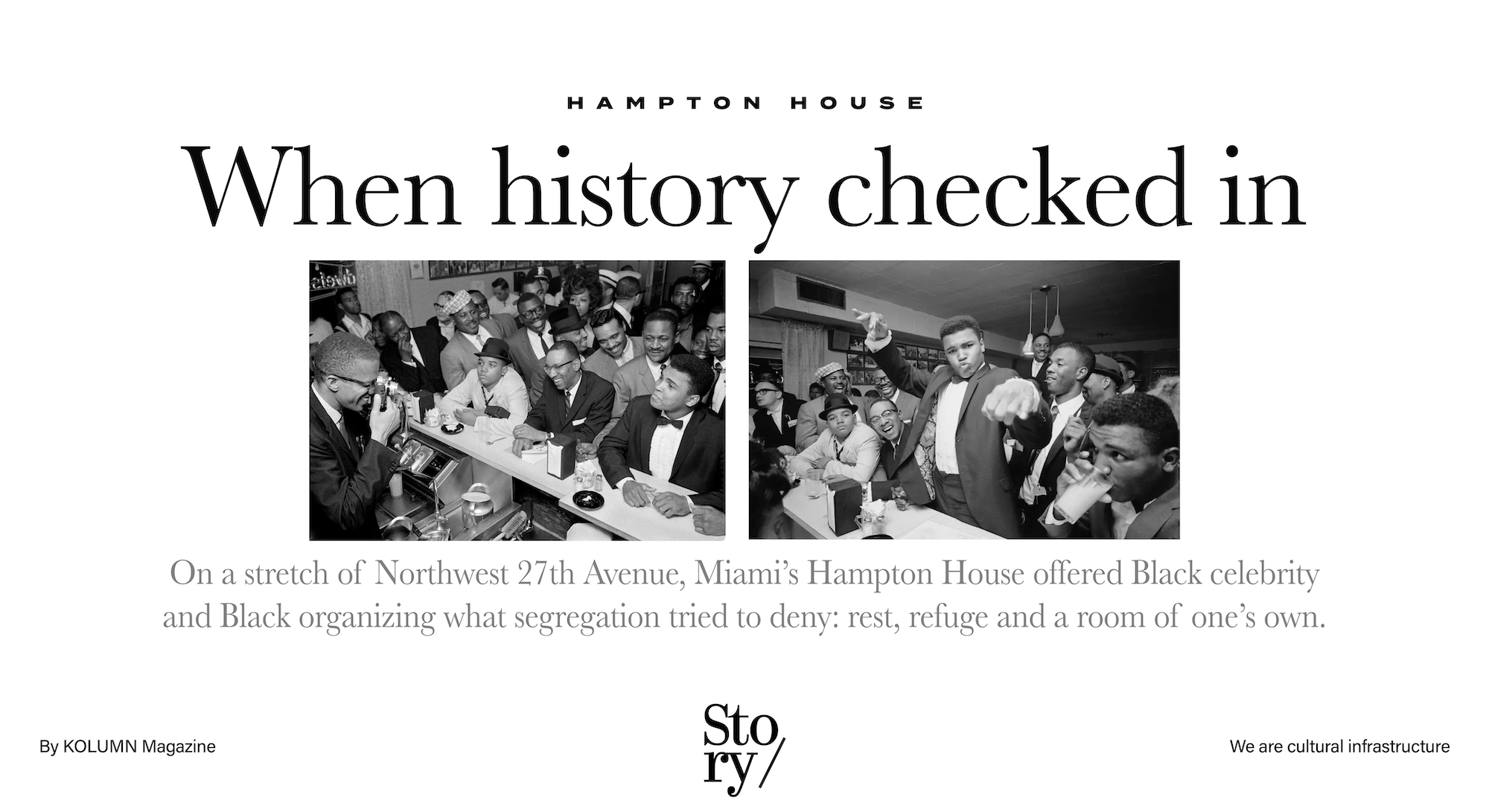
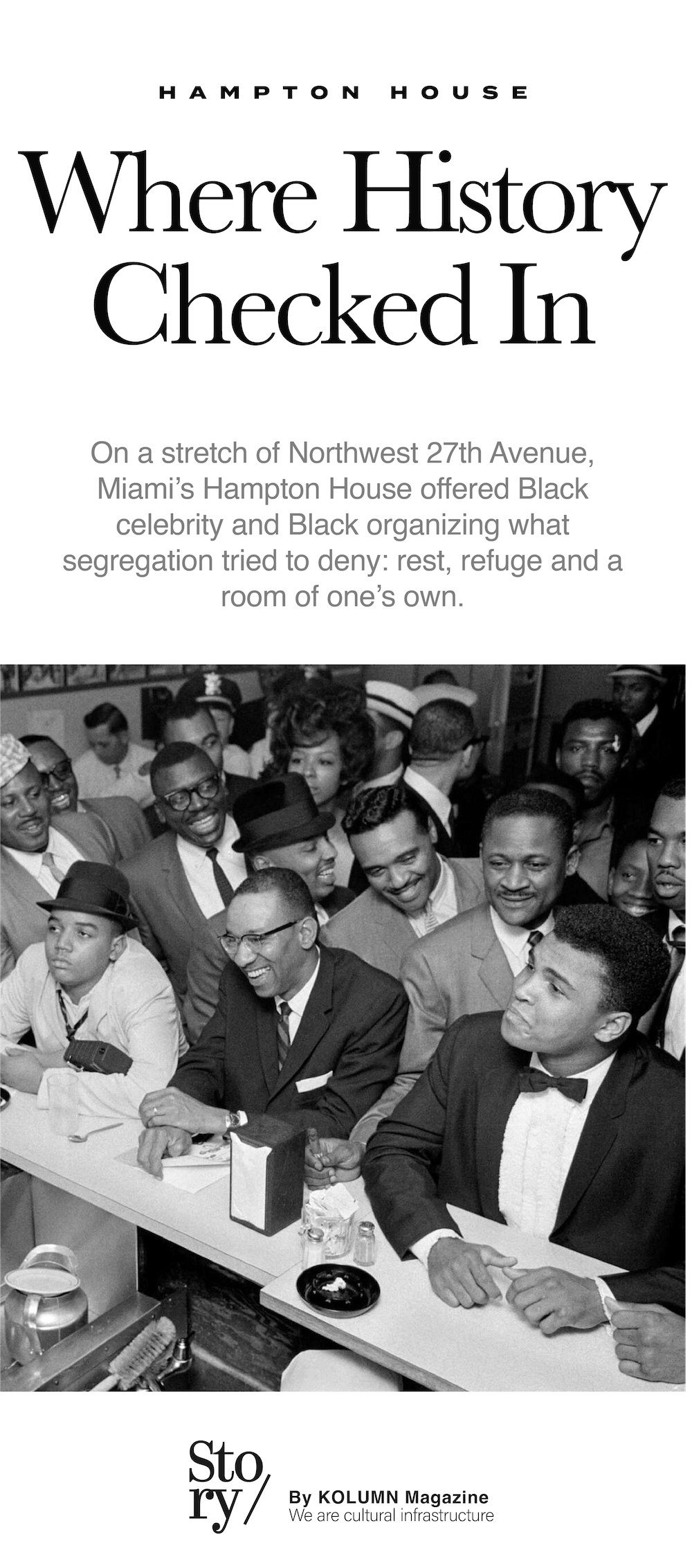
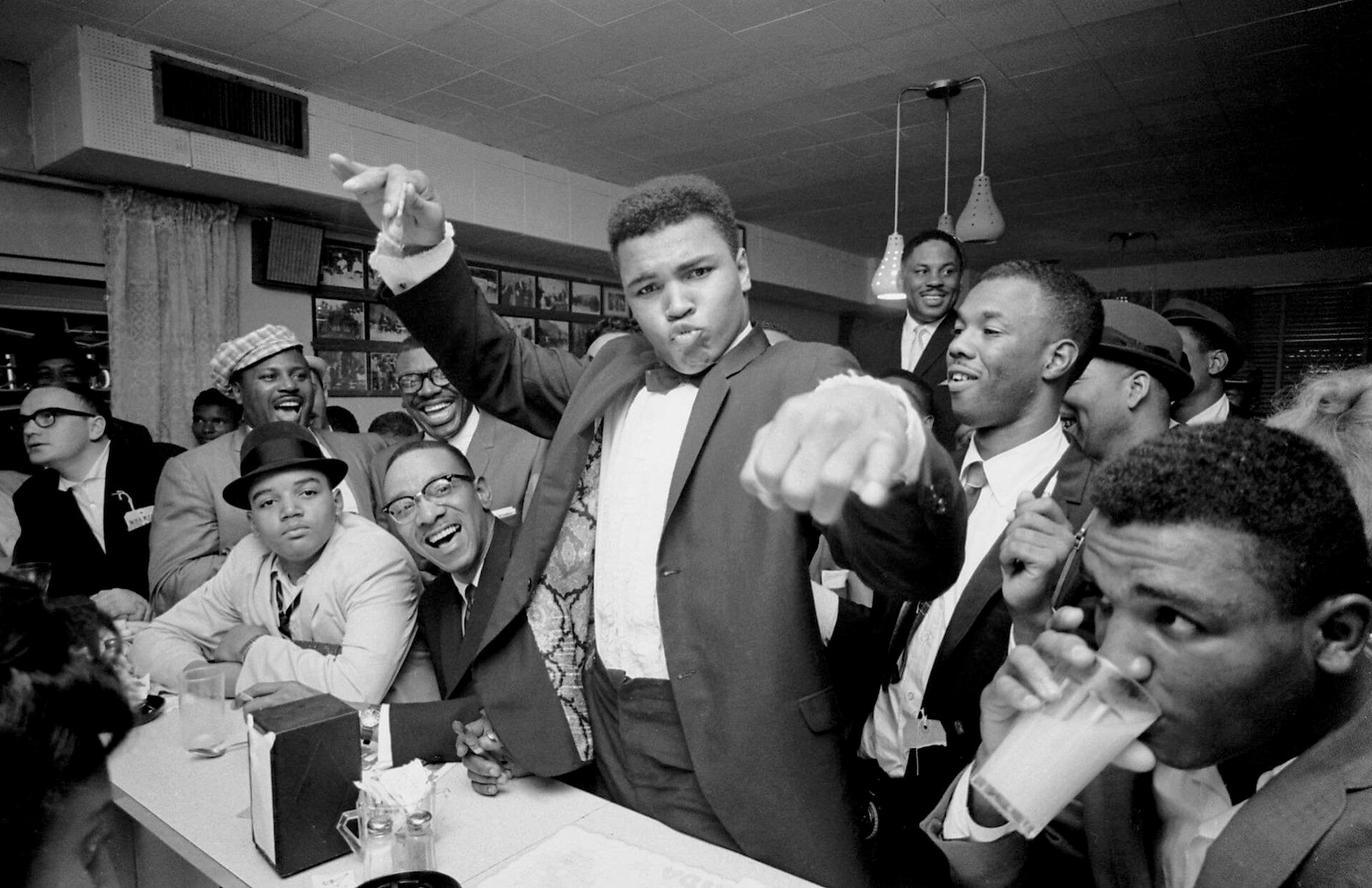
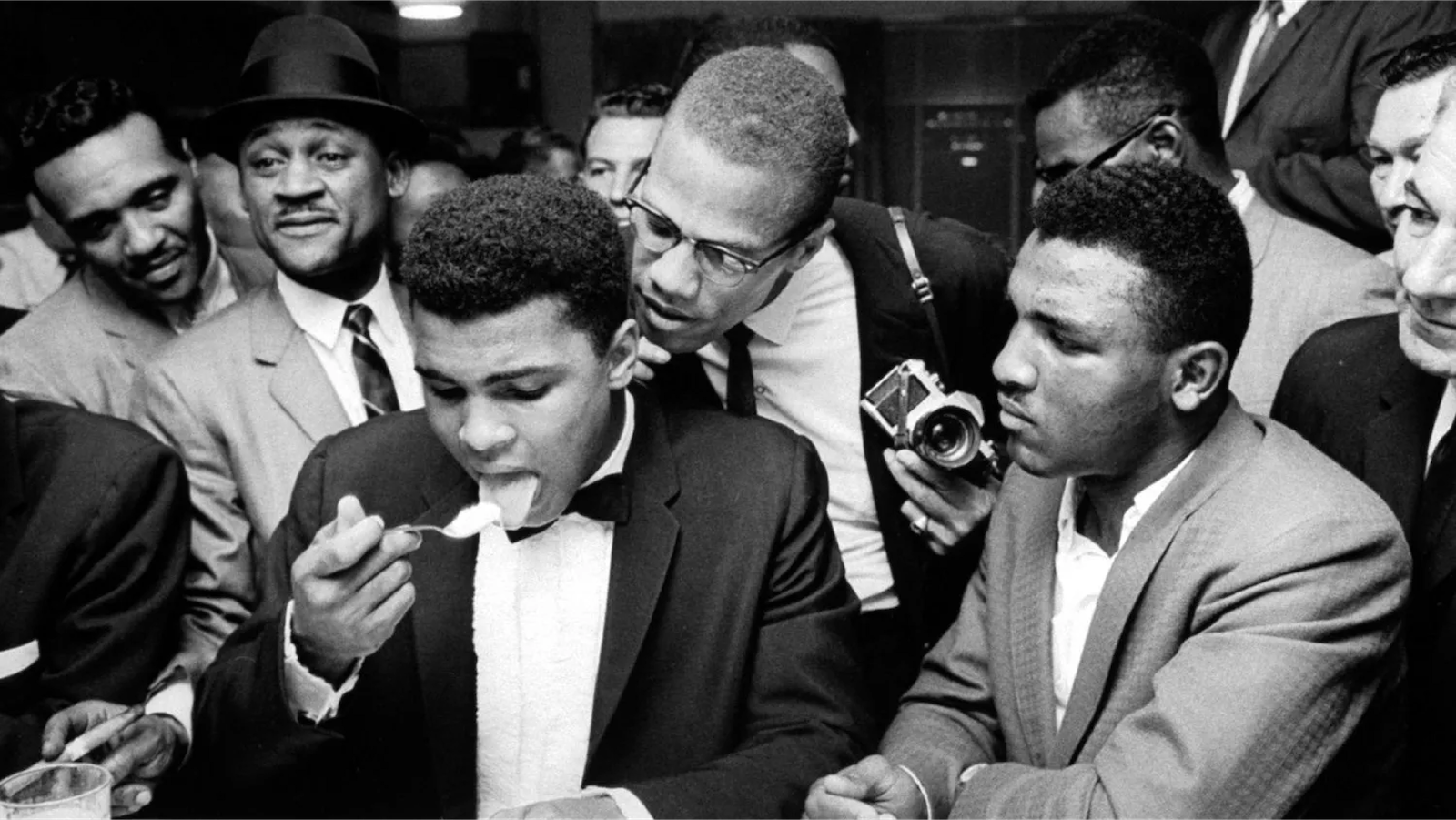
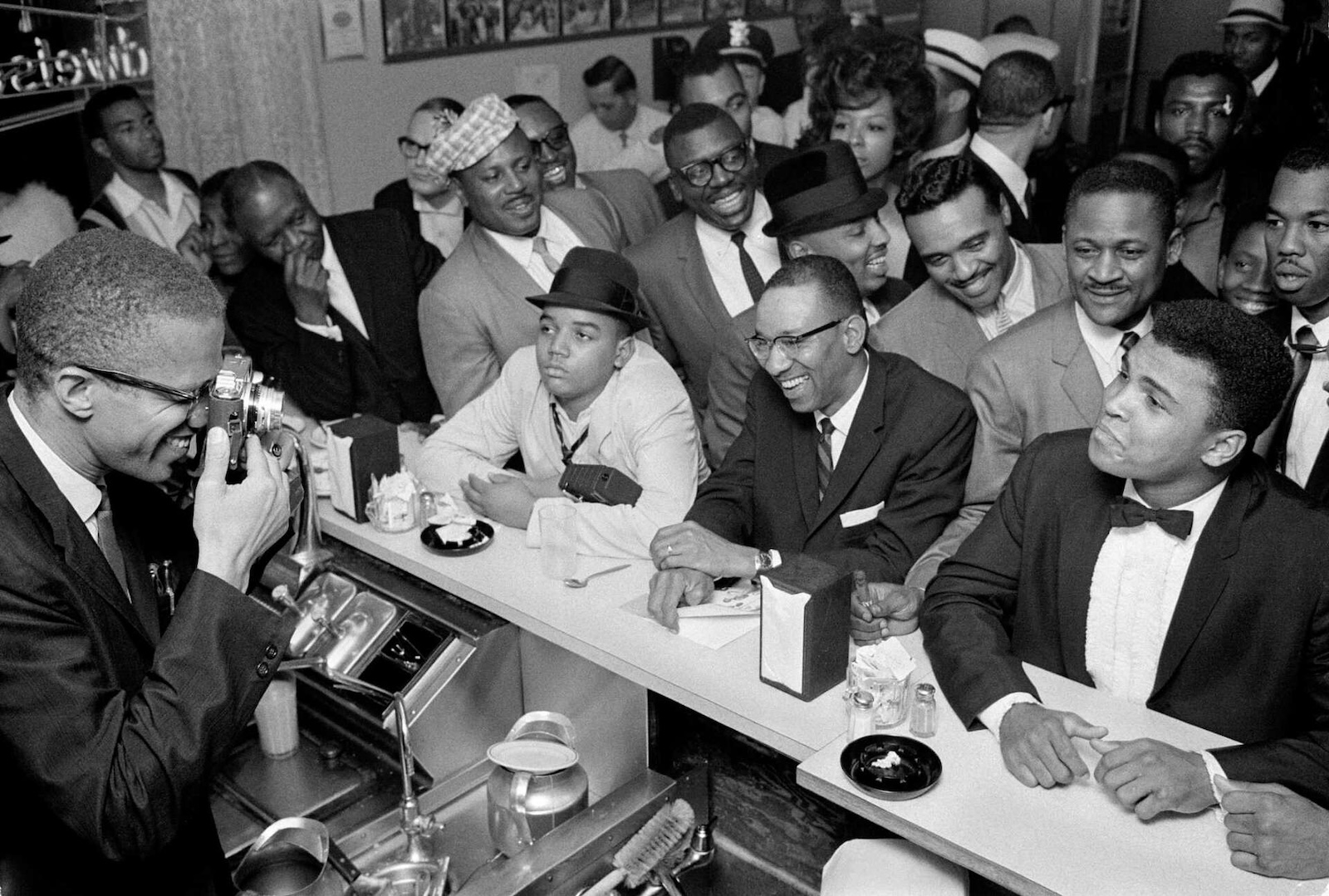
The most widely circulated Hampton House story in the contemporary era centers on a single night in February 1964: the night Cassius Clay defeated Sonny Liston in Miami Beach to win the heavyweight championship. Many Miami narratives make the same point: even after winning the title in the Beach’s spotlight, Clay was not allowed to stay on Miami Beach because segregation still shaped hospitality. So the celebration moved. Clay — soon to be Muhammad Ali — went to the Hampton House, where he gathered with Malcolm X, and where the legend of a late-night summit was born.
The Hampton House’s modern cultural profile owes a great deal to the film and stage work that dramatized a version of that night: Kemp Powers’ play and Regina King’s film One Night in Miami. The Washington Post’s historical framing of the event emphasizes what was “little known” to many: that Clay celebrated in a room at the Hampton House, a motel in Miami’s Black Brownsville neighborhood, and that the motel was frequented by Black celebrities. Architectural Digest, exploring the “real history” behind the dramatization, treats the Hampton House not as a cinematic invention but as a symbol: a refuge during Jim Crow, built and remodeled to serve Black travelers and attract Black celebrity, later restored as a cultural center.
The film’s popularity has created a strange double life for the Hampton House. On one hand, dramatization can flatten reality into a single iconic moment — a one-night narrative that eclipses the motel’s broader role as a recurring hub. On the other hand, popular culture can rescue a landmark from obscurity, especially when preservation depends on public attention and tourist dollars. You can see that tension in coverage of the museum’s contemporary programming, where the site is both a historic landmark and a living cultural venue hosting exhibits and performances.
It is tempting to treat the Clay-Malcolm X story as the Hampton House’s defining episode, but that would misread the place. The deeper significance of that night is not only that it happened. It is why it had to happen there. The Hampton House was the spatial consequence of segregation: when the city’s main stage barred Black people from sleeping near where they performed, an alternative stage was built across town. The party moved, but it also revealed the lie of Miami’s “glamour.” The glamour had boundaries. The Hampton House existed to give Black people a place to cross those boundaries without begging.
The guestbook as a history of Black modernity
When you look at the list of Hampton House guests, you are effectively looking at a cross-section of Black modernity in the mid-20th century: music, sport, politics, and civil rights leadership, all in motion. The motel’s guest roster includes performers like Sam Cooke and Sammy Davis Jr., athletes like Ali and Jim Brown, and civil rights figures like King and Malcolm X. It also includes figures like Althea Gibson, whose presence reminds you that the struggle for dignity was not confined to the American South’s lunch counters — it extended to tennis courts, golf clubs, and the broader world of “respectable” leisure that was often racially policed.
Florida Memory’s “Torch of Friendship” description is especially valuable because it captures how the Hampton House wanted to be seen in its own time. It wasn’t a secretive refuge marketed only by whisper networks. It had promotional material. It presented itself as a destination “oriented to an African-American clientele” and highlighted notable Black guests. That framing matters: it suggests pride, not apology. The Hampton House did not exist as a second-best alternative; it existed as a purposeful Black address.
In the context of Miami, this was a profound claim. The city’s mainstream image leaned on novelty, luxury, and “paradise,” yet those pleasures were segregated. The Hampton House asserted that Black travelers deserved not only safety but style. It also created a place where Black celebrities could move without the exhausting performance of being “the first” or “the only” in a room full of white patrons.
In practical terms, a place like Hampton House likely functioned as a network node. Musicians touring the South could trade information: which venues were hostile, which promoters cheated, which restaurants would serve you late, which cops were looking for excuses. Athletes traveling for exhibitions or speaking engagements could find a place where the staff knew what it meant to be famous and vulnerable at once. Movement leaders could meet sympathetic locals, coordinate logistics, and move again.
This is what the Green Book era produced: a shadow map of America where Black life moved along routes of relative safety. Hampton House was one of those luminous points — not only a motel, but a relay station.
Decline after “progress”: When integration empties a room
There is an irony embedded in the history of many Green Book sites. Civil rights victories expanded access to mainstream hotels and restaurants, but that access often came with an economic consequence: the Black-serving institutions that had thrived under segregation faced new competition and, in many cases, decline. Condé Nast Traveler’s reflection on retracing the Green Book notes this paradox explicitly, pointing out that many once-essential Black establishments diminished or disappeared after the Civil Rights Act, even as the change represented a necessary advance in rights and dignity.
The Hampton House fits that arc. Multiple accounts agree that the motel ceased operating in the 1970s — frequently cited as 1976 — and that the building fell into disrepair, at times vacant and threatened with demolition. The reasons are not reducible to a single cause: shifts in travel patterns, neighborhood disinvestment, changing tourism economies, and the complicated aftermath of integration all likely played a role. What matters is the structural lesson: policy changes do not automatically preserve the institutions that helped people survive before those policies existed.
The aftermath of closure turns the Hampton House into a different kind of symbol: not only a refuge built under segregation, but a casualty of the new era’s uneven development. Abandonment became part of its story, and abandonment in America is rarely neutral. Buildings rot in neighborhoods that lack political power to demand repairs, in communities whose histories are treated as disposable.
That is why Hampton House preservation is inseparable from local organizing. You cannot separate the landmark’s survival from the people who refused to let the city forget it.
The long rescue: Preservation, politics, and the fight to keep Black landmarks standing
If the Hampton House’s peak years tell one story about Black Miami’s social and political life, its resurrection tells another story about what it takes to preserve Black history in a city where development pressures are relentless. The building’s survival was neither inevitable nor swift.
Barry University’s magazine account of the Hampton House’s revival emphasizes how long and difficult the preservation effort was, describing a trajectory from a threatened, deteriorating structure to a restored community hub, and highlighting the role of preservationist Enid C. Pinkney in pushing the project forward through delays and setbacks. Other institutional narratives similarly describe a period when the site was threatened with demolition, followed by historic designation efforts and eventual restoration supported by Miami-Dade County.
This arc matters because it reframes “history” as active labor. The civil rights era created the Hampton House’s meaning, but the modern era had to decide whether that meaning would be physically legible. Preservation is often portrayed as the work of architectural purists or nostalgic elites. In Black communities, it is often the work of people fighting against a different kind of erasure: the tendency to demolish what proves a community existed with complexity, glamour, and political agency.
In Miami, where real estate cycles can be brutal, the temptation to treat a deteriorating building as “blight” rather than as evidence is especially strong. Saving Hampton House required not only money but narrative — a clear articulation of why the building mattered beyond sentimental attachment. That narrative was available: the guest list, the civil rights meetings, the Green Book significance, the architecture, the role as a social center. narratives do not automatically win policy battles. They must be wielded.
Restoration accounts frequently cite a renovation budget in the millions and describe structural stabilization and adaptive reuse planning. What this signals, beyond the dollar figure, is that restoring a place like Hampton House is a technical project as much as a cultural one. Aging buildings require engineering solutions; hazardous materials require abatement; artifacts must be salvaged; code compliance must be negotiated. The labor is expensive, and the expense becomes a political question: Which histories are worth funding?
The Hampton House’s current identity answers that question with an institutional mission. The museum describes itself as dedicated to sharing the segregated-era experience and frames its work as improving perspectives on discrimination across multiple dimensions. Whatever one thinks of mission language, it is clear that the site is not marketed solely as nostalgia. It is positioned as an educational and civic space — a place that makes arguments about race, travel, and American democracy.
From motel to museum: What it means to reopen a Green Book site
When the Hampton House reopened as a museum and cultural center, the reopening did more than restore a building. It reopened a set of questions. What does a city owe the neighborhoods that built its culture but were excluded from its pleasures? What does a tourist economy owe the Black workers and Black performers whose labor made it profitable? What does “integration” mean if it expands access but leaves Black neighborhoods under-resourced and vulnerable to displacement?
Contemporary local reporting portrays the Hampton House as a site of both heritage and economic potential — a destination that can draw visitors into areas of Miami that are often overlooked, generating tour revenue and attention. This framing is pragmatic, and it has risks. Heritage tourism can easily become extraction — visitors consume a community’s pain and resilience without investing in its present. But it can also become leverage, a way to demand resources and policy attention for neighborhoods that have been systematically ignored.
The Hampton House’s programming suggests an attempt to keep the place alive as more than a static exhibit. WLRN coverage, for example, describes performances and exhibitions staged at the site, explicitly connecting contemporary art and storytelling to the building’s historic narrative. In this view, Hampton House is not simply an artifact; it is a platform — a space where the past is interpreted through present creativity.
This matters because the civil rights era itself was not static. It was improvisational, often artistic, filled with music and rhetorical performance. A museum that is too quiet can betray the history it claims to hold. The Hampton House, in its heyday, was noisy: jazz, conversation, laughter, strategy. A living cultural center is arguably closer to the truth of what the motel was than a shrine would be.
Hampton House and the broader map of Black Miami
The Hampton House’s story also works as a gateway into the wider ecology of Black Miami landmarks — the network of places that existed because segregation forced Black life to build parallel institutions. Even as the Hampton House is celebrated, other Black historic sites in Miami struggle for funding and restoration, revealing how uneven preservation can be.
The Florida Memory archive that documents “The Torch of Friendship” is part of what makes Hampton House legible: it provides primary-source style context about how the hotel presented itself and whom it hosted. Academic and cultural heritage projects, like Florida International University’s documentation of the Hampton House as part of its broader public history resources, likewise frame the motel as the last remaining Green Book motel in Miami and situate it in a story of community gathering, decline after integration, and rescue by advocates and institutions.
This larger map matters because it prevents a single landmark from carrying an impossible burden. Hampton House should not be the only place where visitors learn Black Miami’s history. It is one portal — an exceptionally potent one — into a broader story about migration, labor, policing, art, entrepreneurship, and resistance.
Yet its prominence is instructive. Hampton House became preservable in part because it had a compelling and widely marketable story: famous guests, a cinematic moment, mid-century design, Green Book relevance. Other Black landmarks may not have Hollywood narratives attached, and so they can be easier for cities to neglect. That’s not an argument against celebrating Hampton House; it’s an argument for using Hampton House’s success to expand the preservation agenda rather than narrowing it to a single “star” site.
The ethics of telling the Hampton House story
Any serious account of Hampton House has to balance allure and brutality. The motel’s history is glamorous: celebrities, jazz, late-night conversation, style. But glamour existed because segregation imposed constraints. Hampton House was a refuge because Miami Beach was hostile. It was a sanctuary because the city’s mainstream hospitality industry enforced exclusion. The temptation, especially in tourism-forward storytelling, is to turn Hampton House into a feel-good tale of Black excellence — proof that Black people “found a way.” But a way around oppression is not the same thing as freedom.
The best sources avoid this trap by keeping the structure of segregation visible. When Miami tourism materials describe Ali being unable to stay on Miami Beach and going instead to the Hampton House, they are telling a story of displacement disguised as celebration. When Condé Nast Traveler reflects on the Green Book, it points to the danger that made such guides necessary and the paradoxical aftermath that caused many of those sites to fade. When local reporting describes Hampton House as a safe haven and a nonprofit museum today, it underscores that this isn’t ancient history; it’s a legacy still being fought over in how communities are funded, taught, and remembered.
There is also a journalistic obligation to handle lore responsibly. Hampton House is full of stories — who stayed when, who said what, what was planned in which room. Some of these stories have strong documentation; others are partly oral tradition, strengthened by repetition. The claim about an early version of King’s dream speech, for instance, appears in cultural commentary and institutional summaries, but public-facing accounts often do not fully disclose the underlying documentation. A careful approach does not dismiss such claims; it contextualizes them, distinguishing between confirmed stays, widely reported traditions, and items that require deeper archival confirmation.
That distinction is not pedantry. It is respect — for the past, and for the people whose lives were shaped by it. Black history has often been dismissed as “myth” when it lacks institutional archiving, even though the lack of archives is itself a product of exclusion. The solution is not to repeat everything uncritically; it is to do the harder work of tracing sources, presenting claims with appropriate confidence levels, and encouraging institutions to make documentation accessible.
Why Hampton House still matters
Hampton House matters today because the problems it solved have not entirely disappeared; they have changed forms. The explicit signs of segregation are gone, but the geography of exclusion persists in subtler ways: through housing patterns, policing, capital flows, and the unequal distribution of cultural investment. A restored landmark in Brownsville is not merely a museum object; it is a claim that the neighborhood’s history is central, not peripheral.
It also matters because it demonstrates how culture and politics intertwine. Hampton House hosted entertainment, yes, but it also hosted organizing — the social and the strategic in close proximity. In a time when activism is often imagined as separate from leisure, Hampton House offers a reminder: movements are made by humans who need joy, rest, and communion. A jazz club can be part of a political ecosystem. A motel can be a headquarters.
And Hampton House matters because it forces a confrontation with American hypocrisy: the country’s willingness to profit from Black talent while restricting Black life. The Hampton House existed because of that hypocrisy. Its guestbook is, in part, a record of how often Black greatness had to find side doors.
Finally, it matters because preservation is a forward-looking act. Saving Hampton House was not only about honoring the dead; it was about giving the living a site where the past can educate, warn, and inspire. As the museum’s mission language suggests, it is trying to use history as a lens on contemporary discrimination, not as a sealed chapter.
To walk through Hampton House now is to walk through layered time: the era when Black travelers needed the Green Book, the era when civil rights leaders needed safe rooms, the era when a building could be abandoned because a neighborhood was abandoned, and the era when a community fought back — not with a march, but with preservation, funding, and insistence.
A city tells the truth about itself through what it chooses to keep standing. Hampton House is Miami telling — or being forced to tell — a truer story.
More great stories
Jane Crow’s Author
February 24, 2026
No Comments
John Biggers’s America Was a Shotgun House, a Mother’s Hands, a Vast Geometry
February 24, 2026
No Comments