





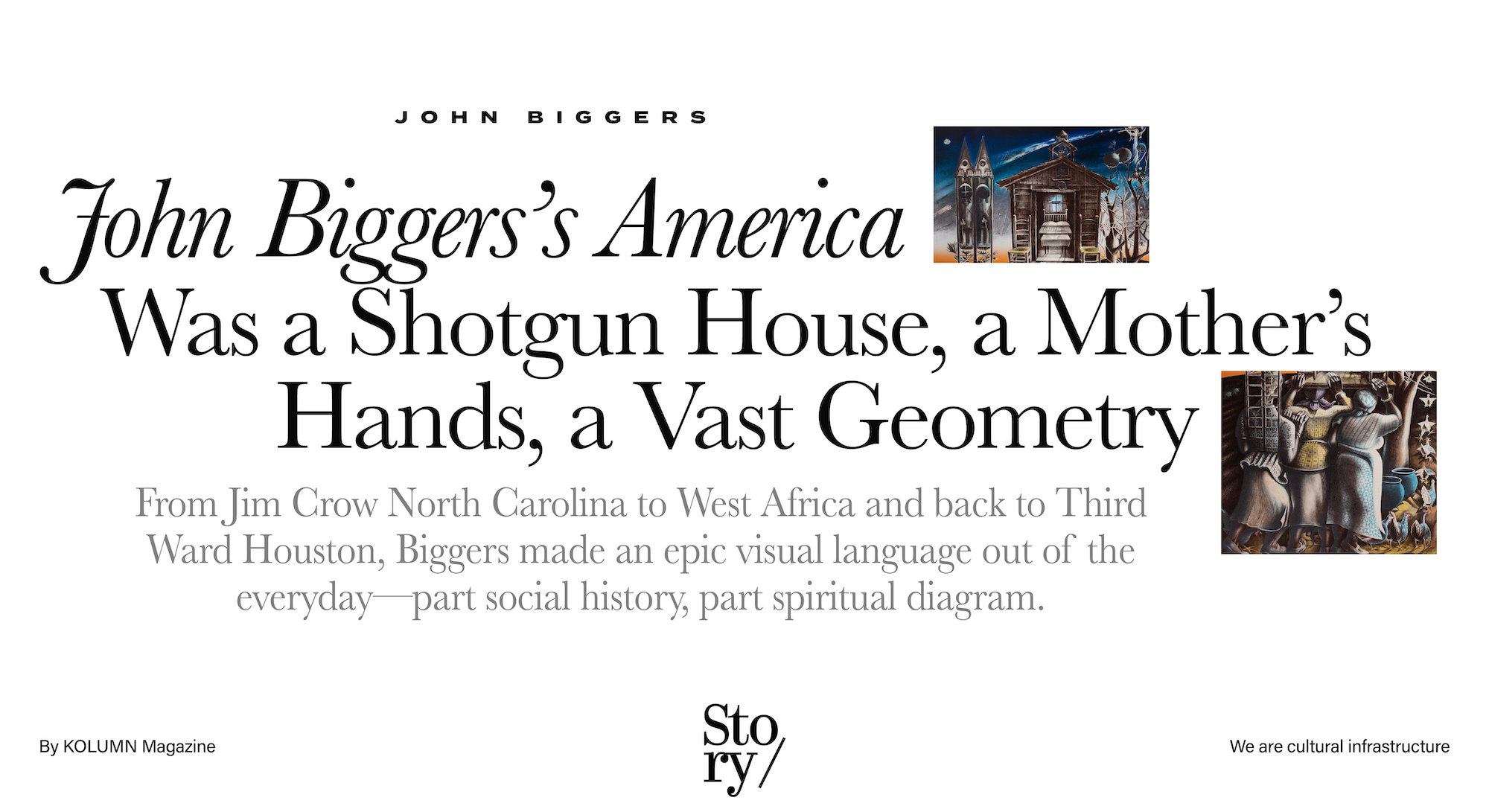
One of the most distinctive features of Biggers’s work is the consistency with which it recognizes Black women as central.
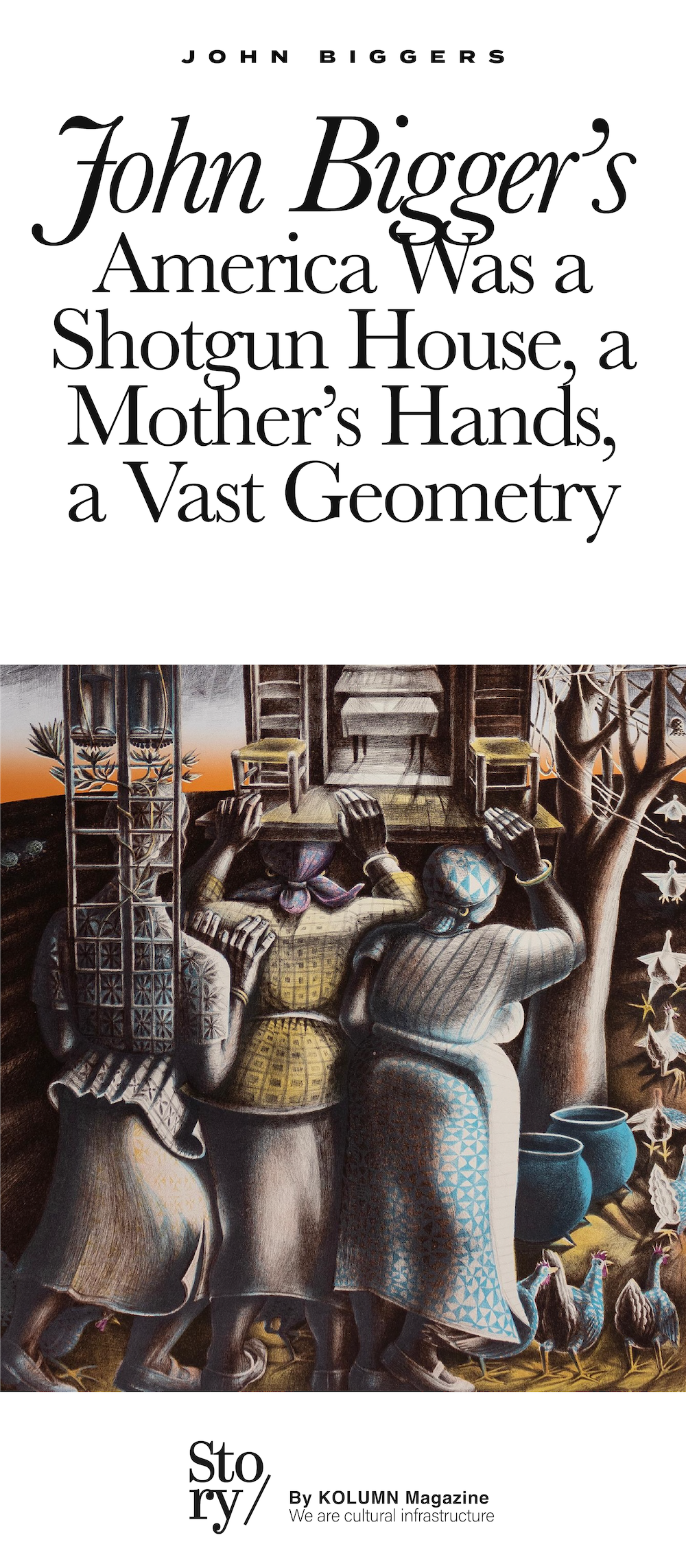
One of the most distinctive features of Biggers’s work is the consistency with which it recognizes Black women as central.
By KOLUMN Magazine
There are artists whose careers read like a sequence of exhibitions, prizes, and acquisitions, the tidy arithmetic of a résumé. John T. Biggers’s career reads more like city planning. His legacy is measured not only in canvases, lithographs, and murals, but in an institution he constructed nearly as deliberately as any painted composition: the art department at what is now Texas Southern University, founded in 1949 when the school still carried the blunt legal label “Texas State University for Negroes.”
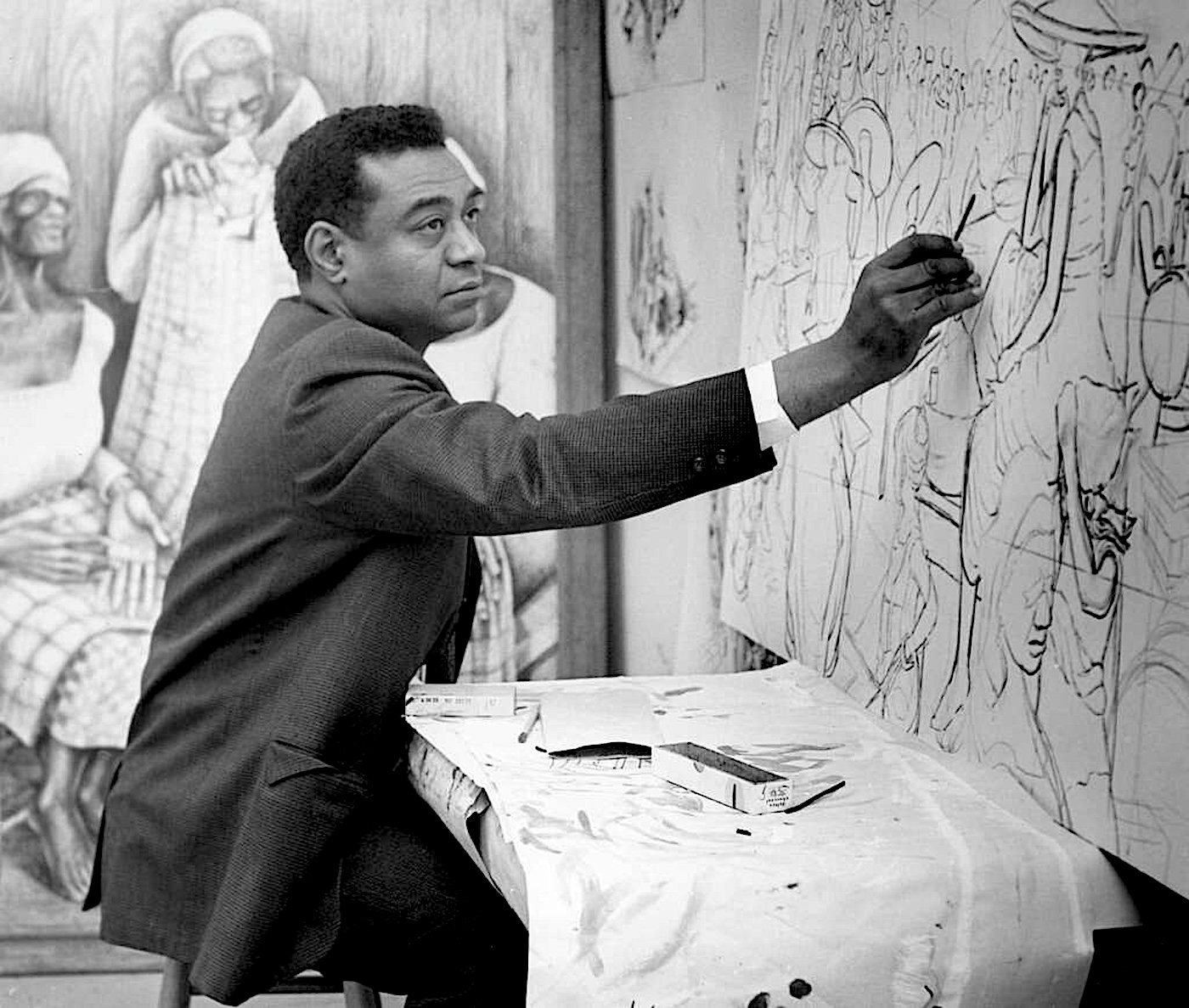
To understand Biggers is to understand a kind of American modernism that did not treat Black life as a “subject” so much as a source—of form, of philosophy, of public purpose. He is often described as a muralist, and it is true that some of his most important works are literally embedded in walls. But “muralist” can undersell what he was doing: a sustained attempt to make Black history and Black everyday life legible at the scale that American civic culture reserves for heroes, myths, and founding stories.
Biggers’s murals—especially The Contribution of the Negro Woman in American Life and Education at the Blue Triangle community center in Houston’s Third Ward—are not simply illustrations of uplift. They are arguments about where knowledge lives, who builds communities, and what counts as civilization. Decades later, when that mural was scarred by mold and water damage after Hurricane Harvey, the public response revealed something else about Biggers: Houstonians did not treat the work as a relic. They treated it as a living civic asset worth saving.
Biggers’s importance is, in part, a story about Houston—the way a city whose national cultural identity often tilts toward energy and engineering also contains a deep, under-credited tradition of Black visual thought. Yet Biggers did not emerge from Houston. He arrived there with a toolkit shaped by the segregated South, by Hampton Institute’s rigorous art training, by the intellectual currents of wartime America, by a formative relationship with the Austrian-born art educator Viktor Lowenfeld at Penn State, and by a life-changing encounter with West Africa in the 1950s.
What ties these experiences together is not a simple narrative of influence but a consistent ethic: art, for Biggers, was a public responsibility. It should help a people see themselves more clearly—especially a people systematically distorted by the nation’s dominant images. That philosophy animates his teaching, his collecting priorities, his insistence on African art as a core reference rather than an exotic sidebar, and his formal evolution from social realist critique toward geometric, symbolic allegory.
The result is a body of work—and a web of students and institutions—through which Biggers helped define what it could mean to make “American” art from Black Southern experience without translating it for outside comfort. In his hands, the shotgun house becomes icon, the laboring body becomes monument, the maternal figure becomes cosmology, and the community becomes a compositional principle.
Growing up under Jim Crow, learning the grammar of dignity
John Thomas Biggers was born on April 13, 1924, in Gastonia, North Carolina, into a large family for whom education was not a slogan but a strategy. His parents, according to the Texas State Historical Association’s biographical account, were Cora and Paul Biggers; his father had a complex mixed heritage (including Anglo, African American, and Cherokee roots), worked as a teacher and principal, and also served as a Baptist minister—roles that placed him inside the Black professional class even while the family navigated the economic constraints of segregation. Biggers’s mother worked frequently as a domestic worker.
Those details matter because Biggers’s later work is saturated with the social worlds they imply: the centrality of the church, the moral authority and exhaustion of domestic labor, the precariousness of Black respectability under white control, and the ways a family’s collective life becomes its own archive. Even when Biggers later absorbed the lessons of European modernism, Mexican muralism, and African iconography, he kept returning to scenes that look like memory: people gathered, bodies working, women anchoring households, children learning how to stand in a world that does not intend to make space for them.
A pivotal stop in his early education was Lincoln Academy, an all-Black boarding school in Kings Mountain, North Carolina. Multiple institutional biographies emphasize that Lincoln Academy cultivated pride in African heritage—an orientation that would become central to Biggers’s mature vision.
If you want a shorthand for Biggers’s life project, it might be this: he was trained early to believe that African heritage was not a wound but a resource. That belief is not a romantic abstraction in his work; it becomes design logic. Textile patterning, quilt-like geometries, and symbols drawn from African cosmology are not decorative add-ons. They are visual structures that organize space and meaning.
Hampton, Charles White, and the seriousness of the human figure
Biggers entered Hampton Institute (now Hampton University) in the early 1940s, a period when the United States was mobilizing for World War II even as it maintained a racial caste system at home. Hampton’s art program, shaped by figures like Viktor Lowenfeld and by the broader legacy of the Hampton approach to Black education, offered Biggers both technical discipline and a sense that art could be integrated into social life rather than isolated in elite spaces.
A key figure in this period is Charles White, the celebrated draftsman and muralist whose influence on Black figurative art in the mid-20th century is difficult to overstate. Biggers assisted White on a mural at Hampton, according to scholarship on American muralism, and the connection places Biggers inside a lineage of artists for whom the human figure—especially the Black working figure—was a site of political and ethical insistence.
White’s practice carried a kind of reverence: he drew Black people as if they were inherently worthy of the same heroic scale that American art history tended to reserve for whiteness. Biggers learned that lesson, but he did not remain within White’s formal orbit forever. Instead, he expanded it, gradually embedding the figure inside symbolic and architectural spaces that were as important as anatomy.
Even early, Biggers was moving through art worlds that saw Black artists not as peripheral but as crucial to redefining American art. A contemporary article on his symbolism notes that while still an undergraduate, Biggers’s mural Dying Soldier (1943) was included in MoMA’s “Young Negro Art” exhibition—an early signal that his work resonated beyond the segregated institutions that shaped him.
But the question for Biggers was never simply how to “make it” in national institutions. It was how to build an art practice—and later an art department—that would not require Black life to be filtered through external approval.
Penn State and Viktor Lowenfeld: Education as method, not credential
In 1946, Biggers enrolled at Pennsylvania State University, encouraged by Viktor Lowenfeld, the influential art educator whose ideas about perception and creative development shaped generations of teachers. Biggers earned bachelor’s and master’s degrees in art education in 1948 and later completed a doctorate at Penn State in 1954.
The fact of these degrees—especially a doctorate in the 1950s for a Black artist—matters for reasons beyond biography. Biggers was not simply an artist who taught; he was a theorist of what art education could do for a community denied cultural infrastructure. His long tenure at Texas Southern would reflect that: he approached teaching as institution-building, and institution-building as a form of cultural self-defense.
Penn State’s campus still holds physical traces of Biggers’s presence in the form of murals and related works, underscoring how early he committed to public-scale storytelling rather than private easel painting alone.
This educational formation also gave Biggers the language to argue for resources. When you build a department, you have to justify budgets, collections, facilities, and faculty lines. Biggers could do that in the grammar of academia while also insisting that the content of the program—its philosophical center—must be rooted in African and African American cultural knowledge.
Houston, 1949: Founding an art department as a civil rights project
When Biggers moved to Houston in 1949 to become the founding chair of the art department at Texas State University for Negroes (now TSU), he entered a city where segregation structured space, opportunity, and public memory. But Houston also had a Black community with deep institutional life—churches, civic groups, and neighborhoods like Third Ward that would become central not only to Biggers’s career but to the iconography of his work.
Texas Southern University’s own description of its museum traces one of Biggers’s major goals: to build a collection of traditional African art so that students could develop “perceptual growth” and cultural sensitivity to African forms. That is not a minor curricular preference. It is a direct challenge to the way American art education historically treated Africa as absence or primitive prelude rather than a sophisticated set of visual systems.
Biggers held the chair position until 1983, training what many accounts describe as generations of African American artists and teachers, in a region where access to major art institutions—and the networks that flow from them—was often constrained by race and geography.
There is a temptation to romanticize this as a lone visionary story: one great artist founding a program, mentoring grateful students, leaving behind an unbroken line of influence. The reality is more complex and more impressive. Building a department at an HBCU in the mid-20th century meant confronting resource scarcity, the devaluation of Black culture, and the constant pressure for Black institutions to prove their legitimacy in white-controlled systems. Biggers’s success suggests not simply artistic talent but administrative stamina and strategic clarity.
You can see that clarity in the way his work and his teaching mutually reinforce each other. Biggers’s art is obsessed with community—people in relation, bodies organized in collective space, individuals nested within social architecture. A department is a kind of community too: a place where skills are transmitted, where aesthetic standards are debated, where students learn the difference between imitation and inheritance.
The Blue Triangle mural: Women at the center of the civic story
If Biggers built TSU’s department as a long-term structure, he also produced a public-facing statement in paint that condensed his philosophy into a single monumental wall: The Contribution of the Negro Woman in American Life and Education (often dated to 1952–53), created for the Blue Triangle branch of the YWCA in Houston’s Third Ward.
The Houston Chronicle’s historical reflection describes Biggers painting the mural as his doctoral dissertation, inspired in part by his admiration for Diego Rivera and the Mexican mural tradition—artists who treated walls as sites for public history. The parallel is instructive: Rivera painted national narratives into public space; Biggers sought to paint Black narratives—particularly the leadership and labor of Black women—into the civic consciousness of a segregated American city.
Scholarship on American muralism notes that while Charles White’s Hampton mural emphasized the contributions of African Americans broadly, Biggers expanded the idea by centering women. That choice is not incidental. It anticipates later feminist and Black feminist scholarship that would insist that Black women’s labor—domestic, educational, communal—has been foundational to American life while persistently undervalued. Biggers was making that argument visually, decades earlier, in a public setting.
To stand before the mural is to see a composition that does not treat “contribution” as a vague moral category. It treats it as infrastructure: bodies building, teaching, caring, organizing. The figures are not anonymous; they carry the specificity of lived experience. Yet the scale makes them archetypal, as if Biggers is proposing a civic mythology that runs parallel to the dominant one.
Later events would reinforce the mural’s civic role in a way Biggers could not have scripted. After Hurricane Harvey in 2017, the Blue Triangle building suffered roof damage and mold, placing the mural in jeopardy. Coverage and institutional statements about the damage and restoration efforts show how the work had become a communal responsibility—something to be preserved not merely for art history but for neighborhood continuity.
In 2020, the Museum of Fine Arts, Houston described a major infusion of support for restoration and preservation efforts at Blue Triangle, including a multi-million-dollar donation from the Qatar Harvey Fund aimed at helping restore and protect the mural and the community center. The language is telling: the mural is framed as a “great work of art” and as part of Houston’s future, not simply its past.
That framing points to a broader truth about Biggers. Many artists achieve acclaim; fewer become woven into a city’s sense of itself. Biggers’s mural did not just decorate a space. It helped define what kind of story that space could tell.
Africa, 1957: The encounter that reorganized the work
Biggers’s 1957 trip to West Africa—often described as travel through Ghana, Nigeria, and other countries—was not tourism. It was a search for understanding, and it catalyzed a major evolution in his visual language.
He later distilled this encounter into Ananse: The Web of Life in Africa (1962), a book combining drawings with narrative reflection. The Smithsonian’s Archives of American Art biographical note references this publication directly, and library catalogs summarize the trip as a quest to understand African heritage by observing everyday life and cultural systems on the continent.
The title’s reference to Ananse (often spelled Anansi), the trickster figure prominent in Akan and related West African storytelling traditions, is more than a literary nod. The “web” becomes a metaphor for interconnectedness—social, spiritual, ecological—that aligns with Biggers’s long-standing interest in community as a compositional principle.
A 2024 essay on Biggers’s legacy describes how the trip “almost paralyzed” his creative efforts at first—an indication of the encounter’s intensity—and notes how he was particularly struck by Ghanaian women as community leaders and by matriarchal cosmological frameworks such as the Akan concept of the queen mother. Whether or not one agrees with every interpretive claim in such writing, the core point aligns with broader accounts: Africa did not simply “influence” Biggers stylistically; it forced a rethinking of the symbolic center of his work, including the prominence of women as carriers of cultural order.
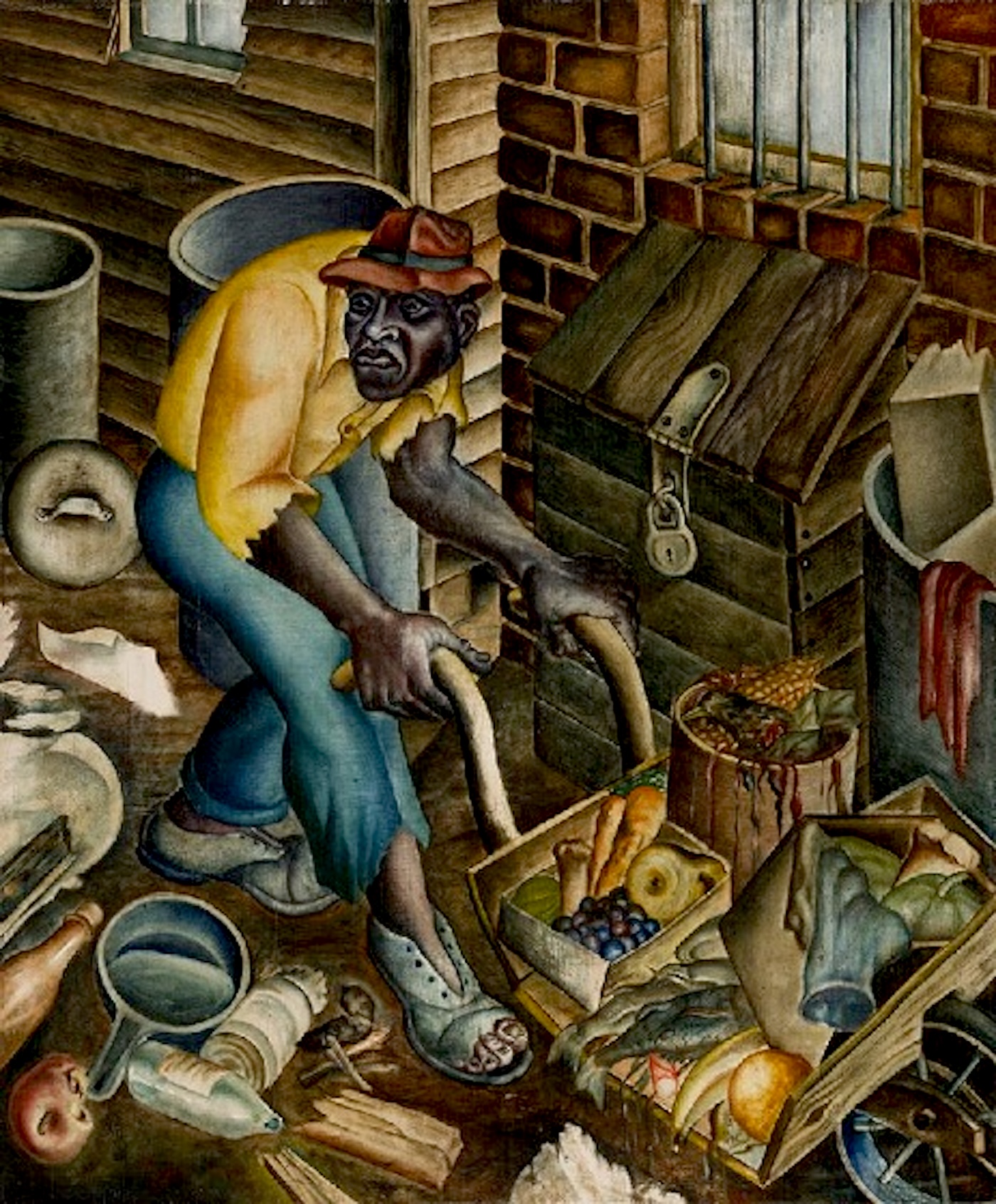
This is visible in the shift many biographies describe: from more overt social critique in early works—images that can confront racial and economic injustice head-on—to later allegorical and symbolic compositions that embed critique within mythic and geometric frameworks.
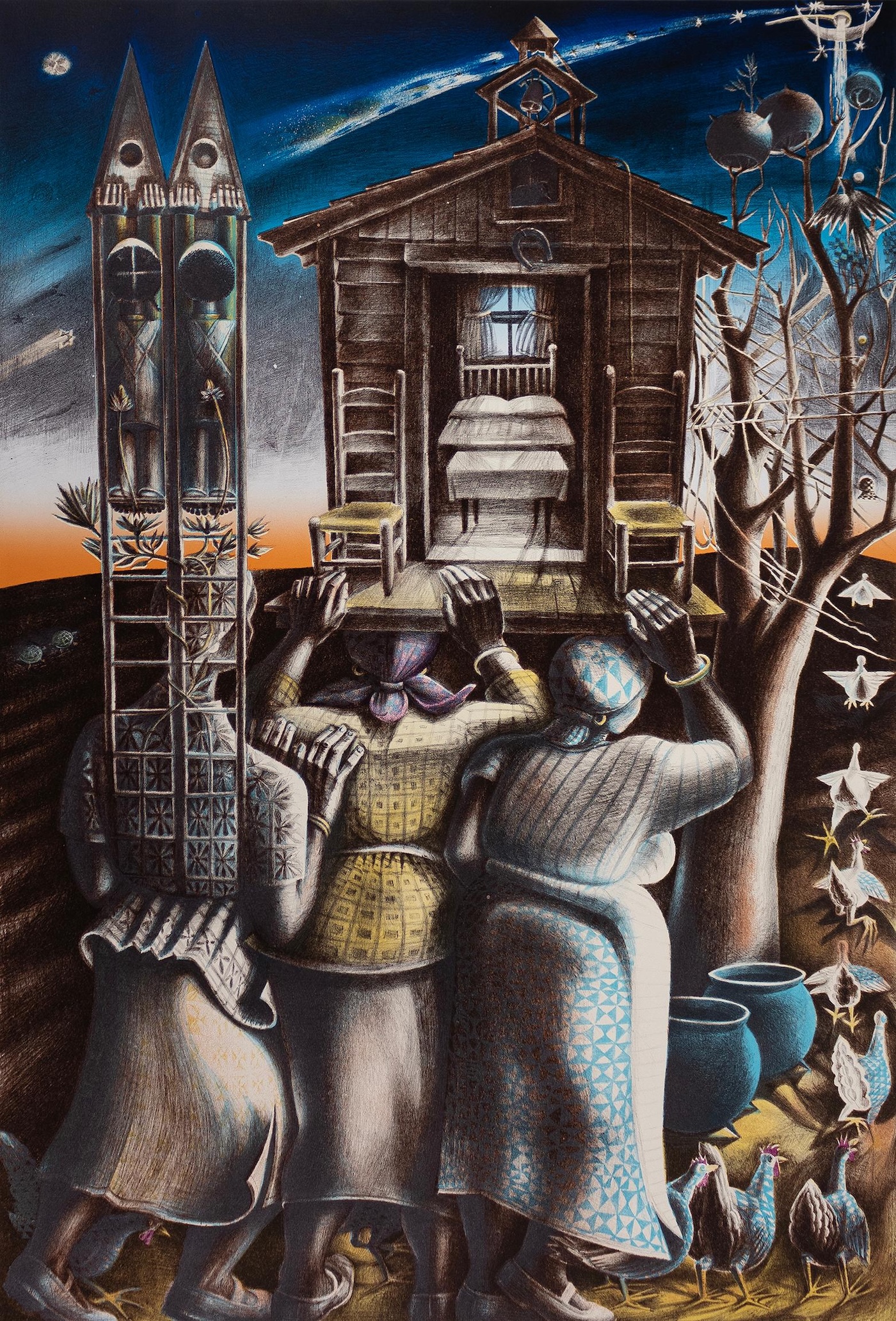
If Biggers’s early training emphasized the human figure as a vehicle for dignity, Africa offered him a deeper archive of symbols through which dignity could be articulated as cosmology. The result is work that feels simultaneously grounded and metaphysical: a woman carrying water is also a structural pillar of the universe; a house is also an emblem of collective identity; a pattern is also a map of social relation.
Style as ethics: Pattern, geometry, and the sacred everyday
Museum descriptions of Biggers often stress his ability to translate African heritage into an American context without flattening either. LACMA’s collection note, for instance, emphasizes that he carried African life into American art and credits early experiences—such as being taught by someone connected to West Africa at Lincoln Academy—with encouraging him to embrace African heritage.
This translation is not a matter of borrowing motifs. Biggers built a visual syntax in which pattern and geometry do philosophical work. Quilt-like structures—linked to African American textile traditions and to the broader logic of patchwork as memory—become unifying devices. The patterns do not merely fill space; they hold communities together, linking bodies and objects into coherent fields.
Biggers’s later work, according to multiple accounts, becomes richer in color and more stylized in form, with symbolism drawn from myth and from daily domestic objects. Even in condensed biographies, the shotgun house emerges as a recurring symbol—an architectural form historically associated with Black Southern life, often born from necessity and constrained economic opportunity, yet rendered by Biggers as a site of dignity.
This is where Biggers’s achievement becomes especially significant for American art history. Modernism is often narrated as a march toward abstraction and away from narrative, away from the local. Biggers complicates that narrative. He embraced modernist structure—flattened space, geometric rhythm, stylization—but he did so in service of narrative and community memory. His work suggests that abstraction need not mean escape from history; it can be a new tool for encoding it.
A contemporary commentary on his symbolism describes an arc from early exaggerated figuration toward “geometric allegories,” while maintaining a consistent focus on empowerment and on racial and economic injustice as underlying themes.
In other words, the formal evolution is not a retreat from politics. It is a refinement of how politics can live inside form.
The teacher’s legacy: A Houston lineage you can still trace
Biggers’s biography is inseparable from his role as an educator. The point is not simply that he “taught at TSU.” He built a training ground that shaped the visual culture of Houston and beyond. A 2024 essay on TSU’s influence states bluntly that the university has been fundamental to shaping Black art in the American South since Biggers founded its art department in 1949, and notes that he continued to influence art in Houston until his death in 2001.
This kind of claim can sound like regional boosterism until you look at the mechanism: Biggers did not just produce work; he produced producers. He created a context in which Black students could study art without the constant implication that their cultural references were secondary. He also insisted, per TSU’s description, on building an African art collection so students could develop perceptual and cultural understanding through direct engagement rather than through reproductions filtered by Western narratives.
There is also an archival dimension to this legacy. The Smithsonian’s Archives of American Art holds a microfilmed collection of Biggers’s art works—sketches, drawings, prints, studies for murals—reflecting both his process and the institutional recognition of his historical importance. Emory University archives, similarly, hold a collection of his papers spanning decades. Archives are not neutral. Their existence indicates that a life and body of work are considered consequential enough to preserve for future scholarship.
Death notices and the question of national recognition
When Biggers died in Houston on January 25, 2001, at age 76, national newspapers described him as a pioneering Black muralist and educator whose work profiled and chronicled the African American experience. The Washington Post obituary emphasized the epic sweep of his work; the Los Angeles Times similarly framed him as chronicling Black life through paintings, murals, and illustrations, noting that no cause of death was given and that he had been in failing health.
Obituaries are a revealing genre. They both summarize a life and signal what editors believe will matter to a general audience. In Biggers’s case, the emphasis on “pioneering” and “epic sweep” suggests that his work was legible to national readers primarily through scale and public visibility. Yet for those who encountered him through TSU—or through the lived reality of Houston’s Third Ward—the more radical aspect of his legacy may have been his insistence that Black life was not merely worthy of depiction but worthy of institution, worthy of permanent cultural infrastructure.
The afterlife of the murals: Preservation as a measure of value
Nothing tests an artist’s long-term civic importance quite like disaster. Hurricane Harvey’s damage to the Blue Triangle mural forced Houston to decide what it valued, and whether it would treat a monumental Black history painting as expendable or essential. The Blue Triangle’s own account of the damage described a roof breach and mold jeopardizing the mural, explicitly naming the work and calling attention to the need for repairs.
The art world’s response—visible in coverage, restoration campaigns, and institutional support—showed that the mural had become more than a neighborhood treasure. The MFAH blog’s discussion of restoration funding framed preservation as a collective effort and tied it to the future of Houston.
There is an irony here: Biggers painted murals partly because he believed art belonged to the public, not just to collectors. But public art is vulnerable precisely because it is public—subject to weather, funding cycles, and shifting political priorities. The push to restore his mural demonstrates the flip side of that vulnerability: when a community claims ownership of an artwork, it can mobilize to protect it.
This preservation story also reframes Biggers’s significance for a contemporary audience. In an era when museums and cities increasingly debate whose monuments deserve maintenance, Biggers’s mural stands as a counter-monument: not a bronze commemoration of individual conquest, but a painted recognition of collective labor—especially women’s labor—as the foundation of civic life.
Where Biggers sits in the broader map of American art
Placing Biggers within American art history raises a question that the standard canon still struggles to answer: What counts as “central” modernism? Biggers’s work complicates neat categories. He is connected to the Harlem Renaissance’s aftermath and to mid-century Black figurative traditions, yet he is also in conversation with Mexican muralism and with the pedagogical theories of European émigré educators. He is regional and international at once: deeply rooted in the American South, yet reoriented by West Africa.
His recognition includes traveling retrospectives and institutional collecting. A University of North Texas Press description of a major book on his murals notes that he was honored by a significant traveling retrospective exhibition in the mid-1990s and emphasizes his archetypal imagery speaking positively to African American heritage long before civil rights-era mainstream attention.
Museums and collections continue to frame him as a foundational figure. LACMA’s note emphasizes his translation of African heritage into American art, and the Smithsonian archives provide a research backbone for scholars and curators.
But Biggers’s most consequential placement may be harder to chart on a museum map: he sits inside the lived visual memory of Houston. His imagery—shotgun houses, maternal figures, communal gatherings—operates as a kind of cultural mirror, offering Black Houstonians a monumental reflection historically denied by the city’s official iconography.
The quiet radicalism of centering Black women
One of the most distinctive features of Biggers’s work is the consistency with which it recognizes Black women as central—not as background, not as symbolic “mothers of the race” in a sentimental register, but as architects of social life. The Blue Triangle mural makes this explicit. The Africa trip, as later commentary suggests, deepened his attention to women’s leadership and to matriarchal cosmologies.
In the context of mid-century American public art, this emphasis is striking. Public murals of the era often celebrated industrial progress, masculine labor, or nationalist mythology. Biggers instead offered a civic story in which education, care, and community-building—domains historically feminized and devalued—are treated as monumental.
This choice also reflects the lived realities of Black communities under segregation, where women frequently held key leadership roles in churches, mutual aid networks, and civil rights organizing. Biggers’s art does not “discover” that reality; it validates it at scale.
Biggers today: What his work asks of the present
To write about Biggers now is to confront a persistent American problem: the nation’s tendency to treat Black cultural production as either niche or newly discovered, rather than as foundational and continuous. Biggers’s career demonstrates that a sophisticated, institution-building Black modernism was thriving in places like Houston long before the mainstream art market learned how to monetize the category.
His work also speaks to current debates about public memory. What should a city preserve? What stories deserve wall space, conservation dollars, and institutional protection? Biggers offers a clear answer in paint: preserve the people who built the city without being credited for it.
And for artists and educators, Biggers offers another model: success is not only what you make; it is what you make possible. Founding an art department at an HBCU in 1949 and sustaining it for decades is an act of cultural engineering.
If the murals are the visible monument, the department is the invisible one—an engine that continued producing Black visual culture long after any single mural’s paint began to age.
More great stories
Jane Crow’s Author
February 24, 2026
No Comments
Where History Checked In
February 24, 2026
No Comments