


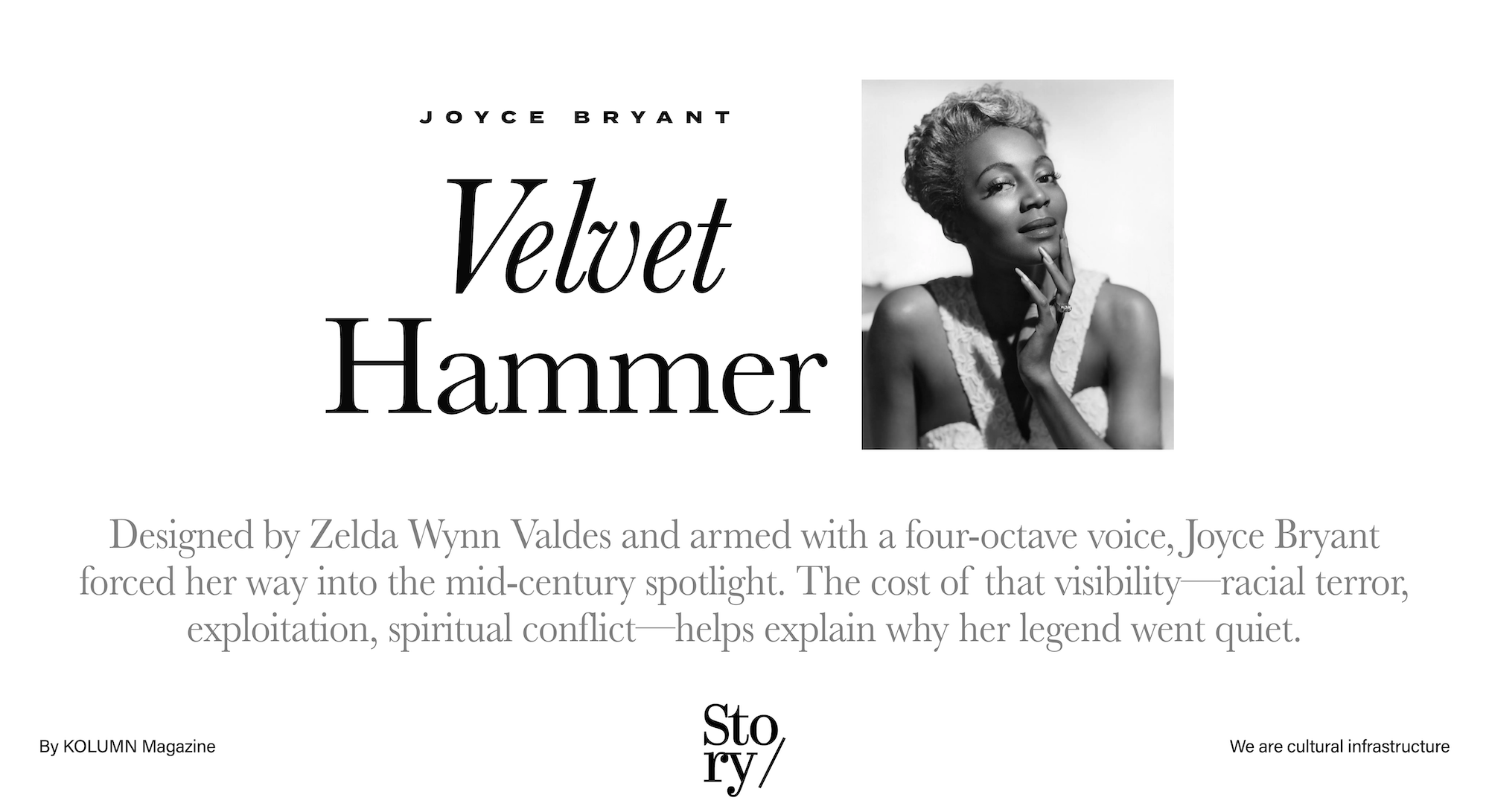
Finding a stage where her gifts could exist without her being consumed by them.
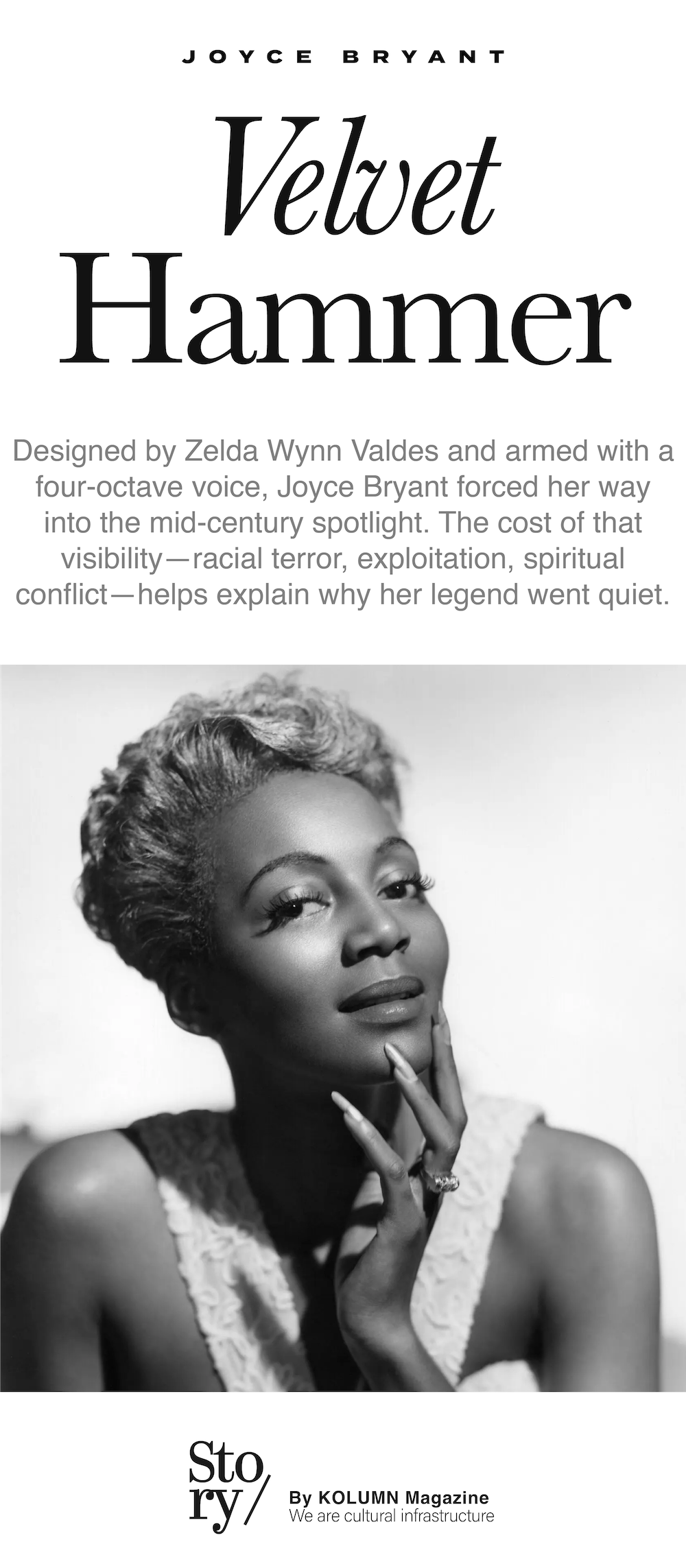
Finding a stage where her gifts could exist without her being consumed by them.
By KOLUMN Magazine
In the early 1950s, Joyce Bryant walked onto nightclub stages with the kind of presence that can reorder a room. She was a torch singer and a belter—an entertainer who did not merely interpret a lyric but attacked it, wrestled it, and then held it up, trembling, for the audience to feel. Promoters and columnists, reaching for language that could contain her, turned her into a cluster of nicknames: the “bronze blond bombshell,” “the Belter,” and “the voice you’ll always remember.”
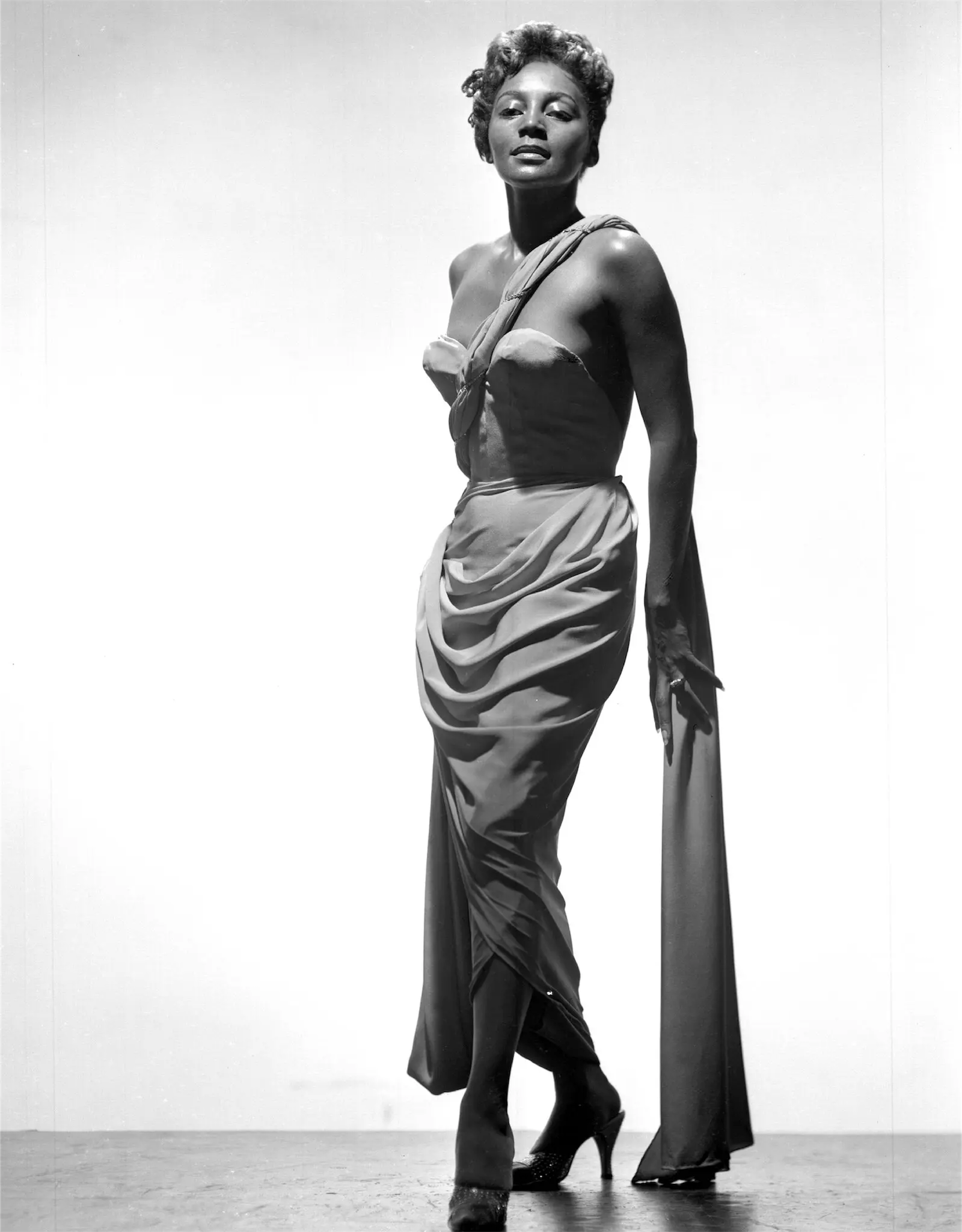
Those labels were meant to sell a sensation. Bryant’s life—its meteoric rise, abrupt disappearance, and improbable reinvention—matters not simply because she was famous, but because she embodied a particular American contradiction. She was invited into the nation’s most glamorous rooms at the very moment Black life was being fenced in by law and violence. She made glamour into a wedge, then discovered that wedges cut both ways.
If Joyce Bryant is less remembered than many of her contemporaries, it is not because she lacked impact. It is because her story does not flatter the eras that produced it. It exposes how quickly the culture forgets the women who break its rules—especially when those women are Black, dark-skinned, and unwilling to perform gratitude for the “opportunity” to be exploited.
A strict beginning, a rebellious instrument
Bryant was born Ione Emily Bryant in October 1927, in Oakland, California, and grew up in a home shaped by Seventh-day Adventism and discipline. Accounts of her early life repeatedly return to the same tensions: a young woman formed by church strictures and family expectations, but drawn to the allure of style, performance, and the wider world.
The outlines of the origin story have the compressed drama of American entertainment myth: a teenager, short on money, singing in a club and being pulled onto the stage; a voice so undeniable it overrides propriety; a life re-routed by the audience’s insistence that the girl keep singing. The Washington Post obituary describes her first public performance around age 14 and the immediate consequence—work. Another long-form profile in Doctor Jazz Magazine similarly recounts her traveling to Los Angeles, ending up at the Cobra Club, and being coaxed into singing when the crowd was asked to volunteer; she “wowed the crowd,” was asked back, and the chain reaction began.
But Bryant’s beginnings mattered for more than their cinematic neatness. They positioned her inside a mid-century circuit where Black performers were both essential and constrained—nightclubs, hotel rooms, touring routes, television spots that promised national exposure, and backstage corridors where money, power, and menace mingled.
She developed not just a voice, but a persona built to survive. Her singing was often described as dramatic, intense, even physical. She did not glide through a song. She worked. In one Washington Post account, “Belter” referred both to her vocal power and to a stage style that looked, in part because of her famously constricting gowns, like a boxer’s flurry—arms thrashing, body straining, a performer seemingly burning calories as she burned through material.
That physicality would become part of her legend. It was also an early clue that the Joyce Bryant story cannot be told as a simple tale of stardom. It is, from the start, a story of labor—artistic labor, emotional labor, and the labor of navigating a world that wanted her to be spectacular without being fully human.
The invention of “silver Joyce” and the politics of visibility
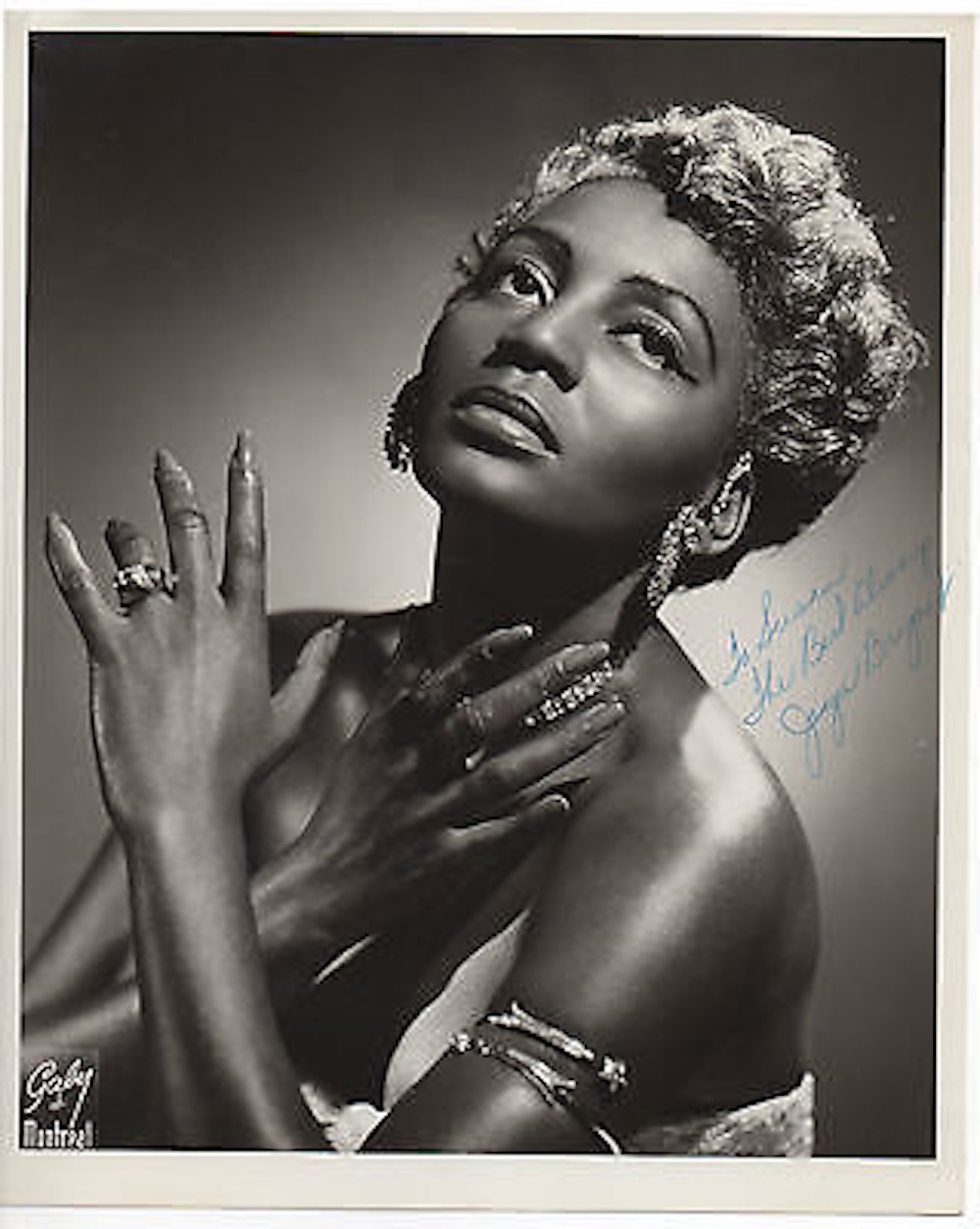
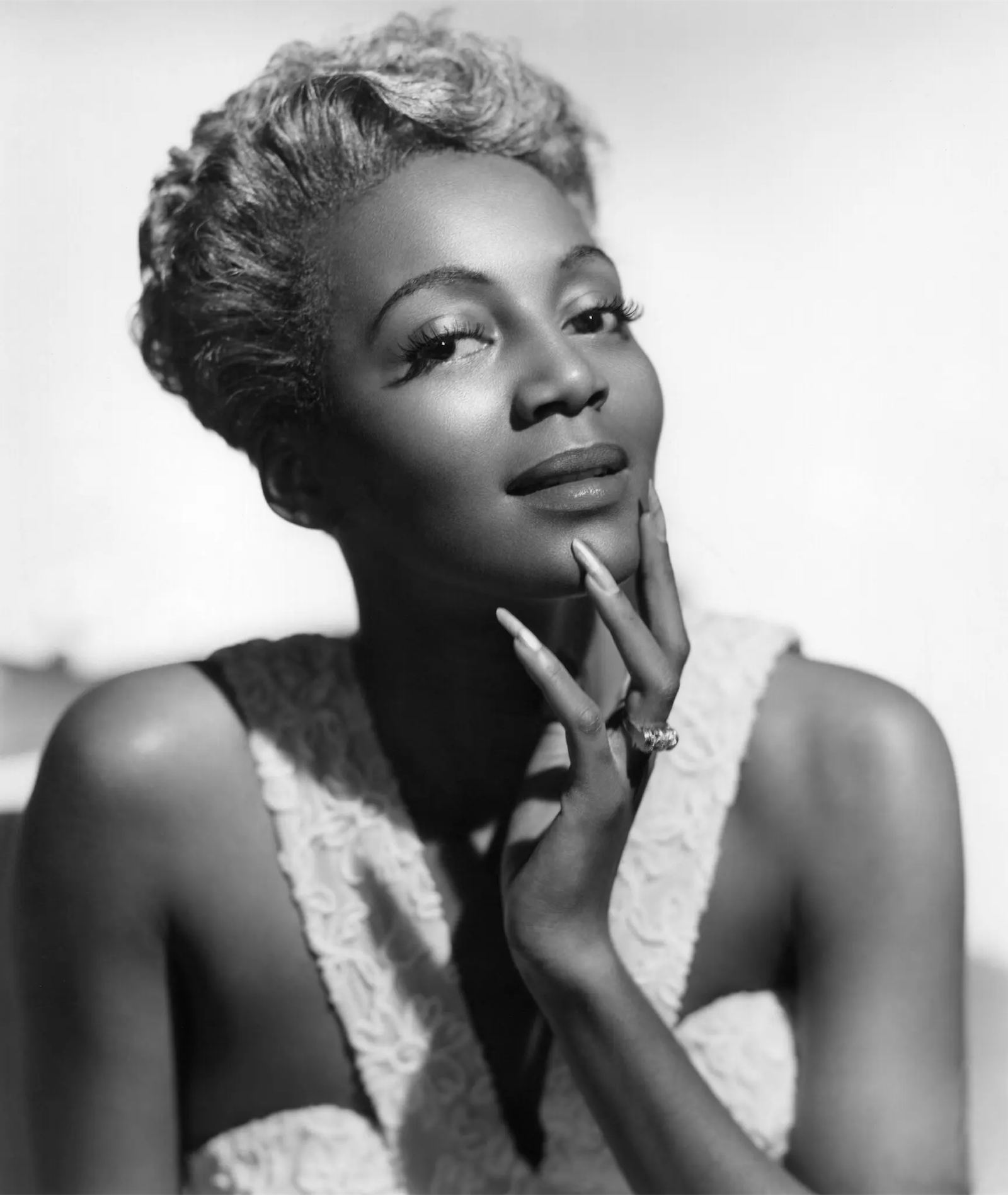
The image most associated with Bryant—silver hair, shimmering gowns, a kind of futuristic bombshell glamour—did not emerge from a neutral aesthetic choice. It was a tactic.
According to accounts gathered by Jim Byers, her authorized biographer and the writer of a recent Metropolitan Museum of Art essay on Bryant’s collaboration with designer Zelda Wynn Valdes, Bryant began wearing her hair silver after realizing she would share a bill with Josephine Baker and refusing to be upstaged. The solution was audacious and, by later standards, dangerous: radiator paint. The result was instantly legible as iconography.
The silver was more than a gimmick. It was an intervention into a visual regime that rendered Black women either invisible or hypervisible on someone else’s terms. In the 1950s, mainstream celebrity culture had few slots for Black women, and those slots were often managed through comparison—Black versions of white stars, rather than stars in their own right. Bryant’s later frustration with being branded “the Black Marilyn Monroe” sits inside that history of imposed analogy: the industry’s habit of translating Black excellence into white reference points to make it marketable to broader audiences.
Yet Bryant’s look also did something else: it treated glamour as a weapon. Byers’s Met essay describes it as a “velvet hammer,” a phrase that captures the paradox. In a segregated society, Bryant’s beauty and style became tools that could pry open doors—if she could survive the backlash of being the one to walk through first.
This matters because it reframes what some might dismiss as mere show business styling. For Bryant, presentation was a method of negotiation with power. She was using the language America claimed to value—sex appeal, sophistication, star aura—to force contact with spaces that were still actively excluding Black people.
Zelda Wynn Valdes, architecture, and the making of a silhouette
Bryant’s image was not made alone. It was engineered—sometimes literally—by Zelda Wynn Valdes, the pioneering Black designer whose gowns helped define Bryant’s stage identity.
Byers’s Met piece gets unusually specific about construction: strapless and backless gowns that plunged dramatically, held up through cantilevered boning and elastic, designed to create the illusion of impossibility—fabric floating, back bare, the performer seemingly sculpted into the garment. Bryant described the bodice pressing back against the rib cage, standing up independently.
The technical detail is not incidental. It clarifies the stakes of Bryant’s glamour: she was, in effect, performing inside an apparatus. The gowns amplified her, but they also constrained her, turning movement into struggle, turning a song into a physically risky act. She recalled wardrobe malfunctions—feeling “the air” at the Copa, realizing she had slipped out of the gown, relying on Valdes’s quick-thinking design adjustments to keep the show from becoming scandal.
In other words, the look that made Joyce Bryant famous also made her vulnerable. It made her a spectacle in rooms where spectacle could become an excuse for disrespect. It made her body part of the performance contract. And it underscored how, for Black women in mid-century entertainment, “image” was never purely personal—it was structural, economic, and political.
Breaking rooms open—and the violence waiting outside
Bryant’s ascent put her into spaces that were, by custom and often by law, guarded against Black presence. The Washington Post obituary notes her appearances at venues like the Copacabana in New York and Miami Beach hotel rooms where segregation was enforced not only socially but through curfews and policing.
One milestone has become central to her story: in December 1952, Bryant performed in the Aladdin Room at the new Hotel Algiers, becoming the first Black entertainer to perform in a Miami Beach hotel showroom, according to the Met’s account. This was not merely a booking. It was an incursion into a leisure economy built on exclusion. Black performers had appeared in standalone clubs in Miami, but a prime hotel booking on Miami Beach’s circuit was “unheard of,” Byers writes.
The response was predictably vicious. The Washington Post obituary reports that members of the Ku Klux Klan burned her in effigy to protest her appearance. That detail matters because it clarifies the atmosphere in which she worked: celebrity did not insulate her from racial terror; it could intensify it. Bryant’s glamour might get her into the room, but outside the room were people willing to make an example of her.
And yet she performed.
It is tempting to frame that as individual courage alone, but Bryant’s significance also lies in what such appearances did for the broader ecosystem of Black performers. In the Met essay, jazz singer Nancy Wilson tells Byers that Bryant got into spaces like the Coconut Grove “a decade before me,” adding, “Without Joyce, there would have been no me.” Even allowing for the rhetorical generosity of tribute, the point stands: barrier-breaking is rarely a single act. It becomes a precedent. It reshapes what bookers consider possible, what audiences expect, what younger performers imagine for themselves.
Bryant helped create those precedents—while paying for them personally.
The voice, the bans, and the limits of respectable desire
Bryant’s repertoire and recordings reveal another axis of conflict: the tension between Black female sexuality and the era’s gatekeepers. She recorded standards such as “Love for Sale” and “Drunk With Love,” songs considered too provocative for radio play in many markets. The Washington Post obituary notes both were banned from the radio.
Censorship was not only about lyric content; it was about who was singing. A Black woman selling desire in public was treated differently from a white woman doing the same. Bryant’s stage image—cleavage-baring gowns, silver hair, the deliberate cultivation of bombshell status—invited both fascination and moral panic. In the postwar United States, “respectability” was a currency frequently demanded of Black public figures as the price of mainstream visibility. Bryant’s act refused to be modest. The culture punished her for it.
This is one reason she fits awkwardly into familiar civil rights-era narratives. Many of the women most celebrated in retrospective accounts are framed in terms of sacrifice and restraint: dignified, non-threatening, safe for commemoration. Bryant was none of those things onstage. She was erotic, flamboyant, and unavoidably modern. Her audacity disrupts tidy storylines.
It also complicates the simplified idea that mid-century Black stardom was a straightforward ascent toward integration. Bryant’s fame coincided with a period when integration was still contested at the level of who could even enter a hotel lobby after sundown. She was, in effect, integrated as an exception—permitted because she could generate money and buzz—while Black communities remained subject to the everyday violence of exclusion.
How the machine chews up its miracles
By 1955, at the height of her popularity, Bryant walked away.
The “why” of that decision is where her biography becomes a kind of indictment. Different accounts emphasize different pressures, but the themes align: physical damage, spiritual conflict, exploitation, and danger.
The Washington Post obituary notes the harsh demands of her performance schedule and the shadow world around nightclub entertainment—the gangsters in clubs, the coercive forces of management, the sense that her humanity was being treated as irrelevant compared to her earning power. In the Met essay, Bryant is quoted with chilling simplicity about leaving: “I felt like a piece of meat. A piece of something… nothing. I just knew I had to get away.”
That statement is not merely personal. It describes how women performers—especially those marketed as sex symbols—often experience the gap between public adoration and private dehumanization. It also points to a racialized dimension: Bryant’s body was being consumed in spaces that were not, in any meaningful sense, safe for her.
A 1978 Washington Post feature about her return to nightclub performing portrays her life as material for a tell-all book: pills, mobsters, high life, pain. It frames her as “torn between two worlds,” a phrase that captures the central fracture—church and stage, sacred calling and secular appetite, respectability and desire.
When she left, she did not do what the industry expected. She did not pivot into a safer mainstream lane or quietly fade into domesticity. She went toward religion and missionary work, drawn back into the Seventh-day Adventist world she had been raised in. In accounts of her life, that choice is often interpreted as moral repudiation of the nightclub world. But it can also be read as an act of self-preservation: the creation of a space where her worth was not negotiated nightly in rooms full of people who wanted something from her.
Faith, disillusionment, and the civil rights reality she could not ignore
Bryant’s post-1955 period is sometimes summarized too neatly: she left show business for the church. That version risks turning her into a morality tale.
The richer account shows a woman trying to rebuild meaning while confronting the realities of segregation more directly than the nightclub world had allowed. Sources describe her enrolling at Oakwood College in Huntsville, Alabama, a historically Black Adventist institution, and traveling through the South. During these travels, she reportedly became enraged witnessing hospitals refusing care to Black people in critical need, prompting her to organize fundraisers for food, clothing, and medicine and to perform concerts to support church efforts.
This matters because it situates her faith not as withdrawal but as engagement. She was no longer singing in white-owned rooms as a marketed bombshell; she was raising resources in a segregated landscape where Black suffering was not abstract, and where her celebrity could be repurposed toward survival.
There is also evidence, via secondary accounts, that Bryant’s activism and insistence on dignity did not disappear when she left entertainment; it simply changed form. A 2023 essay at Black Women Radicals emphasizes her refusal to bow to racist practices and her outspoken critiques of how Black entertainers were treated—barred from restaurants, hotels, restrooms while touring.
Even within church life, she encountered limits. The Wikipedia summary (drawing from cited sources) describes her disillusionment when she confronted her church about taking a stand against discrimination and was told such matters were “earthly” and not spiritually important. Whether one accepts the precise phrasing or not, the underlying dynamic is familiar: Black institutions, including religious ones, often debated how directly to challenge segregation, and women who pushed too hard could find themselves isolated.
Bryant’s story, then, is not a simple arc from “sinful show business” to “pure faith.” It is an arc of seeking: trying to reconcile spiritual commitments with the moral emergency of American racism, and trying to find a life in which her gifts could serve something beyond the appetites of the entertainment market.
Reinvention: Opera as refusal and repair
If Bryant had ended her public life in 1955, she might be remembered as a tragic “what if.” Instead, she did something rarer: she reinvented herself through discipline rather than nostalgia.
Byers’s Met essay describes her training with Howard University voice coach Frederick “Wilkie” Wilkerson and her reemergence touring as the lead in the New York City Opera’s touring company of Porgy and Bess in the early 1960s. The Washington Post obituary also notes her later work on the opera stage.
The symbolism here is hard to miss. Opera has historically been treated as a high-art domain tied to European tradition and to gatekeeping structures that excluded Black performers. For a woman who had been marketed as an erotic nightclub spectacle—“too sexy” for radio, too Black to “pass” in the ways some contemporaries could—opera offered a different kind of legitimacy.
But this was not simply about respectability. It was about control. Classical training, a formal repertory, and the institutional framework of opera could provide boundaries the nightclub world lacked. In opera, the performer’s body is not the primary commodity. The voice is the instrument, and the work is presumed to matter. For Bryant, that shift was likely not merely artistic; it was existential.
The 1978 Washington Post piece captures her return as a woman with a still-massive voice and a life full of bruises. It describes her as refined in speech, theatrical in gesture, willing—almost eager—to discuss pain rather than hide it. That willingness to speak is itself a form of significance. Many entertainers survive by burying what the industry did to them. Bryant returned talking.
The comeback and the stubborn persistence of a torch
In the mid-1970s and beyond, Bryant returned to the Manhattan nightclub scene, headlining at venues such as the Rainbow Room and Harlem’s New Cotton Club, according to the Met essay. The 1978 Washington Post feature centers on this comeback, describing her act as “more Vegas than Harlem,” heavy on love songs and dramatic standards rather than R&B or blues, and noting that she was performing both pop and classical material at a benefit connected to Wilkerson’s scholarship foundation.
What’s striking is the continuity. Even as the music industry changed—rock reshaping the charts, soul and funk dominating Black popular music—Bryant remained committed to a style of bravura vocal drama that critics described as increasingly rare. The Washington Post obituary quotes critic John S. Wilson praising her in 1978 as a type of pop singer that had “virtually disappeared,” emphasizing her “dramatic intensity” and the remarkable range and tonal flexibility of her voice.
That observation points to why Bryant resists easy placement in music history. She wasn’t a straightforward precursor to the soul divas in the way people might assume. Her idiom bridged torch singing, jazz phrasing, gospel tremolo, and theatrical delivery—closer in some ways to Judy Garland’s dramatic presentation than to the “race music” categories the industry tried to enforce. Bryant herself spoke about not fitting the expected molds and not being able to “hide” that she was a Black woman in the ways some performers could musically.
Her significance, then, is also genre significance: she represents a Black performance tradition that mainstream histories often treat as white property—cabaret, torch, “standard” repertoire—despite the deep Black presence in those forms.
Teaching, legacy, and the quiet power of influence
Later in life, Bryant became a vocal instructor, coaching performers across genres and media, according to Byers’s Met essay. That kind of influence is notoriously difficult to document, but it may be one of the most consequential forms of artistic legacy: technique and confidence transmitted from one body to another, a lineage you hear in phrasing and breath rather than in headlines.
This mentoring dimension also helps correct a common error in how we talk about “forgotten” figures. The culture often frames them as isolated, as if they disappeared without impact. In reality, many of these artists remain present through informal networks—teachers, conversations, backstage advice, the transfer of craft. Bryant’s story suggests that even when the spotlight moved on, she kept shaping the sound of others.
Why Joyce Bryant still matters
To argue for Joyce Bryant’s importance is not to claim she was the only barrier-breaker of her era. It is to recognize the particular way her life illuminates the intersection of race, gender, sexuality, labor, and faith in mid-20th-century America.
First, she reveals how “integration” often worked in entertainment: Black artists were permitted into prestigious white spaces as profitable exceptions, while remaining subject to racial terror and legal restriction. Her Miami Beach appearance is emblematic—an historic booking achieved amid curfews that required Black people to be off the streets by sundown and threats severe enough to include a Klan effigy burning.
Second, she exposes the racial politics of glamour. Bryant and Zelda Wynn Valdes created an image that was both aesthetic triumph and structural hazard—gowns engineered to look impossible, a look so commanding it forced mainstream media attention. Yet the very spectacle that opened doors also invited exploitation and dehumanization, leaving Bryant to describe herself as treated like “a piece of meat.”
Third, she complicates the narrative of Black female sexuality in public life. Her songs were banned; her persona was simultaneously commodified and condemned. The culture wanted the thrill of her desirability without granting her the dignity of control.
Fourth, her life is a case study in exit as agency. When she left at her peak, she refused the industry’s demand that stardom must be pursued at any cost. The Washington Post’s 1978 profile notes the scale of what she walked away from—reported contracts and earnings that made the departure seem almost incomprehensible in purely economic terms. But the incomprehensibility fades when you understand the cost: physical harm, coercion, and spiritual conflict.
Finally, her reinvention underscores a different kind of American possibility: not reinvention as brand refresh, but reinvention as rigorous rebuilding. She trained, she learned, she returned on new terms—opera, teaching, selective performance.
The tragedy is not that Joyce Bryant vanished. The tragedy is that the culture let itself forget why she left—and what it says about us that leaving was necessary.
A life that refuses the archive’s laziness
In recent years, institutional and journalistic efforts have begun to pull Bryant back into view. The Washington Post obituary situates her among the major Black nightclub singers of her era and documents both her stardom and her withdrawal. The Met’s essay, written by Byers, explicitly argues that the achievements of Bryant and Wynn Valdes have grown obscure and treats their collaboration as a key chapter in American design and performance history. Ebony and Essence have revisited her as an icon whose beauty and audacity were recognized in her time but insufficiently honored at her death, with Ebony recalling her placement in a 1954 list of the “five most beautiful Black women in the world.”
These recoveries matter, but they should not be treated as charity. Joyce Bryant does not need to be rescued by the archive. The archive needs to be corrected by her.
Her story is an argument against lazy nostalgia about the 1950s. It’s a reminder that “glamour” in America has always been entangled with exclusion, and that the women who created new possibilities often paid with their bodies and their peace.
In the end, perhaps the most accurate way to describe Bryant is not by the nicknames others gave her, but by the shape of her choices. She was a woman who understood early that talent is not protection, and who spent her life trying to find a stage where her gifts could exist without her being consumed by them.
That struggle—between being seen and being owned, between being celebrated and being safe—remains painfully current. Which is why Joyce Bryant, the so-called “lost diva,” is not only worth remembering. She is necessary.
More great stories
Franklin McCain and the Architecture of a Stand
February 23, 2026
No Comments
The Night They Tried to Break Fannie Lou Hamer
February 23, 2026
No Comments