


A writer of work: the work people do, the work the nation does to itself, and the work art can do when it refuses to flatter.
A writer of work: the work people do, the work the nation does to itself, and the work art can do when it refuses to flatter.
By KOLUMN Magazine
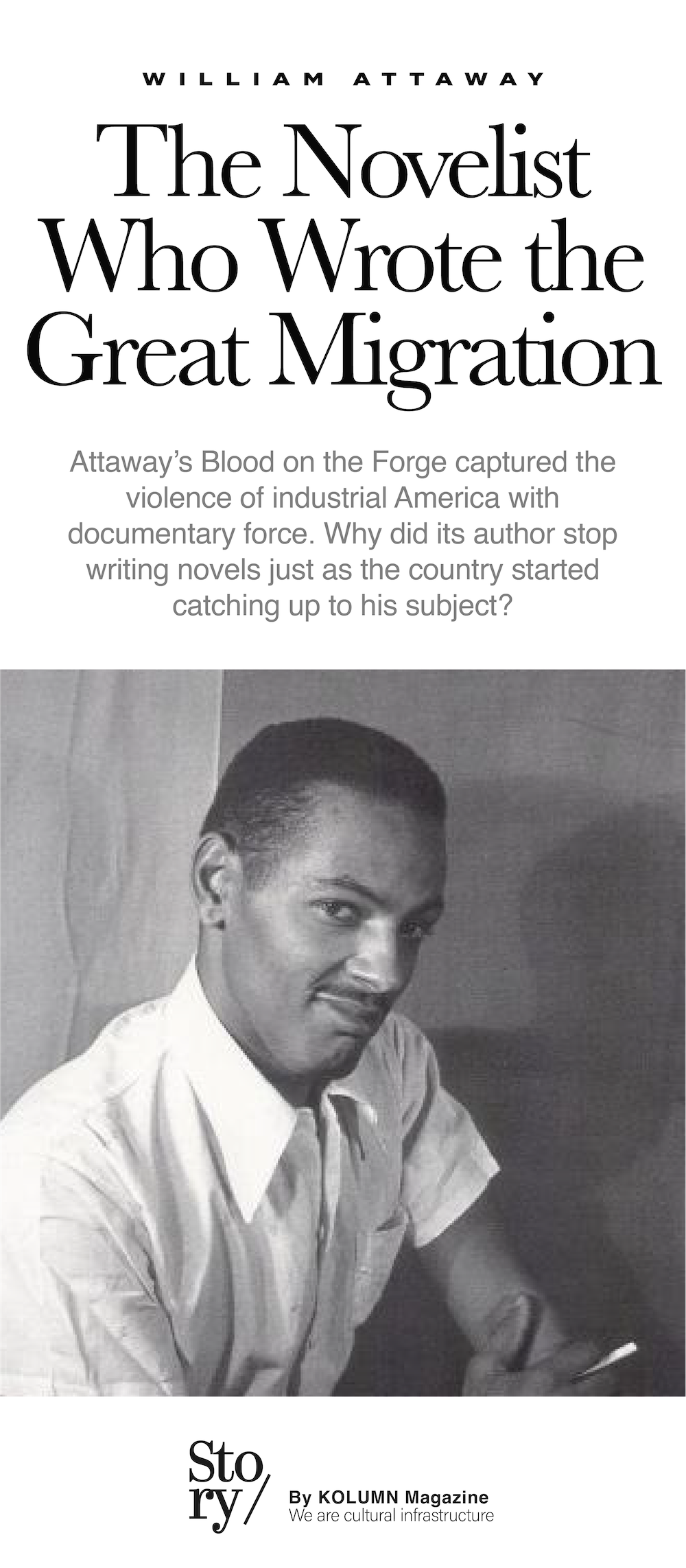
William Alexander Attaway did not simply publish a landmark novel and lose his nerve, or his publisher, or his audience. He published a landmark novel about how the United States manufactures progress—and then he shifted mediums, industries, and even geographies, writing songs and scripts for the mass culture that his novel had already diagnosed. His life, like his work, is a study in the bargain America repeatedly offers: come north, come modern, come be remade. The price is often paid in the body.
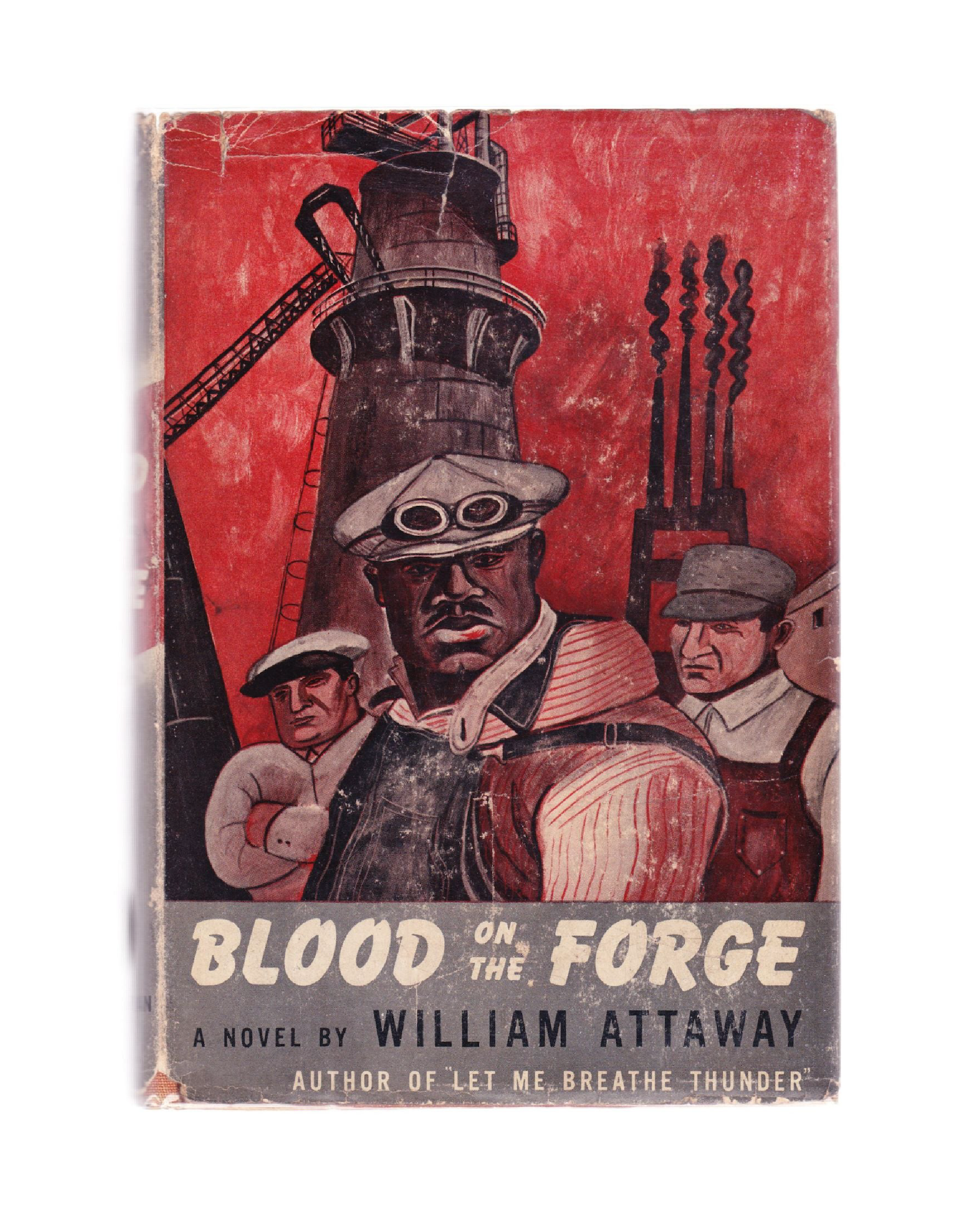
Attaway’s enduring reputation rests on Blood on the Forge (1941), a Great Migration novel set in the steel valley near Pittsburgh in 1919, where Black Southerners are recruited into mill work that is pitched as liberation and delivered as a different kind of captivity. The book follows three brothers—the Mosses—who flee the starvation logic of sharecropping and are absorbed into the inferno of industrial capitalism. The mills provide wages, but they also provide new hierarchies, new humiliations, and a violence that arrives as accident, policing, strikebreaking, and the slow corrosion of spirit. Even in summary, the plot reads like a national allegory: a people escaping one exploitative system only to be sorted into another.
In the decades after its release, Blood on the Forge drifted toward obscurity—overshadowed by better-known contemporaries and a literary canon that often preferred certain kinds of Black narrative over others. Yet when the novel reemerged through reissues and critical reconsideration, it did so not as a quaint historical artifact but as something more uncomfortable: a work that still explains America’s political economy with unnerving clarity. The book’s modern champions describe it in the language of rediscovery and necessity; it is “brutally gripping,” a migration novel crowded with the casualties of industrial life and the distortions it creates.
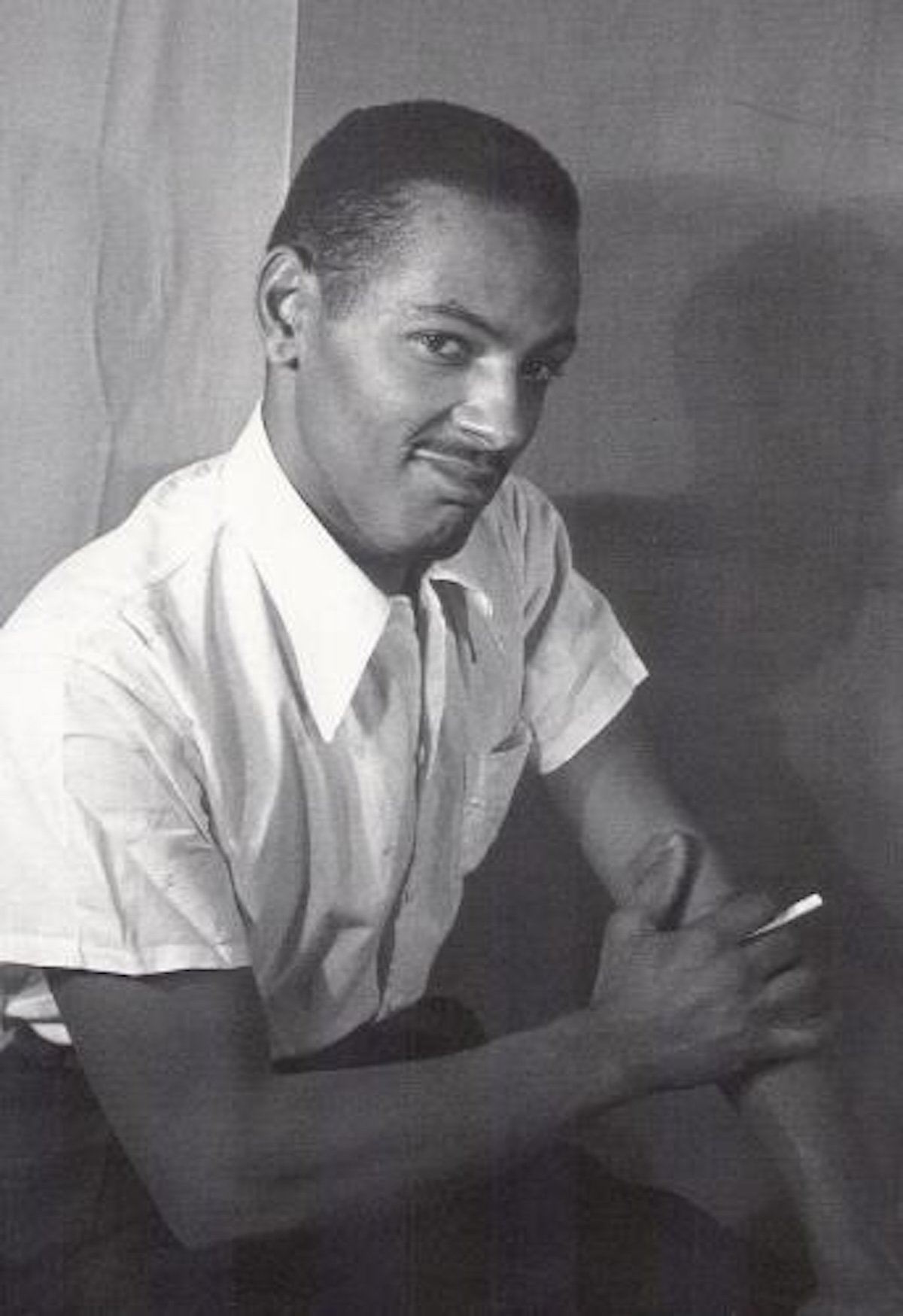
To write honestly about Attaway is to treat him not as an eccentric outlier but as a hinge figure—bridging the Black Chicago Renaissance and Depression-era proletarian writing, bridging the novel and the songbook, bridging “high” literature and the new mid-century machine of television. He was, in multiple senses, a writer of work: the work people do, the work the nation does to itself, and the work art can do when it refuses to flatter.
From Greenville to Chicago: The first migration
William Alexander Attaway was born in Greenville, Mississippi, in 1911, a Southern childhood that was never simply “regional” but structural: the South as a labor regime, the South as a racial order, the South as the place America exported its violence into daily life. Biographical accounts consistently describe his parents as educated professionals—his father a doctor and his mother a teacher—and place the family’s later move within the larger currents of the Great Migration, when Black families left the rural South for Northern cities that promised wages and a measure of safety.
Chicago, where Attaway grew up, matters as more than a setting. It was a city built by industry and arrival, a place where race, labor, housing, and politics collided at street level. For a young writer, it also offered institutions—schools, libraries, theaters—and a Black cultural ecosystem that included journalists, poets, musicians, and organizers. Attaway’s later fiction would not romanticize migration, but it would understand migration intimately as both an act of will and an act of coercion: people leaving because they want to live, and because the world they’re leaving is designed to keep them from doing so.
One oft-repeated anecdote about Attaway’s early awakening centers on Langston Hughes: a student reading a poem and realizing, with a kind of shock, that a Black person could write with public authority. Whether told as legend or literal fact, the story points to a larger reality of the period: Black literary ambition was frequently an act of discovery, not only of one’s talent but of one’s permission. In much of early 20th-century America, permission was the scarce resource.
Attaway attended the University of Illinois and completed his degree in the mid-1930s, a period when the federal government’s New Deal programs—however imperfect and often racially compromised—created cultural work alongside infrastructure. He is commonly linked in biographical timelines to New Deal-era writing labor, including the Federal Writers’ Project milieu that trained many writers in research, interviewing, and documentary habits. Those habits would become visible in his fiction’s feel for work sites, wages, bodies, and the language of survival.
A young writer in a nation of machines
Attaway’s first novel, Let Me Breathe Thunder (1939), is sometimes described as shaped by travel and hobo experience, a book attentive to the restless motion of people trying to outrun their circumstances. But Blood on the Forge is the work that locked him into a particular kind of importance: it takes the Great Migration—a story often framed as upward mobility—and insists on looking at its industrial underside.
The novel’s premise is historically recognizable. In the early 20th century, Northern industries recruited Southern Black labor, especially during wartime booms and periods of labor unrest. Recruiters promised wages and a new start; what migrants often found were segregated housing markets, dangerous jobs, strike politics that weaponized race, and policing systems that protected capital. Attaway stages these forces not as abstract history but as lived experience: the brothers arrive with expectations and are remade by the mill’s demands.
A crucial detail in Attaway’s own career is the support he received to write the book. In 1940, he was a recipient of a Julius Rosenwald Fund fellowship in creative writing—part of a philanthropic program that supported many Black artists and intellectuals in a period when mainstream patronage was scarce. The Rosenwald fellowships matter not only as biography but as cultural history: they are evidence of an alternative infrastructure that Black excellence often required—one built through philanthropic networks because the dominant institutions were unreliable or hostile.
Attaway used that support to produce a novel that reads like an unofficial archive of labor history. The book is set in 1919, a year marked by postwar economic volatility, racial violence, and labor conflict—an America struggling to decide who would be included in its prosperity, and on what terms. In Attaway’s mill town, those national decisions are enforced by foremen, deputies, and furnaces that do not care about the human beings feeding them.
Blood on the Forge: A migration narrative that refuses comfort
The three Moss brothers—Big Mat, Chinatown, and Melody—arrive in the North with different temperaments and different hungers. Big Mat is the embodiment of responsibility and brute endurance; Melody carries the folk culture of the South through music; Chinatown is youthful, improvisational, and alert to pleasure as a form of resistance. Their journey fits the broad outline of the “migration narrative” that scholars have identified as a central form in Black cultural expression: an inciting rupture, a confrontation with the city, an attempt at adaptation, and a reckoning with the North’s possibilities and limits. But what distinguishes Attaway is how quickly he strips away the moral that migration equals salvation.
In the South, the brothers live under a system that can starve them without ever calling it murder. Hunger is not incidental in Attaway’s imagination; it is a governing force, both literal and metaphorical. The brothers’ deprivation shapes their choices and their susceptibility to the recruiter’s promises. When the North arrives as rumor—money, city clothes, full plates—it is experienced as a kind of imagined adulthood. Attaway understands this psychology with brutal compassion: people do not need to be naïve to be exploited; they need only to be desperate.
Then comes the mill. Attaway’s North is not a gleaming skyline but an industrial landscape where nature is defiled and human bodies are treated as expendable inputs. Critics and scholars have long noted how the novel links ecological degradation to racial and class exploitation, rendering pollution and accident as part of the same system that renders workers disposable. The book’s images—ore piles, smoke, the river’s contamination—are not decorative. They are moral evidence.
One of the novel’s sharpest insights is how race operates inside labor politics. The brothers enter a workplace populated by immigrants and other workers who are themselves exploited; rather than producing solidarity, the system often produces competition and resentment, with Black workers positioned as tools against unionization and as scapegoats for the frustrations of white labor. That dynamic—capital using race to break collective power—is not unique to 1919, and it is one reason the novel still feels contemporary.
Attaway also refuses to sentimentalize masculinity. Big Mat’s strength is both protection and trap; authority offered by white power can become a kind of poison. In the novel’s world, the deputizing of a Black man to police labor conflict is not a story of integration but a story of co-optation, a way the system launders its violence through someone who has been denied dignity and is desperate to feel it. The tragedy is not simply personal; it is structural.
Even the book’s treatment of music—carried most explicitly through Melody—registers loss. The folk culture of the South does not migrate intact; it is pressured, mocked, exhausted, sometimes destroyed. The “blues” in Attaway is not only a genre; it is a method of surviving. When industrial time and industrial fatigue crush that method, something more than leisure disappears. A people’s interior life becomes harder to access.
When the novel was republished and praised decades later, writers emphasized its ability to teach America something about itself. The reissue materials preserve an admiring assessment by Richard Wright, who argued that the book presented with skill the impact of industrial life on Black Southerners fleeing plantations and offered moving knowledge of American civilization, even when the reality was not “beautiful.” Wright’s praise is a reminder that Attaway’s work was not invisible to everyone; it simply did not become durable in the way the canon often decides durability.
Why did he stop writing novels?
The question haunts every profile of Attaway: after two novels—after a book as strong as Blood on the Forge—why no more?
The honest answer is that no single explanation satisfies. The United States in the 1940s did not reliably reward Black novelists, especially those whose work centered labor conflict and the mechanics of exploitation rather than the more easily commodified storylines of uplift or individual triumph. Attaway’s novel is also difficult in the way honest labor writing tends to be: it is harsh, it is crowded with injury, and it does not offer the reader an easy place to stand above its characters.
But biography also suggests something else: Attaway did not stop writing. He stopped writing novels. He moved into other forms—songwriting, books about music, scripts for radio and television—forms that were becoming central to American life in the mid-century. The shift can look like disappearance if one is watching only the literary world. From another angle, it looks like adaptation: a writer following the country’s attention.
Attaway’s later work included Calypso Song Book (1957), a compilation and presentation of Caribbean folk music during a period when calypso was circulating widely in U.S. popular culture. He also published Hear America Singing (1967), described as a children’s history or compilation of American popular music with commentary. These projects suggest a mind still preoccupied with how working people carry their histories—through songs, through performance, through what survives the grind.
His involvement with Harry Belafonte’s orbit is one of the more surprising bridges in his story. Attaway is repeatedly credited as a co-writer on “Day-O (The Banana Boat Song),” the calypso hit associated with Belafonte, alongside Irving Burgie (Lord Burgess) and traditional sources. The Washington Post obituary for Burgie notes the collaboration, placing Attaway within the songwriting network that helped bring the song to mass attention. If Blood on the Forge depicts men loading steel into America’s economy, “Day-O” comes from a work-song tradition about labor—banana loading—transformed for global audiences. Attaway’s career, in that sense, loops back: he remains a writer of work, even in pop form.
Attaway also wrote for television and film in an era when those industries were defining modern American storytelling. Sources link him to anthology television such as General Electric Theater, including an episode (“Winner by Decision”) associated with Belafonte and directed under Attaway’s name. The mid-century TV ecosystem was not, on the whole, a welcoming place for Black writers; if Attaway could work inside it at all, that fact is part of his significance—another example of a Black artist navigating institutions that had not been built for him.
The writer as witness: Realism, research, and the alternative archive
What makes Attaway especially relevant to contemporary journalism is how his fiction behaves like reporting without losing its lyric power. Blood on the Forge is often described as naturalistic or proletarian—terms that can feel academic until you remember what they imply: attention to material conditions, to how money and labor shape people’s choices, to how institutions press on the body. The novel’s steel town is not a “backdrop.” It is the engine of the plot.
That method has become newly legible in our own moment, when writers and scholars talk about literature as an “alternative archive”—a way of preserving experience that official records either distort or omit. A modern essay in Jacobin frames the book as precisely this: a conduit for preserving and elucidating oppressed experience, a masterful depiction of racism and capitalism intertwined. You need not share the magazine’s politics to recognize the underlying claim: Attaway’s novel is not merely art; it is evidence.
Local public-history institutions in Western Pennsylvania have also used the novel as interpretive material for understanding the Homestead-area steel world. Rivers of Steel, for instance, has presented the book as a recommended read that connects the region’s industrial past to the Great Migration’s human reality. That kind of institutional uptake is a clue to the book’s power: it can stand beside history as a tool for comprehension.
The novel’s reemergence through NYRB Classics publishing has further shaped its modern life, situating it among “rediscovered” works that the mainstream once allowed to fade.) Reissue culture can sometimes feel like trend. In Attaway’s case, it has functioned as correction.
A life across borders: Race, family, and distance
Attaway’s personal life—like many mid-century artists’ lives—has the outlines of a quiet rebellion. Multiple biographical accounts describe his marriage in the early 1960s to a white woman, Frances Settele, and note that the couple lived for years in Barbados, raising children there before later returning to the United States. In an America where interracial marriage was still illegal in many states until Loving v. Virginia (1967), such a life was not merely “private.” It was political exposure.
Barbados, in that frame, can be read as refuge and as choice: a place where an interracial family might live with less daily hostility than they would face in parts of the United States during the civil-rights era. It is also consistent with Attaway’s artistic interest in Caribbean music and calypso. The geography of his later life—Chicago, New York, Barbados, Los Angeles—mirrors the wider geography of mid-century Black cultural production, which often required movement to find safety, patronage, or simply space to breathe.
He died in 1986, his name better known in certain circles than in the broad national imagination. That gap—between significance and recognition—is one of the central facts of his story.
Attaway’s significance now: What he helps us see
Attaway’s significance is not limited to literary history, though it would be enough if it were. He matters because Blood on the Forge offers a rigorous vocabulary for understanding America’s recurring crises: labor exploitation, racial scapegoating, migration as both hope and coercion, and the human cost of industrial “progress.”
He also matters because his career contradicts a simplistic story about artistic purity. He moved between forms—novel, songbook, television—without abandoning his central subject: the lives working people are forced to live, and the cultural expressions they create to survive. The same mind that wrote a steel-mill tragedy helped shape a work-song into a pop phenomenon; the same writer who made the Great Migration feel like a descent into machinery also curated music as an inheritance.
In the current era—defined by renewed labor organizing, by debates over how we teach migration and race, by environmental reckoning with industrial legacies—Attaway reads less like a period piece and more like a diagnostician. One could argue that the United States has never fully resolved the contradictions his novel dramatizes: it still needs workers it refuses to protect; it still sells mobility while maintaining structures that make mobility precarious; it still converts human lives into inputs for profit.
Attaway gives that contradiction a face and a voice. He shows how it feels when the promised land is built on a furnace.
More great stories
Velvet Hammer
February 23, 2026
No Comments
The Night They Tried to Break Fannie Lou Hamer
February 23, 2026
No Comments