

Why was this officer here, with a gun and legal authority, after the system had reasons to worry?
Why was this officer here, with a gun and legal authority, after the system had reasons to worry?
By KOLUMN Magazine
On the night Sonya Massey called 911, she did what Americans are told to do when they’re afraid: ask the police for help. It was July 6, 2024, and Massey—a 36-year-old Black woman in Woodside Township, near Springfield, Illinois—reported a possible prowler. The story should have ended with reassurance, a report number, a quiet return to bed.
Instead, it ended with a deputy’s gunshot.
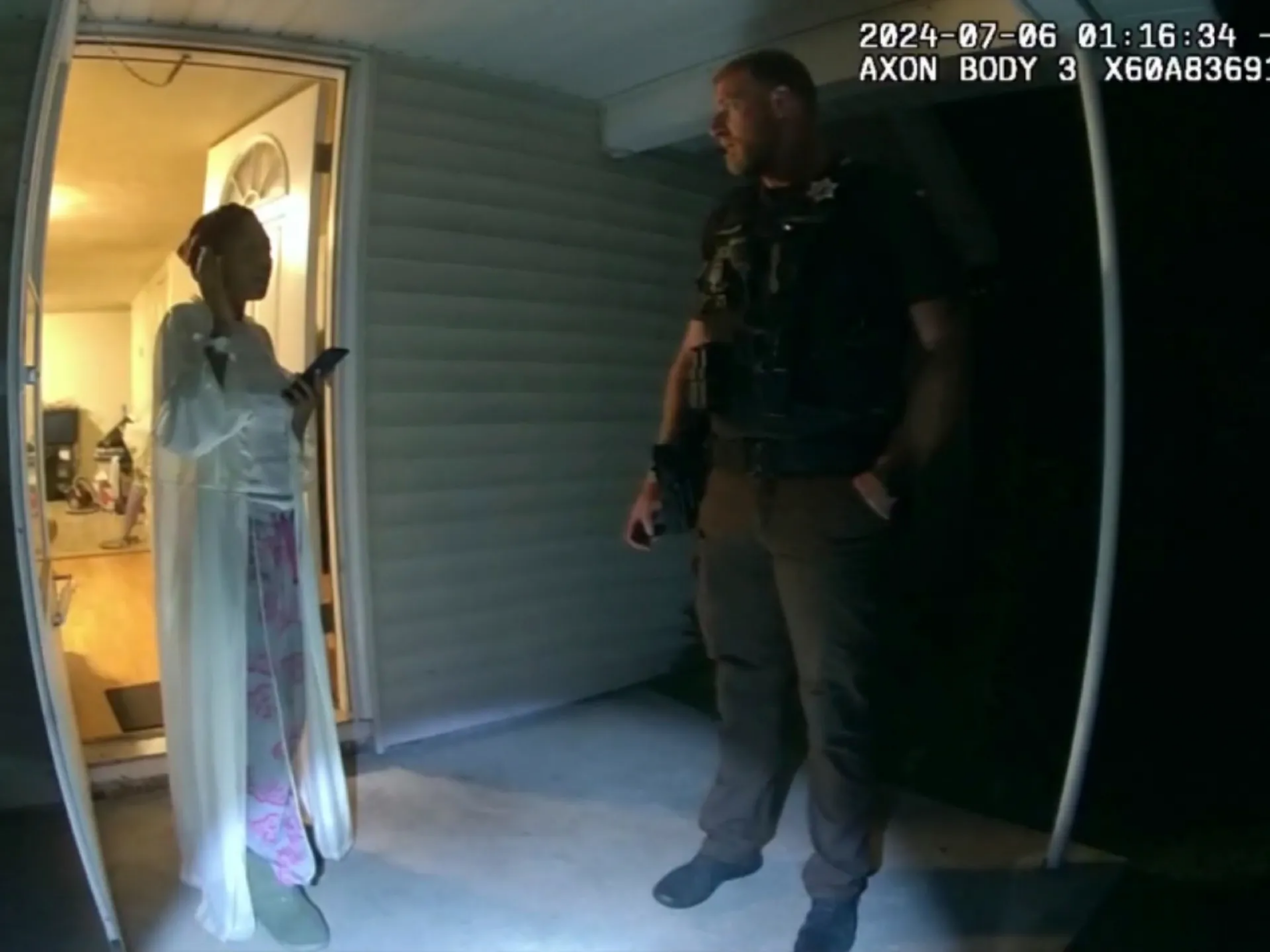
Body-camera footage later showed an encounter that escalated fast and wrong, culminating in the murder of Massey inside her home. The deputy—Sean Grayson, a white Sangamon County sheriff’s deputy—was fired, prosecuted, and ultimately convicted of second-degree murder; on January 29 he was sentenced to 20 years in prison.
But the Massey case is not only about what happened in that kitchen. It is about what happened before the kitchen—before the uniform he wore that night, before the county patch, before the hiring paperwork that turned a history into a payroll line.
Because Grayson’s name did not begin at Sangamon County. Records and reporting describe a pattern of red flags—disciplinary issues, credibility concerns, and prior employers—that did not prevent him from moving through multiple agencies in central Illinois. That movement—the ability to keep policing after a department has reason to worry—is the throughline that ties Massey’s killing to a set of more American tragedies: the death of 12-year-old Tamir Rice in Cleveland; the Danziger Bridge shootings in post-Katrina New Orleans; the murder of George Floyd in Minneapolis; Walter Scott’s fatal shooting in North Charleston; and the Tulia scandal in Texas, where fabricated testimony by a roaming narcotics officer detonated dozens of Black lives.
The phrase “gypsy cop” is sometimes used in popular discourse to describe an officer who bounces from department to department after misconduct. It’s also a term many consider a slur when “Gypsy” is used by outsiders to refer to Romani people—so this story will use the more precise, increasingly common language in research and policy: wandering officers or wandering cops. The label matters less than the mechanism: a system that treats discipline as confidential, resignation as erasure, and hiring as a local decision insulated from national consequence.
That mechanism has an often-fatal pattern in Black America. It looks like this: a complaint becomes a file; a file becomes “unsubstantiated”; “unsubstantiated” becomes “eligible for rehire.” Or a supervisor decides an officer is unfit—but the officer is allowed to resign quietly, leaving no formal termination to warn the next department. Or an arbitrator reinstates an officer a chief tried to fire. Or a state has no meaningful decertification process. Or a database exists but isn’t public, isn’t mandatory, or gets shut down.
Then comes the next stop. The next badge. The next call for help.
And sometimes, the next death.
The wandering-officer problem isn’t anecdote anymore
For years, the public understanding of roaming problem officers has been built on notorious cases and investigative series. The last decade has added something else: large-scale empirical work. In a landmark study in the Yale Law Journal, scholars Ben Grunwald and John Rappaport assembled decades of employment data on roughly 98,000 full-time law-enforcement officers across nearly 500 agencies in Florida. Their findings cut through the debate about whether “wandering cops” are rare outliers or a systemic feature.
They found that, in any given year in their Florida dataset, just under 1,100 officers who had previously been fired were employed by Florida agencies—about 3% of officers. And critically, the study found that these previously fired officers were, on average, more likely than non-fired officers to be terminated again or to engage in misconduct.



Florida is not the nation. But the study’s significance is not that it proves identical rates everywhere; it’s that it demonstrates the phenomenon is measurable, persistent, and structurally enabled. It also exposes a common misconception: that the “worst” officers always get pushed out permanently. In practice, a firing can be less an end than a transfer—especially in a fragmented policing labor market with thousands of agencies, inconsistent standards, and uneven transparency.
The policy landscape reflects that fragmentation. States vary widely in whether they certify and decertify officers, what triggers decertification, whether records are public, and how often departments check them. Some states have historically had no decertification process at all; others have one on paper but rarely use it. Reform groups have argued that without robust certification and accessible records, officers who should be removed can simply reappear elsewhere.
To close the gaps, professional organizations created tools like the National Decertification Index (NDI), a registry of certification revocations maintained by IADLEST. But NDI participation and reporting are not uniformly mandatory, and decertification itself depends on state law and state practice.
Meanwhile, the federal government attempted to build a misconduct database for federal officers—the National Law Enforcement Accountability Database (NLEAD)—launched in late 2023. Yet its scope was limited (primarily federal), access was not public, and in 2025 the database was decommissioned after an executive-order reversal by the Trump administration, underscoring how fragile reforms can be when built without legislation.
Against this backdrop, cases like Sonya Massey’s read less like isolated failures and more like outcomes of design.
Sonya Massey and the Illinois deputy who kept getting hired
The Massey case landed in the national consciousness in a way many local killings do not—because the footage was unambiguous enough to cut through the usual fog of “split-second decision-making,” and because the encounter began with a plea for help. It also landed during a period when many Americans assumed the post-2020 era would bring more robust accountability.
But the deeper scandal was not only what Grayson did—it was that he was in position to do it at all.
Local and regional reporting described how Grayson moved through multiple law-enforcement agencies in central Illinois. Reporting by St. Louis Public Radio, Capitol News Illinois, and Illinois public media detailed concerns raised during prior employment, including disciplinary episodes and credibility issues that did not stop subsequent hiring. Additional documentation cited by investigative outlets described a history that included red flags well before Sangamon County.
This is where the “wandering officer” dynamic becomes concrete. In theory, law enforcement hiring is supposed to be conservative: background investigations, reference checks, psychological screening, training records, use-of-force history. In practice, the system rewards staffing speed and paperwork minimalism—especially for small agencies, rural departments, and sheriff’s offices under political pressure to fill shifts.
When those incentives collide with secrecy norms around personnel files, the result is predictable. A record that could be disqualifying becomes “not shareable.” A resignation becomes a clean exit. A chief’s concerns become a phone call that never happens. An officer becomes, in bureaucratic terms, rehireable—and in human terms, newly dangerous to the next community.
After Massey’s killing, Illinois lawmakers advanced proposals framed explicitly as hiring reform—background checks with more teeth, less reliance on self-reported histories, fewer loopholes that allow departments to accept “no discipline on record” as proof of fitness. Coverage noted legislation popularly linked to Massey’s case that sought to force more thorough checks before officers are hired.
But a reform that arrives after a death is a late reform. Massey’s case asks the harder question: why does the system keep waiting for the corpse before it audits the file?
Tamir Rice and the quiet resignation that became a tragedy
In Cleveland, on November 22, 2014, 12-year-old Tamir Rice was playing with a toy gun in a park when police arrived. Within seconds, Officer Timothy Loehmann shot him. Tamir died the next day.
Not long after, it emerged that Loehmann had been permitted to resign from the Independence Police Department roughly a year earlier after supervisors found him emotionally unstable and unfit for duty during firearms training. Reporting at the time described how the departure was framed as a resignation rather than a hard stop—an administrative choice with profound downstream consequences.
The detail matters because it shows how the system can launder risk through process. A termination can follow an officer. A resignation can disappear into ambiguity. For hiring agencies, “resigned” can sound like “moved on,” not “washed out.” And in policing, where the presumption of competence is often stronger than the evidence of it, ambiguity acts like absolution.
Loehmann’s case also reveals another structural vulnerability: the limits of background checks that rely on cooperative disclosure. Cleveland’s ability to learn about Independence’s concerns depended on what Independence chose to say—and what Cleveland chose to ask, verify, and interpret. When those incentives align toward minimizing friction, the result is an officer with known instability returning to a job where instability can kill.
In the language of public administration, this is a failure of “information governance.” In the language of Black families who bury children, it is a failure of moral imagination.
Danziger Bridge and the post-disaster permissions that became a culture
If Tamir Rice illustrates the bureaucratic quiet of resignation, the Danziger Bridge shootings illustrate something louder: how organizational culture, disaster conditions, and impunity can fuse into violence.
In the aftermath of Hurricane Katrina in 2005, New Orleans police officers shot six unarmed civilians on the Danziger Bridge, killing two and wounding four. The incident became emblematic not just of a single violent encounter but of a broader collapse—of oversight, discipline, and truth. Federal prosecutions later resulted in convictions for civil-rights violations and a cover-up.
The case also became a template for how accountability can be undermined even after convictions. A federal judge later overturned convictions because of prosecutorial misconduct, and subsequent legal proceedings continued. This does not erase the shootings; it shows how the path from violence to accountability is long, contested, and vulnerable to institutional failure on every side.
Where does “wandering” enter a story like this, where officers were not necessarily moving between departments in the same way? In the broader sense of the phrase: the way departments manage problem officers over time—through tolerance, reassignment, informal discipline, and internal protection—creates the conditions in which disaster becomes permission. When misconduct is treated as manageable rather than disqualifying, it can become normalized. In a catastrophe, normalization becomes escalation.
New Orleans’ post-Katrina policing history is also part of a larger national pattern: agencies with deeply rooted misconduct problems often cycle officers through roles, units, and reputations until a single incident forces external scrutiny.
Wandering isn’t only geographic. It can be bureaucratic: the wandering from consequence to consequence without ever arriving at removal.

Derek Chauvin and the warning signs that never mattered
Derek Chauvin did not wander across departments, but his case remains central to the wandering-officer conversation because it illustrates the same underlying pathology: a system that collects warning signs and then refuses to treat them as warnings.
Chauvin had been the subject of numerous misconduct complaints during his Minneapolis Police Department career; multiple outlets reported at least 18 complaints prior to George Floyd’s murder, with little discipline resulting.
The specific number matters less than the broader reality: a complaint system that behaves like a sink. Complaints go in; consequences rarely come out. Many are closed without discipline. Some are “coached” away. A department can, in effect, maintain a record of concern while continuing to put the officer on the street, armed and empowered.
When George Floyd died on May 25, 2020, with Chauvin’s knee on his neck, the country saw a single act. But systems scholars saw a pipeline: recruitment, training, supervision, complaint intake, internal affairs decision-making, union protections, civil liability limits, prosecutorial reluctance. By the time the knee met the neck, the institutional decisions had already been made.
That is why Chauvin belongs in a story about wandering officers: the “wandering” can happen in time. An officer can wander through years of signals—without the system ever deciding the signals mean anything.
Michael Slager and the early warning system that didn’t warn
On April 4, 2015, in North Charleston, South Carolina, Officer Michael Slager shot Walter Scott in the back as Scott ran away. The killing might have been swallowed by the usual script—“feared for my life,” “struggle,” “threat”—but for a bystander video that contradicted the police account.
After the shooting, reporting revealed that Slager had been the subject of prior citizen complaints, including allegations related to taser use. Authorities said they were re-examining past cases involving him in the wake of Scott’s death.
Slager ultimately received a 20-year federal sentence after pleading guilty to a civil-rights charge. But the point here is not the sentence; it’s the chronology. The complaints existed. The department had signals. Yet those signals did not translate into intervention strong enough to prevent a killing.
Police departments often advertise “early warning systems” meant to identify problematic patterns—use-of-force incidents, complaints, pursuits, lawsuits, injuries. In practice, those systems can become compliance theater: data collected, boxes checked, careers sustained.
Slager’s case shows how an “early warning” can become an early archive—a place where concerns are stored until the worst thing happens.
Tom Coleman and Tulia: The wandering officer as architect of mass harm
Not every disaster requires a shooting.
In Tulia, Texas, a small Panhandle town, an undercover narcotics officer named Tom Coleman became infamous for the scale of his damage. His testimony helped drive the wrongful arrest and conviction of dozens of people—many of them Black—based on drug-sting cases later shown to be deeply unreliable. Tulia became a symbol of how a single officer, armed with the credibility of the badge, can warp a justice system.
Coleman’s relevance to this story lies in what came before Tulia: reporting and legal commentary have long noted that he had a troubled background, including misconduct and legal problems, before he was hired into a role with enormous discretion.
The Tulia scandal expands the “fatal consequences” frame beyond literal death. For the people Coleman targeted, life became a different kind of aftermath: prison time, family rupture, economic collapse, stigma, a criminal record that functioned as a civil death sentence.
Wandering officers don’t only kill bodies. They can kill futures.
The machinery that keeps the revolving door spinning
If these cases share a throughline, it is not simply “bad apples.” It is institutional design—the interaction of secrecy, incentives, and legal insulation.
Resignations that operate like erasers
Allowing an officer to resign in lieu of termination can be framed as administrative mercy or risk management. It can also be a bargain that protects the department from a grievance fight and protects the officer from a record that would block future employment. In Loehmann’s case, the resignation narrative mattered because it shaped what the next employer could easily know.
Personnel secrecy and the “local problem” mentality
Misconduct records are often shielded by state laws, union agreements, or departmental policy. Even when disclosure is legally possible, agencies may be reluctant to share details that could invite lawsuits, embarrassment, or claims of defamation. The result is an inter-agency labor market where the people with the most at stake—future communities—have the least information.
Arbitration and reinstatement: firing that doesn’t stick
Even when chiefs fire officers, the decision can be reversed through contractual appeals and arbitration. A major Washington Post investigation found that since 2006, large departments fired at least 1,881 officers for misconduct, yet were forced to reinstate more than 450 after appeals tied to union contracts.
This is not a side issue. It is central. If a department cannot permanently remove an officer it deems unfit, that officer becomes available—to be put back on the street in the same city or to seek employment elsewhere.
Certification, decertification, and the patchwork map
In an ideal system, the power to police would operate like a professional license: lose it for serious misconduct, and you can’t simply pick up the trade in the next county. Some states approximate this. Others do not. Even where decertification exists, reporting to national indices is uneven, and the standards that trigger decertification vary.
Databases that are limited, voluntary, or politically fragile
NLEAD, the federal misconduct database launched in late 2023, was pitched as a hiring integrity tool. But it was limited (federal scope, nonpublic access) and later decommissioned in 2025—an illustration of how reforms built on executive action can vanish with a signature.
Meanwhile, the National Decertification Index exists, but its effectiveness depends on whether states decertify and whether agencies check it.
The lesson is brutal: data can’t protect people if the system won’t reliably collect it, share it, or use it.
Why Black Americans bear the heaviest costs
The disproportionate impact on Black communities is not incidental. It is the result of where policing is most concentrated, how suspicion is distributed, and how violence is rationalized.
Black neighborhoods are more likely to experience heavy police presence, more stops, more enforcement encounters—meaning the “risk surface area” is larger. When a department retains or rehires a troubled officer, the communities most saturated by policing become the communities most exposed to that officer’s worst day.
There is also a historical truth that shapes how misconduct is interpreted: Black complainants have often been treated as less credible, less sympathetic, more threatening. Complaints from Black residents can be discounted as hostility to law enforcement rather than warnings about danger. This is how a system can compile complaints against an officer like Chauvin and still keep treating him as employable.
And when the worst happens, Black families confront a second system: prosecutors who hesitate, laws that shield departments, and civil claims that can take years. A recent legal analysis in the Harvard Law Review described how structural barriers can make it difficult to hold police employers accountable, even when misconduct is obvious—another reason institutions may not feel compelled to treat warning signs as urgent.
This is the cumulative harm: not only deaths and wrongful convictions, but a civic environment in which calling the police can feel like gambling with your life.
What meaningful reform would require
The United States does not lack reform ideas. It lacks reform that is durable, national in scope, and resistant to the incentives that currently reward forgetting.
A credible solution would include at least five pillars:
A licensing model with teeth. Every state should certify officers, and serious misconduct should trigger decertification that is difficult to evade. Congress’s own policy analyses have emphasized the role of decertification systems and the limits of voluntary reporting.
Mandatory, standardized reporting into interoperable systems. The National Decertification Index provides a foundation, but participation and reporting norms need reinforcement through state law and funding conditions.
Transparent, accessible misconduct histories. Databases that only agencies can see—and that can be deleted by political change—are not enough. The public is a stakeholder in hiring outcomes, especially when the consequence of a bad hire can be lethal. The controversy around NLEAD’s limited scope and eventual decommissioning illustrates the weakness of non-legislated, nonpublic accountability infrastructure.
Reform of arbitration and reinstatement pathways. If chiefs cannot keep fired officers off the street, the system cannot credibly claim it removes problem officers. The evidence that hundreds of fired officers have been reinstated through contractual appeals shows why this is not a theoretical problem.
Real consequences for agencies that hire recklessly. Civil liability and employment law should make negligent hiring costly. Without institutional consequences, the incentives will continue to favor “fill the shift” over “read the file.”
None of this guarantees a world without police violence. But it would reduce the number of cases where a killing is followed by the discovery that the warning signs were already written down somewhere—filed, stamped, ignored.
The file is the story we keep refusing to read
In each of these cases, there is a moment when the tragedy seems sudden: the shots in Cleveland, the gunfire on the bridge, the knee on the neck, the bullets in North Charleston, the weapon raised in an Illinois kitchen. But when you trace backward, the story slows down. It becomes administrative. It becomes avoidable.
A resignation accepted instead of a termination.
A record minimized, a complaint closed, discipline withheld.
A hire made despite a trail of concerns.
A database launched, then erased.
A system that treats prior behavior as irrelevant—until it becomes irreversible.
The public is often asked to evaluate these tragedies as isolated encounters: Did the officer fear for his life? Was the suspect compliant? Was it a split-second decision? Those questions matter in court.
But the larger civic question is earlier: Why was this officer here, with a gun and legal authority, after the system had reasons to worry?
For Black Americans, that question is not academic. It is the difference between a 911 call that ends in help and one that ends in a funeral.
And the most damning truth is that the evidence is usually not hidden. It is merely treated as optional—until the cost of ignoring it is paid in blood.