


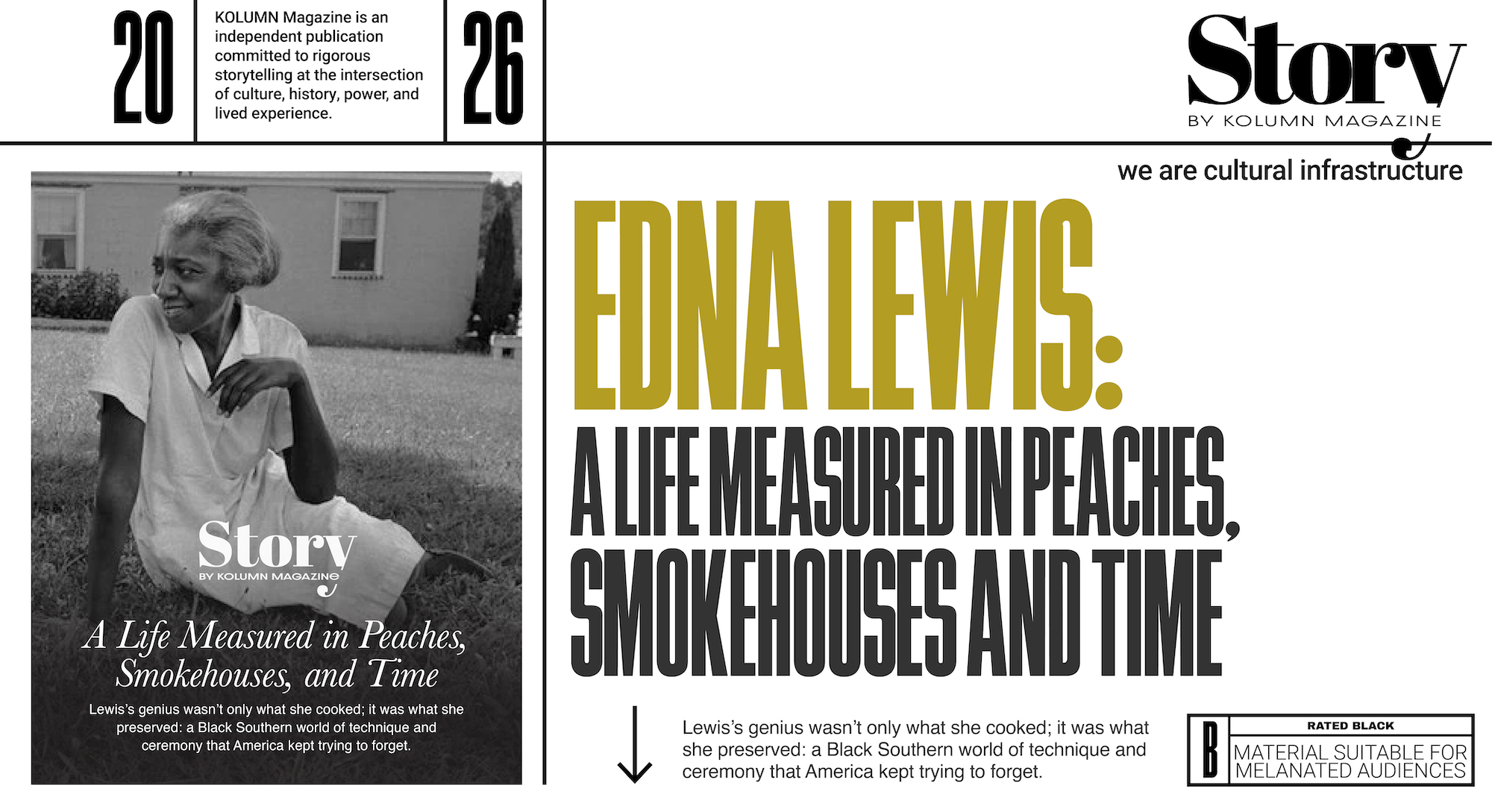
Who gets to define “American cuisine,” who is granted the dignity of complexity, and what it costs?
Who gets to define “American cuisine,” who is granted the dignity of complexity, and what it costs?
By KOLUMN Magazine
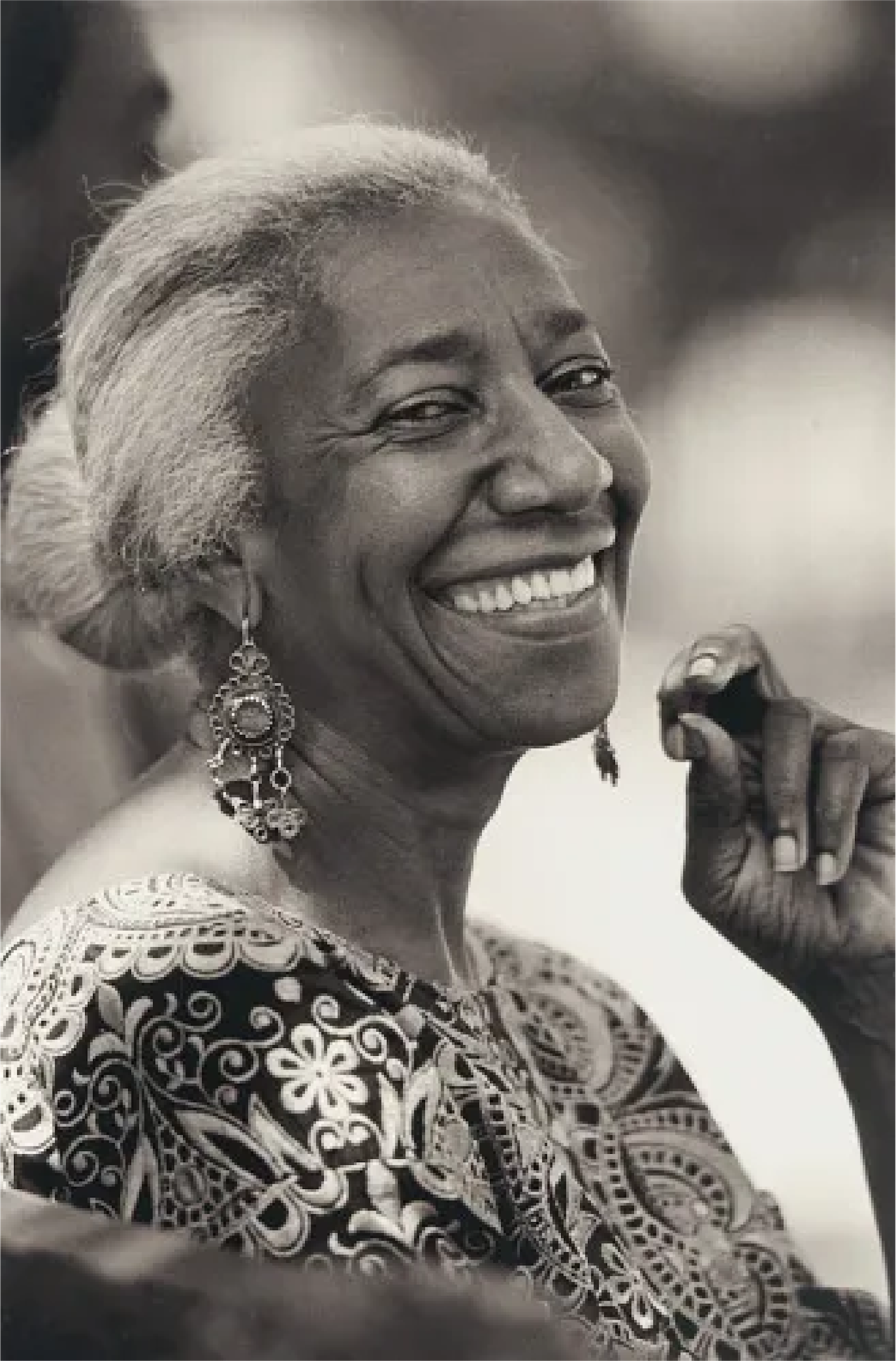
There are cooks whose influence can be tasted instantly—an iconic dish replicated a thousand times, a sauce that becomes shorthand for a city, a restaurant that turns into pilgrimage. And then there are cooks whose influence is subtler and, in some ways, more total: they change the terms by which a culture understands food. Edna Lewis belonged to that rarer category. Her achievement was not simply that she could cook—though she could, by every account, cook with a clarity that made people feel as if they had been eating in grayscale until they met her. Her achievement was that she insisted American food, when taken seriously, had to take Black Southern life seriously: its agriculture and seasons, its ceremonies and labor, its intelligence and refinement, its losses and improvisations, its unbroken thread of technique passed through kitchens that were rarely credited as sites of knowledge.
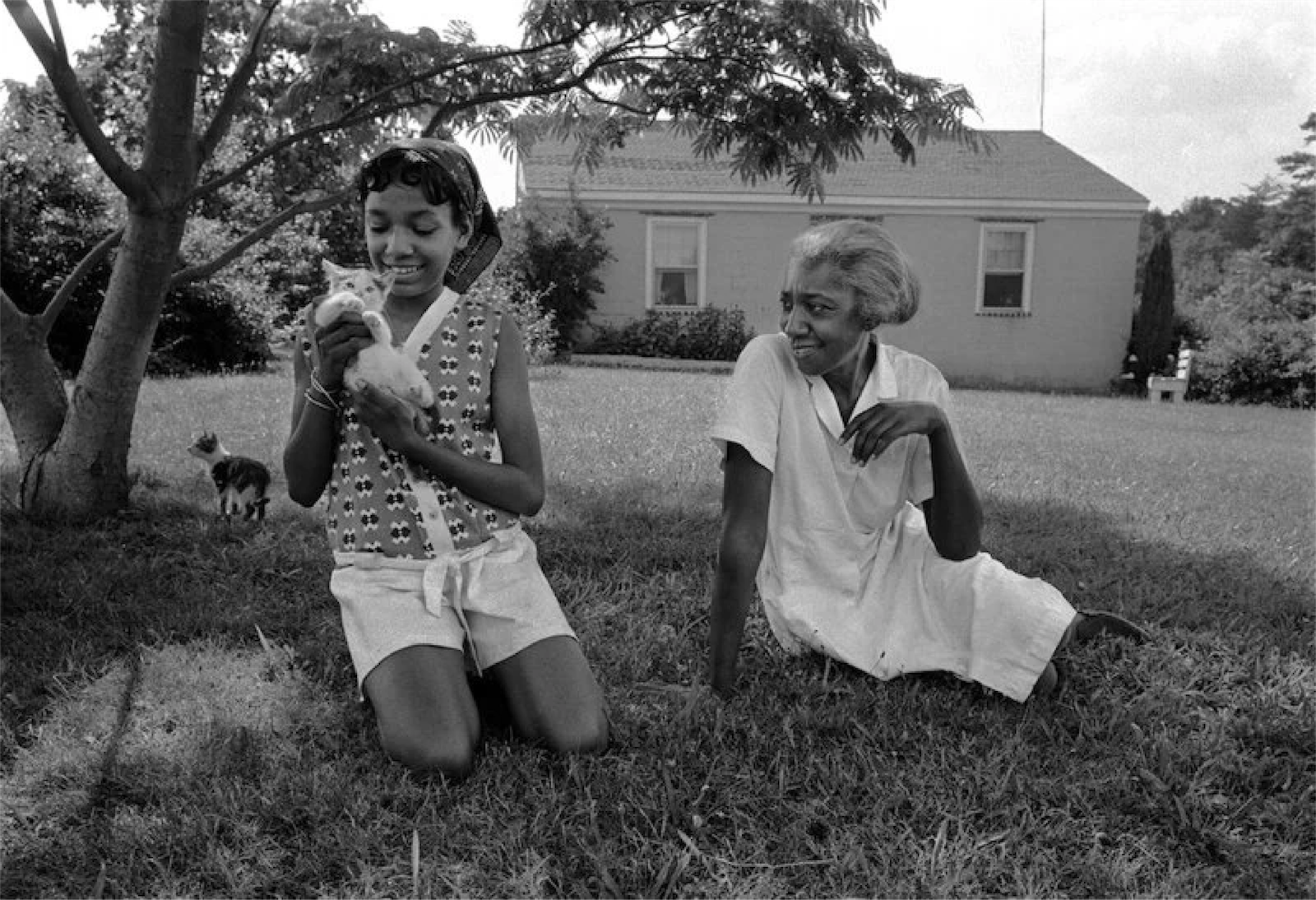
Lewis’s life—spanning nearly nine decades—unfolded as a series of migrations, reinventions, and late recognitions. She was born in 1916 in Freetown, Virginia, an African American community founded by formerly enslaved people and their descendants, and raised in a household where growing, preserving, and cooking were not lifestyle aesthetics but the operating system of survival and pleasure. She left that world as a teenager, moved north during the Great Migration’s long aftermath, and found her way, improbably, into the center of mid-century cultural New York—cooking for artists and celebrities at Café Nicholson, a restaurant whose glamour rarely included public credit for the Black woman at its stove. Decades later, she would publish The Taste of Country Cooking—a book that read like a seasonal memoir disguised as a cookbook—arriving as an elder with the authority of lived experience, and with prose so exact that it made “country cooking” sound like a form of literature.
Her story also exposes an uncomfortable American pattern: the nation’s appetite for Black food traditions paired with its resistance to Black authorship. Lewis’s cooking was routinely praised as foundational and transformative, yet her name was, for long stretches, less famous than the movements she helped prefigure. The recent uptick in public attention—revived best-seller lists, renewed criticism, commemorations, documentaries—can feel like a corrective and an indictment at once.
To write about Edna Lewis is, inevitably, to write about more than a chef. It is to write about who gets to define “American cuisine,” who is granted the dignity of complexity, and what it costs—personally, financially, psychologically—to spend a lifetime insisting on standards in a culture that often prefers its food stories simple and its Black geniuses either anonymous or mythologized.
Freetown: A cuisine built from land, time, and communal memory
Lewis’s first education was ecological. In Freetown, her family’s relationship to food followed the strict but generous logic of seasonality: the garden, the orchard, the smokehouse; the rhythms of canning and curing; the ingenuity required when “what came out of the ground was what you had to work with.” In the Southern Foodways Alliance narrative written by Kim Severson, Lewis appears as “a last direct link” to a way of eating formed just one generation beyond slavery—where preservation methods were not hobbies but infrastructure, and where flavor was inseparable from ripeness.
What made Lewis’s later writing so arresting is that she did not treat this childhood as quaint. She treated it as authoritative. Her voice, even when describing something as modest as lettuce, carried the conviction of someone who had learned taste under conditions that left no room for waste or pretense. In Severson’s account, Lewis explains a kind of tenderness toward ingredients—lettuces that must be harvested before they “bolt,” foods stored in springhouses, the careful calibration of seasoning because the ingredient itself is meant to speak. This is not nostalgia as escapism; it is nostalgia as documentation. It is a record of a Black rural life that mainstream food media long ignored except as stereotype.

Lewis would later become famous for making the case—quietly but insistently—that Southern cooking could not be reduced to fried shorthand. She rejected the flattening of the South into a single register of heaviness and grease. In Severson’s retelling, she “hated the term soul food,” seeing many urbanized, commodified versions as a distortion of what she knew Southern food to be: seasonal, vegetable-forward, technically careful, and built on pure ingredients rather than spectacle. Her critique was not aimed at poor people or city kitchens; it was aimed at the way American culture uses certain labels to signal that a cuisine is unserious—something to crave, not something to respect.
Even her sense of celebration was agricultural. Food was entertainment, ceremony, social glue. The family cooked for revivals and holidays; almost every meal was meant to be shared. That communal orientation—food as a way to belong to each other—would become the emotional throughline of her books. In her writing, gatherings are not backdrops; they are the point. A table is a place where history is rehearsed, where kinship is refreshed, where the past can be tasted without becoming sentimental.
Leaving the South: The Great Migration’s private costs
Lewis’s life took a decisive turn after her father’s death and the narrowing of prospects in rural Virginia. As a teenager, she left for Washington, D.C., and later New York—part of the broader Black migration northward that reshaped American cities and American culture. What often gets lost in simplified biographies is the emotional complexity of this move: leaving a world where you know the names of seasons by what’s on the stove, entering a world where food is purchased, time is monetized, and survival depends on navigating white institutions that do not imagine you as an author of taste.
In the North, Lewis worked as a seamstress—an experience that matters because it shaped her aesthetic intelligence. She understood craft, patience, detail, and finish. Sewing teaches you that a garment’s beauty is built from invisible decisions. Cooking, for Lewis, would operate similarly: flavor as a set of choices that should look effortless only because the labor is disciplined.
This period also complicates any attempt to frame her solely as a culinary figure. Accounts of her life note a political consciousness—an attention to power and dignity—that would later surface in how she wrote about Black food traditions as something more than “home cooking.” In Severson’s narrative, Lewis is described as proud of having worked for Franklin D. Roosevelt’s first presidential race and as having marched with Dr. Martin Luther King Jr. during the Poor People’s Campaign in 1968. Whether every detail of her political résumé is remembered consistently across sources, the larger truth is stable: she moved through the world as someone attentive to citizenship, rights, and representation—and she understood that food, too, is a representation.
Café Nicholson: A Black woman cooking at the center of white glamour
In 1949, Lewis became head chef at Café Nicholson in Manhattan, a French-inflected restaurant known for its clientele of artists, writers, and celebrities. In the Washington Post’s reporting on her legacy trail, this moment is framed as pivotal: a Virginia-born Black woman, trained in an agrarian community, translating her intelligence into a New York dining room that prized sophistication.
The guest list—Faulkner, Capote, Dietrich, Roosevelt—reads like a mid-century index of cultural power. It is tempting to treat this as a Cinderella narrative: genius discovered, doors opening, the cook finally seen. But Lewis’s story is more stringent than that. In kitchens, especially then, talent did not automatically translate into security or authorship. A Black woman could be indispensable and still be treated as background.
What makes Lewis remarkable is that she appears not to have performed gratitude. She performed standards. Accounts suggest that at Café Nicholson she served deceptively simple food, executed with exactness: the kind of cooking that forces diners to realize how little they understand about “simple” until it is done correctly. It was Southern-influenced without being reduced to Southern cliché. It fit the room without surrendering to it.
There is also, embedded in this period, a meditation on visibility. Café Nicholson’s celebrity was built on atmosphere and clientele, not on celebrating the Black woman whose taste made the place sing. Lewis’s later books would, in a sense, correct that imbalance by putting her voice on the page—making it impossible to separate the food from its author.
Reinvention and precariousness: The long middle of a working life
Lewis’s career did not follow the clean arc that biographies prefer. After Café Nicholson, she moved through different phases—some glamorous, some humbling. There are stories of her trying ventures that did not last, including a period farming pheasants in New Jersey that ended disastrously when the flock died. These episodes matter because they reveal how precarious a life in food can be, especially for a Black woman without inherited wealth, institutional backing, or the modern apparatus of branding.
This is one of Lewis’s central challenges: she became a legend in an industry that did not reliably protect its legends. Her authority was cultural before it was financial. The reverence many chefs felt for her did not always translate into the kind of stability that would have allowed her to choose rest. Even late in life, she worked. The Washington Post and other accounts describe her taking on major cooking roles in her seventies, including at Brooklyn’s Gage & Tollner.
This is not simply a story of work ethic; it is a story of how the American culinary world has often treated its elders—particularly Black elders—as reservoirs to draw from rather than people to support. Lewis’s late-career visibility sometimes functioned like a spotlight that arrived after the infrastructure was gone.
The book that changed the story: The Taste of Country Cooking and the literature of seasonality
If Lewis had done nothing beyond The Taste of Country Cooking, her place in American food history would still be secure. First published in 1976, the book has been recognized as a cornerstone text—both for its recipes and for its insistence that Southern food could be narrated with lyric intelligence and historical consciousness.
It is difficult now to remember how radical this was. American food publishing had long treated Southern cooking as either quaint regionalism or as a set of commodified “down-home” gestures. Lewis’s book refused both frames. It organized cooking by the year’s cycle—spring, summer, autumn, winter—making seasonality not an aesthetic choice but a moral and sensory argument: food tastes best when it is ready, when it comes from the world as it is rather than from the world as we have forced it to be.
What’s more, Lewis did not separate recipes from life. The Taste of Country Cooking is, in part, a memoir of Freetown, filled with reminiscences of communal events and food rituals—offering insight into Black Southern life that many mainstream accounts had ignored or flattened. It presented a Black woman not as an anonymous “cook” but as an author, a witness, and a curator of culture. The National Women’s History Museum notes that Lewis was among the first African American Southern women to publish a cookbook without disguising her name, gender, or race—an observation that underscores how often Black culinary expertise had been forced into anonymity or ventriloquized through white intermediaries.
The book’s staying power is measurable in the way it continues to be revived, reissued, and cited as foundational. A 50th anniversary edition is scheduled for release in 2026, with a foreword by food journalist Toni Tipton-Martin—an acknowledgment of the book’s ongoing influence and a reminder that Lewis’s work still requires active stewardship.
Lewis’s prose, too, was part of her accomplishment. Many cookbooks provide instructions; fewer provide a worldview. Lewis offered a theory of taste rooted in memory and agriculture: the “pure ingredients,” the open-pollinated seeds replanted for generations, the care that makes flavor possible. In her writing, the South is not a monolith; it is a sensory ecology. And the Black South, specifically, is not a costume for American nostalgia; it is a world of labor, skill, and beauty.
Correcting the stereotype: Refinement, Black technique, and the politics of “soul food”
One of Lewis’s most complicated legacies is her relationship to what America calls “soul food.” In popular culture, the label can function as a celebration of Black cooking; it can also function as a box—an expectation that Black food is heavy, fried, sugary, and unsophisticated, to be consumed with appetite but not studied with respect.
Lewis resisted that box. In Severson’s account, she saw many restaurant versions of “soul food” as a “bastardization” of Southern cooking—watery greens, greasy chicken, dull sides—and insisted that this was not what she meant by Southern food at all. Her objection was not to Blackness; it was to distortion. She understood that stereotypes are not neutral—they shape what a cuisine is allowed to be, and who gets to be seen as a technician rather than a performer.
Toni Tipton-Martin, one of Lewis’s most perceptive interpreters, frames Lewis’s impact as a challenge to the “mammy” mythology and the narrowing of Black cuisine into caricature. In Tipton-Martin’s tribute, Lewis’s work becomes evidence that African American culinary traditions are “diverse, technical, and sophisticated,” not merely born of deprivation but rich with artistry and historical depth.
This matters because Lewis’s writing arrived in a food culture that often assigned refinement to European traditions and assigned “homey” authenticity to Southern traditions—while simultaneously stripping Black cooks of intellectual credit. Lewis destabilized that hierarchy. She made it possible to talk about Southern food as a cuisine of technique and ceremony, with Black people as its authors, not its props.
Restaurants and late-career influence: Gage & Tollner, mentorship, and the labor of being an icon
Lewis’s professional life included key restaurant chapters beyond Café Nicholson, including work at Gage & Tollner in Brooklyn. Here, her career intersects with a larger American story: the way “classic” restaurant culture is preserved, revived, and narrated, often without full acknowledgment of the labor that sustained it. Even in celebratory accounts, the cook can become atmosphere.
What made Lewis different is that she was also a teacher—sometimes formally, often informally—whose standards shaped younger cooks. She modeled a kind of rigor that was not about ego but about fidelity: fidelity to ingredients, to seasons, to the truth of a dish. That fidelity became a template for later movements that would be branded with new names—farm-to-table, seasonal cooking, localism—without always crediting the Black cooks who had lived those principles out of necessity and tradition long before they became fashionable.
The irony is sharp: the culinary world began celebrating seasonality and “authenticity” in the very decades when industrial food systems were accelerating, when Black rural communities were being economically squeezed, and when the people who held the knowledge were aging. Lewis’s books can be read as an act of preservation against that tide—a refusal to let the sensory archive be lost.
Partnership, care, and the final years: Scott Peacock and the complicated intimacy of legacy
In her later life, Lewis lived in Atlanta/Decatur with chef Scott Peacock, a relationship that has been described as a chosen family: a gay white man from Alabama and a Black woman decades older, bound by food, care, and the shared project of honoring Southern tradition without romanticizing it. The Los Angeles Times obituary reports that Lewis died in 2006 and that Peacock—described as a longtime friend and housemate—said she died in her sleep after years of failing health and dementia. (Los Angeles Times) The Washington Post’s obituary similarly notes her death at home in Decatur, Georgia, at age 89.
Severson’s “Blood and Water” narrative offers a more intimate, ethically complex portrait of this period. Lewis, nearly ninety and frail, is described as living with dementia, largely confined to the apartment she shared with Peacock. The story is careful to show Peacock not as a “keeper of the legend” but as a gatekeeper trying to protect a vulnerable elder from being treated like a museum object. That tension—between public reverence and private fragility—is one of the defining challenges of late-life fame. The world wants access; the person needs care.
Lewis’s last major collaboration with Peacock produced The Gift of Southern Cooking (published in 2003), a book that can be read as both cookbook and testament—two cooks from different generations and backgrounds arguing, together, for the dignity of Southern flavor.
This period also reveals something essential about Lewis’s influence: it did not operate only through recipes. It operated through permission. Peacock describes encountering her as a revelation—an elder who showed him he did not have to run from his past, that Southern food was not “poor food,” and that embracing regional tradition could be an act of pride rather than embarrassment. Lewis offered, to younger cooks, a way to be serious about Southern food without apologizing for it.
Recognition—late, uneven, and still contested
Lewis’s posthumous reputation has grown, but not without irony. In the years after her death, public interest surged in visible spikes, often triggered by cultural moments that exposed how unknown she remained to younger professionals. The Washington Post reported, for example, that after a “Top Chef” tribute, The Taste of Country Cooking shot up bestseller charts—an emblem of how a foundational figure can still require rediscovery in her own field.
There have also been institutional recognitions: the Washington Post notes her inclusion in a U.S. Postal Service celebrity chef stamp series and a New York Times Magazine cover moment that signaled renewed mainstream attention. But recognitions like these raise a harder question: why did it take so long? What does it mean that the country can elevate a person as an icon while failing, during that person’s life, to build the structures that ensure comfort, health care, and financial security?
Lewis’s fame, in other words, exposes a systemic problem in American food culture: the unequal distribution of credit. Black cooks and Black culinary intellectuals have often been treated as sources rather than authors, as labor rather than literature. Lewis’s insistence on refined Southern cuisine—on the idea that Southern cooking is not a culinary underclass but a central American tradition—pushes against that habit.
Her legacy has also expanded through contemporary storytelling. A PBS documentary, Finding Edna Lewis, premiered in 2025, promising archival material and a renewed exploration of her influence, including the work of an Edna Lewis Foundation supporting Black professionals in culinary and agricultural fields. The documentary’s existence is itself a form of acknowledgment: Lewis’s story is not merely a food story; it is an American story that touches agriculture, race, gender, migration, labor, and memory.
What she left behind: A method, a moral stance, and a vocabulary for dignity
To reduce Edna Lewis to “the Julia Child of the South” is both flattering and insufficient. (The comparison appears frequently in popular accounts, including major newspaper coverage.) It flatters because it places her in the lineage of culinary educators who reshaped American cooking. It is insufficient because it risks implying that Lewis’s value is legible only through proximity to a white counterpart. Lewis did not need a mirror; she was a source.
Her real achievement is that she gave Americans a new vocabulary for Southern food—one built from seasons, technique, restraint, and reverence. She made it possible to say, with seriousness, that a dish of peas or a plate of ham and biscuits could carry the same cultural and aesthetic weight as any imported tradition. In Severson’s depiction, Lewis’s writing and cooking erase cartoon versions of the South, replacing them with a cuisine that is bright with herbs, careful with vinegar, attentive to texture, and, above all, guided by memory of what ingredients should taste like.
She also left behind a moral stance: that food is never just food. Food is land and labor. Food is who gets named and who gets erased. Food is a record of migration and survival. Food is a site where stereotypes are manufactured—and where they can be dismantled. Lewis dismantled them by refusing to perform. She dismantled them by writing a book that treated Black Southern life as a subject worthy of lyric attention. And she dismantled them by cooking with such exactness that anyone paying attention had to admit what they were tasting: not novelty, not nostalgia, but mastery.
Lewis died in 2006 in Decatur, Georgia, at 89. But her work has continued to behave like living culture—returning in new editions, revived in restaurant kitchens, rediscovered by new generations, and now reframed through documentary and scholarship. The belatedness of some of that recognition does not diminish it; it indicts the systems that delayed it.
If you want the cleanest statement of her philosophy, you could do worse than her own insistence—quoted in the Southern Foodways Alliance materials—that the foundation of Southern food was “pure ingredients,” seeds replanted for generations, and work done “with love and care.” In an era that confuses abundance with quality and branding with truth, Edna Lewis’s work offers something sterner and more sustaining: a standard. Not simply for how to cook, but for how to remember—accurately, beautifully, and with credit given where it has always been due.