


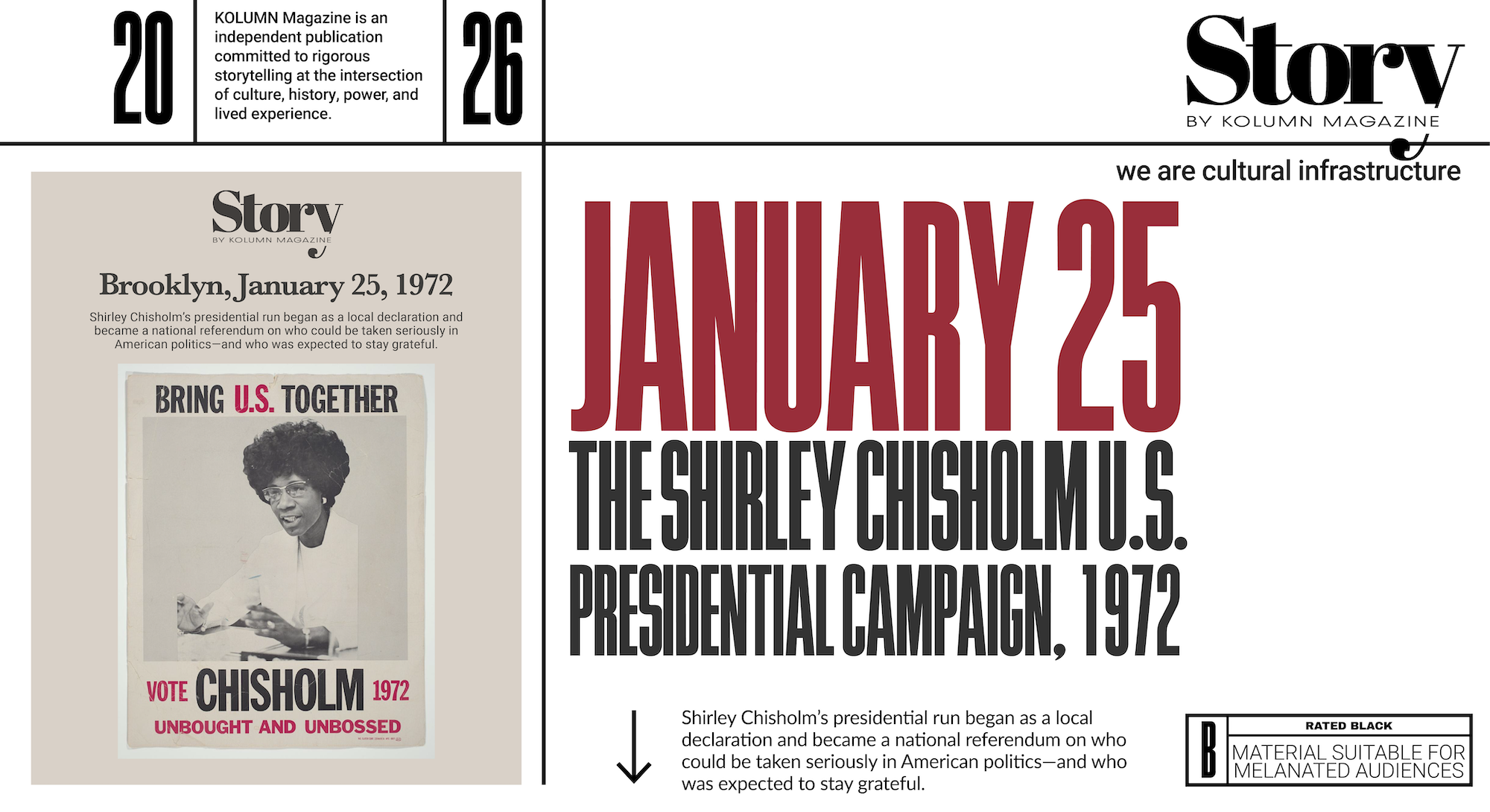
To tell the story of Shirley Chisholm’s presidential campaign is to tell a story about American democracy’s choke points: who gets heard, who gets funded, who gets televised, and who is treated as “electable” before a single vote is cast.
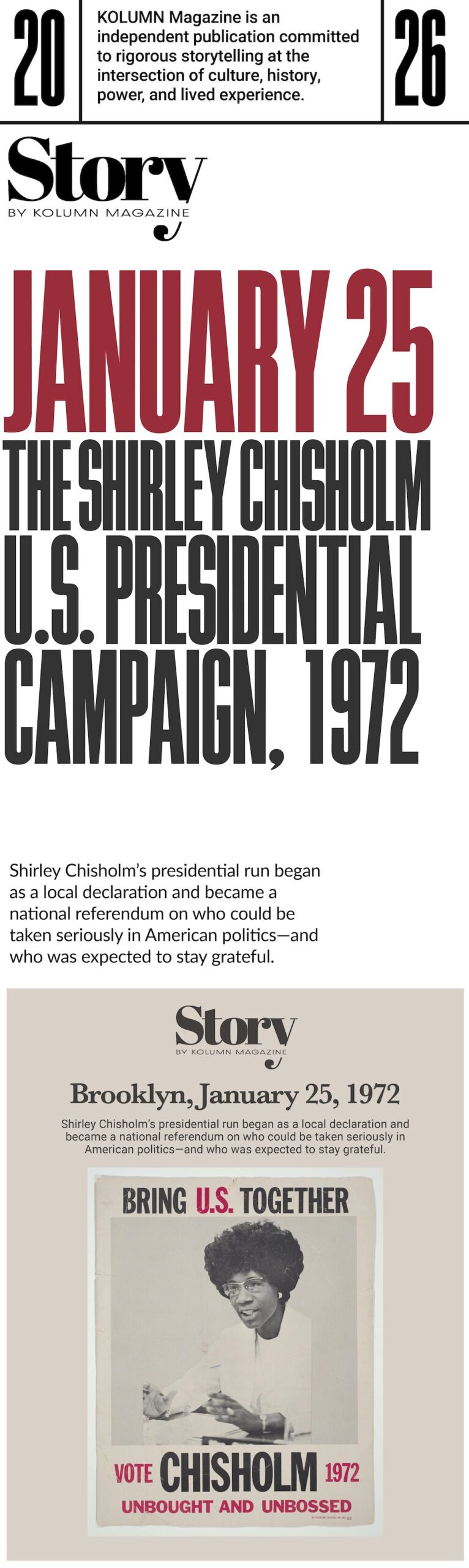
To tell the story of Shirley Chisholm’s presidential campaign is to tell a story about American democracy’s choke points: who gets heard, who gets funded, who gets televised, and who is treated as “electable” before a single vote is cast.
By KOLUMN Magazine
On a cold day in late January 1972, a congresswoman from Brooklyn walked into a Baptist church in her district and did something American politics had never quite seen in the modern era: she announced herself as a candidate for president, not as a symbolic protest and not as a novelty act, but as a serious challenge to the nation’s most fortified assumptions about who could lead. The setting mattered. Shirley Chisholm did not choose a hotel ballroom crowded with donors or a manicured campus stage thick with party officials. She chose Concord Baptist Church of Christ in Brooklyn—her turf, her people, her moral architecture—and she spoke with the calm directness of someone who understood that institutions rarely yield power voluntarily.
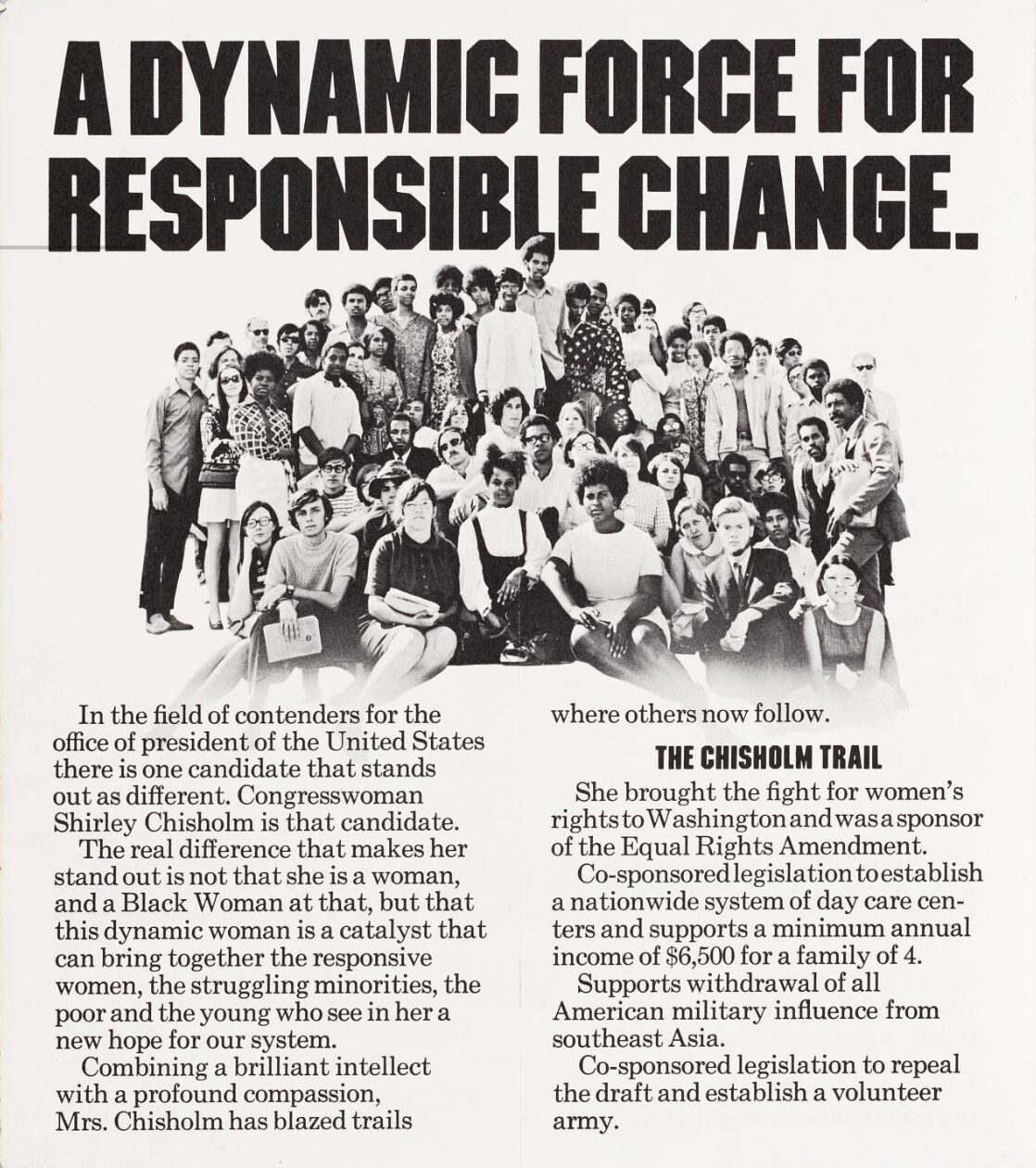
The line that echoed—then and now—was not the fact of her firsts (though those were real and historic), but the insistence of her framing. Chisholm refused to be boxed into a single constituency. She would not be reduced to a “Black candidate” or a “woman candidate” as though those labels were containment. “I am not the candidate of Black America, although I am Black and proud,” she said in her announcement address, and just as firmly: “I am not the candidate of the women’s movement of this country, although I am a woman and equally proud of that.” The point was not to disclaim identity; it was to deny the political maneuver that tried to isolate her from the electorate by insisting she belonged to only one slice of it.
Chisholm’s campaign, over the months that followed, would unfold as a timeline of milestones—some triumphant, many bruising, all illuminating. It would be a campaign shaped not only by the usual calculus of primaries and delegates, but by the underdocumented mechanics of exclusion: ballot access fights, uneven media exposure, donor skepticism, and the genteel cruelty of party gatekeeping. It would also be a campaign that revealed the push-and-pull within movements that, in hindsight, are often misremembered as unified. Feminist leaders and organizations rallied to her in visible ways, but not without tension; Black political institutions recognized her importance, but often hedged, delayed, or withheld full-throated endorsement, wary of risking leverage in a nominating contest dominated by men with deeper networks. Chisholm, in the middle, refused to bargain away her independence. Her creed—“Unbought and Unbossed”—was not branding; it was operating policy.
To tell the story of Shirley Chisholm’s presidential campaign is to tell a story about American democracy’s choke points: who gets heard, who gets funded, who gets televised, and who is treated as “electable” before a single vote is cast. It is also to tell a story about what campaigns can be, even when they do not end in victory—how they function as organizing engines, as argument-makers, as training grounds, and as warning flares. The historian’s temptation is to label Chisholm’s run a symbolic milestone, then move on. The journalist’s obligation is to stay with the chronology long enough to see how that milestone was built—day by day, state by state, rule by rule.
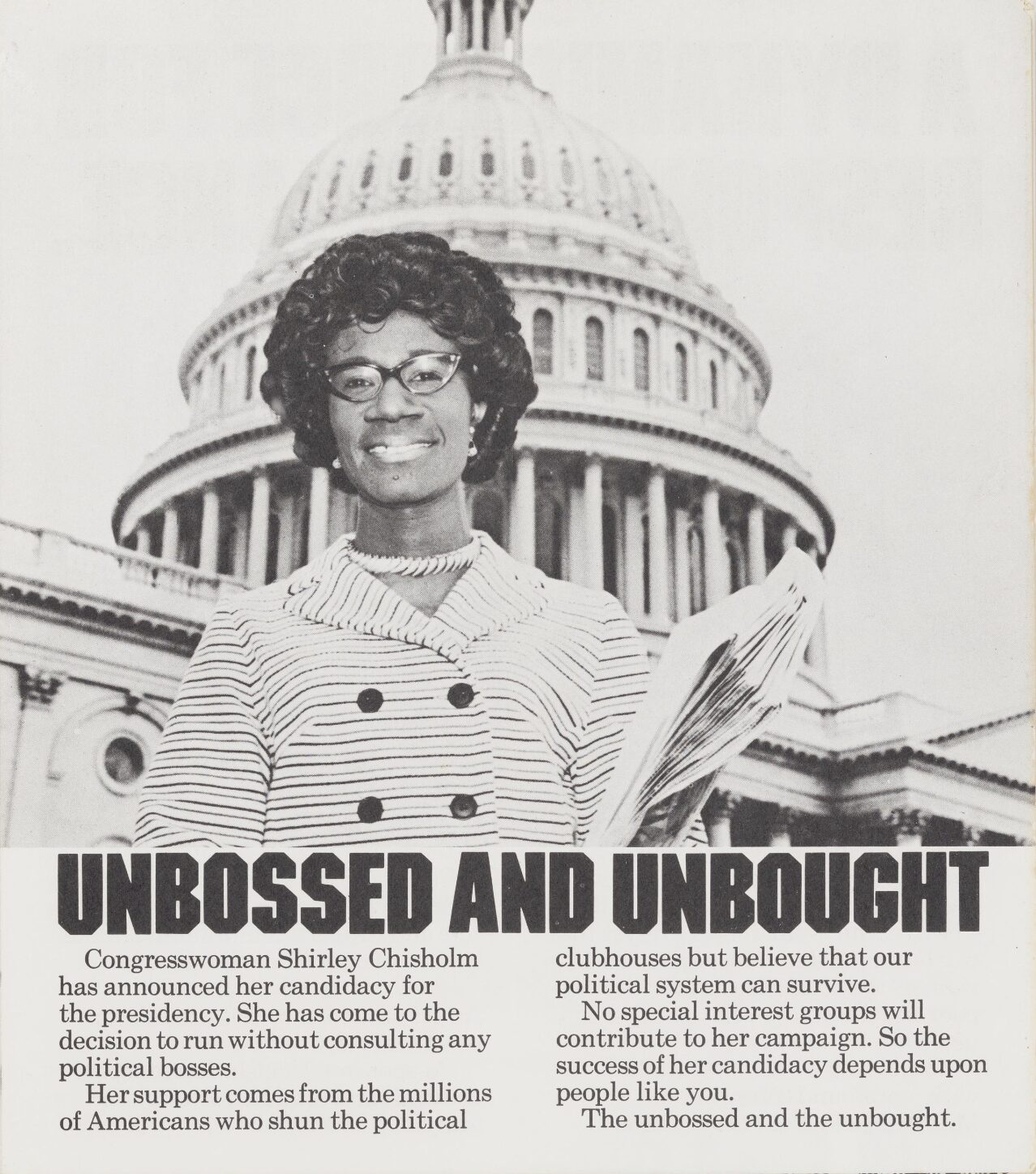
Before the announcement: The summer when she began to explore the impossible
Chisholm did not wake up on January 25 and decide to run. She began exploring the idea months earlier, in 1971, in a Democratic Party that was already convulsing with post-1968 reforms and the moral burden of Vietnam. Party rules were changing; the primaries were becoming more consequential; the convention was becoming a battlefield for insurgent candidates and movement delegates. The timing mattered because it created an opening—and because it revealed how quickly openings can be fenced off again. Chisholm’s exploration period, beginning in the summer of 1971, placed her inside that national upheaval while also marking her as an outlier among outliers: a Black woman in a field of men, a House member competing with governors and senators, an anti-establishment figure attempting to use the party’s own reforms to press her case.
The story is sometimes told as pure audacity, but it was also strategy. Chisholm had already learned in Congress that the formal rules of inclusion could coexist with informal punishment. Early in her House tenure, she had been assigned to the Agriculture Committee—an assignment she publicly criticized as irrelevant to her district’s needs. She understood that institutions control not only outcomes but visibility and credibility. A presidential campaign, for her, offered a way to force visibility—to take the questions of poverty, education, labor rights, and the lived realities of Black and working-class communities and drag them into the presidential conversation.
In July 1971, she was also present at the organizing life of a feminist political movement that was trying to translate activism into electoral power. The National Women’s Political Caucus was taking shape, with figures such as Bella Abzug and Patsy Mink among those in the room, alongside movement leaders like Betty Friedan and Gloria Steinem. This mattered not because the caucus was “the” engine of Chisholm’s campaign, but because it highlights the coalition logic she was building: women in politics, Black political power, labor concerns, antiwar urgency, and the politics of representation as policy—not as symbolism.
Chisholm’s ambition, then, was neither naïve nor purely personal. It was an attempt to convert her legislative worldview into a national platform and to test whether the party’s new era of “participatory” reforms would actually accommodate someone like her. If the answer was no, the campaign itself would become evidence.

January 25, 1972: A Brooklyn church and a national dare
The date is fixed in the record: January 25, 1972. The location is too: Concord Baptist Church of Christ, Brooklyn. In the Library of Congress’s “Today in History” entry, the moment is treated with the institutional clarity it deserves—an announcement that helped redraw what was thinkable. Chisholm stood in a space that was both spiritual and political and declared her candidacy for president of the United States.
She called for what she framed as a “bloodless revolution” at the Democratic convention—language that captured both her militancy and her belief in democratic procedure. Revolution, in her mouth, meant rules and representation, not spectacle. It meant delegates, not drama. It meant the long, grinding work of expanding who gets to be in the room when decisions are made.
The immediate reaction from political commentators, donors, and rivals ranged from patronizing to dismissive. Later retrospectives would document how sexism and racism were not side plots but the operating environment—how she was treated as unserious by default, how pundits framed her as “symbolic,” and how even within progressive circles she faced the quiet question: Why her? Why now? TIME’s later look back captures the era’s blunt misogyny in the kinds of commentary that surrounded women candidates, including claims that women were biologically unfit for leadership. Chisholm’s response, consistent across the campaign, was not to beg for a different standard; it was to treat the standard itself as a political problem worth confronting.
From the start, her campaign posed two parallel challenges. One was to win delegates. The other was to expose the mechanisms that decided—before voters weighed in—who was “viable.” That second objective, critics would argue, was a consolation prize. Chisholm treated it as the point.
The early months: Money, machinery, and the politics of being kept small
Modern presidential campaigns run on money and infrastructure: staff, field operations, data, travel budgets, advertising, legal teams. Chisholm’s campaign, by many accounts, was underfinanced and constantly scrambling. The National Archives’ writing on Chisholm’s presidential run emphasizes how inadequate funding and organizational strain constrained what her campaign could do, even as it remained historically consequential.
This is where the “unbought” part of her identity functioned as both strength and burden. It drew supporters who were tired of machine politics and transactional endorsements. But it also meant she did not have the built-in donor networks that fueled rivals like George McGovern, Hubert Humphrey, Edmund Muskie, and Henry “Scoop” Jackson. The gatekeepers who controlled access to major funding streams were often the same actors who treated her candidacy as improbable—creating a feedback loop where “lack of money” was cited as proof she could not win, and “she cannot win” was used to justify withholding money.
Chisholm’s campaign also faced an obstacle that appears bureaucratic until you see its consequences: ballot access. She had difficulty getting on primary ballots in many states. In practical terms, that meant fewer opportunities to compete for votes and delegates, fewer moments of earned media, fewer chances to translate enthusiasm into counted results. The story of her campaign cannot be told honestly without naming ballot access as a form of structural power—one that tends to protect established candidates and punish insurgents.
She campaigned anyway, and she did it with a constituency logic that was broader than her critics recognized. She drew students, women, minority voters, and people who saw in her campaign a rare refusal to flatter the establishment. The Smithsonian’s framing of her campaign highlights how she was not merely chasing “first” status; she was pushing issues and expanding political imagination—an effort that was legible even to those who assumed she would not win.
March 1972: Florida, the first major test, and the limits of time
Chisholm’s timeline enters its first major electoral milestone in March, with the Florida primary on March 14, 1972. She believed Florida might be receptive—because of Black voters, youth, and a strong women’s movement presence—but her campaign’s organizational challenges and her responsibilities as a sitting member of Congress limited her time on the ground. She made only a couple of campaign trips and finished far back in the pack.
In most campaign narratives, early losses are either brushed off as “momentum killers” or reframed as “learning experiences.” For Chisholm, Florida functioned as a case study in what it costs to run without a machine. When your opponent has staff saturating counties, your “message” is not enough; you need volunteers trained to turn out voters, lawyers to handle ballot questions, and enough money to stay visible when the press moves on.
Florida also illustrated another problem: how the political class interpreted Chisholm’s candidacy through a lens of inevitability. If she performed modestly, that was treated as proof she did not belong. If she performed well, it could be treated as a fluke, a protest vote, an anomaly. The standard was not neutral; it was designed to be undefeated.
Spring 1972: Building coalition in public, confronting skepticism in private
By spring, Chisholm’s campaign had become both more national and more contested. She was building coalitions across movements that did not always trust each other. Feminist leaders publicly advocated for her—sources from academic scholarship and archival writing note how prominent feminist figures and allies were vocal on her behalf, even as the women’s movement itself contained divisions and hesitations.
At the same time, she faced an uneven relationship with Black political institutions, including the newly formed Congressional Black Caucus environment. The National Women’s History Museum notes that she encountered contentiousness from the predominantly male CBC in that period, underscoring a reality often softened in retrospective tribute: representation is not a single-axis story. Chisholm’s campaign forced difficult questions inside Black politics about strategy, risk, and who gets to lead—and it forced difficult questions inside women’s politics about race, priorities, and whether support would be symbolic or structural.
Support from members of Congress existed, but it arrived through identifiable channels rather than as a unified bloc. Academic work on Chisholm’s relationship to the Democratic Party references supportive House colleagues such as Ron Dellums and Parren Mitchell, and it also captures the broader ecosystem of elected officials and activists who signaled readiness to mobilize if she ran.
That kind of support mattered less for press releases than for legitimacy. Every congressional ally functioned as a rebuttal to the insinuation that Chisholm was purely symbolic. A supportive speech, an appearance, a willingness to be seen with her—these were political acts in a party culture that frequently treated association with an insurgent candidate as reputational risk.
There is a surviving trace of Dellums’s support in archival collections: recorded talks and speeches explicitly tied to Chisholm’s campaign. Even absent a single “endorsement moment” that the modern press would recognize, the existence of campaign speeches by a fellow member of Congress illustrates that Chisholm was building a real network of elected allies, not merely a crowd of admirers.
May 1972: Violence, security, and the campaign trail’s constant threat
In May, the campaign landscape turned darker. Death threats against Chisholm were real enough that she received Secret Service protection that month, according to multiple accounts summarized in biographical writing. In the early 1970s—a period defined by political violence, assassinations still fresh in national memory, and a tense climate around civil rights and antiwar politics—threats against a Black woman running for president were not abstract. They were a foreseeable extension of the backlash she represented.
That month also brought a pivotal event involving one of her rivals: Alabama Governor George Wallace was shot while campaigning in Maryland. The incident shook the primary season, altered Wallace’s campaign, and forced every candidate to respond in a way that revealed their moral instincts as well as their political calculations.
For Chisholm, the aftermath of Wallace’s shooting would produce one of the most debated milestones in her campaign.
June 8, 1972: The hospital visit to George Wallace—and what it was really about
On June 8, 1972, Shirley Chisholm visited George Wallace in the hospital. The act stunned supporters and confounded easy ideological narratives: the progressive Black congresswoman, running under a banner of inclusion and justice, sitting with a segregationist whose career had been built on the defiance of civil rights. HISTORY’s “This Day in History” recounting places the visit in stark relief, treating it as a remarkable and unexpected moment that became part of Chisholm’s legend.
Chisholm’s reasoning, then and in later reflection, was grounded less in reconciliation theater than in principle. She did not believe political opponents should be subjected to assassination attempts, and she did not believe empathy should be rationed according to ideology. In later accounts, including political commentary and retrospective reporting, her stance is framed as both moral and strategic: she understood, perhaps more clearly than her critics, that legislative victories often require strange alliances and unexpected persuasion. Some later narratives emphasize that Wallace, after the visit, spoke well of her and that the relationship had downstream legislative consequences.
The visit also illuminates a central feature of Chisholm’s campaign: she refused to be governed by what her base expected her to do if she thought it violated her own ethical compass. That refusal cost her in some quarters. But it also reinforced the “unbossed” identity—not as stubbornness, but as autonomy.
June 1972: California, New Jersey, and the evidence of votes
If the spring and early summer contained the moral drama, they also contained the campaign’s most concrete electoral data.
Chisholm’s largest raw vote total came in California on June 6, where she received a significant number of votes relative to her limited infrastructure, finishing behind better-funded rivals but proving she could compete in the country’s biggest primary arena.
The same day, June 6, brought another milestone in New Jersey—one that is often missed in simplified histories. In the state’s presidential preference primary (a non-binding contest, but symbolically meaningful), Chisholm won, making her the first woman to win a statewide presidential nominating contest for a major party in that category. The New Jersey primary’s historical record underscores the complexity of the 1972 nomination process, where delegate slates and preference votes could tell different stories—yet the preference outcome still carried reputational weight.
It is worth lingering on why this matters. Campaigns are usually remembered through winners and nominees. Chisholm’s campaign, by contrast, is best understood through the accumulation of proof. Every primary where she registered meaningful support was an argument against the claim that she was a mere symbol. Every delegate she earned was a tangible unit of power, not a compliment. Her campaign was effectively converting skepticism into arithmetic.
June also carried another milestone: she became the first woman to appear in a U.S. presidential debate in that primary season, according to compiled historical summaries. The fact is often cited alongside the broader pattern that she was blocked from participating in televised primary debates and, after legal action, was allowed limited access—illustrating how “debate inclusion” has long been a controlled gate rather than an automatic democratic good.
The National Women’s History Museum’s biography is explicit about the discrimination: Chisholm was blocked from televised primary debates and permitted only limited speech time after taking legal action. The timeline implication is sobering. Even as she ran for president, the basic infrastructure of public democratic argument—televised debates—was not equally available to her.
The campaign as a running argument about television, legitimacy, and party control
To understand why debates and television mattered so much, you have to remember the media environment of 1972. Television was not simply an amplifier; it was a validator. It told the average voter who mattered, who belonged on the stage, who was credible enough to be heard. Exclusion from debates was not merely a scheduling inconvenience. It was a mechanism for enforcing hierarchy.
Chisholm’s exclusion—and her attempt to fight it—was, in modern terms, a struggle over platform access. The complaint was not only that she was treated unfairly, but that the party and media were acting as co-governors of viability, narrowing the field through visibility rather than votes.
This dynamic remains familiar in modern politics, but in Chisholm’s case it carried a uniquely sharp edge: she was challenging a party that publicly claimed to embrace participation and inclusion, while privately operating a system that expected a Black woman to accept marginality as her role.
July 1972: Miami Beach and the delegate math that became history
The Democratic National Convention in Miami Beach, held in July 1972, was the culminating arena for Chisholm’s delegate strategy. The convention was also the stage where party factions attempted to block George McGovern’s nomination, where alliances shifted, and where symbolic gestures intersected with real delegate counts.
Chisholm entered that convention having competed in multiple primaries, having fought for ballot access, and having built a coalition that could survive without the blessing of the party establishment. When the roll call arrived, she received a total that sits permanently in the historical record: approximately 152 first-ballot votes for the presidential nomination (often cited as 151.95 in precise tallies).
Those votes did not make her the nominee, but they did something else: they made her candidacy measurable. This is an underappreciated distinction. Many campaigns by marginalized candidates are remembered as “breaking barriers” in an abstract sense. Chisholm’s campaign broke barriers in the only language parties cannot dismiss: delegate counts.
She finished behind McGovern and other top contenders, but she did not disappear. Her support included notable pockets—compiled summaries note, for example, that she drew significant convention support from places where she had not even been on the primary ballot, suggesting both coalition-building and delegate-level politics in play.
In the days after, it would have been easy to reduce her campaign to a footnote. Yet journalists, historians, and movement veterans kept returning to it, because the campaign left a trail of uncomfortable questions the party could not fully answer: Why was she blocked from debates? Why was her ballot access so fraught? Why did “electability” so often sound like a proxy for comfort?
The campaign’s internal contradictions—and the discipline it demanded
Chisholm’s campaign unfolded amid contradictions that are not flaws in the story but its substance.
One contradiction was the tension between symbolic politics and practical power. Chisholm rejected the idea that her run was merely symbolic, yet she also acknowledged that she was running against “hopeless odds” in a system that had not been built for her. That dual awareness—realism without surrender—is what gave her campaign its distinctive posture.
Another contradiction was coalition itself. Coalitions are often narrated as harmonious alliances; in reality, they are negotiations among groups with different risk tolerances and priorities. Chisholm’s support from feminist leaders and organizations existed alongside sexism within political institutions. Her historic role within Black politics existed alongside skepticism from some Black male leaders and lawmakers. Her status as a sitting member of Congress gave her credibility, but also constrained her time—she was legislating while campaigning, which is a particular kind of exhaustion.
A third contradiction was the one she embraced most openly: the contradiction between being “unbossed” and operating inside a party that was built on bosses. The Democratic nomination process, even after reforms, still relied on machinery—endorsements, slates, rules committees, media relationships. Chisholm’s campaign was, in part, an experiment in how far independence could travel inside a system designed to discipline it.
What she put on the agenda, and what the agenda did to the party
Chisholm’s campaign is often remembered as a precursor to later milestones—Black candidates who would reach the nomination, women candidates who would come close, and coalitions that would become more visible in party politics. That is true, but it risks turning her into a mere ancestor rather than a political thinker in her own right.
Her agenda centered on the lives of the people she represented and the moral failures she saw in national policy. The Smithsonian’s portrait of Chisholm emphasizes her legislative focus on anti-poverty programs and education reform, and those priorities carried into her presidential messaging: government responsibility to the poor, serious investment in education, and an ethic of representation grounded in policy rather than pageantry.
She also understood that the “agenda” of a campaign is not only what the candidate advocates, but what the campaign forces others to respond to. Even opponents who dismissed her had to speak in the presence of her critique. Even allies who withheld endorsements had to justify their caution. Even movements that struggled to unify around her had to confront their own fault lines.
That is why historians and political writers continue to return to her 1972 run not merely as a “first,” but as a turning point in how candidacies from the margins can function: as leverage, as conscience, as training, and as pressure.
Legacy in motion: Why the Chisholm timeline keeps resurfacing
In the years since 1972, Chisholm’s campaign has become a recurring reference point whenever American politics confronts questions of representation, coalition, and party gatekeeping. Word In Black’s reflection on her legacy frames her as someone who helped normalize a posture that Black women have increasingly adopted in politics: refusing to wait for an invitation, claiming a seat at the table as a matter of right.
The Root, in contemporary political coverage, invokes Chisholm as foundational—an origin story that modern readers are urged to remember as more than historical trivia.
Even Ebony, in a piece tied to contemporary attention around dramatizations of Chisholm’s life and campaign, returns to the central framing: “Unbought and Unbossed” as a political posture that remains legible because it names a permanent temptation in politics—to purchase loyalty, to boss the insurgent into silence.
And within institutional memory, the facts remain fixed: the January 25 announcement, the struggle for debate inclusion, the primaries in which she competed, and the delegate count that made her candidacy undeniable.
Chisholm’s campaign also persists because it offers a model for how to run “against hopeless odds” without turning hopelessness into an excuse. She ran to win, but she also ran to demonstrate—through the mechanics of politics—that the status quo was not neutral. In that sense, her campaign was a diagnostic tool. It tested the party’s promises against the party’s practices.
The story the timeline tells, when you read it straight through
Read Chisholm’s campaign as a straight timeline and a clearer picture emerges.
It begins with exploration in 1971, amid party reform and movement politics, and the early coalition conversations that would shape her run.
It moves to January 25, 1972, when she makes her announcement in a Brooklyn church, framing her candidacy as a representation project for “all Americans” and calling for a revolution that would be measured in delegates.
It passes through the early primaries, where limited resources and the constraints of being a sitting lawmaker collide with the realities of statewide campaigning.
It reaches the spring, when endorsements and support from elected allies exist, but not in the overwhelming wave that major-party campaigns usually depend on—forcing Chisholm to rely on grassroots energy and movement infrastructure.
It enters May and June, when the campaign becomes inseparable from questions of political violence, security, and moral decision-making—culminating in the June 8 hospital visit to Wallace, a moment that still reads as a defiant refusal to let ideology extinguish humanity.
It arrives at June’s primaries, where she proves she can attract votes in major contests, and where her New Jersey result underscores that “firsts” can also be victories—measured, recorded, undeniable.
And it ends—formally, not spiritually—at the July convention in Miami Beach, where her delegate count becomes part of the Democratic Party’s arithmetic and thus part of the nation’s political record.
The timeline, in other words, does not tell a story of a candidacy that “made history” in a single day. It tells the story of a campaign that kept forcing history to make room—through rule fights, coalition labor, the discipline of travel, the indignity of exclusion, and the stubborn insistence that democracy must mean more than access for the already powerful.
That is why Shirley Chisholm’s presidential campaign remains a living reference point. It is not only the story of what happened in 1972. It is a map of how power protects itself—and how, sometimes, a candidate without permission can still collect delegates, collect evidence, and collect a future.