


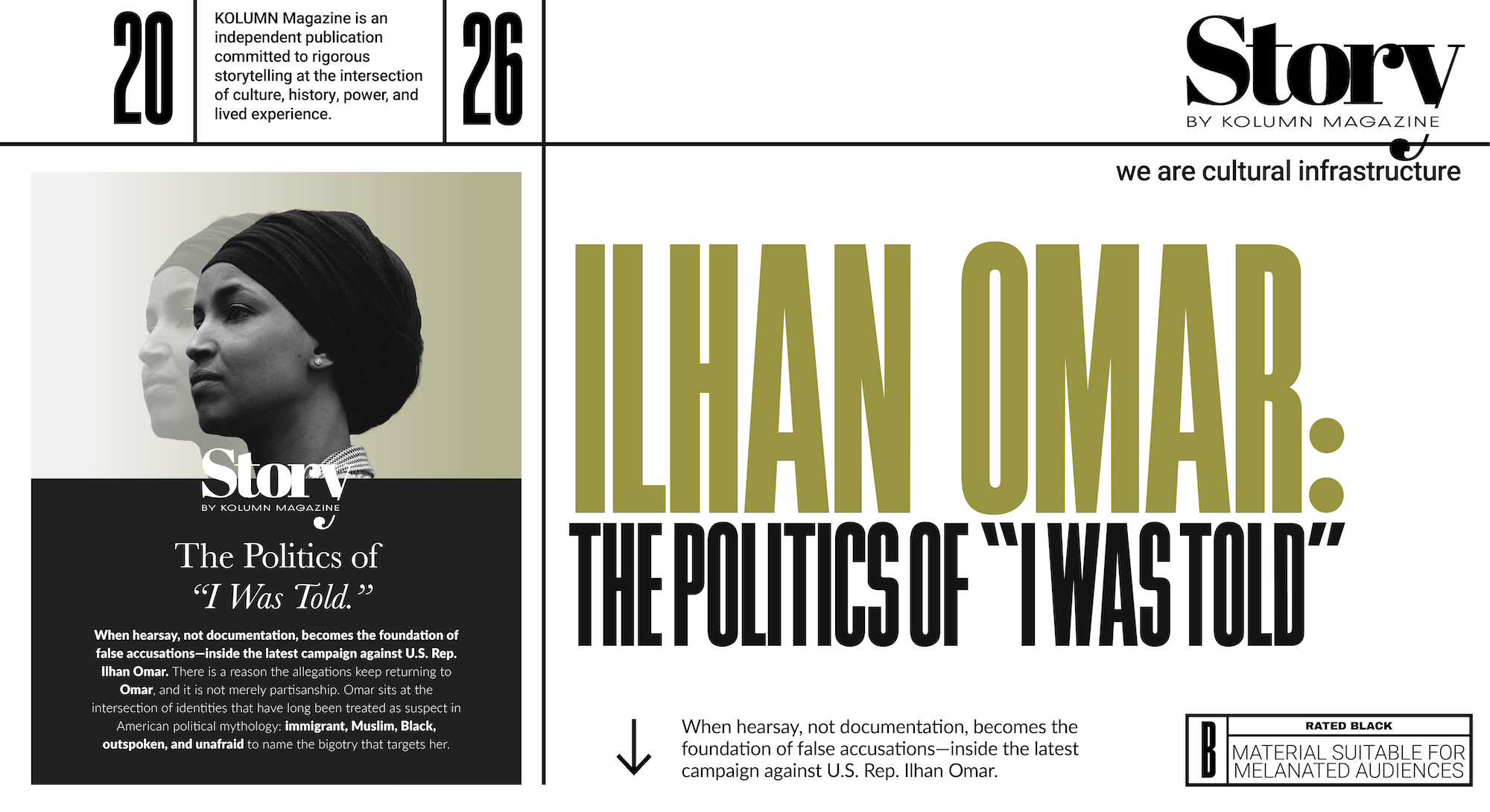
Omar sits at the intersection of identities that have long been treated as suspect in American political mythology: immigrant, Muslim, Black, outspoken, and unafraid to name the bigotry that targets her.

Omar sits at the intersection of identities that have long been treated as suspect in American political mythology: immigrant, Muslim, Black, outspoken, and unafraid to name the bigotry that targets her.
By KOLUMN Magazine
When hearsay, not documentation, becomes the foundation of false accusations—inside the latest campaign against U.S. Rep. Ilhan Omar.
In Washington, wealth is rarely just a number. It is a story people tell about power—who deserves it, who stole it, who must explain it. And in the current cycle of attacks on U.S. Rep. Ilhan Omar, that story has been shaped less by evidence than by a familiar political tactic: assert criminality first, then dare the target to disprove a claim that never met basic standards of proof.
The newest version of that tactic has attached itself to Omar’s publicly filed financial disclosures—documents designed to increase transparency, not to invite conspiracy. The allegation, repeated across right-wing media and amplified through social platforms, goes something like this: Omar is secretly rich—sometimes described as “worth $30 million”—and that wealth is presumed to be the fruit of corruption or fraud. The narrative is then braided into a separate political obsession: Minnesota’s sprawling fraud headlines, especially those involving Somali or East African defendants, become a rhetorical bridge to insinuate Omar’s complicity. It is an insinuation without a demonstrated evidentiary chain, but it is politically useful precisely because it sounds prosecutorial.
That is the throughline: an ecosystem of national Christian conservatives and allied MAGA media figures that tries to establish as fact false allegations of criminal activity, even when publicly available documents and reporting contradict the claims. The method is not subtle. It is a sequence: suggest a crime, cite an investigation that has not found one, invoke faith-and-nation language about “real Americans,” and mobilize the online crowd to do the rest.
You can hear the approach in the way powerful officials talk when they have not yet produced evidence but want the public to treat suspicion as conviction. “We’re going to get answers, whether it’s through the Ethics Committee or the Oversight Committee, one of the two,” Oversight panel Chairman Rep. James Comer, a Republican who represents Kentucky, told the media outlet.
And you can hear it in the way President Donald Trump has described Omar in remarks that combine unverifiable claims, personal insult, and the insinuation of criminality. “I was told that Ilhan Omar is worth $30 million”… “She never had a job. She’s a crooked congressman. So here you – it’s another one.”
In another statement, Trump folded Omar into a claim about Minnesota fraud and then escalated into an accusation of intimate knowledge—again, without publicly presented evidence tying Omar to criminal conduct: “There is 19 Billion Dollars in Minnesota Somalia Fraud. Fake ‘Congresswoman’ Illhan Omar, a constant complainer who hates the USA, knows everything there is to know,”
The arc is predictable: a number is floated, a villain is named, a community is stigmatized, and the insinuation does what the facts have not.
I was told that Ilhan Omar is worth $30 million”… “She never had a job. She’s a crooked congressman. So here you – it’s another one.
U.S. President, Donald Trump, addressing members of the press on January 22, 2025
What the disclosures actually say—and what they do not
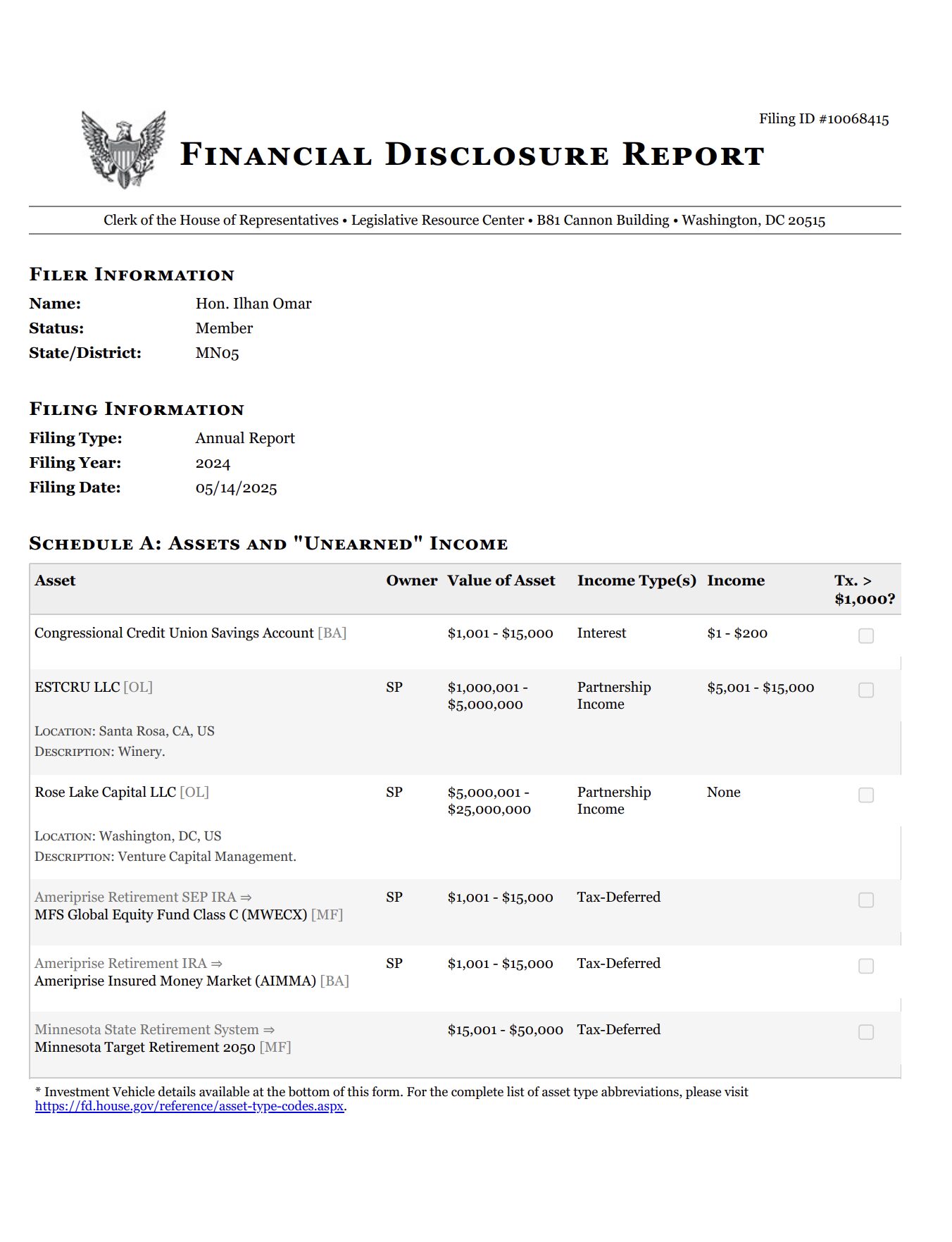
The central problem for the “Omar got rich from crime” storyline is that it depends on a sleight of hand with the very document it claims to expose. Omar’s House financial disclosure is public, standardized, and structured around value ranges. Her 2024 annual report filed May 14, 2025 lists, among other items, a spouse-held (“SP”) partnership interest in Rose Lake Capital LLC with an asset value range of $5,000,001 to $25,000,000, and a spouse-held (“SP”) partnership interest in ESTCRU LLC with an asset value range of $1,000,001 to $5,000,000.
Those line items are the basis for the internet’s favorite number. Add the top ends of the ranges and you can arrive at a household figure near $30 million. But disclosures are not appraisals; they are compliance forms designed to bracket holdings within broad categories. And critically, the disclosure does not itself prove a personal “net worth” number in the way many readers assume. It shows ownership interest types (“Partnership”), owners (here, “SP”), and a required range—nothing more granular.
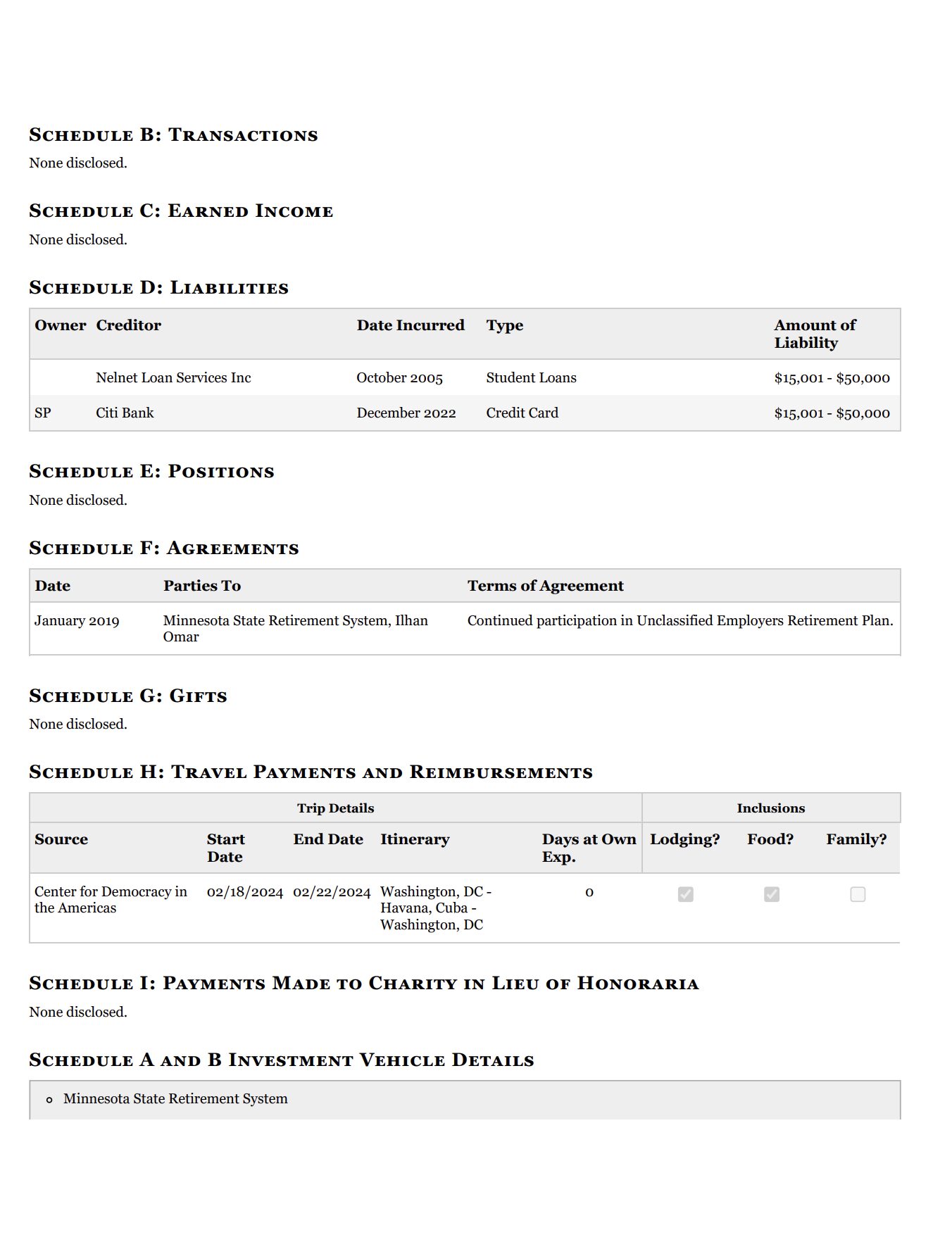
The same disclosure also reports liabilities, including a student loan and a credit card balance, each reported within ranges, underscoring another feature of these filings: they are intentionally coarse.
This is precisely where partisan insinuation thrives—inside the gap between what a disclosure can convey and what audiences think it conveys. Fact-checking and contextual reporting has stressed that these forms can produce misleading “headline net worth” claims because they do not reveal precise valuations, and because the reported value bands can reflect the value of an entity, the value of a stake, or a range that does not correspond to liquid wealth.
If you want to remain grounded, two propositions can be true at once:
First: Omar’s filings do reflect that her household assets—driven largely by her spouse’s reported partnership interests—could plausibly fall within high single-digit millions to the upper range cited by critics, depending on how the interests are valued.
Second: the leap from “the disclosure includes high-end ranges” to “therefore she committed crimes” is not an evidentiary conclusion. It is a political accusation.
That distinction matters, because the allegations being circulated are not mere curiosity about congressional finances. They are framed as criminal insinuations—fraud, graft, laundering, “crooked” dealing—and they are circulated alongside calls to punish her.



Why Minnesota fraud became the accelerant
To understand the intensity of the Omar story, you have to understand the political utility of Minnesota’s fraud headlines and how quickly those headlines are being converted into an ethnic and religious narrative.
The Feeding Our Future case, for example, is real—and enormous: federal prosecutors described it as a $250 million scheme involving a federally funded child nutrition program, and the Department of Justice announced convictions tied to that figure. That case has been widely reported and scrutinized; it is also frequently described in political rhetoric as a proxy for something broader: the idea that “Somalis” in Minnesota are uniquely responsible for theft from American taxpayers.
But outside the courtroom, numbers morph. National coverage has noted estimates for broader fraud in Minnesota programs that range from hundreds of millions to claims in the billions, with prosecutors and journalists disputing methodologies and totals. That uncertainty becomes fertile ground for rhetorical escalation—like the “$19 billion” claim Trump used as a weaponized talking point.
The mechanics are classic scapegoating: take a real criminal case, inflate the number, collapse distinctions between defendants and an entire community, then attach a high-profile immigrant Muslim politician as the face of the alleged rot. PBS’s reporting on Minnesota’s Somali community and the politicization of these attacks has emphasized how fraud cases are used to fuel broad suspicion and stigma.
Omar has rejected the premise of collective blame and has described Trump’s rhetoric as a bigoted distraction that targets her community as a political instrument.
This is not new terrain for her. Omar has been the target of disinformation operations and conspiratorial attacks for years—some of them explicitly Islamophobic and some aimed at delegitimizing her citizenship and belonging. The Guardian documented past disinformation campaigns that singled out Omar and other Muslim lawmakers for profit and political effect. The Washington Post has reported on the way attacks on her have been entangled with Islamophobia and racialized imagery, including high-profile tabloid framing that critics condemned as racist.
The current wealth-and-crime narrative borrows from that older repertoire. It is not just “she’s rich.” It is “she’s not really one of us, and her presence proves the nation is being robbed.” That is why the accusations so often come packaged with language about “fake congresswoman,” deportation, and incarceration, even though she is a U.S. citizen and the public record does not show criminal charges tied to the alleged wealth story.
A tactic with a constituency: Christian nationalism, moral panic, and “crime” as a political brand
Not every conservative is a Christian nationalist, and not every Christian conservative participates in disinformation. But there is a well-documented strand of contemporary right-wing politics in which religious identity, nationalism, and moral panic are fused—and where political enemies are cast not simply as wrong, but as wicked, criminal, and existentially dangerous.
In that worldview, the opponent is not a colleague. The opponent is a contaminant.
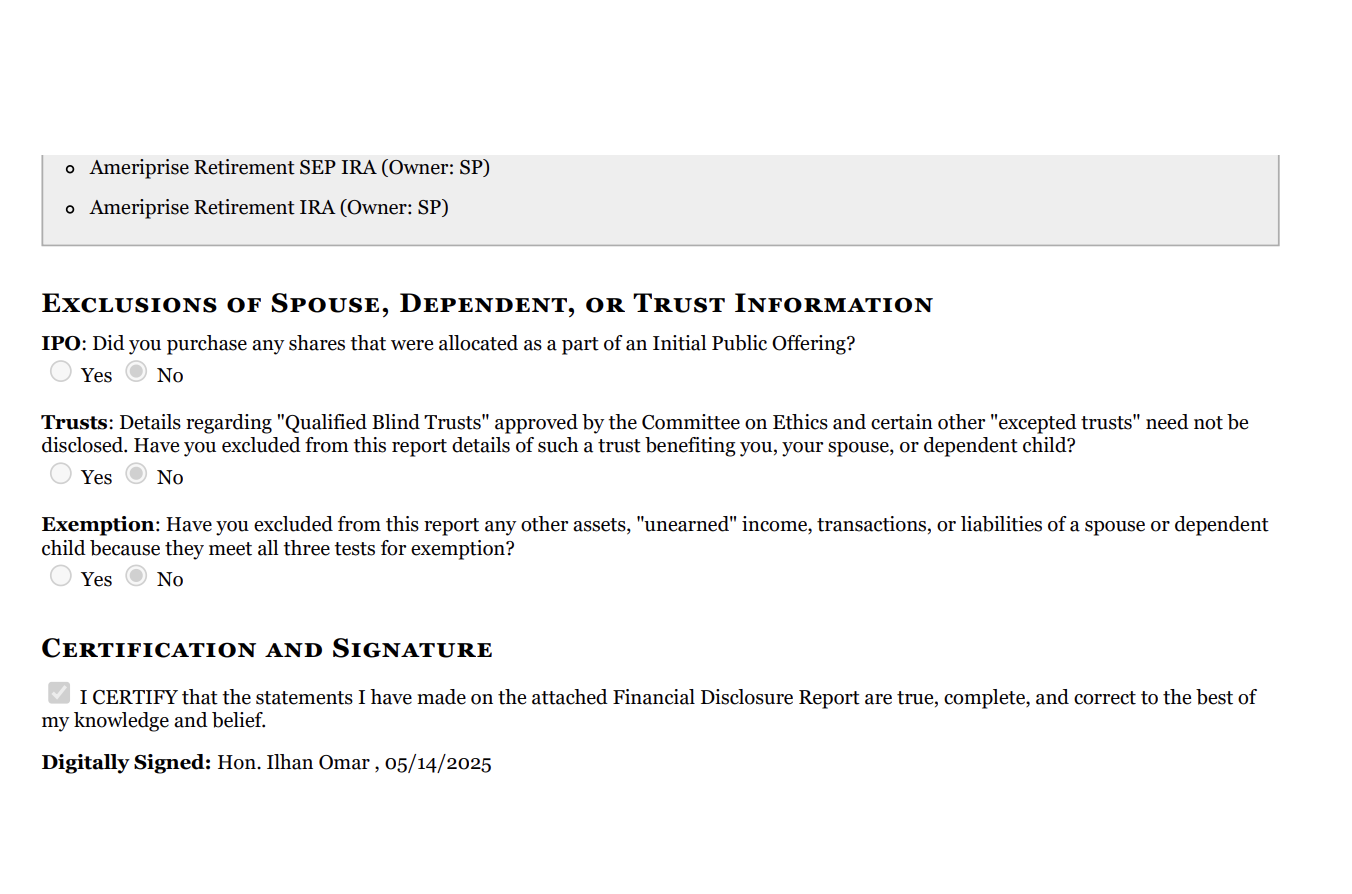
This is why accusations are so often framed as a kind of moral prosecution. It is also why the allegations persist even when documentation is publicly available. The existence of Omar’s disclosure does not stop the story; it fuels it. The form becomes a prop: proof that she is hiding something (even when the form is the disclosure), proof that she is profiting (even when the form lists no income for certain assets), proof that “they” are stealing (even when prosecutors have not implicated her).
The Atlantic’s writing on Omar and the broader “dual loyalty” trope—how accusations of divided allegiance have been used against religious minorities, including Muslims—helps explain why Omar is such a persistent target. These narratives do not require a coherent factual basis; they require a cultural script that audiences already know how to read.
And once the script is activated, “Popular Social Media Commentators” become the chorus. The online version of the attack frequently follows a pattern:
They cite the top-end range from a financial disclosure as a definitive net worth figure.
They add a rhetorical question: “How did she do it?”
They answer their own question with insinuation: “fraud,” “kickbacks,” “Somali scams,” “money laundering.”
They circulate the clip of Trump saying he “was told” she’s worth $30 million, as if hearsay is evidence.
They repost Comer’s pledge to “get answers,” treating an investigative posture as proof of wrongdoing.
The effect is cumulative. Each repost becomes a footnote in an imaginary case file.
What “investigation” can mean—and how it gets weaponized
Congress has legitimate oversight functions. Ethics committees exist for a reason. Financial disclosures are not decorative; they are meant to illuminate potential conflicts of interest and to deter corruption. But oversight can be politicized in at least two ways that matter here.
One way is to treat the existence of an inquiry—any inquiry—as if it validates the underlying allegation. Another is to speak in the language of criminal pursuit while operating in a political arena that has different rules, incentives, and guardrails.
Comer’s quote, in context, functions as a promise of pursuit. The problem is what the broader ecosystem does with it: it converts “we’re going to get answers” into “we already know the answer.”
That conversion is especially potent when paired with the public’s limited understanding of financial disclosures. The forms are complex enough to be misread by casual observers, but familiar enough to be treated as official proof when a partisan influencer points to a number. This is one reason fact-checkers have emphasized the need to contextualize net worth claims derived from disclosure ranges.
We’re going to get answers, whether it’s through the Ethics Committee or the Oversight Committee, one of the two.
Oversight panel Chairman Rep. James Comer
The harm: From reputational sabotage to political violence risk
False accusations of criminal activity do not remain rhetorical. They become material harms that play out across at least four arenas.
First, reputation and governance. When a lawmaker is portrayed as criminal, colleagues and constituents are nudged to treat her as illegitimate. That has downstream effects: committee assignments, the willingness of peers to collaborate, the credibility of her statements in hearings, and the public’s trust in her office.
Second, constituent harm by association. When Omar is framed as the avatar of “Somali fraud,” Somali Minnesotans—most of whom have nothing to do with criminal schemes—face intensified suspicion and political backlash. PBS has noted how attacks on the Somali community can harden stereotypes and obscure the community’s civic contributions.
Third, media ecology damage. The repetition of unsupported accusations trains audiences to accept insinuation as news, and it pressures mainstream outlets to “cover the controversy” even when the underlying claim is thin. The Guardian has reported that Trump’s attacks can fuel threats and create a climate where rhetorical dehumanization correlates with higher risk to public officials.
Fourth, safety. Omar has long been a target of threats. Recent reporting describes her warning that dehumanizing rhetoric can contribute to political violence, a concern echoed in coverage of threats against lawmakers more broadly.
When Trump says a sitting member of Congress should be jailed or “sent back,” he is not simply insulting her. He is directing attention—his audience’s attention—toward punishment. That is not abstract for someone who has lived for years inside the threat stream.
The legal paths Omar might consider—and their constraints
Legal remedies exist in theory, but the Constitution and federal law impose formidable barriers—especially when the speaker is a member of Congress and the target is a public official.
Defamation law and the “actual malice” standard
Because Omar is a public official, she would face the highest constitutional standard in a defamation case: she would need to prove that a defamatory statement was made with “actual malice,” meaning knowledge of falsity or reckless disregard for the truth. Congress’s nonpartisan research explains this standard clearly and situates it within First Amendment doctrine.
That is a steep hill. But it is not impossible—particularly where a statement asserts provably false facts (not opinion), is repeated after correction, and is made in a context that suggests deliberate deception.
The Speech or Debate Clause: Why lawmakers are often shielded
The bigger obstacle is not just defamation doctrine; it is congressional immunity.
The Constitution’s Speech or Debate Clause protects legislators from being “questioned in any other Place” for legislative acts. Congressional Research Service materials explain that the clause can immunize lawmakers from civil liability for actions that qualify as legislative.
But the protection is not unlimited. Courts have drawn lines between speech on the floor (core legislative act) and communications like newsletters, press releases, or other public messaging. Explanations of this doctrine note that certain statements made outside formal legislative contexts have been treated differently by courts, including in landmark disputes.
That distinction matters in the modern era, because many allegations are made on television hits, podcasts, campaign emails, and social media—precisely the spaces where legal exposure may be more plausible.
A real-time test case: Lawsuits challenging the boundary
Recent litigation involving Rep. Nancy Mace illustrates how plaintiffs are attempting to test the contours of congressional immunity when a lawmaker’s allegations spill outside official proceedings. Politico reported on a defamation suit in which the plaintiff argues that the Speech or Debate Clause should not shield defamatory statements made beyond the House floor, including in other communications.
That case is not Omar’s case. But it is instructive: it underscores that the legal battlefield here is not only about “was the statement false,” but also “where, how, and in what capacity was it made.”
Practical legal options Omar could explore
Within these constraints, Omar’s realistic paths include:
A referral or complaint to the House Ethics Committee if a member is alleged to have knowingly spread false claims in a way that violates House rules or ethical standards. Ethics processes are political as well as procedural, but they are built for inter-member disputes and misconduct questions.
A defamation action focused narrowly on statements made outside protected legislative acts—such as campaign material, media appearances, or social media posts—if the claims are specific, verifiably false, and demonstrably made with actual malice. The constitutional standards remain high.
Demand letters, retraction demands, and reputational countermeasures against non-legislator influencers and media entities who amplify provably false criminal accusations. These are often more practicable targets than sitting members of Congress, because they lack Speech or Debate protections, even though they may still invoke First Amendment defenses.
The strategic constraint in all of this is that defamation suits can become political theater, discovery can be invasive, and litigation can prolong a narrative even as it seeks to correct it. Anti-SLAPP laws in various jurisdictions can also affect the calculus for plaintiffs, including public figures.
The journalistic obligation: Separate the documentable from the insinuated
If you strip away the noise, the documentable core is straightforward:
Omar’s financial disclosure lists spouse-held partnership interests in two entities with broad value ranges that, when aggregated at their highest ends, can be described as approaching $30 million in household assets.
Those filings do not, by themselves, establish a precise net worth figure, nor do they establish criminal conduct.
Minnesota has real, large-scale fraud cases, including a DOJ-described $250 million scheme in Feeding Our Future; broader estimates and claims vary, and inflated or politicized numbers are frequently deployed in rhetoric about Somali Minnesotans.
Trump has publicly used the wealth storyline and Minnesota-fraud rhetoric to accuse Omar of being “crooked” and to suggest punishment, including jail or deportation, despite the lack of publicly demonstrated evidence tying her to those alleged crimes.
From those premises, a responsible journalist can ask hard questions about disclosure transparency, conflicts of interest, and whether asset valuations are sufficiently clear for public understanding. But a responsible journalist cannot skip the evidentiary step and launder insinuation into “criminal activity.”
That laundering is the point of the tactic. When people cannot prove a crime, they can still poison a reputation by speaking as if a crime is obvious, imminent, or already known—then demanding that the target “answer questions” as if innocence must be earned.
What this episode reveals—beyond Ilhan Omar
There is a reason the allegations keep returning to Omar, and it is not merely partisanship. Omar sits at the intersection of identities that have long been treated as suspect in American political mythology: immigrant, Muslim, Black, outspoken, and unafraid to name the bigotry that targets her. That makes her a uniquely potent character for an ecosystem that thrives on moralized conflict.
The Atlantic’s exploration of how “dual loyalty” accusations have been used against religious minorities in America gives historical depth to the modern smear: the idea that certain citizens are perpetually on probation, required to prove belonging again and again.
Today’s version swaps out “foreign allegiance” for “foreign fraud.” The structure is the same. The accusation is a story about who counts as American—and who can be imagined as criminal without evidence.
And when that story is told by the president of the United States, by lawmakers, and by an army of online commentators, it becomes something more than gossip. It becomes a civic hazard: a politics that trains people to prefer accusation over proof.