



By KOLUMN Magazine
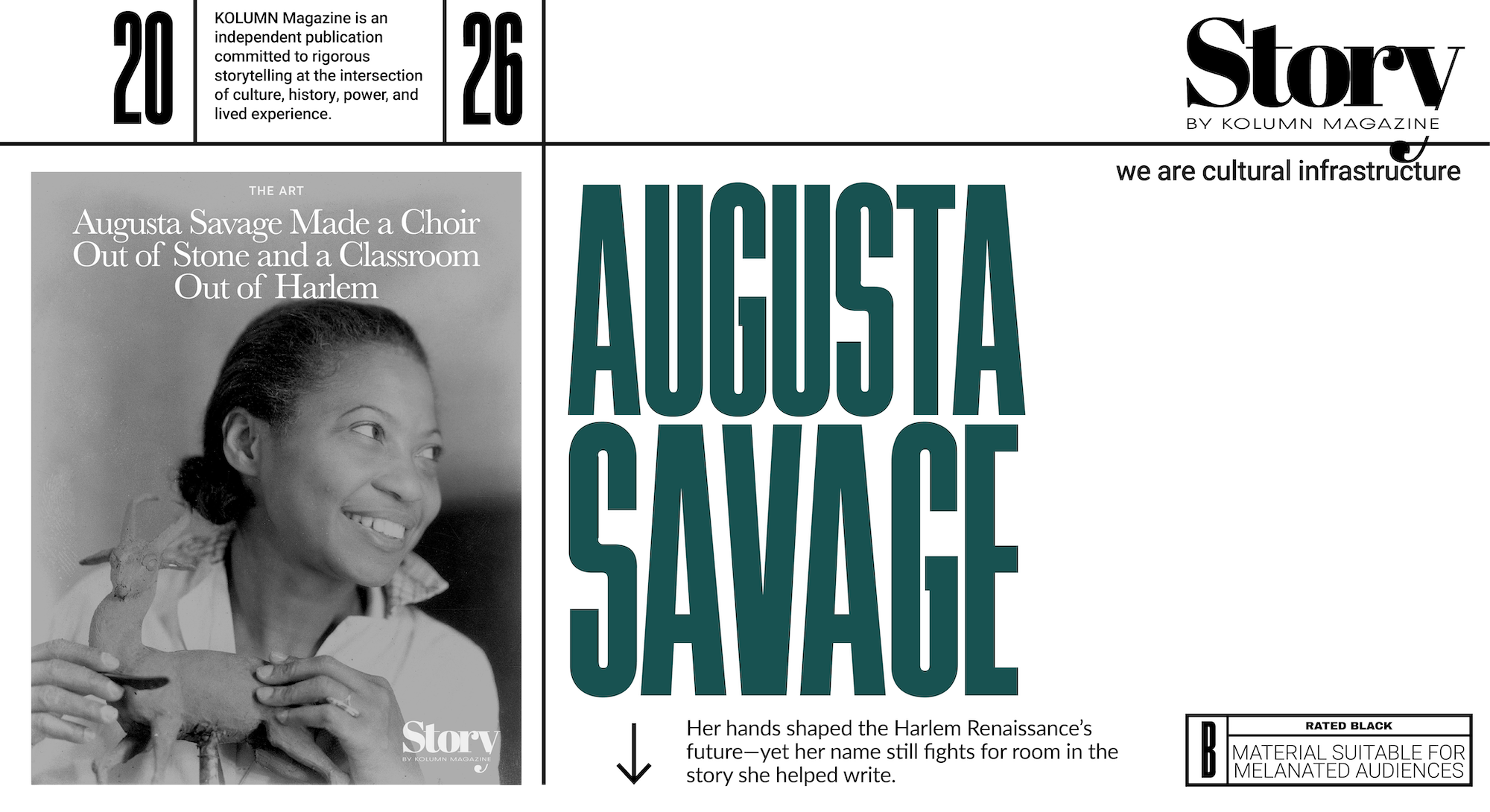
There are artists whose lives read like a straight line—training, commissions, steady recognition—and there are artists whose lives look like a map of America’s refusals. Augusta Savage belonged to the second category. She was born Augusta Christine Fells in Green Cove Springs, Florida, in 1892, the seventh of fourteen children in a family marked by poverty, faith, and the strict authority of her father, a minister. She developed an early fascination with form, pressing whatever material she could find into small sculptures, a child’s insistence that the world is knowable if you can touch it long enough. That insistence did not arrive in a gentle cultural climate. Savage’s earliest years unfolded in a South still enforcing its racial order through law and custom, where artistic ambition for a Black girl could be treated as eccentric at best and insolent at worst.
She would later describe violent resistance from her father to her making art—an origin story that is both personal and emblematic, the collision of household discipline, social precarity, and the fear that creativity will invite punishment from outside the home. Accounts vary in detail across retellings, but the pattern is consistent: Savage’s will did not develop in a vacuum. It developed as a counterforce.
By her teens, she was already moving through adult responsibilities. She married young and became a mother; her daughter, Irene, was born when Savage was still very young herself. Widowed early, she cycled through marriages and losses in ways that make it difficult to separate “the artist” from “the life.” The biography is not a sidebar to the work. It is one of the mediums through which the work became possible. In the United States of the early twentieth century, Black women’s time was routinely conscripted by need: wage labor, domestic labor, kinship labor, survival labor. The decision to claim hours for sculpture was, in itself, a kind of refusal.
Florida is sometimes treated as Savage’s prologue, a place she left behind to become “Harlem Renaissance Augusta Savage.” That framing is convenient but incomplete. Even as she would later be mythologized in New York, Savage’s artistic identity was forged first in a region where the politics of race were not theoretical. Her early recognition came not from Manhattan salons but from local circumstances: by 1919, she won a prize at the Palm Beach County Fair for her work, a marker of talent that nonetheless did not translate into stable patronage. She tried, like so many artists, to make a living through portrait commissions—an entrepreneurial model that should have been practical. Yet the market for a Black woman sculptor’s work was constricted, hemmed in by segregation and by the narrower imagination of who a “serious” sculptor could be.
When Savage moved to New York in the early 1920s with the stated ambition to become a sculptor quickly—an audacious line that reads partly as youthful bravado, partly as realism about time—she entered a city where Black life was being reorganized by migration and where Harlem was emerging as a cultural capital. Her enrollment at the Cooper Union mattered not merely as education but as credentialing, a way to speak back to gatekeepers in the language they claimed to respect. Cooper Union’s scholarship-based model made it possible for Savage to study despite limited resources, and she completed her training with speed and seriousness that impressed observers.
But New York also delivered a different lesson: talent did not neutralize racism; it often triggered it.
The letter that said the quiet part aloud
In 1923, Savage became a public case study in the way art institutions can present themselves as meritocratic while functioning as racial filters. She won a scholarship opportunity to study abroad at the Fontainebleau School of Fine Arts in France—an opening that might have accelerated her training and expanded her network. Then, once her race was known, the offer was rescinded. The facts of that moment were documented in correspondence now preserved in archival form, including letters involving W. E. B. Du Bois, who intervened on her behalf. The episode has been retold so often it risks becoming a morality tale with a neat villain, but the archival residue—bureaucratic language, carefully worded defenses—reveals something more unsettling: how ordinary discrimination can look when it is written on letterhead.
That paper trail matters because it captures an institutional reflex: the belief that excluding a Black woman from artistic formation could be justified as policy, etiquette, or simply “how things are done.” Savage did not treat it as inevitable. She contested it. The scholarship denial became a galvanizing event, not only for her personal trajectory but for her political understanding of what an artist had to do in America to survive as more than a novelty.
The reason this episode should not be reduced to a single injustice is that it illuminates Savage’s dual identity—artist and advocate. In the popular imagination, the Harlem Renaissance is often narrated as a burst of creativity that overcame hardship through sheer brilliance. Savage’s life argues for a more exacting account: brilliance did not “overcome” the system; it negotiated with it, organized against it, and sometimes lost to it anyway.
Her response to exclusion was not only to pursue her own training, but to widen the path for others.
Harlem, portraiture, and the politics of likeness
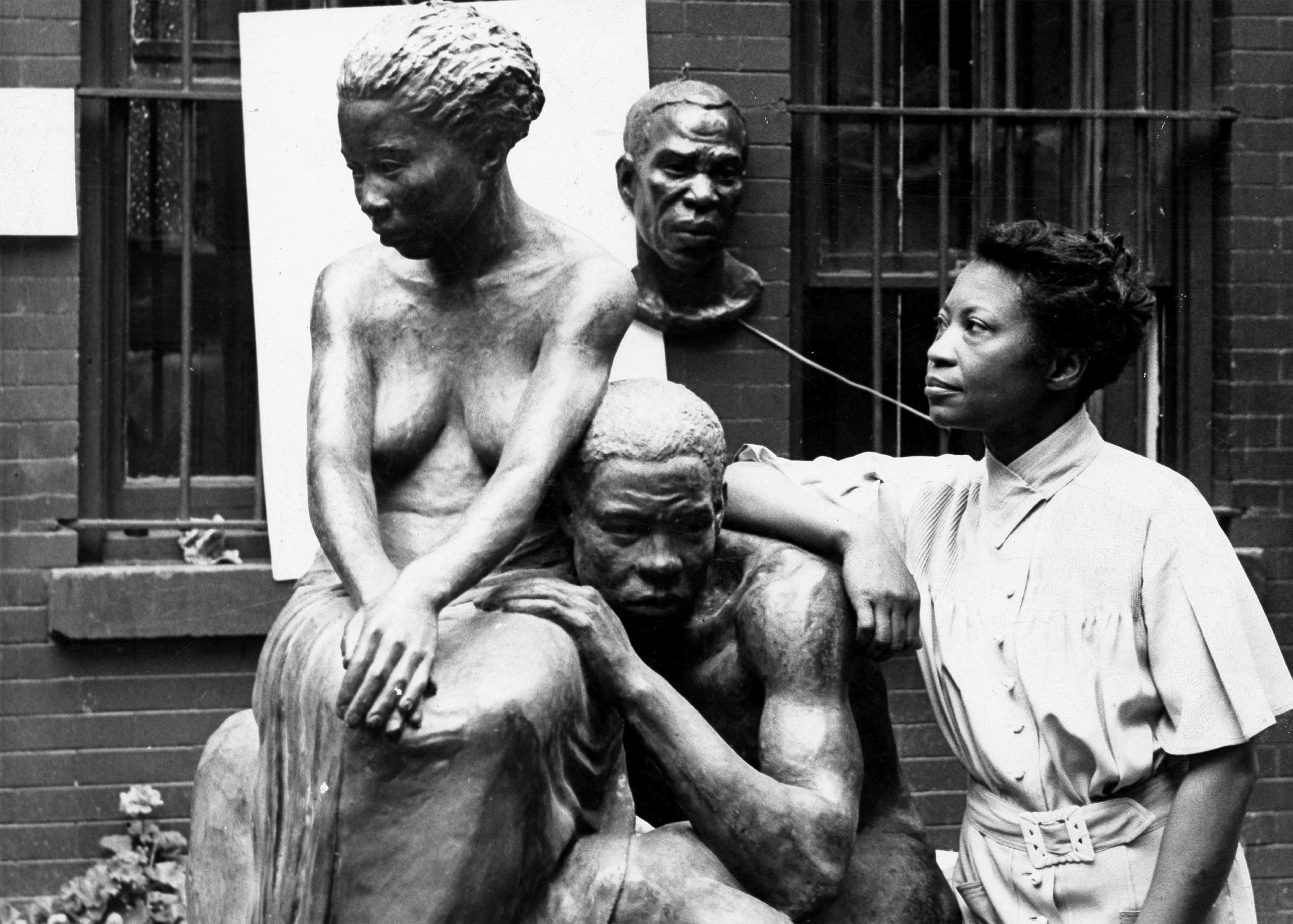
Savage’s surviving sculptures include a body of portrait work that is both intimate and strategic. Portraiture, for Black artists in the early twentieth century, carried unusual stakes. It was a genre through which Black interiority could be asserted against caricature; it was also a genre with buyers. Savage sculpted prominent Black leaders and intellectuals, including W. E. B. Du Bois, in commissions connected to New York cultural institutions.
Her portrait practice was never merely about surface resemblance. It was about dignity—about rendering Black faces with the same seriousness Western art had long reserved for white patrons and white saints. In Harlem, where writers were attempting to reframe Black life on the page, Savage was attempting to reframe Black life in three dimensions. The Harlem Renaissance is frequently defined through literature—poems, essays, novels—because those forms circulated widely. Sculpture is harder to circulate, harder to preserve, and more expensive to produce. That difficulty shaped Savage’s career: her medium carried higher material costs and higher risk, and later it would impose the ultimate indignity—destruction.
One of her best-known works, Gamin (c. 1929), is a portrait bust of a young Black boy, his cap tilted, his expression alert rather than sentimental. The work is often praised for its realism, but realism is not the whole story. Savage’s realism is interpretive: the boy is presented as a full person, neither an emblem nor an innocence cliché. He is street-smart without being criminalized, youthful without being infantilized. That balance is a political achievement.
Gamin is also pivotal in Savage’s professional arc because it helped secure recognition and support that earlier opportunities had withheld. In accounts of her career, the sculpture stands as evidence that when institutions finally did reward her, they did so because she made it impossible to deny her skill. But even that formulation can be misleading: it suggests a fair contest where excellence is eventually acknowledged. Savage’s story indicates that acknowledgment was intermittent, conditional, and vulnerable to economic downturns and institutional priorities.
The teacher as architect of a movement
To write about Augusta Savage as only a sculptor is to miss one of her most consequential artistic works: the artists she helped shape. Savage became a crucial educator and mentor in Harlem, developing spaces where Black artists could learn, work, and exhibit. The New York Public Library’s archival descriptions and research guides identify her as the first director of the Harlem Community Art Center, a WPA-sponsored institution that became a model for community arts education.
This is where Savage’s life bends from personal persistence into institution-building. During the Great Depression, federal arts programs offered employment and support, but access was not evenly distributed. Savage worked to ensure Black artists could enter these programs, a form of advocacy noted in later accounts of Harlem’s cultural infrastructure.
The Harlem Community Art Center mattered because it treated artistic training as a public good rather than a private luxury. It offered classes and workshops; it gave emerging artists a place to develop technique and community. In the public record, the Center is associated with a roster of artists who would become central to American art, including Jacob Lawrence and others who moved through Harlem’s cultural ecosystem.
The teacher’s role also helps explain Savage’s relative scarcity of surviving works. Sculpture requires time, space, and materials; teaching requires time; organizing requires time. Savage spent significant energy building structures that were not designed to preserve her name but to preserve possibility for others. In a culture that often measures artistic success by the quantity of surviving objects, that choice can look like absence. It is more accurately a redistribution.
In 1939, Savage also opened the Salon of Contemporary Negro Art in Harlem, described by the Studio Museum in Harlem as the first known art gallery founded by a Black woman in the United States. Contemporary reporting and later retrospectives frame the Salon as both an exhibition space and an intervention into an art world that excluded Black artists or confined them to ethnographic categories. The Guardian’s account of the Salon’s opening emphasizes the size of the crowd and Savage’s insistence on a simple standard: judge the work on its merits.
That line—judge the work on its merits—can sound like assimilationist rhetoric until you consider what it was pushing against. In an environment where Black artists were routinely dismissed as “primitive,” “folk,” or “political” (as if political art were not also art), to demand merit-based judgment was not an appeal to neutrality. It was an exposure of how selectively neutrality had been applied.
The masterpiece the world applauded—and then threw away
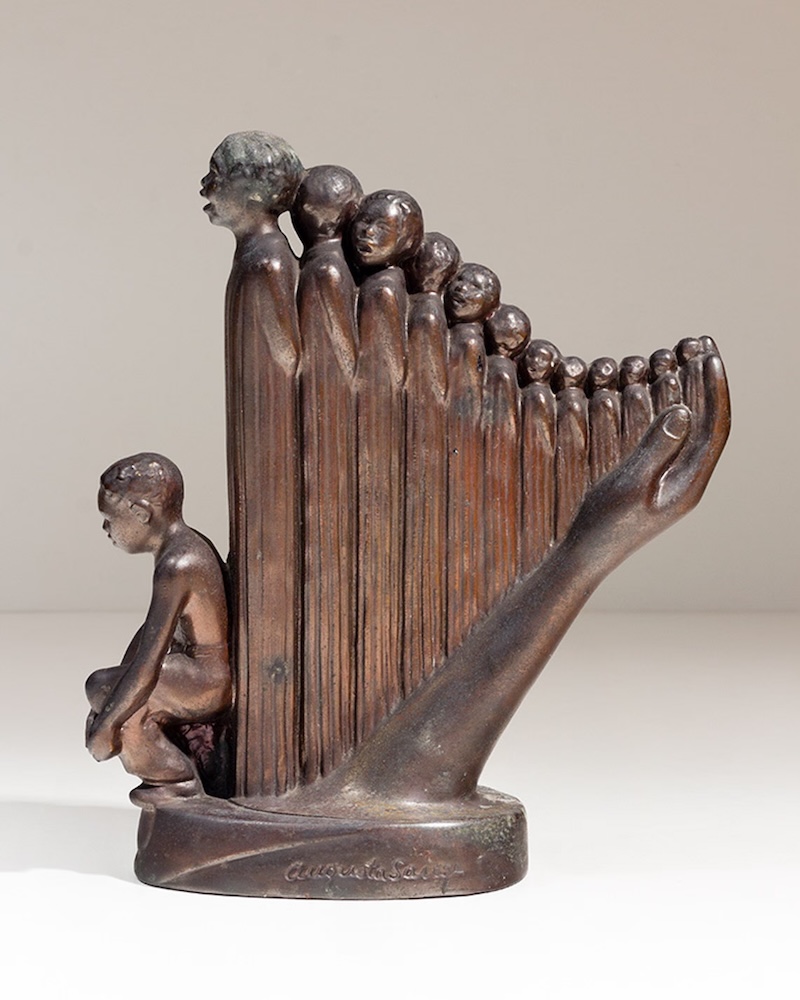
Augusta Savage’s most famous work is, in a cruel twist, also one of her least physically accessible works. In 1939, she was commissioned to create a sculpture symbolizing the musical contributions of African Americans for the New York World’s Fair. The resulting work—known as Lift Every Voice and Sing and also called The Harp—stood about sixteen feet tall and depicted a choir of Black singers arranged as the strings of a harp, supported by an elongated arm and hand, with a kneeling figure holding music at the base.
The work drew directly on the cultural resonance of “Lift Every Voice and Sing,” the hymn with lyrics by James Weldon Johnson that became widely known as a Black national anthem. The sculpture’s design was formally bold and narratively dense: it fused sacred and secular language, turning the human voice into architectural structure, turning Black communal song into a monumental instrument. It is difficult to overstate what it meant for a Black woman sculptor to produce one of the fair’s most discussed works at a moment when the mainstream art world still treated Black creators as peripheral.
And then, at the end of the fair, the sculpture was destroyed.
The reasons given are the kind that sound practical until you hear the moral undertone: the sculpture was made of plaster; there was no funding to cast it in bronze or to store it; the fair’s temporary structures were dismantled; the work was treated as disposable. The New-York Historical Society, recounting the “tragic story” of the lost masterwork, notes its scale, its popularity, and the bitter fact that such acclaim did not translate into preservation. The Smithsonian’s National Museum of African American History and Culture documents the sculpture through object records and photographs, preserving what the physical world did not.
A culture reveals its values not only through what it builds, but through what it refuses to keep. Savage’s Harp became an accidental parable about American cultural memory: Black genius can be celebrated as spectacle and then discarded when the spectacle ends. The destruction of the work is not simply an art-world tragedy; it is a civic one.
In recent years, scholars and curators have returned to The Harp as an example of how the archive can become a second studio. The surviving photographs, small replicas, and written accounts are not substitutes for the original, but they have become the materials through which Savage’s ambition is reassembled in public imagination.
What survives, and what that says about power
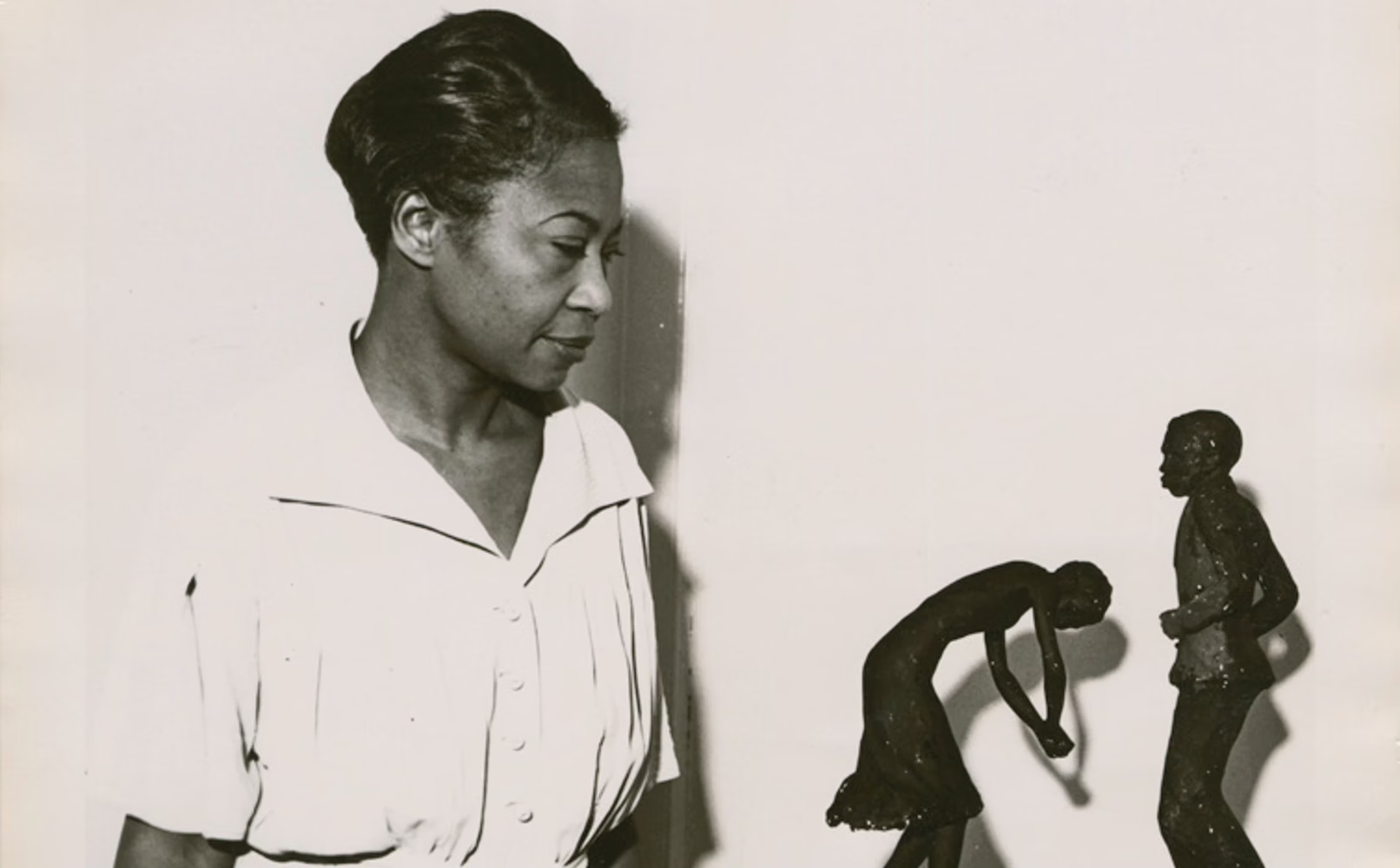
A recurring fact appears across museum biographies and archival records: Savage died in relative obscurity in 1962 after years that included a retreat from the art world’s center. The Smithsonian American Art Museum notes that she moved to Saugerties, New York, explored writing, and later returned to New York shortly before her death. This arc is often narrated with a tone of melancholy—America’s failure to honor a major artist in her lifetime—but it is also, more precisely, an account of what constant struggle can cost.
Savage’s career was not simply “derailed.” It was repeatedly forced to restart. She faced the economic instability of the Depression, the structural constraints placed on Black artists, and the material fragility of sculpture. Many of her works were made in plaster because plaster was affordable; plaster is also vulnerable, easily damaged, rarely treated as “permanent.” When Savage’s most monumental piece was destroyed, the symbolic violence of the act extended to her entire medium: it communicated, again, that Black cultural labor could be treated as temporary.
Yet the survival of her influence is measurable in ways that art markets and museum walls do not always capture. The New York Public Library’s archival collection of her papers, and the continuing scholarly attention to her role in Harlem’s art infrastructure, suggest that Savage’s story is increasingly being told as a structural one: she was not only a maker of objects, but a maker of systems.
This is where the work of contemporary historians becomes essential. PBS’s American Masters segment “Searching for Augusta Savage,” featuring art historian Jeffreen M. Hayes, frames Savage’s legacy as both foundational and erased—a tension familiar to anyone who has watched American institutions “discover” Black women artists after decades of neglect. The question is not whether Savage mattered; it is why the canon acted as if she didn’t.
The answer is not singular. It includes racism and sexism, certainly, but it also includes the politics of medium, the economics of preservation, and the gatekeeping function of museums and collectors. Savage’s work was often public-facing and community-oriented; it did not always align with the private-collection pathways that help artworks survive and appreciate. Even when she was commissioned, the structures around her did not reliably convert public acclaim into permanent care.
Seeing Savage’s style: Realism with a purpose
Savage’s sculpture is frequently described as realist, and that is accurate in the most basic sense: her figures are legible, anatomically attentive, emotionally specific. But the term “realism” can be too blunt for what she achieved. Her realism is not the neutrality of a camera; it is a decision about what the world is allowed to see.
In works like Gamin, the realism does not flatten the subject into “everyday life” as sociological evidence. Instead, it asserts the everyday as worthy of art’s highest attention. The boy is not romanticized, but he is also not subjected to the punishing gaze that so often follows Black youth in American visual culture. The face carries thought. It carries complexity.
In The Harp, the realism becomes collective. The singers are stylized into near-architectural verticals, their robes forming the harp strings, their bodies both individual and unified. The choice is sculptural, but it is also philosophical: it turns community into structure, music into monument, faith into design.
Savage’s style also rejects the era’s expectation that Black art must announce itself through exoticism. Her subjects are not “types.” They are people, and when they represent a community, they do so through dignity rather than caricature.
This is why the loss of her larger body of work is so consequential. What survives offers enough evidence to recognize her mastery; what does not survive likely contained an even richer vocabulary—experiments, shifts, risks—that would complicate the neat labels we often apply in retrospect.
The long struggle for institutional memory
In 2019, The Guardian published a feature explicitly framed as corrective, calling Savage’s story “extraordinary” and pointing to renewed exhibitions aiming to address her historical neglect. The phrasing—“overlooked,” “forgotten,” “rediscovered”—is now common in coverage of Black women artists. But each instance raises a harder question: why are these cycles so predictable?
Part of the answer is that the infrastructure of American art history has long treated certain lives as supplemental. Savage’s career challenges that structure because her contributions are not easily relegated to the margins. The Harlem Community Art Center was not a side project; it was, by many accounts, a key incubator of Black artistic talent during the WPA era. The Salon of Contemporary Negro Art was not a vanity gallery; it was an alternative institution created because the mainstream refused access.
When modern museums and media outlets “recover” Savage, they often focus on The Harp because it makes a compelling narrative: a masterpiece, a world’s fair, a tragic destruction. It is dramatic, visual, and morally legible. But Savage’s deeper legacy may be less cinematic and more structural: she modeled what it looks like to treat Black artists not as exceptions but as a community with a right to resources.
Word In Black, in a 2024 essay emphasizing the continuity of Black artistic excellence, underscores Savage’s dual role as sculptor and teacher, highlighting her advocacy for equal rights for Black artists and the importance of her studio. That framing aligns with the archival record: Savage’s work cannot be separated from her insistence that Black artists deserved institutions built for them, not just invitations to institutions that were never designed to hold them.
Even tangential appearances of her name in mainstream outlets can be revealing. A Washington Post museum-related article from 2018 mentions Savage as part of a future exhibit lineup, a reminder that institutions increasingly recognize her as a figure audiences should know—an acknowledgment that, while welcome, also signals how late the recognition has come.
The meaning of a life that refused to shrink
Augusta Savage’s life is often summarized in a series of “firsts” and “setbacks”: a scholarship student, a denied opportunity, a Harlem mentor, a lost masterpiece, an obscured death. The temptation is to make the story inspirational—she overcame adversity—or tragic—she was never properly honored. Both frames contain truth, but both risk shrinking her into a lesson.
A more accurate account is that Savage lived as an artist who understood the political economy of culture. She understood that talent alone would not protect Black artists from exclusion. She understood that institutions do not become equitable because they are asked politely. She built alternatives. She demanded standards. She taught. She organized. She sculpted faces that refused caricature. She produced a monument that translated Black song into public form, and even when the monument was destroyed, the idea of it continued to insist on its place in American memory.
The Smithsonian’s biography includes a detail that feels quietly revelatory: during her years away from the art world’s center, she explored writing—children’s stories, mysteries, vignettes—none of them published. The detail suggests a mind that never stopped making, even when the world stopped watching. It also suggests the scale of what institutions miss when they fail to support artists across a lifetime: not only the works that are lost, but the works that never get made because survival takes precedence.
Savage’s story is, ultimately, a story about what America is willing to fund, what it is willing to store, and what it is willing to forget. Her work and her teaching offer a counterargument to forgetting. They insist that Black cultural production is not a chapter in a renaissance that ended, but an ongoing architecture—built by hands that were never supposed to hold the tools.
In the photographs of The Harp, the figures rise in disciplined formation, a choir turned into an instrument, a community turned into a structure that looks like it could withstand weather. The irony is that it did not withstand the budgeting decisions of a fair. Yet the sculpture’s afterlife, sustained through archives, museums, scholarship, and renewed public attention, suggests that even destroyed works can continue to speak—if enough people decide that what was thrown away is worth recovering.
Augusta Savage spent her life making that case.