


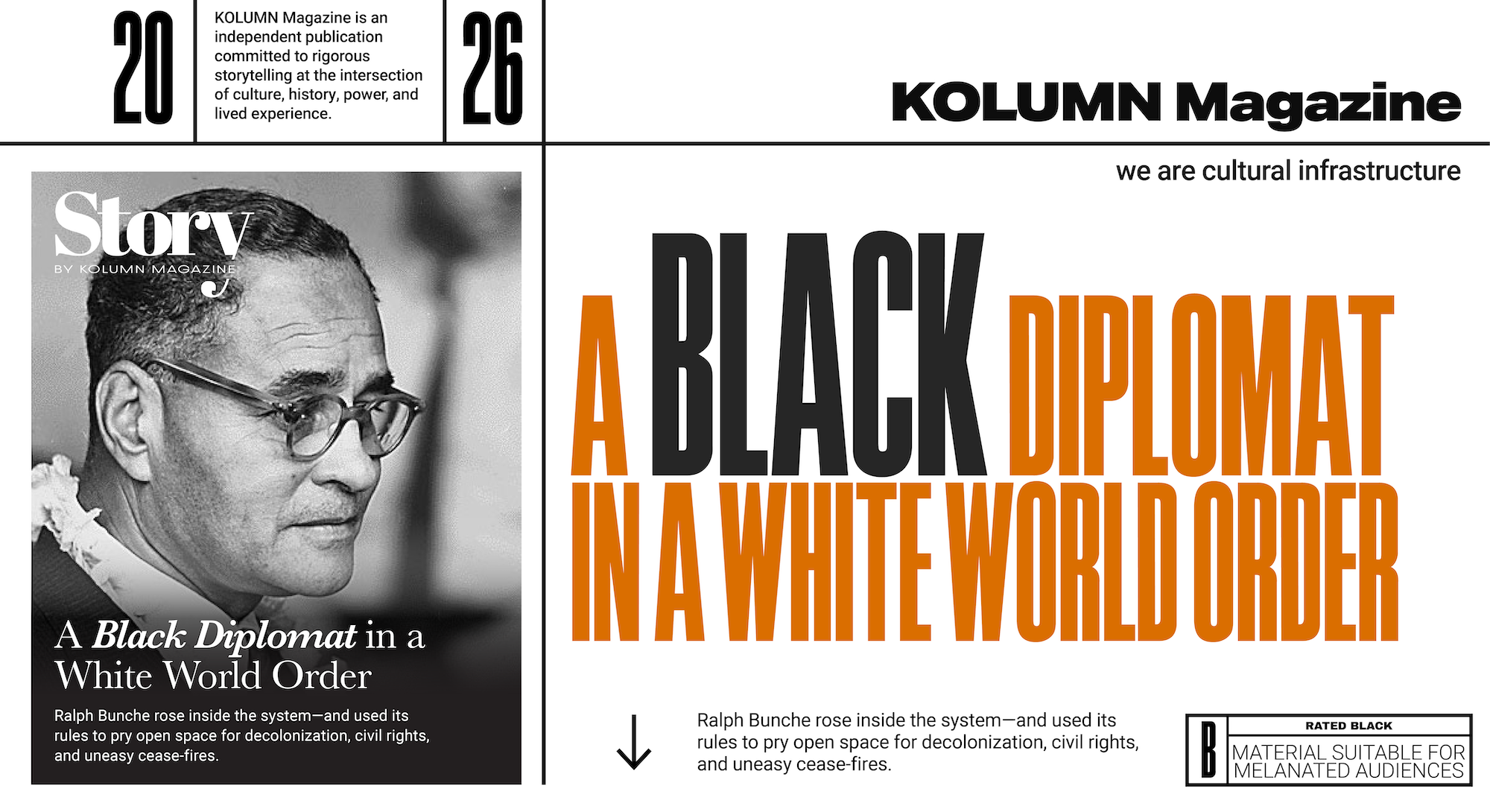
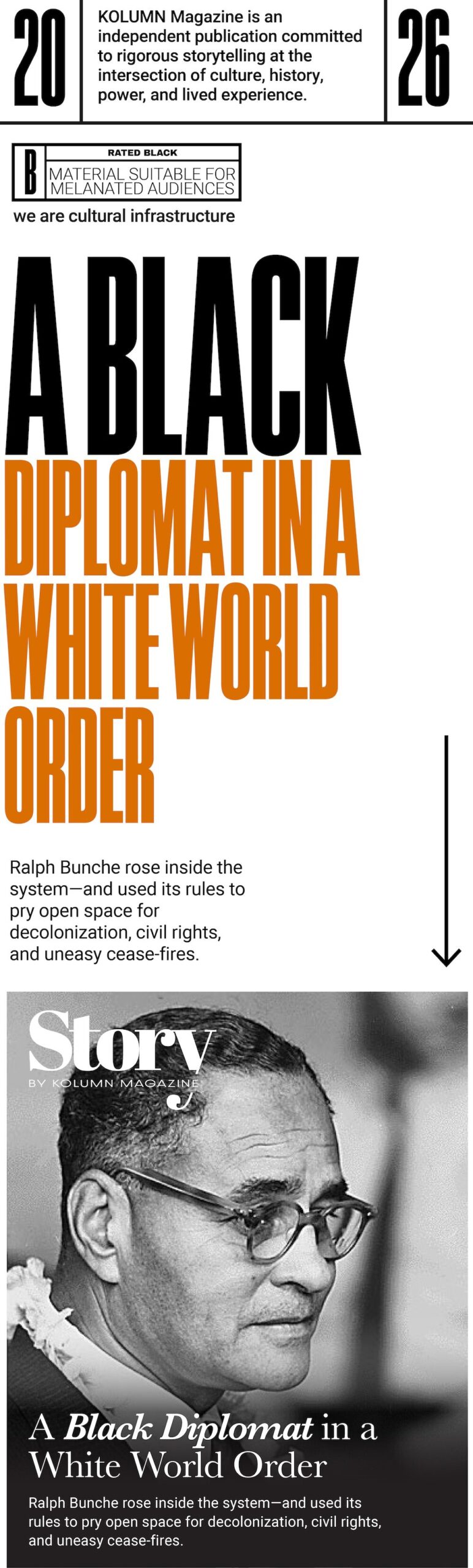
By KOLUMN Magazine
In the popular imagination, diplomacy is an elegant profession—men in tailored suits, soft handshakes, careful phrasing, and communiqués drafted late at night. Ralph Johnson Bunche spent much of his life in that world, but he understood its harsher truth: diplomacy is often triage. It is conducted under the pressure of catastrophe, inside rooms where grief is fresh, where the map has been redrawn by force, and where the people who most need peace have the least leverage to demand it.
Bunche, who became the first Black person and the first person of African descent to receive a Nobel Prize when he won the Nobel Peace Prize in 1950, rose from circumstances that were never meant to produce an international statesman. He arrived at history’s center not as a charming accident but as a deliberate, grinding achievement—an ascent powered by scholarship, by a disciplined belief in institutions, and by a willingness to endure the loneliness that comes from being “first.”
He also arrived with contradictions that remain instructive. Bunche was an anti-colonial intellectual who worked for a global organization built in part by empires. He was a civil-rights ally who sometimes urged moderation when activists demanded confrontation. He was celebrated as a symbol of racial progress while being surveilled and attacked in the United States, including during the fever years when many public servants were suspected—often without evidence—of disloyalty.
To write about Ralph Bunche is to write about the 20th century’s unfinished argument: whether peace is the absence of war, or the presence of justice; whether international institutions can be something more than theaters for the strong; and whether a Black American, working inside those institutions, can advance freedom at home and abroad without being conscripted into someone else’s story of what freedom should look like.
A childhood shaped by loss—and by the insistence on excellence
Bunche was born on August 7, 1904, in Detroit, Michigan. His early life was marked by disruption and hardship; as a child he moved with family to the Los Angeles area, where he would emerge as an exceptionally gifted student. Accounts of his youth, repeated across institutional biographies, emphasize both precocity and discipline—traits that would become his public identity: the brilliant debater, the athlete, the scholar who performed excellence not as an aspiration but as a requirement.

What mattered was not only that he excelled, but that he did so in an America that treated Black excellence as either aberration or provocation. Bunche’s later faith in structured negotiation—his insistence on rules, procedures, and the slow work of building consensus—was not naïveté. It was strategy. When you are denied informal power, you learn the importance of formal mechanisms.
At UCLA, he distinguished himself academically—graduating with honors and establishing the pattern that would define him: achievement that made it difficult to dismiss him, even when the country was determined to dismiss people like him. His trajectory then carried him to Harvard, where he earned a doctorate in political science and produced research that placed him at the intersection of two defining global forces: colonial rule abroad and racial hierarchy at home.
Scholar of race, empire, and the machinery of power
Before Bunche became a household name—before the Nobel ceremony and the photographs—he was a scholar who treated the modern world as a system. His work examined how race could be made into a political instrument, and how empire disguised itself as administration. His doctoral research explored colonial governance and the “mandate” logic that followed World War I: the notion that powerful nations could supervise “less developed” territories under an international framework that claimed moral purpose. In practice, it often resembled empire by another name.
He joined Howard University, where he became an anchor of intellectual life and helped shape generations of students. Howard, a historically Black university with a deep tradition of political thought, offered something that many elite institutions did not: the assumption that Black scholarship could define questions rather than merely answer them. Howard’s own remembrance of Bunche emphasizes not just his international stature but his role as a model of academic excellence linked to public service.
Bunche’s intellectual range also connected him to Gunnar Myrdal’s landmark study of American race relations, “An American Dilemma,” an ambitious attempt to analyze segregation and the contradictions between American democratic ideals and American realities. His involvement in that project underscored his central question: what happens when a nation’s myth is greater than its willingness to honor the people it governs?
That question would soon become his job description.
From analysis to action: The war years and the making of a global civil servant
World War II did not simply reorder borders; it reordered careers. Bunche moved from academia into government service, including wartime analytical work connected to U.S. strategic planning. The period placed him in the bloodstream of policy at the precise moment the postwar order was being imagined.
His later reputation—calm, methodical, relentlessly prepared—was not an affectation. It was formed in a world where the stakes were existential and where information, properly interpreted, could save lives. He learned to think in layers: what leaders say, what they mean, what they can accept, what they cannot admit publicly, and what their constituencies will punish them for conceding.
Those skills became indispensable when the United Nations took shape.
Bunche participated in the planning and early work associated with building the United Nations system, which was, at its best, an attempt to prevent a repetition of the failures that had preceded World War II. Institutional histories highlight his role in those foundational years and his long service within the organization, especially in areas tied to trusteeship, decolonization, and crisis response.
For Bunche, the UN was not merely an employer. It was a bet: that the world could be governed, at least partially, by agreement rather than conquest.
Decolonization and trusteeship: Dismantling empires without detonating the world
In the decades after World War II, colonial empires faced mounting pressure. Independence movements accelerated across Africa, Asia, and the Middle East. The UN became one of the arenas where these transformations were debated, managed, delayed, and sometimes facilitated.
Bunche’s work in trusteeship and related political affairs placed him near that process. The United Nations’ own framing of his career emphasizes his long involvement in managing transitions, advising on territories moving toward self-government, and navigating disputes that could easily trigger wider conflict.
This part of Bunche’s legacy is sometimes overshadowed by his Nobel Prize moment, but it mattered profoundly. Decolonization was not only an ethical question; it was a geopolitical one. Every independence struggle risked becoming a proxy battlefield in the Cold War. Bunche’s approach—deeply procedural, insistently pragmatic—sought to widen the space for political solutions before violence became irreversible.
The criticism, then and now, is familiar: international institutions can slow justice by demanding “stability.” But Bunche’s defenders point to the alternative. The route from empire to independence was rarely peaceful. If the UN could sometimes keep a dispute inside conference rooms and away from mass graves, that was not nothing—it was survival.
Palestine, 1948–49: The negotiations that made history—and earned a Nobel
The episode most associated with Bunche’s name began in the late 1940s, amid the collapse of the British Mandate, the founding of Israel, and the first Arab–Israeli war. The conflict produced mass displacement, trauma, and hardened narratives that still shape politics today.
Bunche served as a senior UN official involved in the effort to mediate. When Count Folke Bernadotte, the UN mediator, was assassinated in 1948, Bunche assumed the role of acting mediator and pursued armistice agreements with a determination that impressed even skeptical observers. The Nobel Prize’s official biography and the UN’s own Nobel page describe Bunche’s central role in achieving armistice agreements between Israel and multiple Arab states—agreements that, while not peace treaties, reduced active hostilities and created a framework for temporary stability.
The Atlantic, writing in 1950, credited the “realism” of Bunche’s approach and highlighted the series of armistice pacts concluded in the wake of his efforts—an early sign of how quickly he became identified with a particular style of diplomatic problem-solving: pragmatic, unsentimental, and focused on what could actually be signed.
In 1950, the Nobel Committee awarded him the Nobel Peace Prize. It was an astonishing milestone in global recognition and, simultaneously, a quietly radical moment in American racial history. At a time when Jim Crow was still the law of much of the United States, the world’s most famous peace prize went to a Black American whose authority derived not from celebrity or moral performance, but from negotiated outcomes.
But even in that triumph, Bunche’s position was complicated. The Nobel honor elevated him into the realm of symbols—a “first” that many Americans wanted to treat as proof of national progress. Yet the most serious measure of progress is not whether a nation can celebrate one exceptional person; it is whether it can protect the dignity of the millions who will never be invited to the ceremony.
The UN’s crisis manager: Peacekeeping as an operating system
After the Nobel, Bunche’s influence inside the UN grew. He became associated with peacekeeping and “special political affairs”—the difficult work of managing conflicts that threatened regional stability. Institutional accounts of his UN career reference his involvement in multiple crises across decades, reflecting how the organization relied on him as a trusted operator and troubleshooter.
If the UN is sometimes caricatured as bureaucracy without consequence, Bunche’s career is a rebuttal. The work was often granular: cease-fire supervision, negotiations with parties who distrusted each other, and constant effort to prevent a spark from becoming a war. His reputation was built not on grand speeches but on stamina and detail.
This is also where Bunche’s worldview mattered. Peacekeeping, in his approach, was not primarily moral theater. It was conflict management—an attempt to create space for politics. You could critique that as insufficient. You could also recognize it as the minimum condition for any future justice to exist.
Civil rights at home: The diplomat who refused to leave America behind
Bunche’s international stature did not insulate him from American racial realities; it sharpened them. He spoke and wrote about race, inequality, and democracy, and he maintained connections with civil rights leaders. The Martin Luther King, Jr. Research and Education Institute notes Bunche’s involvement with civil rights organizations and records his admiration for King, including a private message praising the heroism of the Montgomery movement.
He also appeared publicly in the struggle—present at the 1963 March on Washington, and later participating in events tied to the Selma-to-Montgomery march era, according to historical accounts and archival references.
This mattered because Bunche occupied a rare position: he was both a Black American and an international civil servant whose legitimacy depended on the idea that the UN could represent universal principles. For someone like Bunche, American racism was not merely a domestic scandal. It was a strategic liability—an argument against U.S. moral authority in a world where newly independent nations were deciding what kind of international order they wanted.
That is one reason Bunche is sometimes described not just as a diplomat, but as a bridge: between the anti-colonial world and the American promise; between the UN’s rhetoric and the lived experience of people who had little reason to trust rhetoric.
Surveillance, suspicion, and the politics of being “acceptable”
In the United States, Bunche’s prominence drew suspicion as well as admiration. During the early Cold War, many public servants, intellectuals, and activists were accused of communist sympathies; the era’s paranoia did not spare Black leaders, whose demands for equality were sometimes cast as subversive. The Root’s biographical essay on Bunche notes that he was targeted as a communist sympathizer during the McCarthy period, and later faced criticism from multiple directions, including Black nationalists who rejected him as a symbol of incrementalism.
This is a recurring American pattern: when a Black figure enters elite institutions, the country tries to decide whether he is “ours” or “theirs,” loyal or dangerous, exemplary or threatening. For Bunche, whose work depended on credibility across ideological lines, the pressure to remain “responsible,” “measured,” and “non-radical” was not simply personal—it was structural. The system he worked in rewarded restraint.
The tragedy, as some critics argue, is that restraint can become its own cage. Bunche was praised as the kind of Black leader white America could accept, a role that often comes with an unspoken condition: do not embarrass the nation that is congratulating itself.
Yet the record suggests he did not surrender his convictions. He criticized racism, supported civil rights, and understood that democracy without equality is performance, not principle. UCLA’s archival reflections emphasize that he spoke out on racial inequality and left behind statements tied to the civil rights era, including reactions after King’s assassination.
Philosophy of peace: Realism without cynicism
Bunche’s public persona was often described as pragmatic, even cool. But pragmatism is not the same as cynicism. It can be a form of moral discipline: a refusal to promise what cannot be delivered, paired with an insistence on delivering what can.
A late example of Bunche’s worldview—preserved through institutional memory—captures his suspicion of rhetorical justifications for violence. In 2025, the American Philosophical Society highlighted remarks associated with Bunche that framed hatred as rooted in fear, ignorance, and the desire to dominate—conditions that education and mutual understanding might reduce. Even when separated by decades, the sentiment aligns with the ethic that ran through his career: conflict is not inevitable; it is constructed, and therefore can be interrupted.
He was also clear-eyed about the limits of peace settlements. Armistices are not reconciliation. Cease-fires do not cure historical grievance. But they can keep people alive long enough for politics to resume.
The cost of service: Health, resignation, and death
Bunche’s later years were shadowed by illness. The Nobel Prize biography notes that he suffered from heart disease and diabetes, resigned from his UN role in 1971, and died on December 9, 1971.
His death marked the end of a life that had been stretched across continents and crises. It also sharpened the question that every “first” leaves behind: what happens after the symbol is gone? Do institutions change, or do they simply memorialize the person who briefly forced them to acknowledge a broader humanity?
The archival footprint of Bunche’s life—his papers preserved in major research institutions—suggests enduring scholarly interest, not just in his achievements but in his intellectual process: what he thought, how he wrote, how he weighed competing imperatives.
Legacy: Buildings, institutes, and a still-relevant argument about power
Today, Bunche’s name is affixed to research centers, academic programs, and public landmarks. UCLA’s Ralph J. Bunche Center for African American Studies is one visible example of the way his legacy has been institutionalized—not only as a diplomat, but as a thinker whose life connects race scholarship to global politics.
Howard University likewise memorializes him through programs and narrative—emphasizing Bunche as a founding UN figure and a model of international engagement grounded in intellectual rigor.
And yet his most important legacy may be less tangible: a template for what it means to be both within and against an empire; what it means to do world-historical work without being seduced by world-historical praise.
Bunche’s career also poses an uncomfortable question that remains unresolved: can global institutions built amid unequal power actually produce justice—or do they mainly manage instability?
His defenders point to what he delivered: negotiated pauses in violence, frameworks for political transition, and the institutionalization of peacekeeping as a practical tool.
His critics argue that “management” can become a substitute for transformation, and that the UN’s constraints often mirror the world’s hierarchy.
Both views can be true. Bunche’s greatness may lie in the fact that he never fully pretended otherwise.
Why Bunche matters now
In the 21st century, diplomacy is again under strain. International law is invoked and violated in the same breath. Wars are livestreamed. Global institutions are criticized as either toothless or biased, depending on where one stands. In that climate, Bunche’s life offers neither a romantic model nor a cynical dismissal. It offers a working posture: serious preparation, respect for process, and an insistence that peace—however incomplete—is worth engineering because the alternative is the normalization of catastrophe.
He also matters because the dilemmas he navigated have not gone away. Black public servants still confront the “symbol problem”: being asked to represent progress while being denied the power to produce it systemically. International institutions still confront the “legitimacy problem”: being asked to uphold universal standards in a world where enforcement depends on the powerful. Bunche lived at the intersection of those problems, and his career is a case study in what can be achieved anyway.
It is tempting to reduce Ralph Bunche to a single line: first Black Nobel laureate. The line is true, and insufficient. Bunche was a scholar of empire who helped build an institution meant to outlast empires. He was a civil rights ally who knew that moral clarity does not automatically translate into political victory. He was a realist who believed that people could be moved—not by sentiment, but by structure, incentives, and the disciplined act of staying at the table.
His accomplishment was not that he solved the world. It was that he made the world talk, and kept it talking, at moments when silence would have meant more graves.