



By KOLUMN Magazine
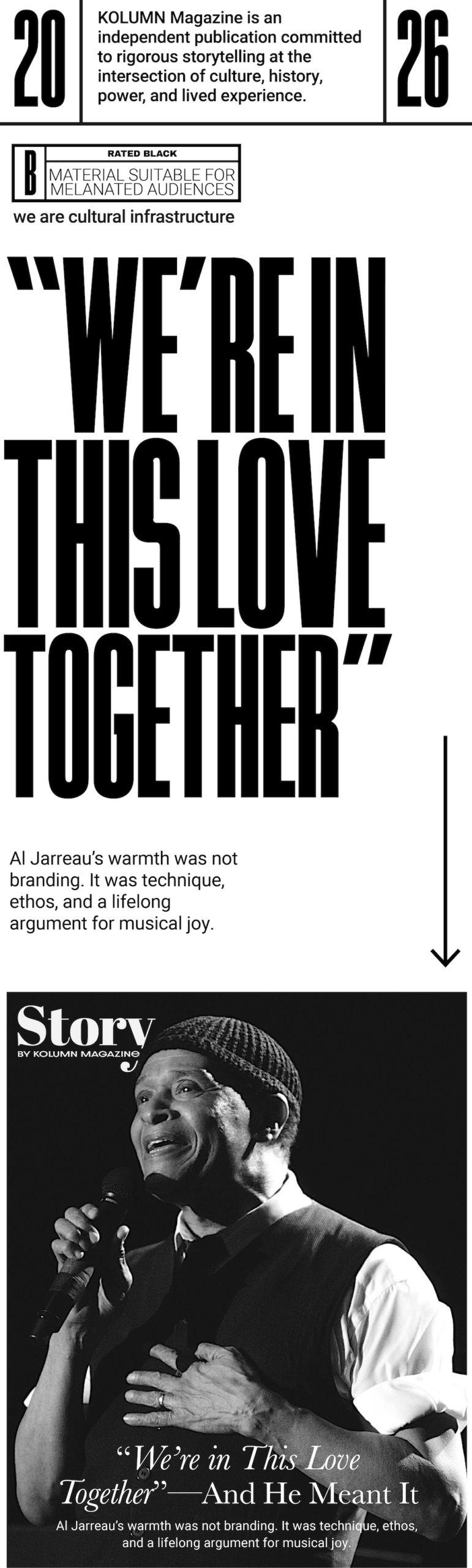
In the American music economy, genre is supposed to function like a set of street signs: jazz this way, pop that way, R&B down the block. For half a century, Al Jarreau treated those signs like scenery. He passed them at speed—sometimes with the aerodynamic ease of a radio hit, sometimes with the risk of an improviser stepping into air and trusting the ground will appear. It made him famous, it made him suspect to the guardians of taste, and it made him—quietly, unmistakably—one of the most consequential vocalists of the late 20th century.
When Jarreau died in Los Angeles in February 2017 at 76, the headlines were quick with their summaries: Grammy-winning; jazz-pop crossover; the man behind “We’re in This Love Together”; the voice of the “Moonlighting” theme; a vocalist who blurred lines. Those were all true, and also inadequate. The more precise accounting is harder to compress: Jarreau was a technician of the human voice, a rhythmic thinker, and a pop formalist who could make virtuosity sound like welcome. He could suggest a drum kit with consonants, imply horn-section punctuation with a split-second melodic jab, and still deliver a lyric as if it had just occurred to him to confess it. As the Washington Post observed in its obituary, his versatile tenor and vibrant stage style “blurred the lines between jazz, soul and pop.”
But “blurring” suggests softness, a smudge. Jarreau’s gift was not smearing boundaries so much as ignoring the premise that boundaries were needed. His voice carried an argument: the American songbook and Black church cadence and R&B sensuality and bebop daring are not separate languages. They are related dialects. If you are fluent enough—if you are brave enough—you can speak them in the same sentence.
That bravery was there at the beginning, before the awards and the television theme songs, when Jarreau was still a Midwestern kid learning what it meant to project feeling into space.
Milwaukee: The church as conservatory
Alwin Lopez Jarreau was born in Milwaukee in March 1940. He grew up in a house where music was not decoration; it was practice, duty, and communal life. Accounts of his childhood consistently return to church—his father a minister and singer, his mother a pianist—an environment that trained more American vocalists than any conservatory ever could, not by teaching scales but by teaching intention: how to move people without manipulating them, how to build an arc, how to testify without turning testimony into theater.


The church also taught him something else that would become a signature: the voice as an instrument that can imply an entire ensemble. In gospel traditions, particularly in smaller congregations or informal settings, a singer learns to carry rhythm, harmony, and narrative at once. Jarreau would later refine this instinct into a kind of vocal orchestration—bass lines implied under melody, percussive textures popping at the edges of phrases, horn-like riffs answering his own lines. But the root was simple: a child hearing that the voice is not merely a vessel for words. It is an engine.
The surprise, at least in the tidy mythology of pop stardom, is that Jarreau did not head straight for a stage. He headed, first, into formal study and a conventional career path.
The practical life: Psychology, rehabilitation, and a late turn
Jarreau attended Ripon College in Wisconsin, earning a degree in psychology in 1962, and later completed a master’s degree in vocational rehabilitation at the University of Iowa in 1964. This is the portion of his biography that reads like a detour until you understand it as training. Psychology and rehabilitation work are, at their best, professions of attention: listening closely, observing patterns, responding to what is actually happening rather than what you assumed was happening. Those are also the foundations of improvisation.
After graduate school, he relocated to San Francisco and worked as a rehabilitation counselor while singing at night. It is tempting to treat this as a romantic narrative—by day, a modest professional; by night, a future star—yet the deeper point is what the dual life required: discipline. The kind that makes a voice reliable, night after night; the kind that makes a performer patient enough to build a style instead of chasing a role.
San Francisco in the 1960s and early 1970s was also an ideal laboratory for someone like Jarreau: musically adventurous, culturally fluid, less beholden to East Coast jazz gatekeeping or Los Angeles industry categories. He began to be known in clubs, developing what listeners would later recognize as his signature approach—part scat, part wordless melody, part rhythmic commentary.
One story that recurs in Jarreau’s early career accounts is his collaboration with guitarist Julio Martinez in a duo format that gave him room to expand his vocal architecture: when there is no band behind you, you must be your own rhythm section, your own horn stabs, your own atmosphere. The duo context helped turn his voice into a full arrangement. Later retrospectives have noted how this setting allowed him to lay down implied bass lines and imitate horns, transforming familiar standards into extended improvisations.
In other words: before Jarreau became a star, he became a system.
The first leap: From clubs to records
By the mid-1970s, Jarreau’s reputation had reached beyond local scenes. He was signed to a major label and released We Got By (1975), a debut that announced his central paradox: a jazz singer with pop lucidity, a technician with a natural grin, an improviser who understood the value of a hook. Two years later, Look to the Rainbow—a live album—won him a Grammy for Best Jazz Vocal Performance, establishing him as a serious figure within the jazz establishment even as his instincts pulled him toward broader audiences.
This early period is crucial for understanding why Jarreau’s later mainstream success did not feel like capitulation to many of his fans. He did not “cross over” because he ran out of jazz options. He crossed because his musical mind was already built for synthesis. The public simply caught up.
Still, synthesis has enemies. The moment a musician can be filed neatly, critics can defend the file. Jarreau was unfileable. That meant he would be adored—and questioned—often in the same breath.
The central tension: The jazz purists and the pop tastemakers
To listen to Jarreau is to hear an artist refusing the idea that credibility and pleasure must be traded against each other. His songs are often bright, even glossy, but the singing inside that gloss is fiercely intelligent. This, predictably, created a two-front war.
The Guardian’s obituary captured the dynamic with unusual clarity, noting that jazz cognoscenti could be “snooty about his commercial leanings,” while pop tastemakers were skeptical of his jazz side—yet by the third decade of his career he had ample opportunities “for the last laugh.” The line lands because it names something many artists experience but few survive: being doubted for being plural.
Jarreau did not win by converting the skeptics. He won by building an audience that did not care to ask permission.
Breakin’ Away: Virtuosity as radio language
If Jarreau’s early records established him as a master, Breakin’ Away (1981) made him a star. It also became a kind of proof-of-concept for an idea that seems almost impossible now: that an artist could bring the vocabulary of jazz improvisation into adult contemporary and pop radio without sanding it down into blandness.
The album’s era matters. Early 1980s mainstream pop was increasingly shaped by studio sheen and genre segmentation. Jarreau’s answer was not to reject sheen, but to inhabit it differently—to use polish as a delivery mechanism for rhythmic complexity and vocal daring. The record produced enduring songs, including “We’re in This Love Together,” whose warmth is inseparable from its craft: the vocal sits inside the groove like a dancer who knows exactly how close to the edge he can lean without falling.
The industry rewarded him. Jarreau won a Grammy for Best Male Pop Vocal Performance for Breakin’ Away, a formal acknowledgment that his voice could carry pop not as a compromise but as a legitimate home.
But the true achievement was subtler. Jarreau made the improviser’s mindset legible to listeners who might never have purchased a jazz record. He taught them, without a lecture, that play and precision can coexist.
The voice as ensemble: Scat, percussion, and the art of sounding like a band
Descriptions of Jarreau often reach for metaphors—“acrobat,” “gymnast,” “instrument.” The metaphors are not wrong; they are simply trying to keep up with what he did technically.
His scat singing was not mere decoration or a bravura encore. It was compositional. In performance settings—especially stripped-down arrangements—he could imply multiple layers: a bass figure suggested beneath the melody, rhythmic consonants acting like hi-hat and snare, horn-like syllables punching accents at the ends of bars. KQED’s remembrance noted how duo performance gave him space to develop trademark scatting while laying down his own bass lines and imitating horns.
Importantly, this technique was never cold. Jarreau’s gift was making technique sound like personality—like humor, flirtation, empathy. He performed virtuosity as if it were hospitality.
This may be why his live shows became central to his legend. Jarreau was an artist whose recordings could impress, but whose performances could convert. The stage let him demonstrate the full architecture of his musical mind, minute by minute.
The 1980s: Pop visibility without losing jazz intelligence
After Breakin’ Away, Jarreau’s profile expanded. Albums like Jarreau (1983) produced hits—“Mornin’,” among them—that further embedded him in mainstream listening. His music lived on pop charts, adult contemporary playlists, R&B rotations, and jazz shelves, sometimes simultaneously, often confusing the people whose job was to keep those shelves separate.
And then there was television.
Jarreau sang the theme for the 1980s series Moonlighting, adding another layer to his public identity: not just a singer of records, but a voice that could enter the living rooms of millions as atmosphere and signature. The theme song became a cultural marker—one of those pieces of music that can evoke a decade instantly, a reminder that Jarreau’s sound was not niche even when it was musically sophisticated.
His presence in the 1985 charity single “We Are the World” further situated him in the era’s pop-civic pageantry: a vocalist called upon not merely for fame but for distinctive color.
This is where the story of Al Jarreau risks being flattened into nostalgia: a sequence of recognizable titles and cameo moments. But the deeper narrative is about how he carried his musicianship through the machinery of mainstream exposure without letting the machinery dictate the terms.
A Black vocalist in the “soft” spotlight
Jarreau’s career also belongs to a particular historical lane for Black American singers—one that is sometimes undervalued because it does not fit the most familiar narratives of either struggle or spectacle.
He was not marketed primarily as a protest artist, though the Black musical tradition that shaped him has always carried social meaning. He was not packaged as an outlaw genius. He was, instead, presented—especially in the Breakin’ Away era and after—as sophisticated, romantic, technically masterful, and broadly accessible. In the racialized economy of American pop, that accessibility can be double-edged: it can mean reach, and it can mean a subtle pressure to sand down the culturally specific edges that gatekeepers fear.
Jarreau’s brilliance was that he did not need to sand. He could be palatable without being diluted because his foundations were solid: church training, jazz study, R&B feeling, and a workman’s discipline. The joy in his records is not a marketing veneer; it is an aesthetic stance. His warmth is not an act; it is a method of phrasing.
When Ebony memorialized him, it emphasized precisely this combination: the consummate performer who toured constantly and dazzled audiences, leaving behind a body of work that spanned albums, live records, and compilations. The framing matters. Jarreau’s legacy is not only a handful of hits; it is the sustained practice of performance across decades.
The musician’s musician: Collaboration and respect
Jarreau was widely regarded within the community of working musicians as a serious peer—an artist who could hang in jazz environments and still deliver in pop contexts. That respect is visible in the way institutions and musician-focused outlets spoke about him.
DownBeat’s notice of his death highlighted not only his stature but the reality of his later years—health struggles, the toll of touring, the physical cost of a life built on performance. The piece reads less like celebrity news and more like a professional community acknowledging the loss of one of its own.
Elsewhere, musician-centered reflections frequently return to his early ties with artists like George Duke and to the social fabric of his career: friendships, bands, touring circuits. The Grammys’ own archival content includes Jarreau discussing his early days with Duke, which underscores that his “overnight success” was built on years of ensemble work and scene-building.
This is a useful corrective to the simplified version of his story. Jarreau did not emerge fully formed. He accumulated craft through collaboration.
The late career: Persistence, reinvention, and the long road
A musician who achieves major mainstream success in the early 1980s can easily become trapped as a nostalgia act. Jarreau avoided that fate, in part because his instrument—the voice—continued to be a site of exploration rather than repetition. He remained an active touring artist, and his catalog extended well beyond the period most casual listeners can name.
His official biography emphasizes the continuity: education, the move to San Francisco, the shift from counseling to full-time performance, and a career defined by relentless live work. Official sources, of course, tend to celebrate rather than critique, but in Jarreau’s case they align with independent accounts on one key point: the road was central. The voice was built in motion.
A late-career touring life also reveals something about Jarreau’s relationship to audience. He was not an artist who treated listeners as consumers. He treated them as participants in the event of music-making. That attitude—generous, outward-facing—is repeatedly cited in remembrances, including WRTI’s tribute, which framed him as a versatile vocalist who “defied categorization” for decades.
The final weeks: Exhaustion, retirement, and loss
In early February 2017, news broke that Jarreau was hospitalized due to exhaustion and would retire from touring. Days later, he died. Multiple outlets reported the sequence with a somber bluntness: the body had finally asserted limits against a life spent pushing air into song.
Time reported that he had recently retired from touring due to exhaustion and died in a Los Angeles hospital surrounded by family. The Guardian also noted that he died days after announcing his retirement from touring because of exhaustion.
There is a temptation, when an artist dies shortly after “retiring,” to turn the story into fate. The more grounded interpretation is structural: touring is physically punishing, especially for vocalists whose bodies are literally the instrument. Jarreau’s career was built on live performance; the cost of that performance is part of the legacy too.
DownBeat’s reporting pointed to respiratory and cardiac issues in his later years, underscoring that this was not merely fatigue in the casual sense but ongoing health strain.
What Jarreau left behind: A method, not just a sound
It is easy to describe Al Jarreau as “unique,” and many tributes did exactly that—including The Root, which called him a “unique musical stylist” and emphasized his rare distinction as a vocalist recognized across jazz, pop, and R&B Grammy categories. But uniqueness can be a way of avoiding analysis. The more important question is: what did he actually change?
He changed, first, the expectations around what a mainstream vocalist could do rhythmically. Jarreau did not treat rhythm as accompaniment; he treated it as content. His phrasing often behaves like a drummer’s mind inside a singer’s body—syncopations that feel conversational rather than academic.
Second, he expanded the emotional palette of “smooth” music. Jarreau’s warmth was sometimes mislabeled as softness, as if tenderness were the absence of edge. In reality, tenderness was his edge—an insistence that mastery need not announce itself as aggression.
Third, he modeled a career strategy for plural artists: you can live between categories if you are willing to accept that category-keepers will misunderstand you. The Guardian’s framing of him as someone doubted by both jazz and pop tastemakers, yet ultimately vindicated by longevity, speaks to that.
And finally, he offered a lesson that is both musical and civic: generosity is not sentiment. It is practice. It is the willingness to make room for listeners inside complexity.
The problem of summarizing him—and why it matters
Obituaries tend to settle on a handful of facts: the awards, the chart placements, the famous songs. These are necessary, but they do not fully explain why Jarreau continues to matter to vocalists and listeners who were not alive when Breakin’ Away ruled adult contemporary radio.
He matters because he made a proposition: that virtuosity can be inclusive; that jazz intelligence can live inside pop pleasure; that a Black vocalist can occupy sophistication without apology; that improvisation can be a mass language if delivered with clarity and care.
In a cultural economy that increasingly rewards easy categorization—playlist moods, micro-genres, algorithmic certainty—Jarreau’s career reads like a rebuke. Not a bitter one. A smiling one. A rebuke that swings.