


By KOLUMN Magazine
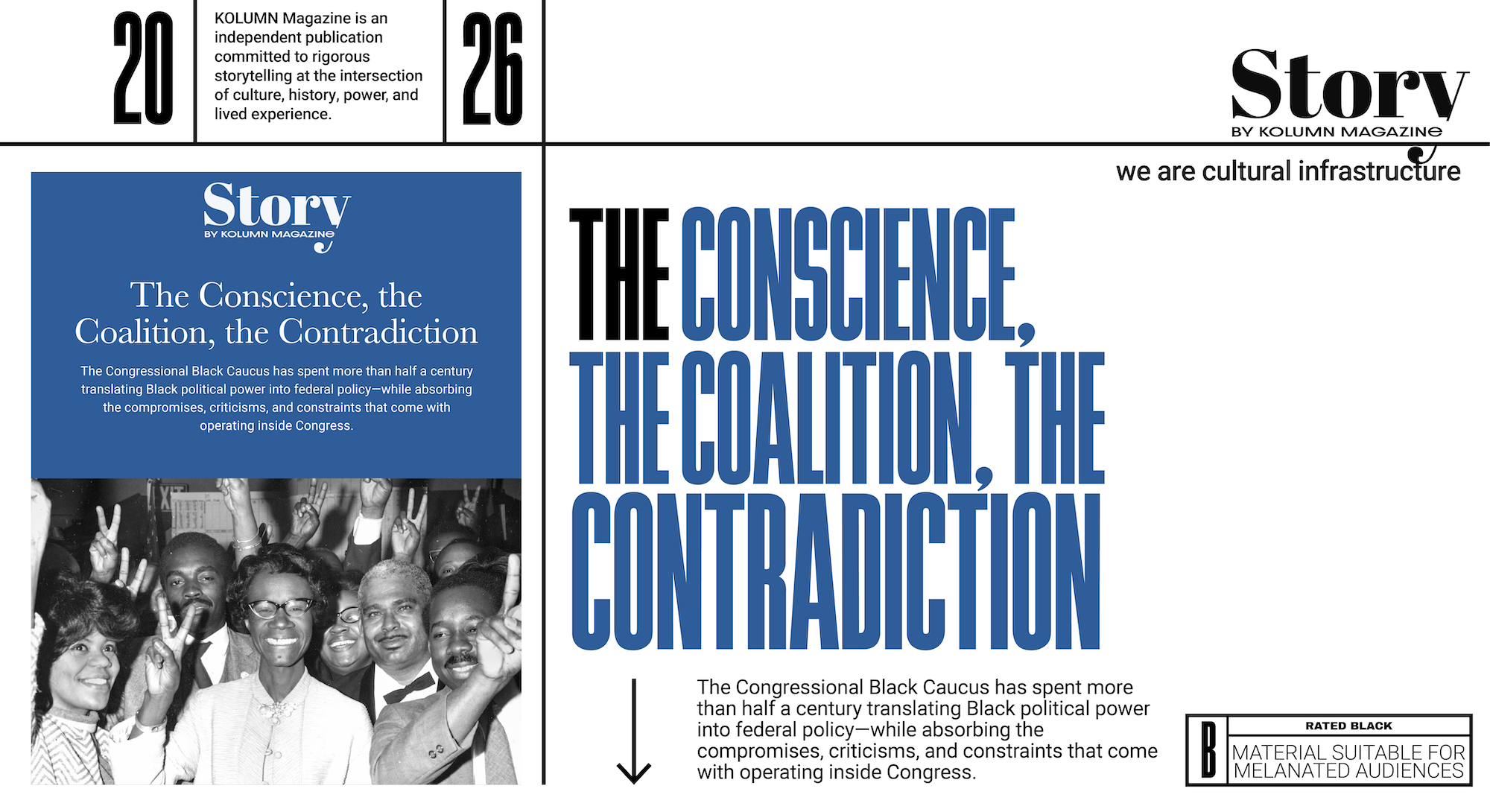
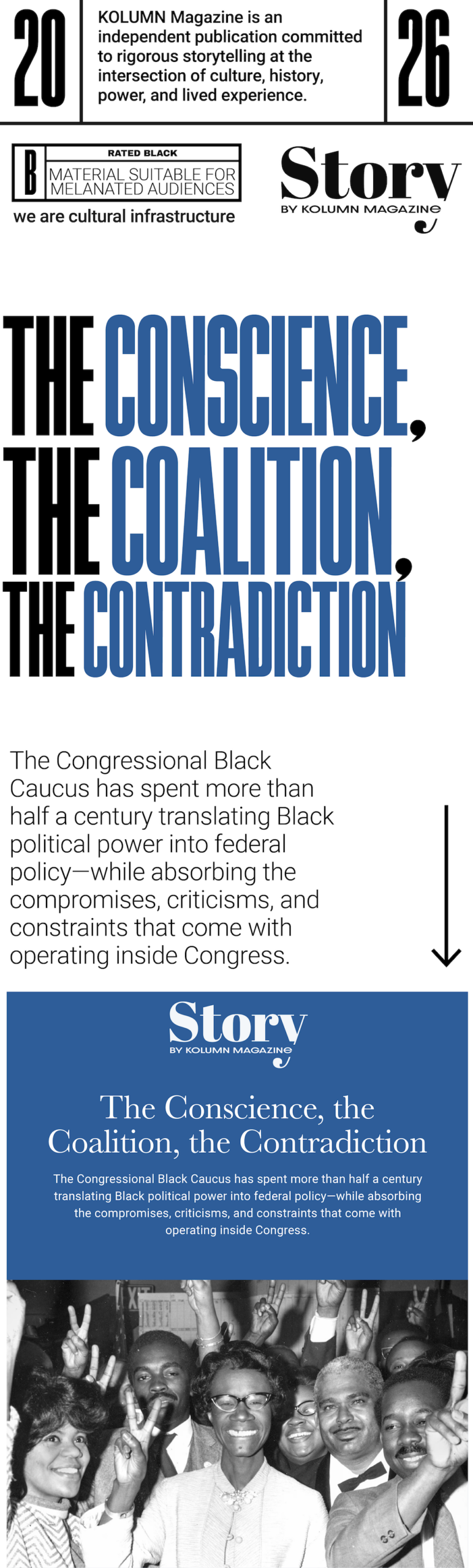
In early January, of 1971, a small delegation of Black lawmakers made a decision that, in hindsight, reads less like a scheduling choice and more like a declaration of political adulthood. President Richard Nixon had refused to meet with them. So they boycotted his State of the Union address—an act of strategic absence meant to register as loudly as any speech delivered from the House floor. When the meeting finally came, on March 25, the group arrived with a thick set of demands: job programs, judicial appointments, housing, criminal justice reforms, and an unapologetic insistence that the federal government treat Black life as a governing priority rather than a campaign-season talking point.
That confrontation, and the discipline required to stage it, captures the Congressional Black Caucus (CBC) at its best: collective leverage applied in public, policy specificity deployed behind closed doors, and a moral claim pressed into legislative form. It also foreshadows the core tension that has shaped the CBC ever since: how to be both a conscience and a caucus—an institution that speaks prophetically about injustice while working pragmatically inside the machinery that often reproduces it.
Today, the CBC is one of the most influential identity-based voting blocs in American politics—an engine of agenda-setting on voting rights, economic equity, health disparities, education, criminal justice, and foreign policy as it relates to Black life in the United States and across the African diaspora. But it is also a lightning rod: criticized at different times for being too uncompromising, too accommodating, too tied to Democratic leadership, too reliant on corporate-aligned fundraising ecosystems, and too limited—structurally and procedurally—to deliver the scale of change its constituents demand.
To understand the CBC is to study how Black political power has been organized inside Congress since the civil rights era; how power is expanded through coalition and procedure; how it is constrained by party control, Senate rules, courts, and money; and how a caucus can simultaneously be a vehicle for liberation politics and a site where those politics are negotiated down.
This is the story of an institution that began with thirteen members—thirteen—and became a governing force whose impact is often felt most acutely in the contested space between what the federal government can do and what it will do.
A founding born from both expansion and exclusion
The CBC did not appear spontaneously. It emerged from the changed political geometry of the late 1960s: the civil rights movement’s legislative wins, the Voting Rights Act era’s downstream effects on representation, and the growing presence of Black members in the House. Before the caucus was formally named, Black lawmakers organized themselves in 1969 as the Democratic Select Committee, then voted in February 1971 to transform into a formal, nonpartisan caucus—an entity meant to amplify Black legislative priorities as a collective rather than as isolated members scattered across committees.



The CBC’s official House history identifies 1971 as the establishment year and lists the thirteen founding members: Shirley Chisholm, William L. Clay Sr., George W. Collins, John Conyers Jr., Ronald V. Dellums, Charles C. Diggs Jr., Augustus F. Hawkins, Ralph H. Metcalfe, Parren J. Mitchell, Robert N.C. Nix Sr., Charles B. Rangel, Louis Stokes, and D.C. Delegate Walter Fauntroy.
Their biographies matter because their politics did not align perfectly. Some were movement-adjacent radicals; others were institutionalists fluent in committee procedure. What they shared was an understanding that representation without coordination is a kind of political mirage: you can have Black faces in Congress and still lack the organized power to force Congress to act.
The early Nixon episode became an origin story because it clarified the CBC’s theory of change. They did not win merely by speaking; they won by making themselves costly to ignore.
The CBC as a legislative instrument, not simply a symbol
A caucus is not a committee. It does not draft law by itself, mark up bills, or issue subpoenas. Its power is relational and procedural: it coordinates votes, sets expectations, pressures leadership, frames narratives, and uses visibility to turn issues into priorities. The CBC is best understood as an internal governing institution—one that operates through agenda documents, budget blueprints, coalition bargaining, and public discipline.
A political-science-oriented reading of the CBC emphasizes the same point: to win in a polarized Congress, the caucus must be strategic about when to obstruct, when to negotiate, and how to convert moral urgency into legislative bargaining power.
Over time, the CBC developed several recurring modes of influence:
1) The policy agenda as contract.
The caucus frequently produces formal policy priorities and budget alternatives that signal not only what it wants, but what it will bargain for.
2) Coalition politics as multiplier.
Because a caucus’s votes matter most when margins are tight, the CBC has historically built alliances with other caucuses and ideological blocs to scale influence—an approach documented in coverage of its coalition-building as the caucus expanded in the early 1990s.
3) The “must-pass” strategy.
CBC leverage is often greatest on deadlines: budget deals, disaster aid, government funding, debt-limit moments—when leadership needs votes and time is short. Reporting on the Flint water crisis funding fight in 2016, for example, described the CBC as a driving force in dramatic standoffs, pressing to secure resources through a broader budget agreement.
4) The outside-inside model.
The caucus often moves in tandem with civil rights organizations, community groups, and advocacy networks—absorbing external demands and translating them into legislative language, while also absorbing criticism from the same movements when congressional outcomes fall short.
South Africa and the moral reach of domestic power
One of the CBC’s most enduring claims to global impact is its role in the U.S. legislative campaign against apartheid in South Africa. Shortly after the caucus’s inception, CBC members began introducing anti-apartheid legislation. A CBC-affiliated archival exhibit notes that in 1972 Rep. Ronald Dellums sponsored the CBC’s first bill concerning apartheid, establishing the caucus’s position and support for Black South Africans. Over the following years, CBC members sponsored more than fifteen bills designed to pressure South Africa and reduce U.S. complicity.
The point is not simply that CBC members “cared” about apartheid; it is that they treated international human rights as a legislative question, tied to U.S. finance, trade, and diplomatic posture. The broader anti-apartheid struggle in Congress culminated in landmark sanctions legislation in the mid-1980s—part of a U.S. political realignment on South Africa that involved activists, churches, students, and lawmakers..
In this sense, the CBC helped expand the meaning of Black political representation. It was not only about local constituent services or domestic civil rights enforcement; it was about leveraging U.S. power to contest global anti-Black governance.
That legacy still echoes in contemporary analyses of CBC influence on foreign policy—work that frames CBC members as thought leaders pushing Congress to make room for democratic debate about U.S. posture toward the African continent, global Black communities, and human rights.
Budget power: A “Black Caucus Budget” as governing philosophy
If the anti-apartheid campaign demonstrates the CBC’s moral reach, the caucus’s budget work demonstrates its governing ambition. For decades, the CBC has issued alternative budgets—documents that function as both policy statement and negotiating position.
Outside budget analysts have described these CBC alternatives as part of a long tradition: fiscally framed, but morally explicit, prioritizing health care access, education, job creation, and safety-net protection.
A CBC budget outline from the 2010s, for instance, explicitly describes deficit reduction targets alongside infrastructure and jobs investments and tax fairness proposals—illustrating how the caucus has sought to contest the frequent Washington assumption that equity and fiscal responsibility must be traded against each other.
This is one of the CBC’s underappreciated impacts: it has insisted, in a medium Congress understands—numbers—that racial equity is not a “special interest” add-on. It is a baseline test of governance.
From moral protest to institutional survival: The 1995 crackdown on legislative service organizations
The CBC has also had to fight for its own institutional survival. In the mid-1990s, House Republicans moved to eliminate taxpayer-funded “legislative service organizations.” In House Resolution 6, adopted at the start of the 104th Congress, Section 222 prohibited the establishment or continuation of such organizations.
This mattered because it targeted the infrastructure that helped caucuses function—office support, staffing capacity, institutional presence. The CBC, like other groups, had to adapt to a new reality: operate as an informal member organization without the same support model. Congressional Research Service analyses of Congressional Member Organizations (often called caucuses) explain how these informal organizations function and how House rules shape their activities and limitations.
In plain terms: the CBC’s influence has never depended solely on moral authority. It has depended on organizational capacity—staffing, coordination, research, convening power. Restrict the infrastructure and you constrain the work.
The CBC Foundation and the rise of “CBC Week”
If the CBC is the legislative body, the Congressional Black Caucus Foundation (CBCF) has become a parallel institution: policy research, leadership development, and the annual convening ecosystem that many people shorthand as “CBC Week.” The CBCF’s Annual Legislative Conference (ALC) describes itself as a leading policy convening on issues impacting Black communities, a platform where lawmakers, advocates, and business leaders gather.
The conference and the foundation’s broader programming also reveal a modern reality: in Washington, influence is built not only through floor votes, but through convening—creating the rooms where agendas form, alliances harden, and policy ideas become “serious” enough to be funded and advanced.
CBCF also openly solicits corporate partnerships and sponsorships, positioning such relationships as strategic support for its programs and events.
This has produced a recurring debate—one that trails the CBC and its broader orbit: whether corporate sponsorship and affiliated fundraising structures expand Black political capacity or entangle it.
Critics have argued that sponsorship-heavy ecosystems can blur lines and create incentives misaligned with grassroots needs. Reporting and commentary over the years have questioned corporate influence around the conference and the reputational benefits companies gain through proximity to Black lawmakers. (The American Prospect)
Supporters counter that in a political system where power is built through institutions, convenings, and research capacity, the foundation’s funding model sustains the infrastructure needed to compete.
Both claims can be true at once. The deeper question is not whether money matters—it does—but how an institution built to advocate for communities historically excluded from capital navigates the reality that capital is often the toll road to influence in Washington.
The CBCPAC and the accountability problem that never goes away
A related—and often conflated—debate surrounds the Congressional Black Caucus Political Action Committee (CBCPAC), which exists explicitly to support candidates and increase Black representation, including by backing non-Black candidates aligned with its priorities.
The CBCPAC has faced public scrutiny over board composition and industry ties. In 2016, for example, criticism highlighted concerns about corporate entanglements and the optics—sometimes the substance—of relationships with industries seen as harmful to Black communities.
These critiques reflect a broader political dilemma: representation gains can be financed in ways that complicate policy credibility. In a system saturated with money, a caucus dedicated to expanding Black power must decide what kinds of financial alliances are tolerable, what costs they impose, and how transparently those costs are disclosed.
Critique from the left, critique from within: “Clout” and its limits
There is a temptation in American political storytelling to measure caucus impact like a scoreboard: how many bills passed, how many programs created, how many dollars delivered. The CBC has wins on that scoreboard—some visible (like funding fights), some embedded in the text of sprawling legislation.
But the caucus’s critics—often on the left—argue that Black representation has not reliably translated into Black policy outcomes at the scale required, and that Black lawmakers can be structurally marginalized even when their numbers rise.
A widely circulated argument in national political analysis has framed this paradox starkly: more Black members in Congress does not automatically mean more ability to enact Black policy priorities, especially in an era of polarization, party discipline, and procedural veto points.
At other moments, critiques have targeted perceived institutional drift—arguing the CBC can become too aligned with party leadership or too focused on access politics rather than insurgent agenda-setting.
These critiques are not merely ideological. They are empirical claims about how power works in Congress:
The House can pass bills the Senate will not.
The Senate can stall bills indefinitely.
Courts can invalidate enforcement mechanisms.
Party leadership controls floor time, committee assignments, and what gets a vote.
Lobbying ecosystems can influence the policymaking environment long before a bill is introduced.
Within those constraints, caucuses often win by extracting concessions in larger deals—work that is real but less narratively satisfying than sweeping standalone victories.
The CBC and voting rights: The long arc and the recurring emergency
It is difficult to tell the CBC story without returning to voting rights repeatedly, because the caucus’s very existence is downstream of voting rights victories—and because contemporary voting fights have become one of the central arenas where the caucus asserts both moral and procedural urgency.
The CBC has repeatedly marked anniversaries and crises around voting rights, framing contemporary restrictions and structural barriers as part of an ongoing contest over political equality rather than as episodic disputes.
In recent years, “CBC Week” programming and allied public messaging have also centered voting as a defining question—reminding audiences that voting is not self-executing, and that rights can erode through policy, courts, and administrative design.
That insistence—that democracy requires maintenance—is one of the CBC’s most consistent throughlines: it treats the right to vote as an infrastructure issue, not simply a moral ideal.
Symbol, substance, and the politics of performance
The CBC operates in a media environment that rewards images. Sometimes the images help. Sometimes they distract.
The 2020 moment when Democrats wore kente cloth stoles during a public tribute connected to the introduction of policing reform legislation illustrates the risk: symbolic gestures can be interpreted as solidarity, appropriation, performance, or all three simultaneously. Some coverage emphasized backlash and the critique that symbolism can overshadow policy.
The deeper issue is not fabric. It is the recurring demand placed on Black political institutions: to be both morally legible and legislatively effective, while operating under constant symbolic scrutiny.
The CBC’s impact cannot be assessed solely by its aesthetics, and yet it cannot escape aesthetics either—because Black politics in America is routinely judged as theater even when it is lawmaking.
The CBC’s practical victories: Leverage in narrow margins
When the CBC is most effective, it often looks like this: leadership needs votes; a deadline approaches; the caucus identifies a concrete, fundable demand; it refuses to move without it; it uses public messaging to frame the demand as a moral necessity rather than a parochial request.
The 2016 Flint water crisis funding fight is an example of that “must-pass” approach being recognized publicly as power: CBC pressure contributed to movement on a critical issue through a broader legislative deal.
This kind of victory is not always clean. It is negotiated, often partial, and frequently requires trading immediate gains against longer-term goals. But it demonstrates how a caucus converts membership size into leverage—especially when margins tighten.
Ethics scrutiny and unequal exposure
CBC members have also navigated a distinct political hazard: ethics investigations and media scrutiny that can function—intentionally or not—as a form of political containment. Analyses of congressional ethics enforcement have noted disproportionate attention to Black lawmakers at various times, raising questions about whether oversight is evenly applied and how reputational risk shapes legislative power.
This intersects with a broader CBC challenge: because it is a visible bloc, scandals involving individual members can be used—fairly or not—to discredit the institution as a whole, or to imply that Black political representation itself is suspect.
The CBC’s survival strategy has therefore always included reputational management: not only advancing policy, but protecting the institutional legitimacy needed to keep advancing policy.
What impact looks like when it is not a headline
The CBC’s impact is not only the bills with “CBC” in the press release. It is also:
Language inserted into large packages,
Oversight pressure applied through letters, hearings, and public coordination,
Federal dollars steered toward historically neglected needs,
Coalition work that changes the boundary of what is politically possible inside a party,
and the slow normalization of the idea that racial equity is a federal responsibility.
Even the caucus’s internal existence changes Congress. It creates an organized bloc whose members can coordinate quickly, develop unified negotiating positions, and signal to party leadership that Black voters and Black policy priorities are not peripheral.
That institutional change is hard to quantify, but it is real.
The CBC’s enduring contradiction: Governing inside a system built without you
The CBC was born because Congress needed an internal institution to force itself to address Black life as a matter of governance. That need has not disappeared; in many ways, it has intensified.
And yet, the CBC is not a government. It cannot unilaterally deliver justice. It operates within a system defined by veto points, donor networks, partisan warfare, and media economies that often prefer conflict to complexity. Its wins are often incremental because that is how Congress is built. Its compromises are sometimes painful because compromise is the price of legislating at all.
The CBC’s critics are correct that representation is not liberation. They are also correct that institutions can drift, and that proximity to power can reshape priorities. The CBC’s defenders are correct that without organized power inside Congress, even partial wins become harder to secure—and that the caucus has repeatedly proven it can move federal policy, especially when it plays the leverage game well.
The truth is that the CBC is simultaneously a vehicle for Black policy ambition and a map of America’s governing limits.
It is an institution that has spent more than fifty years doing what Black political organizations have often been forced to do: fighting for the future while negotiating with the present.
And in that sense, its most durable impact may not be any single bill or budget outline, but the precedent it set in 1971: Black lawmakers acting as a bloc, insisting on a meeting, arriving with demands, and reminding the country that moral urgency is not separate from governance—it is supposed to be the reason governance exists.