

By KOLUMN Magazine
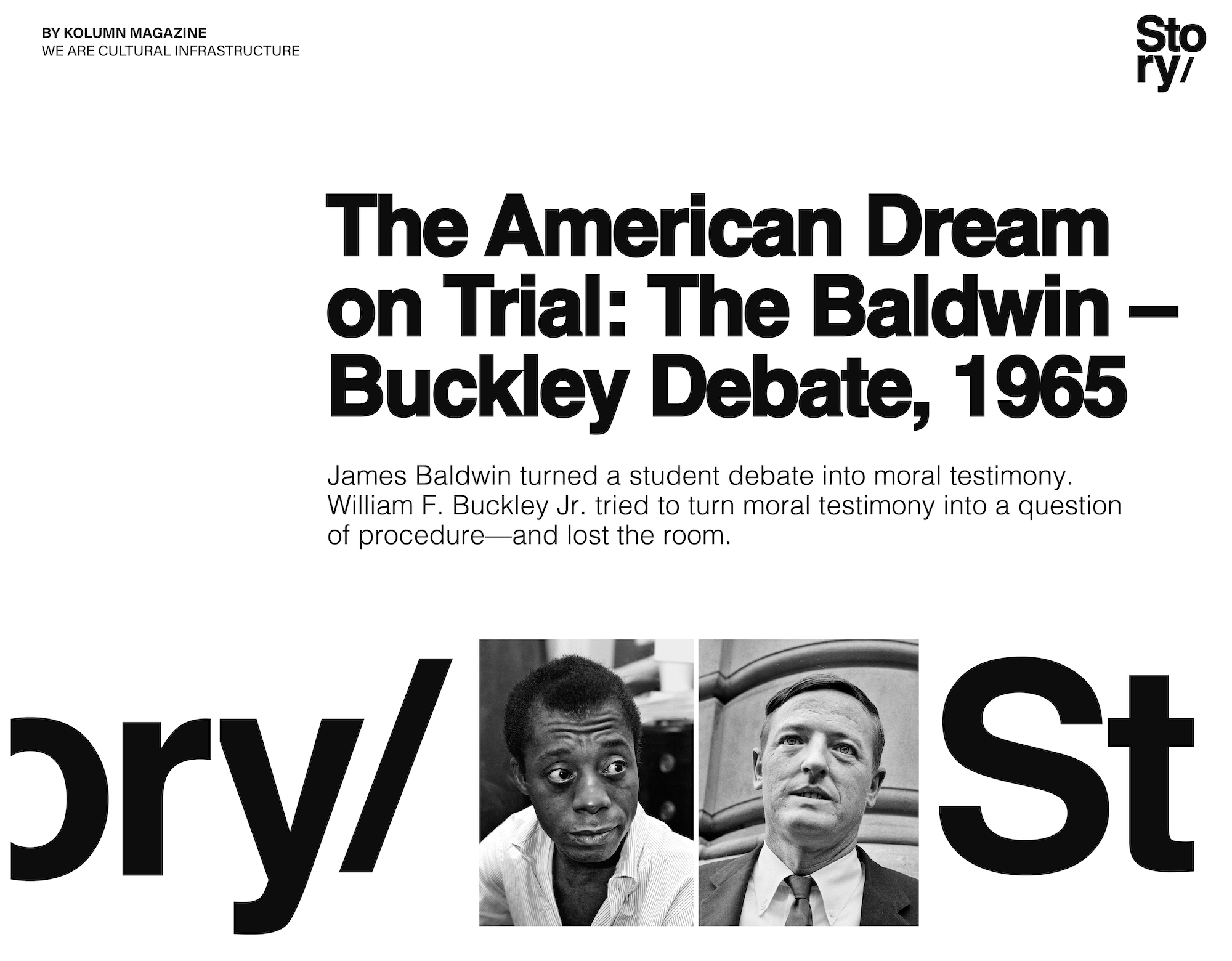
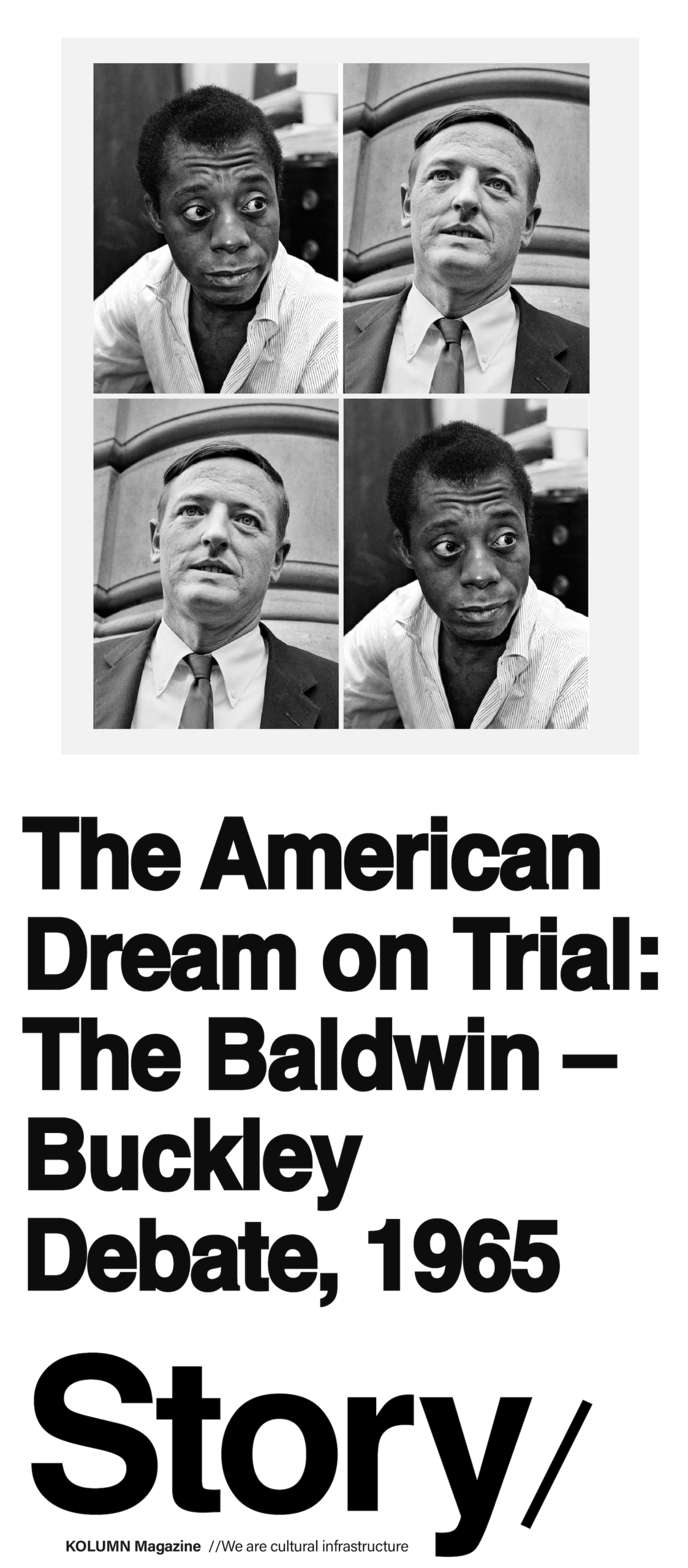
On the evening of February 18, 1965, inside the Cambridge Union—a chamber designed to flatter British parliamentary tradition—America’s most enduring argument about itself was staged as a polite proposition. The motion was blunt: “The American dream is at the expense of the American Negro.” James Baldwin, already among the most piercing moral writers of his century, spoke in favor. William F. Buckley Jr., the patrician impresario of postwar conservatism, spoke against. It was broadcast by the BBC and recorded for rebroadcast; it has since become one of the most watched, cited, reenacted, and re-litigated public debates on race and American identity.
The temptation, in revisiting the event now, is to treat it like a period piece: midcentury suits, a formal lectern, an audience of students whose accents and laughter locate the scene safely across the Atlantic. Yet the debate refuses to stay in its year. That is partly because Baldwin and Buckley were not merely arguing policy. They were arguing epistemology—how to know what America is, what counts as evidence, and who is authorized to name reality. Baldwin arrived prepared to testify. Buckley arrived prepared to cross-examine. Between those two approaches, the American conversation about race has ricocheted for decades.
The outcome that night was lopsided. When the vote was counted at the Union, the “Ayes” carried the motion by a wide margin—numbers that have become part of the debate’s legend. But the deeper verdict was not the tally; it was the shift in atmosphere that viewers can still feel through the grainy recording. Baldwin’s performance, calm and unsparing, made the motion sound less like a thesis than like an invoice long overdue. Buckley’s response—agile, performative, and frequently irritated—made him sound less like an opponent of racism than like a custodian of a civilizational narrative who resented being asked to account for its costs.
The exchange occurred during a hinge moment in the civil rights era. The Civil Rights Act had become law the previous summer. The Voting Rights Act was still months away. Baldwin’s speech was delivered only three days before Malcolm X was assassinated in New York; Selma and the national drama over voting rights were cresting. In that sense, Cambridge hosted a concentrated version of America’s crisis—exported, temporarily, to a venue that could treat it as a set-piece of ideas, even as it was unfolding in bodies, ballots, and blood.
A stage built for sport—and seized for testimony
The Cambridge Union’s format is designed for competition: alternating speakers, points of information, rhetorical flourish, a finish line measured in votes. Buckley, a practiced debater and television performer, understood that world instinctively. Baldwin, by contrast, had spent much of his career interrogating the very conditions under which Americans were permitted to “debate” Black life—who got to define the terms, who got to demand civility, who got to keep the conversation in the realm of abstraction. What made the night extraordinary is that Baldwin stepped onto a stage built for sport and transformed it—without theatrics—into a moral proceeding.



Baldwin did not begin with statistics. He began with location and identity: what it means to be born into a country whose myths, institutions, and daily practices have “not in its whole system of reality evolved any place for you,” as one widely circulated transcript renders it. The claim was not that the American dream had failed due to a regrettable lag in implementation. The claim was more corrosive: that the dream, as historically lived, required a caste of people to be excluded, exploited, or rendered invisible so that others could feel innocent while prospering.
For Baldwin, that innocence was not merely a private moral flaw; it was an organizing principle. The country’s self-image depended on stories it told about itself—stories in which prosperity appeared as merit, safety appeared as order, and the violence required to maintain racial hierarchy appeared either as local aberration or necessary discipline. Buckley’s job that night, whether he framed it that way or not, was to protect innocence from indictment.
Buckley did not deny American racism outright. Instead, he attempted something subtler: he argued that the motion was “loaded,” that it depended on where one “find[s] yourself in the world,” and that the “American dream” had furthered freedom rather than feeding on Black suffering. This maneuver—acknowledging injustice while contesting causality and scale—would become a familiar pattern in later decades: concede the existence of discrimination but resist the implication that it is structural, foundational, or morally binding on the beneficiaries of the system.
Baldwin’s argument: The dream as extraction, not aspiration
To understand why Baldwin’s side carried the room, it helps to see how he treated the phrase “American dream.” He did not treat it as a motivational slogan. He treated it as a material project—a long historical process by which the nation built wealth, identity, and global power through systems that extracted labor and denied personhood. Baldwin’s point was not that white Americans were uniquely evil, but that they were uniquely committed to not knowing what they had done and what they continued to benefit from.
In the most quoted portions of Baldwin’s speech, he describes the distance between national myth and Black experience without raising his voice. The dream, he suggests, is achieved not simply alongside Black deprivation, but through it—through the labor of enslaved people, through the political bargains of Reconstruction’s collapse, through housing and employment systems that created white advantage as a default setting, through policing and punishment that enforced the boundary lines. Baldwin’s language repeatedly returns to a theme that is more psychological than legislative: the need of white America to believe in itself as innocent, and the cost of that need to those forced to live as evidence against it.
This is one reason the debate has remained potent. Baldwin’s argument is not easily solved by incremental reforms, because it is not only about laws. It is about the nation’s imagination—what it can bear to admit about its origins and its present.
Yet Baldwin was not merely diagnosing. He was warning. If the country continued to require Black people to absorb its contradictions—prosperity built on inequality, freedom narrated through exclusion—then the country would not remain stable. The danger, as Baldwin often wrote elsewhere, was not Black rage as a pathology. The danger was the nation’s refusal to mature: its insistence on myth over reckoning.
In later commentary, journalists and historians have noted that Baldwin’s persuasive force came from the way he fused personal experience with structural analysis. He made it difficult to retreat into the idea that the civil rights struggle was an unfortunate regional conflict or a temporary disorder. He cast it instead as a national problem and a national responsibility.
Buckley’s argument: Civilization, order, and the politics of distance
Buckley’s reply is often summarized, especially by admirers of Baldwin, as a failure—an evasion delivered with flourish. That is true in part, but it risks missing the historical significance of Buckley’s performance. Buckley did not arrive as a random foil. He arrived as the editor of National Review and a key architect of an emerging conservative coalition that would spend decades contesting the moral authority of civil rights demands. In Cambridge, he was not only debating Baldwin. He was rehearsing a broader political style: to treat claims of systemic racism as rhetorical excess, to frame the nation’s racial crisis as a question of patience and procedure, and to insist that moral indictment itself is a threat to the “rule of law.”
Buckley attempted to reposition the debate away from Baldwin’s central terrain—lived experience as evidence—toward a terrain where he had more control: comparative claims about progress, civilization, and the dangers of radicalism. He suggested that the motion’s framing was unfair, that the dream was helping Black Americans, and that the real problem was not the dream’s structure but obstacles—cultural, political, even ideological—that hindered its universal application.
At points, Buckley also aimed at the audience, implying that their enthusiasm for Baldwin was a kind of anti-American pageantry. That impulse would follow him afterward; accounts of the debate often note Buckley’s later insistence that the crowd’s predisposition made a fair contest impossible. This is a revealing move. When a debater blames the audience, he is admitting—without quite saying so—that he did not persuade the room’s moral intuition. He can still defend his position, but he cannot claim the legitimacy of victory.
Buckley’s rhetoric that night also illustrates a more enduring dynamic: how American conservatism often responded to civil rights claims by shifting focus from outcomes to intentions, from structures to individual behavior, from harm to decorum. If Baldwin’s core claim was that Black people had paid for the dream, Buckley’s counter was to dispute the accounting method: Who can say what “paid for” means? Compared to whom? Over what time horizon? Under what definition of progress? It is a strategy that can perpetually delay moral reckoning, because it treats the nation’s debt as a matter of semantics.
The vote, the footage, and the afterlife of a single hour
The Cambridge Union vote is frequently cited as proof that Baldwin “won.” But debates are not prizefights, even when they resemble them. The more important question is what, precisely, Baldwin won—and what Buckley preserved despite losing the room.
Baldwin won the immediate moral clarity. He made it embarrassing to pretend the motion was merely provocative rather than descriptive. He also exposed, in front of a sympathetic but not American audience, the fragility of American innocence: how quickly the defense of the “dream” turns into frustration with the people who insist on naming its costs. The debate’s recording, widely circulated online and rebroadcast across years, ensured that the moment did not remain private to the room.
But Buckley won something else—something the vote could not measure. He demonstrated that it was possible to meet a sweeping moral indictment with a performance of procedural skepticism, and that this performance could be styled as sophistication. Over time, that posture would become an asset in American political life: the ability to sound reasonable while refusing to concede structural responsibility.
The debate’s afterlife has been amplified by later interpretations—most prominently Nicholas Buccola’s The Fire Is Upon Us, which frames the Cambridge clash as both a centerpiece and a lens for the broader struggle over race and political ideology in America. Popular treatments have also returned to the debate as a cultural artifact that “still matters,” not because it contains a single decisive argument, but because it captures the roots of today’s rhetorical divide.
The debate has even become theater—literally. Reenactments and stage adaptations have treated the speeches as script, inviting audiences to observe how language, posture, and institutional setting shape what counts as persuasion. The very fact that the event can be reenacted underscores how it has migrated from political episode to civic myth: a scene repeatedly revisited to ask what has changed, and what has simply been renamed.
What the debate reveals about “moderation”
If one watches the footage today, a striking element is how contemporary Buckley can sound in the rhythms of his rebuttal. He is not advocating crude segregationist slogans from a street corner. He is offering a seemingly cultivated resistance to Baldwin’s framing. That is precisely why the debate remains instructive: it shows how arguments that maintain racial hierarchy can present themselves not as hatred but as “sobriety.”
Baldwin anticipated this problem. He understood that the most dangerous forms of racism were not always the most vulgar. They were the forms that could survive scrutiny by disguising themselves as neutrality, as patience, as a demand for “both sides.” In that sense, Baldwin was not only accusing America of injustice; he was accusing it of a talent for laundering injustice through respectable language.
Modern coverage of the debate often highlights how Baldwin’s moral authority cut through that laundering. What is sometimes less emphasized is the cost of needing moral authority at all. Baldwin had to be exceptional—brilliant, controlled, eloquent—to make a truth legible that millions of ordinary Black Americans lived without the luxury of an audience’s admiration. The spectacle, then, contains an irony: the nation’s debt could be discussed as an intellectual exercise only when voiced by a figure so extraordinary that listeners could treat him as an event.
The motion as a map of American arguments
The motion itself—the American dream is at the expense of the American Negro—has survived because it is both historical claim and moral challenge. It asks whether the dream is merely unevenly distributed or structurally dependent on inequality. Baldwin’s answer is unambiguous: dependence is the point. Buckley’s answer, however one judges it, shows the durability of the alternative: that the dream is fundamentally noble and merely imperfect, and that those who indict it risk harming the very civilization they seek to improve.
This is, in miniature, the argument that reappears whenever America confronts racial disparity. Are inequities evidence of structural design or of temporary failure? Is the task repair or reckoning? Are demands for justice constructive or destabilizing? The Cambridge debate did not invent these questions. It clarified the camps.
Even the setting mattered. Cambridge offered a paradoxical vantage point: a British institution adjudicating an American moral crisis. That distance may have made the motion easier to entertain honestly. It may also have made Baldwin’s testimony sound, to some ears, like revelation—something newly understood when spoken in an environment where the listener does not feel immediately indicted. Buckley, conversely, sounded like a man defending the house he lives in against criticism from a guest—even when the guest is describing the house’s foundation.
What a “win” means when the country continues
It is common to describe the debate as a moment when Baldwin “crushed” Buckley. Contemporary write-ups often adopt that frame, sometimes with relish. But the deeper lesson is more sobering. If Baldwin won so decisively, why did the country not simply follow the argument to its obvious moral conclusion?
Part of the answer lies in the nature of American change. The civil rights era produced landmark legal victories, but it did not produce a shared national narrative about why those victories were necessary. Baldwin’s argument required Americans to accept not only that racism existed, but that it was woven into prosperity and identity. Buckley’s argument allowed Americans to accept reform without accepting indictment. That bargain—change without deep responsibility—proved politically sustainable.
The debate therefore functions less as a triumphant climax than as a forecast. Baldwin described the moral price of denial. Buckley modeled the intellectual methods of denial. The decades since have shown that denial, when made elegant, can outlast eloquence.
And yet the footage endures for another reason: it records an instance of public speech that refuses despair. Baldwin did not plead for inclusion as a favor. He demanded honesty as a prerequisite for the nation’s survival. That demand remains radical because it implies that America’s problem is not only what it has done, but what it insists on believing about what it has done.
The historian’s view: Why 1965 still reads like now
In the years since Buccola’s book and renewed media attention, the debate has increasingly been treated as an artifact that “explains” present polarization. That is partly accurate, but it can flatten the historical specificity that made the moment possible.
In 1965, Baldwin was speaking as a witness to a century of post-emancipation betrayal and to a present in which Black political power was still being violently suppressed in many parts of the country. Buckley was speaking as a steward of a conservative project that, at minimum, sought to slow federal intervention in racial hierarchy—and, at times, justified it in the language of civilization and competence. The debate occurred when those positions were not yet fully sorted into today’s party coalitions, but the outlines were already visible.
Recent retrospectives emphasize that the debate’s significance lies not merely in who sounded better, but in what the exchange reveals about how Americans talk past each other: one side offering lived reality as evidence, the other side treating lived reality as insufficiently “objective,” too emotional, too sweeping, too accusatory.
If that dynamic feels familiar, it is because it persists wherever structural injustice is at issue. Baldwin’s insight was that “objectivity” is often a disguise for comfort: a demand that the oppressed translate suffering into formats that do not disturb the listener. Buckley’s skill was to treat disturbance as a rhetorical flaw rather than as a moral signal.
Why the debate remains a civic document
There are plenty of historic debates whose transcripts gather dust. This one does not, because it offers something more than a clash of personalities. It offers a model—almost a template—of two moral languages.
Baldwin’s language is relational and historical. It insists that the past is not past, that wealth and identity are inherited, and that national myths have victims. Buckley’s language is procedural and civilizational. It insists on order, on gradualism, on the danger of sweeping indictment, on the idea that moral claims must be limited by what the speaker can “prove” to an audience already inclined to doubt.
These languages continue to shape policy fights, cultural battles, and even the aesthetics of public discourse. The debate’s longevity in classrooms, documentaries, essays, and stage reenactments reflects an unsettling truth: it still feels like a live argument.
The Baldwin–Buckley debate endures, finally, because it dramatizes a question that America keeps trying to demote into a technical dispute: What does the country owe to the people it used to build itself? Baldwin answered: everything it refuses to name. Buckley answered: less than you think, and not in the way you’re asking.
The Cambridge audience voted for Baldwin. The country has spent the decades since proving that a vote is not the same as a reckoning.