

By KOLUMN Magazine
On the humid edge of dawn in Kinshasa, when most of the city should have been asleep, a stadium stayed awake on purpose. The fight had to happen at 4 a.m. local time—an hour chosen not for Zaire, but for television in the United States. That scheduling detail, often treated as trivia, is the cleanest way to understand what “The Rumble in the Jungle” really was: an athletic contest staged inside a geopolitical bargain, built to serve multiple audiences who wanted different things from the same night.
To the global boxing public, October 30, 1974 was the moment Muhammad Ali reclaimed the heavyweight championship by knocking out the undefeated George Foreman in the eighth round, using what came to be called “rope-a-dope”—absorbing punishment against the ropes, talking the whole time, and baiting the younger champion into exhausting himself. To many Black Americans and people across the African diaspora, the event was a rare mass-cultural mirror: Ali, recently returned from exile in his own country’s sporting economy, arriving in Africa as a world figure who refused to behave as the “ideal Negro” of American civic myth—quiet, grateful, and compliant. To Zaire’s President Mobutu Sese Seko, it was an opportunity to brand a regime—an effort to present political control as national renaissance, and international legitimacy as if it were a championship belt you could win by funding the right spectacle.
Fifty years on, the Rumble remains the rare sports event that functions like an archive. Watch closely and you can see modern celebrity culture being assembled; you can see the early architecture of “sportswashing” before that term existed; you can see the complicated emotional traffic between Black America and Africa—solidarity, fantasy, longing, projection—swirling around a single charismatic man in white trunks who understood the camera as well as he understood a jab.
You can also see the costs.
Two men, two narratives, one commission
The participants looked symmetrical on paper: both listed at 6’3″, both orthodox, both among the most famous athletes alive. But the symmetry ended there.
Ali arrived in Kinshasa carrying more than a record. By 1974, he had been stripped of his title and effectively barred from boxing for years after refusing induction into the U.S. military during the Vietnam War era. That ban did not merely interrupt a career; it produced a public drama about citizenship, conscience, race, and punishment. Even as his boxing prime was being confiscated, Ali became a moral and cultural symbol—beloved, contested, studied, commodified. His body was the ledger on which America kept writing its arguments about dissent.
Foreman arrived as the sport’s apparent future: a terrifying champion, gold medalist, and wrecking force who had demolished Joe Frazier to take the title and entered the Rumble undefeated with a near-mythic knockout percentage. In the public imagination, Foreman was strength without romance—less talk, more damage. That contrast mattered because the entire event was marketed as a referendum on style and spirit: Ali as art and audacity, Foreman as inevitability.
Even the mythology around “rope-a-dope” contains an instructive correction: the tactic is often remembered as a perfectly preplanned genius move. But later reporting, including biographical work and retrospective accounts, suggests Ali adapted in real time—finding a survival strategy that became a masterpiece because it worked. In other words, the most famous tactic of the night may have been less a script than a response—improvisation under extreme risk.
That matters because it humanizes the myth. It shows a man making calculations inside pain, not a magician pulling a rabbit from a hat.
Don King, Mobutu, and the invention of the modern mega-event
The Rumble’s finances and logistics were not incidental; they were the event. Promoter Don King was not yet the Don King of later decades—he was an ambitious operator selling a new scale of spectacle. The pitch was audacious: move the heavyweight championship fight to Africa, attach a music festival, summon celebrities and writers, and broadcast it as a world moment.
Mobutu’s role turned that pitch into a state project. Contemporary and later accounts describe a massive purse promise—commonly referenced as $10 million total, with Ali and Foreman paid $5 million each—underwritten by the Zairian state. The fight’s venue—20th of May Stadium, later known as Stade Tata Raphaël—was not just a building; it was a national stage.
In the simplest terms, Mobutu bought the world’s attention.
It is tempting to interpret this as a kind of benevolent cultural diplomacy, a leader bringing global sport to his people. But that reading collapses quickly under scrutiny. A Washington Post assessment years later argued that the story’s “supreme irony” is that Ali’s morally courageous public persona could be folded into political outcomes far beyond his intentions—contributing, however inadvertently, to how the West and international audiences related to Zaire and its leadership. The same piece faulted celebratory retellings for overlooking the politics and financing that shaped the spectacle.
That critique deserves careful handling: it is possible to acknowledge Ali’s symbolic power and the event’s emotional resonance without sanitizing the regime that hosted it. In fact, a grown-up retelling requires holding both truths at once. The Rumble is not less meaningful because it was politically useful. It is more revealing.
The infrastructure of the event also points to a key evolution in sports media. The fight’s timing—4 a.m. in Kinshasa—was a blunt sign that television markets were becoming the real venue. The event’s enormous viewership claims have become part of its legend; summaries commonly note the scale of live audiences and the developing economics of broadcast and closed-circuit distribution. However one treats the largest numbers, the direction of the trend is indisputable: boxing was no longer primarily a local attendance business. It was becoming a global media product.
That transformation shaped everything that followed in combat sports—and, arguably, in modern sports entertainment more broadly.
Zaire ’74: When the undercard became a cultural text
The fight was not the only magnet. In the days and weeks around it, Kinshasa became a temporary capital of Black celebrity. A concert was organized—later mythologized through the documentary “Soul Power”—as part of the broader festival atmosphere orbiting the bout. The Washington Post, reflecting on the documentary lineage, noted the long gestation of “When We Were Kings” and the sense that “Soul Power” functioned as an unofficial sequel focused on the music dimension of the Zaire trip.
Accounts from artists and observers convey a kind of delirious density: writers, musicians, athletes, and public figures colliding in hotel corridors and press events, all drawn by the gravitational pull of Ali and the idea of Africa. A Root piece quoting Bill Withers’ recollection places names in the Kinshasa Hilton—Norman Mailer, George Plimpton, B.B. King, James Brown—and describes the crowd following Ali as he performed his public self, talking constantly, feeding the spectacle.
This matters because it shows how the Rumble’s meaning was never solely athletic. Even people who came “for the fight” experienced it as something else: a convening, a pilgrimage, a live broadcast of Black global culture. Word In Black, recommending “When We Were Kings” decades later, frames the documentary’s power through Ali’s meaning to Black people globally, and reminds readers that his exile from boxing’s prime years intensified the stakes when he finally returned to take on the “invincible” Foreman.
In that sense, the Rumble was also a media experiment in bundling: sport plus music plus celebrity plus politics. Today that package feels familiar—Super Bowls with halftime shows, F1 weekends with concerts, global sports tournaments as tourism branding campaigns. In 1974, it felt like a new kind of total event.
Kinshasa as character: Pride, performance, and the city’s double exposure
Retellings that focus narrowly on Ali’s tactics often miss that Kinshasa itself was a protagonist. The Guardian, looking back at the Rumble’s fortieth anniversary, described the fight’s electricity in a city “full of pride and promise” in the early years after independence—before “the money ran out,” in a narrative that links the spectacle to longer arcs of political economy and urban change.
That line—pride and promise, then the money ran out—could describe many postcolonial national stories in the 20th century, and it points toward why the Rumble still compels writers. It is a sports narrative with visible seams: you can see ideology, cash, and coercion stitched into the canvas.
Even within celebratory accounts, the presence of the state is unavoidable. The Ali Center’s historical materials, for example, note that the fight was delayed after Foreman suffered a cut in sparring, and emphasize the eventual staging at 4 a.m. to accommodate U.S. prime time. This was an event arranged to satisfy multiple masters: athletic commissions, promoters, dictators, broadcasters.
If Ali was the star, Kinshasa was the set. And the set had its own needs: legitimacy, pride, belonging to the world.
Fight week: Psychology as a weapon
No element of the Rumble is more reproduced than the chant: “Ali, bomaye”—often translated as “Ali, kill him.” The chant is a reminder that the crowd was not neutral, and it exposes the fight’s emotional politics. Ali courted the people; Foreman did not, or could not, in the same way. TIME’s account of the build-up highlights this contrast: Ali’s charisma capturing the local population, Foreman’s intensity and relative isolation, the injury delay, and the fight’s status as a major cultural event promoted by Mobutu.
Ali understood that the crowd was not just atmosphere—it was leverage. He also understood that Foreman’s power came with a psychological vulnerability: impatience. Ali’s most famous lines were never just entertainment. They were strategy: to irritate, to unbalance, to create a fight inside Foreman’s head that Foreman could not punch his way out of.
Later reflections underline the degree to which Ali’s talk functioned as a form of governance. The Guardian’s anniversary coverage, drawing on biographical work, includes Ali’s admission that he did not “really plan” the tactic—suggesting that what looks like premeditated genius may have been a rapid adaptation, informed by confidence and the willingness to gamble with his own body.
The myth of planning flatters our desire for neatness. The truth—that great performances are often constructed under duress—makes Ali’s victory more impressive, not less.
The fight: How rope-a-dope rewrote the physics of power
The contest itself was a study in controlled disaster.
From the opening rounds, Ali did something that looked suicidal to many observers: he let Foreman hit him. Not once. Not occasionally. Repeatedly. He leaned into the ropes, covered up, and invited the champion’s most dangerous tool—the heavy, swinging force that had pulverized previous opponents—to spend itself.
In conventional boxing logic, a fighter who chooses to absorb punishment is a fighter who is losing. But Ali understood the difference between being hit and being harmed, and he trusted his own ability to shape where and how the blows landed. Over time, the ropes held him up; his guard redirected much of the damage; and Foreman’s expenditure of energy—especially in the heat—became a kind of self-administered tax.
The popularized description of these dynamics is widely available, but it remains worth stating plainly: Ali changed the win condition. Foreman’s advantage—power—became the mechanism of his exhaustion.
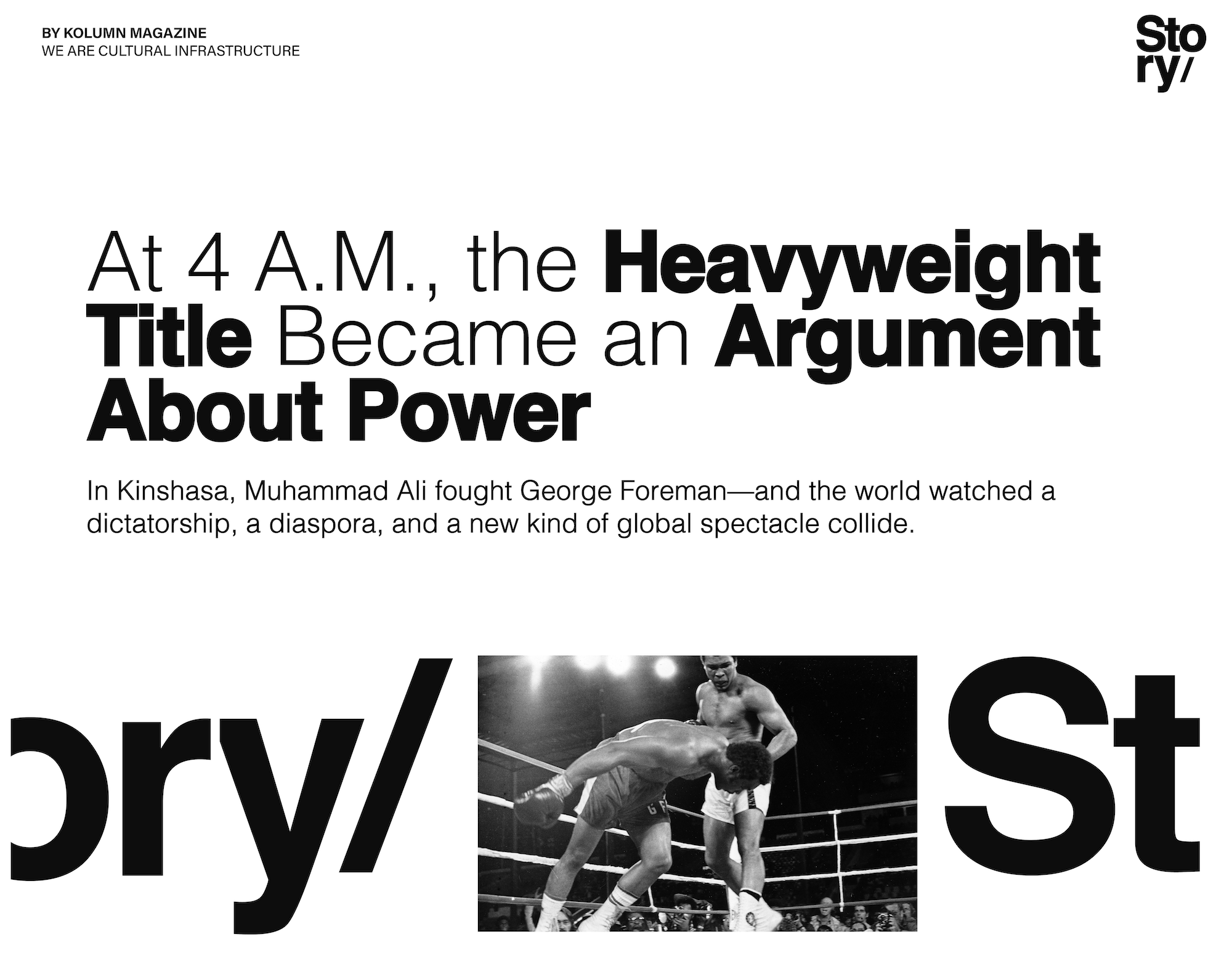
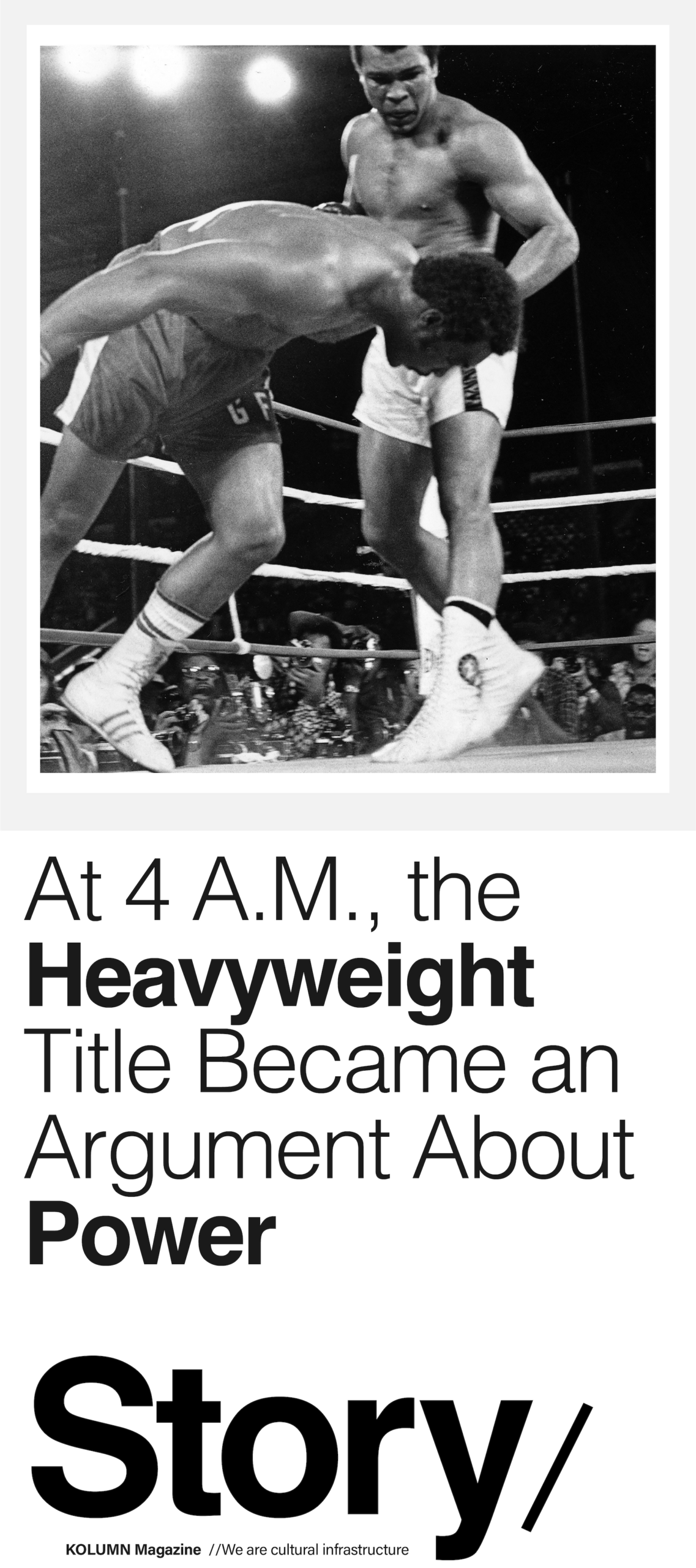
By the eighth round, as the story goes, Foreman’s attacks slowed enough for Ali to reveal the trap. A sharp combination ended with a right hand that sent the champion down. Ali reclaimed the heavyweight title, and a new boxing vocabulary entered public language.
Even the venue’s name—Stade du 20 Mai—felt like part of a state calendar; now, renamed, it anchors the event inside a longer Congolese history of memory and renaming.
The single most important journalistic task here is resisting the temptation to turn the bout into pure morality play. Ali’s strategy was brilliant. It was also dangerous. He did not win because the universe rewards courage. He won because he managed risk better than the man trying to knock him unconscious.
That distinction preserves the athlete’s agency.
“When We Were Kings”: The documentary as second fight
Most people “remember” the Rumble through film. Leon Gast’s 1996 documentary When We Were Kings did not merely document the event; it reframed it as cultural history and secured a canonical place in the public memory of Ali. Word In Black’s later roundup of essential Black documentaries describes the film’s ability to communicate what Ali meant to Black people and people of color globally, and positions the fight as the kind of legend that younger generations can struggle to fully grasp without such storytelling. The Washington Post, writing around the film’s release period, emphasized that the documentary captured not only the fight but Ali’s role in reintroducing Black Americans to African culture—an interpretive frame that became part of the event’s mainstream meaning.
But documentary canonization can produce its own blind spots. A Washington Post critique argued that some retellings, by retracing contemporary press accounts and ignoring deeper financing and political facts, miss the “supreme irony” of the story—how a morally courageous figure could be used within broader geopolitical dynamics. This is not an argument against the documentary’s artistry; it is a warning about how easily charisma can become a kind of narrative solvent, dissolving the harder questions.
If you want the Rumble in full, you need both films: the fight itself and the documentary about the fight’s meaning. And you need a third text—the political economy beneath it—because that is where the modern world is hiding.
What the Rumble meant to Black America, then—and what it means now
The Rumble occurred at a particular moment in Black American public life: post–civil rights legislative victories, amid continuing structural racism, after political assassinations, during debates over Vietnam and dissent, while Black internationalism and Pan-African imagination remained potent currents. Ali represented a refusal: he would not exchange his conscience for acceptance. That refusal, and the punishment that followed, turned him into a vessel for broader feelings about what America asks of Black excellence.
In Kinshasa, that vessel crossed an ocean and changed temperature. The event allowed millions to witness a Black American icon being embraced on African soil in a way that reversed familiar hierarchies of validation. Even if the embrace was complex—shaped by Mobutu’s staging, by crowd psychology, by the economics of the spectacle—it still mattered. The feeling was real.
Popular commentary from Black outlets continues to frame the Rumble inside this lineage. Ebony’s reporting on Foreman’s death recapitulates the fight’s basic facts—Kinshasa, October 30, 1974, the classic status—because the event remains a cultural reference point, not merely a sports statistic. The Root’s coverage of Ali’s championship belt selling for $6.18 million in 2022 illustrates how artifacts of the night remain valuable not just financially but symbolically, with writers describing the intergenerational memory of fear for Ali’s safety and astonishment at the underdog victory.
That last point—fear—deserves attention. In the lead-up, many genuinely believed Ali could be seriously hurt. Foreman’s aura was that strong. The Rumble’s emotional payload was not limited to admiration; it included dread.
When Ali won, he did more than regain a title. He defeated a prediction about what happens to men like him—men who talk too much, refuse too publicly, challenge the wrong institutions, and then dare to stand still in front of violence.
What it meant to Congo/Zaire: Visibility, extraction, and the long hangover
For Zaire, the Rumble brought visibility that states often chase: a moment when global cameras look your way and, for an instant, you are not a footnote. The Guardian’s later reporting frames the fight as a peak of pride and promise in Kinshasa’s early post-independence era, followed by economic unraveling. Another Washington Post reflection, explicitly titled to sharpen the point, argued that “Ali won the fight, but Zaire was the loser,” criticizing narratives that ignore the politics and financing and emphasizing the irony that the spectacle intersected with disastrous policy trajectories.
This is the part of the Rumble story that is least comfortable for celebratory anniversaries: visibility is not the same as benefit. A global event can extract more than it gives. It can turn a nation into scenery.
The question is not whether Zaire “should” have hosted the fight. The question is what it cost, who captured the value, and how the event fit into a governance model where image frequently substituted for accountable development.
Here, precision matters. It would be sloppy and unfair to claim the Rumble “caused” Zaire’s later crises. It did not. But it can be read as a diagnostic—a glimpse of how the regime wanted to be seen, and how global culture industries were willing to cooperate in exchange for access, money, and myth.
Foreman after Ali: Defeat, reinvention, and the afterlife of a single night
For George Foreman, the Rumble was both wound and origin story. The loss did not erase his greatness; if anything, it became the dramatic pivot that made his later reinvention legible to the public. Foreman would later experience a spiritual transformation, become a minister, return to boxing, and accomplish one of the sport’s most extraordinary comebacks by winning a heavyweight title again in the 1990s at an age when champions are not supposed to exist.
When Foreman died in 2025, obituaries and tributes inevitably returned to 1974 because the Rumble had become the defining scene through which many audiences understood him: the terrifying champion who ran into Ali’s mind. Even this framing risks flattening him, and some writers have pushed against reducing Foreman to “Ali’s victim,” reminding readers of his broader achievements and humanity.
This is one of the Rumble’s quieter legacies: it teaches how sports history can imprison as well as immortalize. A single night can become a life sentence in the public memory.
The writers, the witnesses, the performance of documentation
A distinctive feature of the Rumble is how many major literary figures were drawn to it. The event’s press corps and celebrity orbit included celebrated writers and journalists—people who treated the fight as text, not just contest. That is partly because Ali himself was text: a walking sentence, a public argument, a poem that could punch.
The Root’s Bill Withers recollection, while centered on music and celebrity proximity, captures that atmosphere: the sense of a hotel full of storytellers aware they were inside a story. TIME’s retrospective references Norman Mailer’s The Fight as one of the lasting narrative artifacts of the bout.
This matters because the Rumble’s legacy is not simply what happened; it is what was written about what happened. The event is a demonstration of how narrative can extend an athletic moment into decades of meaning. It is also a warning: documentation is never neutral. It selects, frames, and mythologizes.
The Rumble as an early case study in “global brand Blackness”
There is a phrase in modern cultural critique—sometimes used approvingly, sometimes with suspicion—about “global Blackness” as a brand: the exportable aesthetics and politics of Black identity circulating through music, sport, fashion, and advertising. In 1974, the Rumble became one of the earliest mega-events where that circulation was undeniable.
Ali’s image traveled. The chant traveled. The fight traveled. The idea that a Black American could be a world figure whose moral authority exceeded that of presidents traveled too. The Atlantic, in a later reflection on Ali’s life and context, notes the bout’s staging under Mobutu’s auspices and summarizes the rope-a-dope as the mechanism by which Ali reclaimed the title. The same publication, in other contexts, frames Ali’s victory as one of the most significant sports triumphs in modern history, explicitly tying it to his cultural and political symbolism.
But brand is never only empowerment. Brand also invites capture. Mobutu understood that associating his state with Ali’s aura could be politically useful. Promoters understood that “Africa” could function as a marketable stage for Western audiences hungry for novelty and myth. Media companies understood that globalizing the venue could globalize the revenue.
The Rumble does not resolve these tensions. It embodies them.
What responsible journalism owes this story
A responsible account of the Rumble must do several things at once.
It must respect the sport—the tactics, the physical risk, the reality that Ali’s victory was not predestined and could have gone terribly wrong. It must account for the political choreography—the dictator’s investment, the event’s timing for foreign markets, the use of spectacle as image management. It must also take seriously what the event meant emotionally to Black audiences—why Ali’s presence in Africa carried symbolic weight that cannot be reduced to propaganda.
And it must resist the easiest conclusion: that the story’s “truth” is whichever angle flatters our preferred hero. Ali can be heroic and used. Foreman can be terrifying and sympathetic. Kinshasa can be celebratory and exploited. The event can be both a communion and a transaction.
In other words, the Rumble is adult history.
The afterimage: Why this fight still feels contemporary
Modern sports are increasingly staged as geopolitical and commercial instruments. Nations bid for events not only for tourism but for legitimacy; brands pay for association with emotion; athletes are asked to perform identity as well as skill. By that measure, the Rumble looks less like a strange exception than like an early blueprint.
It also offers a useful metric for evaluating “legacy.” Many sports moments fade because they contain only sport. The Rumble persists because it contains the world: dictatorship and diaspora, commerce and culture, fear and theater, brutality and intelligence. Its most famous tactic—rope-a-dope—functions as metaphor as much as strategy: a way of surviving force by managing it, letting power overextend itself, and waiting for the precise opening to reverse the story.
That metaphor has proven portable.
It is portable for athletes who compete under systems that profit from their bodies. It is portable for communities navigating political regimes that demand performance. It is portable for audiences learning—again and again—that spectacle can be both real joy and real manipulation.
And it is portable, most of all, because Ali made it portable: because he understood that the fight was not just about winning, but about being seen winning, and about what that visibility could do for people who rarely saw themselves centered on the world stage.
The Rumble in the Jungle endures because it delivered a clean sports ending—an eighth-round knockout—and a messy historical question that never stopped echoing: when a legend is crowned in a stadium built by power, who else gets crowned with him?