


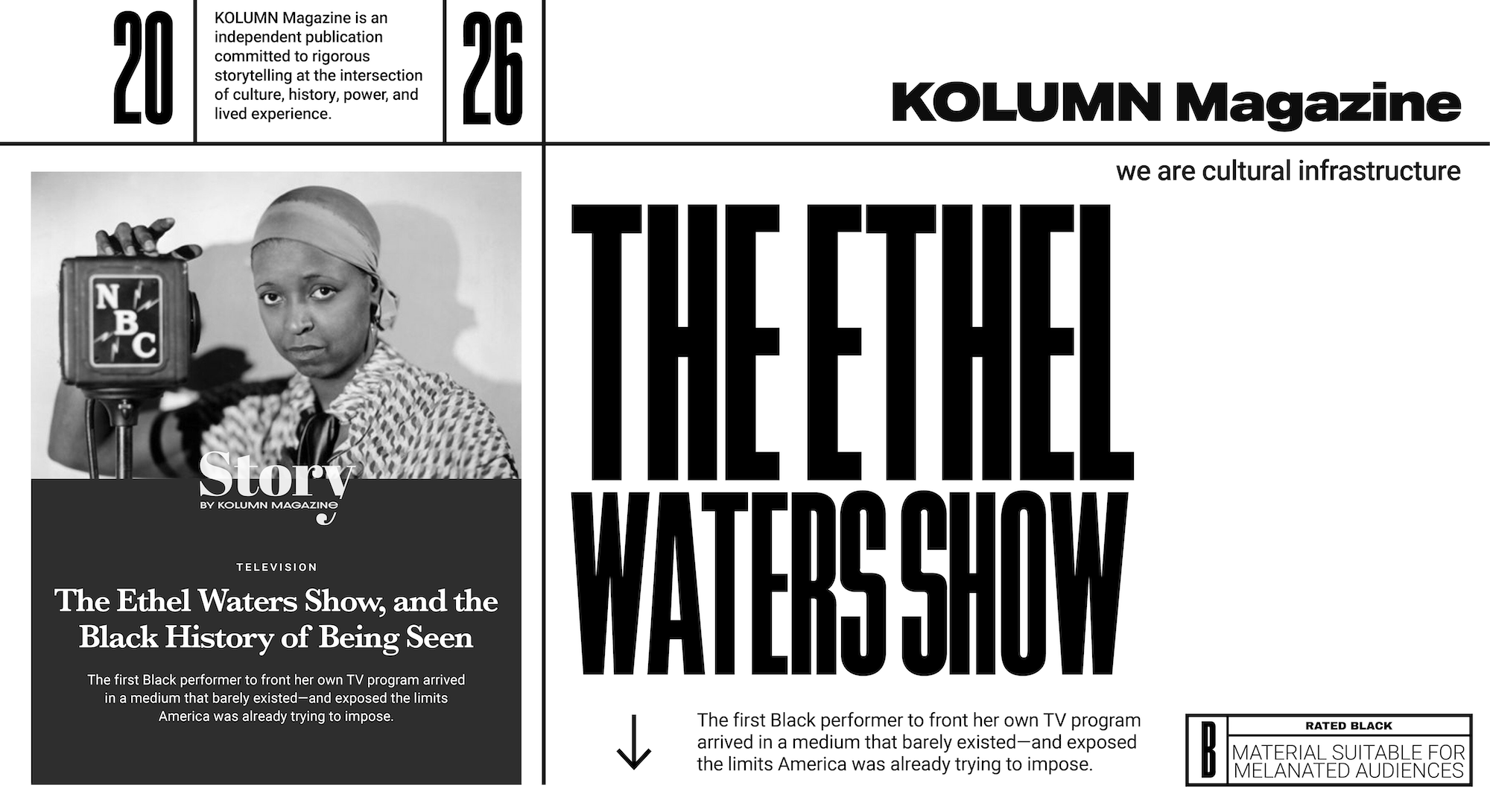

By KOLUMN Magazine
On June 14, 1939, television in the United States was still closer to a laboratory exercise than a shared culture. Sets were expensive, scarce, and clustered in a few urban corridors. The broadcast day was limited. The audience—such as it was—was small enough that “ratings” would have been a misnomer. And yet that night, from NBC’s studios in New York, an hour of programming went out over the network’s experimental station, W2XBS, carrying a name that would become a hinge in American media history: The Ethel Waters Show.
Waters, already famous as a singer and dramatic performer, did more than appear. She hosted. In a medium that had barely decided what it wanted to be, she occupied the most authoritative space television could offer: the center. The program is widely credited as the first instance of a Black performer—male or female—fronting their own television show, and it is also frequently cited as a plausible first appearance of a Black person on television in the United States.
That would be remarkable in any year. In 1939, it was radical. Not because the broadcast declared itself a protest, but because it did not have to. The fact of Waters’ presence—composed, controlled, and unmistakably the star—arrived in a country where Black performance was often permitted only inside boundaries drawn by white gatekeepers: as comic relief, as servitude, as “exotic” color, as spectacle that could be consumed without granting full humanity. Waters had navigated those boundaries for decades, sometimes outwitting them, sometimes enduring them, sometimes colliding with them head-on. Her television first is best understood not as an isolated triumph, but as a distillation of a career spent negotiating the terms of Black visibility in America.
And for Black Americans watching—those few who could—the significance would not have required a manifesto. The scene was the message: a Black woman commanding a new national technology at the moment it was being invented.
A show that aired once—and still changed the story
The Ethel Waters Show was a one-night variety special broadcast from NBC’s New York studios, transmitted over W2XBS. The surviving documentation is partial; no known recording is widely accessible, and the show has the aura of “lost media,” preserved more in references than in replay. But the outline is clear: Waters hosted and performed, and the special included a dramatic sequence from her Broadway hit Mamba’s Daughters, alongside two other Black actresses from the production, Georgette Harvey and Fredi Washington. Comedy sketches with Joey Faye and Philip Loeb rounded out the bill.



It is difficult to overstate what it meant that the centerpiece was not a novelty turn, but drama—specifically a piece tethered to a Black theatrical production with a story shaped around Black life. Mamba’s Daughters was notable for its depiction of Gullah community life in the coastal South, and Waters’ performance in the stage production had been widely celebrated. The choice to bring that dramatic sequence into television’s early public experiments suggested that Waters and NBC were not merely “including” a Black star; they were using a Black star to demonstrate television’s seriousness as an artistic medium.
Even the show’s ephemerality—its single broadcast—adds to its meaning. For many early Black television milestones, the story is not only what happened, but what did not follow. Waters could host a television hour in 1939, and yet the industry that emerged in the 1940s and 1950s would still struggle, aggressively and often intentionally, to imagine Black people as central rather than supporting characters. The point is not that The Ethel Waters Show “fixed” representation; it revealed how early the possibility existed—and how forcefully the culture resisted scaling it.
Who Ethel Waters already was by 1939
By the time NBC turned on the cameras, Waters was not a promising newcomer. She was, by many accounts, among the most successful Black entertainers in America, with a career that had moved across blues, jazz, pop standards, Broadway, radio, and film. Smithsonian profiles emphasize how Waters became one of the highest-paid performers on Broadway—an economic fact that sits uncomfortably beside the racial constraints that still limited her opportunities.
Her repertoire included songs that became cultural markers. In Irving Berlin’s As Thousands Cheer, Waters introduced “Suppertime,” a song about lynching and its aftermath—an astonishing piece to deliver on a Broadway stage in the 1930s, and a reminder that Waters’ mainstream visibility often carried subversive emotional weight. She was not only popular; she was politically legible, even when she was not overtly political.
This matters because Waters’ television first is sometimes reduced to a statistic: first Black person to host, first Black performer with her own show, first Black face on the screen. But in the Black community’s historical memory, “first” is rarely only about chronology. It is about the kind of “first” someone is allowed to be. Waters was a “first” who arrived as a fully formed artist—someone whose fame had already tested America’s appetite for Black excellence that could not be easily contained.
The technical experiment—and the social experiment inside it
To understand the cultural stakes of June 1939, it helps to grasp how experimental the technology still was. Television broadcasting existed, but it was limited; a station like W2XBS represented an early phase of NBC’s television development. The audience was tiny, and yet those early broadcasts were effectively setting templates: what a “show” looked like, how a host addressed viewers, what kinds of performances were suited to the camera.
That is why Waters’ presence was not incidental. Early television could have developed as a closed loop of whiteness by default, because the institutions building it were largely white and the consumer base assumed by advertisers was overwhelmingly white. Instead, one of the earliest high-profile television hours was anchored by a Black woman.
History writers have noted this moment precisely because of how early it arrives. In a survey of boundary-breaking Black television history, History.com flags Waters as possibly the first Black person on TV, emphasizing that she hosted a one-off variety show on NBC on June 14, 1939—long before television became a mass household fixture. That timeline complicates a common narrative that Black presence on television slowly “expanded” only after the civil rights era. The reality is sharper: Black presence appeared at the beginning, and then the industry spent decades constricting what that presence could be.
The Black community context: Visibility that carried risk
It can be tempting, from a contemporary vantage point saturated with screens, to assume that being on television is inherently empowering. But for Black Americans in 1939—and in the decades that followed—visibility was double-edged. Public exposure could mean opportunity, but it could also mean intensified stereotyping, surveillance, and backlash. Being seen did not automatically confer respect; sometimes it invited punishment.
Waters’ career illustrates this complexity. She achieved crossover stardom while also contending with a marketplace that often demanded Black performers trade dignity for access. Her later decision to leave Beulah—a television sitcom in which she played a domestic servant—has been repeatedly interpreted as a refusal to remain inside demeaning portrayals. (The show, and Waters’ place within it, became part of a broader mid-century fight over whether limited “representation” that relied on caricature was a net gain or a cultural trap.)
So when we discuss The Ethel Waters Show as a milestone, we should also acknowledge the question it posed to Black audiences: what does it mean to be on the screen, and on what terms? In Waters’ 1939 hour, the terms looked unusually expansive—variety, drama, comedic sketches, and the authority of hosting. That expansiveness is part of why the show endures as a symbol, even without a widely circulating recording. It offered a glimpse of a television that could have developed differently.
Mamba’s Daughters on television: A choice with cultural weight
The decision to include a dramatic sequence from Mamba’s Daughters is not a footnote. It is a clue. Waters’ Broadway performance in the play had been acclaimed, and Mamba’s Daughters itself carried cultural specificity—Gullah life, Black familial dynamics, and the texture of coastal Southern Black communities.
In 1951, The Atlantic published an excerpt tied to Waters’ life writing—an indication of how her story was framed in the mid-century imagination: as an American artist whose career crossed genre and class while never escaping the pressures of race. Bringing Mamba’s Daughters into early television, even as an excerpt, functioned as a statement about the kind of artistry the medium could carry—and about the seriousness of Black performance beyond song.
Just as importantly, it positioned Black women—Waters, Washington, Harvey—not as background atmosphere but as dramatic engines. That kind of staging mattered for Black viewers who were accustomed to seeing Black characters flattened into “types.” Drama insists on interiority. It asks an audience to believe the emotional reality of a character. In 1939 American visual culture, that insistence was itself a form of resistance.
“First” does not mean “free”
Waters’ television first is often recounted as a clean upward line: a barrier breaks, progress follows. But the history of Black American media rarely behaves so neatly. A “first” can arrive, and then be followed by erasure, backlash, or decades of symbolic inclusion without structural change.
In the years after 1939, Black performers did appear on television, but frequently within formats that reassured white audiences: variety spots that could be compartmentalized, roles that re-inscribed servitude, or comedic depictions that leaned on stereotype. By 1950, when Waters starred in Beulah, the very fact of a Black woman headlining a sitcom was groundbreaking—and yet the content of the show was a flashpoint because the lead character was a maid and the humor relied heavily on familiar racial tropes.
The Museum of Broadcast Communications notes that Beulah drew criticism for perpetuating comic stereotypes and that it was panned by the New York Times and condemned by critic John Crosby, who singled out Waters for censure. That detail is revealing: even as Waters broke barriers, she was often placed in positions where she absorbed blame for systems she did not design. This is a recurring pattern in American entertainment: Black stars are asked to “represent” a race, while white institutions retain control over what representation looks like.
So the importance of The Ethel Waters Show is not only that it happened first, but that it demonstrated an alternative: a Black woman as host of her own hour, not as a supporting character built around someone else’s domestic life. It was a proof of concept that the later industry chose not to replicate widely.
Waters as a template for later Black television “breakthroughs”
When television historians trace the lineage of Black stardom on TV, Waters appears as a starting point, then a missing rung, then a precedent rediscovered. A University of Washington news release about the creation of a reference work on African Americans in television explicitly identifies the “1939 test broadcast of the Ethel Waters Show” as an early anchor point in the chronology. The phrasing matters: “test broadcast” sounds small, but in cultural terms it is enormous. The test was not only technical. It was social: would audiences accept a Black woman in the role of host, at the birth of the medium?
Later milestones—the Nat King Cole variety hour in the 1950s, the long struggle for Black-led sitcoms that were not built on servitude, the eventual arrival of dramas with Black protagonists—often carry an implicit assumption that television needed “time” to mature into inclusion. Waters’ 1939 hour undermines that assumption. The capacity for inclusion was present at the start. The constraints that followed were choices.
This is why Black communities tend to hold onto “firsts” with a particular intensity. They are receipts. They prove that the limitation was never talent, never readiness, never audience ability to understand complexity. The limitation was permission.
The performance politics of respectability—and Waters’ complicated place inside it
Any honest account of Waters must also acknowledge that her legacy is not a single note. She was a product of her era and a shaper of it. Like many Black performers who navigated white-controlled industries, she sometimes moved within the politics of respectability, sometimes outside it, and sometimes in tension with it. The Smithsonian’s women’s history profile frames her as a figure who shaped U.S. entertainment and also notes aspects of her identity and life that complicate easy categorization, including her relationships and later-life religiosity.
The Root, in a survey of Black queer history and cultural “game-changers,” includes Waters and points to her personal life (including a long relationship with dancer Ethel Williams, according to the piece) while also noting that her later association with Billy Graham has complicated how some remember her. The point is not to litigate her life as scandal or purity, but to recognize that Black history, especially Black women’s history, is often forced into simplistic frames—either saint or sellout, icon or cautionary tale.
Waters was neither. She was an artist making strategy in real time, often under punishing constraints. The Black community’s relationship to that kind of figure is frequently intimate and critical at once: pride in the doors opened, frustration at the compromises demanded, admiration for the excellence, grief at the costs.
The Ethel Waters Show sits near the center of that dynamic. It is a moment that offers pride without requiring denial: we can celebrate the breakthrough while still seeing the industry that made breakthroughs rare and expensive.
The economics of Black stardom: Being indispensable and still precarious
Waters’ career exposes another truth that remains relevant in contemporary media debates: visibility is not the same as security. Even as Waters earned acclaim and, at points, high pay, she faced the structural instability that haunted Black entertainers—typecasting, limited roles, the whims of producers, and the fragility of “crossover” acceptance. Smithsonian accounts underline her stature on Broadway, and yet biographical summaries also emphasize the difficulty she had finding work at various points.
In practical terms, this meant that even a performer capable of anchoring early television could be steered into demeaning parts later, because the market offered too few alternatives. It also meant that when Waters took stands—by leaving projects, by resisting certain portrayals—she was not simply making an artistic choice. She was risking income in an industry that already treated Black women as replaceable.
This is where The Ethel Waters Show becomes more than a trivia answer. It becomes evidence of what happens when Black talent is allowed to operate at full range: singing, acting, comedy, hosting, dramatic performance. The tragedy is that this range was treated as exceptional rather than normal.
Why this one broadcast matters to Black American history, not only TV history
If you situate The Ethel Waters Show inside Black American history, its significance expands beyond media. The show becomes part of a longer struggle over public space—who controls it, who is centered in it, who is permitted to narrate the nation back to itself.
Black Americans in the early 20th century were contending with segregation, disenfranchisement, racial terror, employment exclusion, and the daily humiliations that structured Jim Crow. In that context, mass media was not merely entertainment; it was ideology. It taught audiences whom to trust, whom to laugh at, whom to fear, whom to pity, whom to ignore. When a Black woman hosted a television hour in 1939, she was not only entertaining. She was interrupting a cultural training program.
This is why Black communities have historically invested so much meaning in “firsts” in media. They are not just celebratory milestones. They are counters to narratives that portray Black advancement as recent, unnatural, or unearned. Waters did not become legible to television because America suddenly got enlightened in the 1960s. She was legible in 1939—on a screen that barely existed.
Word In Black, in a piece that situates Waters among icons who shaped Black music, frames her as both singer and actress and places her within a lineage of cultural makers who built the sound and sensibility of American life. Read that way, The Ethel Waters Show is a convergence point: Black music history, Black theater history, and Black media history colliding inside a new technology.
The scarcity of documentation—and what communities do with what remains
Because The Ethel Waters Show is not readily available for modern viewing, its legacy travels through secondary traces: museum captions, archival listings, historical chronologies, and biographies. That absence can feel frustrating, but it also highlights a familiar pattern: Black cultural breakthroughs are often poorly preserved relative to their importance, either because institutions did not value them at the time or because the material conditions of preservation were unequal.
Smithsonian archival references—such as a catalog entry related to televising Mamba’s Daughters—underscore that documentation exists in fragments, sometimes as captions and still images rather than moving footage. And when universities and archives acquire and digitize collections, they often reveal how much of Black performance history is scattered, privately held, or newly stabilized into public access only decades later. A 2024 University of Texas Harry Ransom Center release announcing the acquisition and digitization of materials related to Waters’ life is part of that ongoing recovery work.
This matters to Black audiences because cultural memory is not automatic; it is built. When a broadcast disappears, communities rebuild its meaning through testimony, reference, and insistence. “It happened,” the memory says. “We were there.” In that sense, The Ethel Waters Show functions like other partially lost artifacts of Black history: its very fragility becomes part of the story of why it must be repeated.
Waters and the question of “mainstream”: Whose taste counts?
One reason Waters’ career remains instructive is that it illuminates how “mainstream” is manufactured. Waters crossed into spaces that were presumed white—Broadway, major radio, Hollywood films, television experiments—and she did so not by diluting her artistry, but by demonstrating its universality while retaining its Black roots.
That navigation shaped how Black Americans interpreted her success. For some, Waters represented possibility: proof that excellence could not be fully contained by segregation. For others, her career raised harder questions: what concessions were required, and why were Black performers forced to translate themselves to be legible to white institutions?
These debates did not begin with Twitter. They were present in the era of Waters, Robeson, Horne, and the generation of performers who were simultaneously celebrated and constrained. Washington Post reporting on cultural history and archival photography, for instance, has described Waters as extraordinarily popular and noted multiple “firsts” across media and performance contexts, emphasizing how she crossed boundaries that were rigidly policed in her time.
Against that backdrop, The Ethel Waters Show looks less like a one-off novelty and more like a moment when “mainstream” briefly expanded—then snapped back.
The overlooked detail: Early television’s “small” audience and its outsized power
A skeptical reader might ask: if almost no one could watch in 1939, why does this matter?
Because firsts are not only for audiences; they are for industries. The people who watched early experimental broadcasts included executives, engineers, performers, sponsors, and critics—people positioned to shape what the medium would become. A Black woman hosting a program at that stage did not only affect viewers; it challenged the assumptions of the gatekeepers building television’s future.
And there is another layer. For Black history, symbolic events often matter even when their immediate reach is small. Enslaved people learning to read in secret did not change national literacy overnight, but it changed a future. Sit-ins did not desegregate every lunch counter immediately, but they altered the moral climate and exposed the mechanics of exclusion. Waters’ broadcast belongs to that category: a small reach with large meaning.
Television would become, in the decades after 1939, one of the most powerful instruments for shaping American self-perception. Waters’ early presence inside it is therefore not incidental; it is prophetic.
The line from Waters to modern debates: Representation, control, and the right to complexity
Contemporary debates about Black representation—about “firsts,” about tokenization, about stereotypes, about who controls writers’ rooms and executive decisions—often sound new only because the names have changed. The underlying dynamics were visible in Waters’ era: a Black star could be celebrated while being constrained; a Black performer could be positioned as an “exception” rather than a norm; a Black woman could host a show and still be steered toward domestic caricature later.
If you want to understand why “representation” is still argued as if it is unfinished business, you can start with the fact that a Black woman hosted a television show in 1939, and yet Black television history still had to fight for decades to secure roles that were not built on servitude or ridicule.
Waters’ story also clarifies why Black audiences often demand not only presence but authorship. Presence can be granted and revoked. Authorship—control over narrative, tone, humor, dignity—is harder to strip away. The Ethel Waters Show offered an early glimpse of what happens when a Black woman is not merely included but centered as the organizing intelligence of the hour.
What the Black community inherited from that hour
Because so few could watch and because the recording is not a circulating cultural object, the inheritance is less about specific jokes or songs and more about posture.
The inheritance is the image—historical, asserted, and repeated—of a Black woman hosting.
It is the fact that this happened before most Americans had televisions, before the postwar boom, before the civil rights movement’s televised confrontations, before the modern genre system hardened. It happened near the beginning, when the medium was still deciding what it was.
For Black Americans, that matters because so much of the national story has been told as if Black inclusion is always late, always reactive, always borrowed time. Waters contradicts that. She is evidence that Black centrality is not a modern concession; it is part of the origin story. The culture simply tried to forget.
A final note on “significance”: The measure is not airtime, but impact
Measured by conventional television standards, The Ethel Waters Show is small: a single broadcast, early signal, limited audience, little surviving footage.
Measured by Black American historical standards, it is enormous. It is a marker of possibility and a yardstick for critique. It is proof that the gate was never locked because Black people lacked the key; it was locked because the country feared what would happen if Black people walked through first and stayed in the room.
Ethel Waters did walk through. She hosted the room. And in doing so—quietly, professionally, and in the plain language of performance—she offered a vision of television that America has been circling ever since: a screen where Black life is not an “addition,” but part of the foundation.