


By KOLUMN Magazine
On a cold January day in 1969, the University of Minnesota’s Twin Cities campus—an institution that liked to imagine itself progressive by geography alone—met a form of accountability it could not politely table. About seventy Black students, joined by community supporters, occupied administrative offices on the first floor of Morrill Hall, the university’s central administrative building. They arrived with a list of demands for President Malcolm Moos, and they stayed. The occupation lasted roughly a day. The consequences—new structures for recruitment and support, scholarship commitments, and the creation of what became the Department of African American & African Studies—stretched across decades.
To call it a “takeover” is to adopt the shorthand history left behind by headlines and institutional memory. The students themselves practiced something more precise: nonviolent direct action aimed at the university’s operational core—admissions, records, the bursar—where policy becomes reality and where exclusion can be hidden behind paperwork. In the public telling that followed, the event would be praised as peaceful, criticized as disorderly, litigated as criminal, and eventually commemorated as foundational. But it was, first, a deliberate act by young organizers who understood that symbolic protest alone rarely moves budgets, hiring lines, or curriculum.
What happened inside Morrill Hall is inseparable from what happened before it: years in which Black students described an alienating campus climate, thin institutional support, minimal recruitment, and little meaningful representation in decision-making. The takeover was not a spontaneous eruption. It was the escalation of a negotiation that, in the students’ view, had run out of road.
This article reconstructs that moment and profiles several of its key participants—Rose Mary Freeman (later Rose Mary Freeman Massey), Horace Huntley, Warren Tucker Jr., and John S. Wright—while also examining the role of President Moos and the institution that faced them. It draws on contemporaneous archival collections maintained by the university, published retrospectives, public media reporting, and scholarly work that has treated Morrill Hall as a case study in Black campus organizing in the North.
A northern campus, a national moment
The takeover unfolded amid a national surge in Black student activism. Across the United States in the late 1960s, Black students demanded Black Studies departments, increased enrollment and financial aid, the hiring of Black faculty, and campus centers that recognized Black life not as an “issue” but as a constituency. These demands were not abstract. They reflected lived realities: predominantly white institutions that admitted small numbers of Black students while offering few pathways to belonging, academic recognition, or material support.
At Minnesota, the numbers themselves became part of the indictment. Multiple accounts describe a campus of roughly forty thousand students with only a small fraction who were Black—sometimes cited as fewer than 250, and in at least one retelling fewer than 100 at the time—an isolation that shaped daily life and magnified the stakes of institutional indifference.
In April 1968, the assassination of Dr. Martin Luther King Jr. intensified organizing and widened fissures on campuses nationwide. At Minnesota, it became a catalyst for both student mobilization and administrative responses—committees, memorial funds, task forces—that, to organizers, often produced more process than change.
For many white Minnesotans, the state’s reputation as “different” from the South offered a convenient moral alibi. But racism in the North did not rely on explicit segregation statutes to function; it could be enforced through housing patterns, employment barriers, policing, informal exclusions, and an educational pipeline that yielded predictably unequal outcomes. On campuses, those patterns appeared as tokenized recruitment, precarious financial support, and curriculum that treated Black history as peripheral.
The Afro-American Action Committee (AAAC)—a Black student organization that emerged from earlier campus organizing—became the central vehicle for articulating what students experienced as an institutional contradiction: a university that spoke the language of opportunity while failing to build conditions that made opportunity plausible for Black students.



The demands: Not just recognition, but infrastructure
Accounts of the takeover converge on a core point: the students entered Morrill Hall with “a list of demands” presented to President Malcolm Moos—demands that included increased recruitment, scholarship funding, counseling and support services, Black student representation in policy-making, and the creation of an African American Studies program. These were not symbolic asks; they were institutional architecture.
John S. Wright—then a graduate student and AAAC member, later a longtime faculty figure—has been repeatedly credited with drafting the seven demands that were submitted to Moos. In later reflections, he described the organization’s shift toward nonviolent direct action in the tradition of King, paired with a clear-eyed belief that demands had to be specific enough to be measurable.
One reason the Morrill Hall action still reads as tactically sophisticated is that it aimed at the building that housed the levers of student life: records, admissions processes, and financial systems. The occupation effectively forced the university to negotiate on terrain that could not be abstracted away. It also drew immediate attention precisely because it interfered, even briefly, with the routines that keep a university functioning.
University sources and later institutional retrospectives acknowledge the occupation’s direct role in leading to the establishment of Afro-American Studies (later African American & African Studies).
January 14–15, 1969: Inside the occupation
On January 14, President Moos met with the students. The meeting ended without the resolution organizers sought. Then the students moved: they proceeded to occupy offices in Morrill Hall—often described specifically as the bursar’s and records operations—and they refused to leave. The occupation lasted around twenty hours to roughly twenty-four hours, depending on the source.
The action was widely described as peaceful, even by accounts that also note property damage and tense moments. A later grand jury would consider charges including aggravated criminal damage to property and rioting, but jurors ultimately rejected the most serious allegations.
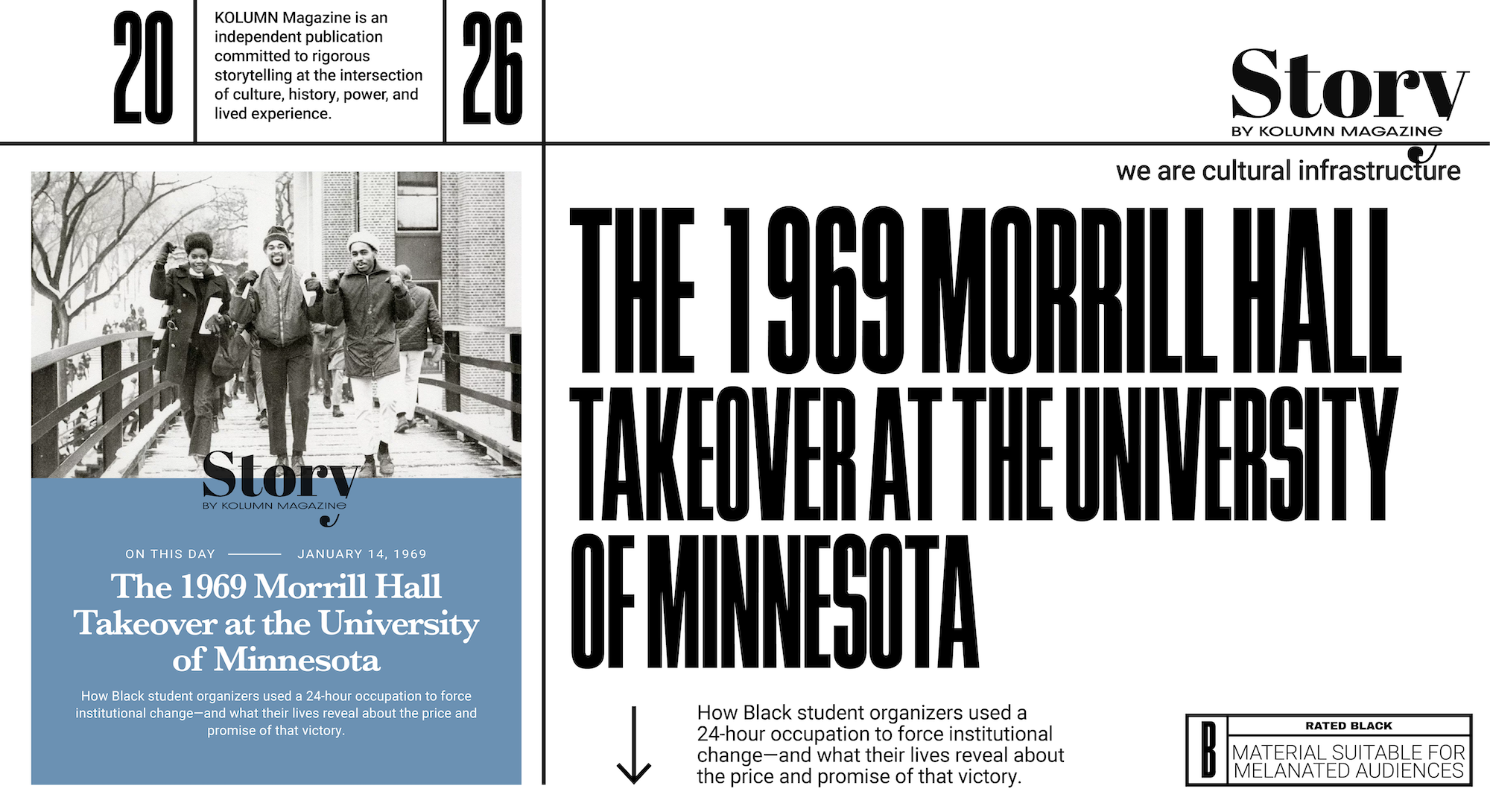
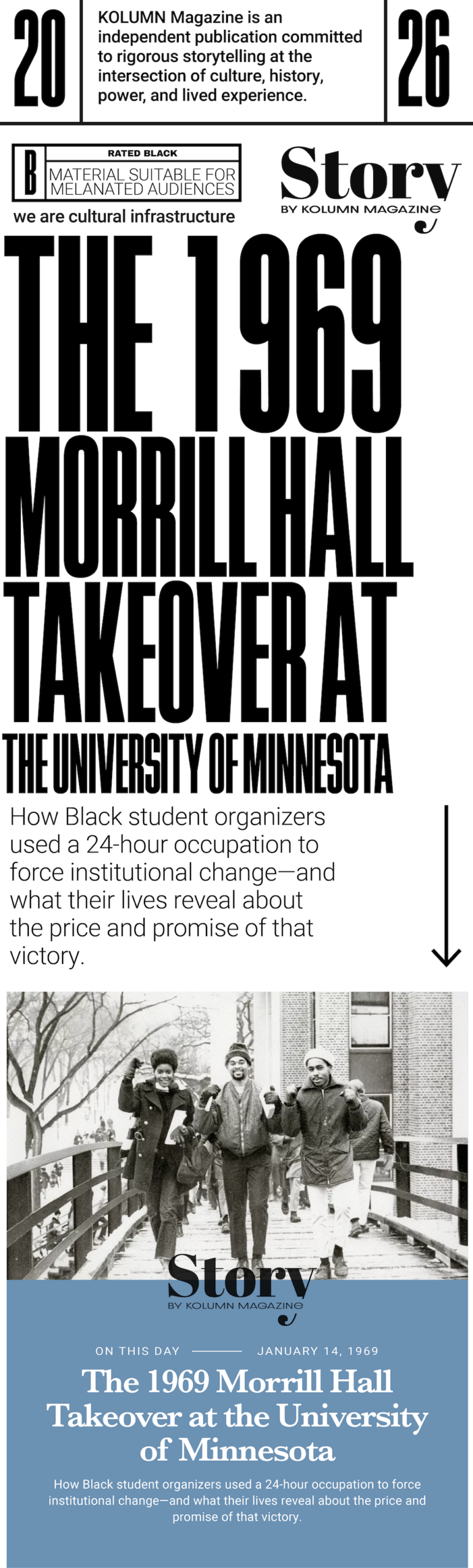
Outside the building, a crowd gathered—students, onlookers, supporters, and the broader campus community trying to interpret what was happening in real time. Photographs from the period show large groups clustered near Morrill Hall in winter coats, framed by snow-covered campus lawns—images that now serve as shorthand for a moment when the university’s self-image was contested in public.
Negotiations continued. The students’ leverage was not violence; it was persistence, moral clarity, and operational disruption. University accounts describe that an agreement was reached and the protest ended on January 15.
The agreement did not represent an endpoint so much as an opening: it forced the institution to put commitments in writing, to concede that Black students’ demands had legitimacy, and to treat Black Studies not as extracurricular interest but as a scholarly imperative.
The institution across the table: President Malcolm Moos
Any account of the Morrill Hall Takeover that profiles student organizers but ignores the person empowered to accept or reject their demands risks flattening the power dynamics the students were confronting.
Malcolm Moos, the university’s president from 1967 to 1974, arrived with national stature: a political scientist and a speechwriter associated with President Dwight D. Eisenhower, including the famous farewell warning about the military-industrial complex.
Moos is often remembered in Minnesota narratives as a skilled administrator who avoided the kind of violent escalation that marked confrontations on other campuses. But it is equally true that he represented the institution as it existed—an institution students believed had long treated them as marginal. The takeaway is not that Moos “gave” the students a department; it is that students forced the administration to recognize the legitimacy of building one. The difference matters, because it assigns agency where it belongs.
Institutional sources describing the anniversary of African American Studies at Minnesota credit the takeover’s leaders—Freeman and Huntley—and describe negotiations with Moos and other administrators that ended in agreement after about 24 hours.
The legal aftermath: When protest becomes prosecution
A common arc in American protest history is the attempt to recast moral confrontation as criminal misconduct. The Morrill Hall Takeover followed that script.
In March 1969, a grand jury indicted three students—Horace Huntley, Rose Mary Freeman, and Warren Tucker Jr.—in connection with the occupation. The indictments triggered protests by students and community members, some of whom argued the legal response was “politically motivated.”
By November 1969, according to MNopedia’s detailed timeline, Freeman and Huntley were convicted of unlawful assembly and received a ninety-day suspended sentence and one year of probation; Tucker was acquitted, and the jury rejected the more serious charges.
This legal episode is central to understanding the takeover’s human cost. The university could eventually celebrate the outcome—the department, the reforms—without fully absorbing what it meant to prosecute students who insisted the institution live up to its own ideals. Commemoration can be a form of closure; prosecution is a form of warning. The organizers lived through both.
Profiles in strategy: The people who moved the institution
Rose Mary Freeman (Rose Mary Freeman Massey): “leveling the playing field”
Rose Mary Freeman was widely described as the president (or chairwoman) of the Afro-American Action Committee during the period leading to the takeover, and multiple accounts name her as a leader of the occupation.
Her leadership mattered in a particular way: she embodied a bridge between southern Black freedom struggles and northern institutional life. An obituary and community accounts describe her roots in Mississippi and note that she brought prior civil rights and Black Power organizing experience to Minnesota—experience that shaped her willingness to confront authority without deference.
One story, repeated across multiple retellings, captures both her style and the takeover’s symbolic force: President Moos entered his office during negotiations and found Freeman seated in his chair. She told him he could sit in another chair—an intentional gesture she later framed as “leveling the playing field.”
This detail can be read as theater, but its meaning is deeper. Universities are built on ritualized hierarchies—who sits where, who speaks first, whose presence is presumed. Freeman’s act was a quiet disruption of those rules. It insisted that the negotiation was not a favor requested by supplicants; it was a reckoning demanded by equals.
Freeman later became Rose Mary Freeman Massey, and accounts of her life emphasize her enduring commitment to education and community. A Milwaukee-focused retrospective notes she earned a B.A. in African-American Studies (1970) and an M.A. in American Studies (1972) at Minnesota, and later taught African American history for decades.
In institutional memory, Freeman can be at risk of being turned into a static icon—“a leader,” “an organizer.” But the archival and commemorative trail suggests a life shaped by sustained work: the kind that happens after cameras leave, when building a department, defending its legitimacy, and teaching students becomes the long continuation of the takeover’s premise.
Horace Huntley: Organizer, historian, builder of memory
Horace Huntley is another name consistently identified as a leader of the takeover, serving as secretary of the AAAC and a key negotiator.
The university’s own community programming has memorialized him through “Huntley House,” a living-learning community named in his honor. That page describes him as one of the leaders of the Morrill Hall Takeover and notes his later academic career, including earning a Ph.D. and becoming a professor of history at the University of Alabama at Birmingham.
Huntley’s trajectory clarifies something essential about the takeover: it was not only about creating a department; it was about creating knowledge—and control over how Black life and Black history would be studied, taught, and archived. In later years, Huntley became deeply associated with oral history work and the interpretation of civil rights history, including through the Birmingham Civil Rights Institute’s Oral History Project.
In 2006, Huntley co-authored a book on the Morrill Hall Takeover with Rose Freeman Massey and Marie Braddock Williams, indicating that participants themselves sought to define the narrative rather than surrender it to institutional mythology.
There is a particular irony—and power—in that arc: the student once prosecuted for unlawful assembly becomes a historian of movements, a curator of memory, and a namesake for a university program meant to support Black students. The institution that indicted him also, eventually, honored him. The tension between those facts is not a contradiction; it is the story of how institutions absorb movements while trying to tame them.
Warren Tucker Jr.: The third indictment, the acquittal, the quieter archive
Warren Tucker Jr. is often remembered in the public record as the third student indicted alongside Freeman and Huntley. University anniversary materials include him in the iconic triumvirate pictured after the takeover’s success.
MNopedia’s account emphasizes the legal outcome: Tucker was acquitted, while Freeman and Huntley received suspended sentences and probation after being convicted of unlawful assembly.
Tucker’s profile is, in some ways, emblematic of how protest history is archived unevenly. Leaders with academic careers or institutional roles often leave more paper trails—faculty profiles, speeches, interviews. Others appear primarily in indictments, photographs, and the brief mention of “acquitted.” Yet the acquittal itself is significant: it suggests jurors, even amid political pressure, rejected the state’s most sweeping attempt to label the occupation a riotous crime.
The burden of this kind of case is not only the possibility of conviction; it is the demand that young people carry the stress, reputational risk, and financial costs of defense—while still attempting to build the very campus changes that provoked the backlash. Tucker’s name, therefore, is not merely a footnote; it is a reminder that movements rest on more people than history usually spotlights.
John S. Wright: Drafting demands, building a department, staying for the long work
John S. Wright occupies a unique position in the Morrill Hall story because his life bridges the moment of occupation and the institution-building that followed.
Several accounts credit Wright with drafting the seven demands delivered to Moos. A University of Minnesota alumni retrospective profiles him as a participant and emphasizes his role in writing demands calling for recruitment, scholarships, support services, representation, and an African American Studies program.
Wright later taught for decades in the department the takeover helped create, becoming a faculty figure whose career was, in effect, a continuation of the protest by other means. In 2024, the College of Liberal Arts recognized him with an achievement award, reflecting his status as a long-serving scholar and institutional anchor.
Wright’s presence complicates a common narrative structure in which student protest is youthful disruption and faculty governance is mature reform. Here, the same person can be both: a student organizer writing demands and a professor later responsible for teaching, mentoring, and defending the intellectual legitimacy of a field that universities once dismissed.
That continuity helps explain why the takeover’s legacy remains contested. Departments born from protest are often asked to justify themselves more than departments born from tradition. Their existence is a reminder that curriculum is political, that institutions do not naturally “expand”; they are pushed.
The archives: Paper trails of conflict and persuasion
One of the most consequential features of the Morrill Hall Takeover is the depth of the documentary record. The University of Minnesota Libraries’ conservancy hosts a dedicated “Morrill Hall Takeover Documents” collection, reflecting how extensively the administration, press, and community responded.
Even the structure of the archive—folders of letters to President Moos, press releases, news clippings, investigative commission notebooks—suggests the university understood it was managing not only an event but a reputational crisis.
This record matters because it preserves the contested nature of the moment. Universities often prefer clean narratives: students protested, administrators listened, progress happened. But the letters and investigations imply a campus and a state arguing—about race, about protest, about who belonged, about whether “order” mattered more than equity.
What the takeover won—and what it did not
By many measures, the Morrill Hall Takeover succeeded. University and alumni accounts connect it directly to the establishment of Afro-American Studies (today African American & African Studies) and to scholarship and support initiatives.
But even celebratory retrospectives include a note of incompletion. The Minnesota Alumni feature, written decades later, points to “unfulfilled hopes,” including concerns about recruitment, tuition, and Black faculty representation—an implicit acknowledgment that the takeover was an opening move, not a final settlement.
This is the dilemma of protest victories institutionalized into programs: once a department exists, the institution may treat the problem as solved. Yet departments can be underfunded, marginalized, or burdened with expectations to “fix” broader inequities that remain embedded elsewhere.
In other words: Morrill Hall changed the university. It did not exempt the university from change.
Morrill Hall as a recurring stage
History has a way of reusing buildings. In 2024, Morrill Hall again appeared in national headlines when protesters occupied the building in a different political context—an echo that, whatever one thinks of the later protest, underscores how physical sites become symbols of institutional power and resistance.
For the students of 1969, the building’s symbolism was clear: Morrill Hall was the administrative heart. If you wanted the university to feel the urgency of Black students’ demands, you went where decisions lived.
The takeaway: A blueprint for accountable universities
The Morrill Hall Takeover is sometimes reduced to a single claim: it created a department. That is true—and too small.
It also demonstrated:
Strategic targeting: the occupation focused on administrative systems that translated policy into everyday student experience.
Concrete demands: organizers insisted on measurable commitments—recruitment, scholarships, support services, representation, curriculum.
Narrative control: participants later co-authored histories and preserved memory through interviews, teaching, and archives.
A long horizon: key participants built lives in education and history, embedding the takeover’s logic into institutions that outlasted the moment.
The occupation lasted roughly a day. The work it demanded—making a university worthy of the students it recruits—remains the work of generations.