


By KOLUMN Magazine
On paper, the idea looked like a corrective to a familiar American injury.
In the mid-1890s, Black Washingtonians—many of them churchgoing, institution-building, and newly practiced in the mechanics of corporate life—organized a venture with a straightforward proposition: pool capital, purchase a large passenger steamer, and operate a line that could move people and goods between the nation’s capital and the Tidewater cities farther south. The route—Washington, D.C., down the Potomac and through the Chesapeake to Norfolk—was not only commercially logical. It was symbolically charged: a watery corridor connecting federal Washington to Virginia’s ports, to Black communities that were growing even as segregation calcified into policy and custom.
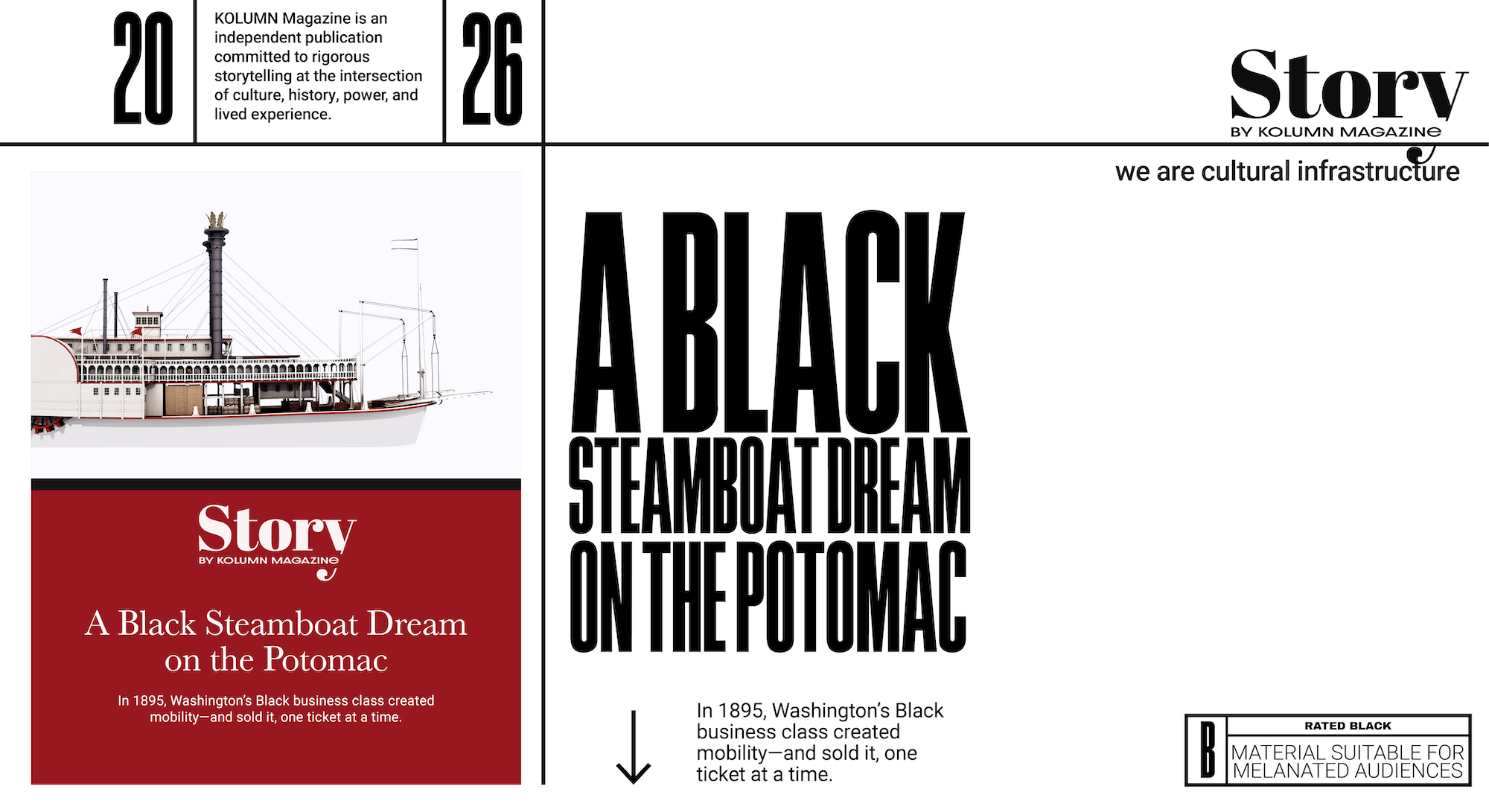
The company they formed became known as the National Steamboat Company, and the vessel most often associated with its ambitions was the George Leary, a sizeable sidewheel steamer that, in contemporary descriptions, could carry crowds in the thousands and offered the fittings of late-19th-century excursion culture: multiple decks, staterooms, berths, and dining facilities.
But the National Steamboat Company’s story is not simply a celebration of entrepreneurship. It is an instructive case study in how Black enterprise operated in the narrow channel between possibility and constraint during the post-Reconstruction era—how it raised money, fought for legitimacy, and tried to build infrastructure in a city where Black citizens could create institutions but rarely control the chokepoints that made those institutions scalable: access to prime waterfront property, favorable press, predictable regulation, and unharassed competition.
To understand the company’s founding and what followed, you have to start with the river itself, then move outward—to churches, newspapers, stock subscriptions, and the persistent politics of “who gets to move.”

A river economy—and a segregated geography of leisure
Long before the Potomac became a postcard of monuments, it functioned as a working artery: for freight and passengers, for market-bound produce, for excursions to places like Mount Vernon, and for the steady circulation of people around the capital’s edges. Steamboats made that circulation legible and profitable. They also made it social. By the late 19th century, excursion culture—day trips, moonlight cruises, resort landings—had become a defining leisure form for Americans with time and a few dollars to spend.
Yet leisure, too, was segregated. Black Washingtonians built parallel institutions—church picnics, fraternal outings, shoreline retreats—often because they were barred from white-controlled spaces or subjected to humiliation within them. The result was not merely separate recreation; it was a Black geography of leisure, stitched together by transportation networks that were frequently owned by others.
That transportation problem—getting large groups to destinations safely, predictably, and with dignity—helped create a market for Black-led ventures that could do more than sell tickets. They could sell a kind of autonomy.
One way to see the National Steamboat Company is as a transportation business. Another is as a social technology: a corporate vehicle for Black collective investment in mobility itself.
The prelude: John W. Patterson, the People’s Transportation Company, and the perils of shareholder faith
The immediate backstory to the National Steamboat Company runs through a controversy—one that reads like an early lesson in how easily Black-led finance could be caricatured, policed, or dismissed.
In May 1894, a Black minister and aspiring businessman in Washington, D.C., John W. Patterson, incorporated the People’s Transportation Company. His pitch was direct: sell shares—many to Black churchgoers—raise enough capital to acquire a steamboat (the Lady of the Lake is named in at least one account), and launch a line.
The business model—small-dollar investment from a broad base—was not inherently unsound. It echoed cooperative traditions and mutual-aid finance that Black communities had long relied upon. But such models were vulnerable to two forces at once: internal mismanagement and external hostility.
According to the National Park Service’s historical account tied to the George Washington Memorial Parkway’s Collingwood area, a Washington newspaper attacked Patterson sharply, labeling him a conman and describing the People’s Transportation Company as a fraud. Whether every allegation was fair is difficult to reconstruct at this distance; what matters is that the reputational damage was real, and it created an opening.
By the spring of 1895, a group described as Patterson’s former partners formed a competitor: the National Steamboat Company. The Park Service notes that the new company adopted a similar business model—suggesting both continuity (the idea was still viable) and rupture (the leadership was different).
This pivot—away from Patterson, toward a new corporate banner—shows a recurring pattern in Black business history in the era: legitimacy was not only something you earned; it was something you had to perform, publicly, again and again, often in response to scrutiny that white-owned ventures did not face in the same way.
“Officered by some of the best colored citizens”: What “best” signaled in 1895
A line in the Afro-American Encyclopedia compiled by James T. Haley captures the way Black institutions narrated ventures like this to their own public: “The National Steamboat Company is the name of the new boat company now being organized in Washington, D.C. It is officered by some of the best colored citizens.”
To a modern ear, “best” can sound like boosterism. In 1895, it was also a credentialing strategy. The phrase communicated three things at once:
Respectability and governance: officers were presumed to be accountable men.
A rebuttal to fraud narratives: the company was not a grift; it was institution-led.
A claim on civic belonging: this was Washington, and Black Washingtonians were organizing corporations like anyone else.
Haley’s encyclopedia also notes that there were “two colored steamboat companies in Washington—the National Steamboat Company and the People’s Transportation Company.” Even if the People’s Transportation Company faltered, its existence mattered: it indicated that Black Washingtonians were not merely passengers in the city’s modernity; they were attempting to own the vehicles.
The vessel: The George Leary and the problem of “elegant but aged”
If the National Steamboat Company’s formation was a governance story, its next challenge was physical: it needed a boat.
In scholarly accounts of Black leisure destinations and the Jim Crow coastline, the National Steamboat Company is described as having $50,000 in capital stock divided into $10 shares—an amount and structure that suggests an effort to combine seriousness (a substantial capitalization) with accessibility (a low per-share price).
Those same accounts describe the company acquiring the George Leary—“elegant but aged”—a phrase that contains both pride and warning.
Why does “aged” matter? Because in transportation, maintenance is destiny. Older vessels cost less up front but more over time, and they can be less reliable in the face of competition from newer fleets. In a market where white-owned firms often controlled better financing channels and prime docking arrangements, starting with an older boat could become a structural disadvantage—especially if the company’s primary investors were ordinary Black citizens for whom additional capital calls would be burdensome.
The George Leary itself had a broader life in the region’s steamboat world; for example, the Norfolk & Washington Steamboat Company—an established operator on the same Washington–Norfolk corridor—began operations with a sidewheeler named the George Leary in 1890, underscoring how vessels could circulate through ownership regimes and business strategies.
For the National Steamboat Company, the boat was both asset and message: a visible, floating assertion that Black capital could purchase scale.
The route: Washington to Norfolk, down the Potomac into the Chesapeake
The Washington-to-Norfolk corridor was commercially meaningful. It linked the capital to major ports and communities along the Potomac and Chesapeake Bay. It also served travelers who wanted alternatives to rail or who preferred the social world of steamer travel: the slower pace, the decks, the dining room, the sense of an event.
In reference works that log significant moments in African American history, the National Steamboat Company is summarized as organizing in Washington, D.C., and launching the George Leary to provide service between Washington and Norfolk. That same basic description appears repeatedly in modern retellings, but the repetition should not obscure what the route implied in 1895: the company was trying to operate at a scale that required dependable docking rights, regular schedules, and enough ridership to cover fuel, payroll, repairs, marketing, and insurance.
It was a logistics business—and, inevitably, a political one.
What “founding success” likely looked like—and how it was measured
In a case like this, “success” should be defined carefully, because the company’s long-term fate is less documented in easily accessible primary sources than its founding moment and its symbolic significance.
A reasonable, evidence-based definition of founding success here includes:
Capital formation: assembling a stock structure substantial enough to acquire and operate a large vessel.
Asset acquisition: obtaining a major steamer associated with a premium travel experience.
Public legitimacy: being framed, in Black reference works, as led by “best” citizens and as one of the city’s Black steamboat ventures.
Conceptual influence: becoming part of the broader ecosystem of Black leisure development along waterways (resorts, excursion grounds, and beach communities).
This is not the same as profitability. But in the post-Reconstruction world—where Black enterprises often had to prove their right to exist before they could prove their margins—founding success often meant surviving the first, most fragile stage: raising money, acquiring assets, and establishing a public claim.
The leisure connection: From excursion travel to Black resort development
The National Steamboat Company sits at the intersection of transportation and leisure development—a theme documented in the scholarship on African American waterfront destinations around Washington.
Patsy Mose Fletcher’s work on historically African American leisure destinations in the Washington region frames steamboat-related recreation as a central strand of Black social life—connecting excursions, parks, and waterfront spaces with the practical need for transportation that respected segregation’s constraints.
Another scholarly source focused on Jim Crow–era beaches places the National Steamboat Company within a broader pattern: Black entrepreneurs, shut out of white leisure spaces, created their own resorts and destinations, often tied to transportation companies that could deliver customers directly.
This connection helps explain why a steamboat company could matter even beyond its balance sheet. If you can control the boat, you can potentially control the destination—especially if you purchase or develop shoreline property. Transportation becomes vertical integration: the ticket funds the trip, the trip funds the resort, the resort reinforces the company’s customer base.
Some accounts explicitly link the National Steamboat Company to this kind of resort-oriented vision, including interest in areas like Cobb (or “Cob”) Island as a leisure site, suggesting that the company’s founders were attuned to the beauty and commercial potential of riverside property.
Barriers at the dock: Access, reputation, and the contested shoreline
Even when a company owned a boat, it still needed a place to land it.
Dock access is an underappreciated form of power: who gets a berth at the most convenient wharf, what fees are charged, whether schedules are disrupted by “administrative” obstacles, and how disputes are resolved. In segregated economies, such chokepoints often functioned as informal enforcement mechanisms. If you cannot reliably dock, you cannot reliably run a line—no matter how impressive your vessel looks in a photograph.
The NPS account of Patterson’s earlier venture illustrates how reputational warfare could precede logistical warfare: if newspapers could define a Black enterprise as fraudulent, they could discourage investors, spook potential customers, and justify regulatory skepticism. The National Steamboat Company’s emphasis on reputable officers can be read as an early defensive strategy against that ecosystem.
The other barrier was competition. Established lines—like the Norfolk & Washington Steamboat Company—operated on the same corridor and were capitalized at levels (at least in their charter visions) that could dwarf a newer venture relying heavily on community investors. Competing against such firms required not only customers but endurance: the capacity to absorb a bad season, a mechanical failure, or a fare war.
The “National” claim: What the name demanded, and what the era denied
Company names can be marketing. They can also be arguments.
To call this venture “National” in 1895 was to assert that Black enterprise belonged at the center of American economic life, not at its margins. Washington, D.C., was the ideal stage for that claim: a majority-Black city in many neighborhoods, a federal workforce that provided stable income to some Black families, and a dense network of churches, schools, and fraternal organizations capable of mobilizing people—precisely the kind of institutions that could buy shares and fill a boat.
Haley’s encyclopedia, in its broader “race facts worth knowing,” embeds the steamboat companies within a landscape of Black institutional growth—property ownership, schools, organizations—offering a snapshot of how Black progress was measured internally even as white politics sought to restrict it.
The steamboat company, then, was not only a business. It was a claim that the nation’s capital could generate Black-owned infrastructure.
A brief window—and a durable lesson
It is difficult, from widely available digitized sources alone, to reconstruct a complete ledger-history of the National Steamboat Company: precisely how many seasons it operated, its year-to-year profitability, the internal disputes (if any), and the exact terms of its later transitions.
But uncertainty about the full operational timeline should not minimize what the record does show with clarity:
The company emerged from a moment of experimentation in Black transportation enterprise in Washington—alongside, and in response to, the People’s Transportation Company episode.
It was framed by Black reference works as led by prominent citizens, a marker of seriousness and community trust.
It adopted an accessible stock structure to raise significant capital—an early example of mass community investment aimed at owning infrastructure.
It acquired a major vessel associated with the Washington–Norfolk corridor, embedding itself in one of the region’s most important water routes.
It belongs to the broader history of Black leisure development along waterways, in which transportation companies were often the hinge between segregated exclusion and community-created destinations.
In other words: even if the National Steamboat Company’s run was limited, its logic was expansive.
Why the National Steamboat Company still matters in Washington’s story
Washington, D.C., is often narrated as a city of federal power—legislation, court decisions, executive authority. But it is also a city of Black civic ingenuity, where residents repeatedly built parallel systems when barred from the main ones: schools, banks, newspapers, mutual aid societies, and social institutions strong enough to sustain a dense community life.
A steamboat company fits that pattern precisely because it is about movement—about refusing to be fixed in place by policy or custom. To attempt a Black-owned line on the Potomac in 1895 was to say: we will not only gather and worship and educate; we will also build the machinery that connects us to the wider region, on our own terms.
The company’s story also clarifies a harder truth: infrastructure is political, and the politics do not stop at the shoreline. The National Steamboat Company could buy a boat. What it could not easily buy—then, as now—was full, frictionless access to the systems that decide whether a business scales or stalls: favorable publicity, equal regulatory treatment, competitive neutrality, and unconstrained entry to prime commercial space.
The National Steamboat Company’s founding success, then, is best understood as a successful act of collective imagination made material—followed by the familiar struggle to keep that material afloat in waters patrolled by unequal power.
That is a Washington story. It is also an American one.